
The rapid expansion of AI automation infrastructure has created a security problem that many organizations are only beginning to recognize. While attention has largely focused on protecting large language models, preventing prompt injection, and securing AI-generated applications, a potentially more consequential attack surface is emerging underneath these systems: the workflow automation platforms that connect AI agents to databases, internal applications, cloud infrastructure, and sensitive business information.
On October 14, 2026, Censys published its latest State of the Internet Report, revealing that 113,926 internet-facing hosts were exposing n8n, making the workflow automation platform the most widely exposed AI-related product in its research. More concerning, approximately 76% of n8n hosts with a parseable software version were running versions affected by at least one recent critical vulnerability. These findings arrive at a particularly sensitive moment for organizations deploying autonomous workflows and AI agents into production environments.
According to the 2026 Censys State of the Internet Report, internet-exposed AI infrastructure grew by more than 63% between October 2025 and July 2026, reaching nearly 268,000 systems. n8n accounted for a substantial proportion of these deployments, followed by other increasingly popular AI agent technologies, including OpenClaw. The research highlights an uncomfortable reality: AI adoption is expanding the enterprise attack surface faster than many traditional asset management and vulnerability assessment programs can accommodate.
The implications extend far beyond the possibility of an exposed administration interface. Unlike a conventional website, an n8n instance frequently acts as a trusted execution and integration environment. It may have authorization to retrieve customer records, execute database operations, access private repositories, trigger cloud infrastructure changes, communicate with internal APIs, or invoke AI models using privileged credentials. A successful compromise could therefore provide an attacker with access to systems that are not themselves exposed to the public internet.
However, the Censys findings also require careful interpretation. An internet-visible n8n instance is not automatically compromised, and a software version associated with a published CVE does not necessarily indicate that every exploitation prerequisite is present. Understanding the distinction between exposure, vulnerability, exploitability, and actual compromise is essential for making the report operationally useful.
This analysis examines what Censys discovered, why n8n is attracting increasing security attention, how recent vulnerabilities affect production deployments, and how security teams can identify and reduce their exposure without disrupting legitimate automation workflows.
What Did Censys Discover About n8n in 2026?
The most significant finding in the Censys n8n research is not simply the number of publicly accessible servers. It is the combination of widespread deployment, potentially outdated software, and the privileged position that workflow automation platforms occupy inside modern enterprise environments.
Censys analyzed global internet-facing infrastructure using historical observations and its continuously updated Internet Map. Its research identified substantial growth in AI-related services during a nine-month measurement period, with n8n emerging as the largest identifiable product category within the studied population.
Exposed n8n hosts
113,926
Internet-facing hosts identified
Affected version range
76%
Of hosts with parseable n8n versions
AI infrastructure growth
+63%
October 2025–July 2026
Exposed AI systems
~268K
Across the studied AI infrastructure
Source: Censys 2026 State of the Internet Report, released October 14, 2026. These figures describe the report’s measurement period, not a live October 15 scan.
These numbers place n8n within a broader transformation in how enterprise computing infrastructure is deployed. As AI agents become increasingly capable of performing multistep tasks, organizations need systems that translate model decisions into actual operations. n8n provides that orchestration layer, enabling workflows to connect external APIs, internal services, databases, messaging platforms, and AI models.
This creates a different risk profile from traditional application hosting. A customer-facing web application may have carefully scoped access to a small number of backend services. An automation platform, however, may be intentionally connected to dozens of systems across different trust boundaries. Its purpose is to move information and trigger actions between those systems, making it particularly sensitive when security controls fail.
The 76% finding deserves particular attention. It refers specifically to hosts for which Censys could identify a parseable n8n version, not necessarily all 113,926 hosts. Furthermore, version-based vulnerability detection cannot establish whether an attacker can successfully exploit a particular deployment. Some vulnerabilities require specific workflow configurations, authenticated privileges, particular nodes, or optional features.
Nevertheless, such a high proportion of potentially affected versions indicates that patch management and continuous security validation deserve urgent attention. The report is evidence of a widespread exposure-management problem, not proof that three-quarters of all publicly accessible n8n instances have been compromised.
Why n8n Has Become a High-Value Target for Attackers
n8n is an open-source workflow automation platform that enables users to connect applications, transform data, execute conditional logic, and coordinate complex processes through a visual workflow editor. Its growing popularity in the AI ecosystem reflects its ability to connect language models with practical tools and production systems.
A typical enterprise deployment might use n8n to receive an incoming customer request, classify it through an LLM, retrieve customer information from a CRM platform, query an internal knowledge base, update a database, and send a notification through Slack or Microsoft Teams. Each of these operations may require a different credential, API connection, or network permission.
From an attacker’s perspective, this creates a concentrated target. Instead of compromising multiple applications individually, gaining control of one highly privileged automation instance could provide access to several connected systems.
The risk can be understood through three characteristics of workflow automation infrastructure.
Credential Concentration
n8n supports stored credentials for integrations with databases, SaaS applications, cloud services, and APIs. These credentials are encrypted by the platform, but their security depends on the integrity of the application environment, its encryption keys, its authorization boundaries, and the permissions assigned to individual users and workflows.
An attacker who gains sufficiently privileged access to a running instance may be able to use connected services through legitimate workflow functionality, even without extracting plaintext secrets. Under more severe compromise conditions, access to application configuration, the database, or encryption-related material can create additional opportunities for credential theft.
This distinction matters because encryption at rest does not prevent an already-authorized application from using a credential. Organizations must protect both the underlying secrets and the workflows that are permitted to invoke them.
n8n’s official documentation explains how its credential encryption mechanism operates. The security of the encryption key and runtime environment should therefore be treated as a critical component of the deployment’s overall trust model.
Workflow Execution Privileges
Automation platforms are designed to perform actions rather than simply display information. n8n workflows may execute JavaScript or Python, interact with files, submit HTTP requests, or call external systems capable of making infrastructure changes.
If an attacker can modify workflows, they may be able to redirect business operations, substitute malicious destinations, alter data processing, or misuse existing integrations. The severity depends on the permissions available to the attacker and the controls enforced by the n8n deployment.
This is why limiting workflow editing privileges is more important than it might initially appear. An individual who can edit an automation connected to sensitive systems may effectively possess operational authority over those systems, even if they cannot log in to them directly.
Internal Network Reachability
Many n8n deployments are configured specifically to communicate with resources that are not publicly accessible. For example, an instance may connect to an internal PostgreSQL database, a private Git server, a cloud metadata service, or an internal administrative API.
When a publicly accessible workflow platform also has access to private network resources, a compromise can create a bridge across security boundaries.
An external attacker does not necessarily need direct access to an internal database if they can manipulate a workflow that is already authorized to query it. This is particularly important for deployments running inside cloud virtual private networks, Kubernetes clusters, or enterprise environments with broad east-west connectivity.
How Attackers Could Exploit an Exposed n8n Instance
A publicly discoverable n8n server is not equivalent to an exploitable server. Still, internet visibility provides a potential starting point for identifying outdated deployments, exposed application functions, and weaknesses that may warrant further investigation.
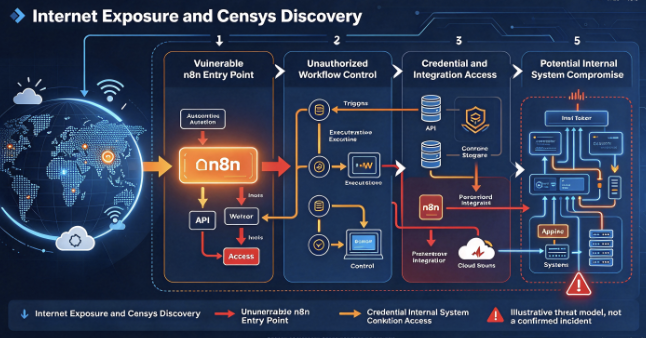
The following scenario illustrates how a successful compromise could progress under vulnerable conditions. It is a representative threat model rather than evidence that any specific host in the Censys dataset was attacked.
Illustrative n8n compromise pathway
Conceptual attack chain. Successful exploitation depends on the specific vulnerability, deployment configuration, and available privileges.
Initial Discovery and Technology Fingerprinting
The first stage involves identifying internet-visible services and determining whether they expose a recognizable technology stack. Internet measurement platforms such as Censys collect service metadata and software fingerprints that can help security researchers and defenders understand where products are deployed.
A workflow service might be identified through software metadata associated with an HTTP response or through other observable service characteristics. The reliability of this identification depends on the available fingerprints, reverse proxies, application configuration, and scanning coverage.
Attackers can use similar information to prioritize potential targets, which is why organizations should not assume that an obscure hostname or nonstandard TCP port provides meaningful protection.
The Censys report reinforces this point by observing that a substantial share of HTTP(S) services operates on nonstandard ports. Effective exposure management must therefore account for services beyond conventional port-based assumptions
Exploitation of Vulnerable Application Functionality
Once an exposed instance has been identified, an attacker may attempt to determine whether a known vulnerability applies to the deployment. Depending on the vulnerability, this may require access to an unauthenticated webhook, a particular workflow configuration, a valid user session, or another application-specific condition.
This is where the distinction between affected software and practical exploitability becomes especially important. A system may run a version associated with a critical CVE while lacking the vulnerable configuration required to trigger it. Conversely, an apparently protected administration interface may coexist with publicly reachable workflows that process untrusted input.
Access to Workflows and Integrated Services
If an attacker obtains access to workflow execution or editing capabilities, the potential impact expands beyond the initial application.
A compromised workflow could misuse an existing database connection, transmit information to an unauthorized endpoint, alter a business process, or invoke cloud services through previously configured credentials. If the attacker obtains privileged access to the underlying runtime, the consequences may include access to application data, connected secrets, and other resources available to that environment.
The practical impact is determined by the combined privileges of the application, operating system, network environment, and connected services. An n8n container running with limited permissions and tightly scoped credentials presents a different risk from an instance with administrative cloud credentials and broad internal network access.
The Most Important n8n Security Vulnerabilities in 2026
The Censys findings should be viewed alongside a series of security disclosures affecting n8n. These vulnerabilities demonstrate how weaknesses in workflow parsing, expression evaluation, credential authorization, and integration logic can create risks for organizations operating automation infrastructure.
Importantly, they do not all share the same prerequisites or exploitation paths.
| Vulnérabilité | Security issue | Affected versions or conditions | Principal concern |
|---|---|---|---|
| CVE-2026-21858 | Unauthorized file access through certain form-based workflows | n8n 1.65.0 to before 1.121.0, under specific workflow conditions | Sensitive file disclosure and possible further compromise |
| CVE-2026-1470 | Authenticated remote code execution through expression evaluation | Vulnerable expression evaluation configurations | Host-level code execution with n8n process privileges |
| CVE-2026-33720 | OAuth state ownership verification bypass | Before 2.8.0 with a particular nondefault environment variable enabled | OAuth token redirection into an attacker-controlled credential |
| CVE-2026-54305 | Insufficient authorization checks in Enterprise Dynamic Credentials endpoints | Affected release ranges before 1.123.55, 2.25.7, or 2.26.2, depending on branch | Credential interference and unauthorized integration access |
Sources : n8n GitHub Advisory for CVE-2026-21858, NVD CVE-2026-1470, NVD CVE-2026-33720et NVD CVE-2026-54305.
CVE-2026-21858: The NI8MARE Vulnerability
One of the most consequential n8n security disclosures of 2026 was CVE-2026-21858, commonly associated with the name NI8MARE. The vulnerability involves improper input validation in the handling of certain form-based workflows, creating a path through which an unauthenticated attacker may access files on the underlying server.
The vendor advisory identifies affected versions starting at 1.65.0 and ending before 1.121.0. The issue was fixed in version 1.121.0.
An especially important technical detail is that exploitation is conditional. n8n’s security communication identified a potentially vulnerable configuration involving an active workflow with both a Form Submission trigger and a Form Ending node returning a binary file.
Under those conditions, improper request handling could allow unauthorized file access. Depending on the data exposed and the privileges of the runtime environment, subsequent compromise may become possible.
Censys published a dedicated CVE-2026-21858 exposure advisory on January 7, 2026, reporting 26,512 observed hosts matching its affected-version search criteria at the time of publication. That historical measurement should not be confused with the larger 113,926-host population in the October research: the former used a vulnerability-oriented filter, while the latter represents identified n8n exposure more broadly.
From a defensive standpoint, this vulnerability illustrates why relying exclusively on an application’s login page is insufficient. Publicly reachable webhooks and form handlers can have their own attack surface, and the security of those entry points must be evaluated independently.
For a more detailed technical examination, see Penligent’s existing analysis, The NI8MARE Collapse: Dissecting CVE-2026-21858 and CVE-2025-68613 in AI Orchestration.
CVE-2026-1470: Expression Evaluation and Runtime Isolation
CVE-2026-1470 demonstrates a different class of security risk. Rather than depending on an unauthenticated form endpoint, this issue involves the execution environment used to evaluate workflow expressions supplied by authenticated users.
According to the Base de données nationale sur les vulnérabilités, insufficient isolation in the expression evaluation mechanism could allow an authenticated attacker to execute arbitrary code with the privileges of the n8n process.
The underlying security problem is the distinction between expressions intended for data transformation and code that can interact with privileged runtime functionality. In a secure design, user-controlled expressions should remain within a narrowly defined execution environment. When this boundary fails, ordinary workflow editing privileges may become a path toward operating-system-level access.
For organizations that permit multiple teams, contractors, or external collaborators to create workflows, the consequences are especially significant. An attacker does not necessarily need to compromise an administrator account if a lower-privileged account already has access to a vulnerable workflow editing capability.
This reinforces the need for isolated code execution, strongly restricted workflow permissions, and careful control over the resources accessible to the n8n process.
CVE-2026-33720: OAuth Integration and Credential Ownership
OAuth-based integrations introduce a different security boundary: the relationship between an authenticated user, an authorization flow, and the credential object that receives the resulting token.
CVE-2026-33720 affects n8n deployments before version 2.8.0 when the nondefault setting N8N_SKIP_AUTH_ON_OAUTH_CALLBACK=true is explicitly enabled. Under this configuration, insufficient ownership validation in the OAuth callback could enable an attacker to influence where authorization tokens are stored.
This issue demonstrates that the security of an automation platform cannot be evaluated by software version alone. Configuration matters, and optional compatibility settings can introduce security consequences that may not exist in the default installation.
Organizations should review OAuth-related environment variables, verify the ownership and sharing permissions of stored credentials, and update affected deployments. They should also investigate unexpected OAuth reauthorization events and unusual changes to credential-linked workflows.
CVE-2026-54305: Credential Authorization Across Projects
Modern workflow platforms increasingly support collaborative projects and shared integrations. This creates complex authorization requirements because users may legitimately access some workflows and credentials while being prohibited from viewing or modifying others.
CVE-2026-54305 illustrates the risks associated with insufficient authorization checks in Enterprise Dynamic Credentials functionality. In affected versions, certain authenticated requests could interfere with credential resources associated with workflows outside the user’s authorized project scope.
According to the published advisory, potential consequences include unauthorized credential information access, manipulation of OAuth authorization flows, token revocation, and the possibility of redirecting workflow operations toward an attacker-controlled identity.
The lesson is broader than any single CVE. Security in collaborative automation platforms depends not only on whether a user is authenticated, but also on whether every sensitive operation verifies the user’s permission to act on the specific workflow, credential, project, and connected account involved.
October 14, 2026: n8n Releases Another Security Update
The timing of the Censys report is particularly noteworthy because n8n published an additional security update on the same day.
On October 14, 2026, the n8n security team announced a group of newly disclosed vulnerabilities involving workflow history handling, webhook responses, project-level authorization, filesystem operations, and credential protection.
The disclosures included a stored cross-site scripting issue in webhook responses, unauthorized access to data tables across project boundaries, potential denial-of-service behavior involving workflow or file operations, and a case in which credentials could be exposed through execution error information.
The security team published the following patched versions:
| Release branch | Patched release announced October 14, 2026 |
|---|---|
| n8n 1.x | 1.123.85 |
| n8n 2.x stable | 2.43.5 |
| n8n 2.x beta | 2.44.1 |
These are the branch-specific fixes identified in the October 14 n8n Security Update. n8n stated that its Cloud instances were automatically patched, while self-hosted administrators running affected older releases should upgrade.
One advisory is particularly relevant to the Censys findings. GHSA-qmvv-q3c9-wpp7 describes a condition in which execution errors from certain integrations could contain sensitive credential material, including Git credentials, MongoDB passwords, or Google access tokens. Under the affected circumstances, users with access to execution records could potentially recover secrets even without direct permission to read the corresponding credential.
This vulnerability illustrates an important weakness in the security of workflow automation environments: sensitive information can leak through secondary application functionality even when the primary credential management system enforces access restrictions.
A credential may be properly encrypted in storage while still being unintentionally included in a log entry, an execution error, a debugging response, or another data structure accessible to less privileged users.
Administrators should therefore treat execution history and workflow debugging information as potentially sensitive records. Restricting access to those records, reducing unnecessary retention, and avoiding the inclusion of credentials in application output are important defensive controls.
How to Find Exposed n8n Instances Using Censys
One practical question arising from the report is how security teams can identify n8n installations within their own infrastructure.
Censys provides search capabilities for internet-facing hosts, services, software metadata, and web properties. These capabilities can help organizations discover forgotten automation servers, cloud-hosted development instances, staging deployments, and services that were unintentionally made public.
Les Censys Query Language documentation describes how to search using full-text queries and structured field filters. For n8n specifically, Censys has published vulnerability-oriented search examples that use recognized software product fields.
Basic Censys n8n Search Query
A starting point is to search for services identified as n8n in the Censys Platform. A general product discovery query adapted from Censys’s published advisory syntax is:
host.services: (software.product: "n8n") or web.software: (product: "n8n")This query is intended to identify records in which n8n is recognized as a software product in host-service or web-property metadata.
The returned population depends on Censys’s current observation data and fingerprint coverage. It should not be assumed to reproduce the exact historical counts from the October report, and it should not be treated as a complete inventory of all n8n installations.
For enterprise investigations, the next step is to narrow results to infrastructure the organization owns or is authorized to assess. This may require correlating IP addresses, certificate names, domains, cloud account records, and asset ownership information.
Censys Query for Potentially Vulnerable n8n Versions
For CVE-2026-21858, Censys published the following search query:
host.services: (software.product: "n8n" and software.version < "1.121.0") or web.software: (product: "n8n" and version < "1.121.0")The purpose of this query is to identify systems reporting older versions associated with the NI8MARE vulnerability.
It is useful as a prioritization mechanism, but version filtering alone has several limitations. Software fingerprinting may produce missing, stale, or inaccurate version data. In addition, the presence of a potentially affected version does not establish that the required form-based workflow is available.
Censys’s published search is also specific to the historical vulnerability. It should not be used as a substitute for evaluating the broader October 2026 advisory set, which has different affected release ranges and prerequisites.
Security teams should use the results to identify systems requiring further inspection rather than automatically classifying every match as exploitable.
How to Confirm Whether a Discovered Instance Belongs to Your Organization
Ownership verification is a necessary step before conducting any active security assessment.
A discovered IP address may be hosted by a cloud provider, managed by a third-party vendor, or associated with infrastructure outside an organization’s control. A domain name alone does not always establish operational responsibility.
A reliable process correlates the discovered service with cloud inventory, DNS records, certificates, deployment manifests, infrastructure-as-code repositories, and internal asset databases. If an instance belongs to a vendor or another team, the appropriate security contact should be identified before further testing.
This distinction also helps prevent an operational mistake: treating all public n8n instances as suspicious. Public access may be intentional for certain workflow entry points, while the administrative interface remains behind a separate access-control layer.
The goal is not simply to eliminate every detectable service. It is to understand which services are publicly accessible, why they are accessible, and whether their exposure is consistent with the intended security architecture.
How to Determine Whether an n8n Deployment Is Actually Vulnerable
The Censys report provides an important discovery signal, but organizations need additional evidence to determine which assets require immediate remediation.
A useful assessment separates three different questions: whether the instance is internet-accessible, whether its software or configuration is associated with a known security issue, and whether that issue can actually be triggered under the deployment’s specific conditions.
Verify the Installed Version
For a self-hosted installation, administrators can check the installed n8n version through the application environment or container runtime.
For example, on a Docker deployment where the container is named n8n, an authorized administrator may run:
docker exec n8n n8n --versionThis provides a local version observation rather than relying exclusively on externally visible software fingerprints.
However, checking the application version is only the beginning. The result should be compared against the official security advisory for the relevant release branch. Administrators should also verify that the running container is actually using the intended updated image, rather than an older image retained by the deployment environment.
Inspect Workflow Preconditions
An important advantage of having access to the deployment itself is the ability to inspect whether the conditions described in a security advisory are present.
For CVE-2026-21858, that means examining active workflows for the vulnerable combination of form-related nodes identified by the vendor. For authenticated code execution vulnerabilities, the assessment should consider which users can create or modify workflows and how the code execution environment is isolated.
For OAuth-related issues, administrators should inspect the relevant feature flags, credential sharing arrangements, and authorization callback configuration. For vulnerabilities involving project boundaries, they should verify whether affected Enterprise features are enabled and which user roles can access the associated resources.
This type of contextual validation is essential for moving beyond generic CVE matching.
Run the Built-In n8n Security Audit
n8n provides a built-in security audit mechanism that can identify several categories of application risk.
According to the n8n Security Audit documentation, an authorized administrator can invoke the audit from the CLI:
n8n auditThe audit evaluates areas such as unused credentials, risky nodes, potentially unsafe database interactions, unprotected webhooks, missing security settings, and outdated installations.
It does not constitute a complete penetration test or guarantee that the deployment is free from vulnerabilities. Nevertheless, it provides valuable internal context that internet-wide exposure scanning alone cannot obtain.
The strongest approach combines external discovery, authenticated configuration review, vulnerability intelligence, and controlled security testing of assets for which the organization has authorization.
Security Misconfigurations That Increase n8n Exposure Risk
Not every n8n security incident originates from a software vulnerability. Configuration mistakes can create serious risk even when the application itself has been updated.
The following deployment patterns deserve particular attention because they can weaken access controls or increase the consequences of a successful compromise.
Publicly Accessible Administrative Interfaces
The n8n editor provides access to workflows, application settings, credentials, and integration management. Exposing the editor directly to the public internet unnecessarily increases the number of potential sources of authentication attacks and application-level probing.
Where possible, organizations should place administrative access behind a VPN, zero-trust access gateway, identity-aware proxy, or similarly restrictive access-control mechanism.
Public webhook access and administrative access should also be considered separately. A business may legitimately require third-party services to call a webhook without granting those services access to the workflow editor or privileged management functionality.
This separation can often be enforced through reverse-proxy routing rules and network architecture, subject to the application’s actual deployment requirements.
Overprivileged Workflow Credentials
A workflow that only needs to read customer information should not automatically possess permissions to delete customer records, modify infrastructure, or administer the entire connected service.
The principle of least privilege is particularly important in n8n because workflow credentials may be reused across multiple automations.
Organizations should create service accounts with narrowly scoped permissions, limit credential sharing between projects, and maintain ownership records for sensitive integrations. Where supported, short-lived credentials and managed identity mechanisms can reduce reliance on long-lived static secrets.
Credential access should also be reviewed whenever a workflow is imported from an external source or shared with another user.
Dangerous Workflow Nodes
Some nodes offer powerful filesystem or command execution functionality. These capabilities may be necessary for legitimate automation, but they increase risk when exposed to untrusted users or inadequately isolated code.
n8n documents the NODES_EXCLUDE environment variable as a method for preventing users from accessing selected node types.
For deployments that do not require filesystem writing or command execution, an example restriction is:
NODES_EXCLUDE: '["n8n-nodes-base.executeCommand","n8n-nodes-base.readWriteFile"]'This configuration must be assessed against the application’s actual workflows and n8n version. It is a defense-in-depth control, not a replacement for patching or privilege isolation, and existing workflows should be reviewed for compatibility before enforcing it.
Les official documentation on blocking n8n nodes explains the supported configuration and its implications.
Unnecessary Public API Exposure
n8n offers a public REST API for programmatic interaction with the platform. Organizations that do not require this functionality can reduce their accessible management surface by disabling it.
The documented configuration is:
N8N_PUBLIC_API_DISABLED=true
N8N_PUBLIC_API_SWAGGERUI_DISABLED=true
The first setting disables the documented public REST API, while the second disables its API playground.
These controls should not be confused with protection of every internal or webhook endpoint. Restricting the public API reduces a specific part of the attack surface, but it does not remove the need for application authentication, network controls, and validation of exposed workflow entry points.
For details, consult n8n’s Disable the Public REST API documentation.
Why Network Isolation Matters More for AI Automation
One of the most dangerous characteristics of a compromised automation platform is its ability to communicate with systems that are inaccessible to an external attacker.
Consider an n8n instance running in a cloud environment with access to a private database and an internal HTTP service. The organization may have properly blocked direct internet access to those systems, yet allowed the automation platform to connect to them because its workflows depend on that connectivity.
If an attacker can manipulate the platform into making unauthorized requests, the automation instance may become an intermediary between the attacker and protected infrastructure.
This is the basis of server-side request forgery, or SSRF, although the exact mechanisms vary by application and vulnerability.
For n8n deployments, the danger is particularly relevant when workflows accept user-controlled URLs, retrieve external content, or permit AI agents to select destinations dynamically.
n8n provides an application-level SSRF protection feature beginning with version 2.12.0. The documented configuration includes:
N8N_SSRF_PROTECTION_ENABLED=trueWhen enabled, the protection applies destination checks to relevant user-controllable outbound requests, including handling of DNS resolution and redirects. Administrators can also configure allowed and blocked destinations according to their operational requirements.
However, application-level SSRF protection is not a substitute for network isolation. Firewall rules, cloud security groups, Kubernetes network policies, and restrictions on access to metadata services remain necessary.
Les n8n SSRF protection documentation describes these controls and explicitly recommends network-level protections as the primary defensive layer.
For workflows that need internal connectivity, a carefully maintained allowlist is preferable to unrestricted network access. The objective is to let each workflow communicate only with the services required for its intended function.
Securing AI Agents Built on n8n
The expanding use of n8n as an AI agent orchestration platform introduces additional risks beyond traditional workflow automation.
In a conventional automation, the sequence of actions may be relatively predictable. A workflow receives a specific event, performs defined transformations, and sends data to predetermined destinations.
An AI-powered workflow may instead use a language model to interpret incoming instructions, select tools, construct API requests, retrieve additional information, and decide which action to execute next.
This makes the trust boundary more complicated because untrusted external content may influence decisions that lead to privileged actions.
Prompt Injection Becomes an Integration Security Problem
Prompt injection is frequently described as an attack against a language model, but the most consequential failures often occur when model-generated output is treated as authorization to perform an external action.
Imagine an n8n workflow that retrieves a document and asks an AI agent to summarize it. The agent also has access to a database query tool and a messaging integration.
If the retrieved document contains malicious instructions, an inadequately constrained agent might attempt to use those connected tools in ways that were never intended by the workflow designer.
The fundamental security issue is not that the model has encountered hostile text. It is that lower-trust content may influence decisions involving higher-trust tools and credentials.
Organizations should therefore limit the privileges available to AI-connected nodes, validate tool arguments before execution, and enforce independent authorization checks for sensitive operations.
High-impact actions, such as deleting records, sending confidential data outside the organization, changing infrastructure settings, or transferring ownership of resources, should not depend solely on an LLM’s interpretation of user intent.
Tool Execution Requires Independent Authorization
A model’s ability to select a tool should not imply permission to use every capability that tool exposes.
For example, a workflow designed to retrieve customer information may need database read access but no ability to execute arbitrary SQL statements or modify records.
Likewise, an agent that generates support responses may need to create draft messages without being authorized to transmit messages to arbitrary external recipients.
This separation reduces the consequences of both prompt injection and compromised workflow logic.
It also helps protect against accidental mistakes made by legitimate agents. A workflow can produce an unsafe action without being directly controlled by an attacker, which means validation must be part of the application architecture rather than an optional security test.
Execution Isolation and Task Runners
Code execution inside a workflow platform should be isolated from the main application wherever practical.
n8n documents external task runners as a way to separate Code node execution into distinct containers. This can reduce the consequences of untrusted code execution by limiting access to the main application environment and sensitive resources.
The official Hardening Task Runners documentation recommends additional controls such as reduced container privileges, a read-only root filesystem, distroless images, and restrictive security profiles.
These controls matter because the compromise of one execution component should not automatically provide access to the entire automation platform.
A well-designed deployment treats workflow code execution, credential storage, orchestration services, and internal network access as separate trust boundaries rather than assuming the platform can securely combine all these capabilities in a single highly privileged environment.
What Security Teams Should Do After the Censys n8n Report
The report provides a clear reason to reassess how organizations discover and protect workflow automation infrastructure.
The most effective response is not to classify every exposed n8n instance as an emergency. It is to build an evidence-based process that identifies the highest-risk deployments first and then verifies their actual security posture.
Establish a Complete Inventory
Organizations should identify all n8n deployments across production, development, testing, cloud accounts, and third-party hosting arrangements.
This inventory should include the software version, deployment owner, public exposure status, authentication configuration, connected services, credential privileges, and business processes supported by each instance.
External discovery data from Censys can reveal assets that are missing from internal inventories. However, the external observations should be reconciled with cloud and deployment records so that each finding has a clear owner and remediation path.
Prioritize the Most Consequential Exposures
An exposed instance that processes public information and operates with limited permissions may have a lower business impact than an instance connected to internal databases, cloud administration APIs, and customer records.
Risk prioritization should therefore consider both the likelihood of exploitation and the potential consequences of compromise.
A useful internal scoring approach can consider four dimensions:
| Risk dimension | Example high-risk condition | Defensive priority |
|---|---|---|
| Exposure | Publicly reachable administrative service or vulnerable form endpoint | Restrict unnecessary internet access |
| Software | Affected version with applicable exploitation conditions | Upgrade and verify the patch |
| Privilèges | Powerful credentials or broad workflow editing permissions | Reduce privileges and access |
| Connectivity | Unrestricted access to internal applications or cloud infrastructure | Apply network segmentation |
These categories are an analytical framework, not a Censys-generated risk score.
The key is to identify combinations of conditions rather than analyzing individual findings in isolation. A single configuration weakness may be tolerable in a tightly isolated environment but become critical when combined with sensitive credentials and broad network connectivity.
Validate Security Controls Continuously
One-time vulnerability scans are insufficient for infrastructure that changes frequently.
Developers may deploy new instances, enable public webhooks, import community workflows, add credentials, or connect new applications without triggering a traditional infrastructure security review.
Continuous monitoring should therefore detect changes to publicly accessible services, software versions, application configuration, connected credentials, and workflow permissions.
Where appropriate, authorized security assessments can validate whether the controls are functioning as intended. This might involve checking authentication enforcement, verifying that sensitive endpoints are inaccessible without authorization, assessing workflow permission boundaries, and confirming that unsafe execution capabilities are restricted.
Active validation should be scoped carefully to prevent interference with production workflows. The goal is to establish the security properties of the deployment without inadvertently triggering business actions or processing sensitive data unnecessarily.
Investigate Possible Compromise When Evidence Warrants It
For an exposed instance with evidence of successful exploitation, unexpected workflow changes, unusual authentication activity, or unauthorized use of credentials, patching alone may be insufficient.
The organization should preserve relevant logs and execution records, review changes to workflows and credential configuration, examine suspicious outbound connections, and determine whether connected systems were accessed outside expected business processes.
If credential compromise is plausible, affected secrets should be revoked or rotated according to an incident response plan. Administrators should also inspect cloud access logs and downstream integrations because an attacker may continue using stolen credentials after the original n8n instance has been patched.
This investigation should distinguish between evidence of compromise and indicators of mere exposure. The presence of a public login page or an outdated software fingerprint is not, by itself, evidence that a system has been breached.
Censys vs. Vulnerability Scanners vs. AI Penetration Testing
The Censys n8n findings highlight an important distinction between discovering infrastructure and validating the security of that infrastructure.
Censys provides visibility into internet-facing systems, including software fingerprints, service metadata, and exposure-related intelligence. This makes it particularly valuable for identifying assets that organizations might otherwise overlook.
Vulnerability scanners add another layer by associating detected software and configuration characteristics with published weaknesses. Their effectiveness depends on scan methodology, authentication, accurate version detection, and access to the relevant application functions.
Penetration testing and controlled security validation address a different question: whether a security weakness can actually be demonstrated within an authorized environment and what impact it could have on connected systems.
| Capability | Censys | Traditional vulnerability scanning | Authorized penetration testing |
|---|---|---|---|
| Identify internet-facing assets | Primary strength | Depends on discovery scope | Depends on assessment scope |
| Detect software and versions | Supported through fingerprints | Common capability | Can be verified manually |
| Identify known CVE exposure | Supported through risk intelligence | Primary capability | Can inform test priorities |
| Validate exploitability | Not established by discovery alone | Sometimes, depending on checks | Can be tested under controlled conditions |
| Analyze workflow authorization | Limited external visibility | Requires specialized or authenticated checks | Can assess application logic and access boundaries |
| Evaluate downstream impact | Requires additional context | Usually limited | Can assess approved impact scenarios |
This distinction is especially important for workflow automation. Discovering that a host runs n8n provides only part of the information needed to judge its risk. Understanding whether a vulnerable workflow exists, whether a low-privileged user can misuse an integration, or whether sensitive credentials are accessible through application behavior requires more contextual assessment.
From n8n Exposure Discovery to Security Validation With Penligent
The growth of AI automation infrastructure is changing the requirements for security assessment. Traditional vulnerability management remains necessary, but workflow platforms introduce complex interactions between application authorization, code execution, credentials, and connected services.
Penligent approaches security testing through AI-assisted penetration testing workflows, with a focus on helping security practitioners investigate potential weaknesses and validate security findings in authorized environments.
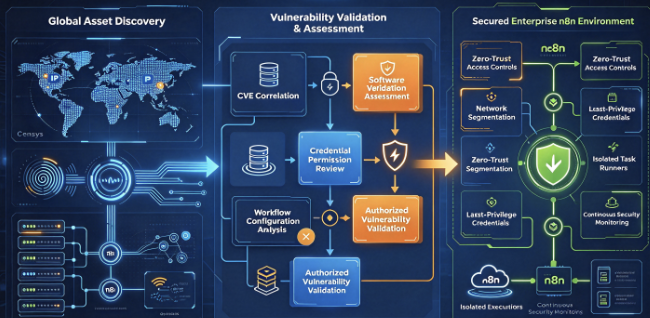
For organizations investigating their own n8n deployments, a practical workflow can begin with Censys-based exposure discovery, continue with software and configuration verification, and then use controlled security testing to examine the application behaviors that matter most.
For example, a team may first identify a publicly accessible n8n service and confirm its installed version. After determining ownership and authorization, the team can assess relevant application entry points, access restrictions, and connected services. Penligent can fit into the testing and analysis stage, while authoritative patch status, application configuration, and remediation decisions remain grounded in vendor documentation and verified evidence.
This approach helps distinguish an externally visible service from a demonstrable security weakness. It also makes the results more useful to engineering teams, which need actionable findings rather than large inventories of unexplained alerts.
For additional background on related weaknesses, Penligent has published analyses of CVE-2025-68613 and authenticated expression-injection RCE in n8n et CVE-2025-68668, the n8n Pyodide sandbox escape.
Organizations evaluating agent-based security testing can also explore Penligent as part of a broader program for discovering, analyzing, and validating security weaknesses in their own infrastructure.
Frequently Asked Questions About Censys n8n
What does the Censys n8n report reveal?
The 2026 Censys State of the Internet Report identifies 113,926 exposed n8n hosts and reports that approximately 76% of hosts with identifiable software versions were running versions affected by at least one recent critical vulnerability. The research highlights the expansion of internet-visible AI automation infrastructure and the importance of continuous exposure management. These figures do not mean that all detected systems are exploitable or compromised.
How can I search for n8n instances in Censys?
Security teams can use the Censys Platform to search software identification fields associated with n8n. Censys also publishes vulnerability-specific search queries, including one for CVE-2026-21858. Organizations should filter findings to infrastructure they own or are authorized to investigate, then confirm the results using deployment records and local software inspection.
Is an internet-exposed n8n server automatically vulnerable?
No. Public visibility is an exposure condition, not a vulnerability by itself. Risk depends on the installed software version, authentication controls, exposed application functionality, workflow configuration, user permissions, and connected services. Some n8n vulnerabilities require specific features or privileges, so security teams need more evidence than a software fingerprint to establish exploitability.
What is CVE-2026-21858 in n8n?
CVE-2026-21858 is a critical vulnerability involving unauthorized file access through certain form-based workflows in affected n8n versions. It applies to versions from 1.65.0 to before 1.121.0 and requires specific workflow conditions. The issue may result in exposure of sensitive files and potentially further compromise, depending on the deployment. Version 1.121.0 contains the fix.
What is the latest n8n security update as of October 15, 2026?
The October 14, 2026 security announcement identifies patched versions 1.123.85 for the 1.x branch, 2.43.5 for the stable 2.x branch, and 2.44.1 for the beta branch. Administrators should follow the official vendor guidance for their deployment, as newer advisories may affect different features and release ranges. n8n Cloud customers were automatically patched according to the vendor’s announcement.
Can n8n expose API keys and credentials?
n8n manages credentials for connected services and normally encrypts stored credential data. However, a compromised instance, overly privileged workflow, authorization weakness, or sensitive information exposed through execution records may create opportunities for credential misuse or disclosure. The October 14 advisory concerning credential secrets in execution error data provides a concrete example of this risk.
How should enterprises secure self-hosted n8n deployments?
Enterprises should keep n8n updated, limit public access to administrative functionality, enforce strong authentication, restrict workflow editing privileges, minimize credential permissions, and isolate runtime execution from sensitive infrastructure. They should also monitor exposed webhooks, review potentially dangerous nodes, protect execution records, and maintain continuous awareness of externally accessible assets.
Why is n8n security becoming an AI agent security issue?
AI agents increasingly depend on workflow automation tools to interact with real business systems. When n8n connects models to databases, messaging services, cloud APIs, and internal applications, it becomes part of the agent’s operational security boundary. Weaknesses in workflow authorization, credential handling, tool execution, or runtime isolation can therefore affect the security of AI-driven business processes.
Final Thoughts: The n8n Exposure Problem Is Bigger Than a Single CVE
The most important takeaway from the 2026 Censys n8n findings is that the attack surface of AI infrastructure is no longer confined to language models and user-facing AI applications.
Automation platforms have become a critical part of the infrastructure connecting AI systems to real-world data and operations. Their value comes from broad integration capabilities, but those same capabilities can amplify the consequences of a security failure.
Censys’s identification of 113,926 internet-facing n8n hosts, together with the large proportion of version-identifiable systems running potentially affected releases, provides a compelling reason for organizations to reassess how they manage automation infrastructure.
The simultaneous publication of new n8n security advisories reinforces the need for regular updates, strict access controls, isolated execution environments, and careful management of integration credentials.
But effective security requires more than discovering exposed servers or matching their versions against known CVEs. Organizations need to understand what those servers can access, which workflows are permitted to execute sensitive actions, and whether security boundaries hold under realistic but controlled testing conditions.
As AI agents become more deeply integrated into business operations, protecting the automation infrastructure behind them will become an increasingly important part of enterprise cybersecurity.
The central question is no longer simply whether an organization uses n8n. It is whether that organization knows where its n8n instances are deployed, what privileges they possess, and how their security is continuously verified.


 French
  English
  German
  Spanish
  Portuguese
  Japanese
  Korean
  Hindi
Hindi  Arabic
  Turkish
  Hebrew