
CVE-2025-59287 is a critical remote code execution vulnerability in Microsoft Windows Server Update Services, or WSUS. The vulnerability results from the deserialization of untrusted data and can allow an unauthenticated attacker to execute code over a network. Microsoft assigned it a CVSS 3.1 base score of 9.8, with low attack complexity, no required privileges, no user interaction, and high potential impact to confidentiality, integrity, and availability. It is classified as CWE-502, Deserialization of Untrusted Data. (NVD)
The vulnerability became especially urgent because Microsoft’s original October 2025 security update did not fully mitigate the exposed WSUS attack paths. Microsoft subsequently released out-of-band updates on October 23, 2025. CISA added CVE-2025-59287 to its Known Exploited Vulnerabilities Catalog on October 24, after evidence of active exploitation emerged. CISA instructed organizations to install the updated patches, reboot affected servers, and disable WSUS or block its default inbound ports when immediate patching was impossible. (GovDelivery)
This is not merely another vulnerability in a peripheral Windows component. WSUS occupies a sensitive position in enterprise networks: it centrally coordinates the acquisition, approval, and distribution of Microsoft updates to managed systems. A server in that position often has broad network connectivity, access to domain information, administrative oversight, and a level of operational trust that ordinary application servers do not receive.
However, the risk must be described precisely. CVE-2025-59287 directly provides remote code execution on the vulnerable WSUS server. It does not, by itself, prove that an attacker can forge Microsoft digital signatures or transparently transform arbitrary malware into a valid Microsoft-signed update. The larger update-trust risk arises because a compromised WSUS host becomes an attacker-controlled system inside an organization’s patch-management boundary. From there, the attacker may steal credentials, tamper with administration, interfere with patch availability, collect infrastructure intelligence, or attempt additional lateral movement.
That distinction is important for both technical accuracy and incident response.
CVE-2025-59287 at a Glance
| Attribut | Détails |
|---|---|
| CVE identifier | CVE-2025-59287 |
| Affected component | Windows Server Update Services |
| Classe de vulnérabilité | Deserialization of untrusted data |
| CWE | CWE-502 |
| CVSS 3.1 score | 9.8 Critical |
| Vecteur d'attaque | Réseau |
| Attack complexity | Faible |
| Authentication required | Non |
| Interaction avec l'utilisateur requise | Non |
| Maximum execution context | SYSTEM privileges |
| Main exposed ports | TCP 8530 and TCP 8531 by default |
| Initially disclosed | October 14, 2025 |
| Out-of-band update | October 23, 2025 |
| CISA KEV addition | October 24, 2025 |
| Exploitation status | Confirmed active exploitation |
| Primary remediation | Install the applicable October 23 out-of-band update or a later superseding update and reboot |
The NVD record describes the flaw as network-exploitable deserialization of untrusted data in WSUS. Its CVSS vector is CVSS:3.1/AV:N/AC:L/PR:N/UI:N/S:U/C:H/I:H/A:H, which reflects the absence of authentication or user interaction and the possibility of complete compromise of the affected server. (NVD)
What Is Windows Server Update Services?
Windows Server Update Services is a Windows Server role used to centrally manage Microsoft product updates. Instead of allowing every managed endpoint to independently obtain updates from Microsoft Update, an organization can use WSUS to synchronize update metadata and content, establish approval policies, organize computers into groups, and control deployment schedules.
This centralized model supports bandwidth management, staged deployments, maintenance windows, compliance reporting, and operational testing. It also concentrates trust.
A typical enterprise may permit its WSUS infrastructure to communicate with thousands of Windows endpoints. Administrators expect traffic from the server to be associated with legitimate update operations. Monitoring teams may treat the host as infrastructure rather than as an application server exposed to hostile input. Network controls may allow the WSUS host to reach domain services, management systems, databases, proxy services, or other sensitive resources.
Microsoft does not enable the WSUS Server Role by default. Therefore, not every Windows Server installation is automatically vulnerable. The relevant systems are servers on which WSUS is installed and enabled, particularly those whose web services are reachable from untrusted networks. Unit 42 identified Windows Server 2012, 2012 R2, 2016, 2019, 2022, Windows Server version 23H2, and Windows Server 2025 among the affected platforms. (Unité 42)
This configuration dependency should not reduce the remediation priority. Organizations frequently lose visibility into infrastructure roles installed years earlier, inherited through acquisitions, deployed by regional IT teams, or left running after migration projects. A vulnerability scanner that only inventories operating-system versions may therefore produce an incomplete assessment unless it also determines whether the WSUS role and relevant services are active.
Why CVE-2025-59287 Is Critical
Several characteristics combine to make CVE-2025-59287 unusually dangerous.
First, exploitation does not require a valid Windows account, WSUS administrator role, API token, or interactive user session. A reachable attacker can send crafted network requests to vulnerable WSUS web services.
Second, successful exploitation can result in code execution with SYSTEM privileges. SYSTEM is one of the most powerful local security contexts on Windows. Code running under this identity can generally access protected files, manipulate services, alter local security configuration, inspect credentials available to the host, and establish persistence.
Third, the attack complexity is low according to Microsoft’s CVSS assessment. The vulnerability does not depend on persuading a user to open a document, visit a website, or accept a prompt.
Fourth, public technical analysis and proof-of-concept material reduced the time and expertise required to reproduce the issue. Shortly afterward, multiple security organizations reported scanning and exploitation activity.
Finally, the affected component is a management service rather than an isolated user application. Compromise of management infrastructure can create disproportionate downstream risk even when the original vulnerability only compromises one server.
CISA’s subsequent SSVC assessment marked exploitation as active, the vulnerability as automatable, and the technical impact as total. CISA’s KEV entry required federal civilian agencies to apply vendor mitigations or discontinue use by November 14, 2025. (NVD)
Technical Root Cause
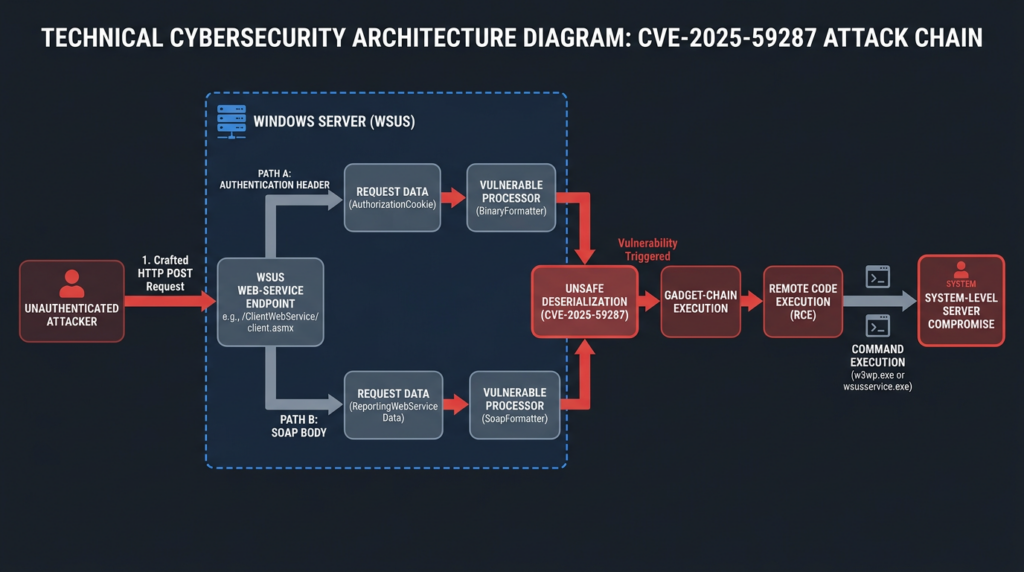
At its core, CVE-2025-59287 is an unsafe deserialization vulnerability.
Serialization converts an in-memory object into data that can be stored or transmitted. Deserialization performs the reverse operation, reconstructing objects from serialized data. The process becomes dangerous when an application deserializes attacker-controlled input using a mechanism capable of instantiating unexpected object types or invoking behavior during object reconstruction.
The official CVE description is deliberately concise, but independent technical research identified more than one relevant WSUS processing path. One path involved specially crafted AuthorizationCookie data reaching the WSUS GetCookie() functionality and being processed through the legacy .NET BinaryFormatter. A separate path involved the WSUS Reporting Web Service and unsafe processing through SoapFormatter. (Unité 42)
Both BinaryFormatter et SoapFormatter are legacy .NET serialization technologies that should not be used with untrusted input. The danger is not simply that an attacker can supply malformed data. Certain serialized object graphs can activate classes and method sequences—often called gadget chains—that produce unintended behavior during deserialization. When an appropriate gadget chain is available in the target process, that behavior can culminate in arbitrary code execution.
A simplified conceptual flow looks like this:
Unauthenticated network request
        ↓
Reachable WSUS web-service endpoint
        ↓
Attacker-controlled serialized content
        ↓
Legacy formatter processes untrusted object data
        ↓
Unexpected object construction or gadget-chain execution
        ↓
Command execution in the WSUS or IIS service context
        ↓
SYSTEM-level server compromise
This is not a normal authentication bypass in which an attacker simply gains access to an administrative webpage. It crosses directly from untrusted network input to privileged server-side execution.
The AuthorizationCookie Path
Security researchers associated one exploitation path with WSUS authorization-cookie handling. In that path, a crafted request causes WSUS to process malicious serialized data embedded in or associated with an AuthorizationCookie.
The vulnerable processing chain was reported to include WSUS authorization functions and an unsafe BinaryFormatter deserialization operation. An attacker does not need to know an administrator’s password because the dangerous operation occurs while the server is attempting to parse and reconstruct supplied data.
The ReportingWebService Path
Researchers also identified a route involving ReportingWebService, where WSUS accepted crafted reporting data and invoked unsafe legacy serialization behavior. Microsoft’s out-of-band update documentation specifically describes the repaired issue as an RCE vulnerability in “WSUS reporting web services.” (Microsoft Support)
The existence of multiple reachable deserialization paths helps explain why the first security update was insufficient. Fixing a single method or object type does not fully remove the risk when another web service still accepts attacker-controlled serialized content through a different formatter.
Why the Initial Patch Was Not Enough
Microsoft first disclosed and addressed CVE-2025-59287 during the October 14, 2025 security release. The vulnerability was initially treated as part of the normal Patch Tuesday cycle.
Subsequent analysis showed that the original remediation did not completely close the vulnerability. On October 23, Microsoft released new out-of-band updates for affected Windows Server versions. CISA explicitly stated that a prior update “did not fully mitigate” the vulnerability. The Dutch National Cyber Security Centre similarly revised its advisory to state that the original update was insufficient and that Microsoft had issued an out-of-band patch with additional fixes. (GovDelivery)
The operational consequence is straightforward: administrators could not safely assume that installing the original October 14 cumulative update was sufficient.
A server that received the first October update but not the October 23 out-of-band update could remain vulnerable. Patch validation therefore needed to confirm the installed build or applicable out-of-band KB, not merely the presence of “October 2025 updates.”
This is a recurring vulnerability-management lesson. A successful update installation record proves that a package was installed. It does not automatically prove that the final, complete remediation for a vulnerability is present.
Disclosure and Exploitation Timeline
| Date | Événement |
|---|---|
| October 14, 2025 | Microsoft disclosed CVE-2025-59287 through its October security release. |
| After October 14 | Researchers determined that the original mitigation did not fully close the WSUS attack surface. |
| October 23, 2025 | Microsoft released emergency out-of-band updates for affected Windows Server versions. |
| October 23–24, 2025 | Security providers observed scanning and exploitation of internet-facing WSUS servers. |
| October 24, 2025 | CISA added CVE-2025-59287 to the KEV Catalog. |
| October 29, 2025 | CISA expanded its guidance with asset-identification and threat-hunting recommendations. |
| November 14, 2025 | CISA’s required remediation date for covered federal civilian agencies. |
Huntress reported observing exploitation beginning at approximately 23:34 UTC on October 23, targeting WSUS instances exposed on TCP ports 8530 and 8531. The company observed the activity across four customer environments. Attackers used multiple HTTP POST requests against WSUS web services, after which wsusservice.exe or the IIS worker process w3wp.exe spawned command shells and PowerShell. (Chasseuse)
Unit 42 also reported exploitation within hours of the emergency update. Its research described an attack pattern focused on initial access, command execution, domain reconnaissance, and data exfiltration. Unit 42’s external attack-surface data identified approximately 5,500 internet-exposed WSUS instances at the time of its reporting. (Unité 42)
The rapid movement from public disclosure to exploitation demonstrates why organizations should not treat an out-of-band security update like a normal monthly maintenance item. Once exploit details become public, internet scanning, exploit adaptation, and opportunistic compromise can occur within hours.
Observed Attack Chain
Observed exploitation did not end with a proof-of-concept calculator process. Attackers used the vulnerability to obtain a useful execution foothold and immediately began collecting information about the surrounding Windows environment.
A representative attack sequence was:
Internet or untrusted network access
        ↓
Discovery of TCP 8530 or TCP 8531
        ↓
Crafted POST requests to WSUS web services
        ↓
Unsafe deserialization
        ↓
Execution through w3wp.exe or wsusservice.exe
        ↓
cmd.exe and PowerShell
        ↓
Host and domain reconnaissance
        ↓
External data exfiltration
        ↓
Potential credential theft, persistence, or lateral movement
Huntress documented two notable process chains:
wsusservice.exe
  └─ cmd.exe
      └─ cmd.exe
          └─ powershell.exe
w3wp.exe
  └─ cmd.exe
      └─ cmd.exe
          └─ powershell.exe
Observed reconnaissance commands included whoami, net user /domainet ipconfig /all. The attacker encoded PowerShell content and transmitted collected information to an external webhook service, using PowerShell web requests or curl.exe. (Chasseuse)
These commands are simple, but they provide valuable information. whoami reveals the execution identity. Domain-user enumeration confirms whether the server can communicate with Active Directory and exposes account names that may be useful for later attacks. Network configuration output reveals DNS servers, interfaces, routes, domain suffixes, and other internal addressing details.
The early exploitation observed by defenders was therefore consistent with reconnaissance preceding broader compromise rather than with a one-command destructive attack.
The WSUS Update-Trust Risk
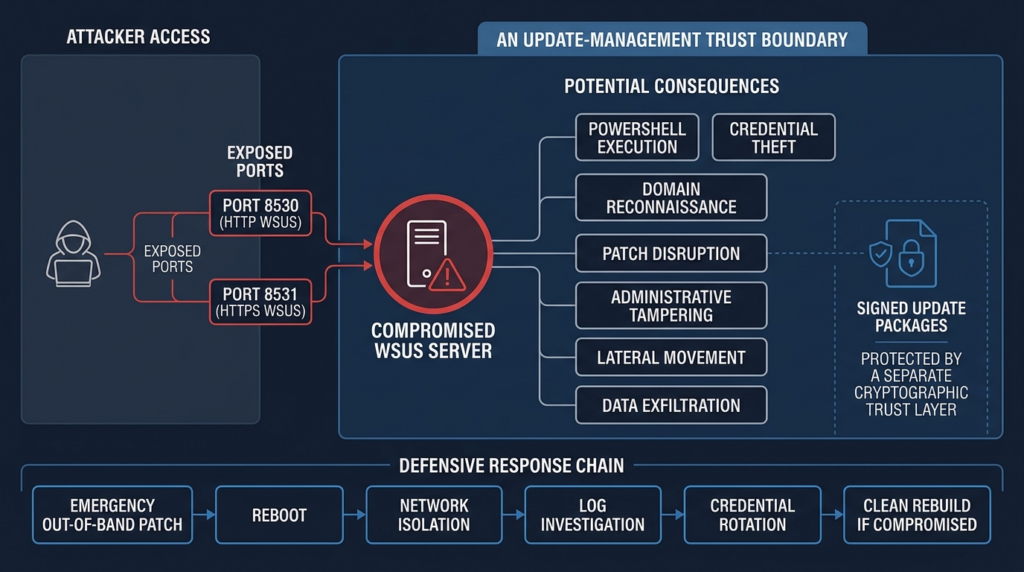
The phrase “WSUS supply-chain risk” must be used carefully.
CVE-2025-59287 compromises the WSUS server. It does not inherently break Microsoft’s update-signing cryptography. Windows clients continue to rely on signature validation and other update-processing controls. A statement that the vulnerability automatically allows arbitrary unsigned malware to be distributed as a valid Microsoft update would exceed the available evidence.
Nevertheless, the trust risk remains serious.
A compromised WSUS server occupies a privileged operational position. Attackers may gain access to administrative consoles, database connections, service-account credentials, update metadata, server certificates, proxy configuration, deployment groups, synchronization settings, and the identities of managed endpoints. They may also disrupt update delivery, delay security patches, interfere with reporting, or use the host as a pivot toward other management services.
The server can additionally provide a highly credible origin for malicious administrative activity. Connections from a recognized update-management host may receive less scrutiny than traffic originating from an ordinary workstation.
The important security model is therefore:
Microsoft update-signing trust
            ≠
Trustworthiness of the local WSUS server
Microsoft’s signatures protect the authenticity of Microsoft packages. They do not make an already compromised WSUS operating system, IIS instance, database, service account, or administrative workflow trustworthy.
Organizations should treat WSUS as security-sensitive management infrastructure, not merely as a cache for Windows patches.
Affected Windows Server Versions
The vulnerability affects supported WSUS deployments across several Windows Server generations. According to Microsoft-supplied version data reflected in the NVD record, builds below the following thresholds were affected. Later cumulative updates can supersede the original emergency packages, so administrators should compare against the minimum fixed build or install the latest applicable security update. (NVD)
| Windows Server version | Minimum fixed build from October 2025 OOB release | Emergency update |
|---|---|---|
| Windows Server 2012 | 6.2.9200.25728 | KB5070887 |
| Windows Server 2012 R2 | 6.3.9600.22826 | KB5070886 |
| Windows Server 2016 | 10.0.14393.8524 | KB5070882 |
| Windows Server 2019 | 10.0.17763.7922 | KB5070883 |
| Serveur Windows 2022 | 10.0.20348.4297 | KB5070884 |
| Windows Server version 23H2 | 10.0.25398.1916 | KB5070879 |
| Serveur Windows 2025 | 10.0.26100.6905 | KB5070881 |
| Windows Server 2025 Hotpatch | 10.0.26100.6905 | KB5070893 |
Microsoft’s support documentation confirms that these out-of-band updates address an RCE vulnerability in WSUS reporting web services. Microsoft also temporarily removed the display of detailed WSUS synchronization errors after installation as part of the remediation. (Microsoft Support)
Windows Server 2012 and 2012 R2 deployments require particular attention because applicable security updates depend on Extended Security Updates and servicing-stack prerequisites. Microsoft’s documentation states that WSUS administrators must approve the relevant servicing-stack update along with the out-of-band monthly rollup for these platforms. (Microsoft Support)
How to Identify Potentially Vulnerable WSUS Servers
The first emergency task is asset identification.
Do not begin by checking only the servers already named “WSUS” in the configuration-management database. Search for the installed role, running services, IIS applications, listening ports, update-services directories, and known WSUS databases.
CISA recommended the following PowerShell command to determine whether the role is installed:
Get-WindowsFeature -Name UpdateServices
A vulnerable configuration generally requires the WSUS Server Role to be enabled. CISA prioritized systems with the role enabled and TCP 8530 or 8531 open. (GovDelivery)
Administrators can collect additional local evidence with:
$role = Get-WindowsFeature -Name UpdateServices

$ports = Get-NetTCPConnection -State Listen -ErrorAction SilentlyContinue |
    Where-Object {
        $_.LocalPort -in 8530, 8531
    } |
    Select-Object LocalAddress, LocalPort, OwningProcess

$services = Get-Service -ErrorAction SilentlyContinue |
    Where-Object {
        $_.Name -match 'Wsus|UpdateServices' -or
        $_.DisplayName -match 'Windows Server Update'
    } |
    Select-Object Name, DisplayName, Status, StartType

[PSCustomObject]@{
    ComputerName  = $env:COMPUTERNAME
    WSUSInstalled = $role.Installed
    OSBuild       = [System.Environment]::OSVersion.Version.ToString()
    Listening8530 = [bool]($ports | Where-Object LocalPort -eq 8530)
    Listening8531 = [bool]($ports | Where-Object LocalPort -eq 8531)
}

$services
$ports
Run inventory commands through authorized administrative channels. Do not send exploit payloads to production systems merely to determine whether they are vulnerable.
External Exposure Assessment
A WSUS server should generally not expose its client or reporting web services directly to the public internet. Public reachability substantially reduces the attacker’s initial-access requirements.
Organizations should inspect:
- Internet-facing firewall and NAT rules.
- Cloud security groups and network security groups.
- Reverse proxies and load balancers.
- VPN address pools.
- Partner or supplier network routes.
- Remote-management networks.
- IPv6 exposure, which is sometimes omitted from IPv4-focused inventories.
- Internal segmentation boundaries between user, server, and management networks.
Internal-only WSUS servers still require patching. A compromised workstation, VPN account, supplier connection, or adjacent server can provide access to an internally reachable service. “Not exposed to the internet” is a useful compensating control, not a permanent exception from remediation.
Emergency Patching Procedure
The safest response is to install the latest applicable Windows Server security update that contains the complete remediation.
1. Prioritize Reachable WSUS Servers
Patch internet-exposed or broadly reachable WSUS systems first. Then address internal WSUS servers, replicas, disconnected-network instances, test systems, and standby infrastructure.
A forgotten replica can remain vulnerable even after the primary server is patched.
2. Confirm Servicing Prerequisites
Review the Microsoft support page for the applicable Windows Server release. Older platforms may require an Extended Security Updates entitlement and a specific servicing-stack update.
Do not assume that a failed installation will be obvious. Review installation status, servicing logs, update history, and the resulting operating-system build.
3. Install the Out-of-Band or Superseding Update
The October 23 packages are the historical minimum emergency fixes. In a current environment, install the latest supported cumulative security update rather than intentionally downgrading to an old package.
The minimum remediation principle is:
Installed build >= fixed build
or:
Applicable OOB KB or a verified superseding update is installed
4. Reboot the Server
CISA explicitly instructed organizations to reboot WSUS servers after installing the update to complete mitigation. A pending reboot can leave vulnerable components or service processes loaded. (GovDelivery)
Check reboot state with:
$rebootIndicators = @(
    'HKLM:\SOFTWARE\Microsoft\Windows\CurrentVersion\Component Based Servicing\RebootPending',
    'HKLM:\SOFTWARE\Microsoft\Windows\CurrentVersion\WindowsUpdate\Auto Update\RebootRequired'
)

$pending = $false

foreach ($path in $rebootIndicators) {
    if (Test-Path $path) {
        $pending = $true
    }
}

[PSCustomObject]@{
    ComputerName = $env:COMPUTERNAME
    PendingReboot = $pending
}
5. Validate the Result
After rebooting, verify:
Get-ComputerInfo |
    Select-Object WindowsProductName, WindowsVersion, OsBuildNumber

Get-HotFix |
    Sort-Object InstalledOn -Descending |
    Select-Object -First 20 HotFixID, InstalledOn, Description
Do not rely exclusively on Get-HotFix. Some update types and servicing states may not be represented exactly as expected. Compare the OS build, review the Microsoft update history, and confirm that the current cumulative update supersedes the emergency package.
6. Test WSUS Functionality
Confirm that:
- WSUS services start successfully.
- IIS application pools remain healthy.
- Upstream synchronization works.
- Downstream replicas can communicate.
- Clients can scan and report.
- Approved updates remain available.
- Monitoring and alerting continue to function.
Microsoft documented that synchronization error details may no longer appear in WSUS error reporting after the remediation. Administrators should not misinterpret the absence of detailed error text as evidence that logging is broken or that the update failed. (Microsoft Support)
Temporary Mitigation When Immediate Patching Is Impossible
CISA recommended disabling the WSUS Server Role and/or blocking inbound traffic to TCP 8530 and TCP 8531 when the out-of-band update could not be deployed immediately. The workarounds should remain in place until the security update has been installed. (GovDelivery)
At the host firewall, an emergency block can be created with commands such as:
New-NetFirewallRule `
    -DisplayName "Temporary Block WSUS HTTP CVE-2025-59287" `
    -Direction Inbound `
    -Protocol TCP `
    -LocalPort 8530 `
    -Action Block

New-NetFirewallRule `
    -DisplayName "Temporary Block WSUS HTTPS CVE-2025-59287" `
    -Direction Inbound `
    -Protocol TCP `
    -LocalPort 8531 `
    -Action Block
These rules can interrupt endpoint scanning, reporting, synchronization, or update delivery. They are emergency containment controls, not equivalent replacements for patching.
A more targeted approach may restrict the ports to known client networks or approved management segments. However, an allowlist is only useful when the listed networks are themselves trusted and controlled. Allowing all internal address space may still leave the service reachable from compromised workstations.
The organization should explicitly record the operational effect of disabling WSUS. An emergency security control that silently stops patch distribution can create a second vulnerability-management problem.
Safe Validation Without Exploiting Production
A good validation process establishes four facts:
- The WSUS role is present or absent.
- The vulnerable service is reachable from relevant network zones.
- The server has received a complete, superseding fix.
- There are no signs that exploitation occurred before remediation.
None of these requires detonating a public RCE proof of concept against a production update server.
Configuration Validation
Use authenticated inventory to inspect server roles, services, listening ports, operating-system builds, installed updates, and reboot status.
Network Validation
From an authorized assessment system, test whether TCP 8530 or 8531 is reachable:
Test-NetConnection -ComputerName wsus.example.internal -Port 8530
Test-NetConnection -ComputerName wsus.example.internal -Port 8531
A successful connection only demonstrates reachability. It does not prove that the target is vulnerable.
Patch Validation
Compare the installed build with Microsoft’s fixed-build threshold. Prefer an enterprise patch-management record combined with local host verification.
Controlled Laboratory Validation
When exploit-level validation is genuinely required, reproduce the vulnerable Windows Server and WSUS configuration in an isolated laboratory. The lab should have no production trust relationship, no reused credentials, no route to operational networks, and no access to real endpoint groups.
The test objective should be to confirm the vulnerable-to-fixed state transition, not to maximize post-exploitation actions.
Detection and Threat Hunting
Patching prevents future exploitation, but it does not remove an attacker who compromised the server before the update was installed.
Organizations with an exposed or broadly reachable WSUS instance should conduct retrospective investigation, even when the server now reports a fixed build.
High-Value Process Relationships
CISA recommended investigating suspicious child processes with SYSTEM privileges, particularly activity originating from wsusservice.exe ou w3wp.exe. It also advised looking for nested PowerShell activity and Base64-encoded PowerShell commands. (GovDelivery)
High-priority relationships include:
wsusservice.exe → cmd.exe
wsusservice.exe → powershell.exe
w3wp.exe → cmd.exe
w3wp.exe → powershell.exe
cmd.exe → cmd.exe → powershell.exe
powershell.exe → curl.exe
powershell.exe → certutil.exe
Not every child process is malicious. IIS applications and administrative scripts can produce legitimate command execution. Analysts should evaluate the command line, parent application pool, user identity, network source, execution time, and associated outbound activity.
Windows Event Investigation
Where process creation auditing is enabled, search Windows Security Event ID 4688 for relevant parent and child processes.
$startTime = (Get-Date).AddDays(-30)

Get-WinEvent -FilterHashtable @{
    LogName   = 'Security'
    Id        = 4688
    StartTime = $startTime
} -ErrorAction SilentlyContinue |
Where-Object {
    $_.Message -match 'wsusservice\.exe|w3wp\.exe' -and
    $_.Message -match 'cmd\.exe|powershell\.exe|pwsh\.exe|curl\.exe|certutil\.exe'
} |
Select-Object TimeCreated, Id, Message
PowerShell operational logs may reveal script-block execution, encoded commands, network requests, or reconnaissance:
Get-WinEvent -FilterHashtable @{
    LogName   = 'Microsoft-Windows-PowerShell/Operational'
    StartTime = (Get-Date).AddDays(-30)
} -ErrorAction SilentlyContinue |
Where-Object {
    $_.Message -match 'EncodedCommand|FromBase64String|net user /domain|ipconfig /all|webhook|Invoke-WebRequest|curl\.exe'
} |
Select-Object TimeCreated, Id, Message
WSUS and IIS Logs
Huntress highlighted the following locations:
C:\Program Files\Update Services\LogFiles\SoftwareDistribution.log
C:\inetpub\logs\LogFiles\W3SVC*\u_ex*.log
The observed request sequence included activity targeting:
/SimpleAuthWebService/SimpleAuth.asmx
/ClientWebService/Client.asmx
/ReportingWebService/ReportingWebService.asmx
/ApiRemoting30/WebService.asmx
Analysts should investigate abnormal POST requests, unusual user agents, unexpected external source addresses, bursts of requests across several WSUS services, and requests immediately followed by process creation or outbound network traffic. Huntress observed malicious requests involving the reporting, simple-authentication, client, and API-remoting services. (Chasseuse)
Example Sigma Detection
The following defensive rule focuses on a high-signal process relationship. It should be tuned for legitimate administrative tooling in each environment.
title: Suspicious Command Execution From WSUS or IIS Worker
id: 71e5496c-5f1d-4bf8-9ea0-cf0fb2d64772
status: experimental
description: >
  Detects command shells or PowerShell launched by WSUS or IIS worker
  processes, a behavior observed during exploitation of CVE-2025-59287.
references:
  - CVE-2025-59287
author: Penligent Research
date: 2026-08-04
logsource:
  category: process_creation
  product: windows
detection:
  parent:
    ParentImage|endswith:
      - '\wsusservice.exe'
      - '\w3wp.exe'
  child:
    Image|endswith:
      - '\cmd.exe'
      - '\powershell.exe'
      - '\pwsh.exe'
  condition: parent and child
falsepositives:
  - Legitimate WSUS maintenance scripts
  - Approved IIS application administration
level: high
tags:
  - attack.execution
  - attack.t1059
  - cve.2025.59287
Network Indicators
Investigate outbound connections from the WSUS server to:
- Webhook and request-capture services.
- Newly registered or low-reputation domains.
- Direct public IP addresses.
- Paste services and temporary file hosts.
- Remote-management ports not previously used by the server.
- Unusual DNS resolvers.
- Internal systems outside the expected patch-management workflow.
Huntress observed data being sent to a remote webhook service after domain and network reconnaissance. Unit 42 reported a consistent pattern of PowerShell-based collection and exfiltration. (Chasseuse)
Incident Response for Suspected WSUS Compromise
A vulnerable server that was internet-accessible before patching should not automatically be declared compromised. However, the combination of public exploit material, active exploitation, and privileged execution justifies a structured investigation.
Isolate the Server
Restrict inbound and outbound network communication while preserving access for the incident-response team. Avoid immediately destroying the system or wiping logs.
Containment should prevent communication with endpoints, domain controllers, file servers, remote-management systems, and the internet unless specifically required for evidence collection.
Preserve Volatile Evidence
Collect:
- Running processes and command lines.
- Active network connections.
- Logged-on sessions.
- Loaded modules.
- PowerShell history and operational logs.
- IIS worker-process details.
- Memory, where justified and supported by the incident-response process.
Preserve Persistent Evidence
Acquire:
- WSUS logs.
- IIS logs.
- Windows Security, System, and Application logs.
- PowerShell operational logs.
- Scheduled tasks.
- Service configurations.
- Autorun locations.
- Recently created executables and scripts.
- Web-server configuration.
- WSUS database and configuration records.
- Firewall and proxy logs.
- EDR telemetry.
- Domain-controller authentication records involving the WSUS host.
Review Credential Exposure
Assume that credentials available to the compromised server may have been accessed.
Review and potentially rotate:
- WSUS service accounts.
- Database credentials.
- Local administrator passwords.
- Accounts used for maintenance or remote administration.
- Secrets stored in scripts, scheduled tasks, deployment systems, or configuration files.
- Certificates and private keys accessible to the host.
Credential rotation should occur after containment. Rotating a password while an attacker remains active on the server may simply expose the new credential.
Investigate Downstream Activity
Search for authentication, remote execution, service creation, scheduled tasks, PowerShell remoting, SMB activity, WMI, WinRM, and RDP connections originating from the WSUS server.
Also review whether patch approvals, computer groups, synchronization settings, update metadata, or administrative roles changed during the suspected compromise period.
Rebuild When Trust Cannot Be Restored
Because exploitation provides SYSTEM-level execution on security-sensitive infrastructure, merely removing one script or scheduled task may not restore confidence.
Where compromise is confirmed, a clean rebuild from trusted media is generally safer than attempting to prove that every persistence mechanism has been removed. Reconnect the rebuilt server only after credentials have been rotated, configurations reviewed, and downstream systems investigated.
Hardening WSUS After Patching
Installing the security update closes the known CVE, but organizations should also reduce the consequences of future WSUS vulnerabilities.
Eliminate Public Exposure
WSUS client and reporting services should not be directly reachable from the public internet unless an exceptional, documented architecture requires it.
Remote devices should normally reach update infrastructure through controlled enterprise access, such as a VPN, managed gateway, or another architecture designed for untrusted networks.
Restrict Client Access
Allow TCP 8530 and 8531 only from approved endpoint networks, downstream WSUS replicas, and management systems. Do not expose the service to guest networks, public wireless networks, development environments, or unrelated server segments.
Restrict Administrative Access
WSUS administration should occur from hardened management workstations or jump hosts. Avoid administering the server from everyday user devices that process email and browse the web.
Apply Tiering Principles
A WSUS server may not be a domain controller, but it should still be classified as critical management infrastructure. Security teams should document:
- Who can administer it.
- Which accounts can log on.
- Which systems can connect.
- Which destinations the server can reach.
- Where credentials are stored.
- How changes are approved.
- How logs are collected.
- How the server will be rebuilt.
Minimize Outbound Access
A WSUS server needs specific outbound communication for synchronization and supporting services. It does not need unrestricted access to arbitrary internet destinations.
An egress allowlist can disrupt reconnaissance exfiltration patterns such as those observed during CVE-2025-59287 attacks.
Centralize Logs
Forward IIS, PowerShell, process-creation, security, and WSUS logs to a remote system. Local-only logs are vulnerable to alteration or deletion after SYSTEM-level compromise.
Monitor Configuration Drift
Alert on:
- New WSUS administrators.
- New local administrators.
- IIS configuration changes.
- New application pools or virtual directories.
- Firewall-rule changes.
- New scheduled tasks and services.
- Changes to proxy settings.
- Unexpected database configuration.
- Patch-approval changes.
- New executable files in WSUS-related directories.
Remove Unused Roles
If the organization has migrated from WSUS to another update-management system, remove the role rather than leaving it installed but neglected.
An unused management service still creates attack surface.
Emergency Patching Is Not the End of the Investigation
The CVE-2025-59287 response illustrates the difference between vulnerability remediation and incident response.
Vulnerability remediation asks:
Is the vulnerable code still present and reachable?
Incident response asks:
Was the vulnerable code exploited before remediation, and what did the attacker do afterward?
A server can be fully patched and still remain compromised. Conversely, a server can have been vulnerable without ever being exploited.
Organizations should therefore track at least three separate states:
| State | Signification |
|---|---|
| Vulnérable | The complete security update is not installed. |
| Remediated | The complete update is installed and relevant exposure has been addressed. |
| Investigated | Available evidence has been reviewed for signs of exploitation and post-compromise activity. |
Marking an asset “closed” immediately after a successful update can conceal the fact that exploitation occurred hours or days earlier.
Safe CVE Verification With an Evidence-Driven Workflow
CVE verification is most useful when it connects advisory information to the organization’s actual deployment state.
For CVE-2025-59287, a defensible workflow should collect:
- The target Windows Server version and build.
- Whether the WSUS role is installed.
- Whether WSUS services are running.
- Whether TCP 8530 or 8531 is reachable.
- Whether an applicable fixed or superseding update is installed.
- Whether the server was previously internet-exposed.
- Whether suspicious request, process, PowerShell, or egress activity exists.
- Whether a reboot completed the remediation.
An agentic security platform such as Penligent can help coordinate this type of authorized validation by combining asset discovery, service identification, patch-state checks, network evidence, and report generation. The objective should not be to fire an unsafe public exploit indiscriminately. It should be to create a reproducible evidence chain showing which prerequisites exist, which controls block exploitation, and whether the final patched state has been independently confirmed.
For critical infrastructure vulnerabilities, the output should clearly separate facts from inference. “TCP 8530 is reachable” is a fact. “The host is exploitable” requires additional evidence. “The host was compromised” requires forensic evidence rather than vulnerability presence alone.
Lessons for Vulnerability-Management Programs
CVE-2025-59287 exposes several weaknesses that conventional patch dashboards can miss.
Role-Aware Inventory Matters
The vulnerable component is an optional Windows Server role. Inventory that records only “Windows Server 2022” cannot determine whether the vulnerable WSUS attack surface is active.
Asset systems should capture installed roles, services, ports, application versions, network exposure, and business function.
Patch Presence Is Not Patch Completeness
The initial October update did not fully mitigate the vulnerability. A dashboard that reported “October Patch Tuesday installed” could produce false confidence.
Vulnerability programs need a way to process revised vendor advisories, superseded fixes, out-of-band releases, and changes in exploitation status.
Management Servers Need Higher Priority
A CVSS score is only one part of prioritization. Management servers, identity systems, hypervisors, backup infrastructure, security consoles, and update services can amplify the effect of compromise.
Exposure Exists Internally Too
Internet exposure accelerated exploitation, but internal reachability remains relevant. Attackers routinely use an initial workstation or VPN compromise to reach services that are not publicly accessible.
Emergency Change Processes Must Be Practiced
Organizations cannot design an out-of-band patching process after the emergency begins. They need predefined authority, testing procedures, rollback plans, communications, and evidence requirements.
Frequently Asked Questions
What is CVE-2025-59287?
CVE-2025-59287 is a critical Windows Server Update Services remote code execution vulnerability caused by deserialization of untrusted data. It can allow a remote unauthenticated attacker to execute code on an affected WSUS server. (NVD)
What is the CVSS score for CVE-2025-59287?
Microsoft assigned the vulnerability a CVSS 3.1 base score of 9.8, with the vector AV:N/AC:L/PR:N/UI:N/S:U/C:H/I:H/A:H. (NVD)
Is CVE-2025-59287 being actively exploited?
Yes. Huntress, Unit 42, CISA, and other security organizations reported or recognized active exploitation. CISA added the vulnerability to its Known Exploited Vulnerabilities Catalog on October 24, 2025. (Chasseuse)
Does the vulnerability affect every Windows Server?
No. The relevant condition is that the WSUS Server Role is installed and enabled. The role is not enabled by default. Servers without WSUS are not exposed through this WSUS vulnerability, although they may still require normal Windows security updates for other issues. (Unité 42)
Which ports are associated with WSUS exploitation?
Attackers were observed targeting TCP 8530 for HTTP and TCP 8531 for HTTPS, which are commonly used as default WSUS service ports. (Chasseuse)
Was the original October 2025 update sufficient?
No. CISA stated that a prior update did not fully mitigate CVE-2025-59287. Microsoft released additional out-of-band updates on October 23, 2025. (GovDelivery)
Is installing the October 14 Patch Tuesday update enough?
Administrators should not rely on the October 14 update alone. They should install the applicable October 23 out-of-band update or a later cumulative update that supersedes it, then reboot and validate the resulting build.
Does CVE-2025-59287 let an attacker forge Microsoft-signed updates?
The vulnerability provides code execution on the WSUS server. Public evidence does not establish that the CVE itself breaks Microsoft’s digital signatures or automatically makes arbitrary unsigned malware appear to be a valid Microsoft update.
The risk is that the attacker controls a trusted update-management server and may abuse its credentials, network position, administrative access, configuration, or downstream relationships.
Should internal-only WSUS servers be patched?
Yes. Removing internet exposure reduces risk but does not eliminate vulnerability. An attacker with an internal foothold may still reach the service.
How can organizations temporarily mitigate the vulnerability?
When immediate patching is impossible, Microsoft and CISA recommended disabling the WSUS role and/or blocking inbound TCP 8530 and 8531. These workarounds can interrupt update operations and should remain in place until the patch is installed. (GovDelivery)
Is patching enough after a server was exposed?
Not necessarily. Organizations should inspect IIS logs, WSUS logs, process telemetry, PowerShell activity, outbound connections, account use, scheduled tasks, services, and changes to WSUS configuration.
A patched server can still contain attacker persistence established before the update.
Conclusion
CVE-2025-59287 combined nearly every characteristic that forces an emergency security response: unauthenticated network access, low attack complexity, SYSTEM-level execution, public technical material, incomplete initial remediation, and confirmed exploitation against real organizations.
The immediate remediation is clear. Identify every server with the WSUS role enabled, prioritize systems reachable on TCP 8530 or 8531, install the applicable out-of-band or superseding security update, reboot, and verify the resulting operating-system build.
The deeper lesson concerns infrastructure trust.
WSUS is not simply another Windows web application. It is part of the mechanism through which an organization maintains the security of its Windows estate. Compromise does not automatically invalidate Microsoft’s package signatures, but it places an attacker inside a highly trusted operational boundary with visibility into endpoints, administrators, network structure, and update workflows.
Security teams should therefore handle CVE-2025-59287 as both a vulnerability-management emergency and a potential infrastructure-compromise event. Patch the vulnerable code, investigate the period of exposure, restore trust in the server, and redesign network controls so that the next flaw in update infrastructure cannot be reached from everywhere.

 French
  English
  German
  Spanish
  Portuguese
  Japanese
  Korean
  Hindi
Hindi  Arabic
  Turkish
  Hebrew