
When a CVE lands against a niche virtualization project, it usually gets one of two bad treatments. Either it is ignored because it does not look internet-exploitable enough to matter, or it is inflated into a generic “critical hypervisor bug” story that says almost nothing useful. CVE-2025-6603 deserves neither treatment. It is more interesting than its headline severity suggests, but for reasons that only become clear when you look at what qCUDA is, how QCOW metadata works, and why integer arithmetic inside host-side emulation code keeps showing up in vulnerability history. (NVD)
The public record for CVE-2025-6603 is thin, but the parts that are available are unusually consistent. NVD describes the issue as an integer overflow in qcow_make_empty within qCUDA/qcu-device/block/qcow.c, caused by manipulation of s->l1_size. NVD also shows that the record is still awaiting full NVD analysis, while the CNA-supplied scoring from VulDB currently characterizes it as a medium-severity local issue with low confidentiality, integrity, and availability impact. GitHub’s advisory record mirrors the same core description and likewise does not map the issue to known patched versions. (NVD)
That combination matters. On one hand, this is not a “drop one packet from the internet and own the host” bug in the public evidence reviewed here. The current record says local attack vector, low privileges required, and no user interaction, which is very different from the sort of remotely reachable virtualization defect that forces emergency patch windows across fleets. On the other hand, local metadata-parsing flaws inside virtualization stacks are never just bookkeeping mistakes. They sit close to disk-image import, host-side emulation, guest-controlled state, and trust boundaries that are easy to blur in labs, CI infrastructure, research clusters, and multi-user environments. (NVD)
The right way to read CVE-2025-6603 is this: not as the biggest bug in virtualization this year, but as a compact case study in how old QCOW-era arithmetic mistakes continue to reappear in forks, derivatives, and specialized emulation projects. qCUDA itself is positioned as a para-virtualized GPU virtualization framework built on virtio concepts, with a backend device component derived from QEMU 2.12.1. Its repository README still describes a host setup centered on Ubuntu 18.04 LTS and CUDA 9.0, and both the repository and the project paper describe qCUDA as a system focused on API remoting and high-bandwidth GPU virtualization rather than on modern hardening or parser isolation. (GitHub)
That background is important because it reframes the vulnerability from “one medium bug in one obscure project” into “one more arithmetic bug in a code lineage that already has a long memory of QCOW metadata problems.” Once you place CVE-2025-6603 alongside older QEMU block-driver issues such as CVE-2014-0222, CVE-2014-0143, and CVE-2014-0145, the interesting question is no longer whether the current score is 5-point-something. The interesting question is why image-metadata sizing, table growth, truncation, and offset arithmetic still create exploitable states whenever a project inherits older storage logic and extends it into new device paths. (NVD)
What CVE-2025-6603 Actually Is
The bare facts are straightforward. NVD says CVE-2025-6603 affects coldfunction qCUDA up to commit db0085400c2f2011eed46fbc04fdc0873141688e. The vulnerable function is qcow_make_empty en qCUDA/qcu-device/block/qcow.c. The weakness mapping includes CWE-190, Integer Overflow or Wraparound, and the described trigger is manipulation of the s->l1_size argument. The record also states that the product follows a rolling-release model, so the public advisory does not provide clean affected-versus-fixed version mapping. (NVD)
GitHub’s advisory record adds two operationally relevant details. First, the advisory lists both affected and patched versions as unknown. Second, it does not associate the issue with a packaged ecosystem in the way a mature library advisory normally would. That makes triage harder for defenders, because the first question in most enterprise workflows is not “what is the bug,” but “which deployed artifact do I upgrade to.” In this case, the public record is much better at describing the arithmetic than at describing the remediation path. (GitHub)
The most information-dense public source is the GitHub issue that appears to have seeded the downstream advisory records. It describes the root cause as unsafe 32-bit multiplication when calculating the L1 table size, identifies the specific expression, and explains the overflow threshold: once l1_size reaches 0x20000000, multiplying by eight wraps a 32-bit result back to zero. The issue then argues that the corrupted l1_length is passed into bdrv_truncate, causing truncation at the L1 table offset rather than at the correct end of the table. It also states that the vulnerability exists in the latest main branch and that all versions with that code remain vulnerable. (GitHub)
Those are not just implementation details. They tell you what the demonstrated impact is. Based on the public issue text and current NVD scoring, the strongest supported claim is not “confirmed host escape” or “proved arbitrary code execution.” The strongest supported claim is that malformed or attacker-influenced L1 sizing can corrupt the size calculation and drive incorrect truncation or related unsafe state transitions in host-side storage logic. That can translate into data corruption, crashes, or broader memory-safety consequences depending on surrounding code paths, but the public record reviewed here stops short of documenting a complete code-execution chain. (GitHub)
A concise fact table helps anchor the discussion:
| Champ d'application | Current public record |
|---|---|
| CVE | CVE-2025-6603 |
| Project | coldfunction qCUDA |
| Vulnerable function | qcow_make_empty |
| Fichier | qCUDA/qcu-device/block/qcow.c |
| Faiblesse | CWE-190, Integer Overflow or Wraparound |
| Vecteur d'attaque | Local |
| Privileges required | Faible |
| NVD status | Awaiting Analysis |
| CVSS shown in NVD page | CNA VulDB 5.3 CVSS v3.1, 4.8 CVSS v4 |
| Public fixed version mapping | Not available in reviewed sources |
| GitHub issue state in reviewed page | Open |
These values come directly from NVD, GitHub Advisory, and the referenced repository issue. (NVD)

Why qCUDA Matters More Than the CVSS Suggests
qCUDA is not a toy parser in isolation. The repository describes it as a GPU virtualization framework that uses a para-virtualized driver on the guest side and a host-side virtual device for CUDA-related operations, memory translation, and command handling. The README also states that the qcu-device component was modified from QEMU 2.12.1. In other words, this is exactly the kind of project where file-format logic, device emulation, and host trust boundaries can end up in the same fault domain. (GitHub)
The project’s own positioning reinforces that point. The README says qCUDA can execute CUDA-compatible programs in Linux and Windows VMs on QEMU-KVM, and both the repository and the linked paper describe performance goals such as above 95 percent bandwidth efficiency in test environments. That is useful context because high-performance virtualization code tends to optimize data movement, metadata translation, and memory handling aggressively. Those are exactly the areas where integer width assumptions and offset arithmetic become dangerous when validation falls behind performance-driven engineering. (GitHub)
The stack age also matters. qCUDA’s documented host prerequisites include Ubuntu 18.04 LTS and CUDA 9.0, and its backend is described as derived from QEMU 2.12.1, a QEMU branch whose major release dates back to 2018. None of that proves the project is insecure by itself, but it does raise the maintenance question that security teams should always ask of specialized forks: how much of the upstream hardening history has actually been inherited, and how much custom code now sits around storage, I/O, and emulation paths that upstream has continued to evolve for years. (GitHub)
This is why medium-scored local flaws inside emulation projects deserve a more serious reading than their severity badge often gets. In practice, the risk is shaped less by the nominal vector string and more by the environment. A single-user research host loading only trusted images is one thing. A shared lab, academic cluster, CI pipeline, or internal platform where users can upload, transform, or import images and artifacts is something else. The same arithmetic defect can move from “annoying local bug” to “real host-side trust boundary problem” depending on who controls the image path and how the project is embedded into larger infrastructure. That is an inference from the architecture and deployment model, but it is a grounded one. (GitHub)
The Root Cause, Step by Step
To understand the bug, you do not need to know every corner of qCUDA. You need to understand what happens when a storage layer calculates the size of a metadata structure using the wrong integer width.
The GitHub issue describes the vulnerable pattern as a 32-bit multiplication of s->l1_size by sizeof(uint64_t). Since each L1 table entry is eight bytes, the code is effectively turning a count of entries into a byte length. That is normal. The mistake is doing it in a 32-bit destination without an overflow guard. Once the count becomes large enough, the arithmetic no longer produces a larger byte length. It wraps. (GitHub)
Here is a simplified version of the vulnerable pattern as described in the public issue:
/* simplified pattern */
uint32_t l1_length = s->l1_size * sizeof(uint64_t);
/* later used to derive the new truncation boundary */
The issue explains that when l1_size is at least 0x20000000, multiplying by 8 exceeds the maximum 32-bit unsigned integer and wraps around. In the example given publicly, the wrapped value becomes zero. That means any downstream logic that assumes l1_length reflects the real size of the L1 table is now operating on a lie. (GitHub)
The arithmetic is easy to demonstrate safely:
l1_size = 0x20000000          # 536,870,912
entry_size = 8                # sizeof(uint64_t)
true_length = l1_size * entry_size
wrapped_32 = true_length & 0xffffffff

print(hex(true_length))       # 0x100000000
print(hex(wrapped_32))        # 0x0
This is not an exploit. It is just the arithmetic the public issue describes, expressed in a harmless way. The important observation is that the true length is 4,294,967,296 bytes, while the 32-bit view wraps to zero. Once that happens, the rest of the program is no longer reasoning about the actual table size. (GitHub)
The next question is why L1 sizing matters in the first place. QEMU’s qcow2 format documentation explains that guest cluster mapping is implemented as a two-level structure using L1 and L2 tables. The L1 table has variable size stored in the image metadata and may span multiple clusters, while L2 tables are single-cluster structures. The L1 table is therefore exactly the kind of metadata object whose size, offsets, and contiguity assumptions have to be handled carefully. If the byte-length calculation for that structure is wrong, later reads, writes, allocations, and truncations can all become inconsistent with the actual image layout. (QEMU)
QEMU’s documentation is for qcow2 specifically, while the qCUDA issue names block/qcow.c. That distinction matters, and a good analysis should not blur qcow and qcow2 into one undifferentiated file format. But the family resemblance is still useful. Both qcow-style image handling paths rely on metadata tables, offsets, and host-side block-driver logic. The public qCUDA issue is persuasive not because it says “this is qcow2 exactly,” but because it demonstrates the same class of failure that storage-emulation code has suffered before: table-size arithmetic escaping validation and poisoning later operations. (GitHub)
The issue text specifically says the corrupted l1_length gets passed to bdrv_truncate, which would move truncation to s->l1_table_offset instead of the correct end position. That is a critical detail because it changes the discussion from generic “overflow bad” language into a concrete failure mode. The demonstrated path is not merely that a size becomes wrong. It is that the wrong size affects file-length manipulation. In storage code, once truncation boundaries are wrong, corruption and denial of service stop being theoretical. They become natural outcomes. (GitHub)

Why QCOW Metadata Bugs Keep Returning
One reason CVE-2025-6603 is more interesting than it first appears is that it echoes older QEMU vulnerabilities almost too neatly. QEMU’s own CVE history includes CVE-2014-0222, which NVD describes as an integer overflow in qcow_open en block/qcow.c, triggered by a large L2 table in a QCOW version 1 image. The Red Hat-modified NVD description goes even further, saying a user able to alter disk image files loaded by a guest could corrupt QEMU process memory on the host and potentially achieve arbitrary code execution in the context of the QEMU process. (NVD)
That older record matters because it shows the pattern is not hypothetical. Large metadata tables in qcow-family image handling have already been associated with host-side memory corruption risk. CVE-2025-6603 does not publicly document the same end-to-end code-execution consequence, and it would be irresponsible to claim that it does. But it clearly belongs to the same engineering failure family: trusting table size arithmetic too much in code that sits close to host-side image operations. (NVD)
Then there is CVE-2014-0143. NVD describes it as multiple integer overflows in QEMU block drivers, including large L1 tables in qcow2 paths such as qcow2_snapshot_load_tmp et qcow2_grow_l1_table, with consequences including buffer overflows, memory corruption, large memory allocations, and out-of-bounds reads and writes. If you want a historical template for why an L1-size bug should make virtualization engineers uncomfortable, that CVE is one of the clearest examples. The qCUDA issue reads less like a novel discovery and more like a reappearance of a problem class the ecosystem already knows well. (NVD)
CVE-2014-0145 pushes the same lesson from another direction. NVD describes multiple buffer overflows in QEMU, including one caused by a large L1 table in a qcow2 snapshot-loading path, with possible denial of service or arbitrary code execution. Again, that does not prove that CVE-2025-6603 is equivalent in impact. What it proves is that once metadata table sizing goes off the rails in image-processing code, the end state can escalate quickly from “wrong arithmetic” to “wrong memory access.” (NVD)
This is why the qCUDA inheritance story matters so much. The repository explicitly says qcu-device was modified from QEMU 2.12.1. QEMU 2.12.0 itself was released in April 2018. Since then, the broader QEMU codebase has continued to accumulate fixes, refactors, fuzzing exposure, and hardening across emulation and device layers. A derivative project does not automatically inherit that long-term hardening unless it actively rebases and reviews the code paths it depends on. Specialized forks often inherit design assumptions far more easily than they inherit security maturity. (GitHub)
More recent QEMU advisories show that the danger is not historical only. NVD describes CVE-2024-3446 as a double-free issue in QEMU virtio devices that could let a malicious privileged guest crash the QEMU host process or potentially execute code in that context. NVD also describes CVE-2024-3447 as a heap-based buffer overflow in SDHCI emulation that could crash the QEMU process on the host. These are not QCOW bugs, but they underline the same strategic point: emulation layers remain a high-value attack surface, and privileged guest or local-adjacent conditions are still enough to make host-side bugs security-relevant. (NVD)
So the deeper lesson of CVE-2025-6603 is not simply “validate arithmetic.” It is “stop assuming niche virtualization projects are insulated from the failure patterns that mainstream hypervisors have already spent a decade learning the hard way.” If a project handles images, metadata tables, host offsets, and guest-facing emulation while also extending older code, its security story is only as strong as its most brittle inherited edge case. That conclusion is inferential, but it is the inference the public evidence supports best. (GitHub)
The Real Impact Boundary
One of the easiest ways to write a bad CVE article is to skip over the attack boundary. For CVE-2025-6603, the public record says local attack vector and low privileges required. That is a real constraint, and it should change how you prioritize response. If your environment gives no untrusted party a way to influence qCUDA image state, metadata, or host-side invocation paths, your immediate exposure is very different from a shared environment where user-controlled artifacts can reach those code paths. (NVD)
The public issue text suggests the vulnerable state can be reached through manipulation of L1 sizing in storage metadata logic. In practice, that means the most relevant environments are the ones where image creation, import, conversion, or mutation is not fully trusted. Think research labs that share GPU-virtualized infrastructure, internal build systems that process images from multiple contributors, CI runners that generate or transform disk artifacts, or custom virtualization platforms where end users can bring their own images. In those settings, “local” stops meaning “physically at the keyboard” and starts meaning “inside a trust zone that still includes untrusted input.” (GitHub)
It is also important not to overstate the demonstrated impact. The public evidence reviewed here does not show a weaponized exploit chain, a known in-the-wild campaign, or a vendor advisory mapping fixed releases. NVD still marks the record as awaiting analysis, GitHub Advisory says patched versions are unknown, and the referenced issue page remained open in the reviewed snapshot. That means any article claiming proven remote code execution or widespread active exploitation would be outrunning the evidence. (NVD)
But underplaying the issue would also be a mistake. Host-side block-driver logic is one of those areas where even medium-severity local flaws can become operationally expensive. Crashes in image handling break automation. Corrupted truncation logic can damage artifacts. Poorly bounded metadata operations can create subtle integrity failures that are harder to detect than a clean segfault. And because the project is a virtualization component rather than a standalone desktop app, those failures can ripple into infrastructure pipelines where reproducibility and trust are already fragile. (GitHub)
The best summary is this: CVE-2025-6603 is not currently documented as an internet-scale emergency, but it is exactly the sort of bug that competent infrastructure teams should take seriously when it appears inside a project that processes VM-related image metadata on the host side. The public evidence supports concern, not panic. (NVD)
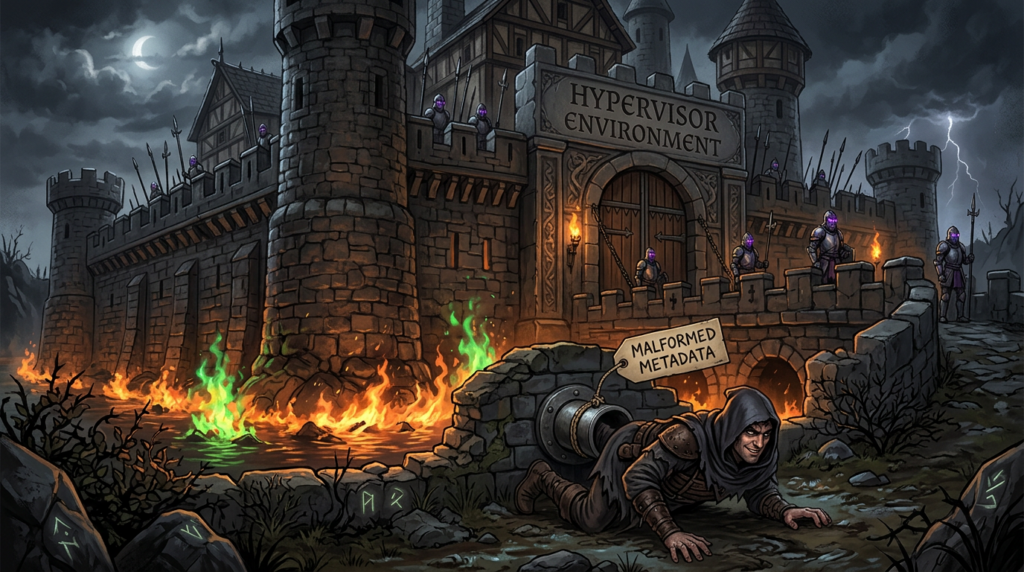
A Safer Way to Explain the Arithmetic Failure
The easiest way to miss the significance of this CVE is to think, “So the number wrapped. Why is that such a big deal?” In systems code, wrapped lengths are dangerous because lengths are rarely endpoints by themselves. They become allocation sizes, file offsets, bounds checks, truncation targets, or loop limits.
A simplified secure pattern looks like this:
/* illustrative defensive pattern */
size_t l1_bytes;
if (__builtin_mul_overflow((size_t)s->l1_size,
                           sizeof(uint64_t),
                           &l1_bytes)) {
    return -EFBIG;
}

if (s->l1_table_offset > UINT64_MAX - l1_bytes) {
    return -EFBIG;
}

uint64_t new_end = s->l1_table_offset + l1_bytes;
The point of this pattern is not stylistic elegance. It is that it defends both multiplication overflow and later offset-addition overflow. Many real-world bugs fix only the first half and still leave a poisoned endpoint calculation behind. That matters here because the public issue is explicitly about the wrong byte length being carried into truncation logic. (GitHub)
A second defensive principle is to reject impossible table sizes before arithmetic even begins. QEMU’s qcow2 documentation makes clear that L1 table size and cluster mapping are constrained by the image format. That means parsers should not wait until a multiplication explodes. They should validate that the count of L1 entries is compatible with the image’s declared geometry, cluster size, and maximum addressable space. When code treats format metadata as advisory rather than authoritative input that must be range-checked, integer bugs become much easier to trigger. (QEMU)
A third principle is separation of consequences. QEMU’s multi-process documentation explains the value of separating services so that a compromised disk service cannot access files or devices beyond what it was granted. That is an architectural mitigation, not a code fix, but it is directly relevant here. The safest arithmetic is the arithmetic that never fails. The second safest is arithmetic that fails inside a process with the least possible privilege and file access. (QEMU)
How to Validate for Similar Bugs Without Weaponizing the Bug
The defensive path forward is not to chase one magic PoC. It is to assume there may be more than one arithmetic edge case in the same family and validate accordingly.
Start with code search. Any host-side storage or image-handling path that multiplies entry counts by entry size or cluster counts by cluster size deserves manual review. You are looking for patterns where a format-controlled or attacker-influenced field is multiplied into a 32-bit or signed intermediate, then reused in allocation, truncation, or index arithmetic. The qCUDA issue makes the exact pattern painfully clear, which makes it a useful seed for broader audit rules. (GitHub)
A practical review heuristic is to search for the combination of table-oriented names and type narrowing. Terms like l1, l2, groupe, entrées, offset, length, truncateet alloc paired with uint32_t, int, or implicit narrowing conversions are much more valuable than generic “grep for overflow” advice. In code derived from older virtualization stacks, the dangerous lines are often not obviously scary. They look like ordinary metadata math. The risk appears only when you ask whether the destination type can still represent the format’s maximum valid state. That logic follows directly from the published issue and from MITRE’s description of CWE-190. (GitHub)
Compiler instrumentation should be part of that workflow. UndefinedBehaviorSanitizer, AddressSanitizer, integer sanitizers where supported, and overflow builtins will not prove a design safe, but they are very good at turning quiet arithmetic assumptions into loud test failures. Projects handling untrusted or semi-trusted image metadata should also include fuzzing against create, open, resize, snapshot, and truncate paths, not just image-open happy paths. QEMU’s own modern ecosystem has benefited heavily from exactly this kind of test pressure, and derivatives should assume they need the same discipline. (NVD)
Here is a simple audit checklist security teams can apply to qCUDA-like code:
| Audit question | Pourquoi c'est important |
|---|---|
| Is a metadata-controlled count multiplied into a smaller integer type? | This is the core bug pattern in CVE-2025-6603 |
| Is the result later used for allocation, truncation, or indexing? | That determines whether wraparound becomes corruption |
| Are format-specific maximums validated before arithmetic? | Prevents attacker-controlled “valid-looking” oversized tables |
| Is offset addition checked after multiplication? | Prevents a second overflow stage |
| Can untrusted images reach host-side handlers? | Converts theoretical local bugs into real deployment risk |
| Is the storage path isolated from unrelated host resources? | Limits blast radius if parsing fails badly |
This checklist is generic, but it is grounded in the mechanics publicly described for this CVE and in the related QEMU history. (GitHub)
A Small Lab Test That Teaches the Right Lesson
If you want to reproduce the engineering mistake safely, do not try to build a full exploit chain first. Start by writing unit tests around boundary arithmetic. The threshold given in the public issue is already enough to create a valuable regression test.
Par exemple :
#include <assert.h>
#include <stdint.h>
#include <stdbool.h>

bool safe_mul_u64(uint64_t a, uint64_t b, uint64_t *out) {
    return !__builtin_mul_overflow(a, b, out);
}

int main(void) {
    uint64_t out = 0;
    assert(safe_mul_u64(0x20000000ULL, 8ULL, &out));
    assert(out == 0x100000000ULL);
    return 0;
}
That test does not touch qCUDA. It tests the boundary condition the public issue identifies and encodes the expected non-wrapped result. Then your review task is to compare every real metadata path against that invariant: is the program preserving the true mathematical result, or is it silently narrowing it into something unsafe. (GitHub)
You can also write property-based tests around “count times element size” invariants. Any function that consumes table metadata should satisfy one simple rule: if the true product does not fit the destination or the resulting endpoint exceeds allowed format bounds, the function must reject the input before any truncation, allocation, or write-side effect occurs. That sounds obvious in prose. It becomes less obvious when older code paths assume image metadata is already sane because it originated from “expected” tooling. CVE-2025-6603 is a reminder that expected tooling is not a security boundary. (NVD)
Patch Strategy and Hardening Priorities
If you maintain qCUDA or a similar derivative, the first priority is boring and non-negotiable: widen the arithmetic and add explicit checked-math guards. There is no serious alternative. The public issue’s demonstration threshold is clear enough that any fix that merely changes control flow without eliminating unsafe multiplication is not a fix in the security sense. (GitHub)
The second priority is to validate image geometry before host-side mutation. QEMU’s qcow2 format documentation shows that table sizes, cluster sizes, and guest-visible mappings are governed by defined format relationships. A robust parser should derive legal ranges from those relationships and reject metadata that implies impossible or unreasonably large table layouts. Overflow checks are necessary. Format-consistency checks are what stop the next adjacent bug from slipping through. (QEMU)
The third priority is to make side effects late. If the wrong length can reach truncate, allocation, or write paths before validation completes, the parser is too eager. Storage and image code should front-load validation and postpone all file-destructive operations until after arithmetic, offset, and geometry checks have passed. The public issue is valuable precisely because it points to a state-changing call site, not just to a bad number. That is where engineering attention belongs. (GitHub)
The fourth priority is process isolation. QEMU’s multi-process design documentation explains the benefit of running disk services with only the privileges and file access they require. If you cannot immediately prove every storage-emulation path is perfect, you can at least reduce what a compromised or crashing component can touch. This is not an excuse to leave parser bugs unfixed. It is what competent teams do while they are still earning the right to trust their own code. (QEMU)
The fifth priority is maintenance reality. Specialized forks often treat upstream lineage as a feature and upstream release discipline as optional. That is backwards. If a project inherits storage and emulation logic from a mature hypervisor, it should inherit the obligation to track parser hardening, fuzzing exposure, and CVE history with the same seriousness. A forked code path is not “simpler” just because fewer people are looking at it. It is often riskier for exactly that reason. (GitHub)

What Security Engineers Should Do This Week
The immediate operational move is inventory. If your team uses qCUDA directly, a private fork of it, or any internal image-processing component derived from older QEMU-era storage code, identify where host-side disk or image metadata is parsed, created, resized, or truncated. If you do not know that answer by the end of the week, you are not ready for the next bug in this family either. (GitHub)
Next, classify trust paths. Who can feed images or metadata-bearing artifacts into those code paths? Is it only root on a single-user workstation, or can untrusted researchers, CI jobs, tenants, or contributors influence the data flow? “Local” is not a free pass in environments where users can meaningfully shape the artifacts the host processes. In many modern infrastructure stacks, local means “inside a large and messy trust zone.” (NVD)
Then gate destructive operations. Any internal tooling that creates empty images, truncates metadata areas, or rewrites QCOW-family layouts should be wrapped with invariant checks and failure telemetry. If a parser rejects an image because a table size is impossible, that is success, not inconvenience. Quiet acceptance is the dangerous behavior here. (GitHub)
After that, add regression tests around boundary values. The threshold published in the qCUDA issue is already enough to build one useful non-regression case. But do not stop there. Test near-zero, near-maximum, power-of-two, and cross-boundary values for all table and cluster arithmetic. Bugs like this are rarely alone. They tend to cluster around the same family of assumptions. (GitHub)
Finally, make patch provenance a formal requirement. One of the more frustrating details in the current public record is the lack of clear fixed-version mapping. NVD says rolling release and no version details. GitHub Advisory says patched versions unknown. That is not just a documentation inconvenience. It means defenders cannot rely on standard package-version reasoning to answer exposure questions. Internal teams need commit-level provenance, not just “we pulled recently.” (NVD)
A bug like CVE-2025-6603 is a good reminder that most security teams do not fail because they never read CVEs. They fail because they do not continuously validate the custom glue around them. In a stack that mixes web control surfaces, automation, image imports, virtualization components, and internal operators, the real exposure often comes from the path that moves untrusted input into privileged code, not from the CVE page alone. That is the point where an automated validation platform can be useful. (NVD)
In that narrower sense, Penligent is relevant around the surrounding attack surface, not as a magical patch for qcow.c. A platform like Penligent can help teams continuously test the management interfaces, upload workflows, orchestration APIs, and other externally reachable components that may feed into privileged infrastructure paths. That is a sensible integration point because it focuses on validating the exposure around the vulnerable component rather than claiming to replace secure systems engineering inside the component itself. Related Penligent material on practical AI pentesting workflows and verified findings is worth reading if your team is trying to move from one-off scanning to repeatable validation. (Penligent)
Why This CVE Matters Even If It Never Becomes Famous
A lot of published vulnerability content trains people to care only about what is dramatic. CVE-2025-6603 does not need to be dramatic to be useful. It is useful because it compresses several enduring lessons into one small, inspectable failure.
First, medium severity does not mean low engineering value. A local integer overflow in a desktop image viewer is one thing. A local integer overflow in host-side virtualization storage logic is another. Architecture matters more than aesthetics. (NVD)
Second, derivatives inherit risk history whether they document it or not. qCUDA’s README makes the QEMU lineage explicit. QEMU’s historical CVE record makes the table-arithmetic risk explicit. Once you put those two facts side by side, the correct response is not surprise. It is disciplined review. (GitHub)
Third, image metadata is part of the attack surface. Storage metadata is often treated like internal housekeeping. In security terms, it is untrusted input that can shape allocation, offset, truncation, and mapping logic. The moment a project stops treating it that way, old parser bugs come back wearing new names. (QEMU)
Fourth, public advisory quality matters. The current record still leaves defenders with incomplete fix mapping. That uncertainty should not produce paralysis, but it should change behavior. When version mapping is weak, teams need commit-level review, code-level validation, and stronger internal provenance discipline than they would for a fully packaged upstream project. (NVD)
And fifth, this CVE is a warning about maintenance culture. Projects that blend old virtualization code, specialized performance goals, and custom host-side device logic need a stronger hardening culture than average, not a weaker one. If the public repository still shows the issue open and the public advisory still lists patched versions as unknown, that is a signal every adopter should take seriously. (GitHub)
Final Assessment
CVE-2025-6603 is best understood as a real but bounded vulnerability. It is real because the arithmetic flaw is concrete, the affected function and file are identified, the overflow threshold is explained publicly, and the downstream effect on truncation logic is described in technical terms. It is bounded because the current public record describes a local, low-privilege issue and does not document a public weaponized exploit or a proven remote takeover path. (NVD)
That does not make it trivial. Inside virtualization and image-processing code, bugs like this are signals of something larger than themselves. They tell you where assumptions went unchallenged, where inherited code paths likely need deeper review, and where “medium” severity can still mean “expensive to ignore.” If your organization uses qCUDA, custom QEMU-derived storage logic, or any internal workflow that lets semi-trusted users push artifacts into privileged emulation paths, CVE-2025-6603 is exactly the kind of bug worth turning into a broader audit. (GitHub)
In other words, this is not the vulnerability that will dominate executive briefings. It is the vulnerability that good engineers use to prevent the next one from becoming much worse. (GitHub)
Further Reading
- NVD entry for CVE-2025-6603. (NVD)
- GitHub Advisory for CVE-2025-6603. (GitHub)
- qCUDA issue #10, the public technical report that explains the overflow threshold and truncation effect. (GitHub)
- qCUDA repository README, for project architecture and QEMU lineage. (GitHub)
- QEMU qcow2 image format documentation, for L1/L2 table structure and metadata semantics. (QEMU)
- QEMU multi-process documentation, for process-isolation mitigation thinking. (QEMU)
- Historical QEMU references worth comparing: CVE-2014-0222, CVE-2014-0143, CVE-2014-0145, CVE-2024-3446, and CVE-2024-3447. (NVD)
- Pentest GPT, What It Is, What It Gets Right, and Where AI Pentesting Still Breaks. (Penligent)
- PentestGPT vs. Penligent AI in Real Engagements, From LLM Writes Commands to Verified Findings. (Penligent)
- OpenClaw Security Audit, What Actually Breaks When an AI Agent Can Touch Your Files, Tools, and Accounts. (Penligent)
 French
  English
  German
  Spanish
  Portuguese
  Japanese
  Korean
  Hindi
Hindi  Arabic
  Turkish
  Hebrew