
CVE-2026-0287 is a set of denial-of-service vulnerabilities in PAN-OS network traffic processing. An unauthenticated attacker with network access to a dataplane interface, or the ability to send traffic through one, may be able to disrupt an affected firewall with specially crafted network traffic. Repeated triggering can cause the firewall to enter maintenance mode.
That combination deserves attention even though Palo Alto Networks assigns the issue a CVSS-BT score of 6.6 and a suggested urgency of Moderate. A firewall is not an ordinary endpoint. Loss of its forwarding path can interrupt internet access, inbound applications, site-to-site tunnels, remote access, cloud routing, and east-west segmentation at the same time.
The most important operational fact is that no special PAN-OS configuration is required for exposure. This differs from vulnerabilities limited to GlobalProtect, DNS Security, IPSec tunnels, or a particular authentication setting. The relevant question is not only whether management services are internet-facing. It is whether untrusted traffic can reach or traverse a dataplane interface running an affected release.
Palo Alto Networks published the advisory on July 8, 2026. The company states that its internal security research teams discovered the issue and that it was not aware of malicious exploitation when the advisory was issued. No known workaround is available. Fixed PAN-OS releases, along with vendor-coordinated upgrades for Cloud NGFW and Prisma Access, are therefore the authoritative remediation path. (security.paloaltonetworks.com)
The Risk in One Minute
| Question | Confirmed answer |
|---|---|
| What is affected | PAN-OS 10.2, 11.1, 11.2, and 12.1 branches below specified hotfix levels; affected Prisma Access releases; all listed Cloud NGFW deployments on AWS and Azure |
| Vecteur d'attaque | Réseau |
| Authentication required | No for ordinary affected PAN-OS deployments |
| Special configuration required | Non |
| Trigger condition | Specially crafted network traffic sent to or through a dataplane interface |
| Impact primaire | Denial of service and loss of availability |
| Repeated-trigger impact | The firewall may enter maintenance mode |
| Panorama affected | Non |
| Cloud NGFW affected | Yes, with vendor-managed resilience and upgrade handling |
| Prisma Access affected | Yes, but Palo Alto Networks describes a more restricted attack path |
| CVSS-BT | 6.6 |
| CVSS-B | 8.7 |
| Exploitation status at publication | No malicious exploitation known to the vendor |
| Known workaround | Aucun |
| Weakness classification | CWE-754, Improper Check for Unusual or Exceptional Conditions |
| Vendor urgency | Modéré |
The advisory records network reachability, low attack complexity, no privileges, no user interaction, and high vulnerable-system availability impact. It does not assign confidentiality or integrity impact. The vulnerability is also marked as non-automatable in the vendor’s CVSS presentation, while exploit maturity remains unreported. (security.paloaltonetworks.com)
These fields help describe the vulnerability, but they do not decide how rapidly a specific organization should act. A single unpatched edge firewall supporting several business-critical services may deserve a faster change window than a higher-scoring defect on an isolated development appliance.
What Palo Alto Networks Has Confirmed
The vendor description is concise but establishes several important boundaries.
First, the triggering traffic may be sent to or through a dataplane interface. The wording matters. Exposure is not limited to traffic addressed directly to an interface IP. Forwarded traffic crossing the firewall may also enter the relevant network-processing path.
Second, the attacker does not need authentication for the general PAN-OS case. The vulnerability is not described as a management API flaw, administrator-interface issue, or post-login weakness. The attacker’s required position is defined by network reachability to the relevant data path.
Third, repeated attempts can move the firewall beyond a transient interruption and into maintenance mode. A single failure that is automatically recovered and a device that stops normal operation pending recovery are materially different incident scenarios. Maintenance mode can lengthen downtime, change the recovery procedure, and make out-of-band management more important.
Fourth, no special configuration is required. Security teams should not restrict their inventory to GlobalProtect-enabled appliances, DNS Security subscriptions, tunnel endpoints, or another optional PAN-OS feature. If the release is affected and untrusted traffic reaches the dataplane, the asset belongs in scope.
Fifth, Panorama is not affected. That does not mean a Panorama-managed environment is safe. It means the centralized management product is not itself vulnerable to this dataplane issue. Managed firewalls can still be affected according to their own PAN-OS versions.
Finally, the vendor has not published a workaround. Rate limits, packet-buffer controls, upstream filtering, HA, autoscaling, and cloud health replacement may improve resilience under certain conditions, but Palo Alto Networks does not identify any of them as a substitute for a fixed release. (security.paloaltonetworks.com)
Affected Products and Fixed Releases
PAN-OS hotfix numbers must be compared carefully. A device running 12.1.7 is not fixed merely because 12.1.7 appears newer than 12.1.4-h8. Each maintenance branch has its own minimum corrected hotfix.
| Product branch | Affected releases | Fixed releases listed by Palo Alto Networks |
|---|---|---|
| PAN-OS 12.1 | Earlier than 12.1.4-h8, 12.1.7-h2, or 12.1.8, depending on the maintenance branch | 12.1.4-h8, 12.1.7-h2, 12.1.8, or later applicable release |
| PAN-OS 11.2 | Earlier than 11.2.4-h20, 11.2.7-h18, 11.2.10-h12, or 11.2.13 | 11.2.4-h20, 11.2.7-h18, 11.2.10-h12, 11.2.13, or later applicable release |
| PAN-OS 11.1 | Earlier than 11.1.4-h35, 11.1.6-h35, 11.1.7-h8, 11.1.10-h30, 11.1.13-h9, or 11.1.16 | The corresponding hotfix level or 11.1.16 and later |
| PAN-OS 10.2 | Earlier than 10.2.7-h36, 10.2.10-h39, 10.2.13-h23, 10.2.16-h9, or 10.2.18-h8 | The corresponding corrected hotfix level |
| Prisma Access 11.2 | Earlier than 11.2.7-h18 | 11.2.7-h18 or later |
| Prisma Access 10.2 | Earlier than 10.2.10-h39 | 10.2.10-h39 or later |
| Cloud NGFW for AWS | All listed versions affected | Vendor-coordinated service upgrade |
| Cloud NGFW for Azure | All listed versions affected | Vendor-coordinated service upgrade |
| Panorama | Not affected | No CVE-2026-0287 remediation required for Panorama itself |
The official product-status matrix and solution section should remain the source of truth because the vendor may revise release guidance after initial publication. (security.paloaltonetworks.com)
Branch-Specific Upgrade Destinations
Palo Alto Networks gives more precise upgrade guidance than a simple fixed-version list.
| Current branch range | Suggested fixed destination |
|---|---|
| PAN-OS 12.1.5 through 12.1.7-h series | 12.1.7-h2 or 12.1.8 and later |
| PAN-OS 12.1.2 through 12.1.4-h series | 12.1.4-h8 or 12.1.8 and later |
| PAN-OS 11.2.11 through 11.2.12 | 11.2.13 and later |
| PAN-OS 11.2.8 through 11.2.10-h series | 11.2.10-h12 or 11.2.13 and later |
| PAN-OS 11.2.5 through 11.2.7-h series | 11.2.7-h18 or 11.2.13 and later |
| PAN-OS 11.2.0 through 11.2.4-h series | 11.2.4-h20 or 11.2.13 and later |
| PAN-OS 11.1.14 through 11.1.15 | 11.1.16 and later |
| PAN-OS 11.1.11 through 11.1.13-h series | 11.1.13-h9 or 11.1.16 and later |
| PAN-OS 11.1.8 through 11.1.10-h series | 11.1.10-h30 or 11.1.16 and later |
| PAN-OS 11.1.7 through 11.1.7-h series | 11.1.7-h8 or 11.1.16 and later |
| PAN-OS 11.1.5 through 11.1.6-h series | 11.1.6-h35 or 11.1.16 and later |
| PAN-OS 11.1.0 through 11.1.4-h series | 11.1.4-h35 or 11.1.16 and later |
| PAN-OS 10.2.17 through 10.2.18-h series | 10.2.18-h8 and later |
| PAN-OS 10.2.14 through 10.2.16-h series | 10.2.16-h9 and later |
| PAN-OS 10.2.11 through 10.2.13-h series | 10.2.13-h23 and later |
| PAN-OS 10.2.8 through 10.2.10-h series | 10.2.10-h39 and later |
| PAN-OS 10.2.0 through 10.2.7-h series | 10.2.7-h36 and later |
| Older unsupported PAN-OS | A supported fixed release |
| Prisma Access 11.2 | 11.2.7-h18 and later |
| Prisma Access 10.2 | 10.2.10-h39 and later |
This matrix demonstrates why vulnerability scanners and asset databases must preserve the complete PAN-OS version, including the hotfix suffix. Normalizing 11.2.10-h12 à 11.2.10 destroys the information required for an accurate decision.
An organization also should not jump to the first fixed version without considering the vendor’s preferred-release guidance, appliance model support, content dependencies, and local upgrade policy. “Fixed” answers the CVE question. “Approved and supportable in this environment” is a broader change-management question.
Why a Dataplane Failure Matters
A next-generation firewall’s dataplane performs the work that keeps production traffic moving and enforces security policy. Depending on deployment and configuration, that work can include:
- Session creation and state tracking
- Routing and forwarding
- Network address translation
- Security-policy evaluation
- Application identification
- Threat and content inspection
- Decryption processing
- Tunnel encapsulation and decapsulation
- Quality-of-service handling
- Packet buffering and queue management
A failure in this path can therefore have a much wider blast radius than the failure of a single application server. One firewall can sit in front of dozens or hundreds of services. It may also be the shared path for employee browsing, customer traffic, software updates, DNS resolution, authentication, remote access, cloud workloads, and third-party integrations.
The advisory assigns no confidentiality or integrity impact to CVE-2026-0287. That is important. Security teams should not describe the vulnerability as remote code execution, data theft, authentication bypass, policy bypass, or firewall compromise without separate evidence. The confirmed effect is availability loss.
Availability loss, however, can create second-order security effects:
- Monitoring systems may lose telemetry.
- Remote responders may lose access to affected sites.
- Organizations may activate less restrictive emergency routing.
- Operators may bypass inspection to restore critical connectivity.
- HA or cloud recovery mechanisms may consume capacity.
- Existing sessions may reset during recovery.
- Business systems may fail in correlated ways because they share the same network choke point.
These outcomes do not change the CVE’s technical impact into code execution. They explain why availability at a security boundary must be evaluated in operational context.
A critical distinction during triage is the difference between management-plane health and dataplane health. A firewall may still answer management requests while failing to establish or forward production sessions. Conversely, an overloaded management plane does not necessarily mean the dataplane is failing. Monitoring should test real application paths, not only device reachability.
Useful synthetic checks include:
- Establishing a TCP connection through the firewall to an authorized internal test service
- Resolving DNS through the expected production path
- Verifying a site-to-site tunnel endpoint
- Testing a representative NAT rule
- Confirming an inbound health endpoint
- Comparing success from multiple network locations
These tests should use normal, known-good traffic. They are resilience checks, not attempts to trigger the vulnerability.
Reachability Means Traffic to or Through the Firewall
The phrase “to or through a dataplane interface” expands the practical exposure model.
Traffic à a dataplane interface might include connections addressed to services terminating on the firewall, depending on configuration. Traffic à travers the interface includes ordinary forwarded packets whose source and destination may both be elsewhere.
As a result, security teams should assess at least four paths:
- Internet to internal applicationUntrusted inbound traffic reaches an external dataplane interface and passes through the firewall toward a published service.
- Internal user to internetUser-generated or externally influenced traffic crosses the firewall on its way to internet services.
- Partner or branch to internal networkPackets arrive through private connectivity, WAN circuits, or tunnels and traverse the firewall.
- East-west workload trafficTraffic between cloud networks, data-center zones, Kubernetes workloads, or security segments passes through a virtual or containerized firewall.
An appliance does not need a publicly reachable management interface to be exposed to dataplane traffic. Removing internet access from the management interface is good practice, but it does not remediate a traffic-processing vulnerability.
The absence of a special configuration requirement also means that a narrow search such as “find firewalls with GlobalProtect enabled” is insufficient. The inventory should begin with every affected PAN-OS instance and then classify how untrusted or semi-trusted traffic reaches its interfaces.
What the Advisory Does Not Disclose
The public advisory does not provide the packet structure or the internal failure path behind CVE-2026-0287. That omission must be respected.
Publicly confirmed information does not identify:
- A particular Layer 3 or Layer 4 protocol
- A specific application protocol
- A required packet length
- A field value or byte offset
- A fragmentation requirement
- A tunneling or encapsulation requirement
- A particular PAN-OS process name
- A specific crash message
- A precise number of trigger attempts
- A vendor-supported detection signature
- A reliable packet-capture indicator
- A safe production reproduction procedure
The plural wording in the advisory’s title indicates multiple denial-of-service vulnerabilities, but it does not justify inventing multiple technical root causes. They could involve different exceptional conditions in one component, several components, or another arrangement that has not been publicly described.
The CWE assignment provides a useful abstraction, not implementation disclosure. CWE-754 covers failures to check or correctly handle unusual or exceptional conditions. Such failures may cause crashes, restarts, unstable states, or incorrect behavior when an attacker intentionally supplies unexpected input. It does not reveal which check PAN-OS missed or how to construct traffic that reaches it. (CWE)
Any article, scanner, or social-media post claiming a precise protocol, payload, process, or exploit sequence should be treated cautiously unless it points to new evidence from Palo Alto Networks or a credible technical disclosure.
How Exceptional Input Becomes an Availability Failure
Network-processing software has to handle far more than well-formed traffic. It must safely reject or normalize unusual combinations of:
- Length and offset values
- Protocol states
- Fragmentation metadata
- Header options
- Encapsulation layers
- Sequence and retransmission behavior
- Session transitions
- Timeouts
- Checksums
- Resource allocation requests
- Partially parsed messages
- Unsupported values
A resilient parser does not merely recognize valid traffic. It also defines safe behavior for every rejected path.
At a high level, an exceptional-input failure can follow this sequence:
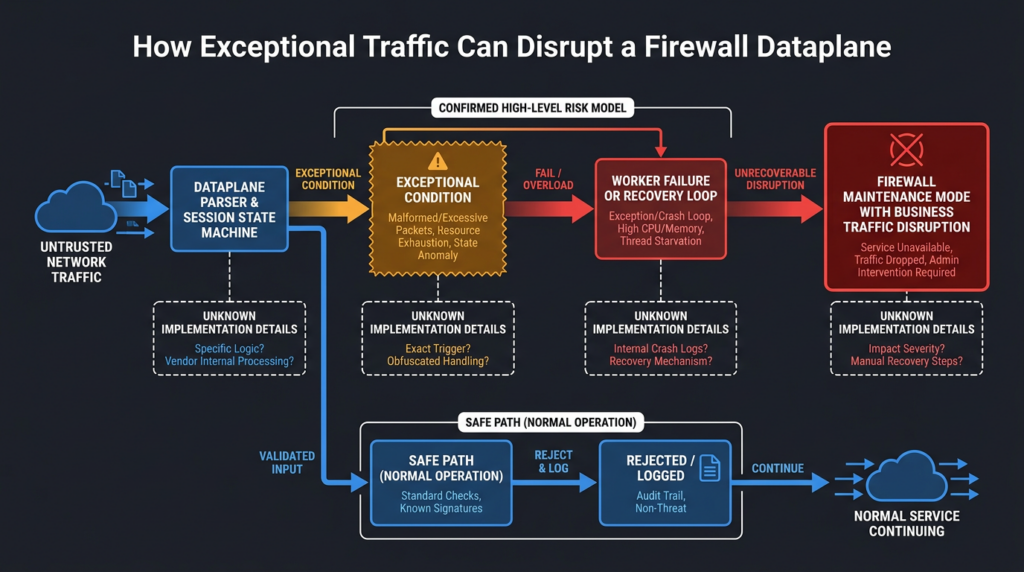
That is a generic model, not the disclosed CVE-2026-0287 implementation.
Several engineering controls normally reduce this class of risk:
- Validate lengths before copying or indexing.
- Reject inconsistent state transitions.
- Bound memory, queue, recursion, and parser work.
- Isolate a failed worker from the rest of the forwarding system.
- Apply circuit breakers to repeated exceptional conditions.
- Log enough context for diagnosis without logging attacker-controlled data unsafely.
- Fail closed or fail safely according to the device’s security role.
- Test malformed and boundary-case input during development.
- Verify that watchdog recovery cannot be forced into an endless loop.
The difficult part for a firewall is that it must apply these controls at high throughput while processing complex, stateful, and sometimes deeply inspected traffic. An input that is harmless to an endpoint application may still reach a network-device parser responsible for classification, state tracking, or forwarding.
Why the Two CVSS Scores Differ
Palo Alto Networks lists CVE-2026-0287 as CVSS-BT 6.6 and CVSS-B 8.7. These scores are not contradictory.
In CVSS v4:
- CVSS-B represents Base metrics.
- CVSS-BT combines Base and Threat metrics.
- Base metrics describe intrinsic vulnerability characteristics.
- Threat metrics account for the current state of exploit technique or code availability.
FIRST explains that Threat metrics can adjust severity based on factors such as available proof-of-concept code or active exploitation. It also recommends enriching Base data with threat and environmental information for organization-specific risk assessment. (PREMIER)
For CVE-2026-0287, the vendor reports exploit maturity as unreported and says it is unaware of malicious exploitation. The threat-adjusted score is therefore lower than the Base score. That does not mean exploitation is impossible. It means public threat evidence was limited at the time of assessment.
A security team should separately evaluate environmental impact:
- Does the firewall protect the only internet connection?
- Are emergency services dependent on the path?
- Can administrators reach the device out of band?
- Is recovery automatic or manual?
- Are both HA peers running an affected release?
- Can traffic be diverted to another inspected path?
- Would failover overload the remaining capacity?
- Is the firewall in a remote site without local support?
- Does maintenance mode require physical intervention?
- Are cloud regions and availability zones genuinely independent?
A numerical score cannot answer those questions.
Cloud NGFW Is Affected, but Exposure Is Not Identical
Palo Alto Networks lists Cloud NGFW deployments on AWS and Azure as affected and does not list an unaffected Cloud NGFW version in the public product-status table. At the same time, the company states that Cloud NGFW and Prisma Access include built-in resilience intended to mitigate disruptive network traffic and preserve service availability. Customers are scheduled to receive upgrades during maintenance cycles and may contact support to request an earlier on-demand upgrade window. (security.paloaltonetworks.com)
Both parts must remain visible:
- The service is affected.
- The managed architecture has resilience controls.
- Those controls do not change affected code into fixed code.
- The vendor controls or coordinates the relevant upgrade.
Cloud NGFW for AWS
Palo Alto Networks documents an AWS design that integrates with Gateway Load Balancer and uses service-managed security-processing capacity. The architecture includes health checking, replacement of unhealthy resources, zone-aware deployment, and dynamic scaling based on operational load. The documented design uses separate scaling constructs per Availability Zone so that an Availability Zone failure can be contained while other zones continue serving traffic. (Palo Alto Networks TechDocs)
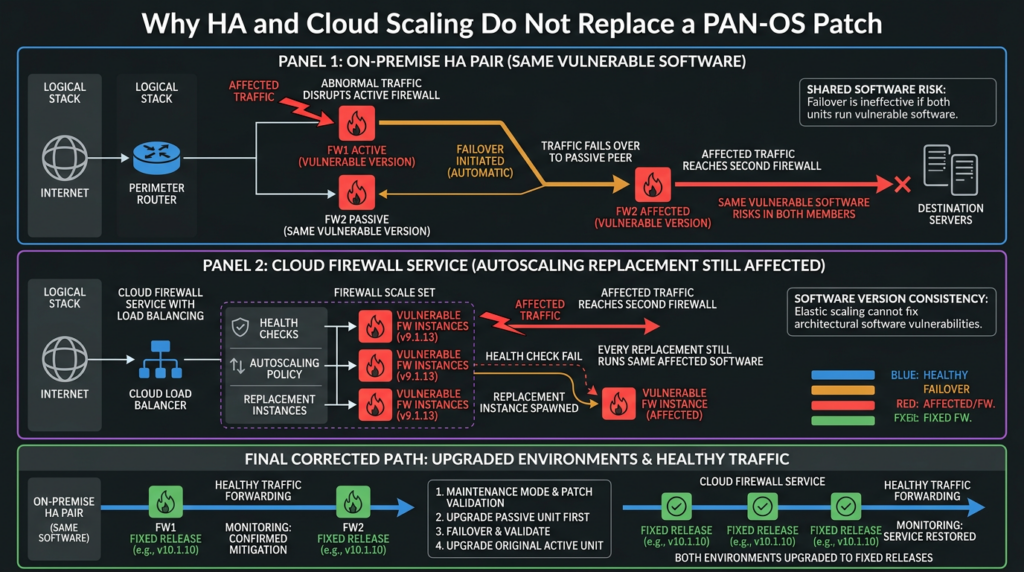
That architecture can reduce the effect of a single worker or instance failure. It does not prove that crafted traffic cannot cause repeated failures across instances running the same vulnerable software.
A shared-code vulnerability creates a different failure model from random hardware loss:
Random instance failure
    -> health check fails
    -> affected instance replaced
    -> healthy code resumes service

Shared software vulnerability
    -> trigger reaches instance A
    -> health check fails
    -> instance A is replaced
    -> replacement runs same affected release
    -> trigger may reach replacement or another instance
The second sequence is an inference from ordinary shared-software behavior, not a claim that CVE-2026-0287 has been observed producing this exact cycle in Cloud NGFW. It illustrates why health replacement is a resilience layer rather than a security patch.
AWS customers should verify:
- The current Cloud NGFW maintenance status
- Whether an on-demand upgrade is appropriate
- Deployment across multiple Availability Zones
- Gateway Load Balancer endpoint health
- Capacity and quota headroom
- Route-table dependencies
- Whether a single regional deployment is a business-critical dependency
- Cross-region recovery procedures
- Cloud monitoring and Palo Alto Networks support contacts
Cloud NGFW for Azure
Palo Alto Networks describes its Azure service as using managed load-balancing and virtual-machine scale-set components, with multiple security-processing instances, health checks, and automatic replacement. The documentation also distinguishes Availability Zone continuity from cross-region continuity, which requires deployment in more than one region. (Palo Alto Networks TechDocs)
The same reasoning applies: multiple instances reduce dependence on one instance, but identical instances can share the same software defect. Regional redundancy also cannot be assumed merely because a service is cloud-hosted.
Azure customers should identify:
- Which virtual networks and routes depend on Cloud NGFW
- Whether workloads span Availability Zones
- Whether the firewall service spans or protects multiple regions
- How route convergence behaves during service degradation
- Whether normal traffic can be redirected without bypassing required controls
- Which alerts identify health replacement or reduced capacity
- When the vendor-managed fixed release will be applied
A dangerous response would be to create an uninspected bypass that remains after the incident. A resilient design should provide an approved alternate security path, not an improvised route around inspection.
Prisma Access Has a Different Attack Precondition
Prisma Access 11.2 releases below 11.2.7-h18 and Prisma Access 10.2 releases below 10.2.10-h39 are listed as affected.
Palo Alto Networks assigns Prisma Access a lower CVSS-BT score of 4.6 and a Base score of 6.9 for this issue. The company explains that exploitation risk is lower because an authenticated user is required and external network access to the dataplane interface is restricted. (security.paloaltonetworks.com)
This changes the attack model in meaningful ways:
- Anonymous internet traffic is not treated as having the same reachability.
- An attacker may need a valid user position.
- Compromised credentials or an already compromised endpoint can matter.
- Insider-originated traffic remains relevant.
- The managed service still requires a fixed software level.
- Customers depend on the vendor’s scheduled or on-demand upgrade process.
“Requires authentication” should not be translated into “not exploitable.” It means the precondition is stronger. Organizations with large remote-access populations, third-party access, unmanaged endpoints, or elevated credential-compromise risk may assign greater priority than the generic score suggests.
Panorama Is Not Affected, but It Still Matters
Panorama is not affected by CVE-2026-0287 because the vulnerability concerns PAN-OS dataplane traffic processing rather than Panorama’s management function.
Panorama can nevertheless support the response by helping teams:
- Identify managed devices and software versions
- Compare versions across device groups
- Coordinate software deployment
- Track configuration state
- Centralize relevant logs
- Confirm whether remote sites have completed remediation
- Reduce inconsistent manual changes
The operational distinction is:
Panorama exposure to CVE-2026-0287: No

Panorama-managed firewall exposure: Determined by each firewall's
product, PAN-OS release, and traffic path
A vulnerability-management rule that suppresses the entire Palo Alto Networks environment because “Panorama is unaffected” would be incorrect.
A Safe Exposure Review
Because no public packet recipe or vendor-supported reproduction procedure is available, the safest validation method does not attempt to trigger the flaw. It proves exposure through product and version evidence.
Step One — Identify Every PAN-OS Enforcement Point
Include more than physical perimeter appliances:
- PA-Series firewalls
- VM-Series firewalls
- CN-Series deployments
- Branch appliances
- Data-center segmentation firewalls
- Cloud transit firewalls
- Internet ingress and egress firewalls
- Partner-network boundaries
- Remote-access enforcement points
- Cloud NGFW subscriptions
- Prisma Access tenants
- Lab or disaster-recovery appliances capable of becoming active
Do not exclude passive HA peers. A passive peer may become the active production device during remediation or failure.
Step Two — Preserve the Exact Version
Record the complete release string:
12.1.7-h1
11.2.10-h12
11.1.13-h8
10.2.18-h7
The hotfix suffix is security-significant. In the examples above, some versions are below the corrected levels even though their base version appears current.
A normalized asset record should use separate fields:
{
  "vendor": "Palo Alto Networks",
  "product": "PAN-OS",
  "major_minor": "11.2",
  "maintenance_release": "11.2.10",
  "hotfix": "h12",
  "full_version": "11.2.10-h12",
  "ha_role": "active",
  "management": "Panorama",
  "critical_paths": [
    "internet-egress",
    "customer-api-ingress"
  ]
}
The example is an inventory format, not output taken from a specific Palo Alto Networks API.
Step Three — Map Traffic Reachability
For every affected device, document:
- Interfaces receiving untrusted traffic
- Interfaces forwarding internet-originated traffic
- Inbound NAT paths
- Outbound user paths
- Partner and branch paths
- Tunnel termination
- East-west segmentation
- Cloud route-table dependencies
- Critical services behind the firewall
- Sources that can generate traffic through the device
The purpose is not to guess the exploit protocol. It is to determine whether untrusted or semi-trusted traffic reaches the affected dataplane at all.
Step Four — Measure Consequence
Classify the failure consequence separately from technical exposure:
| Consequence tier | Exemple |
|---|---|
| Critique | Only firewall path for revenue-generating or safety-relevant services |
| Haut | Major internet, remote-access, branch, or cloud connectivity loss |
| Moyen | Redundant path exists and has verified capacity, but failover is disruptive |
| Faible | Isolated lab appliance with no production dependency |
A technically exposed lab device and a technically exposed national e-commerce gateway share a CVE state but not the same business priority.
Step Five — Review Recovery
Answer concrete questions:
- Can operators reach the device out of band?
- Is there a tested configuration backup?
- Can the team recognize maintenance mode remotely?
- Is HA failover monitored?
- Does the passive peer have adequate capacity?
- Are both peers affected?
- Can normal routing be restored without disabling security controls?
- Is vendor support available during the change?
- Is local hands-on support required?
- Has recovery been exercised recently?
Evidence-driven security-testing workflows can help collect authorized version, configuration, HA, and retest records. A platform such as Penligent may be used to organize those artifacts within a broader validation process, but automation does not make a production denial-of-service trigger safe. For this vulnerability, the defensible validation target is the software and resilience state, not a guessed exploit packet.
Safe PAN-OS Evidence Collection
The following read-only commands can support inventory and health assessment. Exact availability and output vary by appliance, release, operational mode, and administrative role, so teams should confirm syntax against their own PAN-OS documentation.
Confirm the Running Software
show system info
Capture at least:
- Hostname
- Modèle
- Serial number
- Software version
- Operational mode
- HA state where shown
Do not rely on an asset database if the device itself reports a different release.
Check HA State
show high-availability state
Révision :
- Active or passive role
- Peer connectivity
- Configuration synchronization
- Running synchronization
- HA link health
- Last state change
For a change window, capture this output before and after upgrading each peer.
Review HA Transitions
show high-availability transitions
Unexpected transitions near a network outage may indicate that the active peer failed or a monitored condition triggered failover. A transition alone does not identify CVE-2026-0287. Link failures, path-monitor failures, administrative actions, upgrades, power events, and unrelated software defects can produce similar evidence.
Inspect Dataplane Resource Behavior
show running resource-monitor
Depending on release and options, this family of commands can expose dataplane CPU, session, packet-buffer, and descriptor behavior over time. Palo Alto Networks documents resource-monitoring output as a way to review dataplane utilization and pressure. (Palo Alto Networks Knowledge Base)
An example collection pattern is:
show running resource-monitor second last 60
Use the output comparatively:
- Compare with the same hour on normal days.
- Correlate with traffic volume.
- Compare active and passive devices where meaningful.
- Correlate with application and network monitoring.
- Preserve timestamps and time zones.
A high dataplane CPU value is not a CVE-specific indicator. It may result from legitimate load, decryption, threat inspection, traffic bursts, route changes, or capacity constraints.
Review Packet Buffer Protection State
show session packet-buffer-protection
Packet Buffer Protection can expose signs of buffer pressure and, where configured, identify sessions contributing to congestion. Palo Alto Networks documents this command for reviewing packet-buffer protection and congestion state. (Palo Alto Networks Knowledge Base)
It should not be represented as a workaround for CVE-2026-0287. The vendor says no known workaround exists. Packet-buffer controls may help with observability or certain resource-exhaustion conditions, but the public advisory does not say that they prevent the exceptional condition behind this vulnerability.
Confirm Upgrade Readiness
show system disk-space
request system software info preferred
The first command helps identify insufficient storage before downloading or installing software. The second can provide preferred-release information where supported. Palo Alto Networks’ upgrade guidance also emphasizes registration, licensing, content prerequisites, and platform-specific upgrade paths. (Palo Alto Networks TechDocs)
Do not treat a preferred release as automatically fixed unless it meets the CVE’s minimum corrected level.
Detection Is Correlation, Not a Magic Signature
Palo Alto Networks has not published a CVE-specific packet signature, log string, or packet-capture pattern in the public advisory. Detection should therefore combine three evidence groups:
- Traffic behavior
- Firewall health
- Business-path failure
None is decisive alone.
Traffic Evidence
Potentially useful observations include:
- A sudden concentration of traffic toward one interface or service path
- Repeated traffic from one source or a related source set before each failure
- An unusual increase in malformed, fragmented, incomplete, or short-lived sessions
- A protocol distribution that differs sharply from the baseline
- Similar traffic bursts preceding multiple restarts or HA transitions
- Repeated cloud health-replacement events correlated with the same source pattern
These are generic investigation leads. They are not confirmed CVE-2026-0287 indicators.
A traffic anomaly may also represent:
- Volumetric DDoS
- A broken application
- A routing loop
- A vulnerability scanner
- A misconfigured health checker
- A new software deployment
- Packet loss or asymmetric routing
- Normal seasonal demand
- Another network-device vulnerability
Firewall Health Evidence
Investigators should look for temporal correlation among:
- Dataplane CPU pressure
- Packet-buffer congestion
- Session-table anomalies
- Descriptor pressure
- Worker or process restarts
- Unexpected device reboot
- HA transition
- Loss of forwarding
- Entry into maintenance mode
- Recovery followed by another similar failure
The strongest case is not “CPU was high.” It is a repeated sequence such as:
Unusual traffic begins
    -> dataplane health degrades
    -> forwarding fails
    -> HA changes or device restarts
    -> service recovers
    -> similar traffic returns
    -> failure repeats
Even that sequence establishes suspicion, not definitive attribution. Vendor support may be required to analyze technical-support files and determine whether the fault matches the vulnerability.
Business and Network Evidence
External monitoring can often identify the incident sooner than device logs.
Useful signals include:
- Several unrelated applications failing simultaneously
- A sudden drop in outbound session establishment
- Inbound health checks failing across multiple services
- BGP or tunnel adjacency changes
- Remote users losing access at the same time
- DNS, authentication, and application failures sharing a network path
- Cloud load balancers reporting unhealthy backends
- A loss of NAT translations or session continuity
- A failover event followed by restored connectivity
These symptoms help localize the fault to a shared network path.
Detection and False-Positive Matrix
| Signal | Pourquoi c'est important | Common alternative explanations | Required corroboration |
|---|---|---|---|
| Dataplane CPU spike | May precede processing failure | Legitimate traffic, decryption load, threat inspection | Traffic baseline, process health, business impact |
| Packet-buffer pressure | Shows forwarding-resource congestion | Microburst, undersized platform, DDoS | Session sources, interface rate, repeated failure |
| HA transition | May show active-peer failure | Link monitor, path monitor, upgrade, power loss | Transition reason, peer health, timestamps |
| Device reboot | Consistent with severe availability failure | Admin action, hardware fault, unrelated bug | System logs, support analysis, traffic correlation |
| Maintenance mode | Matches the stated repeated-trigger consequence | Failed upgrade, disk issue, boot failure, another defect | Recovery-tool data, support case, preceding events |
| Repeated source pattern | May indicate intentional triggering | Broken client or monitoring system | Packet metadata, timing, recurrence |
| Multiple application outages | Suggests shared path failure | Upstream carrier, DNS, cloud-region outage | Interface, routing, firewall, and provider telemetry |
| Cloud instance replacement | Indicates health-check failure | Routine maintenance or unrelated fault | Service events, vendor support, correlated traffic |
Incident Triage Without Triggering the Vulnerability
When an affected firewall becomes unstable, the first goal is to preserve evidence and service, not prove exploitation by repeating the suspected input.
Preserve the Timeline
Record:
- First observed business impact
- First monitoring alert
- HA transition time
- Reboot time
- Maintenance-mode entry
- Recovery time
- Recurrence
- Software version at the time
- Recent upgrades or content changes
- Known traffic anomalies
- Cloud-provider or carrier events
- Operator actions
Use one time zone in the incident record and retain original source timestamps.
Protect Management Access
If management is still reachable:
- Avoid unnecessary configuration changes.
- Preserve current state.
- Confirm out-of-band access.
- Restrict management access to trusted sources.
- Avoid rebooting solely to “see whether it happens again.”
- Open a Palo Alto Networks support case.
- Prepare a controlled upgrade.
If management is not reachable, follow the organization’s approved recovery and vendor-support procedures. Do not improvise a maintenance-mode reset without understanding its effect on configuration and software state.
Palo Alto Networks provides a Maintenance Recovery Tool for supported recovery and diagnostic operations, including gathering system information and handling certain software-recovery conditions. Recovery actions can be disruptive and should be performed under an approved runbook or vendor guidance. (Palo Alto Networks TechDocs)
Do Not Replay Suspected Traffic
A packet capture taken immediately before an outage can be valuable, but replaying it through an affected firewall may reproduce the denial of service. That is especially dangerous when:
- The packet’s role is uncertain.
- The target is an HA pair sharing the same version.
- The backup device serves production traffic.
- The recovery procedure is not tested.
- No out-of-band path exists.
- A cloud provider controls the service.
- The packet may contain sensitive customer data.
Analysis can instead focus on metadata, protocol conformance, source recurrence, session behavior, and comparison with ordinary traffic. Any active reproduction belongs in a vendor-approved isolated environment with explicit authorization and a recovery plan.
A Safe Toy PoC for Exceptional-Condition Failure
The following demonstration does pas reproduce CVE-2026-0287. It does not implement PAN-OS, generate network traffic, open a socket, encode a firewall protocol, or test a real device. It runs entirely in local memory.
Its purpose is to show how inadequate handling of exceptional input can turn a rejected object into repeated worker failures and an eventual simulated maintenance state.
from __future__ import annotations

from dataclasses import dataclass
from enum import Enum
from typing import Any


class DataplaneState(str, Enum):
    RUNNING = "running"
    DEGRADED = "degraded"
    MAINTENANCE = "maintenance"


@dataclass
class SyntheticFrame:
    """
    A toy in-memory object.

    This is not a real Ethernet, IP, TCP, UDP, tunnel, or PAN-OS frame.
    """
    declared_items: Any
    items: Any


class ToyDataplane:
    def __init__(self, maintenance_threshold: int = 3) -> None:
        self.failures = 0
        self.maintenance_threshold = maintenance_threshold
        self.state = DataplaneState.RUNNING

    def _record_failure(self) -> None:
        self.failures += 1

        if self.failures >= self.maintenance_threshold:
            self.state = DataplaneState.MAINTENANCE
        else:
            self.state = DataplaneState.DEGRADED

    def process_vulnerable(self, frame: SyntheticFrame) -> str:
        """
        Deliberately unsafe toy logic.

        It trusts the declared count, assumes items is a list,
        and indexes the object without validation.
        """
        try:
            selected = [
                frame.items[index]
                for index in range(frame.declared_items)
            ]
            self.state = DataplaneState.RUNNING
            return f"accepted {len(selected)} synthetic items"

        except (TypeError, IndexError):
            self._record_failure()
            return (
                f"worker failure {self.failures}; "
                f"state={self.state.value}"
            )

    def process_hardened(self, frame: SyntheticFrame) -> str:
        """
        Safer toy logic.

        Exceptional input is rejected before indexing or allocation.
        """
        if not isinstance(frame.declared_items, int):
            return "rejected: declared_items must be an integer"

        if not isinstance(frame.items, list):
            return "rejected: items must be a list"

        if frame.declared_items < 0:
            return "rejected: negative count"

        if frame.declared_items > 32:
            return "rejected: count exceeds local safety limit"

        if frame.declared_items != len(frame.items):
            return "rejected: declared count does not match actual count"

        self.state = DataplaneState.RUNNING
        return f"accepted {len(frame.items)} synthetic items"


def run_demo() -> None:
    malformed = SyntheticFrame(
        declared_items=4,
        items=["alpha"],
    )

    vulnerable = ToyDataplane(maintenance_threshold=3)

    print("Vulnerable toy processor")
    for attempt in range(1, 4):
        result = vulnerable.process_vulnerable(malformed)
        print(f"attempt {attempt}: {result}")

    hardened = ToyDataplane(maintenance_threshold=3)

    print("\nHardened toy processor")
    for attempt in range(1, 4):
        result = hardened.process_hardened(malformed)
        print(f"attempt {attempt}: {result}")


if __name__ == "__main__":
    run_demo()
Run it locally:
python3 toy_dataplane_demo.py
Expected output:
Vulnerable toy processor
attempt 1: worker failure 1; state=degraded
attempt 2: worker failure 2; state=degraded
attempt 3: worker failure 3; state=maintenance

Hardened toy processor
attempt 1: rejected: declared count does not match actual count
attempt 2: rejected: declared count does not match actual count
attempt 3: rejected: declared count does not match actual count
The security lesson is narrow but useful.
The vulnerable toy processor accepts an untrusted count and uses it before checking whether the underlying collection matches. Each exceptional condition reaches an error path that is treated as a worker failure. Repetition eventually changes the simulated system state.
The hardened processor rejects the inconsistency at the boundary. The invalid object does not consume repeated recovery operations and does not alter the service state.
Real network devices are much more complex, and Palo Alto Networks has not stated that CVE-2026-0287 involves this particular programming error. The demonstration is only a safe model of the CWE-754 concept.
It should never be converted into a packet generator or used as evidence that a PAN-OS device is vulnerable. Version comparison against the official advisory is the correct exposure test.
Patching Strategy
The absence of a workaround means patch planning should begin as soon as an affected device is identified.
A practical priority order is:
- Internet-facing or internet-transit PAN-OS firewalls without verified redundancy
- Firewalls protecting critical inbound services
- Internet egress and remote-access paths
- HA pairs in which both peers run an affected release
- Cloud transit and segmentation firewalls supporting many workloads
- Branch firewalls without out-of-band access
- Internal segmentation appliances receiving semi-trusted traffic
- Non-production devices that could be promoted during disaster recovery
This is an environmental priority model, not vendor severity replacement.
Before the Change Window
Collect and verify:
- Current software version
- Appliance support status
- Preferred and target releases
- Configuration backup
- Device-state backup where applicable
- Panorama connectivity
- HA state and synchronization
- HA1 and HA2 health
- Link and path monitoring
- Session synchronization
- Content-release prerequisites
- Available disk space
- License state
- Power reliability
- Out-of-band access
- Upgrade image integrity
- Rollback procedure
- Named vendor-support contact
- Application validation plan
For remote sites, explicitly decide who can access the appliance if it fails to return to service.
Upgrade One HA Peer at a Time
Palo Alto Networks’ HA upgrade guidance generally follows a staged process: upgrade the passive peer, allow it to reboot and synchronize, fail traffic to the upgraded peer, and then upgrade the remaining peer. The exact workflow depends on HA mode, platform, PAN-OS release, Panorama orchestration, and organizational change controls. (Palo Alto Networks TechDocs)
Before failover, verify:
- The upgraded peer is healthy.
- Configuration state is synchronized.
- Required content is present.
- HA links are healthy.
- The peer is ready to forward.
- The remaining capacity is sufficient.
- Preemption behavior is understood.
- Monitoring is active.
Do not upgrade both peers simultaneously unless the design and approved procedure explicitly require it.
Validate More Than the Version
After the upgrade, confirm:
show system info
show high-availability state
show high-availability transitions
show running resource-monitor
show session packet-buffer-protection
Then perform known-good business tests:
- Outbound DNS and HTTPS
- Representative inbound service
- NAT
- Site-to-site VPN
- Remote access where applicable
- Critical SaaS access
- Authentication dependencies
- Log forwarding
- Threat-intelligence and content updates
- Surveillance et alerte
- Panorama management
- Routing-neighbor stability
A successful login to the firewall is not sufficient post-change evidence.
Build a Remediation Evidence Package
The final record should contain:
- Asset identity
- Previous version
- Target fixed version
- Vendor-advisory snapshot or reference
- Upgrade start and completion time
- Change ticket
- Operator
- HA state before and after
- Configuration synchronization evidence
- Application-test results
- Monitoring screenshots or logs
- Exceptions and remaining assets
- Rollback decision
- Vendor case number where used
This package helps security, network, audit, and business teams agree that the vulnerability was not merely marked closed but actually remediated and operationally validated.
High Availability Is Not a Patch
PAN-OS supports stateful HA designs that can synchronize configuration and, depending on mode and settings, session information. Failover can be triggered by monitored interface failure, path-monitor failure, heartbeat loss, or critical packet-path and software-component conditions. (Palo Alto Networks TechDocs)
Those mechanisms are valuable, but an HA pair usually runs closely aligned software. If both peers run an affected PAN-OS release, they share the vulnerability.
A plausible shared-fault sequence is:
Affected active peer receives triggering traffic
    -> active peer fails or becomes unhealthy
    -> HA moves forwarding to passive peer
    -> same traffic path now reaches the second affected peer
    -> second peer encounters the same software condition
This is a risk model, not a confirmed CVE-2026-0287 exploitation trace. It explains why redundancy against random failure is weaker against deterministic shared-software faults.
Review Link and Path Monitoring
Link monitoring can detect failure of selected interfaces. Path monitoring can test reachability to important destinations. The failure condition may be configured around one or multiple monitored elements, depending on the required behavior. (Palo Alto Networks TechDocs)
For this incident, verify that monitoring reflects business forwarding, not only local interface state. A physical interface can remain up while a software forwarding path is unhealthy.
Potential monitored destinations include:
- Upstream router
- Downstream core
- Critical internal service
- External test endpoint
- Cloud transit gateway
- Tunnel peer
Monitoring too many unstable destinations can cause false failovers. Monitoring too little can leave a failed dataplane active.
Review Preemption and Failback
Automatic preemption may return traffic to a preferred peer after recovery. During an unresolved shared-software failure, rapid failback can create oscillation.
Change planning should establish:
- Whether preemption is enabled
- How long the recovery timer is
- Whether the formerly failed peer has been upgraded
- Whether the triggering condition could still be present
- Which peer should remain active during remediation
Do Not Assume Fail-Open Behavior
Certain Palo Alto Networks platforms support hardware bypass or fail-to-wire capabilities for particular failure conditions and interface types. Vendor documentation notes that bypass relays are not used for every software event and specifically distinguishes conditions such as soft reboots, crashes, and maintenance mode. (Palo Alto Networks TechDocs)
Therefore:
- Do not assume traffic will automatically bypass an appliance in maintenance mode.
- Do not assume bypass preserves security inspection.
- Do not assume virtual firewalls have an equivalent hardware path.
- Test platform-specific behavior under controlled conditions.
- Document whether the desired security posture is fail-open or fail-closed.
A resilience design that exists only in a diagram is not a reliable recovery control.
A Firewall Resilience Review
CVE-2026-0287 should prompt more than a patch ticket. It provides a concrete reason to test whether the organization can survive a security-control failure.
Control Plane and Management Resilience
Révision :
- Out-of-band management
- Dedicated management routing
- Restricted administrator sources
- Break-glass credentials
- MFA dependencies
- Console access
- Configuration backups
- Panorama availability
- Vendor-support access
- Time synchronization
- Central log retention
An out-of-band path should not depend on the dataplane being recovered.
Forwarding Resilience
Révision :
- HA peer capacity
- Session synchronization
- Route convergence
- NAT consistency
- Tunnel state
- Upstream and downstream redundancy
- Load-balancer health behavior
- Cloud route-table failover
- Alternative inspected paths
- DNS dependencies
- Critical application testing
A backup firewall that cannot support peak traffic is not full redundancy.
Software Diversity
Running different PAN-OS versions within an HA pair can introduce compatibility and support constraints, so software diversity cannot be applied casually. However, the broader architecture can avoid concentrating every path on one software implementation or one failure domain.
Voici quelques exemples :
- Independent regional security stacks
- Separate recovery environments
- Diverse upstream controls
- Cloud-native controls that limit exposure before traffic reaches the firewall
- Application-layer rate limiting
- DDoS mitigation outside the affected device
- Multiple connectivity providers
These controls do not remediate CVE-2026-0287, but they can reduce the consequence of a firewall outage.
Recovery Objectives
Define explicit targets:
| Métrique | Question |
|---|---|
| Recovery time objective | How long can this network path be unavailable? |
| Recovery point objective | Which session or state loss is acceptable? |
| Detection objective | How quickly must forwarding failure be recognized? |
| Failover objective | How quickly must traffic move to a healthy path? |
| Capacity objective | What percentage of peak load must the alternate path carry? |
| Security objective | Which controls must remain active during recovery? |
| Evidence objective | What proves that service and policy enforcement were restored? |
Many organizations define application recovery objectives but never assign them to firewalls, DNS, load balancers, identity providers, or routing infrastructure. The result is an application that is technically recoverable but unreachable.
Cloud Resilience Questions That Matter
Cloud services can conceal infrastructure complexity, but the customer still owns architecture and business-continuity decisions.
Availability Zone Independence
Ask:
- Are security-processing resources deployed across multiple zones?
- Does each zone have enough capacity?
- Do route tables remain zone-local where required?
- Can one zone’s failure overload another?
- Are health checks based on meaningful forwarding health?
- Does the application also span zones?
A multi-zone firewall does not protect a single-zone application, and a multi-zone application does not help if all traffic passes through one failing security path.
Regional Independence
Palo Alto Networks’ Cloud NGFW documentation distinguishes zone resilience from regional resilience. Cross-region continuity requires deliberate deployment and routing across regions. (Palo Alto Networks TechDocs)
Révision :
- Secondary-region firewall availability
- Configuration consistency
- Route propagation
- Data and application readiness
- DNS failover
- Certificate and identity dependencies
- Logging continuity
- Cost and quota limits
- Recovery authorization
Health Replacement
Health replacement is useful for random instance faults. For a shared software issue, teams should also ask:
- Is the replacement running a corrected release?
- Can the same traffic reach every replacement?
- Does repeated replacement exhaust capacity or quotas?
- Is there an alert for replacement churn?
- Can support correlate churn with CVE-2026-0287?
- Can maintenance be accelerated?
Do not attempt to answer those questions by attacking the service. Use service telemetry and Palo Alto Networks support.
Scaling
Autoscaling handles increased legitimate load when the scaling metric accurately reflects demand and new instances become healthy. It may not solve a malformed-input condition that can affect each instance independently.
Scaling can even obscure the incident if dashboards show rising instance counts while users continue seeing intermittent failures. Alert on service quality and replacement behavior, not only aggregate capacity.
Response Timeline
First Four Hours
- Confirm whether the product and exact release are affected.
- Identify critical traffic paths through the device.
- Preserve system, HA, traffic, and business-monitoring timestamps.
- Determine whether the device rebooted or entered maintenance mode.
- Confirm out-of-band and vendor-support access.
- Stop unapproved packet replay or active testing.
- Check whether a fixed release is already staged.
- For Cloud NGFW or Prisma Access, contact Palo Alto Networks regarding upgrade status.
- Validate the alternate path with normal traffic.
- Notify network, security, application, and incident owners.
Within Twenty-Four Hours
- Correlate traffic anomalies with each failure.
- Rule out carrier, cloud, routing, power, capacity, and planned-change causes.
- Review HA transitions and monitoring reasons.
- Prepare the approved fixed release.
- Confirm backup and rollback readiness.
- Test critical applications before the change.
- Verify capacity on the remaining HA peer.
- Schedule high-risk assets first.
- Record exceptions for assets that cannot yet be upgraded.
- Establish compensating resilience controls without representing them as a vendor workaround.
Within Seventy-Two Hours
- Upgrade exposed and business-critical firewalls.
- Validate each corrected release directly on the device.
- Test routing, NAT, tunnels, logging, and applications.
- Confirm HA synchronization and failover readiness.
- Confirm managed-cloud upgrade completion or schedule.
- Review monitoring for unexplained recurrence.
- Preserve before-and-after evidence.
- Escalate unsupported PAN-OS branches.
Within One Week
- Complete lower-priority affected assets.
- Retire or isolate unsupported releases.
- Close inventory gaps.
- Test maintenance-mode recovery.
- Review out-of-band access.
- Update firewall recovery objectives.
- Improve HA and cloud health alerts.
- Review whether emergency routing preserves required security controls.
- Document lessons from any failure or near miss.
- Recheck the vendor advisory for updated guidance.
Erreurs courantes
Treating Medium as Low Priority
The 6.6 score reflects threat-adjusted metrics, including limited reported exploit evidence. It does not measure the business consequence of losing a central firewall.
Checking Only the Management Interface
CVE-2026-0287 concerns traffic sent to or through a dataplane interface. A restricted management interface does not remove the data-path exposure.
Ignoring Hotfix Suffixes
11.2.10 et 11.2.10-h12 are not interchangeable. The latter meets the listed corrected level for the relevant 11.2 maintenance branch; the former does not.
Assuming HA Solves the Problem
Two affected peers provide redundancy against some random failures, not against every shared software condition.
Treating Cloud Resilience as a Fix
Autoscaling, health checks, and instance replacement can maintain service, but the vendor still lists Cloud NGFW as affected and provides an upgrade path.
Creating a Production PoC
No public vendor-supported payload is required to prove exposure. Sending malformed traffic through a production firewall risks an outage and may affect both HA peers.
Inventing Indicators
A reboot, high dataplane CPU, or packet-buffer pressure is not unique to CVE-2026-0287. Attribution requires correlation and, where necessary, vendor analysis.
Calling Packet Buffer Protection a Workaround
Palo Alto Networks states that no known workaround exists. Packet Buffer Protection may provide useful controls and telemetry, but it is not identified as remediation for this CVE.
Forgetting Disaster-Recovery Devices
A powered-off or passive appliance can become production-critical during another incident. Its vulnerability state still matters.
Closing the Ticket at Installation
A fixed version does not prove routing, HA, sessions, tunnels, NAT, inspection, logging, and applications are healthy. Post-upgrade validation is part of remediation.
Related PAN-OS Vulnerabilities
CVE-2026-0287 belongs to a broader pattern of network-edge risk, but nearby PAN-OS CVEs differ substantially in configuration, authentication, impact, and exploitation status.
| CVE | Affected path | Attacker precondition | Confirmed impact | Important distinction |
|---|---|---|---|---|
| CVE-2026-0287 | General network traffic processing | Network access to or through a dataplane interface | DoS, repeated triggers may cause maintenance mode | No special configuration required |
| CVE-2026-0227 | GlobalProtect gateway or portal | Unauthenticated network access | Firewall DoS and possible maintenance mode | Requires enabled GlobalProtect gateway or portal; public PoC maturity reported |
| CVE-2026-0269 | Tunnel traffic processing | Authenticated user and affected tunnel configuration | Reboots and possible maintenance mode | Requires IPSec tunnel or GlobalProtect gateway; Cloud NGFW and Prisma Access unaffected |
| CVE-2024-3393 | DNS Security processing | Unauthenticated crafted traffic through dataplane | Firewall reboot and maintenance mode | Feature-specific and reported as attacked |
| CVE-2026-0257 | GlobalProtect authentication | Unauthenticated access plus specific cookie and certificate conditions | Unauthorized VPN connection | Authentication bypass, not DoS |
| CVE-2024-3400 | GlobalProtect | Unauthenticated network access with affected configuration | Root command execution | Critical compromise rather than availability-only impact |
CVE-2026-0227
CVE-2026-0227 is a PAN-OS denial-of-service vulnerability involving GlobalProtect gateways and portals. Palo Alto Networks says an unauthenticated attacker can cause firewall denial of service and that repeated triggering may move the appliance into maintenance mode.
Unlike CVE-2026-0287, exposure requires an enabled GlobalProtect gateway or portal. The vendor also labels exploit maturity as PoC and marks the issue as automatable. Those factors can justify a different threat-priority decision even though both vulnerabilities affect availability. (security.paloaltonetworks.com)
The defensive response is to identify GlobalProtect-enabled devices, compare exact versions with the advisory, upgrade, and avoid active testing against production gateways.
CVE-2026-0269
CVE-2026-0269 is a memory-corruption vulnerability in PAN-OS tunnel traffic processing. Palo Alto Networks says an authenticated user can send a maliciously crafted packet that initiates system reboots, with repeated attempts potentially causing maintenance mode.
The exposure requires IPSec tunnels or GlobalProtect gateways, and the attacker requires low privileges. Panorama, Cloud NGFW, and Prisma Access are not affected. The vendor was not aware of malicious exploitation when the advisory was published. (security.paloaltonetworks.com)
This comparison shows why “crafted packet DoS” is not a sufficient vulnerability description. Authentication, required features, product coverage, and recovery behavior determine the real attack surface.
CVE-2024-3393
CVE-2024-3393 affected the DNS Security feature. Palo Alto Networks describes an unauthenticated attacker sending a malicious packet through the dataplane, causing the firewall to reboot; repeated attempts could place it in maintenance mode.
The vendor later marked exploit maturity as Attacked. The issue applied only to particular PAN-OS releases and DNS Security conditions rather than every ordinary dataplane configuration. (security.paloaltonetworks.com)
For defenders, the case demonstrates why a network-device DoS can move from theoretical risk to operational threat and why a lack of exploitation evidence for a newer CVE should not be treated as permanent.
CVE-2026-0257
CVE-2026-0257 concerns authentication-bypass vulnerabilities in GlobalProtect portals and gateways. Under specific authentication-override cookie and certificate conditions, an attacker may bypass restrictions and establish an unauthorized VPN connection. Palo Alto Networks marks the issue as attacked. (security.paloaltonetworks.com)
The security objective is different from CVE-2026-0287:
- CVE-2026-0287 threatens availability.
- CVE-2026-0257 threatens access control.
- One may interrupt the firewall.
- The other may create unauthorized network access.
- Both require exact version and exposure analysis.
A related technical review is available in Penligent’s CVE-2026-0257 analysis. It should supplement, not replace, the Palo Alto Networks advisory when determining affected configurations and fixed releases.
CVE-2024-3400
CVE-2024-3400 was a critical GlobalProtect vulnerability in which arbitrary file creation could lead to unauthenticated OS command injection and root code execution on affected PAN-OS firewalls with specific versions and configurations. Palo Alto Networks confirmed exploitation in the wild. (security.paloaltonetworks.com)
Its risk is qualitatively different:
- It can compromise confidentiality, integrity, and availability.
- It can provide root execution.
- It was actively exploited.
- Incident response may require compromise assessment, not only upgrading.
CVE-2026-0287 should not be exaggerated into this category. At the same time, the comparison reinforces why network-edge software must be inventoried and patched precisely: the same appliance class can contain availability bugs, authentication failures, and full system-compromise vulnerabilities.
Frequently Asked Questions
What Is CVE-2026-0287?
- It is a set of denial-of-service vulnerabilities in PAN-OS network traffic processing.
- Specially crafted traffic sent to or through a dataplane interface may disrupt an affected firewall.
- Repeated triggering can cause the firewall to enter maintenance mode.
- The confirmed impact is availability loss, not code execution or data theft.
- Palo Alto Networks published the advisory on July 8, 2026. (security.paloaltonetworks.com)
Can CVE-2026-0287 Be Exploited Without Authentication?
- Yes, for the general affected PAN-OS case, the vendor lists no privileges required.
- The attacker still needs a network path to send traffic to or through a dataplane interface.
- A publicly reachable management interface is not required.
- Prisma Access has a different precondition because the vendor says an authenticated user is required and external dataplane-interface access is restricted. (security.paloaltonetworks.com)
Is Cloud NGFW Vulnerable?
- Palo Alto Networks lists Cloud NGFW on AWS and Azure as affected.
- The service includes built-in resilience intended to reduce disruption and maintain availability.
- Built-in resilience does not change the vulnerable software status.
- Palo Alto Networks plans customer upgrades during scheduled maintenance cycles.
- Customers can contact support to request an on-demand upgrade window. (security.paloaltonetworks.com)
Is Prisma Access Affected?
- Prisma Access 11.2 below 11.2.7-h18 is affected.
- Prisma Access 10.2 below 10.2.10-h39 is affected.
- Palo Alto Networks describes lower exploitation risk because authentication is required and external access to the dataplane interface is restricted.
- Customers should confirm the managed upgrade schedule or request an earlier upgrade.
- Restricted exposure is not equivalent to remediation. (security.paloaltonetworks.com)
How Can I Safely Determine Whether My Firewall Is Exposed?
- Identify the exact product and complete PAN-OS version, including the hotfix suffix.
- Compare that version with the official Palo Alto Networks advisory.
- Determine whether untrusted or semi-trusted traffic reaches or traverses its dataplane.
- Record HA role, critical applications, alternate paths, and recovery readiness.
- Do not send guessed malformed traffic to a production firewall.
- For managed services, confirm upgrade status with Palo Alto Networks.
Is High Availability an Effective Workaround?
- No. Palo Alto Networks states that no known workaround exists.
- HA can reduce downtime when one peer fails.
- Both peers commonly run the same affected software and may share the vulnerability.
- Link monitoring, path monitoring, session synchronization, and out-of-band access still improve resilience.
- Both peers must ultimately reach a fixed release. (security.paloaltonetworks.com)
Are There Reliable Indicators of CVE-2026-0287 Exploitation?
- No public CVE-specific payload signature or unique log indicator is identified in the vendor advisory.
- Possible symptoms include dataplane degradation, reboot, HA transition, forwarding loss, or maintenance mode.
- Those symptoms have many alternative causes.
- Investigators should correlate traffic, system health, HA events, and business impact.
- Palo Alto Networks support may be needed for definitive fault analysis.
What Should Be Patched First?
- Unpatched firewalls carrying internet traffic
- Single points of failure
- Critical ingress and egress paths
- Remote-access and cloud transit enforcement points
- HA pairs in which both peers are affected
- Devices without reliable out-of-band recovery
- Unsupported PAN-OS releases
- Managed Cloud NGFW and Prisma Access instances whose upgrade schedule has not been confirmed
Business dependency, recovery difficulty, and traffic reachability should refine the priority beyond the generic CVSS score.
Patch the Shared Fault, Then Prove Recovery
CVE-2026-0287 is not a confirmed firewall takeover, and the available evidence does not justify describing it as one. It is an availability vulnerability in a component whose availability often determines whether the rest of the environment can communicate.
The immediate work is precise: inventory every enforcement point, preserve complete hotfix versions, identify traffic paths, upgrade to the branch-specific fixed release, and coordinate managed-service updates. Production firewalls should not be used as exploit laboratories, especially when no public vendor-supported reproduction method exists.
The broader work is resilience. Confirm that HA detects forwarding failure, that a passive peer can carry real load, that cloud deployments span meaningful failure domains, that administrators retain out-of-band access, and that recovery does not require abandoning security controls.
A fixed version closes the known software condition. Tested failover, observable dataplane health, verified business traffic, and retained remediation evidence show that the firewall service is ready to withstand the next failure.

 French
  English
  German
  Spanish
  Portuguese
  Japanese
  Korean
  Hindi
Hindi  Arabic
  Turkish
  Hebrew