
CVE-2026-20349 is a high-severity vulnerability affecting the Remote Access SSL VPN functionality of Cisco Secure Firewall Adaptive Security Appliance, or ASA, and Cisco Secure Firewall Threat Defense, or FTD. The vulnerability deserves unusually high operational priority because it sits on an Internet-facing security boundary, requires no authentication to exploit, has been observed in active attacks, and can force an affected firewall to reload.
Cisco published its security advisory for CVE-2026-20349 on August 11, 2026. The company assigned the vulnerability a CVSS 3.1 base score of 8.6, with the vector AV:N/AC:L/PR:N/UI:N/S:C/C:N/I:N/A:H. Cisco states that an unauthenticated remote attacker can send a crafted HTTP request to the Remote Access SSL VPN service and cause the affected device to reload unexpectedly, resulting in a denial-of-service condition. Cisco attributes the vulnerability to insufficient error checking while HTTP requests are processed. (Cisco)
The vulnerability is especially important because this is no longer merely a theoretical weakness. Cisco PSIRT says it became aware of active exploitation in August 2026, and CISA subsequently added CVE-2026-20349 to its Known Exploited Vulnerabilities catalog. (Cisco)
For defenders running Cisco ASA or FTD as a remote-access gateway, the practical conclusion is straightforward: determine whether the affected SSL-facing functionality is enabled, identify the precise software release, and deploy Cisco’s fixed software or hot fix as quickly as operationally possible.
CVE-2026-20349 at a Glance
| Objet | Détails |
|---|---|
| CVE | CVE-2026-20349 |
| Vendor | Cisco |
| Products | Cisco Secure Firewall ASA Software and Secure Firewall FTD Software |
| Primary attack surface | Remote Access SSL VPN service |
| Classe de vulnérabilité | Remote denial of service |
| Authentication required | Non |
| User interaction | Non |
| Vecteur d'attaque | Réseau |
| CVSS 3.1 | 8.6 |
| Impact primaire | Availability |
| Active exploitation | Confirmed by Cisco |
| CISA KEV | Oui |
| Workaround | No official workaround |
| Fixer | Cisco software updates and hot fixes |
| FMC affected | Non |
Cisco’s advisory identifies CVE-2026-20349 as CWE-244 and explicitly describes the underlying problem as insufficient error checking during HTTP request processing. (Cisco)
That distinction matters. CVE-2026-20349 should pas be described as an SSL VPN authentication bypass, credential theft vulnerability, privilege escalation, or remote code execution flaw unless new evidence emerges. The security consequence documented by Cisco is an unexpected device reload and resulting denial of service.
Why CVE-2026-20349 Matters
At first glance, an availability-only vulnerability may appear less dangerous than a remote code execution vulnerability. That interpretation is misleading when the affected component is an enterprise VPN gateway or perimeter firewall.
A Cisco ASA or FTD appliance may sit directly between remote employees, administrators, contractors, applications, and an organization’s internal network. When that device becomes unavailable, the affected organization can lose far more than an individual application.
Potential consequences can include interrupted remote-access sessions, failed new VPN connections, disruption to application access paths, loss of connectivity through a security gateway, and operational instability while the appliance reloads.
Cisco’s CVSS vector reflects this asymmetry. CVE-2026-20349 requires no privileges, requires no user interaction, has low attack complexity, is remotely reachable over the network, and has high availability impact. (Cisco)
For an Internet-facing VPN concentrator, those characteristics are particularly problematic.
An attacker does not first need to compromise an employee account.
They do not need to defeat MFA.
They do not need a valid VPN session.
They do not need a browser exploit.
Instead, the vulnerable service itself may be reached before authentication.
That shifts the defensive problem from identity protection to edge-service resilience.
CVE-2026-20349 Attack Path
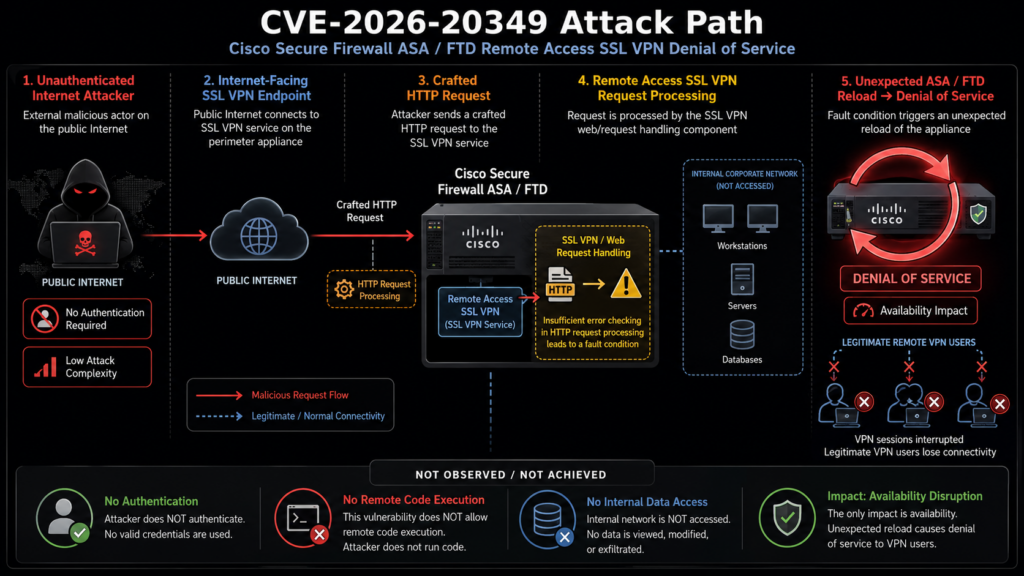
Cisco’s published description provides a relatively concise attack chain:
Internet attacker → exposed Remote Access SSL VPN service → crafted HTTP request → vulnerable request-processing path → unexpected firewall reload → denial of service
Cisco says the vulnerability exists because of insufficient error checking while the affected service processes HTTP requests. A specially crafted request can reach the vulnerable condition and cause the appliance to reload. (Cisco)
Importantly, Cisco does not require the attacker to authenticate before reaching this code path.
Conceptually, the vulnerable flow can be represented as:
External network
      |
      v
Cisco ASA / FTD public interface
      |
      v
SSL-enabled Remote Access service
      |
      v
HTTP request parser / processing path
      |
      v
Malformed or unexpected request state
      |
      v
Insufficient error handling
      |
      v
Unexpected device reload
      |
      v
VPN / gateway availability loss
This is also why authentication controls alone do not mitigate CVE-2026-20349. MFA may protect a VPN account from credential abuse, but it does not necessarily prevent unauthenticated traffic from reaching the HTTPS service responsible for beginning the VPN interaction.
Which Cisco Secure Firewall Configurations Are Exposed?
Cisco does not state that every ASA or FTD deployment is automatically vulnerable merely because it runs one of the relevant software trains.
The appliance must both run vulnerable software et have a configuration that enables the affected SSL listening functionality.
Cisco identifies three potentially vulnerable feature configurations. (Cisco)
SSL VPN
On ASA, one important configuration indicator is:
webvpn
 enable <interface_name>
If WebVPN/SSL VPN is enabled on an Internet-facing interface and the software release is vulnerable, administrators should investigate the device immediately.
IKEv2 Remote Access VPN with Client Services
Cisco also identifies IKEv2 Remote Access VPN when client services are enabled:
crypto ikev2 enable <interface_name> client-services port <port_numbers>
The important detail is the client-services component because it can enable an SSL listening socket associated with remote-access functionality. (Cisco)
Zero Trust Network Access
FTD deployments can additionally expose the affected functionality through Zero Trust Network Access:
zero-trust
 enable
Cisco notes that this feature applies only to Secure FTD Software. (Cisco)
FTD administrators may manage Remote Access VPN functionality through Secure Firewall Management Center or Firewall Device Manager rather than relying exclusively on direct CLI configuration. Cisco specifically notes that FTD remote-access features can be enabled through the Remote Access VPN interfaces in FMC or FDM. (Cisco)
Cisco FMC Is Not Vulnerable
This is another important scoping distinction.
Cisco has confirmed that Cisco Secure Firewall Management Center Software itself is not affected by CVE-2026-20349. (Cisco)
FMC may be used to configure affected FTD appliances, but that does not mean the management platform contains the vulnerable SSL VPN implementation.
Security teams should therefore separate two questions:
- Is FMC itself vulnerable?
- Are FTD appliances managed through FMC exposing a vulnerable Remote Access VPN configuration?
For CVE-2026-20349, Cisco’s answer to the first question is no. The second must be evaluated appliance by appliance.
Why SSL VPN Appliances Are Attractive DoS Targets
Remote-access VPN infrastructure occupies an unusually sensitive position in enterprise architecture.
In many organizations, VPN gateways are deliberately reachable from the public Internet because that is their purpose. Restricting all unauthenticated Internet traffic to the service may therefore be incompatible with normal operation.
That produces a security boundary with three attractive characteristics for attackers:
High exposure, high dependency, and limited upstream authentication.
An application server can sometimes be placed behind a VPN.
The VPN gateway itself cannot be placed behind the same VPN without defeating its purpose.
This architecture makes remotely triggerable flaws in pre-authentication network services particularly valuable for denial-of-service activity.
CVE-2026-20349 demonstrates this issue clearly: the attacker does not need to defeat the protected boundary because the vulnerable component is part of the boundary itself.
Why CVSS 8.6 Understates the Operational Urgency
The CVSS score is useful, but defenders should not use the number in isolation.
Cisco assigns CVE-2026-20349 a base score of 8.6. Its vector indicates network reachability, low complexity, no privileges required, no user interaction, and high availability impact. (Cisco)
What CVSS does not fully communicate is the business role of the affected appliance.
Consider two vulnerabilities with identical technical availability impact.
One crashes an optional internal monitoring application.
The other crashes the gateway through which thousands of remote employees connect to production systems.
Their CVSS characteristics may look similar while their operational consequences differ dramatically.
For CVE-2026-20349, three environmental factors should push remediation priority upward:
The service is commonly edge-facing.
Exploitation is unauthenticated.
Active exploitation has already been confirmed.
The last factor is decisive. Cisco states that PSIRT became aware of active exploitation during August 2026. (Cisco)
CISA also added the vulnerability to its Known Exploited Vulnerabilities catalog on August 11, reinforcing that defenders should treat it as an observed threat rather than a hypothetical vulnerability. (CISA US-CERT)
Is CVE-2026-20349 a Zero-Day?
Security publications have described CVE-2026-20349 as a Cisco firewall zero-day because exploitation was observed in the wild around the time public fixes and disclosure became available. BleepingComputer and SecurityWeek both reported the active exploitation and Cisco’s release of fixes. (BleepingComputer)
For technical documentation, however, the more precise wording is:
CVE-2026-20349 was actively exploited before or around public disclosure, and Cisco released remediation when it published the advisory.
Cisco itself states only that PSIRT became aware of active exploitation in August 2026. The advisory does not publicly attribute the attacks to a specific threat actor or campaign. (Cisco)
That narrower formulation avoids turning an observed exploitation fact into unsupported claims about who discovered or weaponized the vulnerability first.
What Do We Know About Active Exploitation?
As of August 12, 2026, Cisco has publicly confirmed exploitation but has disclosed relatively little about the attacks.
Cisco states:
- PSIRT became aware of active exploitation in August 2026.
- Customers should upgrade to fixed software.
- The issue was independently identified during Cisco internal security testing and was also reported by security researcher Valerio Brussani. (Cisco)
Cisco’s initial advisory does not identify a threat actor, victim sector, geographical targeting pattern, or broader intrusion campaign.
BleepingComputer similarly reported that Cisco had not provided public information about who was exploiting CVE-2026-20349 or what organizations were being targeted, and noted that the advisory did not publish indicators of compromise for the observed activity. (BleepingComputer)
That lack of attribution should not reduce remediation urgency.
From a defender’s perspective, confirmed exploitation plus public vulnerability details usually means the window for treating the vulnerability as obscure has already closed.
CVE-2026-20349 Is Not an RCE
This distinction is essential for accurate threat communication.
There is currently no Cisco-published evidence showing that CVE-2026-20349 provides:
- arbitrary code execution;
- persistent administrative access;
- VPN credential theft;
- firewall configuration modification;
- authentication bypass;
- privilege escalation;
- direct confidentiality compromise.
Cisco’s CVSS vector explicitly records confidentiality and integrity impact as Aucun, while availability is Haut. (Cisco)
The documented successful exploitation result is a device reload and DoS.
This does not make the vulnerability harmless.
It simply changes the attacker’s objective.
An adversary seeking persistence might prefer RCE. An adversary seeking disruption does not necessarily need it.
Could Attackers Repeatedly Crash a Vulnerable Device?
Cisco confirms that a crafted request can cause an affected device to reload, but its initial advisory does not publish enough technical exploit details to responsibly claim a specific repeatability rate, request sequence, or timing behavior. (Cisco)
It is nevertheless prudent to evaluate CVE-2026-20349 as a potential availability threat rather than assuming one reload represents the entire impact.
A security appliance that returns to the same vulnerable configuration after restarting may remain exposed until remediation is applied.
Whether an individual deployment can be repeatedly destabilized depends on factors including appliance state, attack traffic, topology, software release, high-availability configuration, and operational controls.
Organizations should validate resilience in a controlled environment rather than intentionally sending known crash-triggering traffic against production firewalls.
Safe Exposure Assessment
Because the vulnerability can result in a device reload, security teams should avoid using destructive proof-of-concept testing against production appliances simply to confirm exposure.
A safer validation workflow begins with configuration and version analysis.
Step 1: Identify the ASA or FTD Release
Record the exact software version for every externally reachable Secure Firewall device.
For ASA, administrators can inspect software and platform information using standard operational commands such as:
show version
The resulting release should then be compared with Cisco’s advisory or Cisco Software Checker. Cisco explicitly recommends its Software Checker for identifying whether particular ASA and FTD releases are affected and for determining the earliest fixed release. (Cisco)
Step 2: Determine Whether the Vulnerable Functionality Is Enabled
Review configuration for the Cisco-listed features.
Par exemple :
show running-config
Then look for relevant configuration constructs such as:
webvpn
 enable outside
or:
crypto ikev2 enable outside client-services port 443
FTD administrators should additionally inspect Remote Access VPN configuration through FMC or FDM where applicable. (Cisco)
The goal is not to trigger the flaw.
The goal is to answer three questions:
Is the device running an affected software release?

Is an affected SSL-enabled feature configured?

Is that listener reachable from an untrusted network?
If all three conditions are true, treat the device as requiring urgent remediation.
Internet Exposure Matters
Configuration analysis should be paired with an external exposure check.
A firewall can contain the relevant configuration without necessarily being reachable from every network.
Teams should determine:
Public IP / hostname
        |
        v
Internet routing
        |
        v
Upstream ACL / filtering
        |
        v
ASA / FTD interface
        |
        v
SSL VPN listener
An external assessment should confirm whether the expected HTTPS/VPN endpoint is reachable without attempting malformed requests.
For example, simply validating service availability and certificate presentation is considerably safer than attempting to reproduce a request known or suspected to cause a crash.
This approach distinguishes exposure validation de exploit validation.
For CVE-2026-20349, the former is usually enough to drive an emergency patch decision.
Cisco ASA Fixes for CVE-2026-20349
Cisco has released hot fixes across several ASA release families. The advisory currently lists the following mappings. (Cisco)
| ASA Release | Cisco Hot Fix |
|---|---|
| 9.16 | 89.16.4.50 |
| 9.18 | 89.18.4.50 |
| 9.20 | 9.20.4.235 |
| 9.22 | 9.22.3.191 |
| 9.23 | 9.23.1.211 |
| 9.24 | 9.24.1.221 |
There is an additional operational detail for organizations using ASA 9.16 or 9.18.
Cisco states that hot fixes beginning with 89 exiger ASDM Release 7.24.1.374, because previous ASDM versions do not recognize that ASA software numbering format. (Cisco)
That detail should be included in change planning rather than discovered during an emergency maintenance window.
Cisco FTD Fixes for CVE-2026-20349
Cisco has also issued hot fixes for multiple FTD trains, including:
| FTD Release Family | Fixed Hot-Fix Build Family |
|---|---|
| 7.0 | 7.0.9.1-1 |
| 7.2 | 7.2.11.1-2 |
| 7.4 | 7.4.7.1-1 |
| 7.6 | 7.6.4.1-2 |
| 7.7 | 7.7.11.1-2 |
| 10.0 | 10.0.0.1-2 |
The precise hot-fix file varies by hardware platform, including FP1K, FP2K, FP3K, Secure Firewall 1200, 4200, 6100, and other supported images. Administrators should therefore use the exact package Cisco provides for their appliance rather than selecting a package only from the release-family number. (Cisco)
Cisco additionally recommends using the appropriate FTD upgrade documentation and Software Checker when determining remediation paths. (Cisco)
There Is No Cisco Workaround
One of the most important sentences in the advisory is also one of the shortest:
Cisco lists no workaround that addresses CVE-2026-20349. (Cisco)
That changes incident-management strategy.
With some VPN vulnerabilities, administrators can temporarily disable a component, change authentication methods, remove a web interface, or apply an ACL while waiting for a maintenance window.
Cisco does not present such a workaround here as a substitute for remediation.
Organizations may still reduce exposure through architecture changes where operationally appropriate—for example, disabling functionality that is genuinely unnecessary—but such changes should not be presented as equivalent to Cisco’s fix.
The authoritative remediation remains upgrading or installing Cisco’s fixed software.
Detection Challenges
CVE-2026-20349 is fundamentally an availability vulnerability, so detection should focus on both malicious inbound activity and the resulting system behavior.
Possible investigation areas include:
Unexpected appliance reloads. A firewall reboot that has no corresponding maintenance ticket deserves investigation.
Repeated inbound requests to the VPN endpoint. Security teams should look for abnormal request patterns against remote-access interfaces.
Concentrated requests from individual external addresses. High-frequency or structurally abnormal HTTP requests may warrant review.
VPN session disruption. A sudden simultaneous loss of remote-access sessions can provide operational evidence even when application-layer logs are incomplete.
Repeated availability cycles. If an appliance returns and then unexpectedly reloads again, responders should consider active external triggering among the hypotheses.
These are defensive investigation heuristics, not confirmed indicators of compromise. Cisco’s initial public advisory does not publish attack-specific IoCs. BleepingComputer also noted the absence of public IoCs associated with the exploitation observed at disclosure time. (BleepingComputer)
Cisco does, however, link Snort Rules 46897 and 59654 from the CVE-2026-20349 advisory, giving organizations using relevant Cisco/Snort detection tooling additional material to evaluate. (Cisco)
Availability Monitoring Should Be Part of Detection
Traditional vulnerability monitoring often concentrates on indicators such as malware execution, new accounts, outbound command-and-control connections, or privilege escalation.
Those signals may not exist in a pure DoS exploitation scenario.
A better monitoring model for CVE-2026-20349 includes infrastructure state:
VPN endpoint responsiveness
        +
Firewall uptime
        +
HA state transitions
        +
Unexpected reload records
        +
Remote access session failures
        +
Inbound request telemetry
This is especially important because the security device itself is the victim.
When a firewall crashes, some logs related to the final request sequence may be incomplete or unavailable locally. Centralized logging and out-of-band monitoring therefore become valuable for reconstructing what happened immediately before the event.
High Availability Is Not a Substitute for Patching
Organizations running ASA or FTD high-availability architectures may assume redundancy eliminates the risk.
It does not.
HA can reduce business impact from an individual device failure, but it does not remediate the vulnerable request-processing path.
If multiple members of an HA pair or cluster run the same vulnerable software and expose equivalent services, the underlying vulnerability remains present.
A sound response should therefore answer:
Are both nodes vulnerable?

Does failover expose the same SSL VPN service?

Can an attacker reach the standby/failover service after transition?

Are both appliances receiving the fixed software?

Has failover behavior been tested after remediation?
Redundancy improves resilience.
Patching removes the vulnerability.
They solve different problems.
Patch Validation After Remediation
After applying a Cisco fix, validation should confirm more than whether the appliance restarted successfully.
A structured verification process should check:
Software state
Confirm that the expected fixed version or hot fix is actually installed.
Configuration preservation
Ensure that Remote Access VPN, authentication, certificates, routing, NAT, policies, and client-service configuration survived the upgrade correctly.
External reachability
Verify that legitimate VPN users can reach the expected endpoint.
Authentification
Test normal authentication and MFA flows.
VPN session establishment
Ensure supported clients can create stable tunnels.
High availability
Where relevant, verify node status and controlled failover.
Logging and monitoring
Confirm that events are still reaching central monitoring systems.
Vulnerability status
Re-run a non-destructive version/configuration-based check to confirm that the device no longer matches the vulnerable state.
This last distinction matters.
For denial-of-service vulnerabilities, a penetration test that proves remediation by trying to crash the production firewall is usually unnecessary and introduces avoidable operational risk.
Do Not Confuse Version Scanning With Complete Validation
A scanner might report that a device presents a version associated with a vulnerable release.
That evidence is useful but incomplete.
Conversely, a device may have an unusual hot-fix numbering scheme that causes simplistic scanners to produce misleading results.
CVE-2026-20349 provides a good example because Cisco’s ASA 9.16 and 9.18 hot fixes use the 89.x naming pattern. Cisco explicitly warns that older ASDM releases do not recognize this numbering format. (Cisco)
A robust validation process therefore combines:
Asset identity
+
Exact software build
+
Installed hot fixes
+
Feature configuration
+
Interface exposure
+
External reachability
This is more reliable than asking only whether TCP/443 is open.
A Practical CVE-2026-20349 Remediation Workflow
For large environments, security and network teams can approach CVE-2026-20349 as a short exposure-management workflow.
First, inventory all Cisco Secure Firewall ASA and FTD appliances.
Next, record exact releases and hot-fix states.
Then identify appliances with SSL VPN, IKEv2 client services, or FTD ZTNA enabled.
Determine which of those listeners are externally reachable.
Prioritize Internet-facing production gateways.
Compare each device against Cisco’s current fixed-software guidance.
Schedule emergency remediation for exposed vulnerable appliances.
After upgrade, validate VPN functionality, HA, logging, routing, and authentication.
Finally, confirm externally that only expected services remain exposed.
Conceptually:
Inventory
   |
   v
Version identification
   |
   v
Feature configuration
   |
   v
External exposure
   |
   v
CVE-2026-20349 match?
   |
   +---- No ----> Document evidence
   |
  Yes
   |
   v
Apply Cisco fix
   |
   v
Functional validation
   |
   v
External validation
   |
   v
Continuous monitoring
Prioritizing CVE-2026-20349 in a Large Vulnerability Queue
Large organizations may have thousands of vulnerabilities with CVSS scores above 8.
CVE-2026-20349 should not simply become entry number 4,127 in that queue.
A useful prioritization model considers:
Exploitation status: confirmed.
Accessibilité : potentially Internet-facing.
Authentication requirement: none.
Attack complexity: low.
Business role: security boundary and remote-access gateway.
Workaround: none documented by Cisco.
Patch availability: yes.
Those factors together produce a much stronger remediation signal than CVSS alone. Cisco confirms active exploitation and no workaround, while CISA has added the vulnerability to KEV. (Cisco)
For vulnerable public-facing appliances, remediation should therefore be treated as urgent.
Safe Penetration Testing for CVE-2026-20349
Organizations may still want independent security validation, particularly when asset inventories are unreliable or multiple VPN appliances exist across subsidiaries and cloud environments.
The safest methodology is black-box exposure discovery combined with authenticated configuration/version verification where authorized.
A security assessment can identify:
Internet-visible Cisco VPN endpoints

TLS certificates and endpoint identities

Public interfaces accepting Remote Access VPN connections

Associated asset ownership

Software/version evidence where safely available

Internal configuration evidence

Installed hot-fix state

Remediation consistency across HA pairs
What the assessment should generally pas do against production systems is send an untrusted request designed specifically to reproduce the device reload.
For CVE-2026-20349, causing the vulnerable behavior is itself causing an availability impact.
That makes the boundary between vulnerability validation and operational disruption unusually clear.
A production assessment can establish vulnerable exposure with strong evidence without deliberately crashing the gateway.
What Security Teams Should Do Now
As of August 12, 2026, CVE-2026-20349 has all of the characteristics that justify accelerated remediation: Cisco has published patches, there is no documented workaround, exploitation requires no credentials, vulnerable functionality may be exposed directly to the Internet, active exploitation has been confirmed, and CISA has placed the flaw in KEV. (Cisco)
Network and security teams should therefore begin with their public-facing remote-access infrastructure rather than waiting for ordinary monthly vulnerability-management cycles.
The highest-priority devices are ASA or FTD appliances that:
- expose SSL VPN or related Remote Access functionality to untrusted networks;
- run software affected by Cisco’s advisory;
- have not received the relevant Cisco hot fix;
- provide critical employee or administrator remote access;
- lack resilient failover architecture.
Even where redundancy exists, both active and standby devices should be reviewed and patched.
Frequently Asked Questions
What is CVE-2026-20349?
CVE-2026-20349 is a high-severity Cisco Secure Firewall vulnerability affecting Remote Access SSL VPN functionality in ASA and FTD Software. An unauthenticated remote attacker can send a crafted HTTP request that causes an affected device to reload and creates a denial-of-service condition. (Cisco)
What is the CVSS score for CVE-2026-20349?
Cisco assigns CVE-2026-20349 a CVSS 3.1 base score of 8.6 with the vector:
CVSS:3.1/AV:N/AC:L/PR:N/UI:N/S:C/C:N/I:N/A:H
This indicates network exploitation, low complexity, no required privileges, no user interaction, and high availability impact. (Cisco)
Is CVE-2026-20349 being actively exploited?
Yes. Cisco states that its PSIRT became aware of active exploitation in August 2026. CISA also added the vulnerability to its Known Exploited Vulnerabilities Catalog. (Cisco)
Does CVE-2026-20349 require authentication?
No. Cisco describes the attacker as unauthenticated and remote. (Cisco)
Is CVE-2026-20349 remote code execution?
No RCE capability is documented in Cisco’s advisory. The documented result of successful exploitation is an unexpected device reload leading to denial of service. Cisco’s CVSS vector identifies no confidentiality or integrity impact. (Cisco)
Does CVE-2026-20349 affect Cisco ASA?
Yes. Cisco Secure Firewall ASA Software is affected when a vulnerable software release is used with an affected configuration. (Cisco)
Does CVE-2026-20349 affect Cisco FTD?
Yes. Cisco Secure Firewall Threat Defense Software is also affected under the configurations described by Cisco. (Cisco)
Is Cisco FMC affected?
No. Cisco has confirmed that Secure Firewall Management Center Software is not affected by CVE-2026-20349. (Cisco)
Which VPN configurations may be vulnerable?
Cisco identifies SSL VPN, IKEv2 Remote Access VPN with client services, and FTD Zero Trust Network Access among configurations that may enable the affected SSL listening sockets. (Cisco)
Is there a workaround?
Cisco states that there are no workarounds that address the vulnerability. Organizations should deploy fixed software. (Cisco)
Final Assessment
CVE-2026-20349 is a useful reminder that the severity of a firewall vulnerability cannot be measured solely by whether it enables code execution.
Here, the attacker does not need to steal credentials, establish a VPN tunnel, bypass MFA, or gain administrator privileges. The vulnerable component is part of the Internet-facing remote-access boundary itself.
A crafted HTTP request reaching a vulnerable Cisco Secure Firewall Remote Access SSL VPN service can cause the affected appliance to reload and deny service to legitimate users. Cisco rates the vulnerability at CVSS 8.6, confirms active exploitation, provides patches across affected ASA and FTD release families, and states that no workaround addresses the issue. (Cisco)
CISA’s decision to add CVE-2026-20349 to the Known Exploited Vulnerabilities Catalog strengthens the remediation signal further. (CISA US-CERT)
For defenders, the correct response is therefore not to wait for detailed exploit code.
Identify affected Cisco Secure Firewall devices, determine whether Remote Access SSL VPN or related SSL-listening features are exposed, map exact software versions and hot fixes, patch vulnerable appliances, test business continuity, and verify externally that the resulting security posture matches expectations.
For an Internet-facing VPN gateway, availability is part of the security boundary. CVE-2026-20349 shows why a remote DoS against that boundary can warrant the same emergency operational attention normally reserved for far more dramatic vulnerability classes.

 French
  English
  German
  Spanish
  Portuguese
  Japanese
  Korean
  Hindi
Hindi  Arabic
  Turkish
  Hebrew