

Izen Bypass usually refers to Zen Bypass at izen.lol, a service that describes itself as resolving supported advertising links and key-system links. Its official homepage names providers including Linkvertise, Work.ink, Lootlabs, and Admaven. It is a link-processing service; that description provides no basis for treating the name as an AI hardware isolation technology or a model-weight extraction exploit.
If you are looking for the service, check the exact hostname, izen.lol, rather than a similarly spelled address or an advertisement that uses its name. If you are deciding whether to submit a link, the more important questions are what that URL contains, what the service says it processes, and whether you trust the resulting destination. Resolving a link and establishing that its contents are safe are different tasks.
What Izen Bypass does, and what remains unverified
Les Zen Bypass homepage describes a browser workflow: submit a supported link, complete the required CAPTCHA, and receive a result. It says manual single-link use does not require an API key. These are the operator’s descriptions, not results from an independent compatibility or security assessment. This review does not establish successful processing of every listed provider.
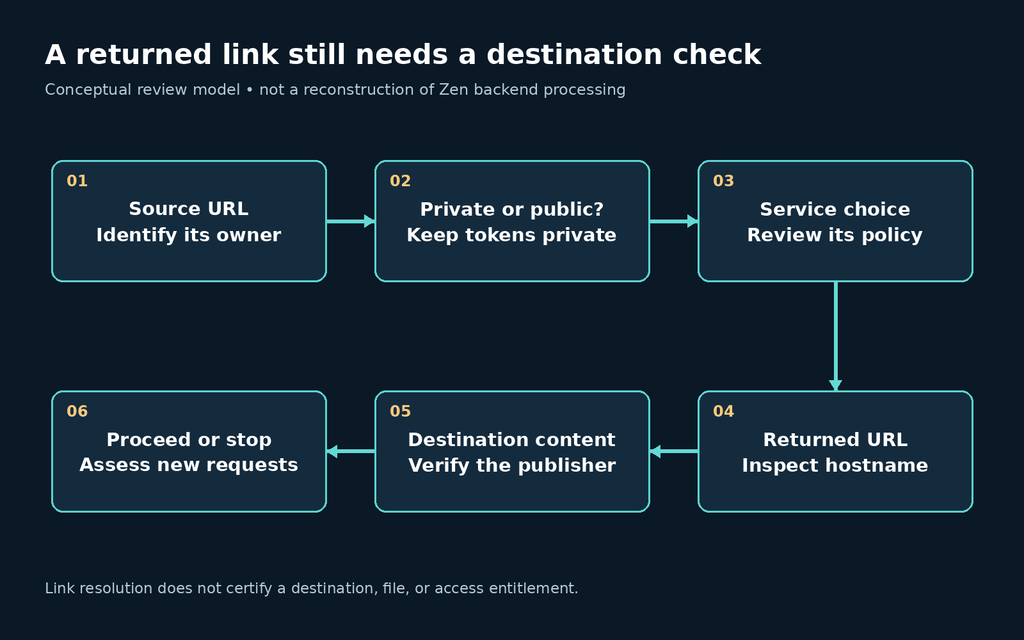
A returned URL can help identify a destination, but it is not evidence that the destination belongs to the person you intended to visit. Nor does it establish that a downloadable file is authentic, that a key is valid, or that you have permission to access the underlying content. Keep those checks separate. For your own content, obtaining a direct link from the publisher is often a simpler way to avoid unnecessary intermediaries.
| Reader question | What to check | What the result does not prove |
|---|---|---|
| Am I on the service’s site? | Compare the address-bar hostname with izen.lol | That the site’s operation has been independently audited |
| Is my link supported? | Check its actual host in the operator’s current catalog | That every URL from that provider will work |
| Did a request succeed? | Inspect the returned result and any explicit error | That the destination or downloaded content is safe |
| Is this an API key? | Identify which service issued it and which account owns it | That a destination access key and a developer credential are interchangeable |
| Is the site operational? | Consult the status page and the specific failure observed | That all providers, regions, and individual links work |
Supported services are a moving catalog
Les supported-services catalog, marked updated October 19, 2026, lists 45 services across three categories: key systems, advertising links, and paste services. Its counts differ from the homepage’s broader promotional totals. Treat the specific catalog entry and hostname as the useful compatibility evidence rather than repeating a universal number as a tested claim.
Provider names and hostnames are not the same thing. One provider may use several domains, while a similar-looking hostname may belong to someone else. Copy the hostname from the actual link you received and compare it with the catalog. Do not assume that a domain is supported because its name contains a familiar brand, or that a provider’s inclusion establishes permission to process every link it hosts.
A support listing also says nothing conclusive about a particular link’s lifetime or account requirements. If the original publisher has withdrawn the content, changed its access rules, or issued a replacement link, a resolver cannot establish that the old address remains valid. Ask for a fresh authorized link before repeatedly trying an expired one.
Is Izen Bypass safe?
There is not enough independent evidence here to give the service a blanket safe or unsafe verdict. The operator’s statements should be evaluated alongside the data you would submit and the behavior you observe. A public policy is useful evidence of what an operator says, but it is not a traffic inspection, code audit, or guarantee about every third-party destination.
Les privacy policy says submitted URLs, short-term cached results, CAPTCHA tokens, technical request information, and API usage information may be processed. It also describes third-party advertising and browser local storage for keys saved through the website. Consequently, do not interpret the homepage’s short privacy language as a promise that a submitted URL is never processed or temporarily retained.
That distinction matters most when the URL itself carries access. A password-reset link, private document share, signed download, or account invitation can contain a token. Sending the complete address to another service can disclose that token to the recipient, even if the link is later invalidated or the result is cached only briefly. The conservative choice is to keep private and account-bearing links out of public URL-processing tools.
| Link or request type | Recommended handling | Reason |
|---|---|---|
| Public link to your own published content | Review the hostname and destination before proceeding | Public availability does not establish destination authenticity |
| Password reset or sign-in link | Keep it in the issuing service’s normal flow | The address may carry temporary account access |
| Private share or signed download | Ask the owner for an approved access route | The full address may be an access-bearing secret |
| Internal application address | Use your organization’s approved tooling | An external processor may not be an approved recipient |
| Request to install software or grant notifications | Assess it separately from the original link task | Additional permissions and code create a different exposure |
Treat each page in the journey as a separate party. An advertisement, a resolver interface, and the final file host can present different claims and permissions. A page asking you to install an extension, run a terminal command, or disable browser protection has expanded the task beyond inspecting a URL. Stop and verify the need through the original publisher rather than relying on the chain’s visual appearance.
HTTPS is useful transport protection, but it cannot establish that a website’s claims are honest or its downloads are appropriate. Likewise, a familiar logo or a result marked successful is not a malware analysis. If your browser presents a security warning, do not reinterpret the resolver’s success message as a reason to bypass it.
When Izen Bypass is not working
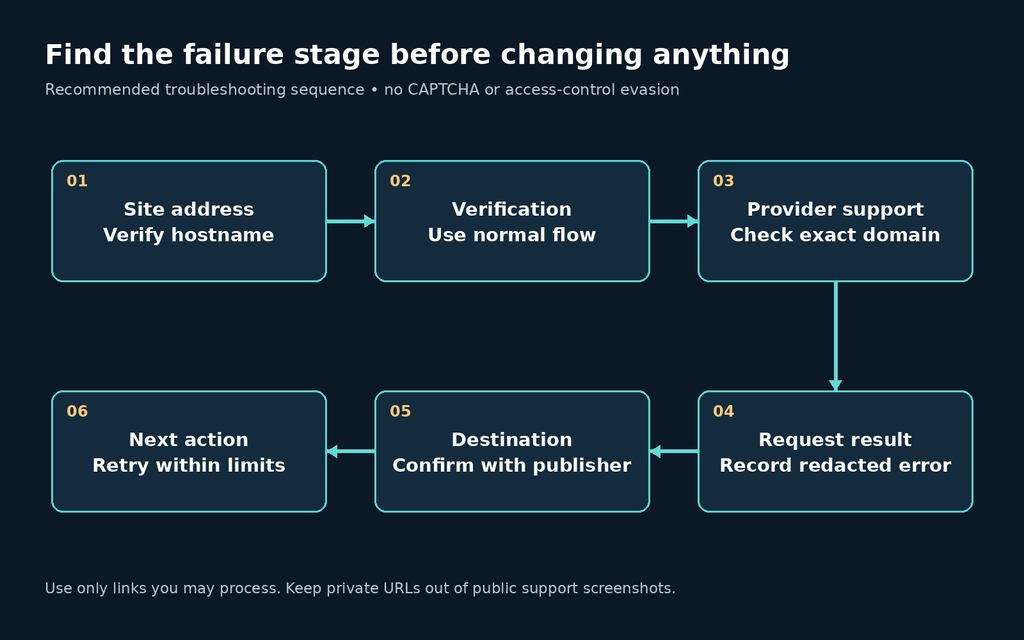
First identify where the failure occurs. A page that does not load, an incomplete verification, a rejected request, and an inaccessible final destination are different failures. Recording the stage prevents unnecessary changes to your browser and makes a support request more useful. Avoid posting the full link publicly when it could contain private data.
Les homepage’s troubleshooting answer names provider changes, expired source links, and upstream rate limits as possible causes. Those are explanations offered by the operator, not a diagnosis of your request. Its status page is another reference point, but a static page or a general operational badge cannot establish the health of the specific provider and route you need.
| Symptom | Useful first check | Avoid this shortcut |
|---|---|---|
| Homepage unavailable | Confirm the hostname and distinguish a local connectivity problem from a wider failure | Following an unsolicited replacement-domain link |
| Verification does not finish | Follow the normal browser verification flow and note the error | Using an untrusted CAPTCHA-solving script |
| Provider rejected | Compare the exact source host with the current catalog | Assuming similar spelling means the same provider |
| Repeated rate-limit response | Respect the stated limit and review legitimate access options | Rotating identities or overwhelming the endpoint |
| Result opens an error page | Ask the original publisher whether the destination or link expired | Treating link resolution as proof the content still exists |
| Unexpected download or permissions prompt | Stop and check with the publisher | Installing software merely to continue troubleshooting |
If a retry is appropriate, make it bounded. Repeatedly submitting an unchanged private URL increases exposure without clarifying why it failed. Record the time, provider name, failure stage, and a redacted error message. A useful support report might say that a listed provider returns a specific error after normal verification; it does not need to include an account token in a public screenshot.
For a link you own, compare the expected destination with the actual result using a harmless test asset. Keep account-bearing URLs and customer content out of that test. A resolver may have returned exactly what it was designed to return while the destination itself is unavailable, restricted, or no longer controlled by the original publisher.
Free website use, API access, and key handling
Les pricing page distinguishes paid developer API access from the free browser flow. At the time of this review it advertises usage-based credits and a monthly plan. Check current billing definitions rather than assuming that a homepage statement about free use applies to every access mode. No purchase or API transaction was performed for this review.
Les terms prohibit evading CAPTCHA, abusive automation of the free endpoint, and unauthorized processing of URLs. They also reserve operational limits on API use. That qualification matters when reading an unlimited-plan description: a commercial label should not be interpreted as permission to ignore abuse controls or contractual restrictions.
Keep a developer API key separate from any key or token returned for a destination. The former authorizes use of a service account; the latter may relate to a different access flow. Giving either to an unknown bot, userscript, or public debugging form changes who can act with it. Identify the issuer and revocation method before storing or sharing credentials.
MDN documents that localStorage persists across browser sessions and is scoped to the origin. The service’s policy says its saved-key interface uses that storage. On a shared device, do not treat a saved key as if it lived in a dedicated secret manager. Removing a local copy also does not revoke a copy that has already been disclosed; credential rotation must happen through the issuing service.
Redirects, destination checks, and privacy
MDN distinguishes HTTP redirects from HTML and JavaScript navigation. HTTP redirect responses use a Location header, while a page can also navigate through its content or scripts. This explains why a simple header inspection and an interactive browser can show different parts of a journey. It does not establish how Zen implements any particular provider integration.
For a destination check, separate the hostname you are contacting from a familiar name in the path or query. The URL https://publisher.test.attacker.test/ has a different hostname from publisher.test. A string search for a trusted brand would not distinguish them correctly. A parser can expose the components for review, although it cannot decide whether the owner is trustworthy.
The following Python example inspects an invented URL entirely offline. It sends no network requests, resolves no links, and bypasses no access controls. It prints the hostname and flags components that deserve review while withholding the path, query values, and fragment values from its output. Use only a synthetic example when demonstrating it to someone else.
from urllib.parse import urlsplit, parse_qsl
import ipaddress

def inspect_url(raw):
    try:
        parsed = urlsplit(raw)
        host = parsed.hostname or ""
        port = parsed.port
    except ValueError:
        return {"valid_for_review": False, "reason": "URL parse error"}
    if parsed.scheme not in {"http", "https"} or not host:
        return {"valid_for_review": False, "reason": "Expected HTTP(S) URL"}
    try:
        ipaddress.ip_address(host)
        ip_literal = True
    except ValueError:
        ip_literal = False
    return {
        "valid_for_review": True,
        "scheme": parsed.scheme,
        "hostname": host,
        "port": port,
        "userinfo_present": parsed.username is not None or parsed.password is not None,
        "query_present": bool(parsed.query),
        "query_parameter_count": len(parse_qsl(parsed.query, keep_blank_values=True)),
        "fragment_present": bool(parsed.fragment),
        "ip_literal": ip_literal,
        "punycode_label_present": any(x.startswith("xn--") for x in host.split(".")),
    }

print(inspect_url("https://files.example.test/item?token=synthetic-only#section"))
For this input, the hostname should be files.example.test, the query count should be one, and the query and fragment flags should be true. The token value should not appear in the output. This is a review aid, not a security verdict. A path can contain secrets too; the example avoids printing it but does not discover every possible secret or validate a domain’s ownership.
Even the hostname can be sensitive for internal systems. Keep output local unless you know it is appropriate to share. A syntactically valid URL can still lead to phishing, malware, unwanted advertising, or simply an unrelated page. Conversely, a query parameter, IP address, or internationalized hostname can be legitimate. These indicators tell you what to inspect, not what conclusion to force.
Userscripts and alternative bypass sites need their own review
A userscript is executable code with a permission model, not just another form of a hyperlink. Before installing one, establish who maintains it, which pages it can run on, where it can send information, and how updates are delivered. Do not assume a script is operated or approved by Zen because its name contains izen.lol. This review does not endorse a particular script or mirror.
An alternative service can also receive the full URL you submit. Trying five services with the same private link can distribute that link to five additional recipients. If the goal is access to legitimate content, ask its publisher for a direct authorized route before expanding the number of intermediaries. A smaller trust chain is easier to understand than a sequence of tools whose operators and data handling you have not checked.
For a developer building a legitimate redirect or link-processing application, test destination validation, secret handling, and error behavior on an owned staging environment. If evaluating Penligent for an authorized application assessment, use those concrete boundaries and require reproducible evidence; do not infer that an application-security tool provides an Izen-specific integration or hardware-extraction capability. Keep the testing question separate from deciding whether to use a consumer link service.
Questions readers ask
Are Izen Bypass and Zen Bypass the same name?
This page uses Izen Bypass for the common query and Zen Bypass for the branding shown at izen.lol. Verify the exact domain before using a service. A similar name, script title, or search advertisement is not proof of the same operator.
Does a successful result mean the download is safe?
No. It means the service returned a result under its own success criteria. Verify the destination and obtain software from the legitimate publisher. Do not disable browser or operating-system protections to open a file merely because a resolver returned its address.
Can I submit a password-reset or private sharing link?
Keep those links in their intended access flow. Their full addresses may carry account access or private sharing authority. If one was exposed, contact the issuing service or owner about invalidation and replacement rather than relying on deletion from a local browser history.
Why not publish a universal list of working links and scripts?
Provider support, individual destinations, and script behavior can change independently. A list without a dated test method and permission boundaries gives a false sense of reliability. The operator’s current catalog is a starting point; it is not an independent guarantee.
What happened to the hardware isolation explanation previously on this page?
The earlier version associated this search term with a hardware isolation system and a specific CVE without adequate supporting evidence. This replacement removes those unsupported claims, including the purported driver interface, firmware fix, and specialized product capabilities. The technical discussion here concerns URLs, redirects, and link-processing privacy.
Choose the shortest trustworthy route to the content you are authorized to access. Before submitting a link, understand whether its address is public information or an access-bearing secret. Before opening a result, verify the destination. Those two decisions remain necessary even when the intermediate service reports success.
 French
 English
 German
 Spanish
 Portuguese
 Japanese
 Korean
 Hindi
 Arabic
 Turkish
 Hebrew