
CVE-2026-9256 is not a generic “NGINX is vulnerable” headline. It is a specific heap-based buffer overflow in ngx_http_rewrite_module, the NGINX module that handles rewrite rules, redirects, and URI changes through PCRE regular expressions. The vulnerable condition appears when a rewrite directive uses distinct but overlapping captures, then references multiple captures in a replacement string in a redirect or arguments context. The canonical advisory example is a pattern such as ^/((.*))$ paired with a replacement that uses both $1 ו $2. Under those conditions, a crafted HTTP request can trigger a heap buffer overflow in an NGINX worker process, leading at minimum to worker restart and, under weaker runtime protections such as disabled or bypassed ASLR, possible code execution. (NVD)
That combination makes CVE-2026-9256 dangerous in a very practical way. NGINX is commonly placed at the public edge, rewrite rules often live for years, and the vulnerable pattern is configuration-dependent enough that version-only scanning can mislead both ways. A host can run an affected binary and still not expose the known trigger path. Another host can hide the dangerous pattern inside an old migration rule, a generated server block, a container image, or a Kubernetes ingress template that nobody reviews by hand anymore. The response should be precise: upgrade to a fixed build, restart the serving workers, audit rewrite rules for the known trigger shape, preserve evidence, and monitor for crash signals.
| Question | Practical answer |
|---|---|
| CVE | CVE-2026-9256 |
| Common public nickname | nginx-poolslip, used by security coverage and downstream advisories |
| Affected component | ngx_http_rewrite_module |
| סוג הפגיעות | Heap-based buffer overflow |
| CWE | CWE-122 |
| Main trigger | Overlapping PCRE captures in a rewrite regex, with multiple captures referenced in a redirect or arguments replacement |
| Attacker position | Remote, unauthenticated HTTP access to a route that reaches the vulnerable rewrite rule |
| Most reliable impact | NGINX worker crash and restart |
| Conditional impact | Arbitrary code execution when ASLR is disabled or bypassed |
| CNA CVSS | CVSS v4.0 9.2 Critical and CVSS v3.1 8.1 High from F5 Networks as the CNA |
| Fixed upstream Open Source versions | NGINX 1.30.2 stable and 1.31.1 mainline |
| Key operational lesson | Version, configuration, traffic reachability, and actual worker restart all matter |
NVD records CVE-2026-9256 as awaiting enrichment, but it already displays the F5 CNA metrics: CVSS v4.0 score 9.2 Critical, vector CVSS:4.0/AV:N/AC:H/AT:P/PR:N/UI:N/VC:H/VI:H/VA:H/SC:N/SI:N/SA:N, and CVSS v3.1 score 8.1 High, vector AV:N/AC:H/PR:N/UI:N/S:U/C:H/I:H/A:H. The same NVD record maps the weakness to CWE-122, heap-based buffer overflow. (NVD) NGINX’s own security advisory page lists the Open Source vulnerable range as 0.1.17 through 1.31.0 and marks 1.30.2 and 1.31.1 or later as not vulnerable. (Nginx)
What changed on May 22, 2026
NGINX released 1.30.2 stable and 1.31.1 mainline on May 22, 2026, with a fix for a buffer overflow vulnerability in ngx_http_rewrite_module tracked as CVE-2026-9256. The NGINX CHANGES file describes the issue as a heap memory buffer overflow that may occur in a worker process when a configuration uses overlapping captures in the rewrite module, potentially resulting in arbitrary code execution. It credits Mufeed VH of Winfunc Research. (Nginx)
The GitHub release for NGINX 1.31.1 points to the same security fix and lists “Rewrite: fix buffer overflow with overlapping captures” as part of the release changes. The release for 1.30.2 similarly identifies the stable release as containing the fix for CVE-2026-9256. (GitHub) That timing matters because NGINX 1.30.1 and 1.31.0 had already shipped a prior wave of May 2026 security fixes, including CVE-2026-42945, another rewrite-module heap overflow. Teams that upgraded for the earlier issue but stopped at 1.30.1 or 1.31.0 still need to account for CVE-2026-9256. (GitHub)
Downstream ecosystems moved as well. cPanel published an ea-nginx security release updating ea-nginx from 1.31.0 to 1.31.1 and described the fix as addressing remote code execution via worker process memory pool handling, using the nginx-poolslip name. (cPanel Support) OpenResty 1.29.2.5, released on May 25, 2026, records a backport from NGINX for CVE-2026-9256, identifying it as a buffer overflow in ngx_http_rewrite_module. (OpenResty)
The safe reading is simple: if you run upstream NGINX Open Source, move to 1.30.2 stable or 1.31.1 mainline or a later release. If you run a vendor package, NGINX Plus, OpenResty, cPanel ea-nginx, an ingress controller, an appliance, or a container image that embeds NGINX, follow the vendor’s fixed build path and verify that the running process has actually been replaced. Do not assume a displayed upstream version string tells the whole story, because distribution packages and downstream projects often backport fixes without changing to the same upstream version number.
Why the rewrite module is the dangerous place to have this bug
The rewrite module is not an obscure module used only by unusual deployments. NGINX’s official documentation says ngx_http_rewrite_module is used to change request URI values using PCRE regular expressions, return redirects, and conditionally select configurations. It processes directives such as break, אם, חזרה, rewrite, set, rewrite_log, ו uninitialized_variable_warn. (Nginx) In everyday infrastructure, that means rewrite rules can sit in front of legacy URL migrations, canonical host redirects, trailing slash normalization, API prefix changes, language routing, tenant routing, old PHP front-controller patterns, reverse proxy normalization, and generated ingress configurations.
A rewrite rule is also close to attacker-controlled input. The client controls the request URI. If a server block or location sends that URI through a regex with captures, NGINX may copy pieces of the request into a new URI, a redirect target, or a query-string-like arguments area. That is normal behavior. The problem is not that captures exist. The problem is when the internal code calculates one buffer length and later writes more data than the allocated buffer can hold.
That is the classic shape of memory corruption in C: attacker-influenced data passes through parsing, length calculation, and copy stages; if the stages disagree about escaping, capture length, or output construction, the worker process can write past the end of the destination buffer. In a web server, a worker crash is already a production incident. In a weaker runtime environment, the same bug class can become a control-flow problem.
The trigger pattern, overlapping captures and multiple references
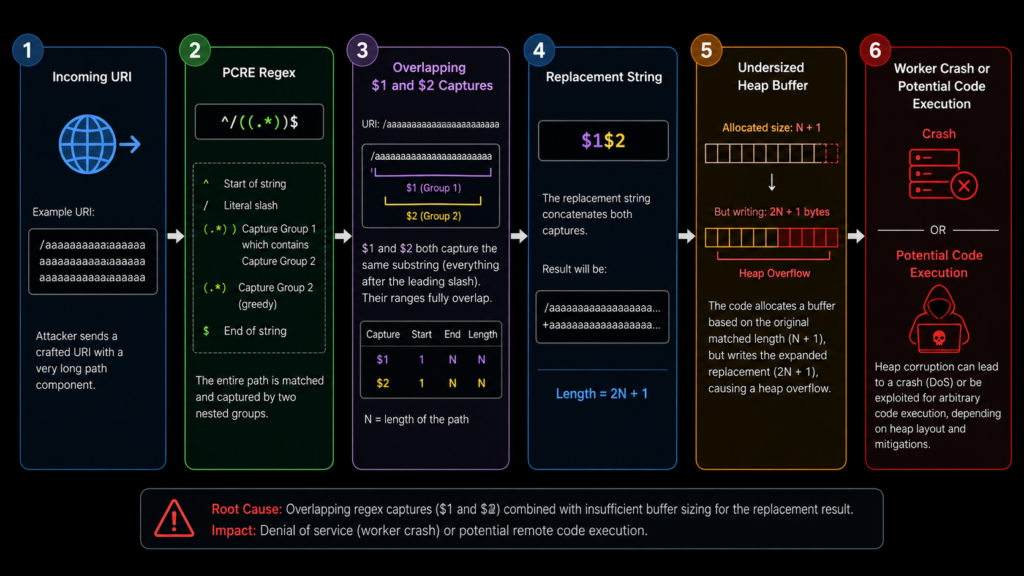
The official descriptions are unusually specific. CVE-2026-9256 exists when a rewrite directive uses a regex pattern with distinct, overlapping PCRE captures and a replacement string that references multiple captures in a redirect or arguments context. NVD gives ^/((.*))$ as an example pattern and $1$2 as an example replacement reference. (NVD)
The GitHub pull request that fixed the issue provides the clearest engineering explanation. It says that when the rewrite replacement string had no ordinary variables but had overlapping captures, the length of the allocated buffer could be smaller than the replacement string. The PR says this could happen when the redirect parameter is specified or when arguments are present in the replacement string, and it shows two minimal configurations that triggered heap buffer overflow with a crafted URI. (GitHub)
A simplified risky shape looks like this:
location / {
    rewrite ^/((.*))$ https://example.internal/$1$2 redirect;
    return 200 "ok";
}
That configuration is not an exploit by itself. It is a configuration shape. The risk comes from the relationship between the captures and the replacement. In ^/((.*))$, $1 ו $2 are not independent fields. They overlap because the outer capture contains the inner capture. Referencing both can cause the output construction logic to reuse attacker-controlled bytes in a way the vulnerable code did not size correctly.
A second risky shape involves arguments context:
location / {
    rewrite ^/((.*))$ https://example.internal/?$1$2;
    return 200 "ok";
}
Again, the lesson is not “all redirects are vulnerable.” It is narrower. The known trigger involves overlapping captures, multiple capture references, and redirect or arguments handling. An ordinary rewrite with one non-overlapping capture does not automatically match the known CVE-2026-9256 pattern. A server with no reachable rewrite rule also does not expose the known path, even if its NGINX binary is from an affected version range. That distinction matters for triage, but it should not delay patching.
What overlapping captures mean in practice
A capture group stores the portion of the input matched by a parenthesized part of the regular expression. Overlapping captures occur when one capture contains another capture that matches the same or partially the same bytes. The example ^/((.*))$ creates two numbered captures. $1 is the outer capture. $2 is the inner capture. For a path like /abc, both captures can refer to essentially the same user-controlled string after the slash.
Compare that with non-overlapping captures:
rewrite ^/users/([0-9]+)/orders/([0-9]+)$ /app?user=$1&order=$2 last;
Here $1 ו $2 refer to different sections of the URI. That does not by itself mean the rule is good or bad, but it is a different shape from nested overlapping captures.
A safer version of many rules is to remove unnecessary nested captures and use only the captured value the rule actually needs:
location / {
    rewrite ^/(.*)$ https://example.internal/$1 redirect;
}
If grouping is needed only for alternation, use a non-capturing group so it does not create a numbered capture at all:
location / {
    rewrite ^/(?:old|legacy)/(.*)$ /new/$1 last;
}
If the rewrite is a simple external redirect and does not need regex extraction, חזרה is often clearer and easier to reason about:
server {
    listen 80;
    server_name old.example.com;
    return 301 https://new.example.com$request_uri;
}
None of these rewrites should be treated as a substitute for the binary fix. They are configuration hardening patterns. If you are running an affected NGINX build, patch it. Configuration cleanup reduces the chance that the known trigger path exists, but it cannot prove that a downstream build does not contain the vulnerable code.
Impact, worker crash first, conditional RCE second
The most defensible impact statement is the official one. NVD says an unauthenticated attacker, with conditions beyond the attacker’s control, can exploit CVE-2026-9256 by sending crafted HTTP requests. The result may be a heap buffer overflow in the NGINX worker process leading to restart. NVD also states that attackers can execute code on systems with ASLR disabled or where the attacker can bypass ASLR. (NVD)
That wording is important. It does not mean every exposed NGINX server is instantly remotely exploitable for code execution. It also does not mean the bug is merely theoretical. A crashable public edge worker is a real denial-of-service risk, especially under repeated requests, traffic spikes, or environments where restart loops cause upstream failures. The RCE path is conditional, but memory corruption in a request-handling worker deserves urgent treatment because exploit reliability can improve after disclosure, and production hardening is uneven across fleets.
For defenders, the right severity model is:
| Condition | Effect on real-world risk |
|---|---|
| Affected NGINX build | Required for the upstream vulnerable code path |
| Reachable rewrite rule | Required for remote triggering through the known route |
| Overlapping captures and multiple references | Central to the known CVE-2026-9256 trigger |
| Redirect or arguments context | Part of the official vulnerable condition |
| ASLR enabled and not bypassed | Reduces practical RCE likelihood, does not remove crash risk |
| Worker process privileges | Determines blast radius if code execution becomes practical |
| Container isolation and seccomp profile | May limit post-exploitation impact but does not fix the bug |
| Rapid worker restart | Restores service for isolated crashes but can still be abused for DoS |
| Patched binary and restarted workers | Removes the known vulnerable code path |
This is why the CVSS v3.1 vector uses high attack complexity even though the attacker position is network and unauthenticated. The exploit does not rely on credentials or user interaction, but it does rely on configuration and runtime conditions that are not fully controlled by the attacker. (NVD)
Affected versions and downstream reality
For upstream NGINX Open Source, the official security advisory is straightforward: versions 0.1.17 through 1.31.0 are listed as vulnerable, and 1.30.2 and 1.31.1 or later are listed as not vulnerable. (Nginx) The NGINX news archive also states that NGINX 1.30.2 stable and 1.31.1 mainline were released with a fix for CVE-2026-9256. (Nginx)
That does not mean every production remediation ticket should simply compare nginx -v output to 1.30.2. Many organizations run NGINX through distribution packages, vendor products, containers, or derived projects. OpenResty, for example, records a backport of CVE-2026-9256 in 1.29.2.5 rather than presenting itself as upstream NGINX 1.30.2 or 1.31.1. (OpenResty) cPanel handled the issue through an ea-nginx update to 1.31.1. (cPanel Support)
A good inventory should therefore capture both upstream-style version evidence and vendor package evidence:
# Runtime version reported by the binary
nginx -v

# Build options, useful for identifying custom builds and modules
nginx -V 2>&1

# Debian and Ubuntu package evidence
dpkg -l | grep -E 'nginx|openresty'
apt-cache policy nginx nginx-core nginx-full openresty 2>/dev/null

# RHEL, AlmaLinux, Rocky Linux, Fedora, and similar systems
rpm -qa | grep -E 'nginx|openresty'
dnf info nginx 2>/dev/null || yum info nginx 2>/dev/null

# cPanel ea-nginx, where present
rpm -qa | grep -E '^ea-nginx'
dnf list installed ea-nginx 2>/dev/null
Package evidence is not only for patching. It is also for audit closure. If your displayed NGINX version is older but your vendor has backported the fix, the ticket needs the vendor advisory, package changelog, package release number, and worker restart evidence. Without that, the next scanner run may reopen the finding and nobody will know whether the machine is truly fixed or only cosmetically different.
Version-only checks are not enough
A version check answers only one question: whether the binary is in a known affected or fixed range. CVE-2026-9256 also requires a configuration pattern and a reachable request path. A version scanner can overstate risk by flagging a server that has no rewrite rule matching the known trigger. It can understate risk when a vendor backport does not update the upstream-looking version string or when the scanner checks the host package while traffic is actually served by a container.
A better triage sequence is:
| שלב | Evidence to collect | מדוע זה חשוב |
|---|---|---|
| Identify serving binary | nginx -v, package metadata, image digest | Confirms whether a vulnerable or vendor-patched build is actually in use |
| Dump running config | nginx -T from the running instance | Shows generated and included config, not only files you remember editing |
| Search rewrite rules | grep and manual review | Finds candidate overlapping captures and multiple capture references |
| Map reachability | server name, location, ingress route, listener, network exposure | A risky rule in an internal-only block is different from a public edge rule |
| Patch | vendor package, upstream release, rebuilt image | Removes vulnerable code path |
| Restart or rollout | process start time, pod restart, deployment digest | Confirms old workers are gone |
| צג | error logs, system logs, 5xx spikes | Detects suspicious crashes before and after remediation |
| Preserve evidence | before and after command output | Gives security, platform, and audit teams a shared record |
The most common failure is stopping after the package manager says “updated.” NGINX uses a master-worker model, and production deployments often reload configuration rather than restart the service. For a binary security fix, you need to verify that the worker processes serving traffic were replaced. In containers, you need a new image or new container instance. In Kubernetes, you need a rollout, not an SSH session inside one old pod.
Safe local triage commands for rewrite rules
Start by dumping the effective configuration. nginx -T includes files pulled in through include directives, so it is safer than grepping only /etc/nginx/nginx.conf.
sudo nginx -T > nginx-full-config.txt 2>&1
Search for rewrite directives that reference multiple numbered captures:
grep -nE 'rewrite[[:space:]].*\$[0-9].*\$[0-9]' nginx-full-config.txt
Search for obvious nested capture shapes. This does not fully parse PCRE, but it is a useful first pass:
grep -nE 'rewrite[[:space:]]+.*\(\([^)]*\)' nginx-full-config.txt
Search for redirect-style rewrite rules:
grep -nE 'rewrite[[:space:]].*(redirect|permanent|https?://)' nginx-full-config.txt
Search for replacements that introduce query arguments:
grep -nE 'rewrite[[:space:]].*\?.*\$[0-9]' nginx-full-config.txt
Then inspect the results manually. A line is more interesting when all of these are true:
| אות | מדוע זה חשוב |
|---|---|
| The regex contains nested captures | It may create overlapping capture groups |
The replacement uses $1$2, $1...$2, or more numeric captures | Multiple capture references match the official trigger class |
| The replacement is an external redirect or contains a query separator | The official condition calls out redirect or arguments context |
| The server block is public-facing | Remote unauthenticated traffic can reach it |
| The rule is generated by a template | The same pattern may exist across many hosts |
| The binary is before the fixed release or not proven fixed by vendor | The vulnerable code may be present |
Treat grep output as a candidate list, not a verdict. PCRE syntax is rich, NGINX configuration scope matters, and include files can change context. A candidate line needs human review or a purpose-built configuration parser before you declare a host exploitable.
A read-only Python scanner for configuration review
The script below is intentionally conservative. It does not send network requests. It does not try to crash NGINX. It reads an nginx -T dump and flags rewrite lines that look like they deserve manual review for CVE-2026-9256. It is not a complete NGINX parser and it does not prove exploitability.
#!/usr/bin/env python3
"""
nginx_poolslip_config_triage.py

Purpose:
  Read an nginx -T output file and flag rewrite directives that may deserve
  manual review for CVE-2026-9256 style conditions.

Safe behavior:
  - No network traffic
  - No exploit requests
  - No writes to NGINX config
  - Prints candidate lines only

Usage:
  sudo nginx -T > nginx-full-config.txt 2>&1
  python3 nginx_poolslip_config_triage.py nginx-full-config.txt
"""

from __future__ import annotations

import re
import sys
from pathlib import Path


REWRITE_LINE = re.compile(r"\brewrite\s+(.+?);")
NUMERIC_CAPTURE_REF = re.compile(r"\$([1-9][0-9]?)")
NESTED_CAPTURE_HINT = re.compile(r"\([^?][^;]*\([^?]")
REDIRECT_HINT = re.compile(r"\b(redirect|permanent)\b|https?://", re.IGNORECASE)


def has_arguments_context(line: str) -> bool:
    """
    A simple heuristic:
    NGINX rewrite replacements may contain '?' to introduce or modify args.
    This function does not parse quoted strings perfectly; it flags candidates.
    """
    return "?" in line


def classify_rewrite(line: str) -> list[str]:
    reasons: list[str] = []

    refs = NUMERIC_CAPTURE_REF.findall(line)
    unique_refs = sorted(set(refs), key=lambda x: int(x))

    if len(refs) >= 2:
        reasons.append(f"multiple numeric capture references: {', '.join('$' + r for r in unique_refs)}")

    if NESTED_CAPTURE_HINT.search(line):
        reasons.append("possible nested or overlapping capture groups")

    if REDIRECT_HINT.search(line):
        reasons.append("redirect context hint")

    if has_arguments_context(line):
        reasons.append("arguments context hint due to '?'")

    return reasons


def print_context(lines: list[str], index: int, radius: int = 2) -> None:
    start = max(0, index - radius)
    end = min(len(lines), index + radius + 1)

    for i in range(start, end):
        marker = ">>" if i == index else "  "
        print(f"{marker} {i + 1}: {lines[i].rstrip()}")


def main() -> int:
    if len(sys.argv) != 2:
        print("Usage: python3 nginx_poolslip_config_triage.py <nginx-full-config.txt>", file=sys.stderr)
        return 2

    path = Path(sys.argv[1])
    if not path.exists():
        print(f"File not found: {path}", file=sys.stderr)
        return 2

    lines = path.read_text(errors="replace").splitlines()
    findings = 0

    for idx, line in enumerate(lines):
        if "rewrite" not in line:
            continue

        match = REWRITE_LINE.search(line)
        if not match:
            continue

        reasons = classify_rewrite(line)
        strong_reasons = [
            reason for reason in reasons
            if "multiple numeric" in reason
            or "overlapping" in reason
            or "redirect" in reason
            or "arguments" in reason
        ]

        if len(strong_reasons) >= 3:
            findings += 1
            print("=" * 88)
            print(f"Candidate #{findings}, line {idx + 1}")
            for reason in strong_reasons:
                print(f"- {reason}")
            print()
            print_context(lines, idx)

    if findings == 0:
        print("No high-signal CVE-2026-9256 rewrite candidates found by this heuristic.")
        print("This is not proof of safety. Confirm NGINX version, vendor patch status, and generated configs.")
    else:
        print("=" * 88)
        print(f"Found {findings} high-signal candidate rewrite line(s). Review manually.")
        print("Do not treat this output as proof of exploitability.")

    return 0


if __name__ == "__main__":
    raise SystemExit(main())
A candidate finding from this script should trigger a config review, not a production exploit test. The reviewer should answer three questions: are the captures actually overlapping, are multiple captures copied into a redirect or arguments replacement, and can untrusted HTTP traffic hit that location? If the answer is yes and the binary is affected or not proven fixed, the remediation priority is high.
How to reduce the config risk while patching
Patching is the durable fix. Configuration changes can still reduce exposure while a controlled rollout is underway, especially for large fleets or vendor-managed environments where maintenance windows are constrained.
First, remove unnecessary nested captures. Many nested captures are accidental leftovers from regex experimentation:
# Risky shape
rewrite ^/((.*))$ https://example.com/$1$2 redirect;

# Cleaner shape
rewrite ^/(.*)$ https://example.com/$1 redirect;
Second, use non-capturing groups when the group exists only for alternation:
# Captures both the section and the rest of the path
rewrite ^/(old|legacy)/(.*)$ /new/$1/$2 last;

# Captures only the value that must be reused
rewrite ^/(?:old|legacy)/(.*)$ /new/$1 last;
Third, avoid broad greedy captures when a stricter pattern is available:
# Broad
rewrite ^/(.*)/(.*)$ /handler?left=$1&right=$2 last;

# Narrower
rewrite ^/products/([a-z0-9-]+)/([0-9]+)$ /handler?slug=$1&id=$2 last;
Fourth, prefer חזרה for simple redirects. It is easier to audit because it does not create PCRE captures unless you put it inside a regex location and use variables from that context:
server {
    listen 80;
    server_name example.com;
    return 301 https://www.example.com$request_uri;
}
Fifth, if query string behavior matters, make it explicit. Many rewrite bugs and operational surprises come from unclear argument handling:
# Preserve existing args by default when appropriate
rewrite ^/old/(.*)$ /new/$1 last;

# Drop old args intentionally by ending replacement with '?'
rewrite ^/old-campaign$ /new-campaign? permanent;
These changes also make future audits easier. A rewrite file full of ((.*)), $1$2, broad .*, and implicit query handling is hard to reason about even when no CVE is in play.
Patch workflow that does not leave old workers exposed
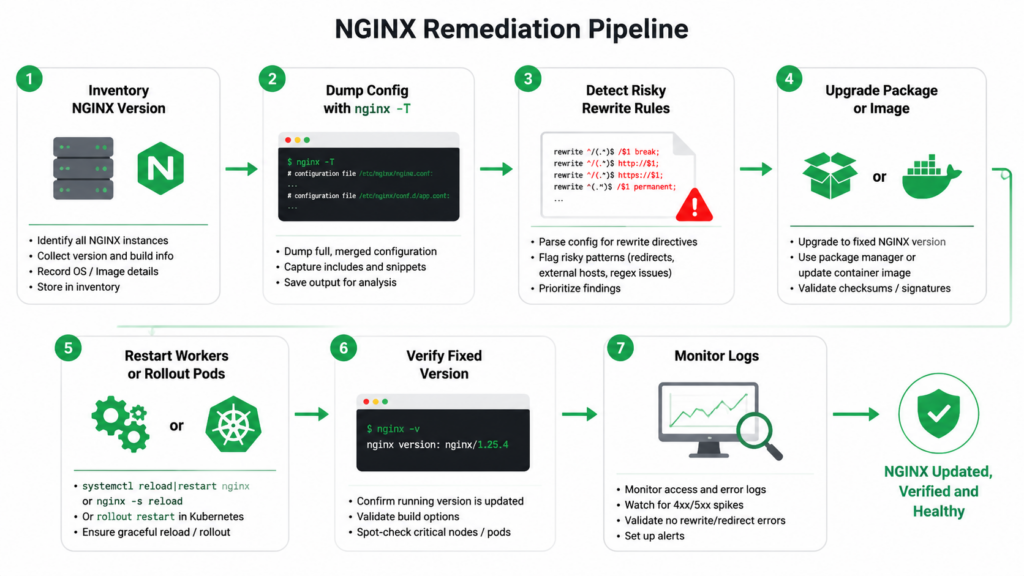
A mature remediation process should leave behind enough evidence that a separate engineer can verify the fix without trusting memory or chat messages. Start with before-state evidence:
date -u
hostname -f
nginx -v
nginx -V 2>&1 | sed 's/ --/\n--/g'
sudo nginx -T > nginx-before-cve-2026-9256.txt 2>&1
ps -o pid,ppid,lstart,cmd -C nginx
On Debian or Ubuntu systems, use the approved vendor channel:
sudo apt update
sudo apt install --only-upgrade nginx nginx-core nginx-full nginx-common
sudo nginx -t
sudo systemctl restart nginx
On RHEL-family systems:
sudo dnf clean metadata
sudo dnf upgrade nginx
sudo nginx -t
sudo systemctl restart nginx
On cPanel systems that use ea-nginx, follow cPanel’s package update path and verify the installed ea-nginx package. cPanel’s advisory specifically tells administrators to confirm whether ea-nginx is installed and to update it through the system package manager. (cPanel Support)
After the restart, capture after-state evidence:
date -u
nginx -v
ps -o pid,ppid,lstart,cmd -C nginx
sudo nginx -T > nginx-after-cve-2026-9256.txt 2>&1
Compare the candidate rewrite rules before and after:
grep -nE 'rewrite[[:space:]].*\$[0-9].*\$[0-9]' nginx-before-cve-2026-9256.txt > rewrite-before.txt || true
grep -nE 'rewrite[[:space:]].*\$[0-9].*\$[0-9]' nginx-after-cve-2026-9256.txt > rewrite-after.txt || true
diff -u rewrite-before.txt rewrite-after.txt || true
A package upgrade followed only by nginx -t is not enough. nginx -t validates syntax. It does not replace running workers. A configuration reload may start new workers under the new binary in many common workflows, but security tickets should not rely on assumptions. For a binary memory-corruption fix, prefer a controlled service restart or a verified process replacement. Confirm process start times after the operation.
Containers and Kubernetes need separate proof
Containers are a frequent source of false closure. A host can have a patched NGINX package while the exposed service is actually a container running an old image. In that case, the host package evidence is irrelevant to the live edge path.
For Docker or containerd-based environments, collect image and runtime evidence:
docker ps --format 'table {{.Names}}\t{{.Image}}\t{{.Status}}'
docker exec <container_name> nginx -v
docker exec <container_name> nginx -T > nginx-container-config.txt 2>&1
docker inspect <container_name> --format '{{.Image}} {{.Config.Image}}'
For Kubernetes, check the controller image, pod image digest, embedded NGINX version, and generated configuration:
kubectl -n ingress-nginx get pods -o wide
kubectl -n ingress-nginx get deploy -o yaml | grep -E 'image:|args:'
kubectl -n ingress-nginx exec deploy/ingress-nginx-controller -- nginx -v
kubectl -n ingress-nginx exec deploy/ingress-nginx-controller -- nginx -T > ingress-nginx-generated.conf 2>&1
Then roll the fixed image through the deployment path:
kubectl -n ingress-nginx set image deployment/ingress-nginx-controller \
  controller=registry.example.com/ingress-nginx-controller@sha256:<fixed_digest>

kubectl -n ingress-nginx rollout status deployment/ingress-nginx-controller
kubectl -n ingress-nginx get pods -o custom-columns=NAME:.metadata.name,IMAGE:.spec.containers[*].image,START:.status.startTime
For ingress controllers, the question is not only “what NGINX version is inside the pod?” It is also “what NGINX configuration did the controller generate?” Custom annotations, snippets, templates, and rewrite-target rules can generate rewrite behavior that application teams do not see in ordinary source repositories. If your ingress product is vendor-managed, use the vendor’s advisory and fixed release rather than assuming upstream NGINX version numbers apply directly.
Detection signals after disclosure
There is no universal log line that says “CVE-2026-9256 exploit attempt.” The best detection approach is correlation: worker crashes, unusual URI patterns, error-rate spikes, and requests hitting rewrite-heavy locations.
Start with NGINX error logs:
sudo grep -Ei 'worker process|signal 11|segmentation fault|core dumped|exited on signal|malloc|buffer|aborted' \
  /var/log/nginx/error.log*
Check systemd logs around the suspected window:
sudo journalctl -u nginx --since "2026-05-22" \
  | grep -Ei 'worker|signal|segfault|core|restart|exited'
If core dumps are enabled, list recent crashes:
coredumpctl list nginx
On Kubernetes:
kubectl -n ingress-nginx get pods
kubectl -n ingress-nginx describe pod <pod_name> | grep -Ei 'restart|last state|terminated|exit code'
kubectl -n ingress-nginx logs <pod_name> --previous | grep -Ei 'signal|segmentation|worker|core|abort'
Look for traffic anomalies near crash times. A candidate access-log query might group suspiciously long request URIs:
awk '{print length($7), $1, $4, $7}' /var/log/nginx/access.log \
  | sort -nr \
  | head -50
If your logs include $request_uri, $status, $server_name, ו $request_time, compare spikes in 5xx responses with worker restarts:
awk '$9 ~ /^5/ {print $4, $7, $9}' /var/log/nginx/access.log | tail -200
These signals have limits. A worker crash can come from unrelated bugs, resource exhaustion, bad modules, or local administrative tests. Lack of crashes also does not prove nobody attempted exploitation. Use detection to prioritize incident review, not to replace patching.
How to write a remediation ticket that survives audit
A good CVE-2026-9256 ticket should not say only “patched NGINX.” It should prove the vulnerable path is gone or explain why the asset was not exposed.
Include:
| ראיות | דוגמה |
|---|---|
| Asset identity | Hostname, IP, service name, cluster, namespace |
| Exposure | Public edge, internal-only, partner-facing, management plane |
| Binary before state | nginx -v, package version, image digest |
| Config before state | nginx -T artifact or secured path to it |
| Rewrite review | Candidate grep output and manual conclusion |
| Vendor fix | Upstream 1.30.2 or 1.31.1, vendor backport, or downstream advisory |
| Restart proof | Worker process start time, systemd restart, pod rollout |
| Binary after state | Post-fix nginx -v, package version, image digest |
| Monitoring review | Error logs, crash logs, 5xx review |
| Exception, if any | Temporary mitigation, owner, expiration date, compensating controls |
This matters because CVE-2026-9256 is exactly the kind of issue that crosses ownership boundaries. Security receives the alert. Platform owns the ingress controller. Application teams wrote the old rewrites. DevOps owns the image. A vendor owns the appliance. SRE owns restarts. Without evidence, teams either over-patch blindly or under-patch because each owner assumes another owner handled the real exposure.
In authorized testing workflows, this is where automation helps most when it is tied to evidence rather than blind exploitation. A platform such as Penligent can be used to structure asset discovery, safe configuration checks, version verification, retesting, and report generation as a repeatable workflow instead of a one-off scramble. The useful output is not a dramatic exploit screenshot; it is a defensible chain of evidence showing which edge services were affected, which rewrite rules were reviewed, what was patched, and how the fix was verified. Penligent’s own NGINX Rift write-up is also a relevant companion read because CVE-2026-42945 sits in the same rewrite-module family and shows why NGINX rewrite bugs need configuration-aware validation, not just version banners. (Penligent)
Related NGINX CVEs to triage in the same window
CVE-2026-9256 arrived only days after another cluster of NGINX security fixes. The NGINX 1.31.0 and 1.30.1 release notes list fixes for CVE-2026-42926, CVE-2026-42945, CVE-2026-42946, CVE-2026-42934, CVE-2026-40460, and CVE-2026-40701. (GitHub) The official CHANGES file describes these as issues affecting proxy HTTP/2 request handling, rewrite-module buffer overflow, SCGI and uWSGI buffer overreads, charset-module buffer overread, HTTP/3 address spoofing, and OCSP resolver use-after-free. (Nginx)
| CVE | רכיב | Why it belongs in the same triage wave | Defender action |
|---|---|---|---|
| CVE-2026-9256 | ngx_http_rewrite_module | Overlapping captures in rewrite rules can trigger heap overflow | Upgrade to 1.30.2 or 1.31.1 or vendor-fixed build, restart, audit rewrites |
| CVE-2026-42945 | ngx_http_rewrite_module | Earlier rewrite-module heap overflow tied to unnamed captures and query handling | Confirm you did not stop at 1.30.1 or 1.31.0 if CVE-2026-9256 also applies |
| CVE-2026-42926 | ngx_http_proxy_module | HTTP/2 request injection affects edge proxy trust boundaries | Patch and review HTTP/2 backend proxy exposure |
| CVE-2026-42946 | SCGI and uWSGI modules | Buffer overread can affect worker memory exposure or stability | Patch and identify SCGI or uWSGI usage |
| CVE-2026-42934 | ngx_http_charset_module | Character conversion bugs can create response-processing memory safety risk | Patch and review charset conversion usage |
| CVE-2026-40460 | HTTP/3 | Address spoofing in a newer protocol path | Patch and review HTTP/3 enablement |
| CVE-2026-40701 | OCSP resolver behavior | Use-after-free in resolver-related OCSP processing | Patch and review TLS and OCSP configuration |
The operational takeaway is not that NGINX is uniquely unsafe. It is that edge software written in C processes attacker-controlled bytes at high volume, and small configuration details can decide whether a memory-safety bug is reachable. When several NGINX CVEs land in the same release window, the right response is to patch the whole fleet through a controlled pipeline rather than handling each CVE as an isolated grep exercise.
Common mistakes during CVE-2026-9256 response
The first mistake is treating every affected-version host as equally exploitable. That creates noise and slows down the truly exposed public-edge systems with risky rewrite rules. Use version checks for inventory, then use configuration and reachability to prioritize.
The second mistake is treating configuration absence as a reason not to patch. If a server is in the affected version range, patch it anyway. Configuration can change, generated files can differ from source files, and old templates often reappear during rollbacks.
The third mistake is patching the package but not replacing the worker processes. Security fixes live in code. Old workers running old code can keep serving traffic after package files on disk have changed. Capture process start times after remediation.
The fourth mistake is ignoring containers. Host package managers do not patch container images. Rebuild images, pin fixed digests, and verify the running pod or container.
The fifth mistake is running public PoCs against production. A worker-crashing test is still a denial-of-service test. For production, prove exposure through safe evidence: version, vendor fix status, configuration, reachability, and runtime replacement.
The sixth mistake is relying on a single scanner finding. CVE-2026-9256 has configuration preconditions. A scanner that cannot read generated NGINX config cannot fully answer exposure. It can start the conversation, not finish it.
The seventh mistake is forgetting old rollback artifacts. Golden images, autoscaling groups, inactive blue-green pools, disaster recovery templates, and old Helm chart values can bring the vulnerable binary back after the main incident is closed.
Hardening beyond the immediate fix
Once the emergency patch is complete, use the incident to clean up rewrite ownership. Rewrite rules often accumulate because they are small enough to avoid architecture review and powerful enough to affect routing, authentication boundaries, cache behavior, and redirect targets.
A better long-term rewrite policy includes:
| Hardening practice | Reason |
|---|---|
העדפה חזרה for simple redirects | Reduces regex and capture complexity |
| Use non-capturing groups for grouping only | Prevents unnecessary $1, $2 state |
| Avoid nested greedy captures | Reduces ambiguity and accidental overlap |
| Document why each rewrite exists | Helps remove stale migration rules |
| Test generated config in CI | Catches risky snippets before deployment |
Store nginx -T artifacts for critical edge builds | Preserves the effective config, not only source fragments |
| Keep edge images rebuilt on a schedule | Prevents old vulnerable builds from lingering |
| Restrict worker privileges | Reduces impact if memory corruption becomes code execution |
| Use seccomp, AppArmor, SELinux, and container boundaries where practical | Adds containment around the worker process |
| Monitor worker crashes as security signals | Turns reliability noise into detection input |
Hardening does not make CVE-2026-9256 harmless. The fix is still the fix. The point is to reduce the chance that the next edge memory bug finds a wide-open path through old, unclear, unaudited rewrite logic.
שאלות נפוצות
Does CVE-2026-9256 affect every NGINX server?
- No. The known vulnerable path depends on both version and configuration.
- Upstream NGINX Open Source 0.1.17 through 1.31.0 is listed as vulnerable, while 1.30.2 and 1.31.1 or later are listed as not vulnerable. (Nginx)
- The known trigger requires overlapping PCRE captures and multiple capture references in a redirect or arguments rewrite context.
- Patch affected builds even if you do not immediately find the pattern, because generated configs, old templates, and rollback images can reintroduce exposure.
Is CVE-2026-9256 a real RCE or only a denial-of-service bug?
- The most reliable impact is worker process memory corruption leading to worker restart.
- NVD states code execution is possible on systems with ASLR disabled or where the attacker can bypass ASLR. (NVD)
- Reliable production RCE depends on runtime conditions such as memory layout, hardening, worker privileges, and exploit quality.
- Treat it as urgent because public-edge DoS is already serious, and heap overflows can become more exploitable after disclosure.
How can I quickly check whether my config has the risky rewrite pattern?
- Dump the effective config with
sudo nginx -T > nginx-full-config.txt 2>&1. - Search for rewrite lines with multiple numeric captures using
grep -nE 'rewrite[[:space:]].*\$[0-9].*\$[0-9]' nginx-full-config.txt. - Manually inspect candidates for nested or overlapping captures such as
((.*)). - Pay special attention to rewrite replacements that perform redirects or include
?arguments. - Treat grep results as triage candidates, not proof of exploitability.
What should I do if I cannot upgrade immediately?
- Remove or rewrite candidate rules that contain overlapping captures and multiple capture references.
- Prefer simpler captures, non-capturing groups, or
חזרהfor direct redirects. - Validate changes with
nginx -tand apply them through your normal deployment process. - Keep a short deadline for the binary patch. Configuration mitigation can miss generated files, containers, vendor builds, or future config changes.
Is Kubernetes ingress affected?
- It can be, depending on the ingress controller, embedded NGINX version, generated NGINX configuration, and custom annotations or snippets.
- Check the controller image, image digest, embedded
nginx -v, and generatednginx -Toutput inside the controller pod. - Do not assume patching the Kubernetes node OS patches the ingress controller container.
- Upgrade through the controller vendor’s fixed release path and verify rollout status.
Is systemctl reload nginx enough after patching?
- For a binary security fix, do not rely on assumptions. Prefer a controlled restart or prove that all old workers were replaced.
nginx -tonly checks configuration syntax.- Capture
ps -o pid,ppid,lstart,cmd -C nginxbefore and after remediation. - In containers and Kubernetes, verify new containers or pods are running the fixed image digest.
Should I run a public PoC to prove exposure?
- Not against production.
- A worker-crashing proof is still a denial-of-service action.
- For production, prove exposure through version, vendor patch status, configuration, reachability, and worker replacement evidence.
- If exploit reproduction is required, use an isolated lab under explicit authorization and stop at the least destructive proof your policy allows.
What should be included in a CVE-2026-9256 closure note?
- Asset name, owner, exposure level, and service role.
- NGINX or downstream product version before and after remediation.
- Vendor advisory or package changelog proving the fix.
nginx -Treview evidence for risky rewrite patterns.- Restart, rollout, or image digest evidence proving old workers are gone.
- Monitoring review for worker crashes, segmentation faults, and 5xx spikes.
- Any temporary mitigation and its expiration date.
Closing judgment
CVE-2026-9256 deserves fast action because it sits in the public request-handling path of a widely deployed edge server and turns a specific rewrite configuration pattern into heap memory corruption. It also deserves precise language. The bug is not “every NGINX server is instantly owned.” It is a configuration-dependent memory-safety flaw where version, rewrite shape, reachability, ASLR, worker privileges, downstream packaging, and restart behavior decide the real exposure.
The practical response is direct: upgrade to NGINX 1.30.2, 1.31.1, or a vendor-fixed build; restart or roll out new workers; audit rewrite rules for overlapping captures and multiple capture references; avoid destructive production PoC testing; preserve before-and-after evidence; and watch for worker crash signals. The teams that handle CVE-2026-9256 well will not be the ones with the loudest alert. They will be the ones that can prove, host by host and config by config, that the vulnerable path is gone.

 Hebrew
  English
  German
  French
  Spanish
  Portuguese
  Japanese
  Korean
  Hindi
Hindi  Arabic
  Turkish