
CVE-2026-49261 is a critical command-injection vulnerability in MariaDB Server, but the important detail is not “MariaDB RCE” by itself. The vulnerable path is MariaDB Galera Cluster’s wsrep_notify_cmd feature. Affected MariaDB versions with wsrep_notify_cmd enabled could execute shell commands embedded in the name of a joining node. MariaDB’s GitHub security advisory lists the issue as Critical with CVSS 3.1 score 10.0, and NVD lists it as Critical with CVSS 3.1 score 9.8. The scoring differs in Scope, but not in the operational conclusion: Galera users should treat this as urgent. (GitHub)
The safest first sentence for an incident ticket is precise: CVE-2026-49261 affects MariaDB Server versions 10.6.1 through 10.6.26, 10.11.1 through 10.11.17, 11.4.1 through 11.4.11, 11.8.1 through 11.8.7, and 12.3.1 when wsrep_notify_cmd is enabled. Fixed versions are 10.6.27, 10.11.18, 11.4.12, 11.8.8, and 12.3.2. If an immediate upgrade is not possible, MariaDB’s advisory states that disabling wsrep_notify_cmd is the workaround. (GitHub)
That wording matters because most MariaDB deployments are not automatically vulnerable in the same way. A single-node MariaDB server with no Galera provider and no wsrep_notify_cmd path is not the same exposure as a production Galera cluster that runs notification scripts for load balancer updates, monitoring, or service discovery. The vulnerability sits at the intersection of cluster membership, peer-supplied metadata, command construction, and shell execution. The database engine is the product, but the risk is an operating-system command path.
Verified facts for defenders
| שדה | Confirmed detail | מדוע זה חשוב |
|---|---|---|
| CVE | CVE-2026-49261 | Use this identifier for patch tickets, vulnerability management, and incident records. |
| מוצר | MariaDB Server with Galera/wsrep behavior | The risk is tied to clustered MariaDB deployments, not every standalone database server. |
| Vulnerable feature | wsrep_notify_cmd | The feature executes a configured command when local node state or cluster membership changes. |
| חולשה | CWE-78, OS Command Injection | Untrusted or externally influenced input reaches an OS command boundary. |
| Main impact statement | Shell commands embedded in the joiner node name could be executed when wsrep_notify_cmd is enabled | The vulnerable value is not SQL input; it is cluster metadata used by the notification path. |
| גרסאות מושפעות | 10.6.1–10.6.26, 10.11.1–10.11.17, 11.4.1–11.4.11, 11.8.1–11.8.7, 12.3.1 | Version range is broad across multiple supported branches. |
| גרסאות קבועות | 10.6.27, 10.11.18, 11.4.12, 11.8.8, 12.3.2 | Upgrade target depends on the branch in use. |
| Workaround | Disable wsrep_notify_cmd if you cannot upgrade immediately | This removes the vulnerable notification execution path, but it may break operational automation. |
| GitHub CNA score | CVSS 3.1 10.0, Critical | GitHub lists Scope as Changed. |
| NVD score | CVSS 3.1 9.8, Critical | NVD lists Scope as Unchanged. |
NVD’s entry also records CISA SSVC enrichment with “exploitation: none,” “automatable: yes,” and “technicalImpact: total” as of its enrichment data. That should not be read as safety. “No known exploitation” in enrichment data is not proof of no exploitation in private environments; it only means defenders should prioritize based on confirmed product exposure, cluster reachability, and log evidence rather than public exploit chatter alone. (NVD)
Safe PoC demonstration of the command injection pattern
A safe way to understand CVE-2026-49261 is to reproduce the vulnerable programming pattern without touching a real MariaDB Galera cluster. The following toy example does not exploit MariaDB and does not join a cluster. It only shows why building a shell command string from cluster metadata is dangerous. The unsafe version places a member name directly into a command string that could later be interpreted by sh -c. The safe version keeps the same value as a single argument in an argument vector, so shell metacharacters remain data rather than syntax.
import shlex

notify_script = "/usr/local/sbin/galera-notify.sh"
status = "Synced"
view_id = "view-demo"

# Simulated cluster member metadata.
# This is intentionally harmless and should not be used against a real cluster.
members = "db-galera-01,db-galera-02; echo SAFE_DEMO_MARKER"

is_primary = "1"

unsafe_command = f"{notify_script} {status} {view_id} {members} {is_primary}"

safe_command = [
    notify_script,
    status,
    view_id,
    members,
    is_primary,
]

print("[unsafe shell command string]")
print(unsafe_command)

print("\n[safe argument vector]")
print([shlex.quote(arg) for arg in safe_command])
If the unsafe string were passed to a shell, the semicolon would be parsed as command syntax rather than treated as part of the member list. That is the class of failure defenders should look for: untrusted metadata crossing into a shell command boundary. The safer design is not to “escape harder” after the fact, but to avoid shell parsing where possible, pass arguments as structured values, and enforce a strict allowlist for fields such as node names and incoming addresses.
Why wsrep_notify_cmd exists
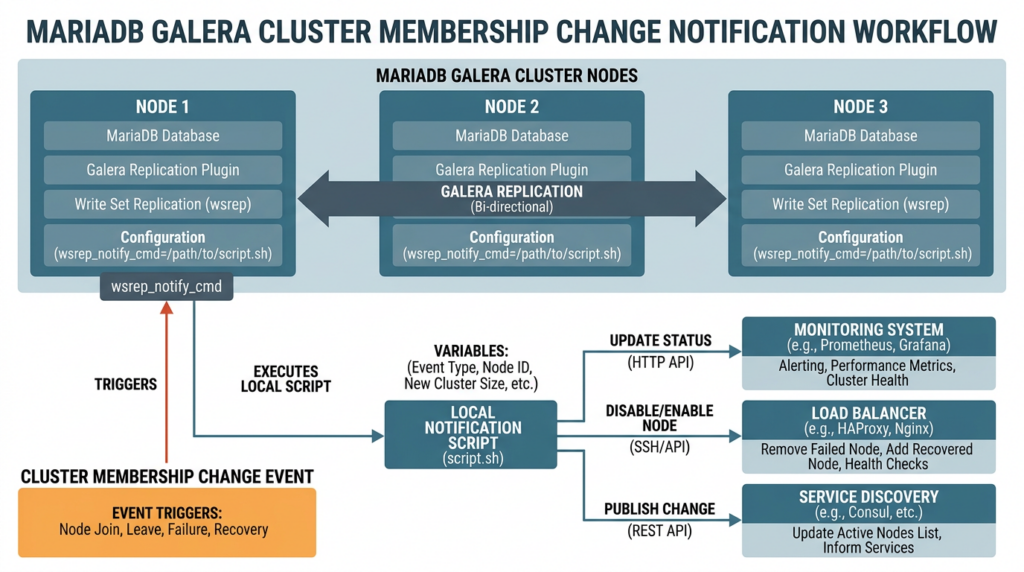
MariaDB Galera Cluster can run a notification command whenever the local node state or cluster membership changes. MariaDB’s documentation describes wsrep_notify_cmd as a system variable used to configure a command or script that runs in response to those changes. Common uses include updating load balancers, sending monitoring alerts, or refreshing service discovery state. (MariaDB)
That feature is useful in real operations. A database cluster is not just a database. It is usually connected to proxies, health checks, monitoring systems, orchestration scripts, inventory systems, and sometimes legacy shell glue that has been stable for years. When a Galera node becomes Synced, a script may add it back to a load balancer. When a node becomes Donor, a script may mark it temporarily unhealthy. When the cluster view changes, a script may write a membership snapshot to a file, a service registry, or a metrics gateway.
MariaDB’s documentation shows that the notification command receives parameters such as node status, view ID, members list, and whether the component is primary. The third argument is a comma-separated list of wsrep_node_name values for members in the current cluster component. (MariaDB)
| Argument position | Parameter | Normal operational meaning | Security concern |
|---|---|---|---|
$1 | Status | Local node state such as Joining, Joined, Synced, Donor, או Desynced | Usually constrained by server state, but scripts should still treat it as data. |
$2 | View ID | Identifier for the current cluster membership view | Often logged or passed to monitoring tools. |
$3 | Members list | Comma-separated member names from the cluster view | Member names can become dangerous if they are treated as shell-safe text. |
$4 | Is Primary | Boolean-style value indicating whether the component is primary | Usually low-risk, but still should be parsed defensively. |
The design problem behind CVE-2026-49261 is not that notification scripts exist. The problem is that cluster metadata can cross a trust boundary and reach a shell command. Any feature that says “run this command when a peer joins” needs strict handling of every value that can be influenced by that peer.
The vulnerable path, from joiner metadata to shell execution
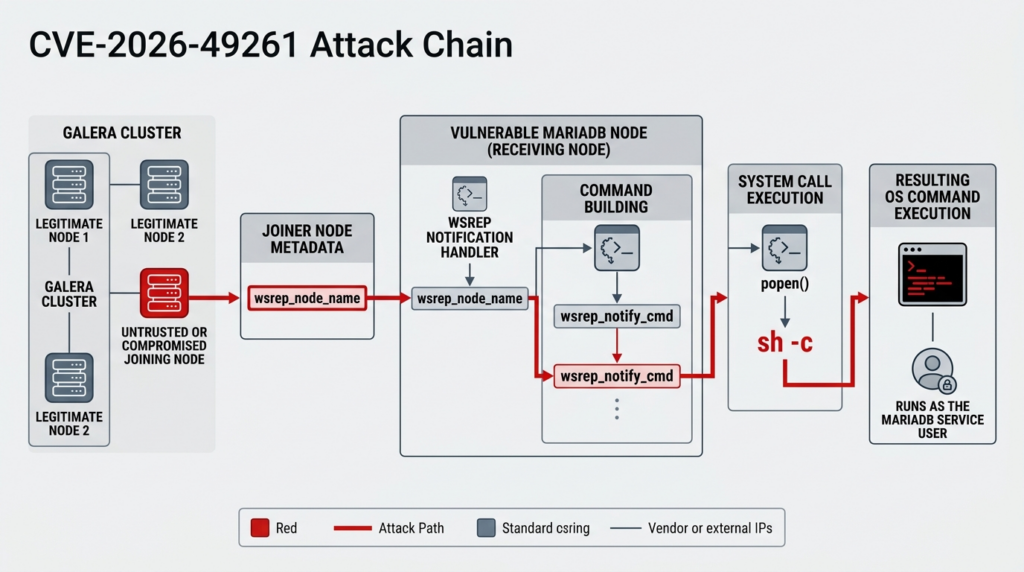
MariaDB’s JIRA issue for MDEV-39721 gives the clearest root-cause description. It says wsrep_notify_status() interpolated members[i].name(), the peer’s wsrep_node_name, ו members[i].incoming(), the peer’s incoming address, verbatim into a command string executed via sh -c. A peer joining with shell metacharacters in either field could inject arbitrary commands on every cluster member that had wsrep_notify_cmd configured. The fix was to validate both fields before substitution, reject values containing shell-significant characters, and skip notification when unsafe values appear. (jira.mariadb.org)
That is a classic OS command-injection shape:
| שלב | What happens | Why it is dangerous |
|---|---|---|
| Peer-controlled metadata exists | A joining node presents values such as node name or incoming address | These values may be treated as cluster identity data, but they still originate outside the local process. |
| Local server builds a notification command | MariaDB prepares a command line for wsrep_notify_cmd | Command lines have syntax, not just bytes. |
| Unsafe text enters shell syntax | Shell-significant characters change how the command is interpreted | The shell may split commands, redirect output, expand values, or run additional programs. |
The command executes through sh -c | The shell parses the final string | Escaping mistakes become code execution. |
| Command runs as the database service context | The process inherits permissions of the MariaDB service user and environment | Impact can include file access, credential exposure, process execution, and lateral movement. |
The issue is more subtle than “bad script.” Even a carefully written notification script can be put at risk if the server invokes it through an unsafe command string. Script hardening is still useful, but the primary fix is the patched MariaDB server behavior that validates unsafe peer-supplied fields before substitution.
Why the CVSS scores differ but the priority does not
MariaDB’s GitHub advisory assigns CVSS 3.1 vector AV:N/AC:L/PR:N/UI:N/S:C/C:H/I:H/A:H, which produces a 10.0 Critical score. NVD lists AV:N/AC:L/PR:N/UI:N/S:U/C:H/I:H/A:H, which produces a 9.8 Critical score. Red Hat’s ADP entry in NVD lists a 9.0 Critical vector with higher attack complexity. (GitHub)
The difference is not a reason to delay. CVSS scoring often reflects slightly different assumptions about scope boundaries, attack complexity, and product packaging. Here, all serious interpretations land in Critical territory because the successful outcome is arbitrary shell command execution from a network-reachable cluster interaction, with no user interaction.
For triage, the more important questions are operational:
| Question | מדוע זה חשוב |
|---|---|
| Are we running MariaDB Galera Cluster, or only standalone MariaDB? | The vulnerable path is tied to wsrep/Galera behavior. |
Is wsrep_notify_cmd configured and non-empty? | MariaDB’s advisory conditions the issue on this feature being enabled. |
| Are affected versions present? | Patch priority depends on version and packaging. |
| Can an untrusted host reach Galera peer ports? | Network exposure changes exploitability. |
Can an attacker influence a joining node’s wsrep_node_name or incoming address? | That is the metadata path described by the bug. |
| What user does MariaDB run as, and what can that user access? | The blast radius depends on OS privilege and local secrets. |
| Do notification scripts update load balancers or service registries? | Post-exploitation impact may extend beyond the database host. |
Affected versions and fixed versions
The affected ranges and fixed versions are consistent across MariaDB’s GitHub advisory, NVD, Debian’s tracker, and the Singapore Cyber Security Agency advisory. (GitHub)
| MariaDB branch | Affected versions for CVE-2026-49261 | Fixed version |
|---|---|---|
| 10.6 | 10.6.1 through 10.6.26 | 10.6.27 |
| 10.11 | 10.11.1 through 10.11.17 | 10.11.18 |
| 11.4 | 11.4.1 through 11.4.11 | 11.4.12 |
| 11.8 | 11.8.1 through 11.8.7 | 11.8.8 |
| 12.3 | 12.3.1 | 12.3.2 |
MariaDB Foundation described the June 2026 releases as corrective releases for Galera users after prior May releases. It named CVE-2026-49261, CVE-2026-48165, and CVE-2026-48163 as related CVEs and explicitly recommended that Galera users upgrade as soon as possible. (MariaDB.org)
Package-level reality may differ from upstream version labels. Debian’s tracker, for example, listed bookworm’s mariadb source package version 1:10.11.14-0+deb12u2 and trixie’s 1:11.8.6-0+deb13u1 as vulnerable at the time shown, while forky/sid had 1:11.8.8-1 fixed. (security-tracker.debian.org) Amazon Linux’s CVE page lists CVE-2026-49261 as Critical with CVSS 9.0 and shows some older Amazon Linux 2 extras packages as “No Fix Planned,” while other packages are not affected. (AWS Explore)
That means a good remediation ticket should not say only “upgrade MariaDB.” It should specify the actual package source, branch, repository, container image tag, Helm chart, AMI, or appliance bundle that provides MariaDB and Galera components.
When the vulnerability is realistically exploitable
CVE-2026-49261 should not be treated as a generic SQL injection or a normal web-exposed database bug. The attacker needs a path into the Galera cluster membership workflow or a way to influence metadata for a node joining the cluster. The JIRA description specifically calls out peer-supplied wsrep_node_name ו wsrep_node_incoming_address values entering a command string executed through sh -c. (jira.mariadb.org)
Real exploitability depends on the cluster boundary.
| Deployment scenario | Likely exposure | Triage priority |
|---|---|---|
Standalone MariaDB, no Galera provider, no wsrep_notify_cmd | Not the vulnerable path described by the advisory | Document as not affected after confirming configuration. |
Galera enabled, affected version, wsrep_notify_cmd empty | The specific notification path is not enabled | Still review related Galera CVEs, but CVE-2026-49261 risk is lower. |
Galera enabled, affected version, wsrep_notify_cmd configured, peer network tightly restricted | Serious if any trusted peer is compromised or misconfigured | Patch during emergency maintenance or disable notify path. |
Galera enabled, affected version, wsrep_notify_cmd configured, peer ports reachable from broad internal networks | High operational risk | Restrict network immediately and patch. |
| Galera peer ports exposed to the internet or untrusted cloud segments | Critical exposure | Treat as incident-level until proven otherwise. |
| Kubernetes or container deployment with permissive service discovery and weak network policy | High lateral movement risk | Confirm pod-to-pod reachability, config sources, and image versions. |
| Managed database service | Depends on provider implementation | Check provider security notice and support response; do not assume upstream version mapping applies. |
The most common mistake is to evaluate only the SQL port. Galera uses additional ports for cluster replication and state transfer. A host that blocks public access to 3306 but exposes Galera peer traffic to a broad private network may still have a serious cluster-plane problem.
The Galera ports defenders should care about
A MariaDB Galera deployment commonly involves more than port 3306. Actual ports vary by configuration, but defenders should review:
| Port | Common Galera use | Defensive control |
|---|---|---|
| 3306 | MariaDB client connections | Restrict to application and admin sources. |
| 4567 TCP/UDP | Galera replication traffic | Allow only known cluster nodes. |
| 4568 TCP | Incremental State Transfer, often IST | Allow only known cluster nodes. |
| 4444 TCP | State Snapshot Transfer, often SST | Allow only known cluster nodes. |
| Custom ports | Changed by provider options or deployment tooling | Inventory from config, not assumptions. |
A clean security group should not say “allow internal VPC.” It should say “allow only the current and expected Galera nodes.” In cloud and Kubernetes environments, that usually means tightening security groups, network policies, firewall rules, and service definitions so a random workload cannot impersonate a database cluster peer.
Safe configuration checks
The following commands are defensive inventory checks. They do not attempt exploitation, do not craft a malicious joiner, and do not require untrusted payloads.
Check the MariaDB version:
SELECT VERSION();
Check whether wsrep/Galera is active and whether notification behavior is configured:
SHOW GLOBAL VARIABLES LIKE 'wsrep_on';
SHOW GLOBAL VARIABLES LIKE 'wsrep_provider';
SHOW GLOBAL VARIABLES LIKE 'wsrep_cluster_address';
SHOW GLOBAL VARIABLES LIKE 'wsrep_node_name';
SHOW GLOBAL VARIABLES LIKE 'wsrep_node_incoming_address';
SHOW GLOBAL VARIABLES LIKE 'wsrep_notify_cmd';
Check cluster status variables:
SHOW GLOBAL STATUS LIKE 'wsrep_cluster_size';
SHOW GLOBAL STATUS LIKE 'wsrep_cluster_status';
SHOW GLOBAL STATUS LIKE 'wsrep_local_state_comment';
SHOW GLOBAL STATUS LIKE 'wsrep_incoming_addresses';
Search common configuration locations:
sudo grep -RInE 'wsrep_(notify_cmd|on|provider|cluster_address|node_name|node_incoming_address|sst_)' \
  /etc/mysql /etc/my.cnf /etc/my.cnf.d /etc/mysql/mariadb.conf.d 2>/dev/null
Check the process and service context:
ps -eo user,pid,ppid,cmd | grep -E '[m]ariadbd|[m]ysqld'

systemctl status mariadb --no-pager
systemctl cat mariadb
Check listening ports:
sudo ss -lntup | grep -E '(:3306|:4444|:4567|:4568)\b'
On a containerized host, include image and environment checks:
docker ps --format '{{.Names}} {{.Image}}'
docker inspect <container_name> \
  --format '{{json .Config.Env}}' | tr ',' '\n' | grep -Ei 'MARIADB|MYSQL|WSREP|GALERA'
On Kubernetes, check ConfigMaps, Secrets, StatefulSets, and Services that may carry MariaDB or Galera settings:
kubectl get statefulsets,deployments,svc,configmaps,secrets -A | grep -Ei 'mariadb|mysql|galera|wsrep'

kubectl get configmap -A -o yaml | grep -Ei 'wsrep_notify_cmd|wsrep_cluster_address|wsrep_node_name|galera'
Do not validate exposure by giving a production node a malicious name. A safe test should confirm configuration, version, network reachability, and patch status. Exploit-like validation belongs only in an isolated lab you own, with a patched/not-patched comparison, no production credentials, no production data, and no route back to live infrastructure.
What a vulnerable configuration may look like
A vulnerable setup does not need a strange script. The dangerous precondition can be as simple as a normal notification command on an affected version:
[mariadb]
wsrep_on=ON
wsrep_provider=/usr/lib/galera/libgalera_smm.so
wsrep_cluster_address=gcomm://10.0.10.11,10.0.10.12,10.0.10.13
wsrep_node_name=db-galera-01
wsrep_notify_cmd=/usr/local/sbin/galera-notify.sh
The script path might be legitimate. The script might only log state changes or notify HAProxy. The vulnerability described by MariaDB is upstream of script logic: peer-supplied fields were interpolated into a command string before shell execution. That is why the first mitigation is upgrade or disable the feature, not simply rewrite the script.
Still, script hygiene matters because it reduces the chance of future command injection and limits blast radius if other bugs exist. A safer notification script should treat every argument as data, avoid eval, avoid shell command construction from untrusted values, log safely, and call external tools with fixed paths and fixed argument boundaries.
Example pattern for a local logging-only script:
#!/usr/bin/env bash
set -euo pipefail

LOG_FILE="/var/log/galera/notify.log"

STATUS="${1:-unknown}"
VIEW_ID="${2:-unknown}"
MEMBERS="${3:-unknown}"
IS_PRIMARY="${4:-unknown}"

case "$STATUS" in
  Joining|Joined|Synced|Donor|Desynced|Initialized|Disconnected|unknown)
    ;;
  *)
    STATUS="invalid"
    ;;
esac

printf '%s status=%q view=%q members=%q primary=%q\n' \
  "$(date -Is)" "$STATUS" "$VIEW_ID" "$MEMBERS" "$IS_PRIMARY" >> "$LOG_FILE"
This does not fix CVE-2026-49261 in the server. It is a defensive pattern for scripts that receive cluster metadata. The key habit is to make the script boring: fixed file paths, no dynamic shell execution, no unquoted expansions, no arbitrary command construction, no network calls with untrusted URL fragments, and no privilege escalation.
Detecting exposure before detecting exploitation
The fastest useful detection is exposure detection. Before hunting for shells and backdoors, find every environment where the vulnerable path could exist.
| Detection question | Safe evidence source |
|---|---|
| Is MariaDB installed? | Package manager, container inventory, SBOM, AMI manifest, Kubernetes image list. |
| Is the version in an affected range? | SELECT VERSION(), package version, image tag, vendor advisory mapping. |
| Is Galera/wsrep enabled? | wsrep_on, wsrep_provider, wsrep_cluster_address, service config. |
Is wsrep_notify_cmd non-empty? | SQL variable output and config file search. |
| Are Galera ports restricted? | Security groups, firewall rules, network policy, ss, cloud flow logs. |
| Which user runs MariaDB? | Process list, systemd unit, container security context. |
| What does the notify command do? | Script review, file owner, file mode, outbound dependencies. |
The highest-risk finding is the combination of affected version, non-empty wsrep_notify_cmd, Galera enabled, and broad peer reachability. Even if no exploit evidence is found, that exposure should be patched or mitigated quickly.
Hunting for suspicious behavior
CVE-2026-49261 can execute operating-system commands through a cluster event path. That means detection should not stop at SQL logs. You need process telemetry.
Useful sources include:
| Signal category | דוגמאות | מדוע זה חשוב |
|---|---|---|
| MariaDB/Galera logs | Unexpected join events, strange node names, notification failures, cluster view churn | The exploit path is tied to joiner metadata and membership changes. |
| Process execution | ש, לנזוף, תלתל, wget, nc, פייתון, פרל, chmod, systemctl, crontab spawned by MariaDB user | Command injection often produces child processes under the service account. |
| File changes | New files under /tmp, /var/tmp, MariaDB writable directories, systemd user paths, cron paths | Short commands may drop scripts or persistence. |
| Network egress | MariaDB host connecting to unknown external IPs or internal admin services | RCE often turns into callback, download, exfiltration, or lateral movement. |
| Account changes | New SSH keys, modified service users, changed sudoers files | Database service compromise can become host persistence if permissions allow. |
| Load balancer/service discovery changes | Unexpected backend registration or deregistration | Notification scripts may have operational authority beyond the database host. |
Example log review commands:
sudo journalctl -u mariadb --since "2026-06-01" --no-pager | \
  grep -Ei 'wsrep|notify|join|joined|synced|donor|cluster|view|member|error|warning'

sudo grep -RInEi 'wsrep|notify|join|joined|synced|donor|cluster|view|member|error|warning' \
  /var/log/mysql /var/log/mariadb /var/log 2>/dev/null
Search for unusual characters in Galera-related log lines. This is not a proof of compromise, but it can highlight records that deserve review:
sudo journalctl -u mariadb --since "2026-06-01" --no-pager | \
  grep -Ei 'wsrep|notify|join|member|incoming|node' | \
  grep -E '[$`;&|<>\\{}()]'
If auditd is available, inspect process execution by the MariaDB service account. The exact user may be mysql, mariadb, or a distribution-specific account:
sudo ausearch -ua mysql -x sh
sudo ausearch -ua mysql -x bash
sudo ausearch -ua mysql -x curl
sudo ausearch -ua mysql -x wget
sudo ausearch -ua mysql -x python
For future monitoring, a simple auditd rule can help capture process execution. Tune it for your environment before deploying broadly:
sudo auditctl -a always,exit -F arch=b64 -S execve -F euid=$(id -u mysql) -k mariadb_exec
sudo auditctl -a always,exit -F arch=b32 -S execve -F euid=$(id -u mysql) -k mariadb_exec
Then query:
sudo ausearch -k mariadb_exec
If your EDR supports parent-child process queries, look for mariadbd או mysqld spawning a shell or a network utility. A production database service should rarely need to launch arbitrary shell interpreters during normal runtime. Notification scripts complicate that rule, so baseline the expected command path and alert on everything else.
Why logs alone may not clear the host
A short command injection may leave little evidence in MariaDB logs. The injected command could run and exit quickly. It could write to a directory that is later cleaned. It could use an existing binary already present on the host. It could avoid obvious persistence if the attacker only needed to read a secret, test access, or pivot to another internal host.
That is why exposure plus suspicious network reachability should trigger more than a grep. For a high-value production cluster, consider:
- Snapshotting disks before cleanup if compromise is plausible.
- Collecting journald, MariaDB logs, audit logs, EDR telemetry, cloud flow logs, and shell histories.
- Reviewing file modification times in directories writable by the MariaDB service account.
- Checking service unit files, cron directories, SSH authorized keys, and temporary directories.
- Rotating secrets that were readable by the MariaDB service account.
- Reviewing database users, replication credentials, backup credentials, and service-discovery tokens.
- Comparing load balancer and service registry changes around cluster membership events.
The hard truth is that patching closes the known bug, but it does not prove the vulnerable host was never used. If peer ports were exposed to broad networks and wsrep_notify_cmd was enabled, incident response should be considered, not just package management.
Mitigation path, in the right order
The best fix is to move to a fixed MariaDB release or a distribution package that backports the fix. MariaDB’s advisory lists fixed versions 10.6.27, 10.11.18, 11.4.12, 11.8.8, and 12.3.2. (GitHub)
If you cannot patch immediately, disable wsrep_notify_cmd as MariaDB recommends. (GitHub) That workaround may break automation, so coordinate with the team that owns load balancer membership, monitoring alerts, or service discovery.
A practical emergency order:
- Identify affected clusters.
- Restrict Galera peer ports to known nodes only.
- Disable
wsrep_notify_cmdon affected clusters if upgrade is not immediate. - Patch to the fixed branch release or distribution-provided fixed package.
- Restart or roll nodes according to Galera-safe maintenance procedures.
- Confirm
SELECT VERSION()and package metadata after upgrade. - Confirm
wsrep_notify_cmdstate after mitigation. - Review logs and process telemetry for suspicious join events or shell execution.
- Re-enable notification only after the server is fixed and scripts are reviewed.
- Document evidence for audit, incident, or compliance records.
A temporary config change may look like this:
[mariadb]
# Temporarily disabled while remediating CVE-2026-49261.
# wsrep_notify_cmd=/usr/local/sbin/galera-notify.sh
Or explicitly empty, depending on your configuration management style:
[mariadb]
wsrep_notify_cmd=
Restart requirements depend on how your environment loads MariaDB configuration. MariaDB’s system variable documentation lists wsrep_notify_cmd as Global and not dynamic, so plan for a service restart or rolling cluster maintenance rather than assuming a live SQL SET GLOBAL will remove the risk. (MariaDB)
Rolling upgrade considerations for Galera clusters
Patching Galera is not the same as patching a stateless web service. A rushed upgrade can cause avoidable downtime if cluster state, quorum, and SST behavior are mishandled. The vulnerability is urgent, but the maintenance plan still needs database discipline.
Before upgrading:
- Confirm current cluster size and primary component state.
- Confirm backups and restore procedures.
- Confirm whether any node is already desynced, donor, or lagging.
- Confirm application failover behavior.
- Confirm load balancer health checks.
- Confirm whether notification scripts are part of node admission or removal.
- Confirm package availability for every branch and OS family.
- Confirm rollback constraints, especially if the upgrade changes Galera package versions.
During upgrade:
- Upgrade one node at a time when possible.
- Remove or drain the node from application traffic before restarting.
- Watch
wsrep_local_state_commentand cluster size after each node returns. - Avoid triggering unnecessary SST if IST is sufficient.
- Keep peer network restricted throughout the maintenance.
- Do not temporarily open Galera ports broadly to “make the upgrade easier.”
After upgrade:
SELECT VERSION();
SHOW GLOBAL STATUS LIKE 'wsrep_cluster_size';
SHOW GLOBAL STATUS LIKE 'wsrep_cluster_status';
SHOW GLOBAL STATUS LIKE 'wsrep_local_state_comment';
SHOW GLOBAL VARIABLES LIKE 'wsrep_notify_cmd';
The final state should be boring: fixed versions, expected cluster size, primary component healthy, notification behavior intentionally enabled or disabled, and no broad peer exposure.
Script hardening after patching
Once the server-side vulnerability is fixed, review the notification script anyway. The script is still an automation hook that reacts to cluster metadata. It may not be the vulnerable component in CVE-2026-49261, but it can be a future incident path.
Good rules:
| Rule | Good pattern | Bad pattern |
|---|---|---|
| Treat arguments as data | Use quoted variables and fixed command paths | Concatenate variables into shell commands |
הימנע eval | Call programs directly | eval "$some_command" |
| Restrict allowed status values | `case “$STATUS” in Synced | Donor |
| Validate node names | Allow only expected hostname pattern | Trust arbitrary member strings |
| Log safely | printf '%q' or structured logging | Unquoted echo into shell-parsed files |
| Limit privileges | Script runs with minimal rights | Script can modify system files or read broad secrets |
| Separate authority | Notify a small local agent | Directly control cloud APIs with long-lived admin keys |
| Make ownership immutable to MariaDB user | root-owned, mode 0750 or stricter | Writable by the database service account |
If the script updates HAProxy, Consul, Kubernetes, DNS, or cloud load balancers, treat its credentials as sensitive. A command-injection path that can trigger the script may also reach tokens, config files, or local environment variables if file permissions are weak.
Network hardening for the cluster plane
The cluster plane deserves the same seriousness as the application plane. Many teams protect SQL login paths but under-protect peer traffic because they assume “internal” means trusted. CVE-2026-49261 punishes that assumption.
A hardened posture:
- Galera peer ports are reachable only from fixed cluster nodes.
- No Galera peer port is exposed to the public internet.
- Security groups use node-specific or subnet-specific rules, not broad internal ranges.
- Kubernetes NetworkPolicies restrict MariaDB pods to expected peers.
- Host firewalls match cloud firewalls.
- VPN access does not automatically grant database peer access.
- CI/CD runners, monitoring boxes, developer workstations, and generic application pods cannot connect to Galera peer ports.
- Cluster node names follow a strict allowlist pattern and are managed by configuration management.
- Joining a new node requires a controlled change, not ad hoc command execution from a random host.
Example host firewall shape:
# Example only. Replace addresses with your actual Galera node IPs.
sudo ufw default deny incoming
sudo ufw allow from 10.0.10.11 to any port 4567 proto tcp
sudo ufw allow from 10.0.10.12 to any port 4567 proto tcp
sudo ufw allow from 10.0.10.13 to any port 4567 proto tcp
sudo ufw allow from 10.0.10.11 to any port 4568 proto tcp
sudo ufw allow from 10.0.10.12 to any port 4568 proto tcp
sudo ufw allow from 10.0.10.13 to any port 4568 proto tcp
sudo ufw allow from 10.0.10.11 to any port 4444 proto tcp
sudo ufw allow from 10.0.10.12 to any port 4444 proto tcp
sudo ufw allow from 10.0.10.13 to any port 4444 proto tcp
Do not copy that blindly. Use your real topology, provider ports, and failover model. The principle is the important part: cluster peer traffic should have an allowlist, not an invitation.
Related MariaDB Galera vulnerabilities from the same cluster risk family
CVE-2026-49261 was not the only MariaDB Galera-related command-execution issue disclosed in this window. The Singapore Cyber Security Agency advisory groups it with CVE-2026-48165, CVE-2026-48163, and CVE-2026-44168, all affecting MariaDB Community Server with Galera Cluster/wsrep enabled. (Cyber Security Agency of Singapore)
| CVE | Affected path | Attack condition | Impact pattern | Fix direction |
|---|---|---|---|---|
| CVE-2026-49261 | wsrep_notify_cmd notification path | wsrep_notify_cmd enabled, unsafe peer-supplied joiner metadata reaches command construction | Arbitrary shell commands on affected cluster members | Upgrade to fixed MariaDB branch version or disable wsrep_notify_cmd. |
| CVE-2026-48165 | wsrep_sst_receive_address או wsrep_sst_donor global variables | High-privileged MariaDB user can influence SST-related values | Shell commands as the mariadbd process user on the Galera joiner node | Upgrade to fixed versions. |
| CVE-2026-48163 | rsync SST donor-side handling | Malicious joiner sends parameters that donor interpolates into command line | Shell commands on donor node through rsync SST method | Upgrade; removing vulnerable wsrep_sst_rsync prevents rsync SST use as a workaround in the GitHub advisory. |
| CVE-2026-44168 | mariabackup SST donor-side handling | Malicious joiner sends unvalidated parameters during SST | Shell commands on donor node through mariabackup SST method | Upgrade to fixed versions for that branch. |
CVE-2026-48163’s GitHub advisory describes donor-side rsync SST parameter handling and lists CVSS 8.0 High with network attack vector, high attack complexity, high privileges required, no user interaction, changed scope, and high confidentiality, integrity, and availability impact. (GitHub) CVE-2026-44168 is similar in concept but tied to the mariabackup SST method rather than rsync; NVD describes donor-side interpolation of joiner-supplied parameters into the command line. (NVD) CVE-2026-48165 differs because it involves a high-privileged MariaDB user abusing global system variables on the joiner side. (NVD)
The shared lesson is bigger than one variable. Galera’s operational features rely on scripts, state transfer tools, command-line utilities, and peer metadata. Those are not secondary details. They are part of the attack surface.
Why database HA code becomes an RCE boundary
Security teams often categorize database risk as SQL injection, weak credentials, exposed admin ports, backup leakage, or overprivileged application users. CVE-2026-49261 belongs to a different category: database high-availability automation becoming a shell boundary.
The dangerous ingredients are common:
- A distributed system needs to react to membership changes.
- The system exposes configuration hooks for operators.
- The hook is implemented through shell scripts or command-line utilities.
- Peer metadata is considered operational data, not attacker input.
- The command is assembled as a string.
- The shell interprets that string.
- A cluster peer, compromised host, or misconfigured network segment turns metadata into code.
That pattern is not unique to MariaDB. It appears in backup systems, CI runners, monitoring agents, container lifecycle hooks, deployment tools, and agent frameworks. Anything that turns “event happened” into “run this command” needs strict boundaries around the event fields.
A secure design avoids shell interpretation when possible. If a process must execute a program, it should pass an argument vector directly rather than building a shell string. If a shell is unavoidable, every externally influenced value must be restricted by allowlist, not merely escaped after the fact. The safest node name is not “anything except a few characters.” It is a small, predictable pattern such as db-galera-[0-9]{2} enforced before the value touches a command boundary.
MariaDB service account blast radius
Successful exploitation runs commands in the context used by the MariaDB process or its notification execution path. That is usually not root in a well-configured Linux installation, but “not root” is not “safe.”
A MariaDB service account may be able to access:
- Database files.
- Local backups.
- TLS keys used by the database.
- Replication credentials.
- Client config files.
- Socket files.
- Logs containing sensitive data.
- Notification script credentials.
- Service-discovery tokens.
- Monitoring secrets.
- Writable directories used by operational scripts.
If the service account can read cloud instance metadata, local environment files, or secrets mounted into a container, a command injection can become credential theft. If it can write to directories consumed by other services, it can become persistence. If it can reach internal network services, it can become lateral movement.
Hardening should reduce that blast radius:
# Example systemd hardening concepts, not a universal drop-in.
[Service]
NoNewPrivileges=true
PrivateTmp=true
ProtectSystem=strict
ProtectHome=true
ReadWritePaths=/var/lib/mysql /var/log/mysql /run/mysqld
RestrictSUIDSGID=true
LockPersonality=true
MemoryDenyWriteExecute=true
Test systemd restrictions carefully. MariaDB needs legitimate write paths for data, logs, sockets, temporary files, SST, backups, and recovery operations. A hardening profile that breaks recovery can create its own outage. The goal is not to paste hardening flags blindly; it is to remove unnecessary filesystem and privilege access from the service context.
Containers and Kubernetes make this easier to miss
Containerized Galera deployments can make CVE-2026-49261 harder to reason about because configuration is spread across images, environment variables, ConfigMaps, Secrets, charts, operators, and entrypoint scripts.
Things to check:
| Container/Kubernetes artifact | What to review |
|---|---|
| Image tag | Does it include an affected MariaDB version or a distribution package without a fix? |
| Entrypoint script | Does it generate wsrep_notify_cmd dynamically? |
| ConfigMap | Does it set wsrep_notify_cmd, wsrep_cluster_address, or node names? |
| Secret | Does notification automation mount credentials into the MariaDB container? |
| StatefulSet | Are pod names used as wsrep_node_name values? |
| Service | Are Galera ports exposed beyond the intended namespace or node set? |
| NetworkPolicy | Are only Galera pods allowed to reach peer ports? |
| הקשר אבטחה | Does the container run as root or with unnecessary capabilities? |
| HostPath volumes | Can the MariaDB process write to host-sensitive paths? |
Kubernetes service discovery often encourages dynamic naming and broad internal reachability. That can be convenient for cluster formation, but it should not become a trust model. A pod in the same namespace should not automatically have the ability to speak Galera peer traffic unless it is a real cluster member.
Cloud-specific failure modes
Cloud deployments introduce their own traps.
A common failure pattern is a security group that allows all traffic from the VPC CIDR. That might feel internal, but modern VPCs often contain CI runners, bastions, test workloads, ETL jobs, monitoring appliances, developer sandboxes, and third-party agents. If any one of those hosts is compromised, the Galera cluster plane becomes reachable.
Another failure pattern is autoscaling or replacement automation that joins nodes dynamically. If the process that provisions node names or incoming addresses can be influenced by user-controlled tags, metadata, hostnames, or environment variables, the cluster identity boundary becomes messy. CVE-2026-49261 makes that mess dangerous on affected versions with notification enabled.
A better cloud posture:
- Use dedicated subnets for database clusters.
- Use security groups that list only peer security groups or specific node interfaces.
- Keep administrative bastions separate from Galera peer access.
- Do not expose Galera peer ports through load balancers.
- Validate instance metadata and tags before using them to generate node names.
- Keep notify scripts free of long-lived cloud admin credentials.
- Monitor database hosts for unexpected outbound traffic.
Distribution and vendor package nuance
Do not assume the upstream fixed version number is the only way a system can be fixed. Enterprise Linux distributions may backport patches without changing the major upstream version in a way that looks obvious. Conversely, older extras repositories or abandoned package streams may not receive fixes.
Evidence should include:
mariadb --version
mysql --version
rpm -qa | grep -Ei 'mariadb|galera'
dpkg -l | grep -Ei 'mariadb|galera'
apt-cache policy mariadb-server galera-4
dnf info mariadb-server galera
For containers:
docker run --rm <image> mariadb --version
docker run --rm <image> sh -c "cat /etc/os-release; rpm -qa 2>/dev/null | grep -Ei 'mariadb|galera' || dpkg -l 2>/dev/null | grep -Ei 'mariadb|galera'"
For Debian-like systems, compare against Debian tracker state and your installed package version rather than assuming a generic upstream number. Debian’s tracker can show different statuses for bookworm, trixie, forky, and sid. (security-tracker.debian.org) For Amazon Linux, check the exact package family because the CVE page distinguishes affected package streams, not just MariaDB as a concept. (AWS Explore)
Safe validation workflow for security teams
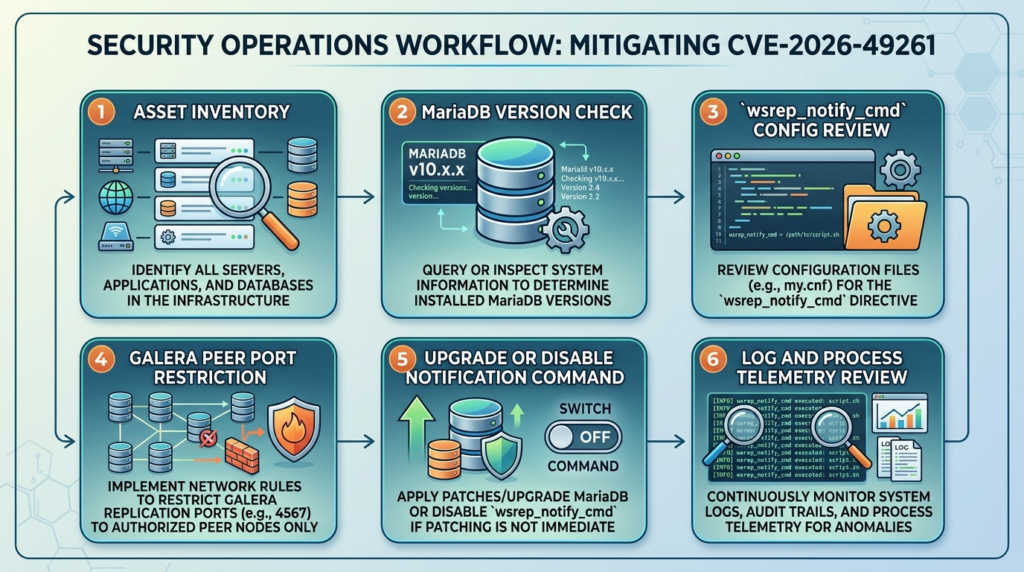
A good validation workflow proves risk and remediation without creating a new incident.
| שלב | מטרה | ראיות |
|---|---|---|
| 1 | Identify MariaDB assets | CMDB, cloud inventory, container registry, package scan, process scan. |
| 2 | Identify Galera usage | wsrep_on, wsrep_provider, cluster address, Galera ports. |
| 3 | Identify notification usage | wsrep_notify_cmd variable and config file path. |
| 4 | Map versions to fixed releases | SQL version, package metadata, image digest, vendor advisory. |
| 5 | Map network reachability | Security groups, firewalls, Kubernetes policies, ss, flow logs. |
| 6 | Disable or patch | Change record, package update logs, config diff. |
| 7 | Confirm after restart | Version query, wsrep status, cluster health. |
| 8 | Hunt for suspicious activity | Logs, process telemetry, network egress, filesystem changes. |
| 9 | Retest safely | Repeat inventory checks, not exploit payloads. |
| 10 | Produce final evidence | Before/after screenshots, command output, advisory references, residual risk statement. |
For authorized security teams that need repeatable validation across many assets, evidence capture matters as much as scanner output. Penligent’s authorized AI pentesting workflow focuses on attack-surface mapping, controlled validation, evidence collection, and report generation for security engineers working under explicit permission. That type of workflow is most useful here when it stays on the defensive side: enumerate MariaDB/Galera exposure, confirm configuration state, record patch evidence, and preserve reproducible findings without turning a production cluster into an exploit lab. (Penligent)
What not to do
Avoid these mistakes:
| Mistake | Why it is dangerous |
|---|---|
| Testing with a malicious node name in production | You may trigger code execution, destabilize the cluster, or create forensic ambiguity. |
| Assuming no public 3306 means no exposure | The vulnerable path is cluster-plane behavior, not only SQL client access. |
| Patching only one node | Mixed clusters can retain vulnerable members. |
| Disabling the script without notifying operations | Load balancer or monitoring automation may silently stop working. |
| Re-enabling notify scripts before upgrading | You may restore the vulnerable path. |
| Trusting internal networks by default | Internal workloads can be compromised or misconfigured. |
| Ignoring related SST CVEs | The same Galera environment may be affected by multiple command-injection paths. |
| Treating absence of logs as proof | Short-lived commands may leave limited MariaDB log evidence. |
A disciplined response makes the cluster safer without creating a second outage.
Incident response playbook
If an affected cluster had wsrep_notify_cmd enabled and Galera peer ports were reachable from untrusted or broad networks, handle it as a potential host compromise until evidence says otherwise.
Immediate containment:
- Restrict Galera ports to known nodes.
- Disable
wsrep_notify_cmdor patch immediately. - Preserve logs before restarting if suspicious activity exists.
- Snapshot affected hosts where feasible.
- Record current process tree and network connections.
- Identify all peers that joined or attempted to join during the exposure window.
Host investigation:
date -Is
hostname -f
whoami
ps auxf
sudo ss -pantuw
sudo journalctl -u mariadb --since "2026-06-01" --no-pager > mariadb-journal-review.log
sudo find /tmp /var/tmp -xdev -type f -mtime -30 -ls
sudo find /etc/systemd /etc/cron.d /var/spool/cron -xdev -type f -mtime -30 -ls 2>/dev/null
Credential review:
- Rotate credentials readable by the MariaDB service account.
- Rotate database replication and backup credentials if exposed.
- Rotate service-discovery or load balancer API tokens used by notify scripts.
- Review secrets mounted into containers.
- Review cloud metadata access controls.
- Review SSH keys and admin credentials on database hosts.
Cluster review:
- Check every node, not only the first patched host.
- Compare node names and incoming addresses against expected inventory.
- Check for unusual cluster membership churn.
- Confirm no unknown node joined during the vulnerable period.
- Confirm backups were not modified or exfiltrated.
The decision to rotate credentials depends on exposure. If the service account had read access to secrets and there is any sign of suspicious command execution, rotation is safer than debating whether the attacker read a file.
Why disabling wsrep_notify_cmd may not be operationally trivial
MariaDB’s workaround is direct: disable wsrep_notify_cmd if you cannot upgrade immediately. (GitHub) In many environments, that is safe. In others, it changes how the cluster interacts with dependent systems.
Before disabling it, answer:
| תלות | Question |
|---|---|
| Load balancer | Does the script add or remove nodes from backend pools? |
| ניטור | Does the script create alerts that replace another health signal? |
| Service discovery | Does the script update Consul, DNS, Kubernetes, or another registry? |
| Failover automation | Does the script influence traffic routing during donor/desync states? |
| Compliance logging | Does the script create required audit events? |
| Backups | Does the script coordinate with backup windows or donor selection? |
If the script controls production traffic, create a temporary manual process. For example, disable notification, patch the cluster, and have the operations team manually drain and re-add nodes through the load balancer until the fixed version is deployed. Do not keep a vulnerable command path enabled just because it is convenient.
Secure node naming
The public JIRA issue specifically identifies peer wsrep_node_name as one of the unsafe values. (jira.mariadb.org) Even after patching, node naming should be boring and controlled.
A good node name policy:
- Use predictable names, such as
db-galera-01,db-galera-02,db-galera-03. - Avoid spaces, punctuation, shell metacharacters, and user-controlled values.
- Do not derive node names directly from cloud tags without validation.
- Do not use externally supplied hostnames without normalization.
- Enforce names through configuration management.
- Alert when a node name does not match the expected pattern.
Example validation logic for deployment automation:
validate_node_name() {
  local name="$1"
  if [[ "$name" =~ ^db-galera-[0-9]{2}$ ]]; then
    return 0
  fi
  echo "Invalid wsrep_node_name: $name" >&2
  return 1
}
This does not replace vendor patches. It prevents a class of bad operational inputs from becoming tomorrow’s security problem.
Why CVE-2026-49261 matters to bug bounty hunters and red teams
For authorized testers, the most useful takeaway is not a payload. It is the attack-surface category. Database HA layers often contain privileged operational paths that normal web scanners will never model.
During an authorized assessment, look for:
- Publicly reachable or broadly reachable Galera ports.
- MariaDB/Galera banners and package versions.
- Configuration leaks showing
wsrep_notify_cmd. - Kubernetes manifests exposing Galera services.
- Overly broad internal network trust.
- Backup and SST endpoints reachable from non-database hosts.
- Evidence that node identity is generated from untrusted metadata.
- Notification scripts with dangerous shell patterns.
A responsible report should avoid claiming RCE from version alone. A better finding states:
- Affected MariaDB/Galera version was observed.
wsrep_notify_cmdwas confirmed enabled, if in scope and safely verifiable.- Galera peer ports were reachable from an unauthorized segment.
- The environment matches the vulnerable preconditions described by MariaDB.
- Exploit validation was not performed against production because it could execute commands.
- Recommended remediation is upgrade, disable notification until patched, and restrict peer traffic.
That is more credible than a dramatic exploit claim without safe proof.
Why defenders should not treat this as only a patch ticket
Patching is mandatory, but the root cause class points to architecture. A cluster that allows untrusted hosts to reach peer ports was already too trusting. A notify script with broad credentials was already too powerful. A database service account that can read unrelated secrets was already too exposed. CVE-2026-49261 makes those weaknesses urgent.
Use the patch event to improve the baseline:
| בקרה | Better target state |
|---|---|
| מלאי נכסים | Every MariaDB and Galera node has owner, version, package source, and cluster role. |
| Config inventory | wsrep_notify_cmd usage is known, justified, and reviewed. |
| Peer network | Only expected nodes can reach Galera replication and SST ports. |
| Script security | Notify scripts are root-owned, minimally privileged, and free of dynamic shell evaluation. |
| Service account | MariaDB user has only required filesystem and secret access. |
| ניטור | Process execution by MariaDB is logged and alertable. |
| Change control | Adding a Galera node is a controlled operation. |
| ראיות | Patch and mitigation evidence is captured for every cluster. |
שאלות נפוצות
Is CVE-2026-49261 exploitable on every MariaDB server?
- No. The confirmed vulnerable path involves MariaDB Galera Cluster behavior with
wsrep_notify_cmdenabled. - A standalone MariaDB server with no Galera/wsrep configuration and no
wsrep_notify_cmddoes not match the main exposure described by the advisory. - You still need to check version, package source, and configuration before closing the ticket.
- Do not rely on product name alone; verify
wsrep_on,wsrep_provider,wsrep_cluster_address, וwsrep_notify_cmd.
What is wsrep_notify_cmd used for?
wsrep_notify_cmdlets MariaDB Galera Cluster execute a configured command or script when node state or cluster membership changes.- Common uses include load balancer updates, monitoring alerts, and service discovery updates.
- MariaDB documentation shows that the notification command receives values such as node status, view ID, members list, and primary-component state.
- The security risk appears when peer-influenced values are placed into a shell command boundary without strict validation.
How do I know whether my cluster is affected?
- Check MariaDB version with
SELECT VERSION();. - Check whether Galera/wsrep is active with
SHOW GLOBAL VARIABLES LIKE 'wsrep_on';וSHOW GLOBAL VARIABLES LIKE 'wsrep_provider';. - Check whether
wsrep_notify_cmdis non-empty withSHOW GLOBAL VARIABLES LIKE 'wsrep_notify_cmd';. - Search configuration files and deployment manifests because runtime output and config management can differ.
- Compare your installed package or image against the fixed versions or your distribution’s security advisory.
Is disabling wsrep_notify_cmd enough?
- It is the official workaround when you cannot upgrade immediately.
- It removes the specific notification-command path involved in CVE-2026-49261.
- It does not fix related Galera SST vulnerabilities, old packages, broad peer exposure, or weak service-account permissions.
- It may disrupt load balancer, monitoring, or service-discovery automation, so coordinate with operations before disabling it in production.
- The final state should still be a patched MariaDB version or a distribution package containing the backported fix.
What ports should I restrict for MariaDB Galera?
- Review 3306 for client SQL access.
- Review 4567 TCP/UDP for Galera replication traffic.
- Review 4568 TCP for Incremental State Transfer in common deployments.
- Review 4444 TCP for State Snapshot Transfer in common deployments.
- Confirm actual ports from your configuration, because Galera settings and deployment tooling can change defaults.
- Allow only known cluster nodes to reach peer ports.
How is CVE-2026-49261 different from CVE-2026-48163 and CVE-2026-44168?
- CVE-2026-49261 affects the
wsrep_notify_cmdnotification path. - CVE-2026-48163 affects donor-side command handling during rsync SST.
- CVE-2026-44168 affects donor-side command handling during mariabackup SST.
- All are related by a common pattern: Galera/wsrep operational values reaching shell command lines without sufficient validation.
- Defenders should patch the full Galera-related update set, not only the single CVE that appears in a scanner result.
What logs should I check after possible exposure?
- MariaDB and journald logs for Galera join events, notification errors, cluster view changes, and unusual node metadata.
- EDR or auditd process telemetry for shells or network tools spawned by the MariaDB service user.
- Cloud flow logs for unexpected outbound traffic from database hosts.
- File modification times in temporary directories, MariaDB-writable paths, cron directories, and systemd unit paths.
- Load balancer and service-discovery logs if notify scripts had permission to modify backend membership.
Should I rotate credentials after patching?
- Rotate credentials if there is evidence of command execution.
- Rotate credentials if the MariaDB service account could read secrets and peer ports were exposed to untrusted networks.
- Prioritize database replication credentials, backup credentials, service-discovery tokens, load balancer API keys, and secrets mounted into containers.
- If exposure was tightly limited, no suspicious activity exists, and
wsrep_notify_cmdwas disabled, credential rotation may be risk-based rather than automatic. - Document the reasoning either way.
Closing judgment
CVE-2026-49261 is a database-cluster control-plane vulnerability, not a normal SQL-layer bug. The vulnerable condition is specific enough to verify: affected MariaDB versions, Galera/wsrep usage, wsrep_notify_cmd enabled, and a cluster peer path that can process unsafe joiner metadata. The fix is also clear: upgrade to the fixed MariaDB branch release or distribution package, and disable wsrep_notify_cmd until that can happen.
The bigger security lesson is that high-availability automation is part of the attack surface. A notification hook that updates a load balancer may look like operations glue, but it runs near a critical data system and may cross a shell boundary. Patch the server, restrict the cluster network, review the script, reduce the service-account blast radius, and keep enough process telemetry to prove what happened the next time a database automation feature becomes a security boundary.
 Hebrew
  English
  German
  French
  Spanish
  Portuguese
  Japanese
  Korean
  Hindi
Hindi  Arabic
  Turkish