
A Linux CVE entry is not a verdict on a server. It is the beginning of an investigation.
The identifier may describe a use-after-free in nf_tables, an out-of-bounds access in a USB driver, a race in memory management, or a logic error that allows page-cache-backed data to be modified through an unexpected kernel path. None of those descriptions, by themselves, prove that a particular production host is exploitable. The answer depends on the kernel that is actually running, the distribution’s backported fixes, the enabled configuration, loaded modules, reachable system calls, container restrictions, attacker privileges, and whether the affected subsystem is used at all.
That distinction has become more important as the Linux kernel project has taken greater control of its own CVE assignments. The project’s published process says potentially security-relevant fixes are identified during the stable release workflow and assigned CVE identifiers on a frequent basis. It also explains that the assignment team is intentionally cautious because the exploitability of a kernel bug is often unclear when the bug is fixed. The result is a large and useful stream of security identifiers, but not a ready-made list of equally urgent emergencies. (Linux Kernel Documentation)
A useful Linux CVE workflow therefore has to answer five separate questions:
- Does the vulnerable code exist in the kernel or distribution package we use?
- Can an attacker reach that code under our configuration and security controls?
- What privileges or physical access are required before exploitation begins?
- Has our distribution shipped and installed a fix?
- Is the machine now running the fixed code, and can we prove it?
A Linux CVE hub should make those questions easier to answer. It should not behave like a feed that simply republishes vulnerability titles, CVSS scores, and upstream version ranges. The value lies in connecting public vulnerability intelligence to the real state of Linux servers, workstations, appliances, container nodes, CI runners, cloud workloads, and embedded systems.
What a Linux CVE Means Now
CVE identifiers provide a common way to name publicly disclosed vulnerabilities. For years, however, the relationship between CVE assignment and Linux kernel development was uncomfortable. The kernel project argued that identifiers were sometimes assigned incorrectly, incompletely, or without sufficient subsystem knowledge. Its current documentation states that the Linux kernel developer team can assign CVEs for potential kernel security issues and publishes those assignments through the linux-cve-announce mailing list. (Linux Kernel Documentation)
The current process has several operational consequences.
First, many assignments are attached to fixes that have already entered a stable kernel tree. The kernel documentation says automatic assignment does not normally occur for an unfixed issue; it happens after a fix is available and applied to a stable tree, where the original fix can be tracked by commit ID. This is different from vulnerability programs where a CVE may be reserved and publicly discussed before a patch exists. (Linux Kernel Documentation)
Second, the kernel team intentionally errs on the side of assigning identifiers. Kernel code sits underneath processes, memory, devices, filesystems, networks, containers, and virtualization. A defect that initially appears to be a crash or incorrect state transition may later prove to have security consequences. The kernel’s CVE documentation explicitly says that almost any kernel bug might be exploitable, even when that possibility is not obvious at fix time, which is why the team takes a cautious approach. (Linux Kernel Documentation)
Third, applicability remains the user’s responsibility. The same documentation notes that Linux can be built and used in many different ways and that a given system uses only a subset of the source tree. It warns that many assigned CVEs will not be relevant to every machine. The CVE assignment team does not know whether a particular organization enables the affected driver, allows unprivileged user namespaces, exposes a device to untrusted users, or runs hostile code inside containers. (Linux Kernel Documentation)
This produces a useful mental model:
A Linux kernel CVE identifies a potentially security-relevant code defect. Exposure is an environment-specific conclusion that still requires evidence.
That model prevents two opposite mistakes. One is panic: treating every new kernel CVE as an immediate compromise of every Linux machine. The other is complacency: dismissing a vulnerability because its CVSS attack vector is local, because a scanner cannot find an exact version match, or because the affected subsystem appears unrelated to the host’s primary purpose.
A local flaw in a rarely loaded media driver may be irrelevant to a locked-down headless server. The same class of flaw may become urgent on an Android device, desktop fleet, kiosk, media-processing host, or system where malicious USB devices are a realistic threat. A namespace-reachable Netfilter defect may be less relevant on a single-user appliance with user namespaces disabled, but critical on shared container infrastructure that routinely executes code supplied by different teams or customers.
The identifier tells you where to start. It does not replace the analysis.
The Source Hierarchy for Linux Vulnerability Decisions
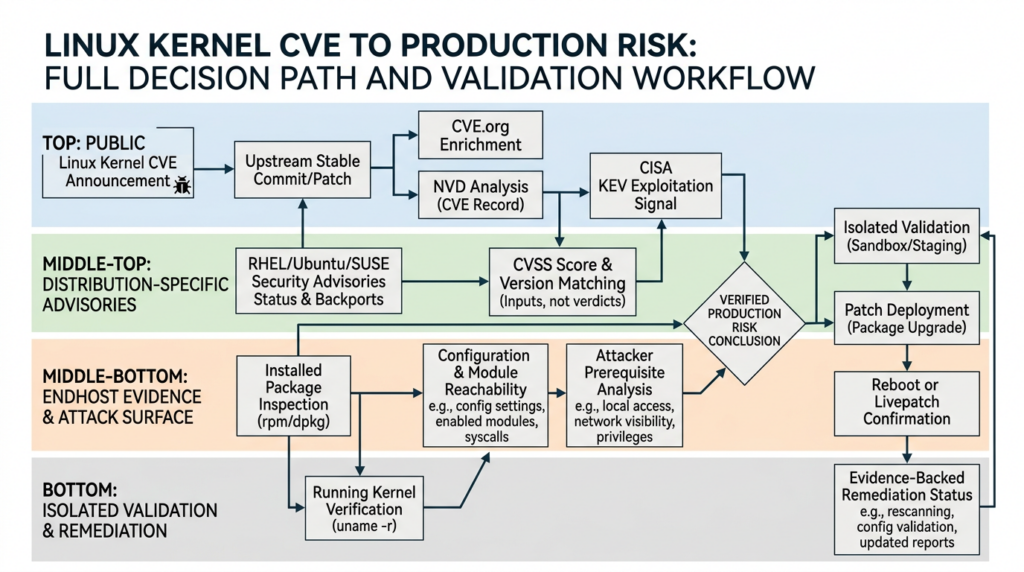
No single vulnerability database contains every fact needed for a defensible Linux CVE conclusion. Security teams need a source hierarchy because each source answers a different question.
| מקור | Best use | What it does not prove |
|---|---|---|
| Linux kernel CVE announcements | Official kernel CVE assignment and associated fixes | Whether a distribution package is affected or fixed |
| Kernel stable commits | Root cause, changed code, introduced and fixed commit relationships | Whether the deployed vendor kernel contains a backport |
| CVE.org | Canonical identifier and CNA-provided record | Environment-specific exploitability |
| NVD | Consolidated descriptions, scoring, references, CPE data, and enrichment | Final distribution package status |
| CISA KEV | Evidence that exploitation has been observed | That every deployment is reachable or compromised |
| Ubuntu CVE Tracker and USNs | Ubuntu release and package-specific status | Status of Debian, RHEL, SUSE, or custom kernels |
| Red Hat CVE pages and advisories | Product-specific impact, package fixes, mitigations, and backports | Status of other distributions |
| Debian Security Tracker | Debian suite and source-package status | Status outside Debian |
| Researcher disclosure | Exploit primitive, technical chain, lab results, and limitations | Guaranteed success on every production environment |
| Public PoC repository | Confirmation that exploit research is available | Safe or authorized use on live systems |
| Local evidence | Running kernel, configuration, modules, namespaces, workload exposure | Broader ecosystem impact without external context |
The Linux kernel announcement and stable commit are normally the best places to understand what code changed. A distribution tracker is normally the best place to decide whether a supported Ubuntu, Debian, RHEL, or SUSE package is fixed. CISA’s Known Exploited Vulnerabilities Catalog is one of the strongest prioritization signals because inclusion requires evidence of real exploitation, but it still does not answer whether a specific host exposes the necessary path.
Ubuntu documents that its security team tracks vulnerabilities through the Ubuntu CVE Tracker and publishes Ubuntu Security Notices when fixed packages are released. Its CVE pages can show different states for the same source package across releases, hardware enablement kernels, cloud kernels, and extended-support products. (Ubuntu)
Debian’s Security Tracker similarly combines Debian Security Advisories, CVE data, NVD information, package records, and Debian bug tracking. A single CVE page can distinguish whether bookworm, bookworm-security, trixie, sid, or an older supported suite remains vulnerable or has a fixed package. (Debian Security Team)
Red Hat’s backporting model is especially important for understanding why version-only scanners often disagree with vendor status. Red Hat defines backporting as taking a security fix from a newer upstream version and applying it to an older version distributed in an enterprise product. The visible upstream version can remain old while the relevant security change is present in the vendor package. (Red Hat Customer Portal)
These sources should be used together rather than ranked as mutually exclusive alternatives.
For example, NVD may identify an upstream affected range. Red Hat may say its kernel package with an older-looking base version is fixed through a backport. A scanner that compares only the base version may continue to report the issue. The correct conclusion is not that NVD is useless or that Red Hat is automatically right in every context. The correct response is to trace the installed package to the vendor advisory, verify the vendor’s fixed build, confirm that build is installed, and then confirm that the fixed kernel is running.
Why Kernel Version Matching Fails So Often
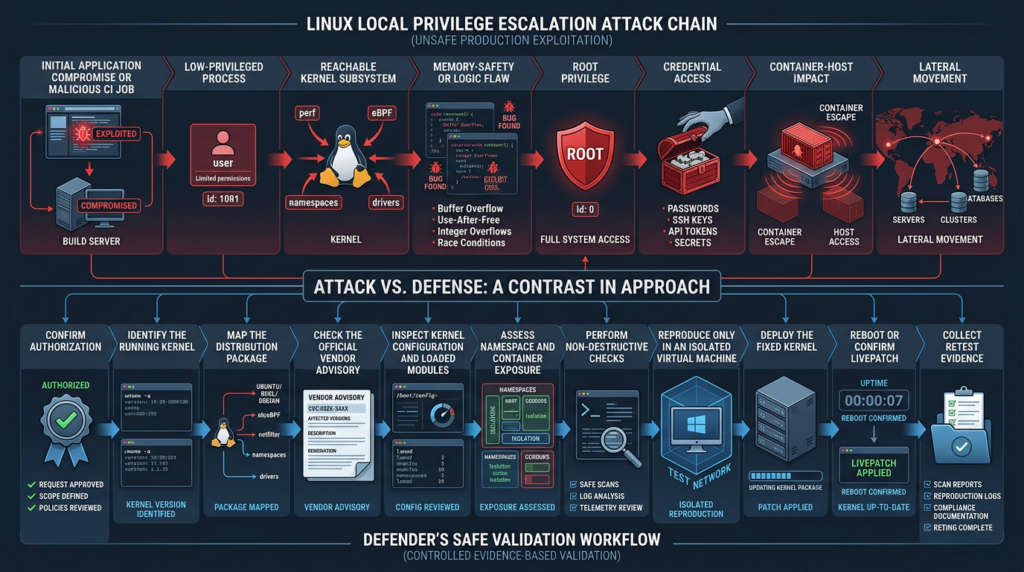
Linux vulnerability management is unusually hostile to simplistic version comparisons.
An upstream kernel release might be identified as fixed in version 6.x.y. Ubuntu may backport the relevant commit into a 5.15.0-... package. Red Hat may include an equivalent fix in a vendor kernel carrying an enterprise release suffix. Debian may publish a fixed build through a security repository while the base stable release retains the same upstream major and minor version.
That means the following inference is unsafe:
Upstream says fixed in 6.1.120
Host runs 5.15
Therefore host is vulnerable
The host may be vulnerable, but the conclusion cannot be established from those two lines alone. The distribution may have backported the fix. The kernel package may include a vendor-specific patch series. The affected feature may be absent. Conversely, a custom 6.2 kernel may still be vulnerable if it was built from a tree that did not include the fix or if a later regression reintroduced the problem.
The reliable comparison is:
Running kernel release
        +
Installed distribution package
        +
Vendor CVE status for that package and release
        +
Evidence that the machine booted into the fixed package
A scanner remains useful. It can locate candidate hosts, normalize CVE identifiers, and provide scale. The problem begins when a package fingerprint is treated as proof rather than a lead.
A sound finding should distinguish at least four states:
| מדינה | משמעות |
|---|---|
| Potentially affected | Version or package metadata overlaps a published range |
| Environmentally reachable | Required module, configuration, device, namespace, syscall, or workload condition exists |
| Exploitability confirmed in a lab | Authorized reproduction succeeded against a representative isolated environment |
| Remediated and verified | Fixed package is installed, fixed code is active, and relevant checks have been repeated |
Many vulnerability tools collapse the first state into the second or third. That creates noise, patch fatigue, and arguments between security and infrastructure teams. A Linux CVE hub should preserve the distinction.
CVSS Is Context, Not a Queue
CVSS helps describe technical properties such as attack vector, required privileges, complexity, user interaction, and impact. It does not know whether a host is a shared CI runner or an offline appliance. It does not know whether code from untrusted pull requests runs every five minutes. It does not know whether a container is privileged, whether a vulnerable module is blacklisted, or whether a public exploit has become reliable across common distributions.
Consider two hosts affected by the same local privilege-escalation CVE:
Host A
- Single-purpose appliance
- No interactive users
- No application code upload
- No containers
- Affected module not loaded
- Strictly controlled update channel
- Physical access restricted
Host B
- Shared CI runner
- Executes pull requests from external contributors
- User namespaces enabled
- Broad kernel syscall exposure
- Multiple secrets available to root
- Persistent access to internal build infrastructure
The CVSS base score is identical. The operational risk is not.
A practical Linux CVE priority model should include:
| Factor | Questions |
|---|---|
| Known exploitation | Is the CVE in CISA KEV or supported by another credible exploitation report? |
| Public exploit maturity | Is there a working PoC, and is it reliable or configuration-dependent? |
| Initial access | Does exploitation require local code execution, a malicious device, authentication, or a network path? |
| Reachability | Is the subsystem built, loaded, enabled, and accessible to the attacker? |
| Privilege transition | Does the issue permit root, kernel code execution, host escape, data exposure, or only a crash? |
| Workload trust | Does the host execute untrusted, customer-supplied, plugin, build, or notebook code? |
| Tenant density | How many workloads or customers share the kernel? |
| Asset sensitivity | What credentials, signing keys, source code, or production data become reachable after root? |
| Patch availability | Is a supported vendor update available? |
| Deployment friction | Does remediation require a reboot, node drain, failover, or compatibility testing? |
| Compensating controls | Do seccomp, user namespaces, SELinux, AppArmor, device restrictions, or module policy block the path? |
| Detection quality | Would exploitation generate observable events in the current telemetry stack? |
Known exploitation should move a vulnerability sharply upward. CISA added CVE-2024-1086, a Linux nf_tables use-after-free that can permit local privilege escalation, to the KEV catalog in May 2024. The underlying NVD record describes a double-free condition arising from verdict handling in Netfilter and recommends moving beyond the fixing commit. (CISA)
That does not mean every machine with an older-looking kernel was exploitable. It means the cost of being wrong increased. Security teams should quickly determine whether the vulnerable code and required namespace conditions were present, then patch through the supported distribution channel.
The Linux Kernel Attack Surface
Linux is not a single monolithic service exposed in one predictable way. It is a configurable kernel with hundreds of subsystems, drivers, filesystems, protocols, security modules, and architecture-specific paths. The reachable attack surface changes based on the build configuration and workload.
Memory management and the page cache
Memory-management defects can violate boundaries between readable and writable mappings, private and shared pages, or file-backed and anonymous memory. Dirty COW and Dirty Pipe became famous because they turned subtle kernel state errors into writes against data that should have been protected.
The page cache deserves special attention. Linux keeps file-backed pages in memory so that repeated reads, mappings, and executions do not always require storage access. A bug that changes the cached representation can affect what a process reads or executes even when the normal filesystem write path was not used.
That creates forensic complications. Traditional file-integrity monitoring focuses on filesystem events and disk contents. Some page-cache corruption paths may alter an in-memory view without producing the expected persistent file modification. Disk verification remains valuable, but it is not a universal detector for every kernel write-boundary failure.
Netfilter and nftables
Netfilter processes packet-filtering and network-policy operations inside the kernel. Its nf_tables subsystem is complex, stateful, and frequently reachable through namespaces in containerized environments. Use-after-free, transaction rollback, object lifetime, and verdict-processing errors in this area have repeatedly produced local privilege-escalation research.
The risk is not limited to administrators who manually use the nft command. Container networking, orchestration, firewalls, and network-policy systems may depend on Netfilter. Removing the userspace tool does not necessarily make the kernel subsystem unreachable.
User namespaces
User namespaces allow a process to have a set of user and capability mappings inside a namespace that differ from those on the host. They are fundamental to rootless containers and multiple sandbox designs. They also expose kernel operations to processes that lack equivalent privileges in the initial namespace.
This makes user namespaces security-relevant in two opposing ways. They can improve isolation by mapping container root to an unprivileged host user. They can also make privileged-looking kernel paths reachable to an unprivileged process inside the namespace.
The correct decision is not “user namespaces are always unsafe” or “user namespaces always solve container security.” It is to evaluate the particular CVE’s namespace requirements and the architecture’s isolation model.
io_uring
io_uring provides high-performance asynchronous I/O through shared ring buffers between userspace and the kernel. Its performance benefits come with a large and complicated kernel interface involving registered files, buffers, networking, memory pinning, and asynchronous object lifetimes. Vulnerabilities in such paths can involve reference counting, stale pointers, or state transitions that are difficult to reason about.
Some organizations restrict io_uring in sandboxed workloads when it is not needed. That may reduce exposure to certain bug classes, but the decision should be based on application compatibility, kernel version, and the specific vulnerability rather than a blanket assumption.
eBPF
eBPF allows verified programs to run within the kernel for networking, observability, tracing, and security use cases. The verifier is designed to prevent unsafe programs, but verifier logic, JIT compilation, helper semantics, and privileged program types create a significant security boundary.
Exposure depends heavily on whether unprivileged eBPF is enabled, which program types are allowed, and what capabilities a process has. Many production clusters rely on eBPF-based networking or observability, so “disable eBPF” is rarely a useful universal remediation.
KVM and virtualization
KVM bugs can affect host-guest boundaries, virtual CPU state, memory translation, interrupt handling, or device emulation. The meaningful attacker may be a guest rather than a local host user. In cloud and hosting environments, that changes prioritization because running untrusted guest code is the normal operating model.
USB, media, and device drivers
Device drivers parse data supplied by hardware, firmware, descriptors, and peripheral protocols. A malformed USB device can be an attacker-controlled input. CVE-2024-53104, for example, involved an out-of-bounds write in the UVC video driver when parsing undefined frame types that were not included in the frame-buffer size calculation. CISA added the vulnerability to KEV in February 2025. (NVD)
Two other kernel issues, CVE-2024-53197 and CVE-2024-53150, involved malformed USB audio configuration or descriptor data. CVE-2024-53197 concerned out-of-bounds accesses when a device supplied an unexpected configuration count, while CVE-2024-53150 concerned insufficient length validation while traversing audio clock descriptors. CISA later identified both as known-exploited vulnerabilities. (CISA)
These cases demonstrate why attack-vector labels require interpretation. “Local” may include physical peripheral access, a malicious accessory, a compromised USB device, or a virtualized device path on a mobile platform. The relevant control may be kernel patching, device policy, endpoint hardening, or all three.
Filesystems and network protocols
Linux supports many local, network, legacy, and specialized filesystems. A filesystem parser may process data from an image, removable device, network share, container layer, or untrusted disk. Network protocols may be reachable through socket creation even when an administrator believes the service is unused. Kubernetes documentation warns that unprivileged processes can sometimes cause protocol-related kernel modules to load simply by creating an appropriate socket. (Kubernetes)
The lesson is that “we do not intentionally use this feature” is weaker than evidence showing that the code is absent, blocked, or unreachable.
Common Kernel Bug Classes
The technical label attached to a Linux CVE often predicts the type of validation and detection work required.
Use-after-free
A use-after-free occurs when code continues using an object after its memory has been released. If another allocation reuses the same memory, stale references may operate on attacker-influenced data.
Exploitability depends on:
- Whether the free and later use can be triggered by an unprivileged process
- Whether heap layout can be influenced
- Which kernel object replaces the freed memory
- Available information leaks
- Kernel hardening such as KASLR, SMEP, SMAP, PAN, and allocator protections
- Reliability across architectures and distribution builds
A crash proves that a memory-safety violation may be reachable, but it does not prove reliable privilege escalation. Conversely, an exploit can sometimes avoid obvious crashes.
Double free
A double free releases the same allocation more than once. It can corrupt allocator metadata, create overlapping allocations, or combine with use-after-free behavior. CVE-2024-1086’s public description connects incorrect Netfilter verdict handling to a double-free condition that enables local privilege escalation. (NVD)
Out-of-bounds read
An out-of-bounds read may expose adjacent kernel memory, cause a crash, or provide information needed to defeat address-space protections. The security impact depends on what can be read, whether the data reaches userspace, and whether the primitive can be repeated.
Out-of-bounds write
An out-of-bounds write can corrupt nearby objects, function pointers, lengths, credentials, or allocator structures. The result may range from denial of service to kernel code execution. The presence of a write does not guarantee an easy exploit, but it warrants careful attention because integrity failures at kernel privilege are severe.
Race condition
Race-condition exploits depend on two or more operations occurring in a specific order. Reliability varies with CPU count, scheduling, system load, locking behavior, and kernel build.
Dirty COW was a race in copy-on-write handling. NVD describes it as allowing a local user to write to a read-only mapping and notes exploitation in the wild in October 2016. (NVD)
Race conditions complicate validation. A failed PoC run does not establish safety because timing may differ. Repeatedly running a race exploit on production is also dangerous because unsuccessful attempts can corrupt state or crash the host.
Uninitialized state
Uninitialized fields can retain stale values from earlier object use. Dirty Pipe involved pipe-buffer flags that were not correctly initialized. Under the right conditions, an unprivileged user could use the stale state to write into page-cache-backed read-only files and escalate privileges. (NVD)
Reference-counting errors
Reference counts determine when kernel objects can be freed. Missing increments, duplicate decrements, or races around ownership can produce stale references and use-after-free conditions.
Type confusion
Type confusion occurs when memory representing one object type is interpreted as another. The attacker may gain control over fields that the kernel later treats as pointers, lengths, callbacks, or credentials.
Ownership and aliasing failures
Some modern kernel vulnerabilities do not begin with an obvious memory-unsafe C operation. They arise when one subsystem passes a page, buffer, fragment, or scatter-gather list to another subsystem under incompatible assumptions.
One component believes it is providing read-only input. Another believes the same memory is private writable output. Individually, each API can appear reasonable. The vulnerability exists in the composition.
This class is especially important for high-performance features that avoid copying. Zero-copy and in-place operations reduce overhead by sharing memory references. They also make provenance, mutability, lifetime, and ownership part of the security boundary.
Why Local Privilege Escalation Is Often the Decisive Step
The word “local” is frequently misread as “low priority.”
A local privilege-escalation vulnerability usually does not provide initial network access. An attacker first needs some form of code execution on the machine. That requirement matters, but modern infrastructure creates many legitimate and adversarial paths to low-privileged execution:
- A web application compromised through command injection or deserialization
- An SSH account with limited permissions
- A CI job executing code from a pull request
- A malicious package installation script
- A notebook or data-science platform running user code
- A browser or document exploit escaping into a restricted process
- A plugin system executing third-party extensions
- A shared hosting account
- A container workload controlled by a tenant
- A compromised service running as
www-data,nginx,node, or another restricted user
Initial execution may be intentionally constrained. The process cannot read /etc/shadow, access the container runtime socket, modify system services, inspect other tenants, or load arbitrary kernel modules. A kernel LPE can remove those constraints.
The complete attack chain often looks like this:
| שלב | דוגמה | Security boundary |
|---|---|---|
| Initial access | Web RCE, stolen SSH credential, malicious build, compromised dependency | Internet or supply-chain boundary |
| Low-privileged execution | www-data, build user, container UID, sandbox process | Process and identity boundary |
| Kernel vulnerability | nf_tables, page cache, filesystem, driver, namespace path | User-to-kernel boundary |
| העלאת הרשאות | Root or kernel-level control | Operating-system privilege boundary |
| Post-exploitation | Credential theft, security-agent tampering, persistence, lateral movement | Host and enterprise trust boundaries |
A host that executes no untrusted code and exposes no initial-access path may have lower immediate risk from a local vulnerability. A CI runner exists specifically to execute code supplied by developers and automation. A Kubernetes node exists to host many workloads on a shared kernel. Those machines should not automatically inherit the same priority as a single-user offline workstation.
Local privilege escalation is also important for incident containment. A compromised application account may be recoverable by rebuilding one service and rotating a small set of credentials. Root compromise can force a broader response because the attacker may have altered logging, replaced binaries, accessed host secrets, inspected other processes, or modified the boot environment.
Linux CVEs That Define the Risk Patterns
The following vulnerabilities illustrate different reasons a Linux CVE becomes operationally important.
| CVE | Subsystem | Core issue | Typical prerequisite | שיעור עיקרי |
|---|---|---|---|---|
| CVE-2016-5195 Dirty COW | Memory management | Copy-on-write race allowed writes to read-only mappings | Local low-privileged execution | Race bugs can turn a long-standing memory optimization into root compromise |
| CVE-2022-0847 Dirty Pipe | Pipe and page cache | Uninitialized pipe-buffer flags enabled writes to page-cache-backed read-only files | Local unprivileged execution | Stale kernel state can bypass file-write expectations |
| CVE-2024-1086 | Netfilter nf_tables | Use-after-free and double-free condition | Local execution with required namespace and Netfilter reachability | Container and namespace exposure can make complex kernel networking code available to attackers |
| CVE-2024-53104 | UVC video driver | Out-of-bounds write while parsing frame descriptors | Access to a malicious or attacker-controlled device path | Hardware input is still untrusted input |
| CVE-2024-53197 | USB audio | Out-of-bounds access from malformed configuration count | Malicious USB audio device or equivalent path | Descriptor validation failures can cross into kernel memory safety |
| CVE-2024-53150 | USB audio | Out-of-bounds read from short clock descriptors | Malformed USB audio descriptors | Read bugs can expose data, crash systems, or support exploit chains |
| CVE-2026-31431 Copy Fail | Kernel crypto and page cache | Incorrect in-place handling allowed controlled page-cache writes | Local low-privileged execution with relevant crypto path | Cross-subsystem ownership failures can become reliable root paths |
Dirty COW
Dirty COW became a reference point for Linux privilege escalation because it affected the copy-on-write mechanism that normally allows processes to share pages until a write requires a private copy.
The bug involved a race between operations on a read-only mapping. If the attacker won the race, data that should have remained protected could be modified. NVD records that the vulnerability was exploited in the wild in October 2016. (NVD)
The enduring lesson is not merely that copy-on-write once had a race. It is that foundational performance mechanisms can create security failures when ownership changes are not synchronized correctly. It also demonstrates why “high attack complexity” does not mean “no practical exploitation.” A race may be difficult in theory yet reliable enough after exploit engineering.
צינור מלוכלך
Dirty Pipe replaced a race-driven story with an uninitialized-state story. The flags member of new pipe-buffer structures was not always initialized correctly. Stale flag values could cause the kernel to treat page-cache-backed data in a way that permitted modification.
NVD states that an unprivileged local user could write to pages backed by read-only files and use the flaw to escalate privileges. (NVD)
Dirty Pipe changed defensive assumptions in several ways:
- The attack did not require an ordinary writable file descriptor to the target.
- The underlying disk file and the cached execution path became distinct parts of the investigation.
- A narrow write primitive could have large consequences when aimed at trusted executable content.
- Containers did not eliminate host-kernel risk because container processes still interacted with the shared kernel.
CVE-2024-1086
CVE-2024-1086 affected Netfilter’s nf_tables component. The public NVD description explains that positive values could be accepted as a drop error, leading nf_hook_slow() into a double-free condition when a verdict resembled NF_ACCEPT. The issue could be exploited for local privilege escalation. (NVD)
Its inclusion in CISA KEV raised the priority beyond theoretical exposure. (CISA)
The practical validation questions were not limited to the kernel number:
- Was the distribution package fixed through a backport?
- Could an unprivileged user create the required namespaces?
- Was
nf_tablesreachable under the container or host policy? - Did the host execute untrusted local code?
- Was the updated kernel installed and running?
This is a strong example of why local, namespace, and container context must be evaluated together.
CVE-2024-53104
CVE-2024-53104 affected the UVC video driver’s format parsing. Frames with an undefined type were not accounted for correctly when calculating buffer size, creating an out-of-bounds write. NVD associates the issue with the UVC driver and records its addition to CISA KEV on February 5, 2025. (NVD)
The vulnerability shows why endpoint and mobile threat models differ from headless-server threat models. A server with no relevant hardware or virtual device path may have low reachability. A workstation, Android device, kiosk, or media system may process attacker-controlled USB descriptors as part of normal use.
CVE-2024-53197 and CVE-2024-53150
These USB audio issues involved malformed device-provided data.
CVE-2024-53197 concerned a device reporting a configuration count that exceeded the allocation assumptions, leading to later out-of-bounds accesses. CVE-2024-53150 concerned short descriptor lengths during clock-source traversal, creating out-of-bounds reads. (NVD)
CISA added both vulnerabilities to KEV in April 2025, indicating active exploitation evidence. (CISA)
Their shared lesson is straightforward: kernel drivers parse inputs from devices, and those devices cannot be assumed trustworthy. Physical access, malicious accessories, compromised peripheral firmware, and virtual device surfaces can all matter.
CVE-2026-31431 Copy Fail
Copy Fail is a more recent example of a cross-subsystem logic failure. The kernel CVE record describes the fix as reverting algif_aead to out-of-place operation because source and destination came from different mappings and the in-place complexity provided no benefit. (NVD)
Ubuntu classifies the issue as high priority and states that improper in-place cryptographic operation handling could allow a local attacker to escalate privileges or possibly escape a container. Its tracker provides different fixed package versions across supported Ubuntu releases, illustrating why one upstream version range is not enough for remediation decisions. (Ubuntu)
Microsoft and the original researchers described a chain involving the AF_ALG userspace crypto interface, splice(), and a controlled four-byte write into the page cache of a readable file. The important defensive concept is that a buffer treated as input by one path was later treated as writable scratch or output by another. (Xint)
CISA added CVE-2026-31431 to KEV on May 1, 2026. (CISA)
For a deeper technical explanation of the page-cache boundary and validation considerations, Penligent’s Copy Fail CVE-2026-31431 analysis follows the chain from the crypto path to the defensive implications without requiring production exploitation.
Copy Fail should not encourage teams to execute public root exploits on live hosts. Its operational value is that it exposes the limits of version-only triage, disk-only integrity checks, and assumptions that a container automatically protects the host from kernel bugs.
A Safe Linux CVE Validation Workflow
A good validation process moves from least invasive evidence to more controlled testing. It should never begin by downloading a public exploit onto a production server.
Step 1: Establish authorization and scope
Before interacting with a system, record:
- The system owner
- The approved target or asset group
- The permitted validation methods
- Whether rebooting is allowed
- Whether a representative lab image is available
- Whether container, node, cloud, and network scopes are separately authorized
- The allowed testing window
- The rollback and incident contacts
Kernel testing can crash a machine, corrupt memory, interrupt workloads, or trigger security monitoring. Authorization must explicitly cover the method, not merely the hostname.
Step 2: Identify the asset’s role
Two identical kernels may carry different business risk.
Record whether the machine is:
- A single-user workstation
- An internet-facing application server
- A Kubernetes node
- A CI runner
- A shared research system
- A hypervisor
- A container host
- An embedded device
- A database server
- A security appliance
- A desktop or mobile endpoint
- A cloud image used to create new instances
Also identify what becomes accessible after root compromise: signing keys, cloud credentials, source code, customer data, runtime secrets, container credentials, or access to internal control planes.
Step 3: Confirm the running kernel
The running kernel is the primary object of investigation.
uname -r
uname -a
cat /proc/version
Do not stop after listing installed packages. A newer kernel can be present on disk while the machine continues running the older vulnerable image.
On systems using systemd, the following can provide boot context:
journalctl --list-boots
journalctl -b 0 -k --no-pager | head -n 50
For evidence, record the command output and collection time.
Step 4: Identify the distribution and package source
cat /etc/os-release
On Debian and Ubuntu:
dpkg-query -W 'linux-image-*' 2>/dev/null | sort
dpkg -S "/boot/vmlinuz-$(uname -r)" 2>/dev/null
apt-cache policy "linux-image-$(uname -r)" 2>/dev/null
On RHEL-family systems:
rpm -q kernel kernel-core 2>/dev/null
rpm -q --whatprovides "/boot/vmlinuz-$(uname -r)" 2>/dev/null
On SUSE systems:
rpm -q kernel-default 2>/dev/null
On Alpine:
apk info -vv 2>/dev/null | grep '^linux-'
Package naming differs across cloud, low-latency, real-time, hardware enablement, and vendor-specific kernels. Do not assume the generic package contains the running image.
Step 5: Check the distribution’s CVE record
Search by CVE in the official tracker for the exact distribution and release.
Record:
- Source package
- Binary package
- Release
- אדריכלות
- Status
- Fixed package build
- Advisory or notice identifier
- Last-updated time
- Any vendor mitigation
- Support-channel limitations
Ubuntu’s own documentation recommends checking the individual CVE page for the package and release of interest rather than relying only on a summarized result. (Canonical People)
If the host runs a vendor kernel, the vendor’s package status should normally take priority over an upstream version guess. If the kernel is custom-built, the organization must inspect the source tree or patch set directly.
Step 6: Trace the introduced and fixed code
The kernel CVE record or stable commit can identify:
- The file and function changed
- The original introducing commit
- Stable-tree backports
- Follow-up fixes
- Reverts
- Affected branch relationships
This evidence is useful for custom kernels, appliances, and environments where the distribution tracker is unavailable.
Be careful with a single commit comparison. The kernel project recommends taking released kernel updates as a tested whole rather than cherry-picking individual fixes, and it warns that the complete solution to a problem may require multiple changes. (Linux Kernel Documentation)
Step 7: Check configuration and subsystem reachability
A kernel CVE may depend on a build option, loadable module, namespace, device, filesystem, capability, or syscall.
Check available kernel configuration:
if [ -r /proc/config.gz ]; then
    zcat /proc/config.gz | less
elif [ -r "/boot/config-$(uname -r)" ]; then
    less "/boot/config-$(uname -r)"
fi
Search for relevant options:
grep -E 'CONFIG_(USER_NS|NETFILTER|NF_TABLES|BPF|BPF_SYSCALL|IO_URING|KVM)=' \
  "/boot/config-$(uname -r)" 2>/dev/null
Inspect loaded modules:
lsmod | sort
modinfo nf_tables 2>/dev/null
modinfo uvcvideo 2>/dev/null
modinfo snd_usb_audio 2>/dev/null
Inspect namespace policy:
sysctl kernel.unprivileged_userns_clone 2>/dev/null
sysctl user.max_user_namespaces 2>/dev/null
Inspect security modules:
cat /sys/kernel/security/lsm 2>/dev/null
getenforce 2>/dev/null
aa-status 2>/dev/null
The absence of a loaded module can reduce current reachability, but it is not always conclusive. Some modules can autoload in response to device insertion, socket creation, or other operations. Built-in code will not appear in lsmod.
Step 8: Model the attacker’s starting position
Ask which users or workloads can run code:
getent passwd
systemctl list-units --type=service --state=running
ps -eo user,pid,ppid,comm,args --sort=user
For container hosts, identify:
- Privileged containers
- Containers running as root
- Added capabilities
- Host PID, network, or IPC namespaces
- Host device access
- Runtime socket mounts
hostPathvolumes- Unconfined seccomp
- User namespace configuration
- Workloads that execute third-party code
The vulnerability’s local prerequisite becomes much less reassuring when arbitrary code execution is part of the workload model.
Step 9: Perform non-destructive checks first
A non-destructive validation can often reach a defensible conclusion without triggering the bug.
דוגמאות לכך כוללות:
- Confirming that the running package is below the vendor’s fixed build
- Confirming the affected module is built and loaded
- Confirming unprivileged namespace creation is enabled
- Confirming a container can invoke the relevant syscall class
- Confirming a malicious USB threat model is realistic
- Confirming the host has not rebooted since the fixed package was installed
- Confirming a livepatch does or does not cover the CVE
- Comparing a custom kernel tree against the fixing commit
Possible conclusions include:
Affected package installed, vulnerable code reachable, exploitation not attempted
or:
Scanner match is a false positive because the distribution backported the fix
or:
Affected code exists, but current policy blocks the required unprivileged namespace path
A compensating control does not always equal remediation. It should be recorded as a temporary reduction in reachability, with an owner and expiration date.
Step 10: Reproduce only in an isolated lab
An exploit test should use:
- A disposable VM or isolated physical test host
- A snapshot or rebuildable image
- The same distribution package and kernel configuration
- No production credentials
- No route to sensitive networks
- Clear success and failure criteria
- Console access for crash recovery
- Monitoring for kernel logs and state changes
Do not use a production node as an exploit laboratory. A kernel PoC can panic the host, deadlock a subsystem, corrupt memory, modify cached binaries, or leave the environment in an unknown state even when the expected privilege escalation does not occur.
A failed public PoC is weak evidence. It may assume a different architecture, allocator behavior, kernel configuration, symbol layout, CPU count, namespace policy, or target binary. The failure may show only that one exploit implementation did not work under one set of conditions.
Step 11: Patch, activate, and retest
After installing the vendor update:
- Confirm the fixed package is installed.
- Determine whether rebooting is required.
- Drain or fail over workloads safely.
- Reboot into the fixed kernel or confirm the applicable livepatch.
- לרוץ
uname -ragain. - Repeat package, configuration, and reachability checks.
- Confirm the old kernel is not still selected by the bootloader.
- Record the new evidence.
- Close the finding only after activation is proven.
The final report should say running fixed kernel verified, not merely patch installed.
A Read-Only Evidence Collection Script
The following script collects basic Linux CVE validation context. It does not exploit a vulnerability, change kernel settings, unload modules, install packages, or contact external systems.
Run it only on systems you are authorized to inspect.
#!/usr/bin/env bash
set -u

section() {
  printf '\n===== %s =====\n' "$1"
}

run_if_exists() {
  local command_name="$1"
  shift
  if command -v "$command_name" >/dev/null 2>&1; then
    "$command_name" "$@" 2>&1
  else
    printf '%s is not installed\n' "$command_name"
  fi
}

section "Collection time"
date --iso-8601=seconds 2>/dev/null || date

section "Host identity"
hostnamectl 2>/dev/null || hostname
printf 'Machine ID: '
cat /etc/machine-id 2>/dev/null || printf 'unavailable\n'

section "Operating system"
cat /etc/os-release 2>/dev/null || true

section "Running kernel"
uname -a
cat /proc/version 2>/dev/null || true

section "Boot history"
run_if_exists journalctl --list-boots --no-pager

section "Installed Debian or Ubuntu kernels"
if command -v dpkg-query >/dev/null 2>&1; then
  dpkg-query -W 'linux-image-*' 2>/dev/null | sort
  dpkg -S "/boot/vmlinuz-$(uname -r)" 2>/dev/null || true
fi

section "Installed RPM kernels"
if command -v rpm >/dev/null 2>&1; then
  rpm -q kernel kernel-core kernel-default 2>/dev/null || true
  rpm -q --whatprovides "/boot/vmlinuz-$(uname -r)" 2>/dev/null || true
fi

section "Installed Alpine kernels"
if command -v apk >/dev/null 2>&1; then
  apk info -vv 2>/dev/null | grep '^linux-' || true
fi

section "Selected kernel configuration"
CONFIG_FILE="/boot/config-$(uname -r)"
if [ -r "$CONFIG_FILE" ]; then
  grep -E \
    'CONFIG_(USER_NS|NETFILTER|NF_TABLES|BPF|BPF_SYSCALL|IO_URING|KVM|SECCOMP|SECURITY_SELINUX|SECURITY_APPARMOR)=' \
    "$CONFIG_FILE" || true
elif [ -r /proc/config.gz ] && command -v zgrep >/dev/null 2>&1; then
  zgrep -E \
    'CONFIG_(USER_NS|NETFILTER|NF_TABLES|BPF|BPF_SYSCALL|IO_URING|KVM|SECCOMP|SECURITY_SELINUX|SECURITY_APPARMOR)=' \
    /proc/config.gz || true
else
  printf 'Kernel configuration file not available\n'
fi

section "Namespace-related sysctls"
sysctl kernel.unprivileged_userns_clone 2>/dev/null || true
sysctl user.max_user_namespaces 2>/dev/null || true

section "Loaded modules"
lsmod 2>/dev/null | sort || true

section "Linux security modules"
cat /sys/kernel/security/lsm 2>/dev/null || true
run_if_exists getenforce
run_if_exists aa-status

section "Container indicators"
if [ -f /.dockerenv ]; then
  printf 'Docker-style container marker detected\n'
fi
grep -E '(docker|containerd|kubepods|lxc)' /proc/1/cgroup 2>/dev/null || true

section "Recent kernel warnings"
if command -v journalctl >/dev/null 2>&1; then
  journalctl -k --since '-24 hours' --no-pager 2>/dev/null |
    grep -Ei \
      'BUG:|KASAN|use-after-free|double free|out of bounds|general protection fault|kernel panic|Oops|segfault|seccomp' ||
    true
else
  dmesg 2>/dev/null |
    grep -Ei \
      'BUG:|KASAN|use-after-free|double free|out of bounds|general protection fault|kernel panic|Oops|segfault|seccomp' ||
    true
fi

section "End"
printf 'Collection completed without modifying system state.\n'
The output is not a vulnerability verdict. It is an evidence bundle that can be compared with a specific CVE’s requirements.
The script also has limitations:
- It cannot prove whether a backported patch is present without vendor data or source inspection.
- It cannot determine exploitability from configuration alone.
- It may miss built-in modules.
- It does not inspect every container or namespace.
- Kernel logs can be incomplete, rotated, restricted, or modified after compromise.
- Absence of a warning does not prove absence of exploitation.
Safe PoC: Modeling an Ownership Failure Without Touching the Kernel
The next example is a safe, user-space model of an aliasing error. It is not an exploit, does not invoke a vulnerable kernel subsystem, does not modify system files, and cannot elevate privileges.
Its purpose is to demonstrate a recurring kernel-security concept: a component may believe it is writing into private output memory when it is actually modifying a shared backing object.
from __future__ import annotations

from dataclasses import dataclass


@dataclass
class CachedPage:
    """
    Toy representation of a file-backed cached page.

    This is normal Python user-space memory. It has no relationship to
    a real kernel page cache and cannot modify protected files.
    """

    data: bytearray

    def readable_view(self) -> memoryview:
        return memoryview(self.data)


def vulnerable_in_place_transform(source: memoryview) -> None:
    """
    Unsafe design:
    the caller thinks 'source' is read-only input, but this function
    treats the same shared memory as writable scratch output.
    """
    source[0:4] = b"FAIL"


def safe_out_of_place_transform(source: memoryview) -> bytes:
    """
    Safer design:
    copy input into private output storage before transforming it.
    """
    private_output = bytearray(source.tobytes())
    private_output[0:4] = b"SAFE"
    return bytes(private_output)


def main() -> None:
    cached_page = CachedPage(bytearray(b"TRUSTED-BINARY-DATA"))
    shared_input = cached_page.readable_view()

    print("Original cached data:     ", cached_page.data.decode())

    vulnerable_in_place_transform(shared_input)
    print("After in-place operation: ", cached_page.data.decode())

    cached_page = CachedPage(bytearray(b"TRUSTED-BINARY-DATA"))
    shared_input = cached_page.readable_view()

    transformed = safe_out_of_place_transform(shared_input)
    print("Original after safe path: ", cached_page.data.decode())
    print("Private transformed copy: ", transformed.decode())


if __name__ == "__main__":
    main()
Expected output:
Original cached data:      TRUSTED-BINARY-DATA
After in-place operation:  FAILED-BINARY-DATA
Original after safe path:  TRUSTED-BINARY-DATA
Private transformed copy:  SAFETED-BINARY-DATA
The exact strings are intentionally simple. The security point is the alias.
In the vulnerable function, the מקור view and cached_page.data refer to the same underlying memory. Calling the parameter “source” does not make it immutable. If a downstream component writes through that view, the original shared object changes.
In the safe function, the operation begins by copying the data into private storage. Writes affect only the private output.
This toy model helps explain why zero-copy and in-place kernel paths deserve careful review. Names such as מקור, destination, scratch, ו readable express intent, but the true security property depends on memory ownership and aliasing.
The example does לא tell you whether a Linux host is affected by Dirty Pipe, Copy Fail, or any other CVE. It demonstrates one class of design error without providing a weaponized payload or touching a real kernel boundary.
Containers Do Not Remove Kernel CVE Risk
Container images package userspace files and dependencies. Containers still use a kernel supplied by the host or node.
Docker’s documentation describes containers as isolated from one another and the host while sharing the operating-system kernel. Kubernetes likewise explains that containers are processes running on a shared kernel and are therefore less isolated than virtual machines with separate kernels. (Docker Documentation)
This creates a recurring vulnerability-management blind spot.
An image scanner can inspect:
- OpenSSL packages
- Language dependencies
- Application libraries
- Utilities inside the image
- Image configuration
- Known userspace CVEs
It usually cannot determine the actual kernel running on every node where the image will execute. The image may be clean while the host kernel remains vulnerable.
For kernel CVEs, the relevant inventory unit is the node, host, virtual machine, or physical machine—not just the container image.
Container conditions that increase risk
Kernel LPE and container-escape risk rises when workloads have:
privileged: trueCAP_SYS_ADMINCAP_NET_ADMIN- Broad device access
- Host PID, IPC, or network namespaces
- Host filesystem mounts
- Container runtime socket mounts
- Unconfined seccomp
- Disabled AppArmor or SELinux confinement
- Arbitrary code execution by tenants
- Root execution without user namespace remapping
- Access to sensitive kernel interfaces
Privileged Kubernetes containers override important restrictions. Kubernetes documents that privileged containers run with an unconfined seccomp profile, ignore AppArmor restrictions, use an unconfined SELinux domain, and receive all Linux capabilities. (Kubernetes)
That does not mean every unprivileged container is safe from every kernel bug. Allowed system calls may still reach a vulnerable path. Kubernetes explicitly notes that seccomp reduces exposure to restricted syscalls, but attackers can still exploit vulnerabilities through syscalls that remain allowed. (Kubernetes)
A safer baseline Pod configuration
The following is a generic hardening example, not a patch for a specific Linux CVE:
apiVersion: v1
kind: Pod
metadata:
  name: hardened-example
spec:
  securityContext:
    runAsNonRoot: true
    seccompProfile:
      type: RuntimeDefault

  containers:
    - name: app
      image: example/app:1.0.0

      securityContext:
        allowPrivilegeEscalation: false
        readOnlyRootFilesystem: true

        capabilities:
          drop:
            - ALL

      resources:
        requests:
          cpu: "100m"
          memory: "128Mi"
        limits:
          cpu: "500m"
          memory: "512Mi"
Kubernetes recommends using the runtime-default seccomp profile as a practical baseline and documents allowPrivilegeEscalation: false as a way to prevent a process from gaining new capabilities. (Kubernetes)
Before enforcing this configuration fleet-wide:
- Test application startup and shutdown.
- Observe blocked syscalls.
- Confirm the workload does not require added capabilities.
- Validate writable-path requirements.
- Roll out through a limited node pool or namespace.
- Maintain an exception process with ownership and expiration.
A hardening profile reduces attack surface. It does not remove the obligation to patch the node kernel.
User namespaces as containment
Kubernetes user namespaces can map a process that appears as root inside a container to a non-root identity on the host. Kubernetes states that a process can retain privileges within its user namespace while remaining unprivileged outside it. (Kubernetes)
This can block or limit some exploit paths, but effectiveness is vulnerability-specific. Some kernel bugs are triggered precisely through namespaced capabilities. Others become less useful because the resulting privilege remains contained. Still others cross namespace boundaries through a shared kernel object.
The correct validation question is:
What privilege does the attacker gain in which namespace, and what host resources become reachable afterward?
Detecting Kernel Exploitation
Linux kernel exploit detection is difficult because many successful attacks use legitimate system calls and normal kernel interfaces.
A PoC may create sockets, namespaces, pipes, file descriptors, or memory mappings. Those operations are not malicious by themselves. Blocking every instance is usually impossible on general-purpose systems.
Detection should combine several signal types.
Kernel fault signals
ביקורת:
journalctl -k --since '-24 hours' --no-pager
dmesg --ctime
חפשו:
BUG:
KASAN
use-after-free
double free
out-of-bounds
general protection fault
kernel NULL pointer dereference
Oops
kernel panic
refcount_t:
slab-out-of-bounds
A fault near an affected subsystem can support an investigation. It is not proof of exploitation. Hardware faults, driver bugs, unrelated regressions, and failed benign operations can produce similar logs.
A successful exploit may avoid crashing.
Privilege-transition signals
High-value behavioral detections include:
- A low-privileged service spawning a UID 0 process
- A container process gaining unexpected host privileges
- New setuid-root files
- Changes to file capabilities
- Unexpected writes to system configuration
- Security agents stopping
- Audit rules being removed
- New kernel modules
- Modifications to bootloader configuration
- Unexpected access to
/etc/shadow, SSH host keys, cloud metadata, or runtime credentials - Root shells originating from web, build, notebook, or plugin processes
Example audit rules should be tested carefully because they can create significant event volume:
auditctl -w /sbin/modprobe -p x -k kernel_module_execution
auditctl -w /usr/bin/setcap -p x -k file_capability_change
auditctl -w /etc/shadow -p r -k sensitive_credential_read
Persistent rules belong in the distribution’s audit configuration, not only in an interactive shell. Paths can differ between distributions.
Namespace and seccomp signals
Monitor unusual use of:
unsharecloneוclone3with namespace flags- New user namespaces
- Netfilter object creation by unexpected workloads
- Seccomp violations
- Privileged Pod creation
- Capability additions
hostPathmounts- Runtime socket mounts
Do not alert on every namespace operation in a Kubernetes cluster. Baseline which services legitimately create them and focus on deviations.
File integrity limitations
Package verification remains useful:
rpm -Va
debsums -s
However, package verification compares persistent files. It may not detect a transient page-cache modification that never followed the normal disk write path. That limitation matters for vulnerability classes such as Dirty Pipe and Copy Fail.
A clean package verification result therefore means:
The persistent package files matched expected content at verification time.
It does not universally mean:
No process executed modified cached content and no kernel exploit occurred.
Incident-response scope
When kernel-level privilege escalation is credible, assume the attacker may have had root-level control. Investigation should consider:
- Rebuilding rather than trusting in-place cleaning
- Rotating host and workload credentials
- Replacing SSH host keys where appropriate
- Reviewing cloud instance identity use
- Inspecting container runtime access
- Checking neighboring workloads on the same node
- Reviewing control-plane and CI credentials
- Preserving memory or forensic evidence when operationally possible
- Comparing boot artifacts and initramfs
- Confirming firmware and secure-boot state where relevant
The response scope depends on what root could access, not only on the original application that was compromised.
Patching, Rebooting, and Livepatch
Kernel remediation has two phases:
- Make fixed code available.
- Make the system execute the fixed code.
Installing an updated package completes only the first phase.
Verify the package
On Debian or Ubuntu:
dpkg-query -W "linux-image-$(uname -r)" 2>/dev/null
apt-cache policy "linux-image-$(uname -r)" 2>/dev/null
On RHEL-family systems:
rpm -q kernel kernel-core 2>/dev/null
Compare the installed build with the official vendor advisory.
Verify the running kernel
uname -r
cat /proc/version
If the fixed package is installed but uname -r still shows the old build, remediation is incomplete unless a verified livepatch covers the issue.
Check reboot state
Depending on distribution and installed tools:
needrestart -k 2>/dev/null
dnf needs-restarting -r 2>/dev/null
These utilities provide useful signals but are not substitutes for direct package and running-kernel comparison.
Validate Livepatch coverage
Ubuntu documents that Canonical Livepatch provides fixes for most major kernel security issues without a reboot. “Most” does not mean every CVE, every kernel flavor, or every state transition is covered. (Ubuntu Documentation)
Where applicable:
canonical-livepatch status --verbose
Record:
- Livepatch client state
- גרסת הקרנל
- Patch version
- CVEs covered
- Whether a transition is pending
- Any unsupported kernel state
- The time of the last successful refresh
Livepatch reduces emergency reboot pressure. It should not become a reason to abandon regular kernel lifecycle management. Some fixes require data-structure changes, initialization changes, boot-time behavior, module updates, or broader changes that are not suitable for a live patch.
Reboot orchestration
For production fleets:
- Confirm redundancy and failover.
- Drain workloads.
- Preserve required logs and metrics.
- Apply the vendor update.
- Reboot one canary.
- Validate networking, storage, security agents, and workload health.
- Confirm the fixed kernel.
- Expand deployment in controlled batches.
- Monitor regression signals.
- Retest vulnerability reachability.
- Remove obsolete kernels according to recovery policy.
Do not delete every previous kernel immediately. Keeping one known-good recovery image may be appropriate, provided the bootloader does not automatically select a vulnerable kernel and access is controlled.
What a Defensible Validation Report Contains
A useful report should allow an engineer who was not present during testing to reproduce the conclusion.
| Evidence area | Required detail |
|---|---|
| Asset identity | Hostname, instance ID, node name, environment, owner |
| Business role | Web server, CI runner, Kubernetes node, endpoint, appliance |
| CVE identity | CVE ID, affected subsystem, public record |
| Threat model | Required access, attacker starting privilege, relevant tenants |
| Running kernel | Full uname -r ו /proc/version output |
| Installed package | Package name, build, repository, installation time |
| Distribution status | Official CVE page and advisory status |
| Code evidence | Introduced or fixed commit where relevant |
| Configuration | Kernel options, modules, namespaces, sysctls |
| Container context | Privilege mode, capabilities, seccomp, host mounts |
| Validation method | Commands or lab procedure |
| Safety boundary | Why testing was non-destructive or isolated |
| תוצאה | Potentially affected, reachable, reproduced, mitigated, or fixed |
| תיקון | Package, reboot, livepatch, configuration control |
| Retest | Running fixed kernel and repeated checks |
| זמן | Collection, patch, reboot, and verification timestamps |
| מגבלות | Conditions not tested or evidence unavailable |
Avoid conclusions such as:
Not vulnerable because PoC failed.
Prefer:
The public PoC did not reproduce against the isolated test image. This
does not establish non-exposure because the exploit assumes a different
kernel configuration and allocator state. The vendor package remains
below the fixed build and should be updated.
Or:
The scanner matched the upstream 5.15 version family. Ubuntu's CVE
tracker marks the installed vendor build as fixed through a backport.
The host is running that fixed build. The finding is closed as a
version-matching false positive.
The wording should separate observed fact, vendor assertion, inference, and untested assumption.
Building a Sustainable Linux CVE Program
A Linux CVE hub becomes useful when it supports a repeatable operating process rather than a one-time reading session.
Maintain a kernel-aware asset inventory
Track:
- Distribution and release
- Kernel package source
- Running kernel
- Installed kernels
- Kernel flavor
- אדריכלות
- Cloud or appliance vendor
- Container-host role
- Virtualization role
- Workload trust level
- Reboot constraints
- Livepatch provider
- Support expiration
- Owner
A daily asset snapshot is more valuable than an annual spreadsheet because cloud instances, autoscaling nodes, ephemeral CI runners, and appliance images change quickly.
Ingest multiple vulnerability sources
Use:
- Kernel CVE announcements
- Distribution advisories
- CISA KEV
- NVD or CVE feeds
- Vendor VEX or CSAF where available
- Threat-intelligence reporting
- Public exploit disclosures
- Internal incident data
Do not overwrite vendor status with upstream metadata. Preserve both and record which source supports each field.
Build reachability rules
Examples:
CVE requires CONFIG_NF_TABLES
    -> check config and module state

CVE requires unprivileged user namespaces
    -> inspect sysctl and container policy

CVE affects UVC USB video parsing
    -> identify endpoints with UVC support and realistic device exposure

CVE affects KVM host code
    -> prioritize hypervisors running untrusted guests

CVE affects a filesystem parser
    -> identify systems mounting or processing attacker-controlled images

CVE affects io_uring
    -> identify workloads allowed to use io_uring
Reachability automation should produce evidence, not a binary truth that hides uncertainty.
Prioritize post-compromise amplifiers
A local kernel LPE should receive higher priority where low-privileged execution is expected or plausible:
- CI systems
- Shared hosting
- Education and research platforms
- Developer workstations
- Notebook services
- Kubernetes nodes
- Plugin-processing services
- Multi-user shells
- Security testing ranges
- Desktop fleets exposed to untrusted documents or peripherals
The initial-access and privilege-escalation teams should not operate in isolation. An application RCE and a kernel LPE on the same host form one attack path even though they have separate CVE records.
Automate evidence, not dangerous exploitation
Automated workflows are well suited to:
- Gathering kernel and package metadata
- Querying official trackers
- Comparing fixed builds
- Checking configurations and loaded modules
- Identifying container security settings
- Creating isolated test tasks
- Preserving commands and results
- Retesting after remediation
- Producing consistent reports
They should not automatically run public root exploits against production systems.
Within explicitly authorized scopes, platforms such as Penligent can be used to organize CVE-validation tasks, preserve evidence from tools and commands, and repeat checks after remediation. The human operator still needs to define the target, acceptable methods, lab boundary, and conditions under which a test must stop.
Manage exceptions as expiring risk decisions
If a host cannot be patched immediately, record:
- Business reason
- Technical blocker
- Affected assets
- Compensating control
- Validation evidence
- Residual risk
- Owner
- Expiration
- Required review date
- Planned maintenance window
“Module not currently loaded” should not become a permanent exception without evidence that autoloading and future configuration changes are controlled.
Common Linux CVE Mistakes
Treating a scanner match as proof
A scanner usually begins with package and version metadata. Linux distributions backport fixes, use release suffixes, and ship multiple kernel flavors. Scanner output should trigger validation, not replace it.
Checking NVD but not the distribution
NVD is valuable for central enrichment and references. The distribution tracker is usually more authoritative for the status of a supported vendor package.
Dismissing local vulnerabilities
A local LPE may be the shortest path from a compromised application account to root. The right priority depends on how likely low-privileged execution is on the host.
Running a root exploit in production
A successful PoC may alter cached binaries, create a root process, crash the kernel, or change state that is difficult to reverse. A failed PoC may still corrupt memory. Use an isolated, representative lab.
Installing a kernel without rebooting
The filesystem can contain a fixed kernel while the machine continues running vulnerable code. Verify uname -r after remediation.
Scanning images but not nodes
Container images do not contain the node kernel that actually handles their system calls. Kernel vulnerability management must include the host.
Relying entirely on disk checksums
Disk verification is useful but may not reveal transient page-cache-only corruption or runtime-only kernel state changes.
Disabling modules without impact analysis
Kernel modules may support networking, storage, VPNs, devices, observability, or container infrastructure. Disablement can create outages and may not be effective if the code is built into the kernel.
Use a vendor-supported mitigation and test it.
Assuming no CVE means no security problem
The kernel documentation explicitly warns that relevant fixes may occasionally exist without a CVE assignment. Stable kernel maintenance and distribution updates remain important even when no identifier attracts attention. (Linux Kernel Documentation)
Closing findings without evidence
A ticket saying “patched” is not enough. Record the package, running kernel, reboot or livepatch status, retest commands, and timestamp.
Frequently Asked Questions
How do I know whether a Linux CVE affects my server?
- Identify the running kernel. שימוש
uname -rו/proc/version; do not rely only on installed packages. - Identify the distribution package. Map the running image to its Ubuntu, Debian, RHEL, SUSE, Alpine, cloud, or appliance package.
- Check the official vendor tracker. Compare the exact release and package with the vendor’s fixed build.
- Check reachability. Confirm required configuration options, modules, devices, namespaces, capabilities, and syscalls.
- Model attacker access. Determine whether an attacker can obtain the required local execution, physical access, guest access, or container context.
- Verify activation. After updating, confirm the fixed kernel is actually running.
- Document uncertainty. If configuration or patch evidence is unavailable, report the system as requiring further validation rather than declaring it safe.
Is a higher kernel version always safer?
- Not necessarily. A lower-looking distribution kernel may contain backported security fixes.
- A custom newer kernel may omit a fix. Version labels do not prove source-tree contents.
- A later regression can reintroduce a problem. Security status must be tied to the relevant commit and vendor package.
- Support status matters. An actively maintained vendor kernel may be safer operationally than an unsupported upstream build.
- Use the distribution advisory. The vendor’s fixed package status is usually the correct reference for a supported distribution.
Why does my scanner report a CVE that my Linux vendor says is fixed?
- The scanner may compare upstream versions. It may not understand the vendor’s backported patch.
- Package suffixes matter. Enterprise distributions often encode security updates in release fields rather than upstream version changes.
- Confirm the scanner’s evidence. Determine whether it inspected the package build, source commit, or only a banner.
- Confirm the vendor record. Match the exact product, release, architecture, and kernel flavor.
- Confirm the running kernel. A fixed package on disk does not help if the host still runs the old image.
- Record the closure evidence. Do not suppress the finding without the vendor advisory and runtime proof.
Are local privilege-escalation CVEs dangerous on servers?
- Yes, when low-privileged execution is plausible. Web RCE, stolen credentials, malicious CI jobs, plugins, and containers can provide the starting foothold.
- They amplify other vulnerabilities. An application compromise may become full host compromise.
- Priority is environment-specific. Shared servers, CI runners, container nodes, and multi-user systems usually deserve more urgency.
- Local does not mean harmless. It describes the attack vector, not the business impact after root is gained.
- Patch and harden. Reduce unnecessary execution paths, apply vendor updates, and verify the running kernel.
Can a Linux kernel CVE escape a container?
- Potentially. Containers share the host kernel, so a kernel flaw can cross the container boundary if the vulnerable path is reachable.
- Privileges and policy matter. Privileged mode, broad capabilities, unconfined seccomp, host namespaces, and device access increase risk.
- User namespaces may reduce impact. They can map container root to a non-root host identity, but protection is vulnerability-specific.
- Image scanning is insufficient. The node kernel must be inventoried and patched separately.
- Sandboxed runtimes can add isolation. VM-backed or alternative-kernel sandboxes reduce shared-kernel exposure, with performance and compatibility tradeoffs.
- The reliable fix remains the host update. Container controls are defense in depth, not a replacement for patching.
Is it safe to run a public Linux kernel PoC in production?
- No, not as a routine validation method. Kernel PoCs can crash, deadlock, corrupt memory, or modify protected runtime state.
- Successful exploitation changes the host’s trust state. A root shell is not a harmless test artifact.
- Failed exploitation is not proof of safety. The PoC may be incompatible with the environment while the vulnerability remains.
- Use a representative isolated lab. Match the distribution package, configuration, and architecture without production secrets.
- Prefer non-destructive evidence first. Vendor package status, configuration, module state, and namespace checks often provide enough information.
- Obtain explicit authorization. The approved scope should name the testing method and acceptable impact.
Does livepatch remove the need to reboot?
- Not universally. Livepatch covers only fixes supported by the provider and compatible with live transition.
- Verify CVE coverage. A healthy livepatch client does not prove that a particular vulnerability is patched.
- Some changes require boot-time activation. Data structures, initialization logic, modules, and broader kernel transitions may require a normal update and reboot.
- Regular maintenance is still required. Livepatch reduces emergency downtime but does not replace lifecycle management.
- Record the active patch state. Capture provider status, covered CVEs, running kernel, and pending transitions.
What evidence should a Linux CVE validation report contain?
- Asset identity and role. Include hostname, instance or node ID, environment, owner, and workload type.
- Running and installed kernels. Capture the complete version and package information.
- Official status. Include the distribution CVE page, advisory, and fixed package build.
- Reachability evidence. Record configuration, modules, namespaces, capabilities, devices, and container policy.
- Attacker prerequisites. State the required local, remote, guest, physical, or container access.
- Validation method. Preserve commands, outputs, timestamps, and lab boundaries.
- Remediation activation. Prove reboot or livepatch coverage.
- Retest result. Repeat the relevant checks after remediation.
- Limitations. Identify what was not tested and which conclusions remain conditional.
Treat Every Linux CVE as a Testable Security Hypothesis
A Linux CVE is most useful when it connects code history to an operational decision.
The identifier tells defenders that a potentially security-relevant defect was found. The kernel commit explains what changed. The distribution advisory explains how the fix reached a supported product. CISA KEV and credible research explain whether exploitation has moved beyond theory. Local evidence determines whether the vulnerable path matters on a particular host.
The highest priorities are rarely defined by score alone. They are the vulnerabilities with credible exploitation, reliable public techniques, reachable kernel interfaces, valuable post-compromise impact, and environments that routinely execute untrusted code.
Patch through supported channels, verify the running kernel, treat containers as shared-kernel workloads, and preserve enough evidence for another engineer to reproduce the conclusion. That is the difference between collecting Linux CVE numbers and actually managing Linux kernel risk.
 Hebrew
  English
  German
  French
  Spanish
  Portuguese
  Japanese
  Korean
  Hindi
Hindi  Arabic
  Turkish