
CVE-2026-20200 is a high-severity argument injection vulnerability in the web-based management interface of Cisco Integrated Management Controller, or Cisco IMC. The issue is particularly important because exploitation does not stop at compromising a normal web application process. According to Cisco, an authenticated remote attacker with זכויות נמוכות can exploit vulnerable Cisco IMC software and execute arbitrary commands on the controller’s underlying operating system as root. Cisco assigns the vulnerability a CVSS v3.1 base score of 8.8, with the vector AV:N/AC:L/PR:L/UI:N/S:U/C:H/I:H/A:H. (Cisco)
The vulnerability became considerably more operationally relevant almost immediately after disclosure because the researcher who discovered it, Christoph Peil of NSIDE ATTACK LOGIC, released a public proof-of-concept toolkit named CIMCown. Cisco explicitly acknowledges that proof-of-concept exploit code is publicly available for CVE-2026-20200. At the time Cisco published its advisory on August 5, 2026, Cisco PSIRT said it was not aware of malicious exploitation of the vulnerabilities described in the advisory. (Cisco)
That combination matters.
This is not merely a vulnerability with a theoretical path from a low-privileged account to root. The vulnerable functionality has been publicly analyzed, the underlying argument-injection mechanism has been explained, and working research tooling demonstrates that exploitation can be extended to file access, file placement, and code execution on a vulnerable IMC controller. (NSIDE ATTACK LOGIC)
For defenders, the important question is therefore no longer simply:
“Does CVE-2026-20200 exist?”
The questions that matter are whether vulnerable standalone Cisco UCS M7 or M8 systems exist in the environment, whether their IMC interfaces are reachable, whether low-privileged credentials could realistically be obtained, whether the relevant firmware has been updated, and whether there is evidence that the management plane has already been accessed in an unexpected way.
CVE-2026-20200 at a Glance
| תכונה | CVE-2026-20200 |
|---|---|
| Vendor | Cisco |
| רכיב | Cisco Integrated Management Controller |
| סוג הפגיעות | Argument injection / improper input validation |
| Cisco severity | גבוה |
| Cisco CVSS v3.1 | 8.8 |
| וקטור התקפה | Network |
| Attack complexity | נמוך |
| Privileges required | נמוך |
| User interaction | אף אחד |
| Successful impact | Arbitrary commands as root |
| Primary affected systems | Standalone UCS C-Series M7 and M8 Rack Servers |
| Cisco Bug ID | CSCwt16342 |
| Official workaround | אף אחד |
| Public PoC | Yes, CIMCown |
| Cisco-known malicious exploitation at publication | None reported |
Cisco maps the advisory to CWE-141, Improper Neutralization of Parameter/Argument Delimiters, and CWE-146, Improper Neutralization of Expression/Command Delimiters. MITRE describes these weakness classes as failures to correctly neutralize delimiters that acquire special meaning when data is passed to a downstream component. In practical terms, data that was supposed to remain merely an input value can instead alter how another program interprets its arguments or commands. (Cisco)
That distinction is central to understanding CIMCown.
What Is Cisco IMC?
Cisco Integrated Management Controller is the out-of-band management environment used across Cisco UCS server platforms. Cisco documentation describes IMC as a web-based server-management interface and documents capabilities including remote KVM, virtual media, server administration, and remote power operations. Cisco’s IMC data sheet, for example, documents remote power control from the Web UI, KVM and XML API, as well as virtual-media capabilities. (Cisco)
This makes the security boundary fundamentally different from that of an ordinary service running inside Linux or Windows.
A normal application vulnerability generally compromises software executing on the host operating system. A management-controller compromise instead targets infrastructure specifically designed to remain available when the host operating system is unavailable.
Cisco’s documentation shows that administrators can use IMC-related functionality for remote KVM sessions and virtual media. Those capabilities are valuable precisely because they provide control independent of the normal server workload. (Cisco)
NSIDE describes the consequence from an attacker’s perspective more directly: a management controller operates beneath the normal server OS security boundary. The researchers specifically highlight the controller’s ability to interact with areas such as BIOS, Secure Boot and the operating system above it. (NSIDE ATTACK LOGIC)
That does לא mean every CVE-2026-20200 exploit automatically compromises every workload running on a server or automatically establishes firmware persistence. Those would be stronger claims requiring separate evidence.
It does mean that root execution inside a privileged out-of-band management controller should be treated differently from root execution inside an ordinary disposable application VM.
The management plane itself is the asset.
The Root Cause Behind CVE-2026-20200
The public research reveals that the vulnerable path begins with a legitimate Cisco IMC feature related to SSH public keys.
According to NSIDE, Cisco IMC lets users register an SSH public key in several ways. A key can be entered directly, uploaded, or retrieved from another server. The last mechanism is where the vulnerability emerges. (NSIDE ATTACK LOGIC)
When the Web application is instructed to retrieve a key remotely, the IMC backend ultimately invokes a script that performs the retrieval.
NSIDE illustrates the intended operation in simplified form as a call resembling:
download_ssh_keys.sh <protocol> <remote-host> <destination>
The script then relies on תלתל for the actual network operation. (NSIDE ATTACK LOGIC)
There is nothing inherently unsafe about calling תלתל.
The security problem occurs when attacker-controlled values are allowed to escape their intended role as נתונים and influence the argument structure passed to תלתל.
That is argument injection.
Conceptually, the vulnerable flow can be represented as:
Low-privileged authenticated user
            |
            v
Cisco IMC Web interface
            |
            v
SSH-key remote retrieval feature
            |
            v
User-controlled retrieval parameters
            |
            v
Backend download script
            |
            v
curl invocation
            |
            v
Unexpected curl arguments
            |
            v
File operations / execution primitive
            |
            v
root-level impact
NSIDE says insufficient sanitization allows user-controlled parameters to affect additional תלתל arguments. Because תלתל supports considerably more functionality than simply downloading an HTTP resource, control over its argument space can be converted into stronger primitives. The researchers report progressing from the argument injection to arbitrary file reading and writing and ultimately code execution. (NSIDE ATTACK LOGIC)
The final piece is what turns the vulnerability from an interesting command-construction bug into a serious server-management compromise: according to NSIDE, the affected script and the resulting תלתל invocation operate with root privileges. (NSIDE ATTACK LOGIC)
Cisco independently confirms the outcome in its advisory: successful exploitation allows arbitrary commands to execute on the underlying operating system as root. (Cisco)
Argument Injection Is Not Exactly the Same as Classic Shell Injection
CVE-2026-20200 is useful for illustrating a security concept that is frequently simplified too aggressively.
When security engineers hear “command injection,” the mental model is often something like:
program --input="USER_DATA"
followed by an attacker placing shell metacharacters into נתוני משתמש so that /bin/sh interprets an additional command.
Argument injection can work differently.
The attacker may not need to break out into a second shell command. Instead, the attacker changes the arguments of the program that is already being executed.
Consider a harmless conceptual example:
tool --download https://trusted.example/file
If untrusted input can add new command-line switches, the effective invocation may no longer mean “download this resource.”
It can mean:
tool [attacker-controlled-option] [attacker-controlled-value]
Whether this becomes code execution depends on the capabilities of the downstream executable.
That is why the choice of תלתל matters in the CVE-2026-20200 research. The security boundary is not simply “can the user change a URL?” but “can the user alter how the privileged תלתל process behaves?”
MITRE’s CWE-141 guidance explicitly warns that injected parameter or argument delimiters may make downstream components take unintended actions. Its mitigation guidance recommends treating inputs as malicious, adopting strict known-good validation, and properly quoting and escaping parameters where dynamic command construction cannot be avoided. (CWE)
CWE-146 similarly covers improper neutralization of expression or command delimiters and lists unauthorized code or command execution among its potential consequences. (CWE)
CVE-2026-20200 is therefore a particularly useful reminder that injection testing should not be limited to searching for semicolons and obvious shell metacharacters.
Argument boundaries themselves are part of the attack surface.
Why Low Privileges Matter So Much
The official Cisco CVSS vector contains PR:L.
That is a major part of the risk.
CVE-2026-20200 is not unauthenticated. An attacker must first possess valid Cisco IMC credentials. But Cisco explicitly states that low privileges are sufficient. (Cisco)
From a vulnerability-management perspective, that changes the meaning of an IMC account.
Before considering CVE-2026-20200, defenders might reasonably treat a read-only or otherwise low-privileged management account as less dangerous than an administrative account.
The vulnerability breaks that assumption.
A compromised low-privileged identity can potentially become a root-level management-controller compromise.
The resulting attack chain is therefore closer to:
Credential compromise
        ↓
Low-privileged IMC session
        ↓
CVE-2026-20200 argument injection
        ↓
Root execution on IMC
        ↓
Management-plane compromise
rather than:
Admin credential compromise
        ↓
Admin actions
This difference matters in environments where low-privileged management identities are distributed to monitoring systems, junior operations teams, automation workflows, third-party support personnel, or shared operational tooling.
The vulnerability converts an identity that was deliberately given restricted authority into a potential privilege-escalation path.
CIMCown Makes the Vulnerability Easier to Operationalize
The exploit project’s name is CIMCown, published by NSIDE ATTACK LOGIC.
The public repository identifies itself as a proof-of-concept toolkit for CVE-2026-20200 and states that it can demonstrate file downloading, file uploading and reverse-shell functionality against vulnerable systems. Its documentation also makes clear that valid username and password credentials are supplied to the tool, consistent with Cisco’s authenticated attack requirement. (GitHub)
This public tooling changes defender priorities even if there is no evidence of widespread exploitation.
A CVE description tells an attacker that a weakness exists.
A technical write-up explains the vulnerable design.
A working proof of concept reduces the engineering work required to test whether exploitation can succeed.
A reusable toolkit reduces it again.
That does not make exploitation “automatic” in every real environment. Attackers still need network reachability, credentials, a vulnerable firmware version, an affected hardware platform, and a usable execution path.
But public exploit code removes uncertainty.
Cisco’s acknowledgment of public PoC availability is therefore more important than the simple existence of a GitHub repository. It means the vendor itself has incorporated PoC exposure into the official security status of CVE-2026-20200. (Cisco)
Is CVE-2026-20200 Critical or High?
Cisco’s authoritative security advisory assigns גבוה severity with a CVSS v3.1 base score of 8.8. (Cisco)
This is the score enterprises should use when mapping Cisco’s official severity into vulnerability-management systems unless their internal scoring process says otherwise.
There is, however, an interesting difference in the researcher’s assessment. The CIMCown repository lists Cisco’s score as 8.8 while also showing a higher NSIDE assessment using a changed-scope interpretation. (GitHub)
This difference should not be silently collapsed into “CVE-2026-20200 is a 9.9 vulnerability.”
For factual reporting:
Cisco: 8.8 High.
For risk analysis:
The operational consequences may still justify urgent remediation because the endpoint is a privileged out-of-band management controller and exploitation results in root execution.
Severity scoring and remediation priority are related, but they are not identical.
Which Cisco Products Are Actually Affected?
This is one of the easiest places to report CVE-2026-20200 incorrectly.
Cisco’s August advisory contains two vulnerabilities:
CVE-2026-20200 and CVE-2026-20288.
The overall advisory therefore names multiple Cisco platforms. But those platforms are not all vulnerable to CVE-2026-20200. (Cisco)
עבור CVE-2026-20200 specifically, Cisco lists:
| מוצר | CVE-2026-20200 status |
|---|---|
| UCS C-Series M7 Rack Servers in standalone mode | Affected when running vulnerable releases |
| UCS C-Series M8 Rack Servers in standalone mode | Affected when running vulnerable releases |
| UCS C-Series M5 standalone | Cisco confirms not affected by CVE-2026-20200 |
| UCS C-Series M6 standalone | Cisco confirms not affected by CVE-2026-20200 |
| UCS C-Series with Fabric Interconnects in UCS Manager or IMM | Not affected by either advisory vulnerability |
| UCS B-Series Blade Servers | Not affected |
| UCS X-Series Modular System | Not affected |
| 5000 Series ENCS | Not affected by CVE-2026-20200 |
| Catalyst 8300 Edge uCPE | Not affected by CVE-2026-20200 |
| UCS E-Series M3/M6 | Not affected by CVE-2026-20200 |
| UCS S-Series standalone | Not affected by CVE-2026-20200 |
Cisco’s vulnerable-products section identifies standalone M7 and M8 C-Series rack servers as affected by CVE-2026-20200. The advisory separately confirms that M5/M6 standalone servers, ENCS, Catalyst 8300 uCPE, E-Series and S-Series servers are not affected by this particular CVE. (Cisco)
This matters tremendously for vulnerability scanners.
A scanner that detects “Cisco IMC” and blindly reports CVE-2026-20200 may generate substantial false positives.
Correct validation needs at least three pieces of context:
Cisco IMC present
        +
Underlying hardware generation is affected
        +
Installed Cisco UCS Server Software release is vulnerable
Only then does the asset match the vendor’s affected configuration.
Cisco also warns that appliances built on preconfigured versions of vulnerable C-Series systems can be affected when the appliance exposes the Cisco IMC UI. This means asset owners should not assume that a system is safe simply because its product label is something other than “UCS C-Series.” The underlying appliance hardware must be mapped back to the Cisco platform and firmware. (Cisco)
Fixed Versions for CVE-2026-20200
Cisco has released fixes and states that there are no workarounds that address the vulnerability. (Cisco)
For standalone UCS C-Series M7 and M8 Rack Servers, Cisco provides the following remediation guidance for CVE-2026-20200:
| Cisco UCS Server Software branch | First fixed release for CVE-2026-20200 |
|---|---|
| Earlier than 4.3 | Migrate to a fixed release |
| 4.3 | 4.3(6.260033) |
| 6.0 | 6.0(2.260044) |
These numbers are worth checking carefully because the same Cisco advisory also contains later-looking releases associated with CVE-2026-20288. For example, 4.3(6.260054) and 6.0(2.260143) appear in the combined table for the second vulnerability. They should not be mistaken for the first fixed releases of CVE-2026-20200 itself. (Cisco)
If an organization is patching the advisory as a whole rather than only CVE-2026-20200, it should naturally ensure that the chosen target firmware remediates all applicable CVEs, not merely install the minimum build that closes one vulnerability.
Cisco explicitly recommends upgrading to the appropriate fixed software as the complete remediation. (Cisco)
There Is No Official Workaround
Cisco states:
No workarounds are available. (Cisco)
This deserves emphasis because security teams sometimes treat network isolation and access-control changes as equivalent to vulnerability remediation.
They are not.
If a vulnerable IMC interface becomes unreachable from most of the network, the attack surface becomes smaller. If the interface is accessible only through a tightly controlled management segment, exploitation becomes harder. If low-privileged accounts are disabled, the required credential path becomes narrower.
Those controls are valuable.
But the vulnerable code remains vulnerable.
NSIDE recommends rapidly upgrading and suggests disabling the Web interface when an update cannot be performed immediately. The researchers also recommend strong management-network segmentation and restrictive access controls. (NSIDE ATTACK LOGIC)
That is reasonable compensating-risk reduction, but Cisco’s official position remains that there is no workaround that actually addresses CVE-2026-20200. (Cisco)
A useful distinction for remediation tracking is therefore:
Patched
= vulnerable software replaced with a Cisco fixed release

Mitigated
= attack path restricted while vulnerable software remains installed
Do not close the CVE as remediated merely because a firewall rule was added.
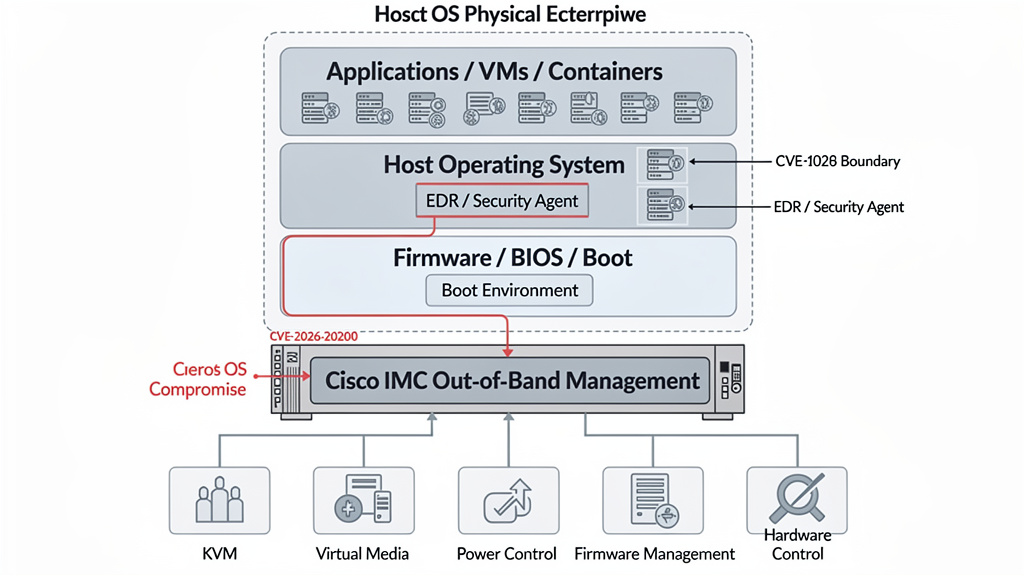
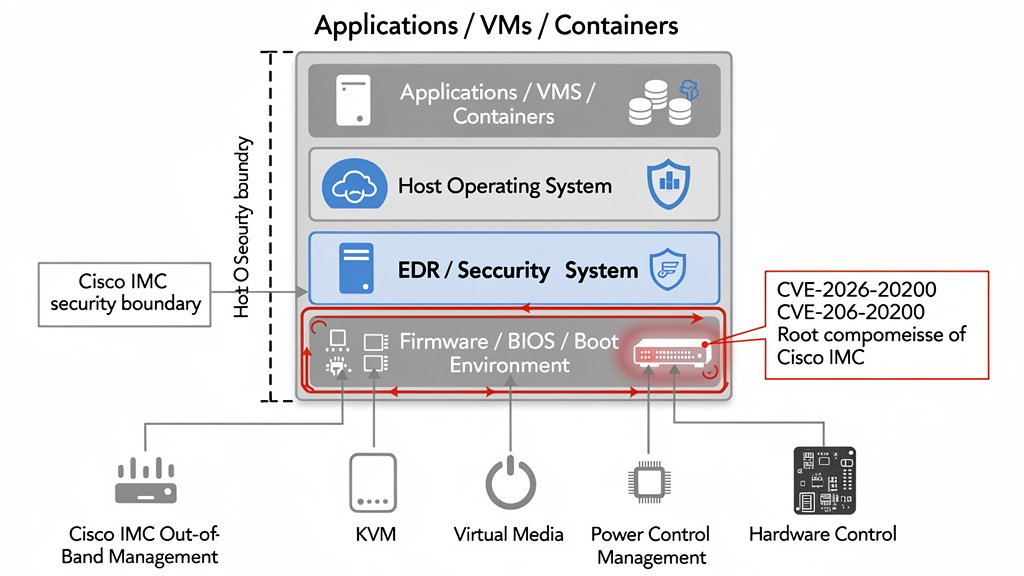
Why Root on IMC Has an Unusual Blast Radius
Cisco IMC provides functionality deliberately designed to control a server from outside its normal operating-system environment.
Cisco documentation includes remote server power control, KVM connectivity and virtual media. (Cisco)
This produces a different security model from compromising a conventional web server process.
Imagine three layers:
+--------------------------------------+
| Applications / VMs / containers     |
+--------------------------------------+
| Host operating system               |
+--------------------------------------+
| Server hardware & management plane   |
| Cisco IMC                            |
+--------------------------------------+
Most endpoint security tooling lives in the first two layers.
The management controller is intentionally separate.
NSIDE points out that this architecture can create visibility challenges for controls operating only inside the host OS. (NSIDE ATTACK LOGIC)
That does not make IMC compromise invisible to every security technology. Network monitoring, management-plane logging, authentication telemetry, firmware-integrity processes and dedicated infrastructure monitoring may still provide useful evidence.
But an EDR agent running inside a production Linux guest cannot automatically be assumed to have complete visibility into activity occurring inside the separate management-controller operating system.
This is why defenders should treat management-plane telemetry as its own detection domain.
A Realistic CVE-2026-20200 Attack Chain
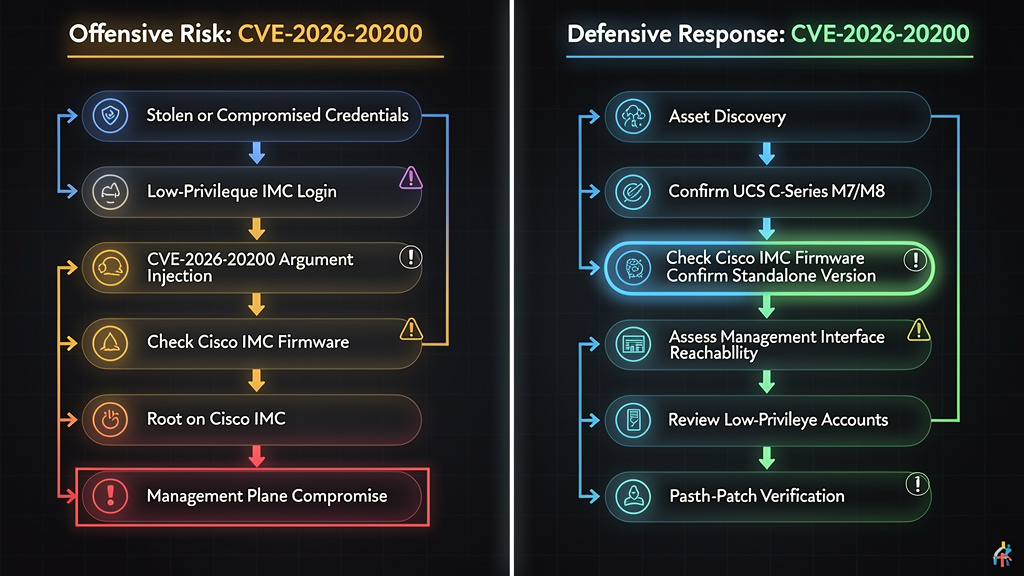
The most realistic threat model begins with access, not exploitation.
The attacker first needs an affected IMC interface and valid credentials.
Possible preceding events could include stolen operational credentials, reused passwords, compromised administrator workstations, leaked secrets, compromised third-party tooling, or an attacker already present inside a management network.
Those are general threat scenarios, not Cisco claims about observed CVE-2026-20200 attacks.
Once the attacker possesses a low-privileged IMC identity, however, Cisco’s advisory establishes the important security transition:
Low-privileged authenticated access
              ↓
Vulnerable Web management functionality
              ↓
Improper validation of user-controlled input
              ↓
Argument injection
              ↓
Control of privileged downstream behavior
              ↓
Arbitrary commands
              ↓
root
The public NSIDE analysis adds the implementation context: the affected feature retrieves SSH keys remotely, its inputs are passed through a script to תלתל, and insufficient sanitization permits additional argument manipulation. (NSIDE ATTACK LOGIC)
The CIMCown tool demonstrates how this primitive can be developed beyond simple injection testing into file transfer and code-execution functionality. (GitHub)
Why Public PoC Exposure Changes Patch Priority
There is a fundamental difference between a CVE with only a short advisory and a CVE accompanied by researcher documentation plus working exploit tooling.
The knowledge required for reproduction is dramatically lower.
With CVE-2026-20200, a prospective attacker does not have to independently determine where the dangerous user input enters the application, which feature triggers the vulnerable operation, what downstream executable is involved, or whether the primitive can be converted into meaningful system access.
Much of that investigative work has already been published by the original vulnerability researcher. (NSIDE ATTACK LOGIC)
Cisco itself therefore calls out PoC availability in the advisory. (Cisco)
For vulnerability-management teams, a sensible prioritization model is consequently not:
CVSS = 8.8
therefore patch after everything scored 9.x
It should instead evaluate:
Official severity
+
Exploit availability
+
Required privilege level
+
Asset criticality
+
Management-plane position
+
Reachability
+
Credential exposure likelihood
An 8.8 vulnerability in an isolated development appliance is different from an 8.8 vulnerability in the out-of-band management controller of important production infrastructure.
Context determines urgency.
How Security Teams Should Validate CVE-2026-20200 Safely
The availability of CIMCown does לא mean that production validation should begin by launching the exploit’s reverse-shell functionality.
That approach introduces unnecessary operational risk.
The first objective should be to establish whether the asset is actually vulnerable according to Cisco’s product matrix.
Start with asset identity.
Determine whether the target is an M7 or M8 standalone C-Series server, or an appliance based on a potentially affected C-Series platform that exposes Cisco IMC.
Then determine the software branch and exact firmware release.
A safe internal worksheet can be as simple as:
Asset:
Management IP:
Hardware model:
Management mode:
Cisco IMC/UCS firmware:
Web UI reachable from:
Low-privileged accounts present:
Cisco fixed release requirement:
Patch status:
Validation owner:
Evidence:
For CVE-2026-20200, an M7/M8 standalone system on an affected release should be considered vulnerable until it is upgraded or vendor guidance proves otherwise. Cisco states that its affected and fixed release information in the advisory is the release information validated by Cisco PSIRT. (Cisco)
The next stage should be exposure validation rather than exploitation.
Confirm whether the IMC Web interface is reachable from user networks, server networks, VPN ranges, administrative jump hosts, third-party support networks, or the public Internet.
A basic connectivity check from an authorized management workstation can establish reachability without exercising the vulnerability:
curl -kI https://IMC-MANAGEMENT-IP/
A response confirms network exposure, not CVE-2026-20200.
Similarly, authorized port discovery can establish whether a management interface is accessible:
nmap -Pn -sT -p 443 IMC-MANAGEMENT-IP
Again, this is attack-surface validation, not exploit confirmation.
The distinction should be preserved in the report.
Version-Based Validation Is Stronger Than Blind PoC Execution
For vendor firmware vulnerabilities with precise affected-product and fixed-version tables, version validation often provides a better first answer than aggressive exploitation.
Suppose an asset is:
UCS C-Series M8
Standalone mode
Cisco UCS Server Software 4.3(6.260020)
Cisco says the first fixed 4.3 release for CVE-2026-20200 is 4.3(6.260033). (Cisco)
That asset is therefore below the documented fixed build.
Conversely:
UCS C-Series M8
Standalone mode
Cisco UCS Server Software 4.3(6.260033)
matches Cisco’s first fixed release for CVE-2026-20200. (Cisco)
An exploit attempt would add little useful information while increasing operational risk.
The security-engineering principle is simple:
Do not use exploitation to answer a question that authoritative inventory data can answer more safely.
Exploit-level testing becomes useful when inventory is unreliable, controls may be backported, remediation needs independent confirmation, or an isolated lab reproduction is required.
Detection Opportunities
CVE-2026-20200 is authenticated, so identity telemetry is particularly valuable.
A defender should first understand what normal Cisco IMC account usage looks like.
A low-privileged service account that normally performs monitoring but suddenly begins interacting with rarely used administrative Web functionality is more interesting than a normal scheduled health check.
Management-network logs can also provide context.
Because the research path involves the remote retrieval of SSH-key material and ultimately manipulation of a privileged תלתל invocation, defenders should investigate unusual outbound connectivity originating from Cisco IMC management addresses, particularly where those management controllers normally have little reason to initiate connections to arbitrary external hosts. The connection alone is not proof of CVE-2026-20200; legitimate remote-resource functionality exists. It is a hunting signal derived from the published exploit path. (NSIDE ATTACK LOGIC)
A conceptual SIEM query might therefore look for:
source_zone = "management"
AND source_asset_type = "Cisco IMC"
AND destination NOT IN approved_management_dependencies
The exact syntax depends entirely on the telemetry platform.
Another useful detection dimension is authentication.
Teams should review successful and failed Cisco IMC logins, recently created accounts, role changes, credentials shared across devices, and access from unusual administrative hosts.
Because the vulnerability requires only low privileges, an investigation should not filter exclusively for administrator identities. (Cisco)
That is one of the most important hunting lessons from CVE-2026-20200:
“Non-admin” does not mean “non-dangerous” on an unpatched system.
Management-Network Segmentation Matters
Out-of-band management interfaces should not be treated like ordinary Web applications.
NSIDE recommends a strictly segmented management network and restrictive access control for Cisco IMC and similar controllers. (NSIDE ATTACK LOGIC)
That architecture matters because exploitation requires network access to the management interface.
A well-designed environment might require an administrator to traverse:
Corporate device
      ↓
Strong authentication
      ↓
Privileged-access gateway
      ↓
Dedicated management network
      ↓
Cisco IMC
A weak environment might instead look like:
General internal network
      ↓
Cisco IMC
The vulnerability is identical in both environments.
The attack opportunity is not.
A useful assessment should therefore evaluate CVE-2026-20200 in conjunction with architecture rather than produce a context-free scanner finding.
Do Not Confuse “Not Internet Exposed” With “Safe”
Because CVE-2026-20200 requires authentication, a common reaction may be:
“Our IMC is internal, so this is not urgent.”
That conclusion is too strong.
Internal placement removes one important attack path, but it does not eliminate compromised employee credentials, compromised administrator endpoints, malicious insiders, third-party access, lateral movement, or an attacker who has already gained a foothold elsewhere in the network.
The more useful question is:
Who can reach IMC, and who can obtain credentials accepted by it?
If the answer includes hundreds of user workstations, broad VPN populations, multiple shared administrative accounts or legacy automation credentials, “internal only” may offer much less protection than expected.
If the answer is a tiny privileged network reachable only through hardened access gateways with strong identity controls, the compensating security value is much stronger.
Either way, Cisco still recommends upgrading because no workaround fixes the underlying vulnerability. (Cisco)
Incident Response for a Potentially Compromised IMC
A vulnerable firmware version is not evidence of compromise.
A successful login by a low-privileged user is not evidence of compromise.
An unexpected network connection is not evidence of compromise.
Incident response therefore needs to distinguish exposure from exploitation.
The first phase should establish whether the system was vulnerable during the suspected period.
The second should reconstruct who authenticated to IMC and from where.
The third should examine management-plane configuration and activity for unexplained changes.
The fourth should correlate those events with network telemetry from the controller and administrative segment.
If a defender has credible evidence that arbitrary root-level code execution occurred on the management controller, merely changing the suspected user’s password may be insufficient as a response strategy.
At that point, the investigation concerns the integrity of the management plane itself.
Because remediation and recovery procedures can vary by Cisco platform and appliance, teams should follow Cisco-supported firmware and recovery procedures rather than improvising destructive cleanup on production controllers.
CVE-2026-20200 Versus CVE-2026-20288
The two vulnerabilities share an advisory and a general weakness category, but they are not interchangeable.
CVE-2026-20200 allows a remote authenticated attacker with זכויות נמוכות to reach root command execution.
CVE-2026-20288 requires Admin privileges according to Cisco. Cisco gives the latter a CVSS base score of 6.5 but still assigns a High Security Impact Rating because root-level consequences create additional security implications. (Cisco)
That distinction explains why the product matrices differ.
CVE-2026-20288 affects a broader collection of products in the advisory.
CVE-2026-20200 is more narrowly associated with standalone M7/M8 C-Series platforms but has the more important privilege transition from low privilege to root. (Cisco)
Security content that simply copies the entire Cisco advisory product table underneath a heading for “CVE-2026-20200 affected products” risks overstating exposure.
Precision matters.
CVE-2026-20200 and the Broader IMC Security Story
CVE-2026-20200 is not the first security issue to affect Cisco IMC.
Cisco’s own product-security pages show a history of IMC advisories involving authentication bypass, command injection, privilege escalation, cross-site scripting and remote code execution across different years and software generations. (Cisco)
The correct conclusion is not that Cisco IMC is uniquely insecure.
The more useful lesson is architectural.
Out-of-band management controllers expose complicated functionality: authentication, remote consoles, virtual media, firmware management, networking, key management, remote resources and privileged interaction with underlying hardware.
Complex privileged control planes deserve a security program of their own.
Treating them as “just another IP address in the server VLAN” fails to account for their role.
What Vulnerability Scanners May Get Wrong
CVE-2026-20200 demonstrates several common failure modes in automated vulnerability management.
The first is product-name matching.
Finding Cisco IMC does not prove CVE-2026-20200.
The hardware generation and management mode matter. (Cisco)
The second is advisory-level product merging.
Because Cisco grouped CVE-2026-20200 and CVE-2026-20288 together, a scanner that does not preserve per-CVE product relationships could incorrectly attribute CVE-2026-20200 to platforms affected only by CVE-2026-20288.
The third is version ambiguity.
The advisory contains different first-fixed releases for each CVE. A system can theoretically be fixed for CVE-2026-20200 while still needing additional firmware to address CVE-2026-20288. (Cisco)
The fourth is reachability blindness.
Two vulnerable devices can have radically different real-world risk depending on whether one is publicly reachable and the other is isolated behind a privileged management gateway.
The fifth is credential-context blindness.
Because exploitation needs authentication, the existence and exposure of low-privileged credentials are relevant to practical risk.
A useful vulnerability finding should therefore look more like:
CVE: CVE-2026-20200
Vendor match: confirmed
Hardware generation: M8
Management mode: standalone
Installed release: confirmed vulnerable
IMC Web interface: reachable from management segment
Public exposure: none observed
Low-privileged identities: present
Public PoC: available
Vendor workaround: none
Required action: firmware upgrade
rather than:
Port 443 open
Cisco detected
CVE-2026-20200 HIGH
The first can drive remediation.
The second creates a ticket.
Those are not the same thing.
Safe Post-Patch Validation
After the firmware upgrade, validation should confirm more than the completion status of a change ticket.
Verify the running firmware version directly.
For an M7/M8 system on the 4.3 branch, confirm that it is running 4.3(6.260033) or a later Cisco release that includes the fix.
For the 6.0 branch, confirm 6.0(2.260044) or an appropriate later fixed release. (Cisco)
Then validate that administrative access remains functional and that the device has returned to the intended management-network posture.
If the wider Cisco advisory also applies, confirm that the selected release addresses CVE-2026-20288 rather than stopping at the minimum release that fixes only CVE-2026-20200.
Finally, retain evidence.
לדוגמה:
Before:
UCS C-Series M8
Cisco UCS Server Software 6.0(x)
CVE-2026-20200 exposure confirmed by version

Change:
Approved firmware upgrade

After:
Fixed Cisco release confirmed
Management UI functional
Expected network controls confirmed
No unexpected account changes observed
Finding status: Remediated
That evidence is more valuable during an audit or incident review than a screenshot saying “patch successful.”
Where Agentic Pentesting Can Help
CVE-2026-20200 is a useful example of where AI-assisted security testing needs to do more than launch a scanner.
The difficult part is not identifying the CVE string.
The useful workflow is to correlate the CVE with the real asset.
For a system like Cisco IMC, an automated security workflow should distinguish M5 from M8, standalone management from Fabric Interconnect-managed deployments, vulnerable firmware from fixed firmware, and publicly reachable management interfaces from strongly segmented ones.
Only after those conditions are established should deeper validation be considered.
Penligent’s current public product materials describe a black-box agentic workflow that maps attack surfaces, calls security tooling, independently validates findings and retains evidence rather than treating every preliminary signal as a confirmed vulnerability. Its public site also describes CVE-oriented exploit verification capabilities and evidence-backed reporting for authorized testing. (Penligent)
For CVE-2026-20200, that model is more useful when framed as:
Asset discovery
      ↓
Cisco IMC fingerprinting
      ↓
Hardware / firmware correlation
      ↓
CVE-2026-20200 applicability decision
      ↓
Reachability analysis
      ↓
Controlled validation
      ↓
Independent verification
      ↓
Evidence chain
      ↓
Patch
      ↓
Retest
The objective should not be to automatically fire CIMCown against every Cisco address that appears in an inventory.
The objective is to answer, with evidence:
Is this exact asset vulnerable, reachable and realistically exploitable, and did the remediation actually close the risk?
Penligent’s Hacking Labs also maintains a CVE-focused security research archive that can be used alongside vendor advisories when building these validation workflows. (Penligent)
What Security Teams Should Do Now
The strongest response to CVE-2026-20200 begins with identifying standalone Cisco UCS C-Series M7 and M8 servers and appliances using the relevant underlying platforms.
Determine the exact Cisco UCS Server Software release.
Where the 4.3 branch is affected, move to 4.3(6.260033) or an appropriate later fixed release. Where the 6.0 branch is affected, move to 6.0(2.260044) or an appropriate later release, while also checking whether other vulnerabilities in Cisco’s August advisory require a newer target version. (Cisco)
Do not treat firewall restrictions as the final fix.
Cisco says there is no workaround. (Cisco)
Review low-privileged IMC accounts as seriously as administrative ones because PR:L is sufficient for CVE-2026-20200.
Restrict access to management interfaces through dedicated management networks and controlled administrative paths.
Review unusual authentication and controller-originated network activity.
And where exploit validation is necessary, conduct it only in an explicitly authorized and operationally safe environment.
שאלות נפוצות
What is CVE-2026-20200?
CVE-2026-20200 is an argument injection vulnerability in the Cisco IMC Web management interface. Cisco says a remote authenticated attacker with low privileges can exploit improper input validation to execute arbitrary commands on the underlying operating system as root. (Cisco)
What is CIMCown?
CIMCown is the public proof-of-concept toolkit released by NSIDE ATTACK LOGIC for CVE-2026-20200. The project demonstrates capabilities including file download, file upload and reverse-shell execution against vulnerable systems. (GitHub)
Does CVE-2026-20200 require authentication?
Yes. Cisco’s CVSS vector specifies low privileges, PR:L. The vulnerability is not an unauthenticated RCE. (Cisco)
Does an attacker need Cisco IMC administrator privileges?
No. That is one of the most significant aspects of CVE-2026-20200. Cisco states that זכויות נמוכות are sufficient. (Cisco)
CVE-2026-20288, disclosed in the same advisory, is different and requires Admin privileges. (Cisco)
Can CVE-2026-20200 give attackers root?
Yes. Cisco explicitly states that successful exploitation can execute arbitrary commands on the underlying operating system as root. (Cisco)
Is CVE-2026-20200 a command injection vulnerability?
Cisco titles it an Argument Injection Vulnerability and maps the advisory to CWE-141 and CWE-146. The public NSIDE research explains that user-controlled data can influence arguments supplied to a privileged תלתל invocation. (Cisco)
Which Cisco servers are vulnerable to CVE-2026-20200?
Cisco specifically lists UCS C-Series M7 and M8 Rack Servers in standalone mode when running vulnerable releases. Cisco explicitly lists several other platforms—including standalone M5/M6 C-Series—as not affected by CVE-2026-20200. (Cisco)
Is every Cisco IMC interface vulnerable?
לא.
Cisco IMC presence alone is insufficient to establish vulnerability. Hardware generation, management mode and software version all matter. (Cisco)
What versions fix CVE-2026-20200?
For standalone UCS C-Series M7/M8 servers, Cisco lists 4.3(6.260033) as the first fixed 4.3 release and 6.0(2.260044) as the first fixed 6.0 release. Systems earlier than the supported 4.3 branch should migrate to a fixed release. (Cisco)
Is there a workaround?
Cisco says no workaround is available that addresses the vulnerability. (Cisco)
Network segmentation, access restrictions and disabling unnecessary management exposure can reduce risk but should not be confused with installing the vendor fix.
Is CVE-2026-20200 being exploited in the wild?
Cisco stated in its August 5, 2026 advisory that PSIRT was aware of public proof-of-concept exploit code but was not aware of malicious use of the vulnerabilities described in the advisory at that time. (Cisco)
That status can change, so security teams should rely on the latest vendor and threat-intelligence information when making current incident-response decisions.
סיכום
CVE-2026-20200 is dangerous for reasons that go beyond its CVSS number.
Cisco rates it 8.8 High, not Critical, but the vulnerability crosses an important privilege boundary: a remote attacker who already possesses only low-level Cisco IMC access can reach arbitrary command execution as שורש. (Cisco)
The underlying weakness is also unusually instructive.
A legitimate SSH-key retrieval function passes user-controlled information toward a privileged תלתל operation. Insufficient validation allows input to alter the command’s argument structure. The result is an argument-injection primitive that the researchers were able to extend into file access and code execution. (NSIDE ATTACK LOGIC)
The publication of CIMCown removes much of the uncertainty that normally separates vulnerability disclosure from practical reproduction. Cisco has explicitly acknowledged the existence of public PoC code. (GitHub)
For defenders, however, precision remains essential.
CVE-2026-20200 does לא mean every Cisco IMC device is vulnerable. The core affected Cisco platforms are standalone UCS C-Series M7 and M8 Rack Servers running vulnerable software, with Cisco specifying 4.3(6.260033) and 6.0(2.260044) as the first fixed releases in their respective branches. (Cisco)
The correct response is therefore neither panic nor indiscriminate PoC execution.
It is disciplined validation:
identify the management controller, map it to the exact hardware and firmware, determine reachability, understand low-privileged account exposure, patch to the appropriate Cisco fixed release, inspect management-plane telemetry, and independently verify remediation.
CVE-2026-20200 ultimately illustrates a broader security lesson: out-of-band management systems should be treated as high-value control planes, not ordinary embedded Web interfaces. When the component controlling the server itself becomes the vulnerable system, the management plane becomes part of the attack surface—and part of the security boundary that defenders need to test, monitor, and protect.
 Hebrew
  English
  German
  French
  Spanish
  Portuguese
  Japanese
  Korean
  Hindi
Hindi  Arabic
  Turkish