
CVE-2026-71362 is a critical authorization vulnerability affecting Adobe Commerce and Magento Open Source that deserves considerably more attention than its generic “privilege escalation” classification might initially suggest.
Adobe disclosed the vulnerability on August 11, 2026, as part of security bulletin APSB26-92. The company classifies CVE-2026-71362 as an Incorrect Authorization vulnerability, CWE-863, עם CVSS v3.1 score of 9.1 Critical. According to Adobe, exploitation requires no authentication, no administrator privileges, and no user interaction. The flaw is remotely reachable over the network and can allow an attacker to obtain elevated access to sensitive resources. (Adobe Help Center)
That description alone makes the issue serious. Subsequent analysis made the practical impact clearer.
Magento security specialist Sansec analyzed Adobe’s patch and reported that the flaw involves the way Magento associates customer identity with an account session. According to Sansec, an attacker can cause a customer session to switch to another customer’s account, gaining access to that victim’s authenticated context and private customer information. Sansec therefore characterizes CVE-2026-71362 as an unauthenticated customer account takeover vulnerability. (Sansec)
The timing makes the vulnerability even more important. Adobe’s August 11 bulletin stated that the company was not aware of exploitation in the wild for the vulnerabilities fixed in APSB26-92. Sansec subsequently reported that its protection platform was already blocking exploitation attempts targeting CVE-2026-71362, and BleepingComputer reported those observations on August 12. These statements are not necessarily contradictory: Adobe’s bulletin describes what Adobe knew when the advisory was published, while Sansec’s telemetry reflects activity observed afterward. (Adobe Help Center)
For defenders, the distinction matters less than the operational conclusion:
An internet-facing Adobe Commerce or Magento environment that has not received the August 2026 fixes should be treated as a high-priority exposure.
CVE-2026-71362 at a Glance
| תכונה | CVE-2026-71362 |
|---|---|
| CVE | CVE-2026-71362 |
| מוצר | Adobe Commerce, Magento Open Source; Adobe’s CVE data also covers Adobe Commerce B2B |
| חולשה | CWE-863 Incorrect Authorization |
| Adobe impact | העלאת הרשאות |
| Practical security risk | Customer account takeover |
| CVSS v3.1 | 9.1 Critical |
| וקטור התקפה | Network |
| Attack complexity | נמוך |
| Authentication required | לא |
| Administrator privileges required | לא |
| User interaction | לא |
| Confidentiality impact | גבוה |
| Integrity impact | גבוה |
| Availability impact | None in the CVSS vector |
| Vendor bulletin | APSB26-92 |
| Patch publication | August 11, 2026 |
Adobe’s assigned CVSS vector is:
CVSS:3.1/AV:N/AC:L/PR:N/UI:N/S:U/C:H/I:H/A:N
NVD currently reproduces Adobe’s 9.1 CNA score and identifies the weakness as CWE-863. NVD’s own enrichment process was still underway when the record was reviewed. (National Vulnerability Database)
What Is CVE-2026-71362?
At its core, CVE-2026-71362 is an authorization failure.
Authentication and authorization are related but fundamentally different security controls.
Authentication asks:
Who is this user?
Authorization asks:
What is this user allowed to access?
A secure commerce application must maintain that distinction throughout every request, session transition, API call, account lookup, and customer-object operation.
CVE-2026-71362 indicates that somewhere in this process Adobe Commerce failed to correctly enforce the relationship between the identity represented by a customer session and the resources that identity was authorized to access.
Adobe describes the consequence as privilege escalation: an attacker can obtain elevated access to sensitive resources without first possessing valid credentials. (National Vulnerability Database)
Sansec’s patch analysis provides a more concrete application-level interpretation. According to the researchers, Magento’s handling of customer identity in the account session could allow one customer session to be switched to another customer account. Once that happens, the attacker effectively operates inside the victim’s customer context. (Sansec)
That makes CVE-2026-71362 very different from an ordinary authentication attack.
The attacker does not necessarily have to steal a password.
They do not have to crack a password hash.
They do not have to phish the customer.
They do not have to wait for a victim to click a malicious link.
According to Adobe’s published CVSS vector, the vulnerability is remotely exploitable with low attack complexity, requires no privileges, and requires no user interaction. (Adobe Help Center)
The security failure occurs after requests reach the application and the application decides which customer identity and resources belong to the current security context.
CVE-2026-71362 Is an Authorization Vulnerability, Not a Password Vulnerability
This distinction is one of the most important things security teams should understand about CVE-2026-71362.
Many account takeover investigations begin with credential-related hypotheses:
- credential stuffing,
- password reuse,
- session-cookie theft,
- infostealer malware,
- phishing,
- OAuth abuse,
- password-reset exploitation.
CVE-2026-71362 represents a different class of failure.
A simplified secure design might conceptually enforce something like:
request
    ↓
session identifier
    ↓
authenticated customer identity
    ↓
server-side authorization check
    ↓
requested customer resource
The critical security property is:
session.customer_id == authorized_resource.customer_id
and, more importantly, that this relationship is established and validated exclusively using trusted server-side authorization logic.
An application should never allow untrusted request state to arbitrarily alter the effective customer identity without re-establishing authorization.
Sansec’s analysis indicates that Adobe’s August fix changes how Magento handles customer identity inside the account session. The available public research does not disclose enough implementation detail to responsibly reconstruct the complete exploit mechanism, so claims about specific parameters, endpoints, payloads, or internal functions should be treated cautiously unless further technical disclosure is released. (Sansec)
That limitation is important.
There is enough evidence to conclude that customer-account switching is possible on vulnerable systems.
יש לא currently enough authoritative public information to justify inventing a precise exploit payload or claiming that an arbitrary Magento endpoint is vulnerable.
How CVE-2026-71362 Can Lead to Magento Account Takeover
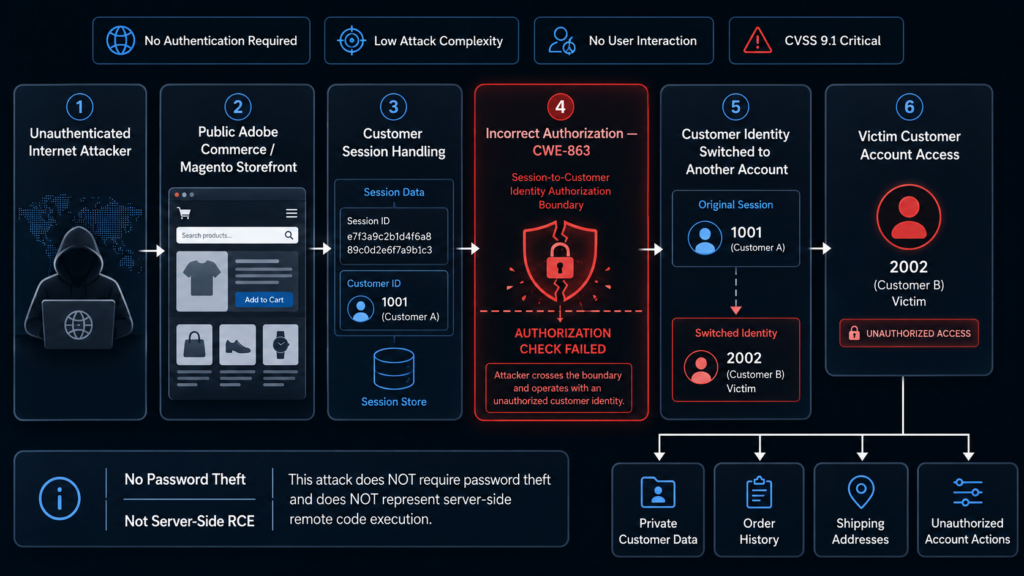
Based on Adobe’s advisory and Sansec’s patch analysis, the defensible high-level attack path looks like this:
Unauthenticated Internet Attacker
            |
            v
Public Adobe Commerce / Magento Storefront
            |
            v
Customer Session Handling
            |
            v
Incorrect Authorization
CWE-863
            |
            v
Customer Identity Becomes Incorrectly Associated
With Another Account Context
            |
            v
Victim Customer Session / Account Context
            |
            +--------------------+
            |                    |
            v                    v
   Private Customer Data   Account Functions
            |                    |
            +----------+---------+
                       |
                       v
              Account Takeover Risk
Adobe confirms that no authentication is required and that the vulnerability produces privilege escalation. Sansec adds that the privilege boundary crossed in practice can be the boundary separating one customer’s session from another customer’s account. (Adobe Help Center)
This is why simply calling the bug “privilege escalation” understates its operational importance for e-commerce defenders.
To a vulnerability-management platform, it is CWE-863.
To a merchant, the consequence may be that an anonymous attacker reaches another customer’s authenticated account.
Those are two descriptions of the same security boundary failure at different levels of abstraction.
Why CVE-2026-71362 Has a CVSS Score of 9.1
The individual components of Adobe’s CVSS vector explain why the vulnerability deserves urgent attention.
AV:N — Network Attack Vector
The attack is remotely reachable.
An attacker does not need local operating-system access, physical access, or presence on the same local network. For an internet-facing commerce storefront, this substantially increases the number of potential attackers. (National Vulnerability Database)
AC:L — Low Attack Complexity
Adobe assigns low attack complexity.
This means the vulnerability does not depend on unusually difficult external conditions in the CVSS model. (National Vulnerability Database)
It does לא necessarily mean that a polished public exploit is trivial to build. CVSS attack complexity and real-world exploit-development difficulty are not identical concepts.
PR:N — No Privileges Required
This is one of the most important metrics.
The attacker does not need an existing customer account or administrative privileges before reaching the vulnerable condition. Adobe’s bulletin explicitly identifies CVE-2026-71362 as requiring neither authentication nor administrative privileges. (Adobe Help Center)
Sansec independently emphasizes the same characteristic in its analysis. (Sansec)
UI:N — No User Interaction
The victim does not have to click a malicious link, open a file, approve a prompt, or interact with attacker-controlled content according to Adobe’s CVSS assessment. (National Vulnerability Database)
That eliminates another common barrier to exploitation.
C:H — High Confidentiality Impact
Unauthorized access to another customer’s security context creates an obvious confidentiality concern.
Sansec specifically reports access to the victim account and private customer data following successful account switching. (Sansec)
Depending on merchant configuration, customer accounts can contain information associated with profiles, orders and other customer-specific resources.
I:H — High Integrity Impact
Integrity is also rated High.
An attacker operating within another customer’s authorized context may be able to interact with account-level functionality that should belong exclusively to that customer. Adobe’s CVSS vector explicitly assigns High integrity impact. (National Vulnerability Database)
The exact actions available after compromise may vary with Commerce configuration, extensions and application logic, so defenders should avoid assuming every installation exposes exactly the same post-takeover functionality.
A:N — No Availability Impact
The CVSS vector does not assign direct availability impact.
CVE-2026-71362 is therefore primarily a confidentiality and integrity problem, not a denial-of-service vulnerability. (National Vulnerability Database)
Which Adobe Commerce and Magento Versions Are Affected?
Adobe lists the following Adobe Commerce release families as affected by APSB26-92 before the August update:
- Adobe Commerce 2.4.9-2026-jul and earlier
- Adobe Commerce 2.4.8-2026-jul and earlier
- Adobe Commerce 2.4.7-2026-jul and earlier
- Adobe Commerce 2.4.6-2026-jul and earlier
- Adobe Commerce 2.4.5-2026-jul and earlier
- Adobe Commerce 2.4.4-2026-jul and earlier. (Adobe Help Center)
Adobe also lists affected Adobe Commerce B2B branches through their July 2026 releases:
- 1.5.3
- 1.5.2
- 1.4.2
- 1.3.4
- 1.3.3. (Adobe Help Center)
For Magento Open Source, Adobe lists:
- 2.4.9-2026-jul and earlier
- 2.4.8-2026-jul and earlier
- 2.4.7-2026-jul and earlier
- 2.4.6-2026-jul and earlier. (Adobe Help Center)
The CVE metadata published through Adobe and reproduced by NVD identifies Adobe Commerce, Adobe Commerce B2B, and Magento Open Source as affected products, with the August 2026 builds marked unaffected. (National Vulnerability Database)
Administrators should nevertheless evaluate their exact installed components and patch state, rather than assuming that a high-level version string alone proves remediation.
That is especially relevant because Adobe’s 2026 monthly security-patching model involves isolated patches and cumulative sequencing requirements. (Experience League)
Fixed Versions for CVE-2026-71362
Adobe’s APSB26-92 bulletin provides August 2026 updates for the supported Commerce branches.
For Adobe Commerce, the fixed security state includes:
| Release family | August 2026 update |
|---|---|
| 2.4.9 | 2.4.9-2026-aug |
| 2.4.8 | 2.4.8-2026-aug |
| 2.4.7 | 2.4.7-2026-aug |
| 2.4.6 | 2.4.6-2026-aug |
| 2.4.5 | 2.4.5-2026-aug |
| 2.4.4 | 2.4.4-2026-aug |
Magento Open Source receives corresponding August updates for its supported 2.4.6 through 2.4.9 branches. (Adobe Help Center)
Adobe recommends updating installations to the newest applicable version. (Adobe Help Center)
Why the Patch Process Is Slightly More Complicated Than “Upgrade Magento”
CVE-2026-71362 remediation deserves attention because the August security update is not simply a conventional new Magento Composer release.
Adobe explains that the August 11 fixes were released as isolated security patches. Adobe says this model is intended to allow merchants to deploy critical fixes without waiting for a broader Composer-based update cycle. (Experience League)
There are several operational details administrators need to understand.
First, Adobe says merchants applying an isolated patch must be on the latest security-only -p release for their supported branch because the patches are tested against those releases. (Experience League)
Second, the monthly isolated patches are sequential rather than standalone. The August 2026 fixes build on the July 2026 patches, so the corresponding July patches must already be present before the August files are applied. (Experience League)
For example, Adobe documents the following sequence for Community Edition 2.4.6-p15:
246p15-2026-07-001-CE
        ↓
246p15-2026-08-001-CE
For installations with Enterprise Edition or B2B components, additional component-specific patches may need to be applied in the documented sequence. (Experience League)
This matters because an emergency response team could mistakenly download the August file, encounter an installation failure due to missing prerequisites, and assume the vulnerability has been addressed when it has not.
Adobe Introduced a Commerce Version Tool for Patch Verification
One valuable change accompanying the August update is Adobe’s Commerce Version Tool.
Adobe describes it as a standalone executable included with monthly security patches that reports which monthly patches are installed, which are missing, and which CVEs the installation is protected against. The tool is intended for Adobe Commerce on-premises and Adobe Commerce on Cloud environments. (Experience League)
That is particularly useful for CVE-2026-71362 because patch verification should be treated as a separate control from patch deployment.
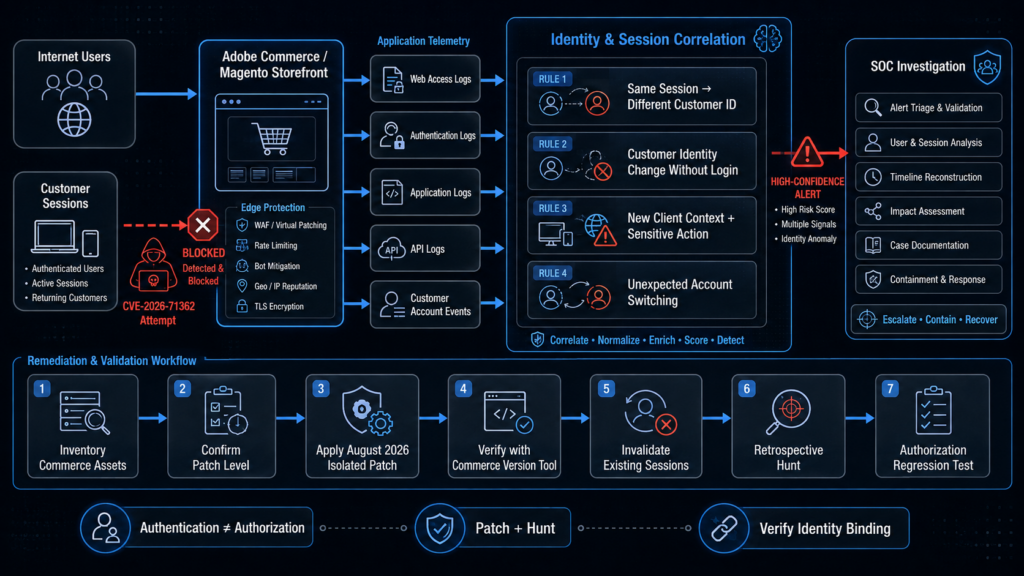
A mature remediation workflow should look like:
Identify affected Commerce asset
        ↓
Determine exact branch and components
        ↓
Confirm latest required -p baseline
        ↓
Confirm prior monthly patches
        ↓
Apply August 2026 isolated patch
        ↓
Verify patch installation
        ↓
Validate CVE coverage
        ↓
Perform post-exposure investigation
“Package installed successfully” and “the application is no longer vulnerable” are not always equivalent statements.
Is CVE-2026-71362 Being Exploited in the Wild?
This question requires careful wording.
Adobe’s APSB26-92 bulletin, published August 11, states that Adobe was not aware of exploits in the wild for the vulnerabilities addressed in that security release. (Adobe Help Center)
Sansec, however, reported that Sansec Shield was already blocking exploitation attempts against CVE-2026-71362. (Sansec)
BleepingComputer reported the same finding on August 12, describing attempts to exploit the flaw following disclosure. (BleepingComputer)
SecurityWeek subsequently reported on August 13 that CVE-2026-71362 was being targeted shortly after disclosure. (שבוע האבטחה)
The most accurate interpretation is therefore:
Adobe had no known exploitation when it published APSB26-92, while third-party security telemetry subsequently identified exploitation attempts against the vulnerability.
There is an important evidentiary distinction between:
Exploit traffic observed
and:
Successful compromise independently confirmed
WAF telemetry showing attempts is strong evidence that attackers are testing or attempting to exploit the vulnerability. It does not by itself prove that every observed request resulted in a successful account takeover.
Defenders should therefore avoid both extremes.
It would be inaccurate to say there is no exploitation activity.
It would also be premature, based solely on the currently cited evidence, to claim a confirmed global mass-compromise campaign affecting thousands of Magento stores.
Why Attackers Can Move So Quickly After a Security Patch
The speed of activity around CVE-2026-71362 illustrates a recurring problem in modern vulnerability management.
A vendor does not necessarily need to publish a proof of concept for attackers to investigate a vulnerability.
Once a patch becomes available, researchers and attackers can compare vulnerable and patched software.
Conceptually:
Vulnerable Release
       |
       | diff
       v
Patched Release
       |
       v
Changed Authorization Logic
       |
       v
Candidate Security Boundary
       |
       v
Dynamic Validation
Sansec explicitly states that its researchers reviewed Adobe’s patch before identifying the customer-session behavior behind CVE-2026-71362. (Sansec)
This means defenders should not assume that withholding detailed technical disclosure gives them a long safety window.
The patch itself can become security intelligence.
That is particularly relevant for authorization vulnerabilities because a small code change around identity lookup, session handling, ownership validation or ACL enforcement can dramatically reduce the search space for someone analyzing the update.
Why Magento Account Takeover Is a High-Value Attack
Commerce accounts are fundamentally different from low-value accounts on many ordinary websites.
An e-commerce customer account can represent a persistent link between an identity and previous commercial activity.
Sansec specifically says successful exploitation can expose the victim account and private customer data. (Sansec)
Depending on merchant configuration and extensions, account context may include information related to:
- customer profile information,
- historical orders,
- delivery addresses,
- saved preferences,
- loyalty or reward functionality,
- account-specific commerce workflows.
The precise data available varies from store to store, so security teams should examine their own customer-account model rather than assuming a universal Magento configuration.
The larger point is that customer identity itself is a high-value security boundary.
CVE-2026-71362 attacks that boundary directly.
Account Takeover Does Not Automatically Mean Full Server Compromise
Another important distinction is what CVE-2026-71362 does לא currently establish.
Adobe classifies the vulnerability as privilege escalation, not remote code execution. Its CVSS vector assigns high confidentiality and integrity impact but no availability impact. (Adobe Help Center)
Public analysis shows customer account takeover.
That does not mean CVE-2026-71362 alone gives an attacker:
- operating-system root access,
- arbitrary PHP execution,
- shell access,
- database administrator access,
- arbitrary server-side file writes,
- direct control of the Magento administrator panel.
Those outcomes should not be attributed to this CVE without additional evidence.
Of course, a compromised customer context could theoretically participate in a larger exploit chain involving business-logic flaws, extensions or other vulnerabilities. But that would be a separate claim requiring separate evidence.
Keeping those boundaries clear makes vulnerability intelligence more useful.
How Defenders Should Detect Potential CVE-2026-71362 Exploitation
Because complete public exploitation mechanics remain limited, defenders should prioritize behavioral and identity-centric telemetry rather than relying only on a single public exploit signature.
The core question should be:
Did a customer session unexpectedly acquire or transition into an identity that should not belong to it?
Potential investigation signals include unusual changes between session identifiers and customer identifiers, abrupt account-context changes without the expected authentication lifecycle, and account access from network or client characteristics inconsistent with previous session behavior.
A conceptual correlation model could be:
HTTP Request
    |
    v
Session ID
    |
    +------> Previous Customer ID
    |
    +------> Current Customer ID
                    |
                    v
             Identity changed?
                    |
             +------+------+
             |             |
            No            Yes
                           |
                           v
                 Was reauthentication
                    expected?
                           |
                    +------+------+
                    |             |
                   Yes            No
                                 |
                                 v
                         High-priority alert
This is not an exploit signature. It is an example of the type of invariant defenders can monitor when a vulnerability involves session-to-identity authorization.
Review Customer Authentication Events
After patching, security teams should review authentication and account activity from the period during which the store was exposed.
Useful questions include:
Did the customer authenticate normally?
        ↓
Did the account subsequently appear in a different session?
        ↓
Did network characteristics suddenly change?
        ↓
Were sensitive account operations performed?
        ↓
Did similar anomalies occur across multiple accounts?
A single IP change is not evidence of exploitation. Mobile networks, VPNs, carrier NAT, privacy proxies and legitimate customer behavior generate noisy telemetry.
Detection should therefore use correlation rather than simplistic indicators.
A combination such as:
unexpected identity transition
+
no corresponding login
+
new client context
+
sensitive customer action
is considerably more interesting than any individual signal in isolation.
Consider Invalidating Existing Customer Sessions After Remediation
Sansec’s analysis centers on customer-session identity handling. (Sansec)
For that reason, organizations responding to possible pre-patch exposure should evaluate whether existing customer sessions should be invalidated after remediation.
CyCognito similarly recommends invalidating active customer sessions after applying the fix, alongside monitoring for unexpected account or session switching. (CyCognito)
The operational tradeoff is straightforward.
Session invalidation may inconvenience customers by requiring reauthentication.
Leaving potentially manipulated or compromised sessions active may preserve attacker access depending on how the application state was affected.
The appropriate response depends on the organization’s risk tolerance and evidence of exposure.
For a high-value commerce environment with indications of exploitation attempts, forcing reauthentication may be the safer option.
Inventory Every Magento Instance, Not Just the Main Store
One of the most dangerous vulnerability-management mistakes is to patch the obvious production domain while forgetting the rest of the commerce estate.
Organizations frequently have additional environments such as:
www.example.com
shop.example.com
store.example.com
staging-shop.example.com
uat-commerce.example.com
dev-magento.example.com
regional storefronts
campaign storefronts
legacy commerce hosts
Not all of them are necessarily vulnerable, and some may not even be publicly reachable.
But any internet-accessible environment running an affected version deserves assessment because Adobe classifies exploitation as network-based and unauthenticated. (National Vulnerability Database)
The existence of a WAF or CDN should not automatically remove a host from the patching queue.
Compensating controls are useful.
They are not equivalent to correcting the underlying authorization defect.
Check Third-Party Magento Extensions Separately
CVE-2026-71362 is an Adobe Commerce/Magento platform vulnerability, but real Magento environments are rarely composed of core code alone.
Stores often depend on payment integrations, shipping extensions, marketing modules, search extensions, B2B modules, caching systems and custom application logic.
Patching CVE-2026-71362 therefore answers one question:
Is the Adobe authorization vulnerability fixed?
It does not answer:
Is this Magento environment secure?
Recent Magento security research provides a good example of why those questions differ. Sansec disclosed an unrelated critical vulnerability in the Mirasvit Cache Warmer extension in May 2026 involving unauthenticated PHP object injection and potential remote code execution. That issue is separate from CVE-2026-71362 but illustrates how extension risk can remain even after the Adobe core is patched. (Sansec)
Commerce security should therefore maintain separate inventories for:
Magento / Adobe Commerce core
Adobe Commerce B2B components
Third-party extensions
Custom modules
Infrastructure dependencies
Payment integrations
Authentication integrations
Safe Validation of CVE-2026-71362
Organizations should verify remediation rather than relying only on deployment records.
For environments you own or are explicitly authorized to test, validation can occur at several levels.
1. Version and Patch Verification
Determine the exact Commerce version, edition and patch branch.
Confirm that the relevant August 2026 fix is present.
Adobe specifically provides the Commerce Version Tool to help determine installed monthly patches, missing patches and CVE coverage. (Experience League)
2. Patch Integrity Verification
Verify that deployment actually modified the expected application state.
Adobe also documents Quality Patches Tool-based status checks for Commerce Cloud environments and provides examples of validating whether individual isolated patches are applied. (Experience League)
3. Authorization Regression Testing
In a controlled test environment, create multiple test customer accounts and verify that customer-specific operations remain rigidly bound to their corresponding authenticated identities.
A defensive test matrix might look like:
| Test | Expected result |
|---|---|
| Customer A accesses Customer A resources | Allowed |
| Customer A requests Customer B resource | Denied |
| Anonymous session requests protected customer resource | Denied |
| Session state changes without reauthentication | No unauthorized identity transition |
| Modified customer identifier references another user | Authorization remains bound to authenticated identity |
| Expired session attempts account access | Authentication required |
The point is not to reproduce unauthorized exploitation against third-party stores.
The objective is to prove that authorization boundaries remain intact after remediation.
Authorization Testing Should Be Object-Centric
Traditional vulnerability scanners sometimes struggle with this type of issue because the core failure is contextual.
A scanner may successfully request:
/חשבון
and conclude that the endpoint behaves normally.
But the meaningful question is:
Which account did the server authorize?
This distinction is central to authorization testing.
A useful model is:
Subject
   |
   | requests
   v
Object
   |
   v
Authorization Decision
Testing must manipulate the relationship between subject and object, not merely check whether an endpoint returns HTTP 200.
For commerce applications, object-level authorization tests should include customer profiles, addresses, orders and other customer-owned resources exposed by the application’s legitimate interfaces.
WAF Protection Is Useful but Should Not Replace Patching
Sansec says its Shield product was already blocking exploitation attempts against CVE-2026-71362. (Sansec)
This demonstrates the value of virtual patching.
A WAF can be especially useful when:
- deployment requires change approval,
- a large Commerce estate cannot be updated simultaneously,
- production testing is still underway,
- isolated patches create dependency conflicts.
But WAF protection should be treated as a temporary or complementary layer.
The application still contains an incorrect authorization condition until the software itself is fixed.
A sound response sequence is therefore:
Emergency detection / WAF rule
        ↓
Deploy vendor patch
        ↓
Verify patch
        ↓
Retrospective investigation
        ↓
Authorization regression testing
        ↓
Remove or retain compensating controls
based on long-term defense strategy
Defense in depth is stronger than choosing between WAF and patching.
Adobe’s Priority 2 Rating Should Not Be Interpreted as “Low Priority”
APSB26-92 carries an Adobe Priority 2 update rating. (Adobe Help Center)
Adobe’s published rating framework says Priority 2 generally applies to vulnerabilities affecting products that have historically faced elevated risk but for which Adobe knows of no current exploits when assigning the rating. Adobe’s general guidance for Priority 2 is to install updates relatively soon. (Adobe Help Center)
That rating must be interpreted in context.
APSB26-92 was issued on August 11, when Adobe said it did not know of in-the-wild exploitation. Third-party telemetry subsequently reported exploit attempts. (Adobe Help Center)
Security prioritization should adapt to new intelligence.
A static patch SLA based entirely on the original Priority 2 designation may therefore be inappropriate for an internet-facing vulnerable deployment after exploitation attempts have been observed.
CVE-2026-71362 vs Credential Stuffing
CVE-2026-71362 and credential stuffing may produce similar outcomes—an attacker operating another person’s commerce account—but their root causes are fundamentally different.
| Characteristic | מילוי פרטי אימות | CVE-2026-71362 |
|---|---|---|
| Requires known credentials | Usually yes | לא |
| Depends on password reuse | לעתים קרובות | לא |
| Authentication succeeds normally | כן | Not required |
| Root security failure | Credential compromise | Incorrect authorization |
| MFA potentially useful | לעתים קרובות | Does not fix vulnerable server authorization |
| Password reset sufficient remediation | לפעמים | לא |
| Software patch required | לא | כן |
This difference has major incident-response implications.
If defenders incorrectly diagnose CVE-2026-71362 exploitation as credential stuffing, they could reset customer passwords while leaving the vulnerable authorization code online.
The attacker would not need the passwords anyway.
CVE-2026-71362 vs Session Cookie Theft
The vulnerability must also be distinguished from conventional session hijacking.
Traditional session hijacking might look like:
Victim authenticates
       ↓
Valid session cookie
       ↓
Attacker steals cookie
       ↓
Attacker replays cookie
       ↓
Victim account
CVE-2026-71362, based on Sansec’s analysis, instead concerns incorrect handling of customer identity within an account session. (Sansec)
That is an application authorization flaw rather than evidence that cryptographic session tokens themselves have been cracked or stolen.
This distinction also explains why generic controls such as requiring stronger passwords do not address the root cause.
Incident Response Checklist for CVE-2026-71362
Organizations operating Adobe Commerce or Magento should approach the vulnerability as both a patch-management issue and a potential identity-security incident.
A practical workflow is:
1. Discover
Identify all externally accessible Adobe Commerce and Magento instances.
2. Classify
Determine exact Commerce edition, release branch, B2B components and monthly patch level.
3. Protect
Apply temporary WAF or access restrictions where patch deployment cannot occur immediately.
4. Patch
Install the August 2026 Adobe fix using the correct isolated-patch sequence. Adobe states that prior monthly patches and the appropriate supported -p baseline may be prerequisites. (Experience League)
5. Verify
Use Adobe’s documented patch-verification mechanisms and Commerce Version Tool where applicable. (Experience League)
6. Invalidate
Evaluate forced expiration of customer sessions created during the exposure window.
7. Hunt
Review customer-session, authentication, API and account-action telemetry for abnormal identity transitions.
8. Investigate
Prioritize accounts with sensitive or anomalous actions that cannot be reconciled with expected authentication events.
9. Validate
Perform controlled authorization regression testing against patched environments.
10. Monitor
Continue watching for new technical disclosures, detection signatures and exploitation intelligence because CVE-2026-71362 was disclosed only days ago.
What Security Teams Should Hunt For
Because CVE-2026-71362 affects identity authorization, defenders should correlate several telemetry layers.
Web Access Logs
Look for unusual sequences involving customer account functionality.
Do not rely exclusively on HTTP status codes.
An HTTP 200 response may be completely legitimate unless the application returned data associated with the wrong identity.
Application Logs
Application-level customer identifiers are particularly valuable.
A useful hunting dataset might conceptually contain:
timestamp
session_id
customer_id
authenticated_state
request_path
source_ip
user_agent
request_id
account_action
Then search for relationships such as:
same session_id
+
different customer_id
+
no legitimate authentication transition
This is a much stronger signal for an identity-mapping anomaly than a conventional network IOC.
Authentication Logs
Correlate sensitive customer activity with actual authentication events.
If an account shows meaningful activity but there is no corresponding login or expected session establishment, investigate further.
API Logs
Commerce APIs can expose customer-account functions independently of browser workflows.
Check whether API-visible identity and session transitions align with expected authorization behavior.
Customer Support Signals
Customer complaints can become security telemetry.
Reports such as:
- unexpected profile changes,
- unexplained account activity,
- altered addresses,
- unfamiliar account sessions,
- unexpected order-related activity,
may warrant correlation against the exposure window.
Not every anomaly will be CVE-2026-71362 exploitation, but clustered incidents after disclosure deserve investigation.
Why Post-Patch Hunting Is Necessary
Patching protects the future.
It does not reconstruct the past.
Sansec reported exploitation attempts very quickly after the vulnerability became public. (Sansec)
Therefore, an organization that remained vulnerable for even a short period should answer two separate questions:
Question 1:
Are we vulnerable now?
and:
Question 2:
Were we successfully exploited before remediation?
A “no” to the first question does not answer the second.
This principle applies broadly to emergency vulnerability response, but it is especially important for account-takeover vulnerabilities because compromise can leave behind less obvious evidence than server-side RCE.
There may be no web shell.
No new process.
No malware binary.
No operating-system crash.
The evidence can exist primarily inside application identity and customer-account telemetry.
Why CVE-2026-71362 Matters Beyond Magento
CVE-2026-71362 demonstrates a broader application-security principle:
identity is not merely authentication.
Modern web applications regularly move identity across multiple layers:
Browser
   ↓
Cookie / Token
   ↓
Session
   ↓
Framework Identity
   ↓
Application Customer Object
   ↓
Authorization Policy
   ↓
Data Object
Every transition represents a trust boundary.
The fact that a session is valid does not automatically mean every identity associated with that session should be trusted.
The fact that a customer identifier exists does not mean the current principal owns that customer object.
The fact that an endpoint is available to authenticated users does not mean every authenticated user should access every object exposed by it.
CWE-863 vulnerabilities appear when the application fails to correctly enforce those relationships.
Authentication Is Not Authorization
A secure implementation follows a conceptual rule such as:
authorization(
    current_server_side_identity,
    requested_resource,
    requested_action
)
A dangerous implementation can effectively drift toward:
authorization(
    attacker_influenced_identity,
    requested_resource,
    requested_action
)
or perform authorization using one identity and subsequently retrieve or modify data using another.
These are simplified models rather than descriptions of Adobe’s unpublished implementation details, but they illustrate the class of security failure represented by CWE-863.
The defensive lesson is universal:
Authorization must be enforced at the point where sensitive objects are accessed, using identity derived from trusted server-side security context.
Why Black-Box Testing Matters for Authorization Vulnerabilities
Source-code analysis can identify missing authorization checks, but runtime security testing remains valuable because authorization failures frequently emerge from interactions among:
- routing,
- session state,
- API serialization,
- framework middleware,
- extensions,
- cached identity,
- customer state,
- asynchronous actions.
A correct-looking helper function does not guarantee a correct end-to-end authorization path.
For an authorized test environment, a black-box security workflow should therefore model multiple identities.
לדוגמה:
Anonymous
Customer A
Customer B
Privileged Customer
Administrator
Then exercise legitimate application operations while checking whether the server preserves the intended identity boundary.
The testing objective is not merely:
Can this endpoint be reached?
It is:
Can this subject perform this action
against this specific object?
CVE-2026-71362 is an excellent example of why that distinction matters.
Defensive Authorization Matrix
A reusable authorization matrix for commerce applications can look like this:
| נושא | Resource | פעולה | צפוי |
|---|---|---|---|
| Anonymous | Customer A profile | קרא | Deny |
| Anonymous | Customer A profile | Modify | Deny |
| Customer A | Customer A profile | קרא | Allow |
| Customer A | Customer A profile | Modify | Allow |
| Customer A | Customer B profile | קרא | Deny |
| Customer A | Customer B profile | Modify | Deny |
| Customer A | Customer B orders | קרא | Deny |
| Customer B | Customer A addresses | קרא | Deny |
| Administrator | Customer account | Authorized admin action | Policy dependent |
Automating this kind of matrix provides far better authorization coverage than simply scanning endpoints for generic error messages.
Should You Wait for a Normal Adobe Commerce Release?
For exposed systems, that would be difficult to justify.
Adobe explicitly released isolated fixes so merchants could remediate the vulnerabilities without waiting for a broader Composer-based security release, and Adobe advises customers to apply the latest security updates as soon as possible. (Experience League)
Third-party observations of exploitation attempts further reduce the value of delaying remediation. (Sansec)
Operational concerns such as regression testing remain legitimate, particularly on heavily customized commerce installations.
The better strategy is therefore:
stage patch
     ↓
run critical commerce regression tests
     ↓
deploy
     ↓
verify
     ↓
monitor
rather than postponing the security fix indefinitely.
Frequently Asked Questions About CVE-2026-71362
Is CVE-2026-71362 critical?
Yes. Adobe assigns CVE-2026-71362 a CVSS v3.1 score of 9.1 Critical. (Adobe Help Center)
Does CVE-2026-71362 require authentication?
No. Adobe states that authentication is not required. (Adobe Help Center)
Does exploitation require Magento administrator access?
No. Adobe says exploitation does not require administrator privileges. (Adobe Help Center)
Does the victim need to click anything?
No. Adobe’s CVSS vector sets User Interaction to None. (National Vulnerability Database)
Can CVE-2026-71362 result in account takeover?
Sansec’s analysis of Adobe’s patch concludes that the flaw allows attackers to switch a customer session to another customer’s account, resulting in access to the victim’s account and private customer data. (Sansec)
Is CVE-2026-71362 remote code execution?
Adobe does לא classify CVE-2026-71362 as an RCE vulnerability. It is an incorrect authorization flaw resulting in privilege escalation. APSB26-92 also fixes separate vulnerabilities with other impacts, so the individual CVEs should not be conflated. (Adobe Help Center)
Is CVE-2026-71362 being actively exploited?
Adobe said on August 11 that it was not aware of exploitation in the wild at publication time. Sansec subsequently reported blocking exploitation attempts, which were reported publicly by multiple security publications. (Adobe Help Center)
The precise wording matters: exploitation attempts have been observed; that does not by itself establish the scope of successful compromise.
Is a patch available?
Yes. Adobe released August 2026 fixes and isolated security patches for supported Commerce and Magento branches. (Adobe Help Center)
Is updating the WAF enough?
A WAF can provide useful temporary protection, and Sansec reports blocking attacks at that layer, but the vendor patch remains the authoritative remediation for the underlying authorization vulnerability. (Sansec)
Final Assessment
CVE-2026-71362 should be treated as one of the more consequential Adobe Commerce vulnerabilities of the August 2026 security cycle.
Its severity comes from the combination of properties rather than any single metric.
The vulnerability is remotely reachable.
It requires no authentication.
It requires no administrator privileges.
It requires no user interaction.
Adobe rates it CVSS 9.1 Critical and identifies high confidentiality and integrity impact. (Adobe Help Center)
Most importantly, independent patch analysis turned Adobe’s relatively abstract “privilege escalation” description into a concrete commerce-security scenario. Sansec found that improper handling of customer identity in the account session can allow an attacker to switch into another customer’s account context and access private customer information. (Sansec)
And defenders should not treat the original “no known exploitation” wording in APSB26-92 as a permanent statement. Adobe published that assessment on August 11; third-party security telemetry subsequently reported exploitation attempts. (Adobe Help Center)
For organizations running Adobe Commerce or Magento Open Source, the correct response is therefore broader than simply adding CVE-2026-71362 to a vulnerability scanner.
Discover every Commerce deployment.
Determine the actual monthly patch state.
Apply the August 2026 security fixes in the correct sequence.
Verify that they were successfully applied.
Consider invalidating exposed customer sessions.
Review historical application telemetry for suspicious identity transitions.
Test customer-to-customer authorization boundaries after remediation.
CVE-2026-71362 is ultimately a reminder of one of the most important rules in application security:
A valid session is not proof that the identity inside that session is authorized to access the object the application is about to return.
When that invariant fails in an internet-facing commerce platform, the result can be far more serious than a conventional access-control bug. It can become customer account takeover. (Sansec)
 Hebrew
  English
  German
  French
  Spanish
  Portuguese
  Japanese
  Korean
  Hindi
Hindi  Arabic
  Turkish