
CVE-2026-73570 is a high-severity command injection vulnerability in Zimbra Collaboration that can allow a remote, unauthenticated attacker to execute operating system commands on a vulnerable mail server.
The vulnerability is particularly important because the externally reachable attack surface is not an obscure administrative interface or an SNMP management port. According to the published CVE description, specially crafted SMTP requests can supply attacker-controlled data that eventually reaches Zimbra’s SNMP notification processing. If the vulnerable configuration is present, inadequate sanitization can transform what should have remained data into operating system command execution.
The vulnerability affects Zimbra Collaboration versions before 10.1.20 when the optional zimbra-snmp package is installed and SNMP notifications are enabled. Successful exploitation results in commands executing with the privileges of the Zimbra service user, not automatically as root. The official CVSS 3.1 score is 8.9 High, with the vector:
CVSS:3.1/AV:N/AC:H/PR:N/UI:N/S:C/C:H/I:H/A:L
The vulnerability is classified as CWE-78: Improper Neutralization of Special Elements used in an OS Command. (GitHub)
More importantly, CVE-2026-73570 is no longer merely a theoretical vulnerability. On August 17, 2026, CERT Polska warned that the flaw was being מנוצל באופן פעיל. Its advisory specifically recommends investigating vulnerable Zimbra installations for suspicious log entries and files potentially created by the zimbra account. (moje.cert.pl)
That changes the appropriate response considerably.
Administrators should not treat CVE-2026-73570 as simply another patch-management ticket. A Zimbra server that was vulnerable and externally reachable should be evaluated as a possible compromise.
What Is CVE-2026-73570?
CVE-2026-73570 is an OS command injection vulnerability associated with the SNMP monitoring functionality in Zimbra Collaboration.
Zimbra’s own security advisory describes the issue concisely as a command injection vulnerability in the SNMP monitoring component when SNMP notifications are enabled and identifies 10.1.20 as the fixed release. (Zimbra Tech Center)
The more detailed vulnerability description explains that affected systems have three important properties:
| Condition | דרישה |
|---|---|
| מוצר | Zimbra Collaboration |
| Version | Earlier than 10.1.20 |
| חבילה | zimbra-snmp installed |
| Configuration | SNMP notifications enabled |
| Attacker authentication | אף אחד |
| Network vector | Remote |
| External input | Crafted SMTP requests |
| תוצאה | Arbitrary OS command execution |
| Execution identity | zimbra user |
| CWE | CWE-78 |
| CVSS 3.1 | 8.9 High |
This distinction matters because saying that CVE-2026-73570 is an “SNMP vulnerability” can lead defenders toward the wrong threat model.
It would be easy to imagine an attack that looks like this:
Attacker
   |
   | SNMP traffic
   v
UDP/161 or UDP/162
   |
   v
Zimbra SNMP service
That is not what the published vulnerability description says.
The actual security boundary is much more interesting.
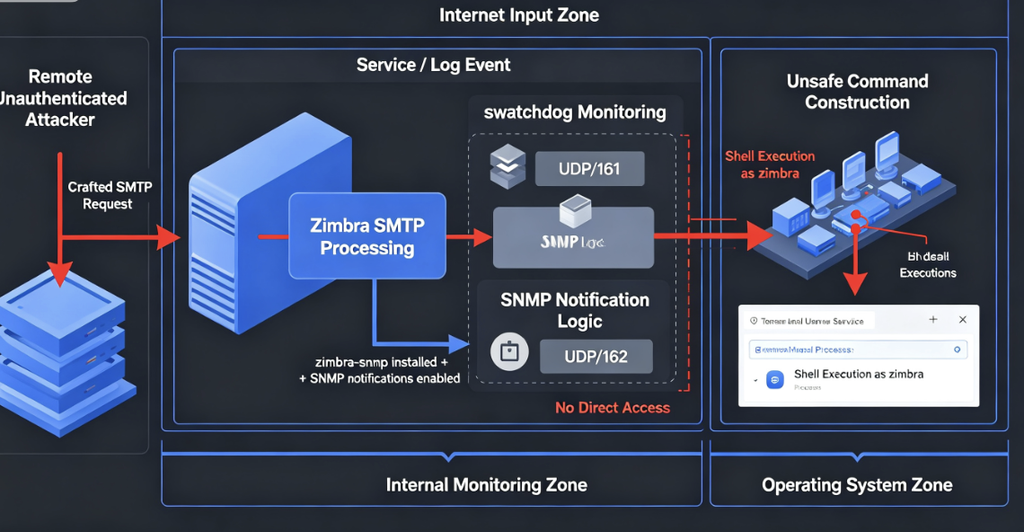
A better conceptual representation is:
Internet
   |
   | crafted SMTP input
   v
Zimbra SMTP processing
   |
   | attacker-controlled data
   v
Monitoring / event pipeline
   |
   v
SNMP notification logic
   |
   | insufficient command neutralization
   v
Shell / operating system command
   |
   v
Command execution as zimbra
This explains why traditional firewall assumptions around SNMP do not necessarily protect a vulnerable installation.
Restricting UDP/161 or UDP/162, for example, does not automatically remove the attack path described by the CVE because the hostile data can originate from SMTP processing.
The SMTP-to-SNMP Trust Boundary Is the Real Vulnerability
The most important architectural lesson from CVE-2026-73570 is not simply that Zimbra contained a shell injection bug.
It is that untrusted network data crossed multiple internal processing boundaries and eventually reached a command execution context.
Consider a simplified application flow.
An Internet-facing SMTP server has to accept substantial amounts of attacker-controlled input by design:
MAIL FROM
RCPT TO
HELO / EHLO
message metadata
delivery failures
host information
service events
Most of this information should be treated as untrusted text.
Zimbra also contains monitoring infrastructure capable of observing service events and producing SNMP notifications for administrators.
There is nothing inherently unsafe about either subsystem independently.
The problem emerges when data originating from an untrusted SMTP interaction is incorporated into an operational command without sufficiently strong separation between נתונים ו shell syntax.
Conceptually, vulnerable code might behave like this:
smtp event
    ↓
monitoring message
    ↓
notification string
    ↓
system command construction
    ↓
shell execution
If the notification layer assumes that the upstream monitoring message contains safe text, an attacker may be able to violate that assumption.
The security failure therefore occurs across a chain of trust.
This is a common pattern in mature server applications. A component that appears safe because it is “internal” can still become externally controllable if its input ultimately originates from a public protocol.
The relevant question for security engineers is not:
Is the SNMP service exposed to the Internet?
The better question is:
Can Internet-controlled SMTP data eventually reach the code responsible for constructing SNMP notification commands?
For CVE-2026-73570, the answer is yes under the vulnerable configuration.
Why This Becomes OS Command Injection
CVE-2026-73570 is categorized as CWE-78, OS command injection.
A basic shell command might normally be constructed from trusted information:
notification_tool "Service status changed"
If an application concatenates an externally influenced value into a command string, the structure conceptually becomes:
notification_tool "<untrusted value>"
The security of that design depends on whether <untrusted value> is reliably treated as plain data.
Shells interpret numerous characters and syntax constructs specially. If an application passes an attacker-controlled string through a shell without robust neutralization, the attacker may be able to alter the intended command semantics.
The vulnerability is therefore fundamentally different from something like a memory corruption bug.
There does not necessarily need to be a buffer overflow, use-after-free, arbitrary pointer overwrite, or ROP chain.
The dangerous primitive already exists:
application
    ↓
shell
    ↓
OS command
The attacker only needs to manipulate the data flowing into that primitive.
This is why command injection vulnerabilities can be so powerful despite being conceptually simple.
Once arbitrary commands can execute, the attacker no longer operates within the application’s normal security model.
What Does “Remote Code Execution” Mean Here?
The phrase RCE can sometimes make readers assume immediate root-level control of the operating system.
CVE-2026-73570 should be described more precisely.
The public vulnerability description states that arbitrary operating system commands can execute as the Zimbra user. (GitHub)
Therefore:
Unauthenticated attacker
        ↓
CVE-2026-73570
        ↓
OS command execution
        ↓
zimbra account privileges
That is already extremely serious.
The Zimbra account naturally has access to resources necessary for operating the mail platform. Depending on deployment architecture, configuration, file permissions, credentials and integrations, successful execution could potentially provide access to sensitive application information and create opportunities for persistence or additional privilege escalation.
However, defenders should avoid overstating the primitive.
CVE-2026-73570 itself does לא mean:
unauthenticated attacker → guaranteed root
It means:
unauthenticated attacker → arbitrary command execution as zimbra
Subsequent escalation would constitute another stage of an intrusion.
Why Pre-Authentication RCE on a Mail Server Is Especially Dangerous
Mail servers occupy an unusually valuable position in enterprise infrastructure.
They contain information that attackers can use to compromise other systems:
password-reset messages
MFA enrollment messages
internal conversations
financial correspondence
customer communications
cloud invitations
VPN instructions
security alerts
document sharing links
authentication notifications
An attacker who compromises a mail platform may therefore obtain much more than access to one Linux account.
Email is often effectively an identity-recovery system.
Consider a typical SaaS password reset:
Application
    ↓
"Forgot password"
    ↓
Reset token sent by email
    ↓
Mailbox
    ↓
Account recovery
If the email infrastructure itself is compromised, the attacker may gain opportunities to intercept or manipulate parts of that process.
This is why externally accessible mail platforms remain attractive targets for espionage, ransomware operators and financially motivated intrusion groups.
CVE-2026-73570 Requires a Specific Zimbra Configuration
Not every Zimbra installation is automatically vulnerable.
The CVE description specifically requires the optional:
zimbra-snmp
package to be installed and SNMP notifications to be enabled. (GitHub)
CERT Polska adds another useful operational detail: affected environments have SNMP trap notifications enabled through snmp_notify וה swatchdog service running. The CERT notes that swatchdog is enabled by default. (moje.cert.pl)
The exposure model therefore looks approximately like this:
Zimbra < 10.1.20
        +
zimbra-snmp installed
        +
SNMP notifications enabled
        +
relevant monitoring processing active
        =
potential CVE-2026-73570 exposure
This deployment condition helps explain the vulnerability’s CVSS Attack Complexity rating.
Understanding the CVSS 8.9 Score
CVE-2026-73570 carries the following CVSS 3.1 vector:
CVSS:3.1/AV:N/AC:H/PR:N/UI:N/S:C/C:H/I:H/A:L
The individual metrics are important.
AV:N — Network Attack Vector
Exploitation can originate remotely over a network.
That is expected for a vulnerability involving crafted SMTP requests.
AC:H — High Attack Complexity
This metric can be misleading.
Some administrators interpret “Attack Complexity: High” as:
The exploit must be extremely technically sophisticated.
That is not necessarily what AC:H means.
Attack complexity can reflect conditions outside the attacker’s direct control.
Here, exploitation depends on the vulnerable Zimbra environment having the required SNMP functionality enabled.
Therefore AC:H should not become an excuse for delaying remediation.
Once an attacker identifies a server with the required configuration, the operational difficulty may be very different from what a non-specialist might infer from the word “High.”
The active exploitation warning from CERT Polska is strong real-world evidence that the vulnerability is exploitable in practical environments. (moje.cert.pl)
PR:N — No Privileges Required
No valid Zimbra credentials are necessary.
That is one of the most concerning properties of the vulnerability.
UI:N — No User Interaction
An employee does not have to click an attachment, open an email or visit a malicious link for exploitation to occur.
S:C — Scope Changed
The vulnerable application processing can affect resources beyond the original security context.
C:H and I:H
Successful exploitation can have severe consequences for confidentiality and integrity.
A:L
The official vector assigns a lower availability impact than confidentiality and integrity.
The combined result is 8.9 High. (Tenable®)
For operational prioritization, however, CVSS should not be considered in isolation.
CVE-2026-73570 now has another signal that is significantly more actionable:
observed exploitation.
CVE-2026-73570 Is Being Actively Exploited
CERT Polska published an advisory on August 17, 2026 stating that CVE-2026-73570 was being actively exploited.
The agency described an ongoing campaign targeting the command injection vulnerability and urged organizations to upgrade immediately and investigate affected environments. (moje.cert.pl)
This is a major change in risk.
Before evidence of exploitation, an organization might model risk as:
vulnerability severity
×
exposure
×
probability of exploitation
Once exploitation is occurring in the wild, one major uncertainty disappears.
The question is no longer whether attackers might eventually operationalize the vulnerability.
Some already have.
BleepingComputer subsequently reported on August 20 that attackers had begun exploiting the Zimbra RCE, citing CERT Polska’s warning. (BleepingComputer)
For defenders operating Internet-facing Zimbra servers, CVE-2026-73570 should therefore receive substantially higher priority than its CVSS classification alone might suggest.
A Plausible CVE-2026-73570 Attack Chain
Public vulnerability documentation currently provides enough information to understand the architecture of the attack without needing a weaponized exploit.
The chain can be represented as follows:
Stage 1
Internet attacker identifies Zimbra SMTP service

                ↓

Stage 2
Crafted SMTP interaction supplies malicious input

                ↓

Stage 3
The input becomes part of a monitored Zimbra event

                ↓

Stage 4
Monitoring infrastructure processes the event

                ↓

Stage 5
SNMP notification functionality handles attacker-influenced data

                ↓

Stage 6
Input is insufficiently neutralized before shell usage

                ↓

Stage 7
OS command executes as the zimbra user

                ↓

Stage 8
Post-exploitation activities become possible
There is an important boundary between stages seven and eight.
The CVE directly establishes the command-execution primitive.
Activities such as installing persistence, stealing credentials, modifying mail data or escalating privileges are post-exploitation actions and should not be incorrectly described as intrinsic features of CVE-2026-73570.
Why SMTP Exposure Makes the Vulnerability Operationally Important
Internet-facing Zimbra servers generally need SMTP connectivity.
That makes CVE-2026-73570 different from vulnerabilities affecting rarely exposed administrative interfaces.
Organizations cannot simply reason:
"Our SNMP ports are blocked,
therefore this doesn't matter."
The externally delivered data involved in the vulnerability comes through SMTP.
This is a classic example of transitive attack surface.
The system might look externally like:
             Internet
                 |
                 |
              SMTP/25
                 |
                 v
        +----------------+
        | Zimbra Server  |
        +----------------+
But internally the real processing graph may look more like:
SMTP
 |
 v
Mail processing
 |
 v
Logging / service events
 |
 v
Monitoring
 |
 v
SNMP notification
 |
 v
Shell command
Security tools that only map listening ports cannot fully capture this type of vulnerability.
Attack surface assessment must also consider how data flows across internal components.
ה swatchdog Connection
CERT Polska specifically identifies the swatchdog service as part of the affected operational configuration.
swatchdog is used to monitor log activity and react to matching events.
This provides a useful conceptual explanation for how attacker-controlled SMTP information can reach a monitoring and notification subsystem.
The architecture resembles:
SMTP event
   ↓
Zimbra log/event
   ↓
swatchdog monitoring
   ↓
service-state detection
   ↓
SNMP notification processing
   ↓
unsafe command construction
CERT Polska states that vulnerable installations have SNMP trap functionality enabled using snmp_notify while swatchdog is running. (moje.cert.pl)
This is important for both vulnerability assessment and incident response.
Security teams should inventory those conditions rather than simply checking the Zimbra version.
How to Check Whether a Zimbra Server Is Potentially Exposed
Authorized administrators can begin with three questions.
1. What Zimbra version is installed?
The fixed release is:
10.1.20
Zimbra’s security advisory explicitly lists 10.1.20 as the fix release for CVE-2026-73570. (Zimbra Tech Center)
Any affected deployment running an earlier version requires remediation.
2. Is zimbra-snmp installed?
Administrators should inspect the packages installed on the server and their Zimbra component configuration.
The vulnerable condition depends on the optional SNMP package being present.
3. Are SNMP notifications enabled?
The relevant configuration includes:
snmp_notify
according to CERT Polska. (moje.cert.pl)
These checks can help distinguish potentially vulnerable installations from installations that do not expose the affected processing path.
They should not, however, replace patching.
Configuration changes can reduce exposure, but the safest long-term remediation is to run a fixed Zimbra release.
Upgrade to Zimbra Collaboration 10.1.20 or Later
Zimbra identifies version 10.1.20 as containing the fix for the SNMP monitoring command injection vulnerability. (Zimbra Tech Center)
Administrators should therefore upgrade vulnerable environments to at least:
Zimbra Collaboration 10.1.20
or a newer supported release containing the patch.
But there is an important incident-response distinction:
patching vulnerability
        ≠
removing attacker
If a vulnerable server was compromised before the update, installing the patch prevents exploitation of that particular vulnerability but does not necessarily remove persistence already created by an attacker.
For a server that had:
ZCS < 10.1.20
+
zimbra-snmp
+
SNMP notifications enabled
+
Internet-accessible SMTP
during the exploitation window, defenders should consider compromise assessment in addition to upgrading.
CERT Polska Detection Guidance
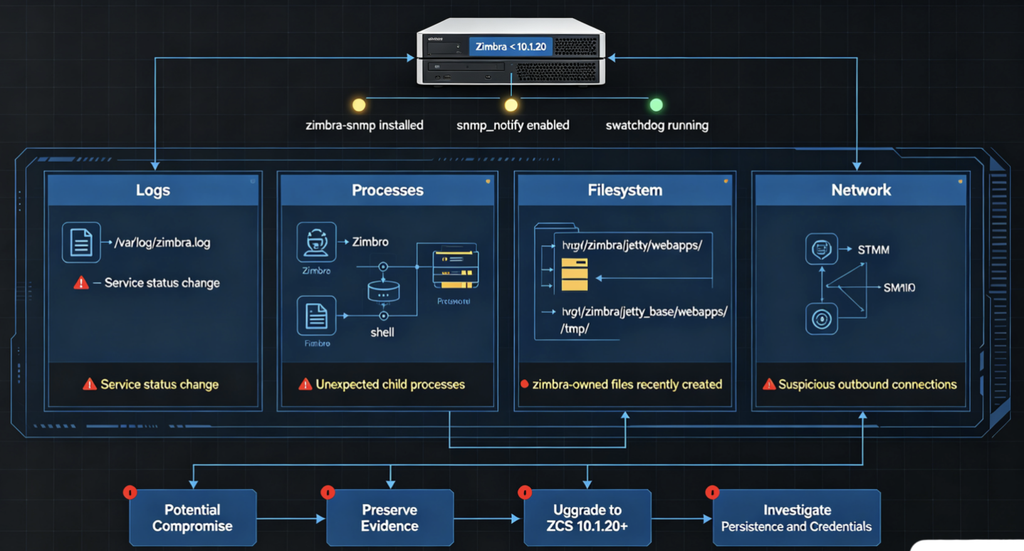
CERT Polska provides unusually useful forensic guidance for CVE-2026-73570.
The agency recommends examining:
/var/log/zimbra.log
for suspicious service-status-change entries.
The patterns highlighted by CERT Polska take the form:
Service status change: <suspicious content> changed from stopped to running

Service status change: <suspicious content> changed from running to stopped
These log patterns are valuable because they correspond closely to the vulnerable monitoring workflow. (moje.cert.pl)
Defenders should not search only for a known exploit string.
Instead, examine service-status messages for values that do not resemble legitimate service names.
Potential suspicious indicators include unusual:
shell syntax
encoded strings
URLs
temporary paths
command-line fragments
download commands
unexpected filenames
A conservative detection workflow might begin with:
grep -n "Service status change:" /var/log/zimbra.log
and then manually or programmatically analyze the resulting values.
Searching for unusual child processes and file-system changes can provide additional context.
File-System Investigation
CERT Polska also recommends checking files created by the zimbra user during the previous 30 days in several locations:
/opt/zimbra/jetty/webapps/
/opt/zimbra/jetty_base/webapps/
/tmp/
These locations are significant.
The Jetty web application directories can potentially provide useful persistence locations for attackers who have gained execution inside a Java-based web application environment.
/tmp, meanwhile, is commonly used during intrusion activity because it is usually writable and suitable for staging temporary tools or payloads.
Defenders can perform a basic file inventory, for example:
find /opt/zimbra/jetty/webapps \
     /opt/zimbra/jetty_base/webapps \
     /tmp \
     -user zimbra \
     -mtime -30 \
     -ls
This is not a definitive compromise detector.
Legitimate Zimbra activity can also create files.
The goal is to identify anomalies requiring deeper analysis.
Look particularly for:
unexpected JSP files
recently modified web application files
executables
shell scripts
archives
encoded content
hidden files
unusual ownership or timestamps
Any suspicious file should be preserved before modification so that hashes, timestamps and content can be examined during incident response.
Process-Level Detection
Because the vulnerability produces OS command execution, process telemetry can be highly valuable.
A normal mail platform executes many legitimate processes, so simplistic alerts such as:
zimbra launched shell
may generate noise.
Better detections focus on unexpected process relationships.
לדוגמה:
Zimbra monitoring process
        ↓
shell
        ↓
network utility
or:
Zimbra process
        ↓
script interpreter
        ↓
unexpected external connection
Interesting child processes could include unexpected instances of:
sh
bash
python
perl
curl
wget
nc
socat
Their presence does not independently prove exploitation, but unusual parent-child relationships combined with the log artifacts documented by CERT Polska substantially increase confidence.
Endpoint monitoring should therefore correlate:
SMTP activity
+
Zimbra service event
+
shell execution
+
new file
+
outbound network connection
rather than treating each event independently.
Network Detection
Network defenders face a difficult challenge with CVE-2026-73570.
The malicious traffic travels through a legitimate protocol used continuously by mail servers:
SMTP
Blocking SMTP is obviously not a practical mitigation for an Internet-facing mail server.
Signature-based inspection may eventually detect known exploit patterns, but relying exclusively on a specific payload is fragile.
Attackers can alter command representations and encoding.
A stronger detection architecture combines network and host telemetry:
Internet SMTP session
        ↓
suspicious Zimbra service event
        ↓
monitoring component activity
        ↓
unexpected OS command
        ↓
filesystem or network behavior
This provides behavioral detection even when the exact exploit syntax changes.
Why an Upgrade Alone May Be Insufficient
Suppose an organization discovers the following configuration today:
Zimbra 10.1.19
zimbra-snmp installed
snmp_notify enabled
SMTP exposed publicly
It immediately upgrades to 10.1.20.
The vulnerability itself is now patched.
But that does not answer the question:
Was the server already exploited?
Because active exploitation has been reported, exposed organizations should examine historical telemetry.
At minimum, review:
/var/log/zimbra.log
recent zimbra-owned files
process execution history
EDR telemetry
authentication activity
cron configuration
systemd changes
web application modifications
outbound connections
SSH configuration
authorized_keys
Depending on incident-response capabilities, organizations may also want to compare the filesystem against known-good package contents.
Persistence After Zimbra RCE
Once arbitrary commands execute under a service account, attackers generally attempt to convert transient execution into durable access.
Conceptually:
Initial RCE
   ↓
Environment discovery
   ↓
Credential discovery
   ↓
Persistence
   ↓
Privilege escalation
   ↓
Lateral movement
Again, these stages are not automatically provided by CVE-2026-73570.
They are possibilities created by the initial command-execution primitive.
Potential persistence locations on a compromised Linux application server can include:
cron jobs
startup scripts
web application files
SSH keys
modified application configuration
backdoored scripts
scheduled jobs
additional accounts
Incident responders should therefore avoid limiting investigation exclusively to the exact vulnerable component.
Once operating system commands have executed, the relevant security boundary becomes the host.
Why Zimbra Vulnerabilities Receive Rapid Attacker Attention
Zimbra has repeatedly been a high-value vulnerability target because of its position as an Internet-facing collaboration and email platform.
The Zimbra advisory history itself illustrates this risk.
For example, Zimbra previously fixed CVE-2024-45519, another vulnerability capable of allowing unauthenticated command execution, this time involving the postjournal service. Zimbra lists that vulnerability with a CVSS score of 9.8 in its security advisory history. (Zimbra Tech Center)
The details differ substantially between the two vulnerabilities.
CVE-2024-45519 should not be treated as the same vulnerability class implementation as CVE-2026-73570.
But the comparison highlights an important defensive theme:
Internet protocol
        ↓
server-side processing
        ↓
inadequate trust boundary
        ↓
command execution
Mail infrastructure should therefore receive vulnerability-management priority comparable to VPN gateways, remote-access appliances and identity infrastructure.
CVE-2026-73570 Versus a Typical Web RCE
CVE-2026-73570 is also interesting because it challenges the common assumption that remotely exploitable enterprise application vulnerabilities originate from HTTP endpoints.
There may be no malicious:
GET /vulnerable
POST /api/exploit
request for a WAF to inspect.
Instead, the initial attack channel is SMTP.
Organizations that concentrate application security telemetry almost exclusively around HTTP may therefore have less visibility into this type of attack.
An enterprise attack-surface model should include:
HTTP
HTTPS
SMTP
IMAP
POP3
LDAP
SIP
DNS
VPN protocols
administrative protocols
message queues
custom TCP services
Any parser reachable from an attacker can become the beginning of an exploit chain.
Safe Verification Strategy
Because CVE-2026-73570 is actively exploited, organizations should avoid unnecessary production exploitation attempts merely to determine whether they are vulnerable.
A safer workflow is configuration-driven.
Start with:
1. Determine Zimbra version
2. Determine whether zimbra-snmp is installed
3. Determine whether SNMP notifications are enabled
4. Verify swatchdog state
5. Inspect historical logs
6. Upgrade to 10.1.20+
7. Perform compromise assessment
If exploit reproduction is required for an authorized security assessment, it should be conducted in a controlled environment containing a disposable vulnerable Zimbra instance rather than against a production mail system.
The validation objective does not need to be destructive.
A good security test should answer:
Can attacker-controlled SMTP data
reach an operating-system command context?
without installing persistence or accessing real mailbox data.
Agentic penetration-testing platforms such as Penligent can also be used in authorized environments to structure vulnerability verification around evidence collection rather than blind vulnerability scanning. For a flaw such as CVE-2026-73570, the useful evidence chain is not merely “version appears vulnerable”; it is the relationship between exposed SMTP input, configuration state, observable processing behavior and the patched boundary.
That distinction is especially important for vulnerabilities with environmental prerequisites.
Detection Is More Valuable Than a Public PoC
Security teams often search immediately for:
CVE-2026-73570 PoC
CVE-2026-73570 exploit
CVE-2026-73570 GitHub
But from a defensive perspective, reproducing the final command injection is often less important than answering four operational questions:
Was I vulnerable?

Was I exposed?

Was anyone attempting exploitation?

Did exploitation succeed?
Version and configuration answer the first question.
SMTP exposure answers much of the second.
Logs and network telemetry help answer the third.
Process and filesystem evidence are critical for the fourth.
A public exploit script does not answer those questions for your environment.
Why Vulnerability Scanners May Underestimate the Problem
CVE-2026-73570 demonstrates a limitation of version-only vulnerability management.
Imagine that a scanner reports:
CVE-2026-73570
CVSS: 8.9 HIGH
Attack Complexity: HIGH
A vulnerability-management team might rank several CVSS 9.8 findings above it.
That logic ignores two crucial pieces of context:
no authentication required
+
active exploitation
Conversely, a server running an affected version but without the relevant SNMP configuration may not expose the vulnerable path.
So prioritization should combine:
CVSS
+
reachable service
+
configuration
+
exploit intelligence
+
business criticality
+
observed attacker activity
For an Internet-facing mail server satisfying the vulnerable conditions, CVE-2026-73570 should be treated as an urgent incident-response concern.
Defenders Should Distinguish Vulnerability Exposure From Compromise
A useful model is:
פגיע
affected version
+
affected component
+
affected configuration
Exposed
vulnerable
+
attacker can reach required protocol path
Exploited
attacker successfully reaches command execution
Compromised
attacker establishes meaningful unauthorized access
or changes system state
These stages require different responses.
A vulnerable but non-exposed host should still be patched.
An exposed host requires urgent patching.
A potentially exploited host requires investigation.
A confirmed compromised host requires incident response.
CVE-2026-73570 has progressed far enough in the threat landscape that defenders can no longer safely stop at the first two stages.
Recommended Response Priority
Organizations running Zimbra should first identify every ZCS installation and determine its version.
Anything below 10.1.20 should immediately trigger further assessment.
Then determine whether:
zimbra-snmp is installed
snmp_notify is enabled
swatchdog is running
If those conditions existed on an Internet-facing server, treat it as having meaningful exposure to CVE-2026-73570.
Upgrade to ZCS 10.1.20 or newer.
After patching, review the indicators published by CERT Polska, particularly:
/var/log/zimbra.log
and files recently created by the zimbra account under:
/opt/zimbra/jetty/webapps/
/opt/zimbra/jetty_base/webapps/
/tmp/
If suspicious evidence is discovered, preserve it before remediation and expand the investigation beyond Zimbra itself.
Incident Response Checklist for CVE-2026-73570
A practical investigation might proceed in roughly this order:
Identify server
       ↓
Record current Zimbra version
       ↓
Verify SNMP configuration
       ↓
Preserve logs
       ↓
Search documented indicators
       ↓
Inspect zimbra-owned files
       ↓
Review process history
       ↓
Review outbound connections
       ↓
Check persistence mechanisms
       ↓
Rotate exposed secrets if required
       ↓
Patch / rebuild
       ↓
Continue monitoring
Credential rotation is particularly important if investigation reveals evidence that an attacker was able to inspect application configuration or sensitive local files.
Do not automatically assume that passwords or keys were stolen merely because the server was vulnerable.
But if successful command execution is confirmed, credential exposure should become part of the incident scope.
Mitigation When Immediate Upgrade Is Impossible
The preferred response is upgrading.
Where immediate patching truly cannot be completed, organizations should at minimum disable the vulnerable optional functionality if operational requirements permit.
That means reducing or removing the conditions associated with:
zimbra-snmp
SNMP notifications
This can reduce exposure to the vulnerable processing path.
However, mitigation should not become a long-term substitute for installing the vendor fix.
There is also an important historical consideration.
Disabling the component now does not prove it was not exploited yesterday.
Therefore:
mitigation
+
historical compromise assessment
may both be necessary.
Lessons for Application Security Engineers
CVE-2026-73570 illustrates several broader engineering principles.
Never Treat Internal Data as Trusted Solely Because It Came From Another Internal Component
The relevant data path can be:
attacker
→ SMTP
→ mail subsystem
→ monitoring subsystem
→ notification subsystem
→ shell
By the time the string reaches the final component, it may appear internally generated.
Its true trust origin is still the attacker.
This is why mature systems need taint-aware thinking.
Avoid Shell Construction Entirely Where Possible
The safest way to prevent shell command injection is usually not better escaping.
It is eliminating unnecessary shell interpretation.
Prefer execution models conceptually equivalent to:
execve(
  binary,
  fixed_argument_array
)
rather than:
shell(
  "binary " + user_controlled_string
)
The fewer interpretation layers between data and execution, the smaller the command-injection attack surface.
Logging Pipelines Are Security Boundaries
Logs are frequently treated as passive data.
Modern infrastructure makes that assumption increasingly dangerous.
Logs may feed:
alerting systems
SIEM automation
monitoring agents
notification scripts
SOAR systems
webhooks
incident-response automation
An attacker who controls a log field may indirectly control downstream systems.
This is sometimes described as a form of second-order or indirect injection.
Even if the initial parser does nothing dangerous, downstream consumers may.
Why CVE-2026-73570 Matters Beyond Zimbra
The vulnerability is a useful example of why modern attack paths cannot be understood purely by looking at exposed ports.
Externally, the attacker sees SMTP.
Internally, the payload crosses several boundaries before reaching an execution primitive.
That architecture can appear in many systems:
HTTP → log processor → shell
SMTP → monitoring → shell
API → job queue → worker → shell
file upload → converter → command
message queue → automation → script
The vulnerable component does not necessarily have to be Internet-facing itself.
It merely needs to consume information derived from something that is.
This is particularly relevant as infrastructure becomes more automated.
Every monitoring agent, notification engine and orchestration layer creates another possible interpreter for untrusted information.
CVE-2026-73570 FAQ
Is CVE-2026-73570 an unauthenticated RCE?
Yes.
The published vulnerability description says an unauthenticated attacker can send crafted SMTP requests that may cause arbitrary operating system commands to execute as the Zimbra user. (GitHub)
What versions of Zimbra are affected?
The CVE describes Zimbra Collaboration versions before 10.1.20 as affected when the required SNMP configuration is present. (GitHub)
What version fixes CVE-2026-73570?
Zimbra lists 10.1.20 as the fix release. (Zimbra Tech Center)
Does every Zimbra installation below 10.1.20 expose the RCE?
לא.
The vulnerable path requires the optional zimbra-snmp package and enabled SNMP notifications.
Does the attacker need Zimbra credentials?
לא.
The CVSS vector specifies:
PR:N
and the vulnerability is described as unauthenticated.
Does exploitation require user interaction?
לא.
The CVSS vector specifies:
UI:N
Is the attack delivered over SNMP?
This is an important misconception.
The vulnerable component involves SNMP notifications, but the published CVE description identifies specially crafted SMTP requests as the source of the malicious input. (Tenable®)
Does blocking SNMP ports completely mitigate the vulnerability?
That should not be relied upon as the primary defense because the documented external input path is SMTP rather than an attacker directly talking to an exposed SNMP service.
Upgrade the affected Zimbra software and disable unnecessary vulnerable functionality.
What privileges does the attacker obtain?
Commands execute as the Zimbra user, according to the CVE description. (GitHub)
That is not automatically root access.
Is CVE-2026-73570 actively exploited?
Yes.
CERT Polska reported active exploitation on August 17, 2026. (moje.cert.pl)
Where should defenders look for evidence?
CERT Polska specifically recommends reviewing:
/var/log/zimbra.log
and recent files created by the Zimbra user under:
/opt/zimbra/jetty/webapps/
/opt/zimbra/jetty_base/webapps/
/tmp/
Final Assessment
CVE-2026-73570 deserves more attention than the phrase “SNMP command injection” might initially suggest.
It is fundamentally a pre-authentication server-side command execution vulnerability accessible through attacker-controlled SMTP input.
The complete risk can be summarized as:
Internet
   ↓
SMTP
   ↓
attacker-controlled data
   ↓
Zimbra monitoring pipeline
   ↓
SNMP notification processing
   ↓
OS command injection
   ↓
execution as zimbra
The vulnerability affects Zimbra Collaboration before 10.1.20 when zimbra-snmp is installed and SNMP notifications are enabled. Zimbra patched the issue in 10.1.20, and CERT Polska has since confirmed that attackers are exploiting CVE-2026-73570 in real environments. (Zimbra Tech Center)
That last fact should drive remediation priorities.
For potentially affected organizations, the correct workflow is no longer simply:
scan → patch → close ticket
It should be:
identify exposure
        ↓
preserve evidence
        ↓
patch to 10.1.20+
        ↓
hunt for exploitation
        ↓
investigate persistence
        ↓
remediate compromise if found
CVE-2026-73570 also reinforces a broader security lesson: the externally visible protocol is only the beginning of an attack surface.
SMTP input became dangerous because it crossed an internal trust boundary and reached a command-execution mechanism several layers deeper inside the application.
For defenders, pentesters and application-security engineers, that is the important takeaway. Security testing should trace attacker-controlled data through the entire processing chain rather than stopping at the first exposed service.
For Zimbra administrators, however, the immediate priority is simpler: if a server may meet the affected conditions, update to Zimbra Collaboration 10.1.20 or later and investigate the host for evidence of prior exploitation.


 Hebrew
  English
  German
  French
  Spanish
  Portuguese
  Japanese
  Korean
  Hindi
Hindi  Arabic
  Turkish