
CVE-2014-0160, better known as Heartbleed, remains one of the most recognizable vulnerabilities ever discovered in Internet infrastructure. Publicly disclosed on April 7, 2014, the flaw affected OpenSSL’s implementation of the TLS and DTLS Heartbeat Extension and allowed a remote peer to read portions of memory belonging to a vulnerable process.
The bug was particularly dangerous because exploitation did not require authentication, code execution, or breaking TLS encryption. An attacker could send a malformed heartbeat message and cause vulnerable OpenSSL implementations to return memory that had never been included in the legitimate request.
That leaked memory could potentially contain passwords, authentication cookies, session tokens, application data, cryptographic material, or even private keys.
The official OpenSSL advisory described the root cause as a missing bounds check and confirmed that as much as approximately 64 KB of process memory could be disclosed to a connected client or server. OpenSSL recommended upgrading affected installations to OpenSSL 1.0.1g, while the 1.0.2 development branch was corrected in 1.0.2-beta2.
More than a decade later, CVE-2014-0160 still matters because old OpenSSL libraries remain embedded in appliances, unsupported operating systems, firmware, industrial products, internal infrastructure, and forgotten Internet-facing services. CISA also includes CVE-2014-0160 in its Known Exploited Vulnerabilities Catalog, reinforcing that Heartbleed should not be treated merely as historical trivia. (CISA)
What Is CVE-2014-0160?
CVE-2014-0160 is an out-of-bounds read vulnerability in OpenSSL’s implementation of the TLS and DTLS Heartbeat Extension.
NIST classifies the vulnerability under CWE-125: קריאה מחוץ לגבולות. Its current NVD CVSS 3.1 score is 7.5 High, with a network-accessible attack vector, low attack complexity, no required privileges, and no required user interaction. The principal security impact is loss of confidentiality. (NVD)
The important distinction is that Heartbleed does not directly defeat the TLS cryptographic algorithms themselves.
AES was not mathematically broken.
RSA was not mathematically broken.
The TLS protocol did not suddenly become incapable of encrypting traffic.
Instead, a memory-safety error inside the software implementing TLS allowed an attacker to ask the vulnerable process to disclose memory located outside the legitimate heartbeat payload.
That distinction explains both the simplicity and severity of Heartbleed.
An application might correctly encrypt all network traffic while simultaneously leaking its secrets through an implementation bug.
Heartbleed OpenSSL Vulnerable Versions
The most important question for administrators encountering an old OpenSSL installation is simple:
Which OpenSSL versions are vulnerable to CVE-2014-0160?
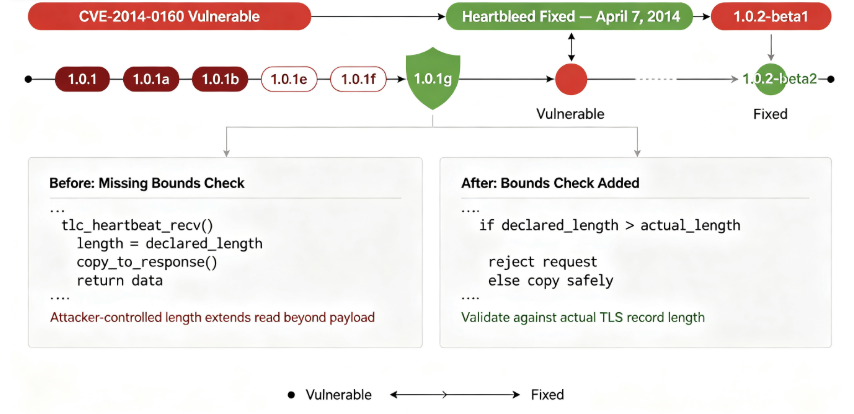
The official OpenSSL advisory states that the vulnerable code affected the OpenSSL 1.0.1 series and 1.0.2 beta releases available at the time, including OpenSSL 1.0.1f and 1.0.2-beta1. Users were told to upgrade to 1.0.1g, while the 1.0.2 branch would be fixed in 1.0.2-beta2.
| OpenSSL version | Heartbleed status |
|---|---|
| OpenSSL 0.9.8 | Not affected by CVE-2014-0160 |
| OpenSSL 1.0.0 | Not affected |
| OpenSSL 1.0.1 | פגיע |
| OpenSSL 1.0.1a | פגיע |
| OpenSSL 1.0.1b | פגיע |
| OpenSSL 1.0.1c | פגיע |
| OpenSSL 1.0.1d | פגיע |
| OpenSSL 1.0.1e | Vulnerable upstream |
| OpenSSL 1.0.1f | פגיע |
| OpenSSL 1.0.1g | Fixed |
| OpenSSL 1.0.1h and later | Heartbleed fixed |
| OpenSSL 1.0.2-beta1 | פגיע |
| OpenSSL 1.0.2-beta2 | Fixed |
The OpenSSL project summarizes the affected range as 1.0.1 before 1.0.1g, while the original April 7 advisory explicitly included the contemporary 1.0.2 beta code. (OpenSSL Library)
The widely cited Heartbleed disclosure site likewise identified OpenSSL 1.0.1 through 1.0.1f inclusive as vulnerable and 1.0.1g as not vulnerable. (Heartbleed)
Was OpenSSL 1.0.1e Vulnerable to Heartbleed?
Upstream OpenSSL 1.0.1e was vulnerable.
However, this question becomes more complicated on Linux distributions because vendors often backport security fixes without changing the upstream version number.
For example, a system might report:
OpenSSL 1.0.1eyet contain a distribution-specific patch equivalent to the Heartbleed fix.
That means the statement:
“OpenSSL 1.0.1e is always vulnerable”
is not reliable when evaluating packaged operating-system builds.
Red Hat, for example, documented RHEL builds based on OpenSSL 1.0.1e where later RPM revisions contained the Heartbleed patch backported from OpenSSL 1.0.1g. Red Hat Enterprise Linux 7 shipped openssl-1.0.1e-34.el7 with the relevant fix, despite the upstream version portion still saying 1.0.1e. (Red Hat Customer Portal)
Debian used the same security-maintenance model. Debian Wheezy’s fixed package was 1.0.1e-2+deb7u5, even though its upstream source version remained 1.0.1e. (Security Tracker)
Therefore, asset owners should examine the complete vendor package revision and vendor security advisory rather than comparing only the OpenSSL upstream version string.
Why the TLS Heartbeat Extension Exists
Understanding Heartbleed requires understanding RFC 6520.
RFC 6520 introduced the TLS and DTLS Heartbeat Extension as a way for endpoints to verify that peers remained responsive without performing another expensive TLS renegotiation. For DTLS, the mechanism could also support path MTU discovery.
Conceptually, a heartbeat request looks like this:
Heartbeat Request

+--------------------+
| Message Type       |
+--------------------+
| Payload Length     |
+--------------------+
| Payload            |
+--------------------+
| Padding            |
+--------------------+
The sender specifies a payload length and supplies some arbitrary payload.
The receiver is supposed to return that same payload.
RFC 6520 explicitly states that if the declared payload_length is larger than what the received heartbeat message can actually contain, the message must be silently discarded.
That validation requirement is exactly where vulnerable OpenSSL implementations failed.
How CVE-2014-0160 Works
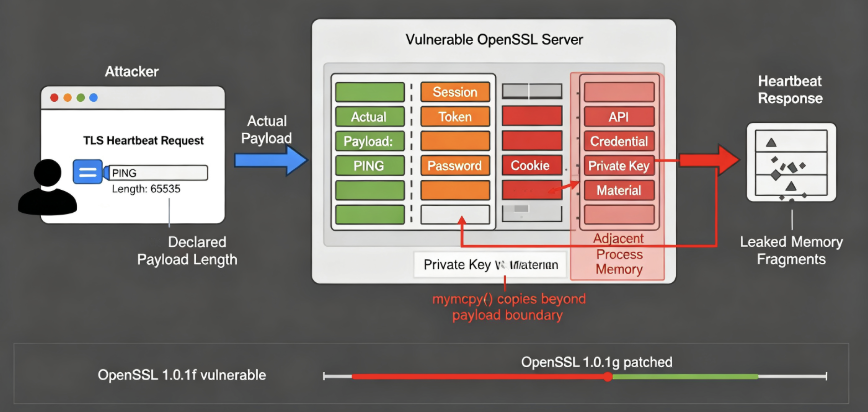
Imagine a legitimate heartbeat request containing a small payload:
Payload length: 4
Payload: PING
The server reads four bytes and returns:
PINGThat is expected behavior.
Now imagine that a malformed request says:
Payload length: 16384
Actual payload: PING
The vulnerable implementation trusted the declared length without first verifying that 16,384 payload bytes were actually present inside the received TLS record.
It then attempted to copy the claimed amount of data into the heartbeat response.
Only four legitimate payload bytes existed.
The remaining data therefore came from whatever happened to occupy adjacent process memory.
Conceptually:
Attacker sends:

Declared payload length = 16384
Actual payload          = "PING"

Vulnerable OpenSSL sees:

[ P I N G ][ adjacent process memory..................... ]

              |
              | copies according to claimed size
              v

Response:

[ P I N G ][ leaked process memory...................... ]
This is an over-read, not a buffer overflow.
The attacker is not primarily writing outside a buffer or replacing application code.
The vulnerable process is reading beyond the intended buffer boundary and returning the resulting data.
NVD therefore categorizes CVE-2014-0160 as an out-of-bounds read. (NVD)
Why Heartbleed Could Leak Up to 64 KB
The heartbeat protocol represents the payload length using a two-byte field.
A two-byte unsigned value can represent lengths approaching 65,535 bytes.
Because vulnerable OpenSSL trusted this attacker-controlled size when copying the heartbeat payload, a malformed message could trigger disclosure approaching the famous 64 KB figure associated with Heartbleed.
OpenSSL’s own advisory said that the vulnerability could reveal up to 64k of memory from the connected peer.
Importantly, the attacker did not necessarily receive the same data every time.
Heap layout changes as applications process traffic, allocate buffers, free objects, authenticate users, perform TLS operations, and process requests.
Repeated probes could therefore expose different memory fragments.
This transformed an apparently small memory disclosure into a potentially powerful intelligence-gathering technique.
What Data Could Heartbleed Expose?
A vulnerable process could potentially disclose anything temporarily present near the over-read region.
Depending on workload and memory layout, that could include:
- usernames;
- passwords;
- HTTP headers;
- session cookies;
- bearer tokens;
- API credentials;
- application requests;
- email contents;
- database credentials;
- cryptographic material;
- TLS session information;
- portions of other users’ requests;
- private-key material.
The official OpenSSL material specifically warned that leaked memory could contain sensitive data including private keys, account names and passwords. (OpenSSL Wiki)
Private-key recovery attracted enormous attention because possession of the certificate’s corresponding private key could have consequences extending beyond one leaked request.
However, Heartbleed should not be described as automatically extracting a server’s private key.
It may expose cryptographic material depending on process state and memory placement.
That distinction is important.
Heartbleed Could Affect Clients Too
Heartbleed is commonly described as an attack against HTTPS servers, but the underlying bug was not inherently server-only.
The OpenSSL advisory noted that either participant in an SSL/TLS connection could request a heartbeat. Consequently, a vulnerable client connecting to a malicious server could also potentially disclose memory. (OpenSSL Wiki)
That broadened the vulnerable surface beyond websites.
Potentially affected software categories included:
Web servers
Reverse proxies
VPN concentrators
Mail servers
XMPP servers
Network appliances
Embedded systems
Client applications
TLS-enabled management interfaces
Custom software linked against vulnerable libssl
The Heartbleed disclosure project specifically noted that OpenSSL was widely used beyond Apache and nginx, including mail servers, VPN products, network appliances and client software. (Heartbleed)
Why Heartbleed Was So Dangerous
Several characteristics combined to make CVE-2014-0160 unusually serious.
No Authentication Was Required
An Internet-connected attacker could potentially interact directly with a vulnerable TLS service.
There was no prerequisite application account.
Attack Complexity Was Low
The attacker did not need a complicated race condition, memory-corruption exploit chain, or user interaction.
This is reflected in NVD’s modern CVSS vector:
AV:N/AC:L/PR:N/UI:N/S:U/C:H/I:N/A:N(NVD)
Exploitation Could Leave Little Application-Level Evidence
A heartbeat message is processed inside the TLS stack.
Traditional HTTP access logs might therefore provide little visibility into the memory disclosure itself.
Organizations that relied purely on web-server request logs could have difficulty determining retrospectively whether sensitive memory had been exposed.
Repeated Requests Could Reveal Different Memory
Each request could sample a different fragment of process memory.
The absence of interesting data in one heartbeat response did not prove that subsequent responses would also be harmless.
Secrets Could Remain Valuable After Patching
Upgrading OpenSSL stops future exploitation.
It does not magically invalidate secrets potentially exposed before the patch.
That distinction is critical to Heartbleed incident response.
The OpenSSL 1.0.1g Fix
OpenSSL 1.0.1g was released on April 7, 2014, the same day the Heartbleed security advisory was published. OpenSSL’s release timeline lists the release alongside the CVE-2014-0160 advisory. (OpenSSL Library)
At its core, the fix introduced proper validation of the heartbeat record before OpenSSL copied the claimed payload.
The relevant logic can be reduced conceptually to:
read heartbeat type
read claimed payload length

if (header + payload + required_padding > actual_record_length)
    reject_message

copy payload
The corrected OpenSSL code added checks equivalent to:
if (1 + 2 + payload + 16 > s->s3->rrec.length)
    return 0;
OWASP’s technical explanation of the patched code shows the same principle: validate the claimed payload against the actual TLS record length and silently discard invalid messages. (GitHub)
This is a tiny code change compared with the enormous security consequences of the bug.
That contrast is one reason Heartbleed became such an important secure-coding case study.
Vulnerable Logic vs. Fixed Logic
The vulnerability can be understood with simplified pseudocode.
Vulnerable behavior
payload_length = request.claimed_length;
payload_pointer = request.payload;

response = allocate(payload_length);
copy(response, payload_pointer, payload_length);
The problem is obvious once expressed this way:
claimed_length != necessarily actual_available_bytesFixed behavior
payload_length = request.claimed_length;

if (payload_length + headers + minimum_padding > received_record_length) {
    discard_request();
    return;
}

copy(response, request.payload, payload_length);
The fix enforces a security invariant:
Never read more bytes than were actually received.RFC 6520 already required oversized heartbeat payload declarations to be discarded. The vulnerability came from OpenSSL’s failure to correctly enforce that requirement.
What About OpenSSL 1.0.2?
This version is easy to misunderstand because the stable OpenSSL 1.0.2 release did not yet exist when Heartbleed was disclosed.
At that time, OpenSSL was testing the 1.0.2 branch.
The official April 2014 advisory explicitly states that the affected versions included 1.0.2-beta1, while the fix would appear in 1.0.2-beta2.
OpenSSL’s historical timeline confirms:
24 February 2014 — OpenSSL 1.0.2-beta1
7 April 2014     — Heartbleed advisory and OpenSSL 1.0.1g
22 July 2014     — OpenSSL 1.0.2-beta2
22 January 2015 — OpenSSL 1.0.2 stableTherefore, statements claiming that “OpenSSL 1.0.2 was vulnerable to Heartbleed” need qualification.
The vulnerable code existed in early beta builds.
The later stable 1.0.2 release incorporated the correction.
How to Check an OpenSSL Version
A basic local check begins with:
openssl version -aOn RPM-based systems:
rpm -q opensslOn Debian-based systems:
dpkg -l | grep opensslBut version strings must be interpreted carefully.
A result such as:
OpenSSL 1.0.1edoes not by itself establish that the host is vulnerable.
A distribution may have backported the Heartbleed patch while preserving the older upstream version identifier.
For example, Red Hat documented patched releases that remained branded as 1.0.1e, and Debian’s Wheezy fix similarly retained the 1.0.1e upstream base. (Red Hat Customer Portal)
A better assessment workflow is therefore:
1. Identify the complete OS and OpenSSL package version.
2. Check the vendor's CVE-2014-0160 advisory.
3. Determine whether the vendor backported the patch.
4. Identify applications linked against the vulnerable library.
5. Confirm those processes were restarted after patching.
6. Validate exposed TLS services using an authorized vulnerability scanner.
Why Restarting Services Matters
Replacing libssl on disk does not necessarily replace the copy already loaded into a running process.
A long-lived process such as:
nginx
Apache HTTP Server
Postfix
Dovecot
HAProxy
VPN services
custom application daemons
could continue using an old vulnerable OpenSSL library until it is restarted.
Debian’s security-tracker entry for CVE-2014-0160 specifically notes that a system reboot is recommended after the upgrade. (Security Tracker)
This creates an important distinction:
Patched filesystem ≠ patched running processOperational vulnerability management must consider both.
Why Installing OpenSSL 1.0.1g Was Not Enough
Heartbleed incident response required more than eliminating the buggy code.
Consider this timeline:
Day 1
Private key exists in vulnerable process memory.

Day 2
Attacker successfully retrieves memory fragments.

Day 3
Administrator installs OpenSSL 1.0.1g.

Day 4
Server is no longer vulnerable.
The software is fixed on Day 4.
But any secret stolen on Day 2 might still be valid.
That is why post-Heartbleed remediation often required treating credentials and cryptographic keys as potentially compromised.
Recommended Heartbleed Remediation Sequence
For systems that were genuinely exposed to CVE-2014-0160, a complete response should follow roughly this order:
1. Patch the Vulnerable OpenSSL Implementation
Historically, the official recommendation was to upgrade to:
OpenSSL 1.0.1gor use a vendor-patched package.
OpenSSL also offered the temporary alternative of recompiling with:
-DOPENSSL_NO_HEARTBEATSif an immediate upgrade was impossible.
Today, however, organizations should not deploy OpenSSL 1.0.1g merely because it fixes Heartbleed.
The entire OpenSSL 1.0.1 branch has been unsupported since December 31, 2016. OpenSSL explicitly announced that no further security updates would be provided after that date. (MTA OpenSSL)
For a modern environment, the appropriate action is to migrate to a currently supported OpenSSL release or a vendor-supported operating-system package.
2. Restart or Reboot
Ensure no process remains mapped to the vulnerable library.
3. Replace Potentially Exposed Private Keys
Generate new private keys rather than continuing to use keys that were present while the system was vulnerable.
4. Obtain New Certificates
Issue certificates tied to the new private keys.
Where appropriate, revoke superseded certificates.
5. Invalidate Authentication Material
Consider invalidating:
Web sessions
Remember-me cookies
API tokens
VPN sessions
Application tokens
Authentication cookies
Other long-lived secrets
6. Rotate Passwords and Credentials Where Exposure Was Plausible
Credential rotation should ideally happen after the vulnerable systems have been fixed.
Changing a password while the vulnerable process is still leaking memory could expose the new password as well.
7. Search for Hidden Copies of Vulnerable OpenSSL
Inventory:
Containers
VM templates
Appliances
Firmware
Static binaries
Bundled application libraries
Development environments
Load balancers
Legacy VPN servers
Embedded systems
Disaster-recovery images
Heartbleed remediation fails if only the obvious public web server is updated.
Why Network Appliances Matter
One of Heartbleed’s most persistent risks came from systems where OpenSSL was not maintained like a conventional Linux package.
A network appliance might contain vulnerable OpenSSL inside:
VPN firmware
Router firmware
NAS appliances
Security gateways
VoIP systems
Management controllers
Load balancers
Industrial equipment
Embedded web interfaces
Users cannot necessarily run:
apt upgrade opensslon these products.
They depend on the vendor shipping updated firmware.
If the vendor discontinued the product, CVE-2014-0160 can effectively become a permanent vulnerability unless the appliance is replaced or isolated.
Is Heartbleed Still Relevant Today?
For modern, actively maintained systems, Heartbleed should have disappeared years ago.
But from an asset-management perspective, CVE-2014-0160 remains relevant.
CISA added Heartbleed to its Known Exploited Vulnerabilities Catalog on May 4, 2022, requiring affected U.S. federal civilian agencies covered by the directive to remediate the issue according to the catalog’s deadline. (CISA)
That is a useful reminder that vulnerability age does not equal vulnerability irrelevance.
Organizations commonly accumulate:
forgotten servers
unsupported appliances
acquired-company infrastructure
development systems
old cloud images
abandoned subdomains
legacy VPNs
industrial devices
embedded products
Any of those can preserve code long after the mainstream Internet has moved on.
Heartbleed and Attack Surface Management
CVE-2014-0160 is also a good example of why vulnerability management cannot be reduced to scanning the main corporate website.
An organization may have patched:
www.example.comwhile leaving vulnerable:
vpn.example.com
mail.example.com
legacy.example.com
dev.example.com
remote.example.com
appliance.example.com
A Heartbleed assessment should therefore begin with asset discovery.
Security teams should determine:
Which hosts expose TLS?
Which software terminates TLS?
Which OpenSSL library is actually loaded?
Was the library vendor patched?
When was it patched?
Were processes restarted?
Were secrets rotated?
Does an unsupported appliance remain exposed?
This is a much stronger approach than searching configuration-management records for the string 1.0.1.
Detecting CVE-2014-0160 Safely
Authorized vulnerability scanners can determine whether a TLS endpoint responds improperly to malformed heartbeat requests.
The OpenSSL project’s historical Heartbleed documentation referenced multiple detection implementations, including test utilities designed to send invalid heartbeat probes and observe whether memory was returned. (OpenSSL Wiki)
For enterprise environments, the preferable approach is normally to use established security scanners and validate results against the package-management state.
A positive result should be treated as urgent.
A negative network probe, however, should not always be treated as complete proof.
You may be testing:
a load balancer rather than the origin;
one node of a larger cluster;
only IPv4 rather than IPv6;
one hostname on a multi-tenant endpoint;
one externally exposed interface;
a patched process while another vulnerable service remains.
This is why version inventory, runtime inspection, network testing and vendor advisory correlation should be combined.
למה openssl version Alone Can Produce False Positives
Suppose two systems both report:
OpenSSL 1.0.1eSystem A contains the original upstream vulnerable code.
System B contains a vendor package with the Heartbleed patch backported.
A scanner based only on this string would classify both as vulnerable.
That would be wrong.
Red Hat provides a concrete example: certain patched RHEL packages remained on a 1.0.1e base while incorporating the 1.0.1g Heartbleed correction. (Red Hat Customer Portal)
The correct vulnerability condition is not:
version_string < 1.0.1gThe correct condition is closer to:
Does this running TLS implementation contain
the vulnerable heartbeat-processing code?
Version matching is only one way of answering that question.
Heartbleed vs. Buffer Overflow
Heartbleed is sometimes incorrectly described as a classic buffer overflow.
It is more accurately a buffer over-read / out-of-bounds read.
A traditional buffer overflow commonly involves writing beyond the intended memory boundary:
Input
  ↓
[buffer][overwrite adjacent memory]
Heartbleed instead involved reading beyond the legitimate payload:
[valid payload][secret memory][other memory]
      └──────── vulnerable read ────────┘
The security objective was disclosure rather than immediate modification or code execution.
This explains NVD’s classification under CWE-125 rather than a generic write-based memory-corruption category. (NVD)
Was Heartbleed Remote Code Execution?
לא.
CVE-2014-0160 itself is an information-disclosure vulnerability, not a remote code execution vulnerability.
Its direct impact is unauthorized memory disclosure.
That leaked information might enable further compromise. A stolen password could provide account access. A stolen token could allow session hijacking. A leaked private key could have cryptographic consequences.
But those secondary outcomes should not be confused with Heartbleed itself executing attacker-controlled code.
Did Heartbleed Break HTTPS?
Not exactly.
Heartbleed demonstrated that secure cryptography can fail because of unsafe surrounding software.
TLS could encrypt a connection correctly while vulnerable OpenSSL code disclosed plaintext information directly from process memory.
The lesson is broader than this particular CVE:
Strong cryptography
        +
Unsafe implementation
        =
Unsafe system
Secure protocol design is only one layer.
Memory safety, parser validation, dependency management, patching, secret rotation and operational response are equally important.
The Secure-Coding Lesson From OpenSSL 1.0.1g
At a code level, Heartbleed came down to a basic principle:
Never trust a length supplied by an untrusted peer without validating it against the actual available buffer.
Security-critical parsers constantly handle structures similar to:
[type][length][value]Whenever a parser reads length, it must reason about:
Is length negative?
Can arithmetic overflow?
Does length exceed the received buffer?
Does length include headers?
Is mandatory padding accounted for?
Will allocation arithmetic overflow?
Will a copy read past the source?
Will a copy write past the destination?
Heartbleed shows what happens when one such validation is missing inside software deployed across enormous parts of the Internet.
CVE-2014-0160 Timeline
| Date | Event |
|---|---|
| February 2012 | RFC 6520 defines the TLS/DTLS Heartbeat Extension |
| March 14, 2012 | OpenSSL 1.0.1 is released |
| February 24, 2014 | OpenSSL 1.0.2-beta1 is released |
| April 7, 2014 | CVE-2014-0160 Heartbleed is publicly disclosed |
| April 7, 2014 | OpenSSL 1.0.1g is released with the fix |
| July 22, 2014 | OpenSSL 1.0.2-beta2 is released |
| December 31, 2016 | OpenSSL 1.0.1 support ends |
| May 4, 2022 | CISA adds CVE-2014-0160 to its Known Exploited Vulnerabilities Catalog |
The OpenSSL historical timeline confirms the April 7, 2014 release of 1.0.1g alongside the Heartbleed security advisory, as well as the subsequent 1.0.2-beta2 release. (OpenSSL Library)
CVE-2014-0160 FAQ
What is CVE-2014-0160?
CVE-2014-0160 is the Heartbleed vulnerability in OpenSSL. A missing bounds check in TLS/DTLS heartbeat processing allowed a remote peer to retrieve portions of process memory.
Which OpenSSL versions are vulnerable to Heartbleed?
Upstream OpenSSL 1.0.1 through 1.0.1f are vulnerable. The contemporary 1.0.2-beta1 development release was also affected. OpenSSL 1.0.1g fixed the stable 1.0.1 branch, while 1.0.2-beta2 fixed the development branch.
Is OpenSSL 1.0.1g vulnerable to Heartbleed?
No. OpenSSL 1.0.1g contains the Heartbleed fix. (OpenSSL Library)
However, 1.0.1g itself is now extremely obsolete and should not be deployed as a modern security baseline.
Is OpenSSL 1.0.1e vulnerable?
The upstream OpenSSL 1.0.1e source is vulnerable.
Some Linux distributions later applied backported Heartbleed patches while continuing to identify their packages as 1.0.1e-based. Check the complete vendor package revision. (Red Hat Customer Portal)
Is OpenSSL 1.0.0 vulnerable?
No. The Heartbleed disclosure specifically identified the OpenSSL 1.0.0 branch as unaffected. (Heartbleed)
Is OpenSSL 0.9.8 vulnerable?
No. OpenSSL 0.9.8 did not contain the vulnerable heartbeat implementation involved in CVE-2014-0160. (Heartbleed)
What did OpenSSL 1.0.1g change?
The fix introduced bounds validation so OpenSSL would verify that the claimed heartbeat payload plus required protocol fields actually fit inside the received TLS record before copying the payload. (GitHub)
How much memory can Heartbleed leak?
The OpenSSL advisory stated that the flaw could disclose up to approximately 64 KB of memory from a connected client or server.
Does Heartbleed require authentication?
No. NVD describes it as remotely exploitable over the network with no required privileges or user interaction. (NVD)
Can Heartbleed steal private keys?
Potentially. Sensitive cryptographic material may reside in the vulnerable process’s memory, and both OpenSSL and historical Heartbleed analyses identified private keys as potentially exposed information. It should not be assumed that every Heartbleed request automatically retrieves a private key. (OpenSSL Wiki)
Should I upgrade to OpenSSL 1.0.1g today?
לא.
OpenSSL 1.0.1g is important historically because it fixed CVE-2014-0160, but the entire OpenSSL 1.0.1 branch reached end of support on December 31, 2016. Modern infrastructure should use a currently supported OpenSSL or operating-system release. (MTA OpenSSL)
CVE-2014-0160 Remediation Checklist
| פעולה | מדוע זה חשוב |
|---|---|
| Identify all TLS endpoints | Heartbleed was not limited to web servers |
| Verify full OpenSSL package revision | Vendor backports can invalidate simple version checks |
| Patch or replace vulnerable software | Removes the memory-disclosure condition |
| Restart affected processes | Running applications may still hold the old library |
| Replace private keys | Old keys may have been exposed |
| Reissue certificates | New keys require corresponding certificates |
| Revoke obsolete certificates where appropriate | Limits continued use of compromised credentials |
| Expire active sessions | Cookies and session tokens may have leaked |
| Rotate exposed credentials | Passwords/API secrets could have been present in memory |
| Investigate appliances and firmware | Embedded OpenSSL copies are easy to overlook |
| Remove unsupported OpenSSL 1.0.1 systems | The branch no longer receives security updates |
מחשבות אחרונות
CVE-2014-0160 Heartbleed became infamous not because it involved an extraordinarily complicated exploit, but because such a small validation error existed in such widely deployed security infrastructure.
The vulnerability can ultimately be summarized in one broken assumption:
attacker-supplied payload length == actual payload lengthOpenSSL trusted that assumption.
It should have verified it.
ה OpenSSL 1.0.1g fix added the missing boundary validation and stopped malformed heartbeat messages from causing the library to read beyond the legitimate record. OpenSSL also corrected the 1.0.2 development line in 1.0.2-beta2.
For defenders, however, Heartbleed’s most important lesson goes beyond patching.
When a vulnerability exposes process memory, remediation has two separate objectives:
1. Stop future disclosure.
2. Assume previously exposed secrets may no longer be secret.
That means patching, restarting services, rotating keys, invalidating sessions and investigating credentials must be treated as parts of the same response.
And for organizations that still discover OpenSSL 1.0.1-era systems in 2026, Heartbleed should trigger a larger question than whether 1.0.1g contains the fix.
The real question is why an unsupported cryptographic stack from more than a decade ago is still part of the production attack surface.


 Hebrew
  English
  German
  French
  Spanish
  Portuguese
  Japanese
  Korean
  Hindi
Hindi  Arabic
  Turkish