
Tailworm raises a specific question for Tailscale operators: after a device is allowed to establish an SSH session, does the server preserve the local privilege boundaries that the operator intended? Begin by identifying whether the destination uses Tailscale SSH, reviewing who can reach it, and checking whether SSH forwarding is necessary. Those observations are more useful than treating every machine with Tailscale installed as identically exposed.
The assessment below was checked on October 26, 2026. Tailscale is still validating the scope of the reported issues. Its engineering response recommends reviewing access and disabling unnecessary forwarding, while explicitly declining to recommend that everyone disable Tailscale SSH. Follow the vendor’s current engineering response rather than infer a universal shutdown requirement from the incident name.
Record the actual SSH implementation, the relevant access path, the control changed, and the observation that shows the change took effect. Keep a separate investigation record if there is reason to suspect earlier unauthorized activity. A configuration improvement cannot retrospectively establish that a host was never compromised.
What Tailworm reports, and what remains unsettled
Erica Windisch’s Tailworm assessment describes laboratory testing of Tailscale 1.104.2 and headscale 0.29.5 during October 22–24. Its SSH findings concern forwarding operations involving privileged local resources. The report also discusses connector, relay, availability, and Serve-related issues. Its propagation claims describe its laboratory environment; they do not establish an observed campaign against customer networks.
Tailscale’s public response acknowledges issues under investigation around Unix privileges and forwarding after an authorized connection. The company is still determining affected configurations. This is not a statement that an unauthenticated internet client can connect to arbitrary machines. A tested research version is also not a complete vendor affected-version matrix.
The practical consequence is to maintain a dated status record. If a formal advisory or fixed release appears after this assessment, use its configuration and version boundaries. Do not reuse an earlier security bulletin’s fixed version simply because both bulletins mention SSH, or assume that the newest available package necessarily closes every newly reported path. Consult the official Tailscale security bulletin index for the applicable notice.
| Evidence available | Conclusion it supports | Conclusion it does not support |
|---|---|---|
| Researcher describes a successful laboratory test | A reported result in the stated setup | A fleet-wide compromise or universal affected matrix |
| Vendor acknowledges issues under investigation | A response is underway and scope is being assessed | Confirmation of every claim in the research report |
| Forwarding is disabled on a checked destination | That control is active in the observed context | Proof that every related finding has been patched |
| An update is installed and running | Deployment of that identified release | Proof that earlier unauthorized activity never occurred |
First identify which SSH server receives the connection
Tailscale networking and Tailscale SSH are different deployment choices. A team can use the network to reach an ordinary OpenSSH service, or enable Tailscale’s own SSH feature. In the latter case, Tailscale handles SSH arriving on port 22 of the Tailscale address. The vendor’s SSH documentation explains that distinction and notes that ordinary SSH configuration files are not rewritten when the feature is enabled.
Inventory the path a real operator uses, not just the package list. A machine can have more than one address and more than one administrative route. A connection through a public address, a private subnet address, and the tailnet address may traverse different controls. An administrator successfully logging in through one route tells you little about which service handles another route.
A useful review record names the destination, the address class used for the test, the service expected to receive it, and the owner who confirmed that expectation. Preserve the observation that establishes the service choice. If configuration management says one thing and the running environment says another, keep the discrepancy open. Do not choose whichever source makes the inventory look complete.
This distinction also changes the remediation owner. Editing an OpenSSH configuration is not evidence that an independent embedded SSH server changed its forwarding behavior. Conversely, changing a Tailscale daemon setting does not document the configuration of every ordinary SSH service reachable through the network. Assign each change to the service that actually enforces it.
Avoid turning this into a remote discovery exercise across machines you have not been authorized to assess. Start with management inventory, supported administrative interfaces, and the teams responsible for the hosts. The purpose is to establish a reliable service map. A broad scan that cannot identify the responsible process adds traffic without resolving the decision.
Network permission and local privilege answer different questions
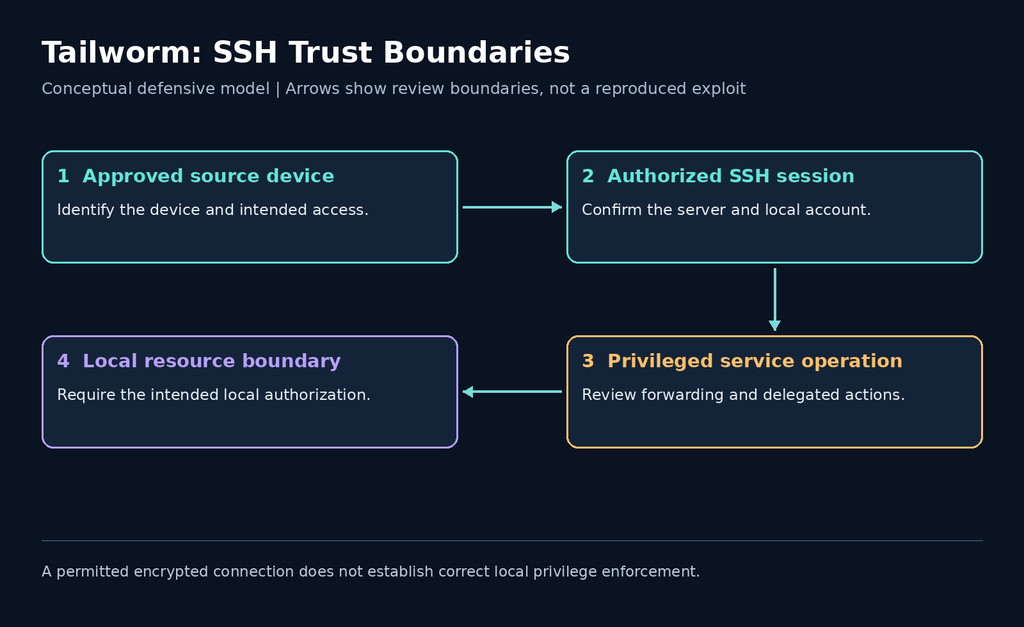
The first boundary asks whether a source can establish the intended connection to a destination. The next asks which local account and operations that session is allowed to use. A third asks what authority the process implementing those operations holds. These boundaries can fail independently, even when the encrypted transport and initial access policy work as designed.
Consider a fictional deployment in which a support laptop is allowed to reach a maintenance account on a test server. The permission is deliberate. The security expectation is that the session remains within the maintenance account’s authority. If a privileged component performs additional actions on behalf of that session, those actions need their own authorization checks. Initial permission to connect is not a general delegation of the component’s privileges.
This is a defensive interpretation of the reported class, not a reproduction of the Tailworm exploit. It explains why two teams can report apparently contradictory results: the network team sees the correct permitted connection, while the host team investigates an operation that exceeded the intended local authority. Both observations can be accurate because they concern different boundaries.
Forwarding deserves separate attention because it changes what an SSH connection can carry. A shell session and a forwarded connection are different operations. An organization may need interactive maintenance while having no business requirement for forwarding on a particular destination. Writing those requirements separately makes it possible to reduce unnecessary capability without removing the entire administrative service.
The same reasoning limits a common reassurance: an account being non-root does not, by itself, prove that every privileged helper servicing its requests runs with the same restricted authority. The question is what the helper does on the session’s behalf. Establishing that requires implementation-specific evidence or vendor guidance, not an account name printed in a ticket.
Build an exposure queue from deployment facts
Use an inventory row for each relevant destination, with a separate entry for a materially different administrative route. At minimum, retain the host owner, running build, SSH implementation, approved source set, intended local accounts, forwarding requirement, and time of observation. Record unknown values explicitly. Unknown is a request for evidence; it is not another spelling of unaffected.
Version evidence is useful, but configuration gives it operational meaning. A workstation with no relevant SSH service and a privileged administrative server should not automatically receive the same work item merely because their installed package versions match. Likewise, a destination with an unfamiliar version should remain in scope review instead of being dismissed because the researcher tested a different build.
| Deployment observation | First action | Evidence to request |
|---|---|---|
| Tailscale SSH is enabled; forwarding is unnecessary | Prepare the vendor-recommended forwarding restriction | Running service setting and an approved behavior check |
| Tailscale SSH is enabled; forwarding supports a real workflow | Identify the exact dependent workflow and sensitive targets | Owner, required capability, and a reviewed temporary access boundary |
| Only ordinary SSH over the network is intended | Confirm the actual server and configuration | Service identity and the route used by operators |
| SSH implementation or access policy is unknown | Assign an owner and preserve uncertainty | Current inventory and a supported administrative observation |
| Suspicious activity is present | Start the incident procedure alongside containment | Relevant logs, time range, host state, and handling record |
A fleet count alone is an inadequate completion metric. It can hide the one administrative destination with broader access than the rest. Prioritize by the authority reachable through the connection, the number and type of approved sources, and the consequences of losing the destination. Make that prioritization visible so application owners understand why their maintenance window differs from a low-impact workstation’s.
Use deployment groups carefully. A common image can justify preparing a shared change, but it does not prove every running instance received it. Treat managed, unmanaged, disconnected, and exception hosts as different rollout states. A failed inventory query is an exception requiring follow-up, not evidence that the device disappeared from the risk.
Apply the forwarding mitigation to the service that is running
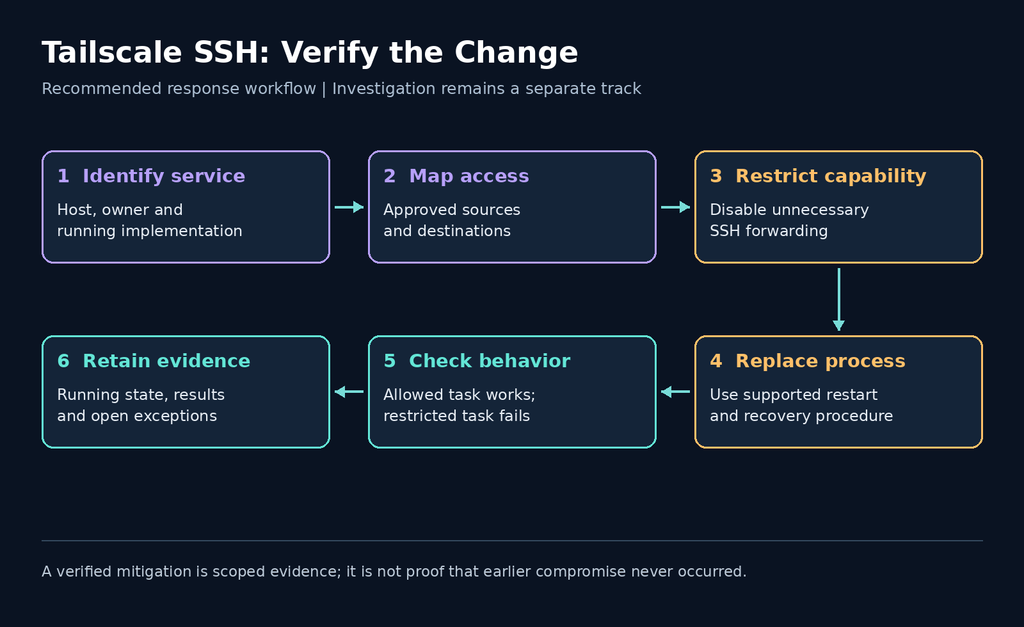
The current vendor response identifies TS_SSH_DISABLE_FORWARDING=1 ב tailscaled service environment, followed by a service restart, as a way to disable SSH forwarding and mitigate several serious findings. This is a mitigation instruction, not a declaration that all reported issues are fixed. Check for updated guidance before making a production change.
The exact deployment mechanism depends on how the service is managed. Put the setting in the supported service configuration for that host or image, review it through the normal change process, and replace or restart the relevant process as planned. An environment variable set in an administrator’s interactive shell does not establish that a previously running service inherited it.
# Vendor-recommended service-environment value.
# Apply through the supported tailscaled service configuration.
TS_SSH_DISABLE_FORWARDING=1
Before the restart, arrange an independent recovery path appropriate for the environment. Confirm who can use it and what they will do if the expected connection does not return. The Tailscale SSH documentation notes that restarting the daemon terminates existing Tailscale SSH sessions. A recovery plan should not depend entirely on the session the maintenance work will terminate.
Review the intended operational effect with the service owner. A user may describe a database client or remote development workflow without realizing that it depends on SSH forwarding. Record the dependency before changing it. If that capability must remain temporarily available, an accountable exception should name the source, destination, permitted purpose, compensating restrictions, and expiry condition.
Do not silently replace a disabled capability with a broader route merely to keep a workflow working. A temporary workaround that exposes a service directly can defeat the purpose of the mitigation. Compare the resulting access boundary, not just the user’s ability to complete the task. A change is acceptable when both the security requirement and the approved business operation have a documented outcome.
Verify behavior with positive and negative controls
A change record should distinguish what was configured from what was observed. The configuration is the intended input; the running process and an approved behavior check supply additional evidence. Keep these observations separate so a later reviewer can tell whether a change reached the destination or existed only in a deployment template.
For a forwarding restriction, define one harmless negative case that exercises the prohibited capability against a synthetic resource in an owned test environment. Also define a positive case for an operation that should remain available. The objective is to establish that the restriction works while the permitted maintenance workflow still functions. Neither case requires access to a privileged system socket, a credential store, or real customer data.
A failure needs an interpretable reason. A test account with expired access can make every request fail, including one that would otherwise reveal an ineffective control. Record that the prerequisite was valid, then evaluate the operation. If the prerequisite cannot be established, mark the check blocked. Do not convert an authentication failure into a successful mitigation verdict.
Repeat the check after the actual deployment transition. A behavior observed before the restart cannot prove what the replacement process does. In a group of destinations, retain per-instance evidence or a clearly justified sampling boundary, with exceptions visible. Document which machines remain outside the observation; a representative example is not a universal attestation.
The evidence package can remain small: test identity label, destination identifier, deployed change identifier, observation time, expected result, actual result, and a link to the restricted artifact. Use synthetic markers where possible. The point is to let another operator repeat the decision without distributing sensitive configuration or full session transcripts unnecessarily.
Review access as a graph, then test the real policy separately
Broad access rules increase the number of relationships an operator has to understand. A useful review asks which destinations become reachable from each class of source, and which destinations carry administrative importance. The number of enrolled devices is not the same as the number of permitted administrative paths.
The following offline Python example illustrates that distinction with fictional names. It represents approved relationships as directed edges and compares the graph before and after a hypothetical access reduction. It does not read a Tailscale policy, implement Tailscale rule semantics, contact a network, test SSH, or reproduce a vulnerability. Transitive reachability is a planning assumption that each intermediate machine could become a new source; it is not proof that such a pivot is possible.
from collections import deque

def reachable(edges, start):
    graph = {}
    for source, destination in edges:
        graph.setdefault(source, set()).add(destination)
    seen = {start}
    queue = deque([start])
    while queue:
        source = queue.popleft()
        for destination in graph.get(source, set()):
            if destination not in seen:
                seen.add(destination)
                queue.append(destination)
    return seen - {start}

before = {
    ("support-laptop", "build-host"),
    ("build-host", "admin-host"),
    ("admin-host", "backup-host"),
}
after = {("support-laptop", "build-host")}

assert reachable(before, "support-laptop") == {
    "build-host", "admin-host", "backup-host"
}
assert reachable(after, "support-laptop") == {"build-host"}
assert reachable(before, "unlisted-device") == set()
assert reachable({("a", "b"), ("b", "a")}, "a") == {"b"}

print("before:", sorted(reachable(before, "support-laptop")))
print("after:", sorted(reachable(after, "support-laptop")))
print("4 offline graph checks passed")
The model’s most useful output is a question for the policy owner: did we intend the support source to have a route toward the administrative and backup roles? If the answer is yes, the team still needs to explain the conditions governing each transition. If the answer is no, the graph exposes a relationship to investigate without pretending to know the product’s enforcement details.
An omitted edge is equally important. Inventory that misses a shared device, a service identity, or a temporary grant will understate possible relationships. Keep the provenance of the graph inputs. Record which policy version, device inventory, and owner review supplied the relationships, and which assumptions remain unresolved. A diagram built from an incomplete spreadsheet cannot become authoritative merely by looking precise.
For actual policy regression, use the product’s supported facilities. Tailscale documents separate tests assertions for network access and sshTests assertions for SSH access; failed assertions reject a policy update. Those policy-file tests are useful for intended access relationships. They do not execute the daemon’s forwarding implementation or demonstrate that a privilege-escalation defect is absent.
Maintain both allowed and denied cases. A test suite containing only expected denials can pass after an accidental lockout, while a suite containing only expected successes can miss an unwanted permission. Keep a small set tied to operational requirements and add a regression assertion whenever a policy review discovers an unintended relationship.
Keep authentication checks separate from privilege fixes
An additional login step can reduce opportunities to establish a session, but it does not repair what happens after that session is established. Tailscale’s check-mode documentation describes an optional reauthentication gate controlled by SSH policy. Evaluate it as an access control, with its own operational requirements, rather than as evidence that a forwarding or local-privilege defect has disappeared.
This separation matters during an emergency rollout. A team might require fresh approval for sensitive destinations while a separate team deploys a daemon change. Give each control its own status. If the approval step works but the daemon change remains unverified, the result is reduced access opportunity with an open implementation question. Reporting both as patched would hide the remaining work.
Test the user journey before requiring a new gate fleet-wide. An interactive administrator can usually respond differently from an unattended maintenance task. Identify which jobs depend on the old behavior, whether those jobs are still required, and how they should operate under the new policy. An automated job should not gain a blanket exemption just because its first attempt failed.
Do not let an exception become an alternate privilege model. A temporary maintenance identity should have a defined purpose and expiry, and the destination set should reflect that purpose. Review what happens when the job completes or its operator leaves. Review the route used by every exempt identity.
Use logs to answer questions they can actually resolve
Tailscale’s configuration audit logging documentation describes records of configuration-changing actions, including actor, target, time, and relevant differences. Policy changes include a diff. That makes these records useful for reconstructing who changed an access relationship and when. It does not make them a complete transcript of activity inside a destination host.
Build an investigation around explicit questions. Was an unexpected device approved? Did an access rule expand? Did a host perform an operation outside its maintenance window? Each question may require a different evidence source. Keep the relationship between the question, the retained record, and the interpretation visible. A single exported log file should not stand in for an entire incident assessment.
Time alignment deserves deliberate work. Record the time zone and collection context for each source, then compare events on a consistent basis. A configuration change close to a host event is a lead to investigate, not proof of causation. Ask whether the identity, destination, and operation also align before attributing the activity to the reported issue.
Distinguish an unexpected event from an unexplained one. An approved automation rollout can produce unfamiliar administrative behavior. Conversely, a familiar account can perform an unauthorized action. Ask the owner to reconcile the observed event with the approved change record, and retain unresolved discrepancies. Familiar names and ordinary working hours are weak substitutes for that reconciliation.
Missing telemetry changes the confidence of the conclusion. If a destination did not retain the relevant host records, say which part of the activity cannot be assessed. The absence of an alert may reflect a coverage gap, an expired retention period, or behavior the control was never intended to recognize. It cannot automatically establish that no unauthorized operation occurred.
Keep evidence collection proportional and restricted. Administrative records may expose internal identities, hostnames, paths, and workflow details. Preserve what is needed under the incident process, with access appropriate to the investigation. Use redacted references in routine status updates instead of copying complete records into broad collaboration channels or external AI tools.
Treat headscale and adjacent features as separate review scopes
ה research report includes headscale and additional Tailscale features beyond SSH. Those findings should not be compressed into a single version verdict or one mitigation checkbox. The operator’s responsibility is to map the component actually deployed and find guidance applicable to that component. This article does not establish a common fixed version across the report.
For a self-hosted control plane, identify who owns its deployment and release process. The client fleet, control service, and host service manager can have different update owners. A successful client rollout does not establish that the control service changed, and a control-plane maintenance record does not establish the state of every destination daemon. Keep the change records linked without conflating them.
Review feature entitlements as part of that component map. An organization that does not intentionally use a connector or service-exposure feature should still verify whether it is configured anywhere. An old experiment, a development device, or a temporary support route can outlive the person who created it. Resolve those cases through the actual owner and supported configuration, not a global assumption that unused features are absent.
When a report and a vendor response differ in their proposed controls, retain the distinction. Prefer the current vendor instruction for the vendor-supported deployment, and verify any alternative with the responsible maintainer. A setting that exists in one distribution or management model should not be assumed available in another. If applicability is uncertain, keep the exception open and narrow access while obtaining authoritative clarification.
This is also why a remediation ticket should identify the finding or component it addresses. A title such as “fix Tailworm” provides too little information for someone reviewing the system next month. Name the destination class, the service behavior being restricted, the applicable guidance, and the evidence required for closure. Another reported path can then remain open without making the record internally contradictory.
Node enrollment is another security boundary
Tailnet Lock addresses node-key trust and signing. Its official documentation describes how new nodes are admitted to a locked tailnet and how trusted signing nodes are managed. Evaluate that boundary separately from SSH session privileges. A control over node admission is not, by itself, a fix for an operation performed inside a session on an already admitted device.
In an incident, ask which trust material may have been accessible on the affected host and which systems relied on it. The answer should come from the deployment and evidence, not from a generic list of secrets that might exist. Route any revocation or replacement through the relevant owner, with a plan for dependent services. Removing trust in the right place matters more than accumulating unrelated password changes.
A host rebuild and an identity decision are separate actions. Rebuilding can replace a system image while leaving unresolved questions about credentials or trust relationships. Re-enrollment can restore expected connectivity without establishing that downstream services were assessed. Track the host lifecycle, network identity, and connected application credentials as linked but distinct records.
Protect recovery authority as well. During an urgent response, the people who approve replacement devices or grant temporary administrative access can become a bottleneck. Define a controlled process rather than relaxing admission requirements until the incident is over. Emergency access should be observable, attributable, and reconciled after use; otherwise recovery creates a second set of unreviewed relationships.
Three deployment examples that lead to different decisions
These examples are fictional planning cases, not observed Tailworm incidents. They illustrate how the same initial report can produce different operational priorities without minimizing the underlying concern.
A small team with two maintenance destinations
A development team intentionally uses Tailscale SSH for two internal test servers. Neither workflow needs forwarding. The proportionate first change is to restrict the unnecessary capability using applicable vendor guidance, verify ordinary maintenance access, and record the running state on both destinations. The team should still review whether every approved source needs access to both machines.
The small inventory makes exhaustive verification practical. A screenshot from the first server is not a reason to skip the second. Assign a single owner to reconcile both records, including the software state and any failed check. A short, complete record is preferable to an elaborate report that leaves one destination unexamined.
If no suspicious activity is present, the work can remain an exposure-reduction task with explicit evidence limits. Do not invent an intrusion to justify the change. If the review discovers an unexplained administrative event, open an investigation with its own evidence and owner. That new question should not erase the completed mitigation record.
A platform team with a necessary forwarding workflow
A platform team depends on forwarding for a restricted maintenance task. An immediate blanket change would interrupt recovery work. The team first identifies the exact source and destination pair, the business operation, and the sensitive authority reachable from the destination. It then decides whether the workflow can be moved to a safer approved route or must run under a short exception.
An exception needs more than a date in a spreadsheet. It should identify what evidence will end it: an available fix, a replacement workflow, or a verified configuration change. Set an owner who can make that decision and a review trigger if the vendor changes its guidance. Without a closure condition, a temporary requirement can become the permanent design by default.
The test plan should exercise the actual maintenance operation, including failure and recovery. A shell login alone does not establish that a specialized workflow remains usable. Use a synthetic destination service where possible, and record the minimum observation needed. Avoid escalating the validation into an exploitation attempt merely because the underlying report concerns privilege escalation.
A service provider operating several customer environments
A provider must keep customer scope separate. Authorization to review one tenant’s administrative access does not authorize inspection of another tenant’s hosts or records. Establish a customer-specific inventory and testing approval before collecting evidence, then keep the resulting artifacts tied to that scope throughout review and reporting.
Shared infrastructure complicates the distinction. A common management host may be permitted to reach several environments. Record that shared role explicitly and ask what prevents a problem in one engagement from affecting another. The answer should identify enforced boundaries and an owner, rather than rely on an operator remembering to select the correct customer.
Delivery should distinguish controls verified for the customer from claims inherited from a supplier. If the provider cannot observe the running configuration, report the vendor or platform owner’s assertion as such. A customer-facing report is stronger when it clearly separates direct observation, attestation, and unresolved access than when it converts all three into a single green status.
Define closure before the maintenance window ends
An acceptable mitigation record connects the approved change to the running destination and an interpretable test. It should also record service health, exceptions, and who accepted the remaining conditions. Do not require an unreviewed public exploit as the default acceptance test. A bounded configuration and behavior review can answer the operational question without attempting root access.
| Workstream | Minimum defensible closeout | Reason to keep it open |
|---|---|---|
| Service inventory | Actual SSH implementation and owner identified | Installed package is known but serving process is not |
| Access reduction | Intended source and destination relationships reviewed | Broad or temporary grants remain unexplained |
| Forwarding mitigation | Applicable setting reaches the running process; bounded checks pass | Only a configuration template changed |
| Software remediation | Applicable advisory maps to the installed running release | A newer package exists but applicability is uncertain |
| Incident assessment | Evidence addresses the suspected activity and remaining gaps | Missing records or unresolved unauthorized changes |
Leave the next operator able to answer: what changed on this destination, what still works, what was restricted, and what remains unknown? That is a more durable outcome than a statement that the organization responded to a headline.
For adjacent application work, evaluate an AI-assisted testing workflow against a separately approved target and a specific evidence requirement. A product demonstration is not proof of Tailworm coverage or a substitute for the vendor’s daemon guidance. The video below introduces general application testing and report review; it is not a Tailworm reproduction.
Questions operators are asking
Is Tailworm a confirmed internet-wide compromise?
- The cited report describes laboratory findings. Do not translate that into a confirmed customer campaign or a claim that arbitrary unauthenticated internet clients can reach every tailnet host.
Does ordinary OpenSSH over Tailscale have the same status?
- Identify the server that actually handles the connection. The embedded Tailscale SSH feature and an ordinary SSH daemon reached through the network are different review scopes.
Does disabling forwarding fix every reported issue?
- No universal conclusion follows. Record the specific mitigated capability, then follow the applicable advisory for the remaining components and software remediation.
Is check mode a privilege-escalation patch?
- No. It adds an authentication gate. Track it independently from the implementation behavior of an established session.
Can a graph or policy test prove the daemon is safe?
- No. The example models fictional relationships, and supported policy assertions check intended permissions. Neither reproduces the reported bug or validates the daemon’s implementation.
What should a customer or auditor receive?
- Provide scope, service identity, dated configuration and release evidence, approved test outcomes, exceptions, and investigation limits. Do not promise certification or absence of compromise from a mitigation record alone.
What should change when a formal fix becomes available?
- Map the advisory to the actual component and deployment, complete the supported rollout, and repeat the relevant checks. Retain the earlier mitigation history so the reason for a temporary restriction is not lost.
The next action is a destination-specific decision: establish the SSH service, remove authority the workflow does not require, and retain evidence of the result. Leave uncertain scope and suspected earlier activity visible until the appropriate evidence resolves them.
 Hebrew
 English
 German
 French
 Spanish
 Portuguese
 Japanese
 Korean
 Hindi
 Arabic
 Turkish