
CVE-2026-1642 is a security vulnerability in NGINX Open Source and NGINX Plus that affects deployments using NGINX as a proxy to TLS-enabled upstream servers.
Unlike many NGINX vulnerabilities that begin with an attacker sending a malicious HTTP request directly to an Internet-facing server, CVE-2026-1642 exists on the other side of the proxy boundary: the connection between NGINX and the backend application.
F5 describes the issue as an SSL upstream injection vulnerability. An unauthenticated attacker who has a man-in-the-middle position on the upstream side of an NGINX proxy may, under additional required conditions, inject plaintext data into a response that NGINX can subsequently send to a client. The official NGINX security advisory classifies the vulnerability as Medium severity. (Nginx)
The vulnerability was publicly disclosed on February 4, 2026. F5 assigned it a CVSS v3.1 score of 5.9 Medium with the vector CVSS:3.1/AV:N/AC:H/PR:N/UI:N/S:U/C:N/I:H/A:N. Under CVSS v4.0, F5 rates it 8.2 High, reflecting its potentially significant integrity impact despite the attack requirements. (my.f5.com)
The vulnerability is particularly interesting because it exposes an important security assumption in modern reverse-proxy architecture:
Using HTTPS between a reverse proxy and an application server does not automatically mean that every response consumed by the proxy was actually protected by TLS.
The implementation has to enforce that assumption correctly.
CVE-2026-1642 demonstrates what happens when that enforcement briefly fails.
CVE-2026-1642 at a Glance
| פריט | פרטים |
|---|---|
| CVE | CVE-2026-1642 |
| מוצר | NGINX Open Source and NGINX Plus |
| פגיעות | SSL/TLS upstream response injection |
| NGINX severity | בינוני |
| CVSS v3.1 | 5.9 Medium |
| CVSS v4.0 | 8.2 High |
| השפעה ראשונית | Response integrity |
| Attacker position | MITM between NGINX and TLS upstream |
| Privileges required | אף אחד |
| User interaction | אף אחד |
| NGINX OSS affected | 1.3.0 through 1.29.4 |
| גרסאות קבועות | 1.28.2 and 1.29.5 |
| Vendor mitigation | None; upgrade is required |
NGINX’s official security advisory lists versions 1.3.0 through 1.29.4 as vulnerable and identifies 1.28.2 and 1.29.5 as the first non-vulnerable releases in their respective branches. (Nginx)
NGINX’s changelog confirms that version 1.29.5, released February 4, 2026, contains the security fix preventing an attacker from injecting plaintext data into a response from an SSL backend.
What Is the CVE-2026-1642 NGINX Vulnerability?
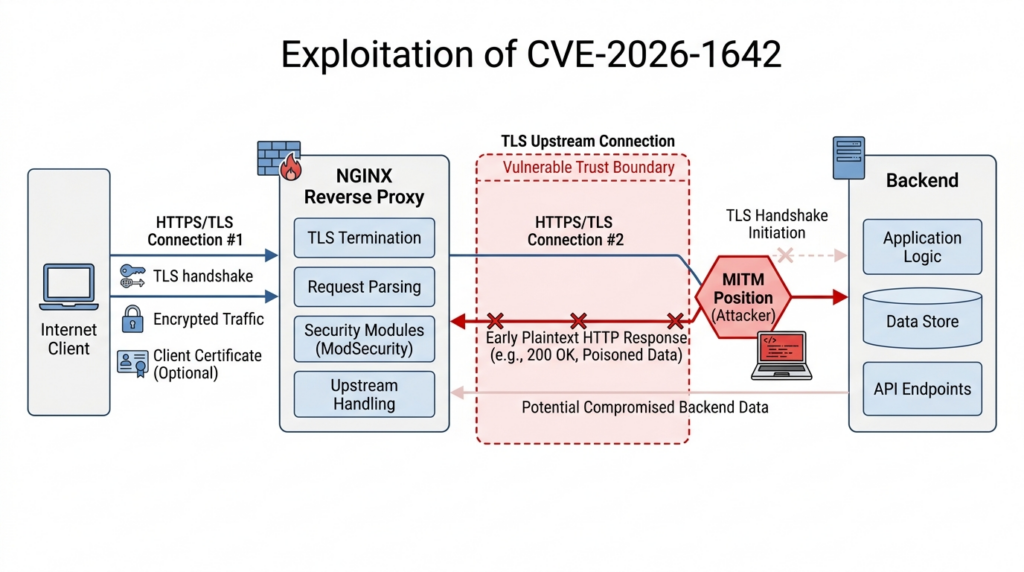
Consider a common production architecture:
Internet Client
      |
      | HTTPS
      v
+-------------+
|    NGINX    |
| Reverse     |
| Proxy       |
+-------------+
      |
      | HTTPS / TLS
      v
+-------------+
| Application |
| Backend     |
+-------------+
The browser establishes TLS with NGINX.
NGINX then establishes a second, independent TLS connection to the backend.
A typical configuration might look conceptually like this:
location /api/ {
    proxy_pass https://backend.internal;
}
From an architectural perspective there are therefore two separate trust relationships:
Client <-- TLS #1 --> NGINX <-- TLS #2 --> Backend
CVE-2026-1642 concerns TLS #2.
F5 states that the vulnerable component includes NGINX proxying to TLS-enabled HTTP backends, including HTTP/1.x and HTTP/2, as well as TLS-backed gRPC and uWSGI configurations. (my.f5.com)
The attacker does not necessarily need control of the public-facing client.
Instead, the attacker needs to interfere with traffic on the backend-facing network path.
That distinction is crucial when evaluating real-world exposure.
הגורם הטכני הבסיסי
The NGINX patch provides significantly more insight into the vulnerability than the short CVE description.
The relevant change is titled:
“Upstream: detect premature plain text response from SSL backend.”
According to the NGINX source-code change, when NGINX connects to an upstream backend, the connection’s write event normally executes first.
That matters because the TLS handshake begins from the write path: NGINX needs to send the TLS ClientHello before a valid encrypted application response should be processed.
Under unusual timing conditions, however, a backend response can arrive extremely quickly.
Both the read and write events can then become ready during the same event-loop iteration.
NGINX explains that in this situation the read event handler may execute before the write event handler. Before the fix, this created a dangerous state: the upstream response parser could process received data even though TLS had not yet been initialized for a connection that was supposed to be SSL-enabled. (GitHub)
Conceptually, the vulnerable flow looked like this:
NGINX opens connection
        |
        v
TLS expected
        |
        +-----------------------------+
        |                             |
        | attacker sends plaintext    |
        | extremely early             |
        v                             |
read event becomes ready              |
        |                             |
        v                             |
response handler executes             |
        |                             |
        v                             |
plaintext parsed as backend response  |
        |                             |
        v                             |
TLS initialization occurs too late <--+
The fundamental problem was therefore not a cryptographic failure in TLS itself.
TLS was not broken.
The problem occurred because NGINX could process data before enforcing that TLS had actually been established.
That difference matters.
How the Patch Changes NGINX Behavior
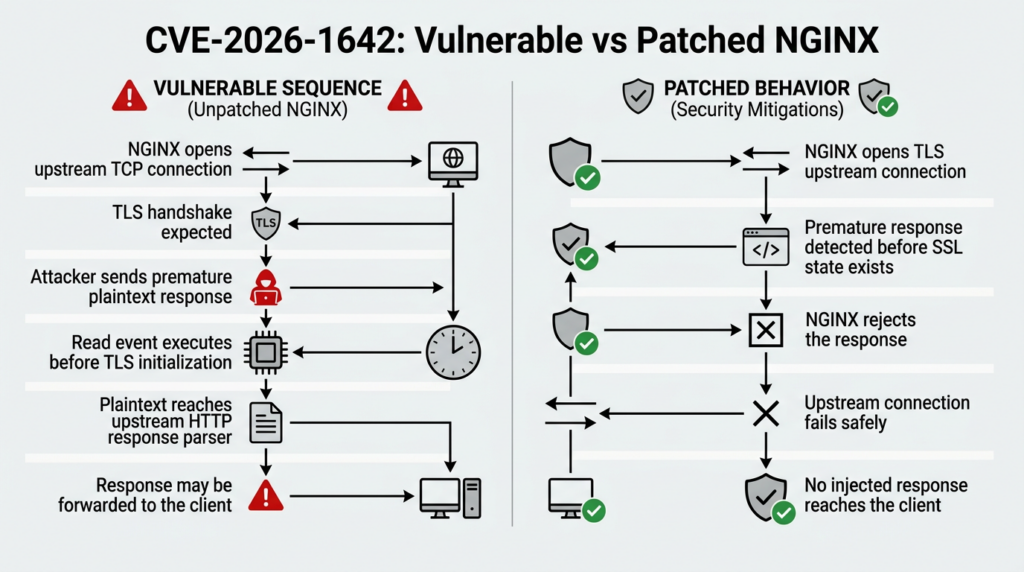
The patch adds an explicit guard to the upstream response processing path.
Conceptually, NGINX now asks:
Is this configured as an SSL upstream?

        AND

Has the SSL state actually been created?
If the answer indicates that an SSL upstream is receiving data before TLS initialization, NGINX refuses to process the response.
The patched behavior effectively becomes:
SSL upstream configured
        |
        v
response arrives
        |
        v
Has TLS been initialized?
   |              |
  yes             no
   |              |
   v              v
process        reject response
response       and fail upstream
The actual patch logs an error corresponding to an upstream prematurely sending a response and moves NGINX to upstream failure handling rather than allowing the plaintext data to reach normal HTTP response parsing. (GitHub)
This is a comparatively small source-code change, but it protects a very important protocol boundary.
Why an Attacker Needs a MITM Position
F5 explicitly describes the attacker as requiring a man-in-the-middle position on the upstream server side. (my.f5.com)
That means the standard threat model is closer to this:
Client
   |
   v
NGINX
   |
   | intended TLS connection
   |
   +-------- Attacker -------- Backend
             MITM position
Possible environments where this network position becomes relevant include compromised internal hosts, malicious infrastructure operators, insecure routing environments, incorrectly segmented container networks, compromised Kubernetes nodes, cloud networking mistakes, or other situations where an attacker can interfere with traffic traveling from NGINX to its upstream service.
This requirement substantially reduces the exploitability compared with an ordinary remote vulnerability reachable from the public Internet.
That is one reason the CVSS v3.1 attack complexity is rated High.
However, organizations should not interpret “MITM required” as “irrelevant.”
Modern microservice architectures contain many more backend network boundaries than traditional monolithic systems.
Why CVSS v3.1 Says 5.9 but CVSS v4.0 Says 8.2
CVE-2026-1642 provides an interesting example of how scoring models represent attack conditions differently.
F5’s CVSS v3.1 vector is:
CVSS:3.1/AV:N/AC:H/PR:N/UI:N/S:U/C:N/I:H/A:N
The most important characteristics are:
Network attack vector
High attack complexity
No privileges required
No user interaction
No confidentiality impact
High integrity impact
No availability impact
F5 gives the vulnerability a CVSS v3.1 score of 5.9 Medium. (my.f5.com)
Its CVSS v4.0 score is 8.2 High.
The important operational lesson is not whether teams should call the issue “medium” or “high.”
The important question is:
Can an attacker realistically obtain the required backend network position in your architecture?
For an isolated NGINX host communicating with a backend over a tightly controlled private interface, practical risk may be relatively limited.
For a large Kubernetes environment with hundreds of workloads, shared networks and complex east-west traffic, the attack surface can look very different.
Integrity Is the Primary Security Impact
The CVSS vector assigns High impact to integrity while assigning no direct confidentiality or availability impact.
That aligns with the vulnerability’s behavior.
The attacker is attempting to influence what NGINX believes the upstream server returned.
In the normal model:
Backend
   |
   | authenticated/encrypted TLS
   v
NGINX
   |
   v
Client
With successful exploitation:
Backend
   |
   | expected TLS
   |
Attacker
   |
   | injected plaintext
   v
NGINX
   |
   | trusted-looking response
   v
Client
The dangerous part is the transition from untrusted network data לתוך trusted upstream response data.
Once NGINX accepts the injected bytes as an upstream response, downstream security controls may have difficulty determining that the response did not originate from the legitimate backend.
Why Response Injection Can Be More Serious Than It Sounds
“Inject plaintext into a response” can sound relatively minor compared with memory corruption or remote code execution.
In a reverse proxy, however, responses may carry security-sensitive information.
דוגמאות לכך כוללות:
HTTP status codes
authentication results
redirect locations
JSON API responses
authorization decisions
security headers
cookies
cacheable application content
backend-generated metadata
The exact effect depends heavily on the application architecture and the structure of the injected response.
CVE-2026-1642 should therefore not be interpreted as automatically giving an attacker arbitrary application control.
The public vendor advisory does not claim remote code execution, complete authentication bypass, credential disclosure or host compromise.
Those stronger claims would be unsupported.
The reliable conclusion is narrower but still important:
The vulnerability can violate the integrity guarantee of the TLS-protected upstream response path.
Proxy Cache Poisoning Is an Architecture-Level Concern
Organizations using NGINX caching should pay particular attention to upstream response integrity issues.
Consider:
Client
   |
   v
NGINX
   |
   +---- proxy cache
   |
   v
TLS backend
Normally, NGINX obtains a response from the backend and may store that response in its cache depending on configuration and headers.
If an attacker can influence the response NGINX accepts from an upstream connection, defenders should examine whether the affected location also participates in caching.
That does לא mean CVE-2026-1642 automatically provides reliable cache poisoning.
Successful caching depends on response semantics, cache configuration, cache keys, request methods, response headers and application behavior.
Instead, cache behavior should be treated as an impact multiplier during risk assessment.
A useful investigation question is:
Could an incorrectly accepted upstream response become persistent
or be delivered to more than one downstream client?
Kubernetes and Microservice Environments Deserve Special Attention
The architecture most likely to make CVE-2026-1642 strategically interesting is one where NGINX communicates with multiple TLS-enabled services.
לדוגמה:
                    +--> auth-service
                    |
Client --> NGINX ---+--> api-service
                    |
                    +--> billing-service
                    |
                    +--> admin-service
Every NGINX-to-service connection creates an upstream security boundary.
In Kubernetes the topology may become even more complicated:
Internet
   |
Load Balancer
   |
NGINX
   |
Kubernetes Network
   |
   +--> Service A --> Pod
   +--> Service B --> Pod
   +--> Service C --> Pod
Teams should therefore inventory not only Internet-facing NGINX installations but also internal reverse proxies, API gateways and application-side NGINX deployments.
The public attack surface alone does not describe CVE-2026-1642 exposure.
TLS Encryption and TLS Authentication Are Different Questions
CVE-2026-1642 also provides an opportunity to revisit a common NGINX configuration mistake.
NGINX’s official documentation shows that:
proxy_ssl_verify off;
is the default for proxied HTTPS servers.
Likewise:
proxy_ssl_server_name off;
is the default unless explicitly enabled. (Nginx)
These settings are not the root cause of CVE-2026-1642.
Patching is still required.
However, upstream certificate validation is an important independent layer of protection against backend impersonation.
A stronger HTTPS upstream configuration commonly includes concepts such as:
location /api/ {
    proxy_pass https://backend.example.internal;

    proxy_ssl_server_name on;
    proxy_ssl_name backend.example.internal;

    proxy_ssl_verify on;
    proxy_ssl_trusted_certificate /etc/nginx/internal-ca.pem;
    proxy_ssl_verify_depth 2;
}
NGINX documents proxy_ssl_verify as the control enabling verification of the proxied HTTPS server certificate and proxy_ssl_trusted_certificate as the trust store used for that validation. (Nginx)
Again, administrators should not treat these directives as a substitute for the CVE patch.
F5 lists no mitigation for CVE-2026-1642. Upgrading is the remediation. (my.f5.com)
How to Check Whether Your NGINX Version Is Vulnerable
Start with the installed version:
nginx -v
or:
nginx -V
If the output contains an affected NGINX Open Source version between:
1.3.0
and
1.29.4
the software version falls within the affected range identified by NGINX.
The first fixed releases are:
1.28.2
1.29.5
NGINX’s official advisory confirms those version boundaries. (Nginx)
For packaged distributions, do not rely exclusively on the upstream version string because Linux vendors sometimes backport security patches without changing the apparent major release in the same way upstream NGINX does.
Check the security status of the actual package supplied by your operating-system vendor.
Finding TLS Upstream Configurations
Version detection tells you whether the software contains the vulnerable code.
Configuration analysis tells you whether the vulnerable functionality is actually relevant.
Dump the active NGINX configuration:
nginx -T
Then inspect upstream destinations:
nginx -T 2>/dev/null | grep -nE 'proxy_pass[[:space:]]+https://'
Look for gRPC TLS upstreams as well:
nginx -T 2>/dev/null | grep -nE 'grpc_pass[[:space:]]+grpcs://'
The goal is to identify routes where the communication pattern resembles:
NGINX --> TLS --> backend
These locations deserve higher priority than configurations where NGINX never proxies to a TLS-enabled upstream.
F5 specifically identifies TLS-enabled HTTP, HTTP/2, gRPC and uWSGI backends as affected proxying scenarios. (my.f5.com)
Audit Upstream Certificate Verification
Security teams should also search the configuration for:
nginx -T 2>/dev/null | grep -n proxy_ssl_verify
Absence of the directive can itself be meaningful because NGINX documents the default as:
proxy_ssl_verify off
(Nginx)
An inventory can therefore classify upstreams roughly as:
HTTPS upstream
    |
    +-- certificate verification enabled
    |
    +-- certificate verification disabled
This is valuable beyond CVE-2026-1642.
Upstream TLS without certificate validation protects traffic from passive observation but provides weaker protection against active impersonation.
Check SNI Configuration Too
Another useful check is:
nginx -T 2>/dev/null | grep -n proxy_ssl_server_name
NGINX documents:
proxy_ssl_server_name off
as the default. (Nginx)
Where virtual hosting or hostname-based certificates are involved, properly configured SNI and hostname verification help ensure that NGINX talks to the intended TLS endpoint.
Security teams should therefore evaluate these controls together:
proxy_ssl_verify
proxy_ssl_trusted_certificate
proxy_ssl_name
proxy_ssl_server_name
Detection Opportunities
CVE-2026-1642 is unusual because a successful exploitation attempt occurs around the establishment of an upstream TLS connection.
After patching, NGINX explicitly rejects situations in which an SSL upstream sends data before the TLS state has been initialized.
The patch introduces logging corresponding to:
upstream prematurely sent response
(GitHub)
That message can provide a useful detection signal on fixed systems.
Security monitoring can search NGINX error logs for unusually frequent premature upstream responses, especially when accompanied by connection errors against TLS-enabled backends.
Operational teams should correlate these events with:
backend IP address
destination port
request URI
upstream hostname
container or node
network flow
connection reset events
TLS errors
One log message alone does not prove exploitation.
A misconfigured backend or network device may produce unusual responses as well.
But in an environment where an HTTPS backend unexpectedly emits plaintext before TLS negotiation, investigation is warranted.
Network Monitoring Can Help
Because the vulnerability concerns protocol boundaries, packet-level telemetry can be valuable.
A legitimate connection to an HTTPS upstream should begin with an appropriate TLS negotiation rather than an HTTP response appearing before the expected TLS handshake.
Defenders monitoring east-west traffic may therefore investigate sequences resembling:
NGINX establishes TCP connection
        |
        v
remote endpoint immediately sends plaintext
        |
        v
expected TLS ClientHello/handshake incomplete
Encrypted environments make application payload visibility difficult, but the ordering and protocol characteristics themselves may still be useful.
The patched NGINX behavior is especially helpful because it converts what previously might have been accepted response data into an explicit upstream failure condition.
Safe Validation of CVE-2026-1642
Production validation should focus first on configuration and patch state rather than trying to reproduce an active MITM attack.
A useful defensive workflow is:
1. Identify NGINX instances
        |
2. Record exact versions/packages
        |
3. Identify TLS upstreams
        |
4. Check certificate validation
        |
5. Upgrade vulnerable releases
        |
6. Reload NGINX
        |
7. Confirm patched version
        |
8. Test application behavior
        |
9. Monitor upstream/TLS errors
For a dedicated authorized security laboratory, deeper testing can recreate the network topology with an NGINX proxy, controlled upstream server and controlled intermediary.
The objective should be to confirm that patched NGINX refuses unexpected plaintext on an SSL-enabled upstream rather than developing a reusable interception mechanism against third-party systems.
Why Simply Enabling proxy_ssl_verify Is Not Enough
Administrators may reasonably ask:
If I enable backend certificate validation, doesn’t that solve the MITM problem?
Certificate verification is excellent defense in depth, but it should not be considered the vendor-supported remediation for this CVE.
The vulnerable behavior occurs before the normal TLS state has necessarily been initialized.
That is exactly what makes the vulnerability unusual.
The patch explicitly prevents the upstream parser from accepting the premature data.
F5 therefore lists no configuration mitigation and directs affected customers toward fixed software. (my.f5.com)
The correct approach is:
PATCH
+
VERIFY UPSTREAM CERTIFICATES
+
SEGMENT BACKEND NETWORKS
+
MONITOR TLS CONNECTIONS
not:
proxy_ssl_verify on
=
CVE fixed
Recommended Remediation
For NGINX Open Source, upgrade to a supported version containing the CVE-2026-1642 fix.
The historical fixed boundaries are:
Stable branch:   1.28.2+
Mainline branch: 1.29.5+
(Nginx)
Organizations running much older releases should generally move to a currently supported release rather than installing only the minimum historical fixed version.
F5’s advisory lists no workaround or mitigation. (my.f5.com)
That makes patching the central remediation requirement.
After upgrading:
nginx -t
should be used to verify the configuration before reload.
Then confirm the running binary and package state.
Hardening NGINX Upstream TLS
CVE-2026-1642 should also trigger a broader review of upstream TLS architecture.
A stronger model looks like:
NGINX
   |
   | TLS
   | certificate validation
   | hostname validation
   | restricted routing
   v
Backend
Rather than:
NGINX
   |
   | TLS encryption only
   | backend identity not verified
   v
Backend
NGINX provides directives for specifying trusted CA certificates, enabling certificate verification, controlling verification depth, selecting the certificate name and enabling SNI. (Nginx)
Where appropriate, organizations can go further and deploy mutual TLS:
NGINX
   |\
   | \ client certificate
   |
   | TLS
   |
Backend
NGINX supports presenting a client certificate and associated private key to proxied HTTPS servers through its upstream TLS configuration directives. (Nginx)
mTLS does not eliminate the need for the CVE patch either, but it substantially improves the general trust model for service-to-service communication.
Segment the Upstream Network
Because CVE-2026-1642 requires an upstream-side MITM position, network architecture directly influences exploit feasibility.
A weak architecture might allow:
many workloads
     |
     v
shared network
     |
NGINX <------> backend
A stronger model restricts which systems can participate in the communication path:
NGINX security zone
        |
        | restricted ACL
        |
        v
backend security zone
Security controls may include:
VPC segmentation
Kubernetes NetworkPolicy
cloud security groups
host firewall rules
service-mesh authorization
dedicated backend networks
mutual TLS
The objective is to make obtaining the required MITM position substantially more difficult.
Prioritization Guidance
Not every vulnerable NGINX server should receive exactly the same operational urgency.
A useful priority model considers both software state and architecture.
Highest Priority
Prioritize instances where:
vulnerable NGINX version
+
TLS upstreams
+
shared or potentially hostile network
+
security-sensitive backend
Examples include API gateways connecting to authentication, payment, administrative or tenant-isolated services.
Medium Priority
Systems where:
vulnerable NGINX
+
TLS upstream
+
strongly segmented network
remain vulnerable and should still be patched, but exploitation may require substantially more prior access.
Lower Direct Exposure
An NGINX installation that does not proxy to TLS-enabled upstream servers may contain the affected code version without exercising the vulnerable configuration identified by F5.
That distinction is useful for emergency triage.
It is not an argument for retaining obsolete NGINX versions indefinitely.
CVE-2026-1642 Is Not an NGINX RCE
Security teams should be careful with headlines surrounding this vulnerability.
The official disclosure supports:
upstream response injection
It does not support describing CVE-2026-1642 itself as:
NGINX remote code execution
NGINX server takeover
NGINX authentication bypass
NGINX private-key disclosure
NGINX arbitrary file write
F5’s published CVSS metrics indicate High integrity impact but no direct confidentiality or availability impact. (my.f5.com)
Application-specific consequences may become more serious if an injected response interacts with caching, authentication logic or downstream clients, but those consequences need to be demonstrated independently.
Maintaining this distinction is important for accurate vulnerability management.
The Bigger Lesson: Reverse Proxies Are Trust Translators
CVE-2026-1642 reveals a security property that is easy to overlook.
A reverse proxy is not simply moving packets.
It is translating trust.
Consider what happens every time NGINX processes an upstream response:
network bytes
      |
      v
TLS validation
      |
      v
HTTP parsing
      |
      v
proxy policy
      |
      v
trusted response
      |
      v
client
Every transition matters.
CVE-2026-1642 occurred because, under the vulnerable event ordering, the transition from network bytes to HTTP parsing could occur before the TLS requirement had been fully enforced.
The fix restores the intended invariant:
If the upstream requires TLS,
application response parsing must not happen
before TLS initialization.
That principle applies well beyond NGINX.
API gateways, load balancers, service meshes, edge proxies and custom reverse proxies all contain similar state transitions.
What Security Teams Should Do Now
The most important first step is simple:
nginx -v
Then determine whether the installation proxies requests to TLS-enabled upstream services.
If a vulnerable NGINX Open Source release is present, upgrade to a supported version incorporating the fix. NGINX identifies 1.28.2 and 1.29.5 as the first corrected releases. (Nginx)
Next, inspect upstream TLS configuration.
Confirm that backend certificate validation is enabled where appropriate, trusted CA files are correctly configured, SNI and certificate names match the intended upstream identity, and backend networks are appropriately segmented. NGINX’s own documentation confirms that upstream certificate verification and SNI are not enabled by default, making explicit configuration review worthwhile. (Nginx)
Finally, review logs and network telemetry after upgrading. Patched NGINX explicitly rejects premature responses from SSL upstream connections, which provides defenders with a clearer signal when an upstream endpoint behaves unexpectedly. (GitHub)
How Penligent Can Help Validate Proxy Security
For authorized environments, an agentic penetration-testing workflow can treat CVE-2026-1642 as more than a version-matching problem.
The useful question is not simply:
Is NGINX < 1.29.5?
A stronger validation workflow evaluates the complete exposure path:
NGINX discovered
      |
      v
version fingerprinted
      |
      v
TLS upstream identified
      |
      v
network trust boundary analyzed
      |
      v
TLS verification configuration checked
      |
      v
safe validation performed
      |
      v
evidence collected
Penligent’s security-testing workflow can be used in authorized environments to combine asset discovery, configuration analysis, proxy traffic inspection and evidence-driven vulnerability validation rather than relying only on a scanner’s version banner.
This distinction is especially relevant for CVE-2026-1642 because vulnerable code alone does not describe the complete attack path. Whether NGINX actually proxies to TLS upstream servers and whether an attacker could realistically reach that backend network boundary determine much of the practical risk.
Frequently Asked Questions
What is CVE-2026-1642?
CVE-2026-1642 is an NGINX upstream TLS vulnerability that may allow an unauthenticated attacker positioned between NGINX and a TLS-enabled upstream server to inject plaintext data that could be processed as an upstream response. (CVE)
Is CVE-2026-1642 remotely exploitable?
The attack vector is network-based, but exploitation requires an upstream-side MITM position and additional conditions. It is therefore not equivalent to a normal Internet attacker simply sending a malicious request to any vulnerable NGINX server. (my.f5.com)
What NGINX versions are affected?
NGINX’s security advisory lists NGINX Open Source versions 1.3.0 through 1.29.4 as vulnerable. (Nginx)
Which NGINX versions fix CVE-2026-1642?
The first fixed NGINX Open Source releases are 1.28.2 and 1.29.5. (nginx.org)
Does CVE-2026-1642 affect HTTPS clients connecting to NGINX?
The vulnerable boundary is specifically NGINX proxying toward a TLS-enabled upstream backend. The issue is not primarily about the browser-to-NGINX TLS connection.
Does proxy_ssl_verify fix CVE-2026-1642?
No. Certificate verification is valuable defense in depth, but F5 provides no configuration mitigation for the vulnerability. Organizations should install a fixed NGINX release. (my.f5.com)
Is proxy_ssl_verify enabled by default?
No. The official NGINX documentation states that proxy_ssl_verify defaults to off. (Nginx)
Is CVE-2026-1642 an RCE?
No remote-code-execution impact is stated in the official advisory. The documented security impact is upstream response injection with a significant integrity impact. (my.f5.com)
סיכום
CVE-2026-1642 is not the kind of NGINX vulnerability that should be evaluated solely by asking whether port 443 is exposed to the Internet.
Its security boundary lies deeper inside the infrastructure.
The vulnerability affects the relationship between an NGINX reverse proxy and the TLS-enabled services behind it.
A subtle event-ordering issue allowed an upstream response to be processed before TLS initialization under specific circumstances. The NGINX patch makes that trust requirement explicit: when an upstream connection is configured to use SSL/TLS, plaintext received before SSL initialization must never be treated as a valid backend response. (GitHub)
For defenders, the remediation path is clear.
Upgrade vulnerable NGINX installations to a supported release containing the CVE-2026-1642 fix. Identify every TLS-enabled upstream relationship rather than looking only at public NGINX listeners. Explicitly verify backend certificates, configure upstream identity correctly, segment east-west traffic and monitor unexpected behavior during upstream TLS establishment.
CVE-2026-1642 ultimately illustrates a broader proxy-security principle:
Encryption is only trustworthy when the system guarantees that unencrypted data can never cross the boundary where encrypted data is expected.

 Hebrew
  English
  German
  French
  Spanish
  Portuguese
  Japanese
  Korean
  Hindi
Hindi  Arabic
  Turkish