
CVE-2026-50751 is not a routine “VPN patch available” notice. It is an authentication bypass in the remote-access boundary of Check Point VPN deployments that still expose a vulnerable deprecated IKEv1 path. In the affected condition, a remote unauthenticated attacker may establish a remote-access VPN connection without a valid user password. NVD describes the flaw as a logic flow weakness in Remote Access and Mobile Access certificate validation in deprecated IKEv1 key exchange, maps it to CWE-287, and shows a CVSS v3.1 score of 9.3 Critical from CISA-ADP. (NVD)
That does not mean every Check Point gateway on the internet is automatically exploitable. It also does not mean the vulnerability is a direct remote code execution bug. The important point is narrower and more operationally dangerous: if a Check Point Remote Access VPN, Mobile Access, or Spark Firewall deployment matches the vulnerable IKEv1 remote-access configuration, the attacker may cross the identity boundary first and do the rest of the intrusion from a network position that should have required valid authentication. Check Point says additional post-authentication activity is required to access internal resources or escalate privileges, but the vendor also says it observed active exploitation, with at least one case involving Qilin ransomware affiliate post-compromise activity. (הבלוג של Check Point)
For defenders, the right response is not to search for exploit code. It is to answer four questions quickly and with evidence: Which Check Point VPN assets exist? Which of them expose Remote Access VPN or Mobile Access? Which still allow the risky IKEv1 legacy path? Which have logs, endpoint telemetry, and network evidence going back to the earliest observed exploitation window, May 7, 2026? Check Point explicitly tells incident response teams to prioritize forensic log audits and configuration reviews from that date. (הבלוג של Check Point)
The facts that matter first
| שדה | Current public information | Defender meaning |
|---|---|---|
| CVE | CVE-2026-50751 | Use one identifier across vulnerability management, SOC, IR, and change tickets. |
| Vendor | Check Point Software Technologies | This is a vendor appliance and configuration issue, not an open-source package advisory. |
| Affected area | Remote Access VPN, Mobile Access, and Spark Firewall deployments using vulnerable deprecated IKEv1 conditions | Asset inventory must include central gateways, branch appliances, HA peers, standby devices, and cloud-hosted gateways. |
| חולשה | Improper Authentication, CWE-287 | The control failure is at the identity proof boundary, not merely at a web page or management console. |
| Public impact | Unauthenticated remote attacker may establish a remote-access VPN connection without a valid user password | Treat unauthorized VPN entry as serious initial access. |
| CVSS | 9.3 Critical under CVSS v3.1, with network attack vector, low attack complexity, no privileges, no user interaction, changed scope, high confidentiality impact, low integrity impact, and no availability impact | CVSS alone does not prove exposure, but it supports emergency prioritization when the vulnerable configuration is present. |
| ניצול | Check Point observed active exploitation in the wild | Do not wait for a public proof of concept before remediation. |
| CISA KEV | NVD lists the vulnerability in CISA’s Known Exploited Vulnerabilities catalog, with date added June 8, 2026 and due date June 11, 2026 | Federal urgency is a strong prioritization signal even outside U.S. government environments. |
| CVE קשור | CVE-2026-50752 | Patch adjacent IKEv1 certificate-validation exposure, but do not confuse its site-to-site MITM risk with the remote-access authentication bypass. |
NVD’s record says CVE-2026-50751 is in CISA’s Known Exploited Vulnerabilities catalog as “Check Point Security Gateway Improper Authentication Vulnerability,” with required action to apply mitigations per vendor instructions, follow applicable BOD 22-01 guidance for cloud services, or discontinue use if mitigations are unavailable. (NVD)
What CVE-2026-50751 actually is
CVE-2026-50751 affects the authentication path used by Check Point Remote Access VPN and Mobile Access deployments when a deprecated IKEv1 key exchange configuration remains reachable. The short version is simple: the gateway can accept an authentication state it should reject. The practical consequence is severe because the target system is not a back-office application. It is the system that decides whether a remote entity becomes a VPN participant.
NVD’s description is precise: “A logic flow weakness in Remote Access and Mobile Access certificate validation in deprecated IKEv1 key exchange allows an unauthenticated remote attacker to bypass user authentication and establish a remote access VPN connection without a valid user password.” (NVD)
The phrase “without a valid user password” deserves careful handling. It does not automatically mean “full internal compromise.” It means the expected authentication boundary can be bypassed under the vulnerable conditions. After that, the attacker still needs to discover reachable internal resources, abuse permissions, steal credentials, exploit internal services, or perform other post-authentication activity. Check Point explicitly says additional post-authentication activity is required to access internal resources or escalate privileges. (הבלוג של Check Point)
That caveat should prevent overstatement, not reduce urgency. Most real intrusions are chains. Initial access is often the hardest part. Once a VPN session is established, the attacker may be able to reach internal portals, Active Directory services, file shares, ticketing systems, source-code systems, CI/CD infrastructure, management interfaces, jump hosts, databases, or legacy applications that were never meant to face the public internet. Even if segmentation blocks many paths, the unauthorized VPN session itself is a security incident until proven otherwise.
Why the IKEv1 detail is not a footnote
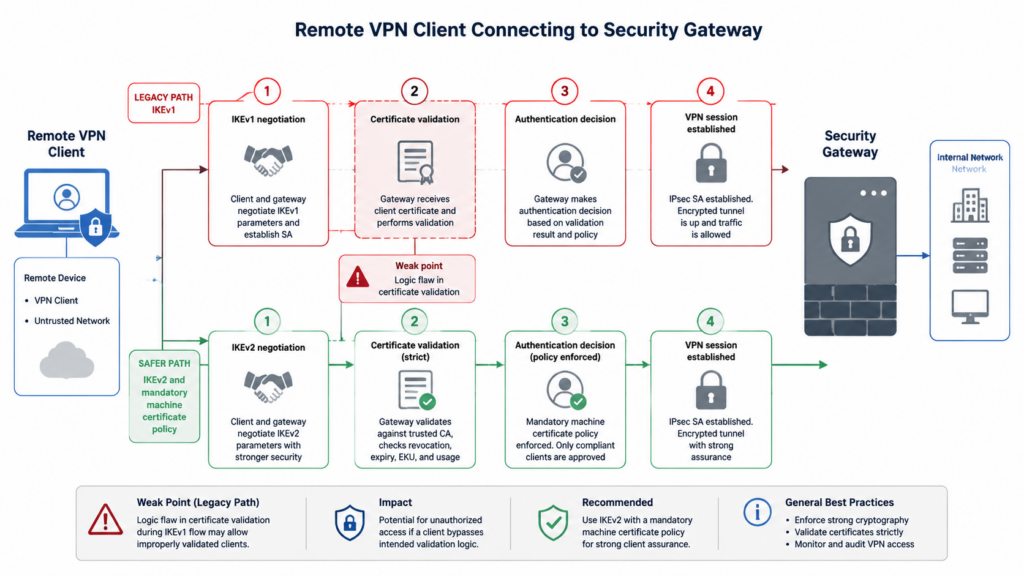
IKE, the Internet Key Exchange protocol, negotiates cryptographic material and security associations for IPsec VPNs. In a remote-access VPN, it sits near the front of the trust decision. If that trust decision is wrong, the rest of the VPN stack may treat the attacker as a participant in a private network.
The affected path matters because it is tied to IKEv1, not simply to “VPN” in the abstract. IETF RFC 9395, published in April 2023, formally deprecated IKEv1, moved RFCs 2407, 2408, and 2409 to Historic status, and states that IKEv2 replaced IKEv1 long ago and provides a full replacement for IKEv1 functionality. RFC 9395 also warns that IKEv1 systems should be upgraded and reconfigured to run IKEv2, noting risks around unmaintained code, end-of-life systems, frozen implementations, amplification abuse, and outdated cryptographic defaults. (מעקב נתונים של IETF)
Deprecation is not the same as exploitability. A deprecated protocol can still be deployed in a way that is not exposed to a given attack. But deprecated compatibility paths often survive because someone still has an old client, an old branch appliance, an old integration, or an exception that no one wants to break. That is exactly where authentication state machines become harder to reason about. Compatibility code has to accept more modes, more flags, more certificate states, and more client behavior. The branch that “only exists for legacy clients” can become the branch attackers care about most.
CVE-2026-50751 is a concrete example of that risk. The problem is not that IKEv1 is magically exploitable everywhere. The problem is that a specific Check Point IKEv1 remote-access path could let authentication validation be bypassed when several configuration conditions line up.
Who is actually exposed
The most important operational detail is that exposure is configuration-dependent. A version number alone is not enough. A visible UDP 500 service alone is not enough. A Check Point product name alone is not enough.
HKCERT lists the required vulnerable conditions for CVE-2026-50751 as Remote Access VPN or Mobile Access enabled, IKEv1 enabled for remote access, gateways accepting legacy Remote Access clients, and gateways not demanding a machine certificate for connections. NHS England Digital lists the same conditions in its cyber alert. (HKCERT)
| Exposure component | מדוע זה חשוב | Defensive verification |
|---|---|---|
| Remote Access VPN or Mobile Access enabled | The vulnerable path is tied to remote-access functionality. | Check SmartConsole, gateway object settings, enabled blades, and policy. |
| IKEv1 enabled for remote access | The flaw is in deprecated IKEv1 key exchange certificate validation. | Review Remote Access VPN authentication settings and global properties. |
| Legacy Remote Access clients accepted | Legacy compatibility keeps older client paths reachable. | Identify whether older clients, L2TP, StrongSwan, or unsupported client modes are still allowed. |
| Machine certificate authentication not mandatory | The vulnerable condition depends on certificate handling that should be controlled by gateway policy. | Confirm whether Machine Certificate Authentication is mandatory for relevant users and clients. |
| Network reachability | A remote attacker still needs a path to the VPN service. | Validate from approved scanner locations and review exposed UDP 500, UDP 4500, and any relevant TCP-access path. |
| Affected version or take | Some fixed versions and hotfix takes remediate the issue. | Record product branch, Jumbo Hotfix Take, Spark build, HA peer status, and change evidence. |
Security teams should classify assets into at least five buckets. “Confirmed vulnerable” means affected software plus vulnerable configuration plus reachability. “Potentially vulnerable” means Check Point remote-access exposure exists but configuration is not yet proven. “Not vulnerable by configuration” means an affected branch exists but the vulnerable remote-access conditions are absent and documented. “Not affected” means the product or service path is not relevant. “Unknown owner” should be treated as operationally risky until someone is accountable for the device.
Affected versions and why end-of-support branches raise the stakes
The affected version picture includes Security Gateways and Spark Firewalls. RunZero summarizes affected Security Gateway branches as R82.10 Jumbo Hotfix Take 19 or below, R82 Jumbo Hotfix Take 103 or below, R81.20 Jumbo Hotfix Take 141 or below, and R81.10, R81, and R80.40 as end-of-support branches; it lists Spark Firewalls R80.20.X, R82.00.X, and R81.10.X in the affected set. (runZero)
HKCERT gives a similar affected configuration view and lists Security Gateways R82.10 Jumbo Hotfix Take 19 or below, R82 Jumbo Hotfix Take 103 or below, R81.20 Jumbo Hotfix Take 141 or below, R81.10 EOS, R81 EOS, R80.40 EOS, and Spark Firewalls R80.20.X EOS, R81.10.X, and R82.00.X. (HKCERT)
End-of-support branches matter for two reasons. First, they are more likely to contain legacy operational dependencies. Second, even when emergency guidance exists, the long-term control cannot be “keep the unsupported VPN edge online and hope for special handling next time.” An internet-facing security appliance that protects remote access is not a place to carry old software indefinitely.
A practical remediation plan should not treat EOS gateways as ordinary backlog items. They need a migration owner, an exception record, a business impact note, and a retirement date. If the organization cannot quickly replace them, it should at least remove the vulnerable conditions, restrict reachability, increase logging, and avoid treating mitigation as a permanent fix.
What public technical analysis suggests about the bug
The official description says the problem is a logic flaw in certificate validation during deprecated IKEv1 key exchange. That is enough for patching and triage. Public reverse engineering adds useful defensive context, but it should not become a playbook for unauthorized testing.
WatchTowr’s technical analysis compared a vulnerable Check Point build with a hotfixed build and focused on IKEv1 certificate and authentication logic. The analysis says the vulnerable and patched builds differed in the signature of a function involved in certificate payload processing; in the patched version, the code reads the gateway’s own machine-certificate policy instead of relying on a caller-controlled flag to decide whether machine-certificate material should be processed. WatchTowr summarized the fix as stopping the client from deciding whether the client needs to authenticate. (watchTowr Labs)
The same analysis describes authentication checks being skipped based on flags in the IKE negotiation state and traces how an attacker-controlled value could influence those flags. It also reports that a vulnerable appliance accepted an authentication path that the patched appliance rejected. (watchTowr Labs)
The defender takeaway is not “copy the exploit.” The defender takeaway is that the vulnerable condition is deeper than a missing password prompt. It is an authentication-state validation failure in a legacy key-exchange path. That is why mitigations should remove the path, enforce the gateway’s policy, and require evidence that the dangerous configuration is no longer reachable.
Why this can become a ransomware incident
Check Point says exploitation attempts increased in early June 2026 and that responders should audit logs and configurations from May 7, 2026 onward. It also assesses with medium confidence that the actor behind observed exploitation is financially motivated and uses Qilin ransomware, and it reports infrastructure and post-compromise activity consistent with that assessment. (הבלוג של Check Point)
BleepingComputer reported that Check Point released updates for a critical flaw affecting Remote Access VPN and Mobile Access deployments exploited in zero-day attacks, and that attacks began on May 7, surged in early June, and affected only “a few dozen” organizations worldwide, with at least one incident linked to Qilin ransomware activity. (BleepingComputer)
Cybersecurity Dive similarly reported that the vulnerability had been under exploitation for more than a month and that CISA added it to KEV; it also noted Check Point’s finding of a second related vulnerability and that Rapid7 researchers had observed at least one case involving CVE-2026-50751. (Cybersecurity Dive)
A reasonable intrusion chain looks like this:
| שלב | What the attacker may try | Defensive evidence |
|---|---|---|
| Initial access | Establish unauthorized VPN session through vulnerable remote-access path | VPN session logs, IKE logs, source IPs, username or DN activity, legacy client indicators |
| Internal discovery | Identify reachable subnets, domain controllers, file shares, web apps, and administrative portals | NetFlow, firewall logs, DNS queries, EDR network telemetry |
| Credential access | Abuse exposed internal services, cached credentials, service accounts, or password reuse | EDR alerts, authentication logs, LSASS access, Kerberos anomalies, failed and successful login bursts |
| Lateral movement | Move to servers, file shares, virtualization platforms, backup systems, or management hosts | RDP, SMB, WinRM, SSH, admin tool usage, new service creation |
| Collection and exfiltration | Stage sensitive files or transfer data externally | Rclone or similar tool usage, unusual outbound volumes, archive creation, cloud storage connections |
| Ransomware deployment | Encrypt Linux or Windows systems, disable recovery, delete backups | EDR ransomware behavior, process anomalies, mass file writes, backup deletion, hypervisor events |
The point is not that every exposed gateway will suffer all these steps. The point is that a VPN authentication bypass gives attackers a plausible first move in a chain that defenders cannot dismiss as “only perimeter noise.”
Safe exposure validation without running exploit code
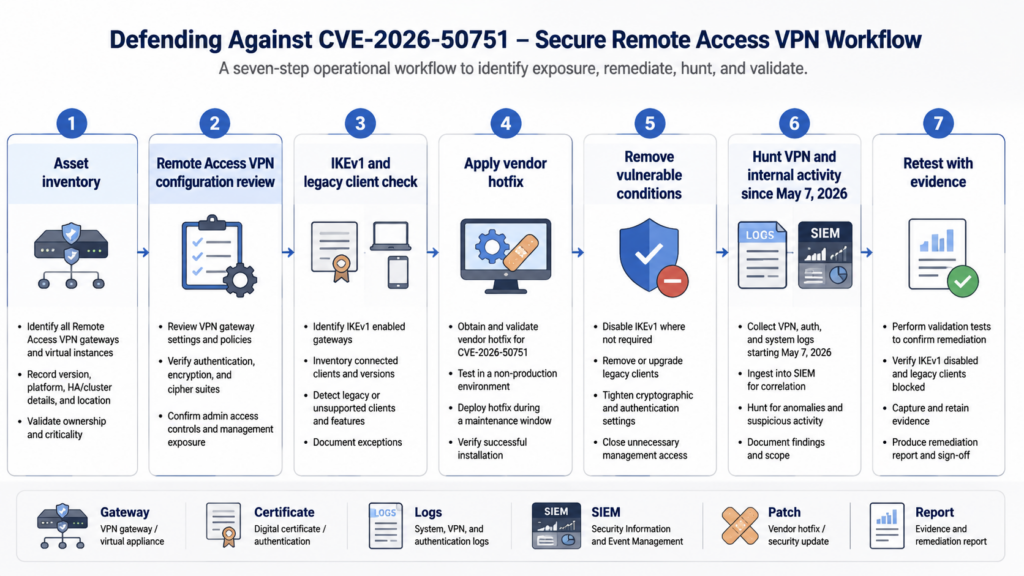
Do not validate CVE-2026-50751 by running untrusted exploit repositories against production VPN gateways. The presence of active exploitation, CISA KEV status, and vendor hotfix guidance is already enough to justify emergency remediation. Validation should focus on asset ownership, configuration, version, reachability, and post-fix evidence.
A safe workflow looks like this:
- Build an authoritative list of Check Point Security Gateways, Remote Access VPN gateways, Mobile Access deployments, Spark Firewalls, HA peers, standby nodes, branch appliances, and cloud appliances.
- For each device, record product branch, Jumbo Hotfix Take or Spark build, enabled blades, Remote Access VPN state, Mobile Access state, IKEv1 remote-access state, legacy client support, machine certificate requirement, and external reachability.
- Use only authorized external discovery to identify exposed IKE services.
- Apply the vendor fix or fixed take.
- Remove the vulnerable configuration conditions wherever possible.
- Preserve logs from May 7, 2026 onward.
- Hunt for suspicious VPN sessions and internal follow-on behavior.
- Recheck the fixed state and document evidence.
Nmap’s ike-version NSE script is useful for authorized IKE service discovery because Nmap documents it as a discovery, safe, and version script that obtains information from an IKE service by sending a small number of packets; it does not prove exploitability. (Nmap)
# Authorized external inventory only.
# Purpose: find exposed IKE services and possible VPN endpoints.
# This does not prove CVE-2026-50751 exploitability.

sudo nmap -sU -sV -p 500,4500 \
  --script ike-version \
  --version-intensity 0 \
  -oA checkpoint_ike_inventory \
  -iL authorized_vpn_targets.txt
Treat the output as a lead, not a verdict. If the scan shows IKE exposure, confirm the actual Check Point configuration from the management plane. If the scan does not show IKE exposure, do not automatically close the case. Some deployments may expose VPN paths through different interfaces, NAT, partner networks, cloud paths, managed service providers, or TCP-based access modes.
Turning messy asset data into a triage list
Many teams lose time because gateway data lives in different places: CMDB, scanner results, firewall exports, SmartConsole notes, tickets, cloud inventory, and SOC alerts. A simple normalization step helps responders avoid blind spots.
#!/usr/bin/env python3
"""
Defensive triage helper for CVE-2026-50751.

Input CSV columns expected:
asset,owner,product,version,take_or_build,remote_access_enabled,
mobile_access_enabled,ikev1_remote_access,legacy_clients_accepted,
machine_cert_mandatory,external_ike_reachable,logs_available_from

This script does not test exploitation. It only prioritizes review.
"""

import csv
from datetime import date

REVIEW_START = date(2026, 5, 7)

def truthy(value: str) -> bool:
    return str(value).strip().lower() in {"yes", "true", "1", "y"}

def has_logs_from_required_window(value: str) -> bool:
    try:
        y, m, d = [int(x) for x in value.strip().split("-")]
        return date(y, m, d) <= REVIEW_START
    except Exception:
        return False

def classify(row: dict) -> str:
    remote_path = truthy(row.get("remote_access_enabled", "")) or truthy(row.get("mobile_access_enabled", ""))
    vulnerable_config = (
        remote_path
        and truthy(row.get("ikev1_remote_access", ""))
        and truthy(row.get("legacy_clients_accepted", ""))
        and not truthy(row.get("machine_cert_mandatory", ""))
    )
    reachable = truthy(row.get("external_ike_reachable", ""))
    owner_missing = not row.get("owner", "").strip()

    if owner_missing:
        return "UNKNOWN_OWNER_ESCALATE"
    if vulnerable_config and reachable:
        return "CONFIRMED_HIGH_PRIORITY_REVIEW"
    if vulnerable_config:
        return "CONFIG_RISK_VERIFY_REACHABILITY"
    if remote_path:
        return "REMOTE_ACCESS_PRESENT_VERIFY_PATCH"
    return "LOWER_PRIORITY_DOCUMENT_EVIDENCE"

with open("checkpoint_assets.csv", newline="") as f:
    reader = csv.DictReader(f)
    rows = list(reader)

for row in rows:
    row["triage_class"] = classify(row)
    row["log_window_ok"] = str(has_logs_from_required_window(row.get("logs_available_from", ""))).lower()

with open("checkpoint_cve_2026_50751_triage.csv", "w", newline="") as f:
    fieldnames = list(rows[0].keys()) if rows else []
    writer = csv.DictWriter(f, fieldnames=fieldnames)
    writer.writeheader()
    writer.writerows(rows)

print("Wrote checkpoint_cve_2026_50751_triage.csv")
This kind of script is intentionally boring. It does not replace Check Point’s advisory. It does not detect exploitation. It helps incident responders see which assets need human verification first.
What to hunt for after possible exposure
Check Point published indicators of compromise, including multiple IP addresses and hashes, and added IoCs across June 9, June 10, and June 11. (הבלוג של Check Point) IoCs are useful, but they are not enough. Infrastructure changes. Source IPs change. A successful actor may reuse one path in one environment and a different path in another. Hunt for behavior as well as indicators.
| Signal category | What to look for | מדוע זה חשוב | False positive risk |
|---|---|---|---|
| VPN session anomalies | Successful sessions from unusual VPS, cloud, hosting, or country sources | Check Point reported attacker infrastructure hosted across VPS providers | Traveling users and MSPs can look similar |
| Username or DN probing | Many failed lookups followed by one success, especially from one source | Public analysis suggests valid user identity knowledge can matter | Password spray and normal mistyped usernames can overlap |
| Legacy client activity | Sessions using old or unexpected client modes | Vulnerability depends on legacy remote-access compatibility | Old but legitimate clients may still exist |
| VPN-to-internal scanning | New VPN source reaches many internal hosts or ports | Unauthorized VPN access often leads to discovery | Some admin tools also scan broadly |
| Identity service access | VPN source hits AD, LDAP, Kerberos, SSO, password reset, or admin portals | Attackers need credentials and privileges after initial access | Help desk and IT admins may do this legitimately |
| File share and backup access | Access to SMB shares, NAS, backup consoles, hypervisors, or storage admin panels | Ransomware chains often target data and recovery systems | Backup maintenance can be noisy |
| Suspicious tools | Rclone-like transfers, unknown ELF downloads, Tox-like communications, unexpected tunneling tools | Check Point and eSentire discuss malicious ELF downloads and Tox-related communication indicators in observed activity | Some tools have benign admin uses |
| Endpoint anomalies | New services, credential dumping, mass file access, privilege escalation, or ransomware behavior | VPN entry becomes serious when endpoint or server activity follows | Endpoint detections require local context |
A generic Splunk-style starting point might look like this. Field names vary by environment, so adapt the query to actual Check Point, firewall, VPN, identity, and EDR log schemas.
index=vpn OR index=checkpoint earliest="05/07/2026:00:00:00"
(
  sourcetype="checkpoint:*" OR sourcetype="vpn:*"
)
| eval src_is_cloud_or_vps=if(match(src_category, "(?i)vps|hosting|cloud|unknown"), 1, 0)
| stats
    count as events
    values(action) as actions
    values(vpn_client) as clients
    values(user) as users
    min(_time) as first_seen
    max(_time) as last_seen
  by src_ip, dest, src_country
| where src_is_cloud_or_vps=1 OR mvcount(users) > 3
| convert ctime(first_seen) ctime(last_seen)
| sort -events
A KQL-style starting point for Microsoft Sentinel might look like this:
let ReviewStart = datetime(2026-05-07);
CommonSecurityLog
| where TimeGenerated >= ReviewStart
| where DeviceVendor has_any ("Check Point", "Checkpoint")
| where DeviceAction has_any ("accept", "success", "login", "vpn")
| summarize
    Events=count(),
    Users=make_set(SourceUserName, 20),
    Actions=make_set(DeviceAction, 20),
    FirstSeen=min(TimeGenerated),
    LastSeen=max(TimeGenerated)
  by SourceIP, DestinationIP, DeviceName
| where array_length(Users) > 3 or Events > 50
| order by Events desc
Neither query is a finished detection rule. A finished rule needs the organization’s normal VPN behavior, known MSP ranges, employee travel patterns, approved cloud egress, Check Point log taxonomy, and endpoint correlation. The useful question is not “did a single IP match an IoC?” It is “did a remote-access identity boundary produce a session that cannot be explained by normal authentication, normal device posture, normal geography, and normal user behavior?”
Patching and mitigation priorities
The best fix is to apply the Check Point hotfix or upgrade to a vendor-fixed version for every affected gateway, including HA members and standby appliances. Check Point’s advisory says customers using the IKEv1 key exchange protocol should apply available security updates immediately and refers customers to its support advisories for affected configurations, alternative mitigations, IoCs, and exact upgrade guidance. (הבלוג של Check Point)
If patching cannot happen immediately, break the vulnerable condition chain. BleepingComputer reports that Check Point’s mitigation measures for customers who cannot immediately patch include removing support for legacy Remote Access clients, configuring global properties for Remote Access VPN Authentication to IKEv2 only, setting Machine Certificate Authentication as mandatory, and enabling IPS with downloaded signatures. (BleepingComputer) NHS England Digital gives the same practical direction: remove legacy Remote Access client connections, configure Remote Access VPN Authentication to IKEv2 only, and set Machine Certificate Authentication as mandatory. (NHS אנגליה דיגיטלית)
| בקרה | Why it helps | Caveat |
|---|---|---|
| Apply vendor hotfix or fixed take | Removes the vulnerable code path as specified by the vendor | Verify every gateway and HA member, not just the primary device |
| Disable IKEv1 for remote access | Removes the deprecated key-exchange path associated with the flaw | Old clients may break and need migration |
| Remove legacy Remote Access client support | Reduces compatibility paths that keep vulnerable behavior reachable | Requires user communication and client inventory |
| Require machine certificate authentication | Forces stronger device identity where appropriate | Must be deployed correctly with certificate lifecycle management |
| Enable IPS and update signatures | Adds detection or blocking coverage where available | IPS is not a substitute for patching |
| Restrict VPN reachability | Reduces attacker access to exposed services | May not be feasible for all remote workforce models |
| Preserve logs from May 7 onward | Enables investigation of the exploitation window | Missing logs must be documented as a visibility gap |
Do not rely on MFA alone as the only mitigation. MFA is valuable, but the public description of CVE-2026-50751 centers on certificate validation logic and an authentication path in IKEv1. If the vulnerable path can establish a session without the expected user-password flow, then the right fix is to patch and remove the vulnerable path, not assume a separate control always compensates.
Proving closure with evidence
A remediation ticket that says “patched” is not enough. The closure evidence should let another engineer, auditor, or incident commander understand exactly what changed.
| Validation area | Evidence to collect | Passing condition |
|---|---|---|
| Patch status | Version, Jumbo Hotfix Take, Spark build, installation timestamp, change ticket | Vendor-fixed level applied to every affected device |
| HA and standby coverage | Device list, cluster member status, standby member version | No unfixed peer remains capable of taking traffic |
| Remote Access VPN state | SmartConsole screenshot or configuration export | Remote Access path known and documented |
| IKEv1 remote access | Configuration evidence | Disabled for remote access unless a formally approved exception exists |
| Legacy client support | Client compatibility settings | Removed or documented with compensating controls |
| Machine certificate policy | Configuration evidence | Mandatory where used as mitigation |
| External reachability | Approved scanner output and network path review | Only expected services reachable |
| Log review | Query output, time window, analyst notes | Logs reviewed from May 7, 2026 onward or gap documented |
| Suspicious sessions | Case notes, account review, endpoint correlation | All unexplained sessions investigated |
| Retest | Independent verification record | Fixed state confirmed after change |
The report should avoid two common mistakes: overstating the bug as direct RCE and understating it as “just a VPN issue.” A precise internal finding might read:
Finding:
Potential exposure to CVE-2026-50751 on Check Point Remote Access VPN gateway

Affected asset:
vpn-edge-03.example.net, public IP 203.0.113.10

Evidence:
- Check Point Security Gateway R81.20, Jumbo Hotfix Take below vendor-fixed level
- Remote Access VPN enabled
- IKEv1 enabled for remote access
- Legacy Remote Access client support enabled
- Machine Certificate Authentication not mandatory
- UDP 500 reachable from approved external scanner
- VPN logs available from 2026-05-01 onward

Impact:
A remote unauthenticated attacker may be able to establish a VPN session without a valid user password if the vulnerable IKEv1 certificate-validation path is reachable. Additional post-authentication activity would still be required to access internal resources or escalate privileges, but unauthorized VPN entry creates serious initial-access risk.

Remediation:
- Apply Check Point vendor hotfix or upgrade to fixed take
- Disable IKEv1 remote access or migrate to IKEv2-only
- Remove legacy Remote Access client support
- Require Machine Certificate Authentication where applicable
- Review VPN, identity, network, and endpoint logs from 2026-05-07 onward

Retest:
- Confirm fixed version or hotfix take
- Confirm IKEv1 remote access disabled or vulnerable conditions removed
- Confirm no unexplained suspicious VPN sessions from May 7 onward
That structure separates exposure, impact, remediation, and retest. It also gives leadership a clean answer to a hard question: “Are we exposed, were we compromised, and how do we know?”
For teams already using AI-assisted security workflows, this is the type of finding where automation is useful only if it remains evidence-driven. Penligent describes itself as an AI-powered pentesting platform, and its own CVE-2026-50751 resource focuses on authorized validation, configuration-aware triage, safe exposure testing, retesting, and report evidence rather than public exploit execution. (Penligent) In a real response, that means the tool should help collect and organize proof across assets, configuration state, reachable services, remediation evidence, and post-fix verification. It should not replace vendor patching or encourage untrusted exploit code against production.
Related CVEs that help frame the risk
CVE-2026-50751 should not be viewed in isolation. The useful comparison is not “same bug, different year.” It is “same category of high-value edge systems, different failure modes.”
| CVE | Product area | Main issue | מדוע זה חשוב במקרה זה |
|---|---|---|---|
| CVE-2026-50751 | Check Point Remote Access VPN, Mobile Access, Spark Firewall under vulnerable IKEv1 remote-access conditions | עקיפת אימות | Allows possible unauthorized VPN session establishment without a valid user password |
| CVE-2026-50752 | Check Point site-to-site VPN under deprecated IKEv1 certificate-validation conditions | Improper certificate validation, potential MITM | Shows adjacent certificate-validation risk in the same legacy protocol family |
| CVE-2024-24919 | Check Point Security Gateway with Remote Access VPN or Mobile Access enabled | Information disclosure | Shows prior real-world pressure on Check Point remote-access edge devices |
Check Point says CVE-2026-50752 was discovered during the CVE-2026-50751 investigation through an extended review of affected VPN components. It affects certificate validation in deprecated IKEv1 key exchange and may allow man-in-the-middle interference with site-to-site VPN communications under specific conditions; Check Point says it has not observed exploitation of CVE-2026-50752 in the wild. (הבלוג של Check Point) NVD lists CVE-2026-50752 as CVSS 7.4 High, CWE-295 Improper Certificate Validation, and describes the potential impact as interception or modification of traffic traversing the VPN tunnel. (NVD)
CVE-2024-24919 is different but operationally relevant. NVD describes it as potentially allowing an attacker to read certain information on Check Point Security Gateways once connected to the internet and enabled with Remote Access VPN or Mobile Access Software Blades; it has CVSS 8.6 High and is also listed in CISA KEV. (NVD)
The shared lesson is that remote-access gateways are not passive infrastructure. They are authentication systems, cryptographic systems, routing systems, and internet-facing security appliances at the same time. When they fail, the blast radius can extend far beyond the appliance itself.
Common mistakes during response
The first mistake is treating CVE-2026-50751 as a simple version-scanner result. Version matters, but configuration decides exposure. A gateway on an affected branch with IKEv1 remote access disabled and no legacy client support is not the same as an internet-facing gateway that still accepts the vulnerable legacy path.
The second mistake is patching only the primary gateway. High availability peers, standby devices, branch Spark appliances, lab gateways temporarily exposed for support, cloud firewalls, and managed-service-provider-controlled devices can be missed. Attackers do not care which device the change ticket forgot.
The third mistake is assuming “we have MFA” closes the issue. MFA is important, but this vulnerability is about a certificate-validation and authentication logic path in deprecated IKEv1. The fix is to patch and remove the vulnerable conditions. MFA can help reduce follow-on abuse, but it should not be the sole answer.
The fourth mistake is declaring “no compromise” when logs do not cover the period of interest. If the organization cannot review back to May 7, 2026, the correct statement is not “clean.” The correct statement is “visibility is incomplete before this date,” followed by compensating investigation steps.
The fifth mistake is hunting only the published IoCs. Check Point’s IoCs are useful, but source infrastructure can change. A mature hunt combines IoCs with behavior: odd VPN sessions, unusual usernames, new internal scanning, suspicious endpoint activity, credential access, file staging, and outbound transfer patterns.
The sixth mistake is treating CVE-2026-50751 and CVE-2026-50752 as the same issue. They are related by investigation area and deprecated IKEv1 certificate-validation logic, but they have different exposure models. One is an actively exploited remote-access authentication bypass; the other is a site-to-site MITM risk with no observed exploitation according to Check Point.
The seventh mistake is leaving EOS gateways in place after the emergency passes. If the incident response conclusion is “we mitigated the old branch for now,” the architecture conclusion should still be “replace it.”
Practical incident response workflow
The response should run in parallel, not strictly one step at a time. Patch teams should move while SOC teams preserve logs. Network teams should validate exposure while endpoint teams watch for post-VPN movement. Leadership should receive short evidence updates, not vague status.
A strong workflow looks like this:
Emergency response checklist:

[ ] Freeze non-essential Check Point VPN configuration changes until triage is complete.
[ ] Identify every Remote Access VPN, Mobile Access, Security Gateway, Spark Firewall, HA peer, and cloud gateway.
[ ] Assign a technical owner and incident contact for each asset.
[ ] Confirm product version, Jumbo Hotfix Take, or Spark build.
[ ] Confirm whether Remote Access VPN or Mobile Access is enabled.
[ ] Confirm whether IKEv1 is enabled for remote access.
[ ] Confirm whether legacy Remote Access clients are accepted.
[ ] Confirm whether Machine Certificate Authentication is mandatory.
[ ] Confirm external reachability from authorized scanner locations.
[ ] Apply vendor hotfix or upgrade to fixed version.
[ ] Disable IKEv1 remote access where operationally possible.
[ ] Remove legacy client support where operationally possible.
[ ] Require machine certificate authentication where applicable.
[ ] Update IPS protections and confirm policy installation.
[ ] Export and preserve logs from 2026-05-07 onward.
[ ] Hunt suspicious VPN sessions and post-session internal activity.
[ ] Review credentials and accounts tied to suspicious sessions.
[ ] Retest fixed state and document evidence.
[ ] Create an exception plan for any remaining legacy dependency.
If the organization cannot complete the checklist quickly, that is itself a finding. The inability to identify VPN gateways, owners, configuration state, or logs during an actively exploited edge-device vulnerability is not a minor administrative problem. It is a security operations gap.
Useful resources for defenders
Check Point’s advisory should be the primary remediation source because it is the vendor source for hotfixes, mitigations, affected configurations, and IoCs. NVD is useful for the canonical vulnerability description, CVSS vector, CWE mapping, and CISA KEV record. RFC 9395 is useful for understanding why IKEv1 should not remain a normal remote-access dependency. Nmap’s ike-version documentation is useful for safe, authorized IKE service discovery, not exploit validation. (הבלוג של Check Point)
שאלות נפוצות
What is CVE-2026-50751?
- CVE-2026-50751 is a critical Check Point VPN authentication bypass.
- It affects Remote Access VPN and Mobile Access deployments when a vulnerable deprecated IKEv1 remote-access configuration is present.
- NVD maps it to CWE-287, Improper Authentication, and describes a logic flow weakness in certificate validation.
- A successful attacker may establish a remote-access VPN connection without a valid user password.
- It is actively exploited, according to Check Point and CISA KEV-linked records. (NVD)
Is CVE-2026-50751 a remote code execution bug?
- No authoritative source currently describes CVE-2026-50751 as direct unauthenticated remote code execution.
- Check Point says additional post-authentication activity is required to access internal resources or escalate privileges.
- The risk is still critical because unauthorized VPN access can become initial access for internal discovery, credential theft, lateral movement, data theft, or ransomware.
- Report it as an authentication bypass at the VPN identity boundary, not as RCE. (הבלוג של Check Point)
Which Check Point deployments are actually exposed?
- Start with Check Point Remote Access VPN, Mobile Access, Security Gateway, and Spark Firewall deployments.
- Risk depends on configuration, not only product name.
- The highest-risk condition includes Remote Access VPN or Mobile Access enabled, IKEv1 enabled for remote access, legacy Remote Access clients accepted, Machine Certificate Authentication not mandatory, and attacker reachability.
- Affected version branches include several supported and end-of-support releases, so asset owners should verify both version and configuration. (HKCERT)
How should defenders safely validate exposure?
- Use Check Point management-plane configuration review first.
- Confirm Remote Access VPN or Mobile Access state, IKEv1 remote-access state, legacy client settings, and machine certificate policy.
- Use authorized external discovery only to confirm IKE service exposure.
- Nmap’s
ike-versionscript can help identify IKE service information, but scanner output is not proof of exploitability. - Do not run untrusted public exploit code against production gateways. (Nmap)
What should teams do if they cannot patch immediately?
- Break the vulnerable condition chain as quickly as possible.
- Remove support for legacy Remote Access clients.
- Configure Remote Access VPN Authentication to IKEv2 only where operationally possible.
- Set Machine Certificate Authentication as mandatory where applicable.
- Enable IPS protections and update signatures.
- Restrict VPN reachability where feasible.
- Continue to prioritize the vendor fix because mitigations should not become a permanent substitute for patching. (BleepingComputer)
How far back should incident responders review logs?
- Start from May 7, 2026.
- Check Point says responders should prioritize forensic log audits and configuration reviews from the earliest observed exploitation date of May 7, 2026.
- Review VPN logs, gateway logs, identity provider logs, EDR, DNS, proxy logs, NetFlow, file server access, and internal firewall telemetry.
- If logs do not go back that far, document the visibility gap and increase monitoring around affected accounts, gateways, and internal systems. (הבלוג של Check Point)
How is CVE-2026-50751 different from CVE-2026-50752 and CVE-2024-24919?
- CVE-2026-50751 is the actively exploited remote-access authentication bypass in deprecated IKEv1 conditions.
- CVE-2026-50752 is a related certificate-validation issue in deprecated IKEv1 that may allow man-in-the-middle interference with site-to-site VPN traffic under specific conditions; Check Point says it has not observed exploitation of CVE-2026-50752 in the wild.
- CVE-2024-24919 is a prior Check Point Security Gateway information disclosure vulnerability involving internet-connected gateways with Remote Access VPN or Mobile Access enabled.
- The shared lesson is operational: internet-facing remote-access gateways are high-value targets and need fast patching, configuration baselines, telemetry, and post-fix validation. (NVD)
Closing judgment
CVE-2026-50751 is a boundary failure. It affects the place where an external client becomes a VPN participant and, potentially, an internal network neighbor. That makes the response different from ordinary patch management.
The right answer is not only “install the update.” The right answer is to identify every Check Point remote-access deployment, remove deprecated IKEv1 dependency where possible, end legacy client exceptions, require stronger certificate controls where applicable, apply the vendor fix, preserve logs from May 7 onward, hunt for unauthorized VPN and post-session activity, and prove the final state with evidence.
A VPN gateway is an identity system, a cryptographic system, and a network boundary at once. If any part of that boundary still depends on deprecated protocol compatibility, it deserves the same scrutiny as production authentication code.

 Hebrew
  English
  German
  French
  Spanish
  Portuguese
  Japanese
  Korean
  Hindi
Hindi  Arabic
  Turkish