
CVE-2026-76306 is a Splunk SOAR information-disclosure vulnerability in REST API query filtering. ב SVD-2026-1010, published October 21, 2026, Splunk describes an Observer-role user inferring other users’ password hashes and authorization tokens because sensitive fields influence filtering before protection is applied. Versions below 8.7.0 are affected; the stated remedy is 8.7.0 or higher. Splunk rates this CVE High, CVSS 3.1 7.5.
Reviewed October 23, 2026. The useful technical question is not simply whether a response contains a password field. It is whether a caller can learn something about a protected value from the answer to a query. This article uses a small synthetic Python model to explain that distinction. It does not send requests to Splunk, recover real credentials or claim a reproduced CVE exploit.
Why response redaction can leave a query-inference channel
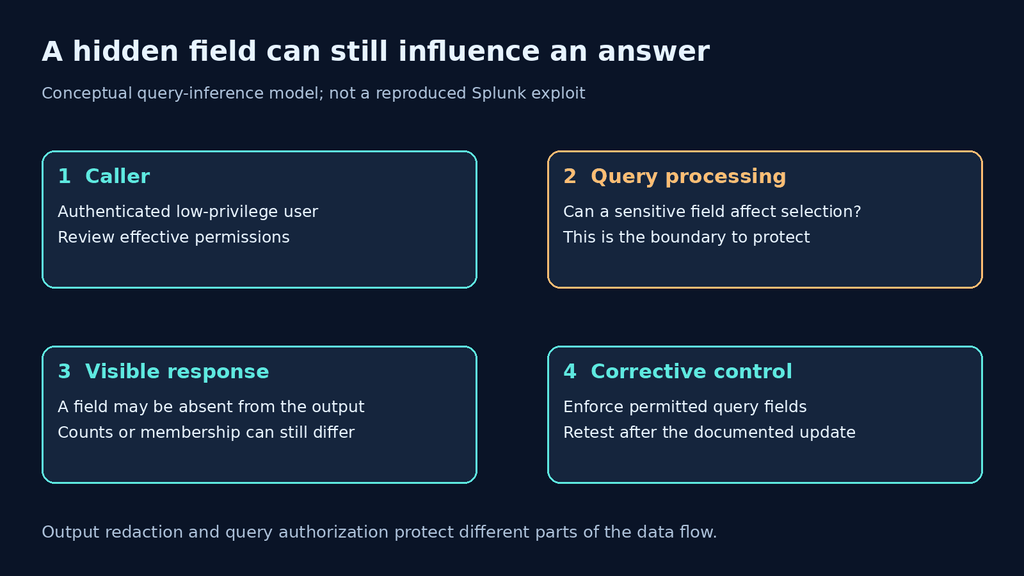
Consider two records that have identical fields an Observer is allowed to see but different private values. If the same low-privilege query returns a different count or membership result depending only on the private value, the visible response carries information about that value. Removing the private field from the serialized record does not remove that dependency.
This is a general explanation of the security boundary, not a claim about the exact response format or inference sequence used against Splunk. The vendor identifies filter processing on sensitive user-record fields; it does not provide enough implementation detail in the advisory to reconstruct a complete extraction procedure. Keep that distinction beside any diagram or example rather than hiding it in a disclaimer at the end.
For API designers, the implication is concrete: permissions must constrain what a caller can ask the system to evaluate, as well as what the system returns. A field omitted from output may still affect selection, ordering, aggregation or error behavior in an application. Those are review candidates in a general API assessment, not additional confirmed Splunk attack paths.
Observer is an identity with permissions, not an absence of access
Splunk’s role documentation describes Observer as able to view most areas while lacking edit and execution privileges. It also says users with multiple roles receive their cumulative privileges. That means a role name alone is insufficient for a clean test: record the account’s complete effective role assignment and relevant object restrictions.
A read-only workflow can still encounter a confidentiality defect. Do not make “the account cannot edit anything” the acceptance criterion for this issue. Equally, do not test with a full administrator and generalize its result to a restricted account. The identity used in the test is part of the evidence, not an incidental setup detail.
| Question | Evidence worth retaining | Insufficient substitute |
|---|---|---|
| Which software is running? | SOAR version and deployment identity mapped to the advisory | An installer downloaded to a workstation |
| Who made the request? | Dedicated test identity and effective permissions | A label saying read-only |
| What should remain private? | Synthetic protected value and approved expected behavior | Only checking visible JSON fields |
| What did the test observe? | Matched requests, responses and the changed lab variable | A generic successful API request |
An offline model: same visible record, different hidden-field count
The following Python standard-library fixture creates one synthetic user record, copies it, and changes only a private marker. Its intentionally permissive function lets that marker influence a count. A second function rejects queries on fields outside a small explicit allowlist. Neither function is Splunk source code; the field names and query interface are invented for this teaching model.
We ran the exact fixture locally on October 23, 2026. It produced the following output and its assertions passed:
The first line demonstrates the information dependency: changing only the private marker changes the count. The second shows the model’s restricted-field rejection. The third preserves an allowed query under the same private-field change. No password hash, authorization token, remote endpoint or real user record appears in this experiment.
This does not validate Splunk’s patch. It gives developers a precise question to bring to a controlled regression test: can two states that differ only in data hidden from the caller still be distinguished through an otherwise permitted query? A real test must use the product’s supported interface, an approved fixture and the version under review. Do not turn the local model into a guessed production request.
Keep the neighboring token-inference CVE separate
The same Splunk advisory lists CVE-2026-76307 separately. It describes token inference by a caller with Users and Roles view permission and notes possible administrative access if the inferred token grants it. Its score is 7.2. The related issue shares the 8.7.0 remediation, but its permission prerequisite should not be silently replaced with the Observer description of CVE-2026-76306.
For incident records, keep one row per CVE and identity prerequisite. That prevents a team from marking both complete after testing only one account. A common fixed release makes the deployment work easier to coordinate; it does not make the two exposure descriptions identical.
Patch the deployment, then test the boundary with owned data
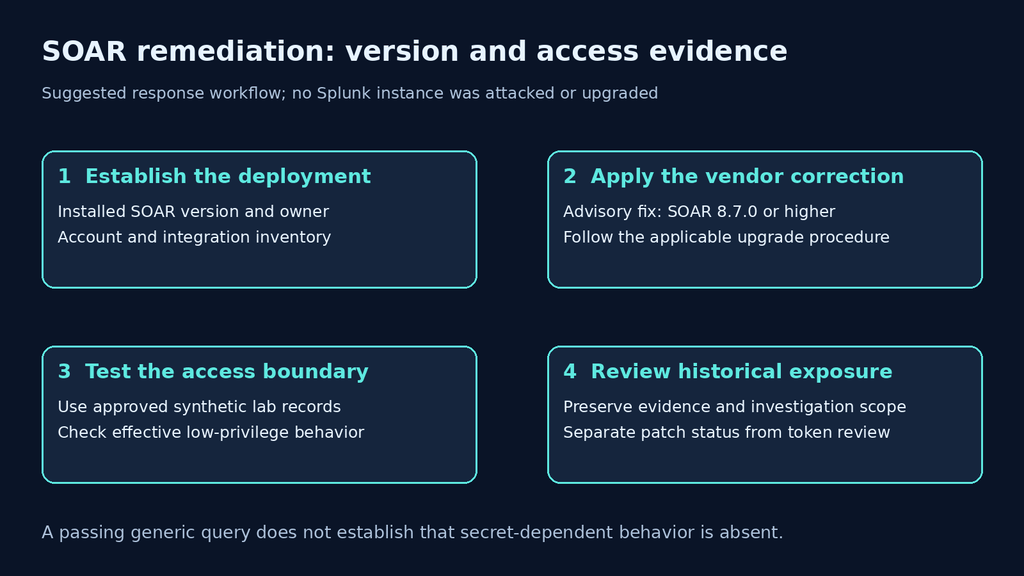
Use the applicable Splunk upgrade procedure and compatibility guidance for the environment you operate. Record the starting version, chosen artifact, recovery owner and the resulting running deployment. The advisory’s fixed release is a security boundary, not a universal installation command or a guarantee that an arbitrary source version can jump directly to it.
For acceptance, define a dedicated lab identity with the intended restricted permissions and synthetic user records approved by the owner. Record the expected behavior before changing the deployment. Keep public fields stable while changing only a synthetic protected value, and compare the same authorized observations. Avoid collecting actual tokens merely to make the test look convincing.
| Gate | Proposed check | Conclusion it supports |
|---|---|---|
| Artifact | Map the selected SOAR release to the vendor fix | A remediation artifact has been selected |
| Activation | Verify the intended deployment is serving requests | The selected artifact reached the workload |
| Restricted identity | Record all roles and relevant permissions | The caller matches the test’s assumptions |
| Synthetic confidentiality case | Compare approved observations while only private lab data changes | The tested boundary behaves as expected |
| Normal workflow | Exercise permitted read and automation workflows as authorized | The tested business functions remain usable |
A request rejected because the identity cannot authenticate is not the same result as rejection of an unauthorized query field. A timeout is not a confidentiality assertion. Preserve the reason for failure and enough context to distinguish network, authentication, authorization and application behavior. Those distinctions prevent a rollout from receiving a misleading green check.
Review credential exposure without claiming every token was stolen
If the deployment ran an affected build, preserve relevant access and administrative records according to the incident process. Identify who could authenticate with the relevant permissions and what logging is available. The advisory establishes potential disclosure; it does not prove that a particular organization’s credentials were extracted.
Treat recovery as an incident-owner decision informed by evidence and exposure. Patching removes the documented software condition going forward; it does not revoke a token that might already have been obtained. Conversely, changing credentials without correcting the vulnerable software can leave the same exposure open. Keep software remediation, credential review and historical investigation as separate tracked outcomes.
Do not publish raw token values, password hashes or complete customer records in a testing report. Use synthetic identifiers where possible, restrict sensitive evidence and record redaction decisions. An account review should include service identities owned by integrations, rather than assuming all meaningful activity belongs to an interactive analyst.
Questions API owners should ask
Is this an unauthenticated RCE? The cited CVE concerns information inference by an Observer-role user. Do not substitute another vulnerability’s prerequisites or impact.
Is removing secret fields from JSON enough? The local model shows why output shape alone is insufficient. A query result can depend on a hidden value even when that value is never serialized.
Does the Python fixture prove my SOAR installation is safe? No. It demonstrates a general information-flow property using synthetic data and does not exercise Splunk.
What is the next useful application-security task? Review effective identities and server-side query permissions in your own API, then design bounded tests with owned data. Keep that broader review separate from verifying the vendor patch.
Apply the lesson to your own authorized API assessment
If this incident reveals a gap in your application’s authorization testing, evaluate Penligent for a scoped assessment with explicit identities, expected access rules and reviewable evidence. This article does not establish a dedicated CVE-2026-76306 detector or claim that a broad application scan certifies a Splunk deployment.
The walkthrough below introduces Penligent’s product workflow; it is not a demonstration of this CVE or a substitute for the deployment owner’s patch evidence.


 Hebrew
 English
 German
 French
 Spanish
 Portuguese
 Japanese
 Korean
 Hindi
 Arabic
 Turkish