
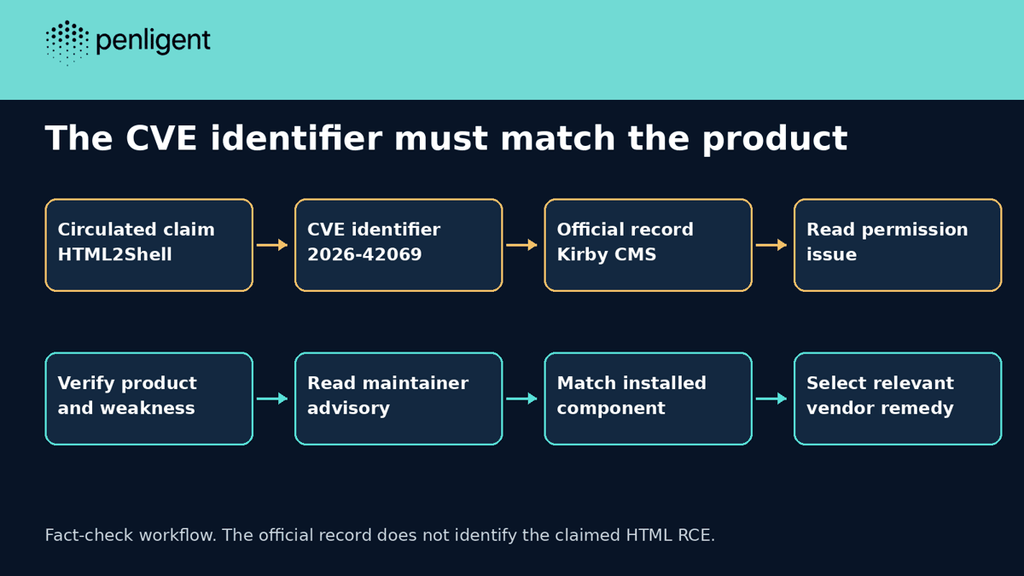
The claim that CVE-2026-42069 is an “HTML2Shell” remote code execution vulnerability does not match the official CVE record. As checked on October 25, 2026, CVE.org identifies a Kirby CMS authorization issue: read access to site, user and role information was not gated by permissions. That record is not an advisory for arbitrary code execution in HTML.
This distinction changes what to patch. A name in a forwarded screenshot cannot identify an affected dependency or a repair. Use the record’s product and its linked maintainer advisory. If your immediate concern is PHP2Shell or the Node.js Brotli decoder issue, those have different CVE identifiers, affected components and update instructions.

What the CVE actually identifies
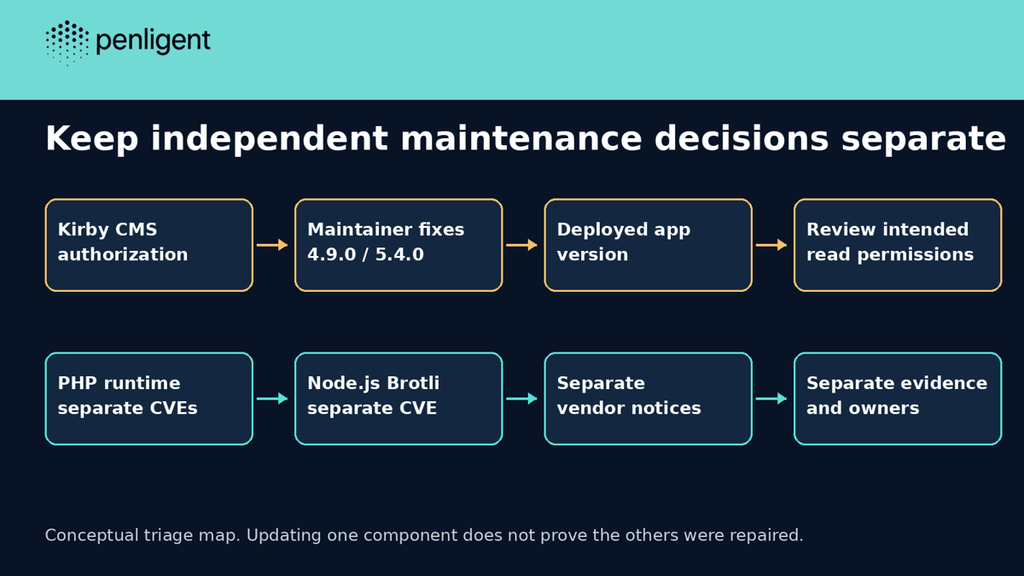
ה Kirby maintainer advisory lists affected versions as 4.8.0 and earlier, and 5.0.0 through 5.3.3, with fixes in 4.9.0 and 5.4.0. It concerns authenticated Panel users who should not be allowed to read all relevant models. The advisory says write actions were already permission-gated. Its publication date is April 23; the CVE record shows publication on May 9, 2026. Neither date makes this a newly disclosed October HTML RCE.
A real authorization flaw can still deserve attention without the invented impact. For a Kirby site, identify the deployed version and intended access policy, then use the maintainer’s update instructions. For a deployment that does not use Kirby, this record alone does not identify an affected component. Keep the inventory decision separate from whatever another security announcement requires.
| Question | Verified answer | Unsupported inference |
|---|---|---|
| Which product does CVE-2026-42069 name? | Kirby CMS | Every application that serves HTML |
| What does the maintainer describe? | Missing read authorization for specific CMS information | A demonstrated HTML parser RCE chain |
| Which repairs are listed? | Kirby 4.9.0 and 5.4.0 | A universal browser, Node.js or PHP patch |
| What does the October trend establish? | People are searching the term | The nickname, product mapping or claimed impact is correct |
Do not merge three different security stories
The Node.js October security bulletin describes CVE-2026-111497 in the bundled Brotli decoder. Attacker-supplied compressed data must reach decompression; malformed data can corrupt process memory and lead to serious impact, including potential remote code execution. The relevant component is the decoder, not the fact that a website displays HTML.
PHP’s dated security announcements identify CVE-2026-109618 and CVE-2026-109619 as separate PHP runtime issues. A PHP runtime update does not establish that a Kirby permission defect was fixed, and a Kirby package upgrade does not establish that the underlying PHP interpreter received its security update. The application and interpreter can have independent maintenance owners.
A useful incident ticket therefore names the identifier, product, deployed artifact and required action on separate lines. If an alert combines one CVE with another product’s impact, correct that association before assigning a patch. Otherwise the team can complete a valid update and still close the wrong issue.
Verify the claim before running a supposed detector
Open the official CVE record through your known route. Compare the product, weakness, prerequisites and references with the claim you received. Follow the maintainer advisory and read the affected and fixed versions. Record a disagreement explicitly; do not fill the gap with a plausible explanation involving another vulnerability.
Next, identify whether the named component exists in your deployment and which version is running. Package metadata, a lockfile and an active service can answer different questions. A local dependency entry is a lead; it does not show that a production instance uses the same artifact. Assign the relevant owner to resolve that connection.
Do not download or execute an unknown “HTML2Shell scanner” just because the term is trending. A detector needs provenance and a clear account of what it checks. A version comparison, a behavioral fixture and exploit execution have different risks and prove different things. No exploit or detector was executed for this fact check.
What to do if your team already forwarded the alert
Correct the original message where practical and preserve the authoritative links beside the correction. State exactly what changed: the identifier maps to Kirby authorization, not the alleged HTML RCE. Avoid claiming that every related warning is false; the PHP and Brotli advisories remain independent issues to assess on their own evidence.
For a change ticket, keep four fields: verified component, deployed version, vendor remedy and evidence still needed. If the inventory is incomplete, leave the item open. If a supposed patch was installed from an untrusted source, handle that as a separate software-provenance concern through the incident process rather than assuming the nickname explains its behavior.
An AI-assisted testing workflow such as Penligent can help organize an authorized application assessment, but it cannot make an incorrect CVE-to-product association true. Ask for evidence tied to the actual target and security property. This page does not claim a Penligent HTML2Shell-specific detector.
Questions about HTML2Shell and CVE-2026-42069
Is CVE-2026-42069 a real CVE?
Yes. The official record identifies a Kirby CMS read-authorization issue. The real identifier does not validate the unrelated HTML RCE label.
Is HTML2Shell a verified universal HTML vulnerability?
This review did not establish that claim from an authoritative advisory. The CVE circulated with it describes a different product and weakness.
Should a Kirby operator ignore the record?
No. Review the actual maintainer advisory, applicable permissions and deployed version. An exaggerated label does not erase the underlying authorization issue.
Is it the same as Node2Shell or PHP2Shell?
The cited official advisories use different CVEs and describe different components. Follow each relevant vendor’s instructions separately.
Does this article demonstrate exploitation?
No. It compares the official record and maintainer advisories. No target, exploit payload or remote detector was executed.


 Hebrew
 English
 German
 French
 Spanish
 Portuguese
 Japanese
 Korean
 Hindi
 Arabic
 Turkish