
Security teams don’t search what is zero trust security because they’re missing a definition. They search it because something in their environment made a hard truth obvious: the “inside” of the network is no longer meaningfully safer than the outside, and a single foothold can turn into a full-blown incident fast.
Zero trust is the response to that reality. It’s a security model and architecture approach built around a simple operational stance: remove implicit trust, verify explicitly, and continuously—for every access to every resource, using identity and context signals rather than network location alone. NIST summarizes the idea in plain language as “never trust, always verify.” (NIST)
This article is written for practitioners. It treats zero trust the way an on-call security engineer experiences it: as concrete control points, data flows, policies, telemetry, failure modes, and measurable outcomes.
Zero trust in one sentence
Zero trust security is an architectural approach where access decisions are made per request, based on verified identity plus real-time context, enforced by policy at execution points, and designed to limit blast radius when compromise happens.
That sentence matters because it also tells you what zero trust is not:
It’s not a product you buy once.
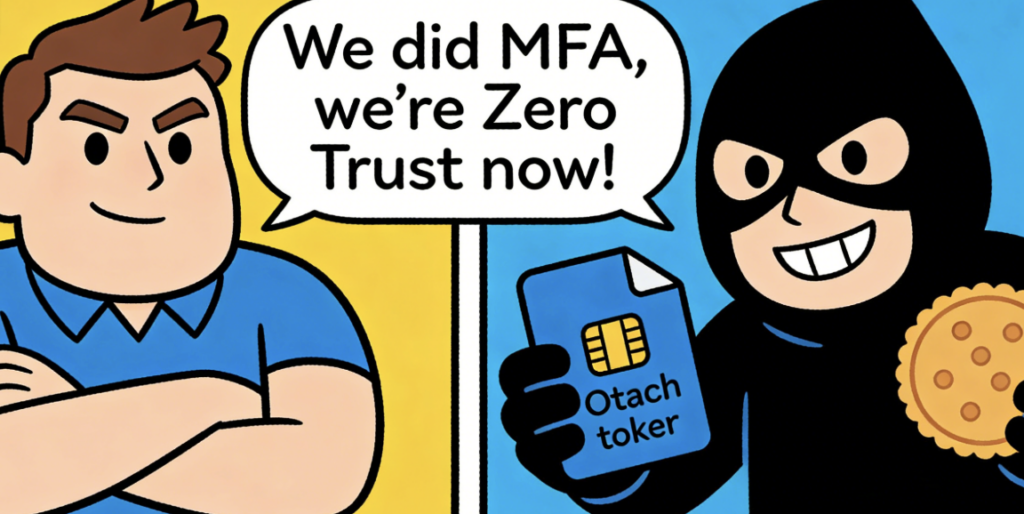
It’s not just MFA.
It’s not a synonym for VPN replacement.
It’s not “deny all” chaos.
It’s a way to build systems where compromise is expected and containment is engineered.
Where zero trust came from, and why it replaced perimeter faith
The term “zero trust” is widely credited to John Kindervag during his time at Forrester Research, with Forrester’s 2010 report introducing the “Zero Trust Model.” (Palo Alto Networks) That early framing attacked a long-standing assumption: perimeter defenses create a “trusted internal network.” In practice, internal trust becomes a multiplier for attacker movement.
Fast-forward to modern enterprise reality:
Cloud workloads sit outside old perimeters.
SaaS is the default.
Endpoints roam across networks you don’t control.
Identity has become the real chokepoint.
Supply chain and zero-day exploitation make “keep them out” an unreliable strategy.
CISA’s maturity model captures this shift in government-friendly terms: zero trust is a set of foundations expressed across five pillars and enforced through visibility, automation, and governance. (CISA)
NIST SP 800-207 puts it into architecture language—components, roles, and how decisions are made and enforced. (NIST)
The principles that make zero trust real
If you strip the branding and vendor debates away, zero trust reduces to a handful of operational principles that can be tested.
Verify explicitly, every time it matters
Authentication alone is not “verification.” Verification means the access decision uses multiple signals:
- user identity and assurance level
- device identity and posture
- request attributes and location
- workload identity and service-to-service claims
- sensitivity of the target resource
- behavioral and risk signals
This is why CISA treats identity and devices as first-class pillars rather than afterthoughts. (CISA)
Use least privilege as an engineering constraint, not a policy poster
Least privilege is not a quarterly access review that everyone dreads. In zero trust, it becomes a design constraint:
- narrow entitlements
- short-lived credentials
- just-in-time elevation
- אסימונים מוגדרים
- segmentation boundaries that prevent lateral movement even when a token is abused
Assume breach, then build for containment
“Assume breach” is often repeated, rarely implemented. Implementing it means:
- the first foothold is survivable
- lateral movement is expensive and noisy
- privilege escalation has limited payoff
- sensitive actions require stronger proofs
- detection and response operate with high-fidelity telemetry
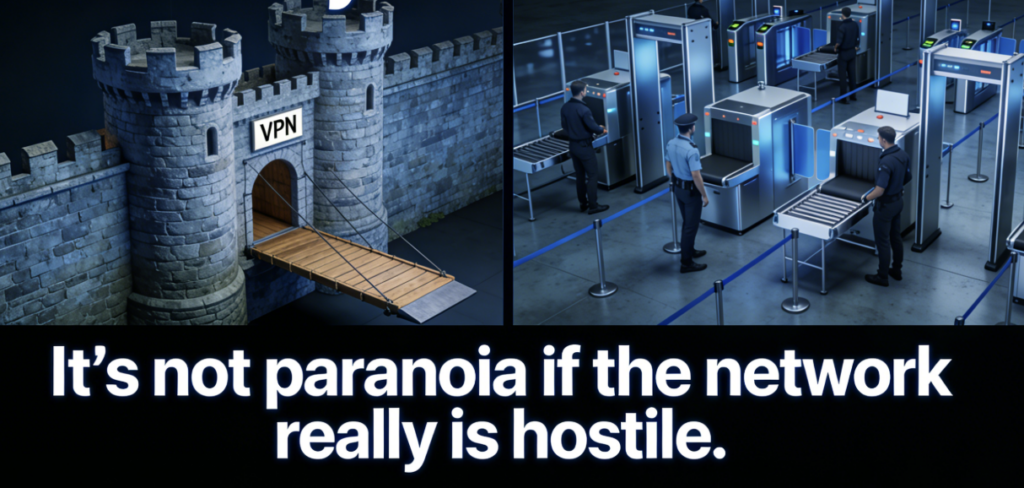
Treat network location as a weak signal, not an authority
Network location can contribute to risk scoring, but it should not grant blanket trust. That’s the point of moving from “inside equals safe” to “per-request decision.”
NIST’s zero trust architecture, the control plane you can diagram
NIST SP 800-207 is helpful because it names the moving parts. You can argue about implementations, but you can’t implement zero trust without something that behaves like these components. (NIST)
ברמה גבוהה:
- Policy Engine evaluates requests against policy and context
- Policy Administrator turns decisions into enforcement actions
- Policy Enforcement Point sits in the traffic path or service boundary and enforces
- Signals come from identity providers, device management, telemetry, threat intel, and data classification
- Logging and analytics feed continuous improvement and automation
This is why “we turned on MFA” is not a zero trust implementation. MFA is one signal. Zero trust is the system that uses signals to decide and enforce.
CISA’s five pillars, a practical decomposition of the work
CISA’s Zero Trust Maturity Model is useful because it decomposes a large program into domains you can staff and execute. It defines five pillars—Identity, Devices, Networks, Applications and Workloads, and Data—plus cross-cutting capabilities such as visibility/analytics, automation/orchestration, and governance. (CISA)
Below is a practitioner-friendly mapping of what “good” looks like per pillar.
| Pillar | What you are trying to prove | Control examples that actually matter |
|---|---|---|
| Identity | Every access is bound to a verifiable identity with an assurance level | phishing-resistant MFA for privileged actions, conditional access, short-lived tokens, strong service account hygiene |
| Devices | Compromised or unmanaged devices cannot quietly become trusted clients | device inventory, posture checks, EDR health gating, certificate-based device identity |
| Networks and environment | Network reachability does not equal authorization | microsegmentation, identity-aware proxies, egress control, service-to-service mTLS |
| Applications and workloads | Workloads have identities and policies, not shared static secrets | workload identity, per-service authorization, least-privilege runtime roles, hardened CI/CD |
| נתונים | Data access is intentional, logged, and constrained | classification, DLP where it works, encryption, access broker patterns, auditability |
This pillar framing prevents a classic failure mode: teams implement identity controls and call it done, while lateral movement inside flat networks remains trivial.
The related searches that show what people really want
When people search what is zero trust security, the next queries tend to cluster around a few high-intent topics:
- zero trust architecture, NIST 800-207
- CISA zero trust maturity model, five pillars
- zero trust network access, ZTNA
- microsegmentation vs zero trust
- zero trust vs SASE
- is MFA enough for zero trust
- zero trust implementation roadmap
You can see how government and major vendors structure these questions in their public guides and glossaries, which mirror how practitioners evaluate implementations. (CISA)
The point isn’t keyword trivia. The point is that these clusters reveal the real intent: teams want to translate the idea into enforceable boundaries and measurable control coverage.
Zero trust versus the perimeter model, what changes technically
Traditional perimeter security assumes internal traffic is more trustworthy. Zero trust assumes trust must be earned per request.
| Topic | Perimeter model | Zero trust model |
|---|---|---|
| Trust default | inside is implicitly trusted | no implicit trust, even “inside” |
| Primary control point | firewall/VPN boundary | identity-aware enforcement points everywhere |
| Credential strategy | long-lived credentials and broad network access | scoped, short-lived, continuously evaluated access |
| Lateral movement | often easy after foothold | engineered friction via segmentation and policy |
| ניטור | perimeter-heavy logs | end-to-end telemetry across identity, device, workload, and data |
| Failure assumption | prevent breach | assume breach, limit blast radius |
This table is simple, but it’s the mental model you use during incident response. When something gets popped, your architecture determines whether it’s a localized event or a company-wide crisis.
What to implement first, a roadmap that doesn’t collapse under its own scope
Zero trust programs fail when they start with a big-bang rewrite. They succeed when they start with choke points that produce immediate risk reduction and better telemetry.
Phase 1, 30 days, stop the easiest wins for attackers
Start where compromise is most common and most painful:
- inventory identities, including service accounts
- enforce MFA for admin and sensitive actions, move toward phishing-resistant methods for high risk roles
- require managed device posture for access to core apps
- centralize logs for identity and access decisions
- remove the worst legacy exposures and shared credentials
Phase 2, 90 days, build policy and segmentation that reduces blast radius
This is the containment layer:
- define “protect surfaces” rather than trying to protect everything equally
- introduce segmentation boundaries around crown-jewel services and data
- move access to identity-aware proxies where practical
- adopt policy-as-code for consistent enforcement and reviewability
- implement egress control for high-risk workloads
Phase 3, 180 days and beyond, automation, verification, and continuous improvement
This is where zero trust stops being a project and becomes how the system operates:
- automate access reviews and entitlement changes
- correlate telemetry across identity, endpoint, workload, and data
- continuously test segmentation and policy effectiveness
- measure and reduce lateral movement paths over time
CISA’s model is explicit that automation and orchestration are cross-cutting capabilities, not optional extras. (CISA)
Code and configuration examples, policy you can review and test
These examples are intentionally small. The goal is to show the shape of enforceable policy, not to pretend there’s one universal stack.
Example 1, authorization as code with OPA Rego
package zta.authz

default allow = false

# Request context
# input.user.email
# input.user.groups
# input.device.managed
# input.device.risk_score
# input.resource.type
# input.resource.sensitivity
# input.action

high_risk_device {
  input.device.risk_score >= 70
}

is_admin {
  "admins" in input.user.groups
}

# Require managed device for sensitive resources
allow {
  input.device.managed == true
  input.resource.sensitivity != "high"
}

allow {
  input.device.managed == true
  input.resource.sensitivity == "high"
  is_admin
  not high_risk_device
  input.action == "read"
}

# Write requires stronger proof
allow {
  input.device.managed == true
  input.resource.sensitivity == "high"
  is_admin
  not high_risk_device
  input.action == "write"
  input.user.mfa_strength == "phishing_resistant"
}
What matters here is not syntax. It’s the concept: decisions are made from identity plus context, and the policy is reviewable, testable, and versioned.
Example 2, Kubernetes NetworkPolicy to enforce a protect surface
apiVersion: networking.k8s.io/v1
kind: NetworkPolicy
metadata:
  name: allow-only-api-gateway-to-payments
  namespace: prod
spec:
  podSelector:
    matchLabels:
      app: payments
  policyTypes:
  - Ingress
  ingress:
  - from:
    - podSelector:
        matchLabels:
          app: api-gateway
    ports:
    - protocol: TCP
      port: 8443
This is microsegmentation in a form your platform can enforce. It doesn’t solve identity by itself, but it removes a class of “everything can talk to everything” lateral movement.
Example 3, service-to-service identity with mTLS, conceptual Envoy snippet
transport_socket:
  name: envoy.transport_sockets.tls
  typed_config:
    "@type": type.googleapis.com/envoy.extensions.transport_sockets.tls.v3.UpstreamTlsContext
    common_tls_context:
      tls_certificates:
      - certificate_chain: { filename: "/etc/certs/service.crt" }
        private_key: { filename: "/etc/certs/service.key" }
      validation_context:
        trusted_ca: { filename: "/etc/certs/ca.crt" }
The key idea is workload identity: services prove who they are, not just where they are.
The mistakes that turn zero trust into a slogan
Mistake 1, treating zero trust as a product category
ZTNA products can be part of zero trust. So can EDR, IAM, PAM, service mesh, and data controls. None of them alone is “zero trust.”
Mistake 2, implementing MFA everywhere and calling it done
MFA is necessary and still insufficient. Attackers don’t only bypass authentication; they abuse sessions, tokens, OAuth grants, service accounts, and post-exploitation privilege paths.
Mistake 3, ignoring service accounts and non-human identities
In real incidents, service accounts are often the quiet bridge between systems. Zero trust that only governs humans is a partial implementation.
Mistake 4, skipping telemetry and the feedback loop
If you can’t answer “why was this allowed” and “what changed,” you don’t have a zero trust control plane—you have a hope-based perimeter with extra steps.
OWASP’s Zero Trust Architecture cheat sheet pushes the same core idea: default distrust and explicit verification, implemented as architecture rather than a single control. (סדרת דפי העזר של OWASP)
CVE-driven reality, why zero trust is about surviving the foothold
Vulnerabilities are not theoretical. They are the recurring proof that initial access will happen—through internet-facing software, supply chain compromise, endpoint exploitation, or credential abuse. The practical question becomes: what happens next?
Log4Shell, CVE-2021-44228, the “foot in the door” lesson
Log4j exploitation was a global reminder that a single software component can offer broad initial access across organizations. Even if you patched quickly, the lesson remains: architectures that assume an internal trust zone give attackers room to roam. Microsoft’s federal zero trust guidance even calls out Log4j as evidence that perimeter-based defenses aren’t enough. (מיקרוסופט)
Browser and endpoint exploitation, CVE-2026-2441 and CVE-2026-20805
A modern enterprise reality is that browsers are part of your attack surface at scale. Penligent’s write-up on CVE-2026-2441, a Chrome CSS use-after-free issue with active exploitation noted, is a good example of why “the user is inside the VPN” is not a meaningful trust signal. (Penligent)
Similarly, endpoint vulnerabilities like CVE-2026-20805 in Windows DWM, described as actively exploited information disclosure useful for exploit reliability, reinforce the idea that device posture and endpoint telemetry are not optional in a zero trust program. (Penligent)
Collaboration platforms and internal services, CVE-2025-53770 in SharePoint
On-prem collaboration systems remain high-value targets because they sit close to identity, documents, and workflows. Penligent’s analysis of CVE-2025-53770 in SharePoint, described as critical and exploited in the wild as part of an exploit chain, illustrates a key zero trust point: patching matters, but you also need containment controls that reduce post-compromise movement and privilege expansion. (Penligent)
Backup infrastructure and “last resort” systems, CVE-2026-22769
Backup and recovery systems often represent the last line of defense. A hardcoded-credential vulnerability in backup infrastructure is exactly the kind of trust boundary failure zero trust tries to shrink: when “infrastructure” systems are reachable broadly, one weakness can become catastrophic. Penligent’s CVE-2026-22769 coverage frames it in that trust-boundary context. (Penligent)
The common thread across these examples is not the vulnerability mechanics. It’s that initial access is normal. Your architecture decides whether the attacker gets a contained foothold or a runway.
How to prove zero trust is working, metrics that survive scrutiny
If you can’t measure it, you can’t defend it during budget season or incident review.
Here are metrics that map directly to zero trust outcomes:
- Protected resource coverage: percentage of crown-jewel apps behind identity-aware enforcement
- Device-gated access: percentage of sensitive access requiring managed, healthy devices
- Privilege reduction: reduction in standing admin rights, increase in JIT elevation usage
- Segmentation effectiveness: number of reachable lateral movement paths between protect surfaces
- Policy decision observability: percentage of access decisions logged with reason and context
- Incident blast radius: mean number of systems touched per incident class over time
CISA explicitly treats visibility/analytics and automation/orchestration as cross-cutting, because without them you won’t sustain these measurements or continuously improve. (CISA)
Zero trust designs often look clean on whiteboards, then fail quietly in production because teams don’t continuously validate assumptions.
An AI-assisted penetration testing platform like Penligent can support a zero trust program in two practical ways:
First, it helps you verify segmentation and access controls with evidence, not belief. Microsegmentation rules, identity-aware proxy policies, and least-privilege roles can be tested as living controls—continuously—rather than reviewed as static configurations.
Second, it helps you translate CVE-driven risk into architecture validation. When new high-impact vulnerabilities appear in browsers, collaboration platforms, or infrastructure, the question isn’t only “did we patch,” but “what does compromise of this component allow in our environment today?” Penligent’s CVE analyses frequently frame vulnerabilities through trust boundaries and post-exploitation realities, which aligns with how zero trust programs mature from checklists into containment engineering. (Penligent)
Closing perspective, zero trust is the end of implicit trust, not the end of incidents
Zero trust doesn’t promise you won’t be breached. It promises you can build systems where compromise is less likely to cascade, and where the access path to sensitive resources is always explicit, logged, and enforceable.
If your current security posture depends on the idea that internal network location implies safety, you don’t have a perimeter problem—you have an architectural debt problem. Zero trust is the disciplined way to pay that debt down.
הפניות
- NIST, Zero Trust Cybersecurity, Never Trust, Always Verify (NIST)
- CISA, Zero Trust Maturity Model and v2 PDF (CISA)
- OWASP, Zero Trust Architecture Cheat Sheet (סדרת דפי העזר של OWASP)
- Forrester, No More Chewy Centers, the original Zero Trust model report (Palo Alto Networks)
- Google Cloud Threat Intelligence, zero-day trends and zero trust fundamentals (ענן גוגל)
- CVE-2025-53770 ToolShell and the SharePoint trust problem (Penligent)
- CVE-2026-2441 Chrome CSS zero-day analysis (Penligent)
- CVE-2026-22769 backup infrastructure trust boundary (Penligent)
- Clawdbot Security, zero-trust architectures for local-first AI agents (Penligent)


 Hebrew
  English
  German
  French
  Spanish
  Portuguese
  Japanese
  Korean
  Hindi
Hindi  Arabic
  Turkish