
In the shadow of headline-grabbing AI model exploits, a more fundamental infrastructure threat has emerged to remind us of the fragility of modern web services. CVE-2025-59304 is not just another bug; it is a critical architectural failure in the Swetrix Web Analytics API, an open-source platform increasingly adopted for privacy-focused data telemetry.
This vulnerability carries a CVSS Score of 9.8 (Critical), indicating that an unauthenticated, remote attacker can exploit it with low complexity to achieve total system compromise. The vector? A classic Directory Traversal (CWE-22) that, due to poor API design, escalates directly into Remote Code Execution (RCE).
For security engineers and DevSecOps architects, CVE-2025-59304 is a textbook case study in “Sink Pollution.” It demonstrates how a failure to normalize file paths in a high-level API can turn a routine file operation into a gateway for server takeover. This article provides a deep-dive forensic analysis of the flaw, reconstructing the kill chain from the initial HTTP request to the final shell execution.
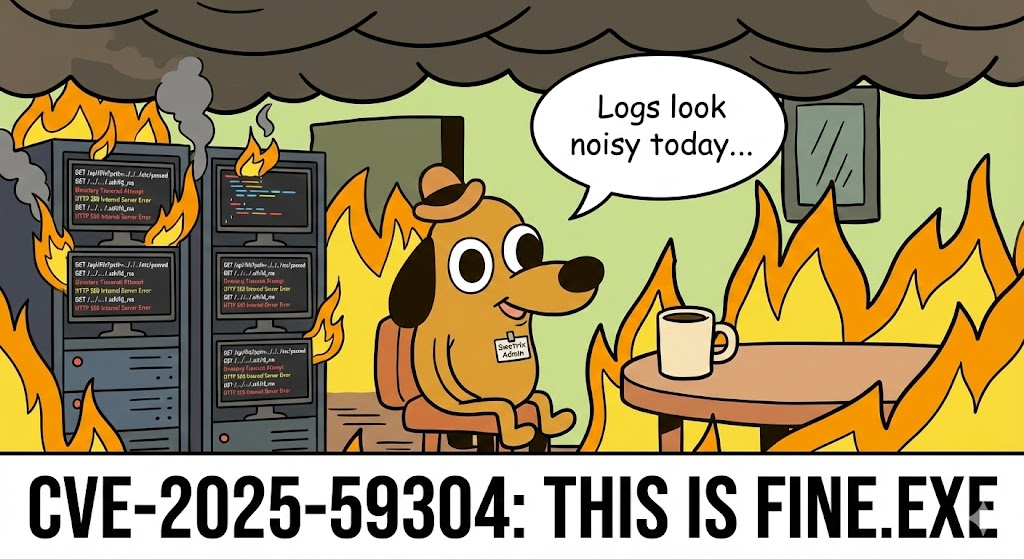
Vulnerability Intelligence Card
| मेट्रिक | Intelligence Detail |
|---|---|
| CVE Identifier | CVE-2025-59304 |
| Target Component | Swetrix Web Analytics API (v3.1.1 and prior) |
| Vulnerability Class | Directory Traversal (CWE-22) leading to RCE |
| CVSS v3.1 Score | 9.8 (एवी:न/एसी:एल/पीआर:न/यूआई:न/एस:यू/सी:एच/आई:एच/ए:एच) |
| उपचार | Upgrade to version post-commit 7d8b972 |
Technical Deep Dive: From Traversal to Shell
Swetrix API handles data ingestion and configuration management for the analytics platform. The vulnerability exists because the application fails to properly sanitize user-supplied input that dictates file system paths.
1. The Broken Logic: Path Normalization Failure
In secure coding, any input used to construct a file path must be “normalized” (resolving .. segments) and checked against an allow-list of directories. CVE-2025-59304 arises because the API endpoint blindly concatenates user input into a file path operation.
Hypothetical Vulnerable Backend (Node.js/Express Logic):
जावास्क्रिप्ट
`// THE VULNERABLE PATTERN // Endpoint designed to save custom config or temporary data app.post(‘/api/v1/save-preference’, async (req, res) => { const { filename, content } = req.body;
// FATAL FLAW: No sanitization of 'filename'
// Attacker sends: { "filename": "../../../../../etc/cron.d/pwn", "content": "* * * * * root /tmp/shell.sh" }
const targetPath = path.join(__dirname, 'data', filename);

try {
    // The application writes content to the traversed path
    await fs.writeFile(targetPath, content);
    res.json({ success: true });
} catch (e) {
    res.status(500).json({ error: e.message });
}
});`
2. The Kill Chain: Escalating to RCE
While Directory Traversal is often associated with reading files (Information Disclosure), its transformation into RCE implies Arbitrary File Write capabilities. Here is how an attacker weaponizes this:
- Phase 1: Reconnaissance The attacker identifies the API endpoint accepting file-related parameters (e.g., filename, path, key) via Swagger docs or traffic analysis.
- Phase 2: The Traversal (The Breakout) The attacker crafts a JSON payload containing directory traversal sequences (../ or encoded %2e%2e%2f). They verify write access by attempting to drop a benign file outside the intended directory.
- Phase 3: Weaponization (The Execution) To execute code, the attacker must write to a location that the system automatically executes or interprets. Common targets include:
- Cron Jobs: Writing a file to
/etc/cron.d/या/var/spool/cron/crontabs/to execute a reverse shell script every minute. - Web Shell: If the API runs alongside a web server (e.g., Nginx serving PHP or a Node.js dynamic loader), writing a shell script (
shell.js,cmd.php) into the public webroot. - Configuration Poisoning: Overwriting a configuration file (like
config.jsया.env) that the application reloads, injecting malicious code into the startup routine.
- Cron Jobs: Writing a file to
- Phase 4: Persistence Once the shell connects back, the attacker establishes persistence by adding a legitimate-looking user account or a systemd service.
Impact Analysis: Infrastructure Collapse
The compromise of the Swetrix API server is a catastrophic event for data integrity and network security:
- Data Lake Exfiltration: Attackers gain direct access to the underlying database credentials (often stored in env files accessible via traversal), allowing them to dump the entire analytics dataset containing sensitive user behavior logs.
- Supply Chain Poisoning: If the compromised instance is part of a larger SaaS offering, attackers can modify the analytics JavaScript snippet served to client websites, turning the analytics platform into a distributor of malware (e.g., crypto-drainers).
- Lateral Movement: The server effectively becomes a bastion host for the attacker, allowing them to scan and attack internal services that were previously shielded from the internet.
AI-Driven Defense: The Penligent Advantage
Traditional DAST (Dynamic Application Security Testing) scanners are notoriously inefficient at detecting logic-based traversal vulnerabilities in modern APIs.
- संदर्भ अंधापन: Legacy scanners spray generic payloads (like
../../win.ini) that often fail validation schemas (e.g., if the API expects a JSON object, a raw string payload will be rejected before processing). - Blind Logic: They cannot determine कहाँ the file was written, leading to false negatives.
यहीं पर पेनलिजेंट.ai represents a paradigm shift. Penligent utilizes Context-Aware API Fuzzing powered by AI Agents:
- Schema Interpretation: Penligent’s agents parse the API definition (OpenAPI/Swagger) to understand the expected data structure. They construct valid JSON payloads that embed traversal sequences अंदर the legitimate parameter fields.
- Intelligent Payload Generation: Instead of random noise, the AI crafts payloads tailored to the target operating system (detecting Linux vs. Windows). For CVE-2025-59304, it generates “Marker File” payloads—benign files with unique hashes.
- Closed-Loop Verification: The system doesn’t just send the payload; it actively checks if the file was successfully written and is accessible. This confirms the Arbitrary File Write vulnerability with 100% certainty and zero risk of crashing the service, distinguishing a critical flaw from a generic error.
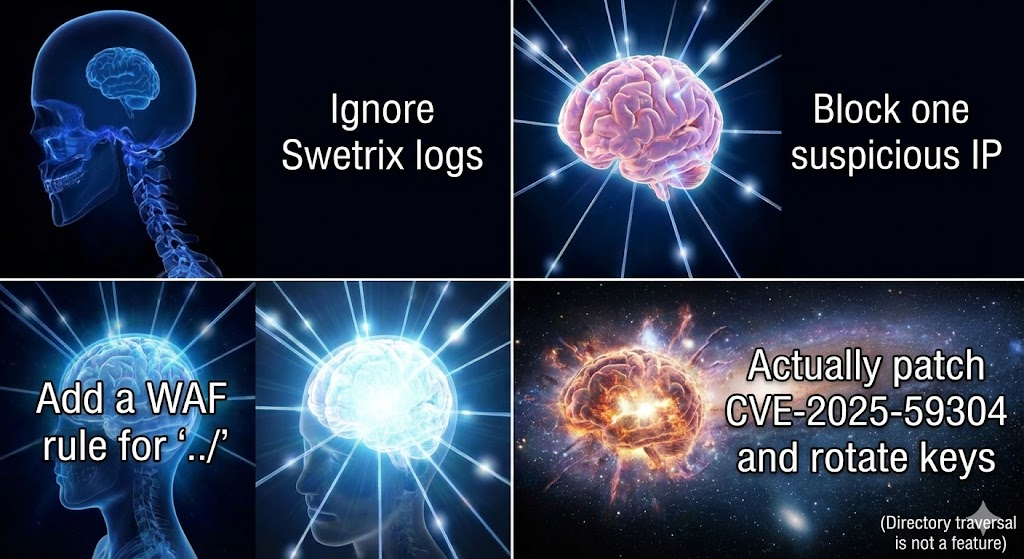
Remediation and Hardening Handbook
If you are running Swetrix or similar self-hosted analytics tools, immediate action is required.
1. Immediate Patching
Upgrade your Swetrix Web Analytics API instance immediately. Ensure your build includes the fix from commit 7d8b972 or is version v3.1.2+. This patch introduces rigorous path validation logic preventing traversal characters.
2. Implementation of “Jail” Logic (Chroot)
Developers should ensure that file operations are strictly confined to a specific directory.
- Secure Code Pattern: उपयोग
path.resolve()and check if the resulting path starts with the allowed directory prefix.JavaScriptconst resolvedPath = path.resolve(baseDir, userInput); if (!resolvedPath.startsWith(baseDir)) { throw new Error("Path Traversal Detected"); }
3. WAF and Runtime Protection
- WAF Rules: Configure your Web Application Firewall (Cloudflare, AWS WAF) to block requests containing
../,..%2f, या%2e%2ein JSON bodies or URL parameters. - Container Hardening: Run the API service as a non-root user. Configure the container’s file system as Read-Only (
readOnlyRootFilesystem: truein Kubernetes), mounting only specific temporary directories as writable. This prevents attackers from writing to system paths like/etc/cron.d/.
निष्कर्ष
CVE-2025-59304 serves as a stark reminder that in the era of complex microservices, a simple path handling error can lead to total infrastructure compromise. Security is not just about authentication; it is about rigorous input validation at every layer of the stack.
For the elite security engineer, the lesson is clear: Trust No Input. Validate paths, restrict file system permissions, and leverage AI-driven testing to find these logic flaws before the adversaries do.


 Hindi
Hindi  English
  German
  French
  Spanish
  Portuguese
  Japanese
  Korean
  Arabic
  Turkish
  Hebrew