
Why this CVE shows up with “Update Now” language
If you skim the strongest-performing coverage around emergency mobile patches, you’ll notice a pattern: headlines repeatedly combine “actively exploited” + “zero-day” + “update now” + “targeted attacks.” That’s not just clickbait—those phrases are shorthand for “real exploitation signals exist, and patch timing matters.” (द हैकर न्यूज़)
For CVE-2025-31200, the exploitation signal is explicit: Apple states it is aware of a report that this issue may have been exploited in an extremely sophisticated attack against specific targeted individuals on iOS. (Apple Support)
What CVE-2025-31200 is (verified facts only)
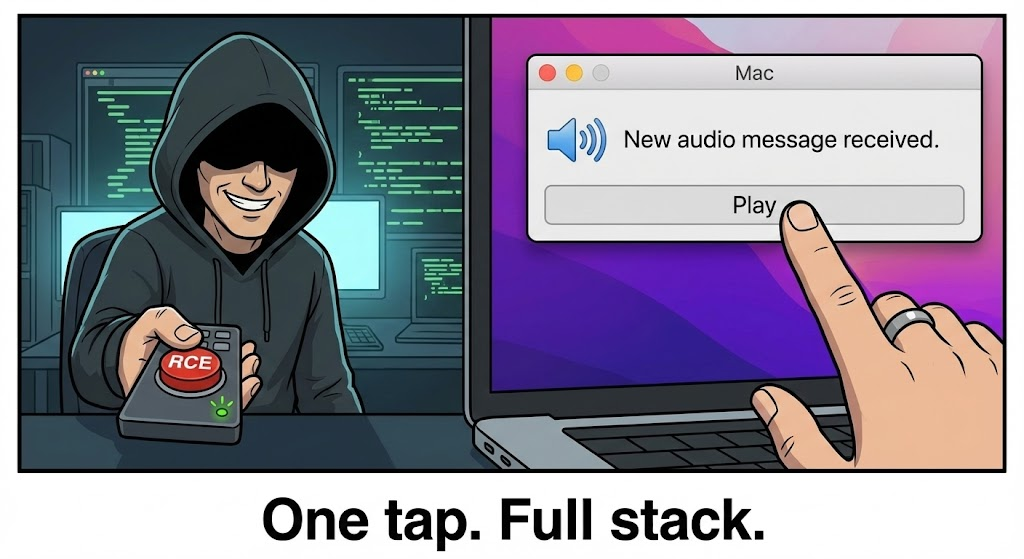
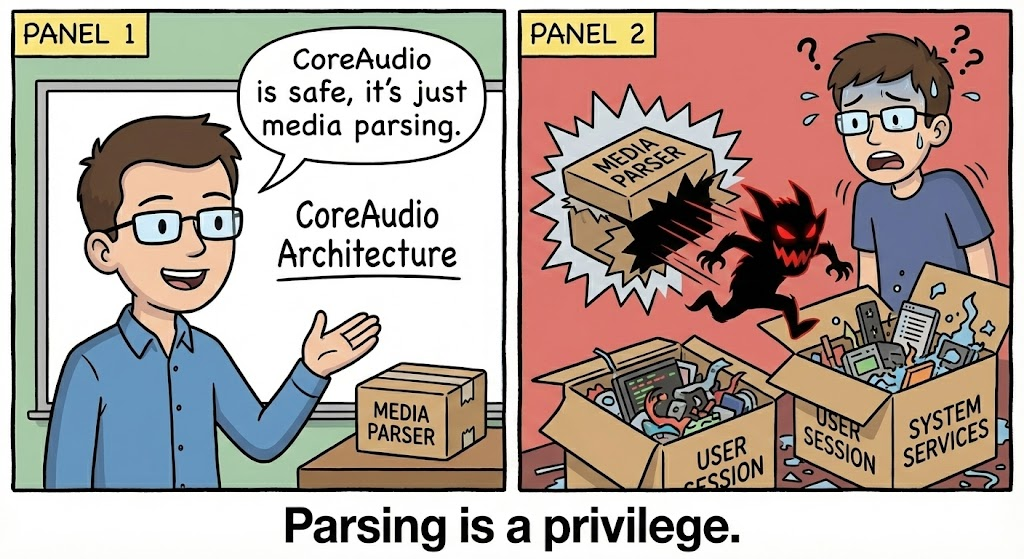
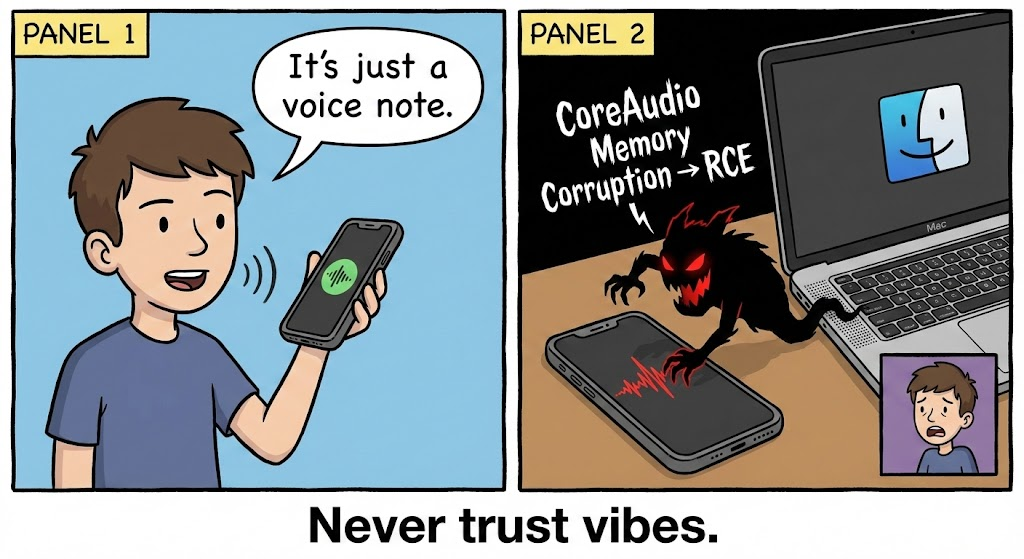
CVE-2025-31200 is a memory corruption vulnerability in Apple’s CoreAudio. Apple’s advisory describes the impact as:
- Impact: Processing an audio stream in a maliciously crafted media file may result in code execution. (Apple Support)
- हल करना: Addressed with improved bounds checking. (Apple Support)
- Exploitation context: Apple is aware it may have been exploited in an extremely sophisticated targeted attack. (Apple Support)
NVD mirrors Apple’s description and lists the fixed versions across Apple platforms. NVD also shows a CISA-ADP CVSS v3.1 base score of 9.8 (Critical) and maps relevant weaknesses (e.g., CWE-787 Out-of-bounds Write, CWE-119). (एनवीडी)
Affected systems and fixed versions
The version boundary is the whole game. If your fleet is below these versions, assume exposure:
| मंच | Fixed version boundary for CVE-2025-31200 |
|---|---|
| iOS | 18.4.1 (Apple Support) |
| iPadOS | 18.4.1 (Apple Support) |
| macOS Sequoia | 15.4.1 (एनवीडी) |
| tvOS | 18.4.1 (एनवीडी) |
| visionOS | 2.4.1 (एनवीडी) |
Why “targeted attacks” still equals enterprise urgency
“Targeted” often implies high-end tradecraft and selective victimology, not mass exploitation. But that does नहीं reduce enterprise risk:
- High-value employees are exactly who targeted campaigns prioritize (execs, security leadership, finance, legal, IR staff).
- Mobile compromise can cascade into identity, MFA prompts, corporate chat, email, and document access.
- Even when the initial campaign is narrow, the same bug class can later be reused, commoditized, or incorporated into new chains.
This is also why mainstream security reporting groups CVE-2025-31200 with strong urgency framing. (द हैकर न्यूज़)
Risk-based action table: how to prioritize in real programs
Use a simple, defensible policy: patch every vulnerable device, but prioritize the highest blast-radius users first.
| Scenario | Practical risk | Recommended action | SLA target |
|---|---|---|---|
| Executives, journalists, dissidents, IR/security admins | Highest | Patch immediately; consider Lockdown Mode where appropriate | 24–48 hours |
| Corporate iPhones/iPads with MDM | उच्च | Enforce minimum OS; quarantine non-compliant devices | 48–72 hours |
| macOS Sequoia endpoints in privileged roles | उच्च | Force update to 15.4.1+; verify via endpoint inventory | 48–72 hours |
| BYOD Apple devices accessing SSO/VPN | Medium–High | Conditional access: block below minimum versions | 3–7 days |
| Low-privilege, offline lab devices | Lower | Patch in next maintenance window | 1–2 weeks |
Lockdown Mode is explicitly designed to help protect against extremely rare and highly sophisticated attacks, and Apple provides guidance for enabling it on iPhone and Mac. (Apple Support)
The companion CVE you should patch in the same sprint: CVE-2025-31201
CVE-2025-31201 was addressed in the same update train. Apple describes it as a condition where an attacker with arbitrary read/write capability may be able to bypass Pointer Authentication, fixed by removing vulnerable code, and Apple notes similar targeted exploitation language. (Apple Support)
Security coverage commonly discusses CVE-2025-31200 + CVE-2025-31201 together, which matches how defenders should treat it operationally: patch both, because exploitation chains often combine code execution plus mitigation bypass. (द हैकर न्यूज़)
Patch verification you can automate today
macOS: fast local check (bash)
#!/usr/bin/env bash
# macOS Sequoia: flag if below 15.4.1 (CVE-2025-31200 patched boundary)

ver="$(sw_vers -productVersion)"
min="15.4.1"

echo "macOS version: $ver"
if [ "$(printf '%s\\n' "$min" "$ver" | sort -V | head -n1)" != "$min" ]; then
  echo "⚠️  BELOW $min — update required (CVE-2025-31200)."
  exit 2
fi

echo "✅ At or above $min."
NVD lists macOS Sequoia 15.4.1 as the fixed version for CVE-2025-31200. (एनवीडी)
macOS fleet inventory (osquery)
SELECT
  hostname,
  version AS os_version,
  build AS os_build,
  platform
FROM os_version;
iOS/iPadOS: enforce minimum versions in MDM + conditional access
Treat the minimum version as a policy, not a suggestion:
- iOS/iPadOS 18.4.1+
- macOS Sequoia 15.4.1+
These version boundaries are directly stated in Apple’s advisory and NVD. (Apple Support)
Hardening: what helps beyond patching
Lockdown Mode for high-risk profiles
Lockdown Mode is not for everyone, but it is explicitly positioned by Apple as a protective mode against rare, highly sophisticated attacks—and it’s a reasonable control for users under heightened threat. (Apple Support)
Operationally, it’s best deployed with:
- a defined “high-risk user” policy,
- a support runbook for compatibility tradeoffs,
- and an exit plan once patch compliance is confirmed.
What to tell leadership
CVE-2025-31200 is a CoreAudio memory corruption vulnerability that can lead to code execution when processing a maliciously crafted media file, and Apple says it may have been exploited in highly sophisticated targeted attacks. The fix is available in iOS/iPadOS 18.4.1, macOS Sequoia 15.4.1, tvOS 18.4.1, and visionOS 2.4.1. The business goal is simple: drive vulnerable build count to zero, prioritize high-value users first, and confirm compliance via inventory—not assumptions. (Apple Support)
Where Penligent fits naturally
When teams respond to actively exploited client-side issues, the bottleneck is rarely “knowing a CVE exists.” It’s the messy middle: translating advisories into दोहराए जाने योग्य सत्यापन, proving fleet compliance, and producing audit-friendly evidence that remediation actually happened. Penligent is built around orchestrating security workflows and generating evidence-driven outputs, which maps cleanly to that “prove it, don’t assume it” posture—especially when you need consistent verification artifacts for security reviews. (पेनलिजेंट)
For security engineering teams that run continuous exposure management, a practical approach is to treat urgent zero-days like CVE-2025-31200 as triggers for an “accelerated lane”: inventory → enforce minimum versions → verify → document. Penligent’s credit model is explicitly described as usage-based rather than target-count limited, which can be useful when you need to run repeated checks across changing assets and environments during a patch sprint. (पेनलिजेंट)
संदर्भ
- Apple security content for iOS/iPadOS 18.4.1 (CVE-2025-31200 / CVE-2025-31201) (Apple Support)
- NVD: CVE-2025-31200 (platform fixes, CISA-ADP score, CWE mapping) (एनवीडी)
- NVD: CVE-2025-31201 (Pointer Authentication bypass conditions, fixed versions) (एनवीडी)
- Apple: About Lockdown Mode / enabling guidance (Apple Support)
- Coverage examples that reflect common high-intent headline framing (exploit + emergency patch) (द हैकर न्यूज़)
- Penligent product/pricing (for the two Penligent paragraphs above) (पेनलिजेंट)


 Hindi
Hindi  English
  German
  French
  Spanish
  Portuguese
  Japanese
  Korean
  Arabic
  Turkish
  Hebrew