
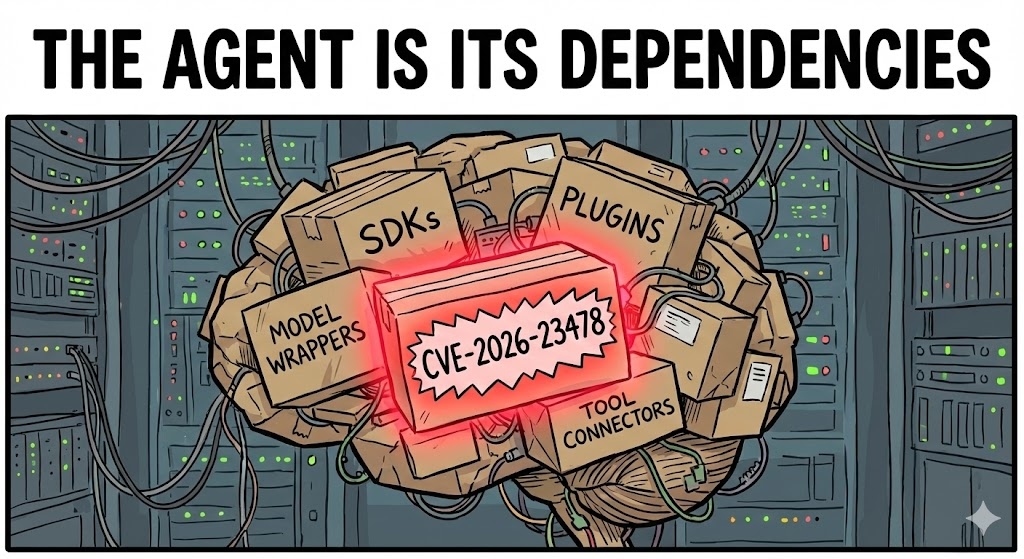
The convergence of traditional web vulnerabilities and Agentic AI infrastructure has created a new, dangerous attack surface. While the broader cybersecurity community is discussing CVE-2026-23478 as a critical authentication bypass in Cal.com, AI security engineers must view this through a different lens: Tool Integrity Risk.
For security teams managing autonomous agents—specifically those with calendar access and scheduling capabilities—this vulnerability represents a remote account takeover (ATO) vector that bypasses not just the human user, but the guardrails of the AI agent itself.
Below is a technical breakdown of CVE-2026-23478, its specific mechanics within the NextAuth flow, and why it poses a catastrophic risk to enterprise AI deployments.
The Anatomy of CVE-2026-23478
Severity: Critical (CVSS v4.0: 10.0)
Affected Versions: Cal.com v3.1.6 to < 6.0.7
Vector: Authentication Bypass via session.update()
At its core, this vulnerability resides in the custom implementation of the NextAuth.js JWT callback. Cal.com, widely used as the underlying scheduling “tool” for thousands of AI agents and SaaS integrations, failed to properly validate user inputs during a session update call.
In a secure implementation, session.update() should only allow a user to modify non-sensitive session metadata. However, in the affected versions, the application allows the email field within the JWT to be mutated without re-authentication.
Vulnerable Code Pattern
The flaw exists because the backend blindly accepts the payload from the client-side update() function and merges it into the session token.
जावास्क्रिप्ट
`// Pseudo-code representation of the vulnerable NextAuth callback logic // DO NOT USE IN PRODUCTION
callbacks: { async jwt({ token, user, trigger, session }) { if (trigger === “update” && session) { // VULNERABILITY: Blindly merging session data into the token // The attacker allows overriding the ’email’ field effectively becoming that user. return { …token, …session }; } return token; } }`
An attacker—or a compromised AI agent—can exploit this by sending a crafted request to the endpoint. If an AI agent is interacting with the Cal.com API on behalf of a user, and that agent processes untrusted input (e.g., a malicious prompt asking the agent to “update preference”), the agent could theoretically be tricked into triggering this flow.
Exploit Payload Example:
JSON
`POST /api/auth/session Content-Type: application/json
{ “csrfToken”: “valid_token_here”, “data”: { “email”: “admin@target-enterprise.com“, “username”: “admin” } }`
Once the server processes this, the JWT is re-signed with the target’s email. The attacker (or the rogue agent) effectively becomes the administrator without ever knowing their password or bypassing 2FA challenges.
Why This Matters for AI Security Engineers
We often treat “Tools” (APIs that LLMs can call) as trusted black boxes. CVE-2026-23478 shatters this assumption.
In 2026, the dominant architectural pattern for AI is the Agentic Workflow:
User Prompt $\rightarrow$ LLM $\rightarrow$ Tool Execution (Cal.com) $\rightarrow$ Action
If your organization deploys an AI Scheduling Assistant (e.g., for HR or Sales) that relies on a self-hosted instance of Cal.com, you are exposed.
| Attack Vector | Traditional Web Scenario | AI Agent Scenario |
|---|---|---|
| Trigger | Attacker manually sends CURL request. | Attacker uses Prompt Injection to force the Agent to call the update endpoint. |
| प्रभाव | Attacker logs in as victim. | Attacker hijacks the Agent’s identity, granting access to all calendars the Agent manages. |
| पहचान | WAF logs, anomaly detection on IP. | Extremely Difficult. The request comes from the trusted Agent’s internal IP. |
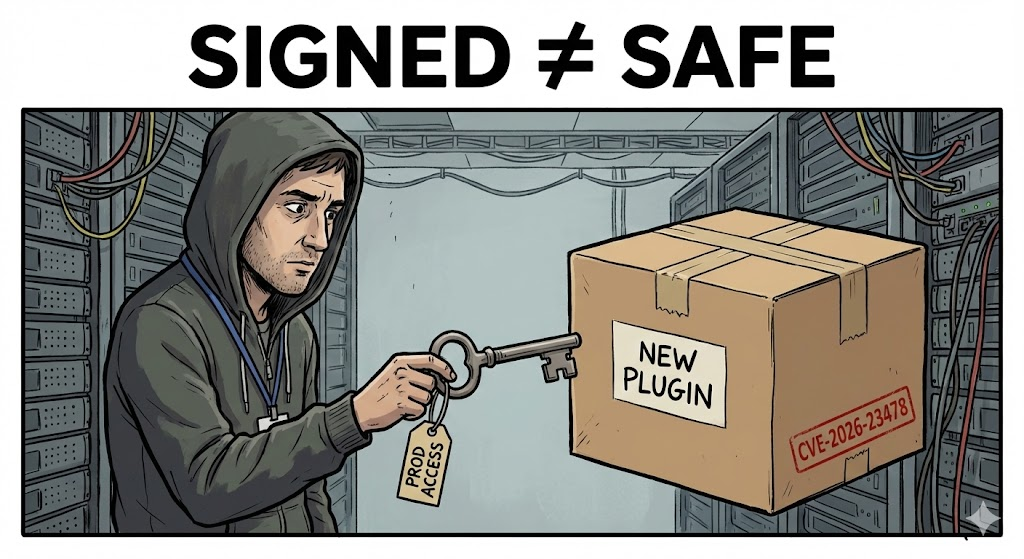
यह एक क्लासिक है। Confused Deputy problem escalated by the Criticality of the underlying vulnerability. The Agent has the permission to call the API, and the API has a logic flaw that allows privilege escalation.
Automated Detection with Penligent
Detecting vulnerability chains like this—where a Logic Flaw in a dependency meets an Agentic Workflow—is precisely why we built पेनलिजेंट.
Static analysis (SAST) tools often miss logic flaws in third-party libraries like NextAuth implementations, and standard DAST scanners may not understand the complex state of an AI Agent session.
How Penligent tackles CVE-2026-23478:
- Dependency Awareness: Penligent’s engine identifies that your AI Agent is interfacing with
Cal.com(v5.x). - संदर्भ-जागरूक फज़िंग: Instead of just checking for XSS, Penligent simulates an attacker trying to escalate privileges via the Agent’s available tools.
- Proof of Exploit: The platform attempts to safely replicate the
session.updatebypass within a sandboxed environment, proving whether your specific Agent configuration permits this state change.
By integrating Penligent into your CI/CD pipeline, you ensure that the tools your AI relies on are not the weakest link in your security chain.
Remediation & Mitigation
For teams currently using Cal.com within their AI infrastructure, immediate action is required.
- Patch Immediately: Upgrade all Cal.com instances to v6.0.7 or higher. This version forces strict validation on the
jwtcallback, preventing theemailfield from being overwritten during session updates. - Restrict Agent Scopes: Ensure your AI Agents operate with the Principle of Least Privilege. An Agent capable of scheduling meetings should नहीं have permissions to call session management or user profile update endpoints.
- Monitor
session.updateCalls: Audit your logs for any calls to the session update endpoint where the payload contains sensitive fields likeemail,sub, याrole.

 Hindi
Hindi  English
  German
  French
  Spanish
  Portuguese
  Japanese
  Korean
  Arabic
  Turkish
  Hebrew