
As we navigate the cybersecurity landscape of 2026, the complexity of modern SaaS interconnections has introduced novel attack vectors. One of the most significant discoveries this year is CVE-2026-23478, a critical authentication bypass vulnerability in Cal.com, the leading open-source scheduling infrastructure. For hard-core security engineers, this CVE isn’t just another patch—it’s a masterclass in how subtle logic flaws in JWT (JSON Web Token) handling can lead to catastrophic account takeovers.
Anatomy of CVE-2026-23478: When Trust is Misplaced
The vulnerability resides in the custom NextAuth.js JWT callback implementation within Cal.com. Specifically, versions between 3.1.6 and 6.0.7 failed to properly sanitize or validate the data provided during a session update trigger.
In many modern web applications, the session.update() client-side method is used to refresh local session data (e.g., updating a user’s display name). However, the underlying implementation of CVE-2026-23478 allowed an attacker to include an email field in the update request. The server-side JWT callback would then blindly accept this email and update the token’s identity claims.
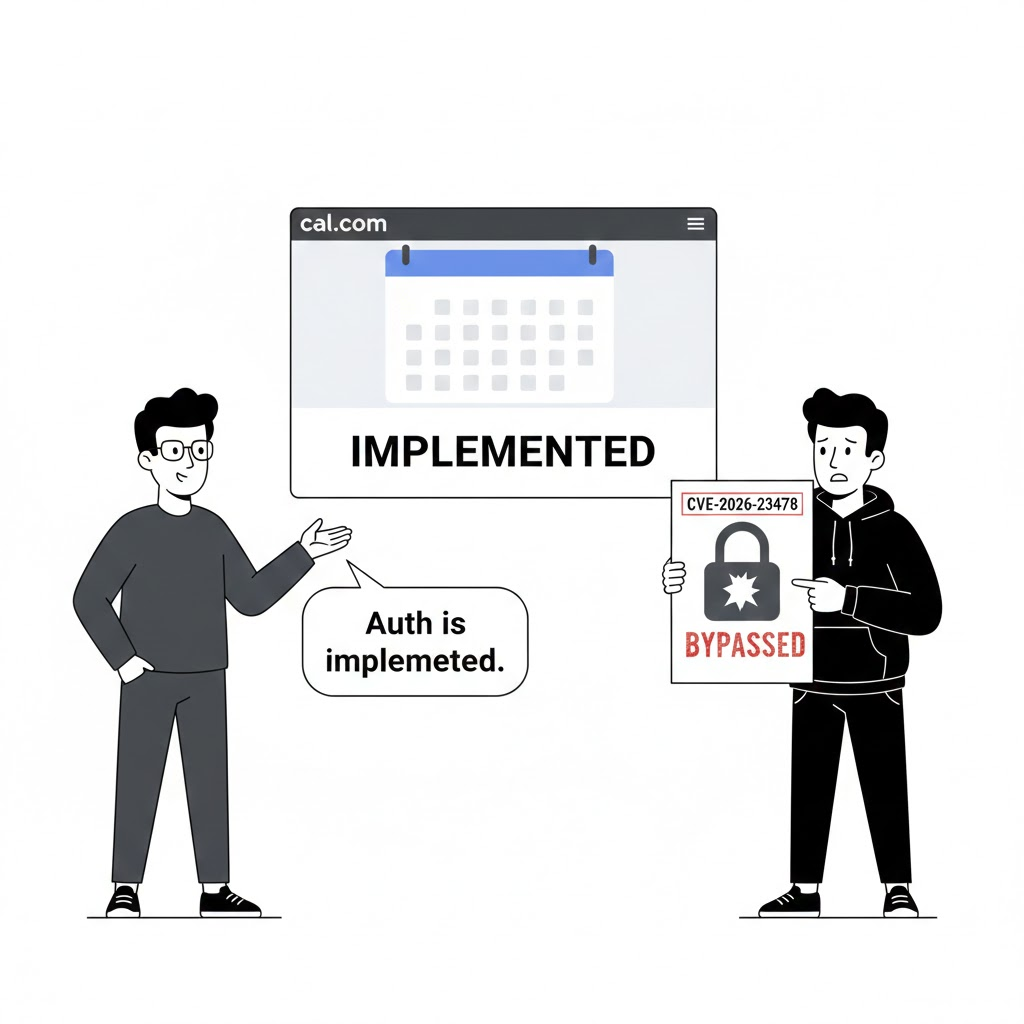
Vulnerability Parameters
- सीवीई आईडी: CVE-2026-23478
- CVSS 4.0 Score: 10.0 (Critical)
- Vector:
CVSS:4.0/AV:N/AC:L/AT:N/PR:N/UI:N/VC:H/VI:H/VA:H/SC:H/SI:H/SA:L - CWEs: CWE-639 (Authorization Bypass Through User-Controlled Key) and CWE-602 (Client-Side Enforcement of Server-Side Security).
Exploitation Logic: The “Email Injection” Attack
A security engineer looking to understand the exploit chain would focus on the interaction between the client-side state and the server-side JWT signing process.
Imagine an attacker who registers a low-privilege account. By intercepting the session update API call, they can modify the payload:
JSON
// Malicious payload sent to /api/auth/session { "data": { "email": "victim-admin@enterprise.com", "name": "Attacker" } }
If the server-side callback looks like the following, the system is compromised:
टाइपस्क्रिप्ट
`// Vulnerable Implementation Example async jwt({ token, trigger, session }) { if (trigger === “update” && session?.email) { // SECURITY FLUX: Trusting client-supplied email token.email = session.email;
// Fetching the user from DB based on the untrusted email
const user = await db.user.findUnique({ where: { email: session.email } });
if (user) {
    token.sub = user.id;
    token.role = user.role;
}
} return token; }`
The resulting JWT, signed by the server’s secret key, now identifies the attacker as the victim. This allows full access to the victim’s dashboard, API keys, and private scheduling data without ever knowing their password.
The 2026 Threat Landscape: Synergy of Vulnerabilities
CVE-2026-23478 does not exist in a vacuum. It represents a broader trend of Identity-Centric Vulnerabilities that have plagued the start of 2026.
| सीवीई | Target | प्रकार | प्रभाव |
|---|---|---|---|
| CVE-2026-23478 | Cal.com | Auth Bypass | Full Account Takeover |
| CVE-2026-21858 | n8n | आरसीई | Full Instance Compromise |
| CVE-2026-20953 | MS Office | Use-After-Free | Remote Code Execution |
| CVE-2026-22868 | Geth (Ethereum) | DoS | Node Shutdown |
These vulnerabilities highlight a shift: attackers are moving away from simple memory corruption and toward exploiting the complex logic of distributed systems and identity providers.
Strategic Defense with Penligent: Automated AI Penetration Testing
In an era where 100,000 servers can be scanned for CVE-2026-23478 in minutes, manual testing is no longer sufficient. This is why we developed पेनलिजेंट, an AI-powered intelligent penetration testing platform designed for the modern DevSecOps lifecycle.
How Penligent Addresses Logic Flaws
Unlike traditional scanners that rely on known signatures, Penligent utilizes advanced reasoning agents to map the business logic of an application. For a vulnerability like CVE-2026-23478, Penligent doesn’t just check version numbers; it actively attempts to manipulate session states. Its AI engine identifies the session.update() endpoint and autonomously tries to escalate privileges by injecting different user identifiers.
By integrating Penligent into your security stack, you gain:
- Autonomous Exploit Discovery: Find zero-days in your custom business logic before they are assigned a CVE.
- High-Fidelity Evidence: Instead of “potential vulnerabilities,” Penligent provides actual proof-of-concept (PoC) steps, including the exact payloads needed to reproduce an auth bypass.
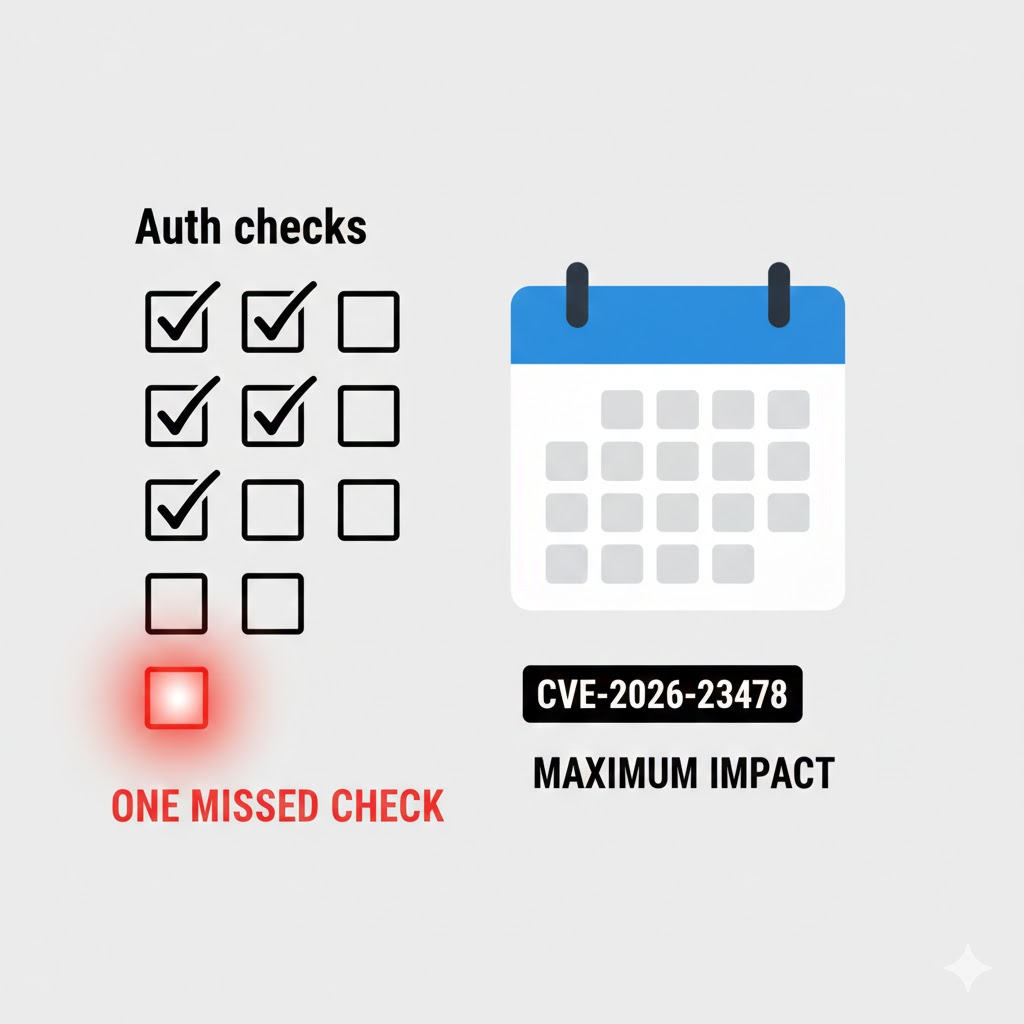
Remediation and Engineering Best Practices
To secure your infrastructure against CVE-2026-23478 and similar identity-based attacks, engineers should adhere to these principles:
- Strict JWT Callback Validation: Never allow sensitive fields like
email,role, याuserIdto be updated directly from a client-side trigger. These should only be fetched from a trusted source of truth (e.g., your database) after re-authentication. - Implementation of NIST 800-63B: Follow digital identity guidelines that mandate robust session management and re-authentication for sensitive actions.
- Audit NextAuth Configurations: If you use NextAuth/Auth.js, audit your
callbacks.jwtऔरcallbacks.sessionfor any logic that uses thesessionobject during anupdateevent. - Immediate Patching: Ensure all Cal.com instances are running version 6.0.7 or higher.


 Hindi
Hindi  English
  German
  French
  Spanish
  Portuguese
  Japanese
  Korean
  Arabic
  Turkish
  Hebrew