
CVE-2026-20262 is an arbitrary file write vulnerability in Cisco Catalyst SD-WAN Manager, formerly SD-WAN vManage. Cisco describes it as a flaw in the web UI file upload process that can let an authenticated remote attacker create or overwrite files on the filesystem of an affected system. The attacker needs valid credentials with at least write access, but successful exploitation can later be used to elevate privileges to root. Cisco released fixed software and states that no workaround addresses the vulnerability. (सिस्को)
That combination should make defenders slow down before treating the CVSS score as the whole story. The Cisco-assigned CVSS 3.1 base score is 6.5, Medium, with low attack complexity, network attack vector, low privileges required, no user interaction, unchanged scope, no confidentiality impact, high integrity impact, and no availability impact. NVD repeats the same description and notes that the CVE is in CISA’s Known Exploited Vulnerabilities catalog. (सिस्को)
The operational risk is higher than “medium” may sound. CISA’s KEV entry lists CVE-2026-20262 as a Cisco Catalyst SD-WAN Manager directory or path traversal vulnerability, added on June 15, 2026, with a federal due date of June 29, 2026. NVD also shows CISA’s SSVC status as active exploitation. (एनवीडी.एनआईएसटी.जीओवी) Cisco says its Product Security Incident Response Team became aware of limited exploitation in June 2026 and strongly recommends upgrading to a fixed release. (सिस्को)
The short version for defenders is simple: patch, preserve evidence, check the right logs, and do not assume that authentication requirements make this safe. A vulnerability that lets an attacker write files on the SD-WAN Manager filesystem belongs in the same risk conversation as management-plane compromise, credential abuse, post-auth escalation, and control-plane trust.
The facts that matter first
| क्षेत्र | Current public information |
|---|---|
| सीवीई | CVE-2026-20262 |
| Vendor | सिस्को |
| उत्पाद | Cisco Catalyst SD-WAN Manager |
| Former name | SD-WAN vManage |
| संवेदनशीलता वर्ग | Arbitrary file write through insufficient validation in a file upload process |
| सामूहिक रूप से | CWE-22, Improper Limitation of a Pathname to a Restricted Directory, commonly path traversal |
| CVSS 3.1 | 6.5 Medium, CVSS:3.1/AV:N/AC:L/PR:L/UI:N/S:U/C:N/I:H/A:N |
| Attack vector | Network |
| Privileges required | Low, but Cisco says the attacker must have valid credentials with at least write access |
| User interaction | None |
| सार्वजनिक शोषण की स्थिति | Cisco reports limited exploitation in June 2026; CISA KEV lists active exploitation |
| Workaround | Cisco says there are no workarounds |
| प्राथमिक सुधार | Upgrade to the fixed Cisco Catalyst SD-WAN release for the affected train |
| Affected deployment types | On-Prem Deployment, Cisco SD-WAN Cloud-Pro, Cisco SD-WAN Cloud, Cisco Managed, and Cisco SD-WAN for Government, FedRAMP |
| Main defensive checks | Admin-tech collection, /var/log/nms/vmanage-server.log*, /var/log/nms/vmanage-appserver.log*, and service proxy access logs |
| Key related CVEs | CVE-2026-20182, CVE-2026-20127, and CVE-2026-20245 |
Cisco’s advisory says the issue affects Cisco Catalyst SD-WAN Manager regardless of device configuration and across the deployment types listed above. (सिस्को) That matters because teams should not assume that “we do not run the exact legacy vManage name” or “our deployment model is different” automatically removes them from scope. The product name has changed, but the old name still appears in many runbooks, inventories, dashboards, and support conversations.
What CVE-2026-20262 actually is
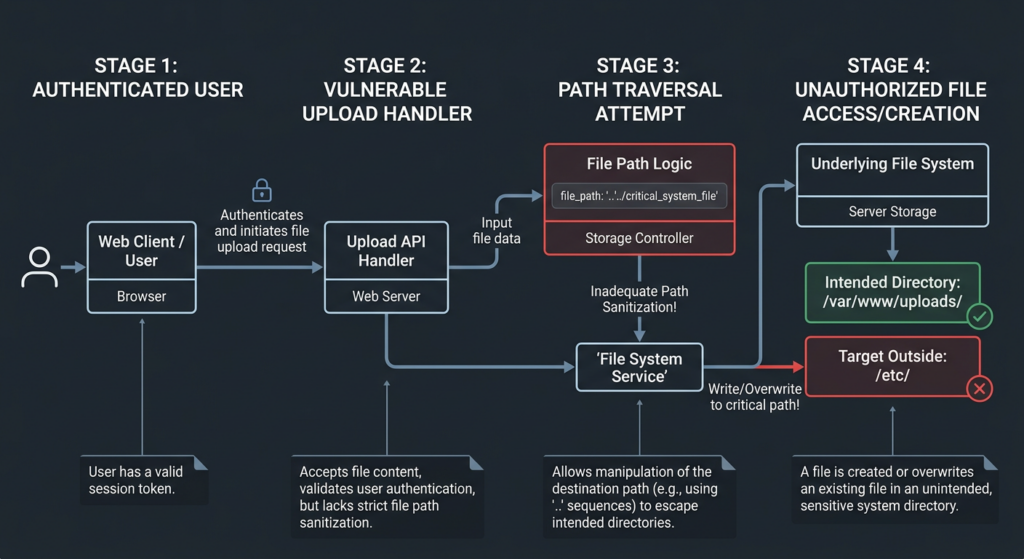
Cisco’s public description gives defenders enough to understand the risk without publishing a weaponized exploit. The vulnerable area is the web UI file upload process. The software does not properly validate user-supplied input during that process. An authenticated remote attacker can send a crafted HTTP request to an affected API endpoint and create or overwrite a file on the underlying operating system. That file can later be used to elevate to root. (सिस्को)
The weakness mapping is CWE-22. MITRE defines CWE-22 as a condition where software uses external input to construct a pathname that should stay under a restricted parent directory, but fails to neutralize special path elements that cause the pathname to resolve outside that restricted directory. MITRE’s extended description specifically calls out relative traversal using ../ sequences and absolute path traversal using full system paths. (cwe.mitre.org)
For this CVE, the critical point is not merely “file upload.” Many systems allow file uploads for legitimate administrative reasons. The critical point is the phrase “create or overwrite any file on the filesystem.” A safe upload flow should limit where the file lands, what it can be named, what extension is allowed, whether it can be executed, and whether the final canonical path stays inside the expected directory. A vulnerable upload flow may make those boundaries porous.
A simplified safe handling pattern looks like this:
from pathlib import Path

UPLOAD_ROOT = Path("/opt/app/uploads/profiles").resolve()
ALLOWED_EXTENSIONS = {".xml", ".json", ".txt"}

def safe_upload_path(user_filename: str) -> Path:
    # Keep only the final name component. Do not trust directory input.
    candidate_name = Path(user_filename).name

    # Reject empty names, hidden path tricks, and unsupported extensions.
    if not candidate_name or candidate_name in {".", ".."}:
        raise ValueError("Invalid filename")

    candidate = (UPLOAD_ROOT / candidate_name).resolve()

    # Enforce that canonical path stays inside the upload directory.
    if UPLOAD_ROOT not in candidate.parents:
        raise ValueError("Path traversal attempt blocked")

    if candidate.suffix.lower() not in ALLOWED_EXTENSIONS:
        raise ValueError("Unsupported file type")

    return candidate
That code is not Cisco-specific and should not be read as a reproduction of the vulnerability. It shows the defensive idea: normalize the path, remove directory control from the attacker, allow only expected extensions, and verify the canonical destination before writing. MITRE’s mitigation guidance for path traversal recommends allowlist validation, canonicalization before validation, avoiding weak denylist-only filtering, and least-privilege execution. (cwe.mitre.org)
In enterprise appliance software, file upload handlers often interact with deployment directories, configuration directories, temporary directories, profile import/export features, or service-specific storage. When a path validation mistake appears in a management-plane appliance, the impact is rarely limited to “someone uploaded a file.” It may become a way to alter system behavior, plant a deployable artifact, or prepare a later privilege escalation.
Why the authentication requirement does not make this low risk
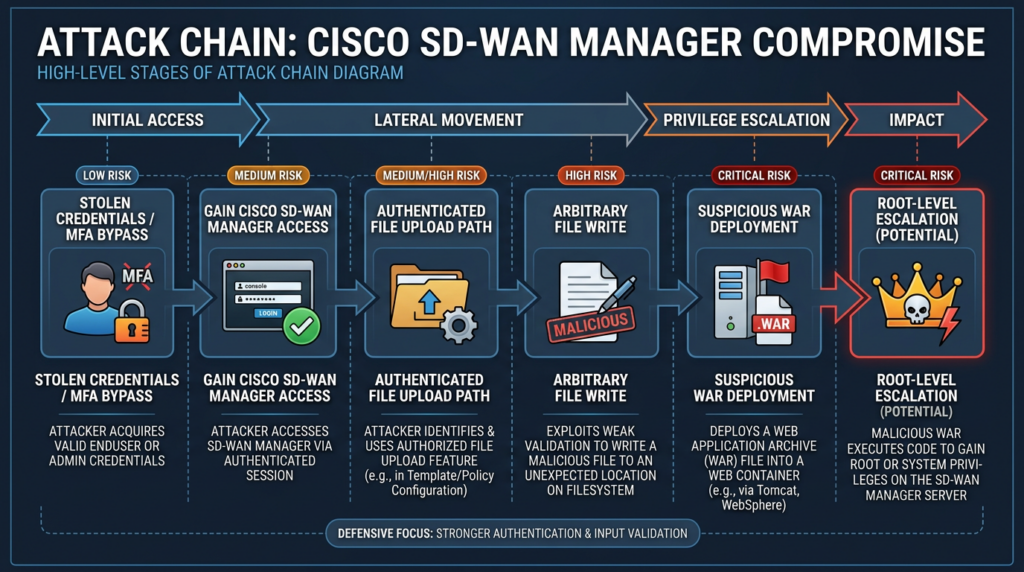
CVE-2026-20262 is not described by Cisco or NVD as unauthenticated. That distinction matters. A public article should not turn it into a pre-auth RCE or claim that any internet user can exploit it without credentials. Cisco says the attacker must have valid credentials with at least write access, and NVD says at least a lower-privileged, single-task user account is required. (सिस्को)
The mistake is going too far in the other direction and treating “requires credentials” as “safe.” Management-plane credentials are not theoretical. They are phished, reused, over-permissioned, exposed in internal documentation, stored in automation, left active after staff changes, and sometimes obtained through other vulnerabilities. A post-auth arbitrary file write in a WAN management system is exactly the kind of bug attackers can use after an initial foothold.
Cisco’s June 2026 remediation document makes that relationship explicit. For CVE-2026-20245 and CVE-2026-20262, Cisco says known paths for an unauthenticated remote attacker to obtain the required credentials include exploitation of CVE-2026-20182 or CVE-2026-20127. Cisco also distinguishes privilege requirements: CVE-2026-20245 requires netadmin privileges, while CVE-2026-20262 requires at least a lower-privileged single-task user account. (सिस्को)
That turns the risk model into a chain, not a single-ticket vulnerability:
- An attacker reaches SD-WAN control or management infrastructure.
- The attacker obtains credentials through valid credential theft or a separate SD-WAN authentication bypass.
- The attacker uses the authenticated file write path to create or overwrite files.
- A written file becomes part of a root escalation, deployment, persistence, or follow-on compromise path.
- The defender may see log events that resemble legitimate administrative workflows unless they correlate file paths, deployment events, accounts, source IPs, and timing.
That is why a medium CVSS score can be operationally urgent. CVSS captures a standardized technical severity vector. It does not fully capture whether the affected component is a Tier 0 management plane, whether CISA has confirmed exploitation, whether a vendor has reported limited attacks, or whether recent related CVEs create credential paths into the same environment.
Affected products and deployment models
Cisco says CVE-2026-20262 affects Cisco Catalyst SD-WAN Manager, formerly SD-WAN vManage, regardless of device configuration. Cisco lists the following affected deployment types: On-Prem Deployment, Cisco SD-WAN Cloud-Pro, Cisco SD-WAN Cloud, Cisco Managed, and Cisco SD-WAN for Government, FedRAMP. (सिस्को)
That scope has three practical consequences.
First, asset inventory must use both the current and old names. If your CMDB says “vManage,” your vulnerability scanner says “Catalyst SD-WAN Manager,” and your firewall objects say “sdwan-mgmt,” you can easily miss one of the systems that needs review.
Second, cluster and disaster-recovery designs matter. Cisco’s verification guidance tells users to repeat checks on every vManage in the deployment, including all cluster members and any DR-paired vManage. (सिस्को) Checking one node and closing the ticket is not enough.
Third, cloud-managed or vendor-hosted deployment language should not become an excuse for uncertainty. Cisco’s advisory lists multiple deployment types as affected, but responsibility boundaries may differ by contract, support model, and service arrangement. Security teams should confirm their exact support and upgrade path with Cisco or their provider rather than assuming that “cloud” means “already solved.”
Fixed versions and upgrade path
Cisco says there are no workarounds that address CVE-2026-20262. It recommends upgrading to the fixed software releases documented in the advisory. (सिस्को) Cisco’s June remediation document also says software fixes are available on all release trains for the advisories covered there, and that no workarounds are available. (सिस्को)
| Current Cisco Catalyst SD-WAN release | First fixed release |
|---|---|
| 20.9.9.1 and earlier | 20.9.9.2 |
| 20.12.7.1 and earlier | 20.12.7.2 |
| 20.15.4.4 and earlier | 20.15.4.5 |
| 20.15.5.2 and earlier | 20.15.5.3 |
| 20.18.3 | 20.18.3.1 |
| 26.1.1.1 and earlier | 26.1.1.2 |
Cisco’s advisory says the release table was accurate at publication time and that Cisco PSIRT validates only the affected and fixed release information documented in the advisory. (सिस्को) The practical guidance is to use Cisco’s official upgrade matrix and compatibility documentation for production planning, especially in clustered deployments where vManage, vSmart, vBond, WAN edge compatibility, and operational maintenance windows can complicate a rapid upgrade.
Do not upgrade first and investigate later if compromise is plausible. Cisco’s remediation workflow says admin-tech files should be collected before any upgrade or configuration change so diagnostic data and possible indicators of compromise are preserved. (सिस्को) The order matters because log retention and artifact availability can define what you can prove after the fact.
Preserve evidence before changing the environment
Cisco’s June remediation workflow is unusually important for defenders because it does not stop at “install the fixed release.” It recommends collecting admin-tech files from all SD-WAN control components before upgrades or configuration changes, then opening a TAC case and uploading those bundles so Cisco TAC can analyze indicators of compromise. The listed components include all Controllers, all Managers, and all Validators. (सिस्को)
Cisco says TAC’s analysis for CVE-2026-20262 focuses on several files in /var/log/nms on each Manager, and that in some instances the indicators can occur during standard operations. Cisco also warns that these logs do not distinguish legitimate from malicious use, so matching entries require manual review against normal operational posture before being treated as confirmed indicators. (सिस्को)
That is a useful warning against two bad outcomes. One bad outcome is ignoring matching entries because “admins upload files all the time.” The other is declaring compromise from a single log line without checking whether the activity was a legitimate administrative action during a maintenance window.
A better workflow is evidence-first:
# Defensive triage checklist, not an exploit workflow

# 1. Identify every Manager, Controller, and Validator in scope.
# 2. Record hostname, role, software version, cluster membership, and DR pairing.
# 3. Collect admin-tech bundles before upgrades or configuration changes.
# 4. Preserve log retention metadata and timestamps.
# 5. Run targeted log searches only after evidence preservation is planned.
# 6. Send findings and bundles through the Cisco TAC process when required.
The goal is not to prove a negative from one command. The goal is to build a reliable timeline: what systems existed, what versions they ran, what accounts were active, what file upload events occurred, whether a deployable artifact appeared, whether it was accessed, and whether the activity aligns with normal operations.
Log checks for CVE-2026-20262
Cisco’s manual verification guidance is meant for cases where admin-tech files cannot be collected and shared with TAC. Cisco calls the manual result preliminary and says findings should be documented and shared with TAC for official assessment. It also states that log entries targeted by the checks can be generated by legitimate activity and must be reviewed against normal operations. (सिस्को)
The most relevant log locations are:
| Log file | What to look for | यह क्यों मायने रखती है |
|---|---|---|
/var/log/nms/vmanage-server.log* | Upload handler entries such as SdraAnyConnectFileUploadHandler | Indicates the relevant upload handler path was used |
/var/log/nms/vmanage-appserver.log* | Deployment events such as WFLYSRV0010 | May show that a WAR file was deployed |
/var/log/nms/containers/service-proxy/serviceproxy-access.log* | Requests to paths associated with the suspicious deployed artifact | May show access to a deployed JSP or WAR-backed resource |
| Admin-tech bundles | Same evidence preserved across control components | Preferred collection path for TAC review |
Cisco’s example suspicious vmanage-server.log entry shows a Remote Access AnyConnect profile upload path containing traversal sequences and landing under a WildFly deployment directory with a suspicious .war file. Cisco’s example vmanage-appserver.log entry shows WFLYSRV0010: Deployed "suspicious.war", and the service proxy example shows a POST /suspicious/index.jsp request. (सिस्को)
Cisco’s manual commands include the following defensive searches:
# From the vManage CLI, drop into vshell first.
vs

# Search vManage server logs for the upload handler.
zgrep "SdraAnyConnectFileUploadHandler" /var/log/nms/vmanage-server.log*

# Search appserver logs for WildFly deployment events.
zgrep "WFLYSRV0010" /var/log/nms/vmanage-appserver.log*

# When service-proxy logs are in an admin-tech archive, search the archive.
tar -xOf <admin-tech-filename>.tar.gz \
  var/log/nms/containers/service-proxy/serviceproxy-access.log \
  2>/dev/null | grep "suspicious"

# If service-proxy logs are directly accessible, search for POST access
# using the suspicious WAR name identified from earlier results.
zgrep "POST" /var/log/nms/containers/service-proxy/serviceproxy-access.log* | grep "suspicious"
Those commands should be adapted carefully to your environment. The string suspicious is a placeholder based on Cisco’s example. In a real case, the file name, deployment path, account, source address, and timestamp are the evidence. Cisco says each matching entry should be reviewed against normal operational posture, and for matching vmanage-server.log entries, defenders should capture the timestamp, full log line, and file path referenced in the upload handler. (सिस्को)
How to read the evidence without fooling yourself
A single log hit is not enough. A missing hit is not enough either. Evidence quality depends on log retention, time synchronization, cluster coverage, DR coverage, archive availability, and whether the attacker cleaned up after themselves.
| Finding | Possible benign explanation | Why it can still be serious | Follow-up |
|---|---|---|---|
SdraAnyConnectFileUploadHandler appears in vmanage-server.log | Legitimate remote access profile operation | The same handler is part of Cisco’s CVE-2026-20262 triage path | Capture timestamp, account, source IP, full path, and maintenance context |
| Traversal-like path appears in uploaded filename or destination | Usually no benign reason if it escapes expected upload directory | Strong path traversal signal | Treat as potential compromise and escalate to TAC or IR |
.war appears under a deployment path | Could be legitimate deployment in some systems, but should be rare in appliance workflows | A deployed WAR can become an execution path | Correlate with WFLYSRV0010 deployment logs and service proxy access |
WFLYSRV0010 deployment event appears | Legitimate appserver deployment during upgrade or maintenance | Attackers may rely on the appserver to load a written artifact | Compare with upgrade records and artifact hashes |
POST /<name>/index.jsp appears | Could be legitimate application traffic if the path is known | Suspicious if it matches a newly deployed or unknown artifact | Correlate with source IP, account, user agent, and preceding upload event |
| No matching entries | Logs may not cover the exploitation window or may be incomplete | Absence of evidence is not evidence of absence | Confirm log retention, archived logs, cluster nodes, DR nodes, and TAC assessment |
Cisco’s own language supports this cautious interpretation. Its remediation document says matching entries require review against normal operational posture and that TAC performs the official assessment. It also says no matching entries only means no indicators were observed in the reviewed admin-tech files, subject to log retention limits. (सिस्को)
What exploitation likely means in operational terms
Public sources do not provide a full exploit request, and defenders should not need one to prioritize this vulnerability. The available facts are enough:
- The attacker needs valid credentials with write access or at least a lower-privileged single-task account, depending on how the source phrases the privilege requirement.
- The vulnerable path is an authenticated file upload workflow in the web UI or an affected API endpoint.
- The flaw can create or overwrite files outside the intended boundary.
- The file can later be used to elevate to root.
- Cisco observed limited exploitation in June 2026.
- CISA added the CVE to KEV with active exploitation status.
The likely defensive model is post-auth abuse of a management-plane file write primitive. That means the most important questions are not only “Is the version vulnerable?” They are also:
- Who had write access before the patch?
- Were any low-privilege or single-task accounts exposed, stale, shared, or overused?
- Were CVE-2026-20182 or CVE-2026-20127 already relevant in this environment?
- Did any upload handler events appear outside approved change windows?
- Did a
.wardeployment happen unexpectedly? - Was any JSP path accessed after deployment?
- Are there local accounts, trusted SSH keys, VPN secrets, SNMP strings, TACACS secrets, or certificates that should now be rotated?
Cisco’s remediation document recommends review of local user accounts, rotation of credentials, rotation of secrets present in device configurations, review of trusted SSH keys, and review of configuration templates after remediation, depending on assurance requirements. (सिस्को) That is the right level of paranoia for a management-plane vulnerability with known exploitation.
Why SD-WAN Manager should be treated as a Tier 0 system
SD-WAN Manager is not a random web admin panel. It is part of the system that defines and operates enterprise connectivity. Cisco’s June remediation document lists SD-WAN architecture and control components, including vManage, vSmart, and vBond, as prerequisite knowledge for handling these advisories. (सिस्को) The Manager’s role in configuration, monitoring, templates, device onboarding, and operational visibility gives it a trust position that ordinary application servers do not have.
A compromise of the SD-WAN management plane can affect decisions far beyond one host. Depending on the environment and attacker position, the downstream concerns may include unauthorized configuration changes, malicious template edits, credential exposure, routing or policy manipulation, visibility loss, and persistence in devices or automation connected to the SD-WAN fabric. CVE-2026-20262 itself is described as confined to the SD-WAN Manager filesystem and does not directly affect edge devices, but that does not make the management plane low impact. Cisco’s FAQ distinguishes direct impact from broader operational concern: for the arbitrary file write advisory, the vulnerability is confined to the Manager filesystem, while other SD-WAN advisories may involve control components and edge-device configuration concerns. (सिस्को)
This is where security testing needs to move beyond banner checks. In an authorized environment, teams need a workflow that can map management-plane assets, verify versions, preserve evidence, test whether remediation changed exposure, and package findings for engineering and leadership without turning the process into a pile of screenshots. Penligent’s AI-assisted pentesting workflow is relevant to that kind of authorized validation because it focuses on scope control, evidence capture, tool execution, verification, and reporting rather than treating a CVE number as proof by itself. Its broader guidance on AI pentesting also emphasizes that CVE-focused testing should combine asset mapping, product detection, version evidence, behavior-based validation, patch guidance, and false-positive handling. (पेनलिजेंट)
That same evidence discipline matters when reviewing related SD-WAN vulnerabilities. Penligent’s earlier analysis of CVE-2026-20182 is especially relevant because Cisco’s June remediation document names CVE-2026-20182 as one known unauthenticated path that can provide the credentials required to exploit CVE-2026-20262. (सिस्को)
Related Cisco SD-WAN CVEs that change the risk picture
CVE-2026-20262 should not be triaged in isolation. Cisco’s 2026 SD-WAN advisories show a pattern of high-value management and control-plane exposure. The relationship is not that every CVE has the same root cause or the same exploitation steps. The relationship is that attackers who care about SD-WAN infrastructure can chain access, credentials, file writes, command execution, and configuration influence.
| सीवीई | Product area | Why it matters for CVE-2026-20262 triage |
|---|---|---|
| CVE-2026-20127 | Cisco Catalyst SD-WAN Controller, Manager, and Validator authentication path | Cisco names it as one known path for an unauthenticated attacker to obtain credentials needed for CVE-2026-20262 |
| CVE-2026-20182 | Cisco Catalyst SD-WAN Controller and Manager authentication bypass | Cisco also names it as a known unauthenticated path to credentials needed for CVE-2026-20262 |
| CVE-2026-20245 | Cisco Catalyst SD-WAN control components privilege escalation | Disclosed close to CVE-2026-20262 and handled in the same June remediation workflow |
| CVE-2026-20133 | Cisco SD-WAN Manager information disclosure issue | Part of the broader 2026 SD-WAN exploitation context reported by security media |
| CVE-2026-20128 | Cisco SD-WAN Manager sensitive data exposure or credential-related issue in public reporting | Relevant to credential access risk around SD-WAN management systems |
| CVE-2026-20122 | Cisco SD-WAN Manager arbitrary file overwrite issue in earlier reporting | Useful historical comparison for file overwrite risk in the same product family |
| CVE-2022-20775 | Older Cisco SD-WAN privilege escalation issue | Shows that SD-WAN management and control-plane privilege paths have been a recurring concern |
Cisco’s June remediation document is the strongest source for the specific relationship among CVE-2026-20262, CVE-2026-20245, CVE-2026-20182, and CVE-2026-20127. It says the known unauthenticated paths to obtain the required credentials for CVE-2026-20245 and CVE-2026-20262 are exploitation of CVE-2026-20182 or CVE-2026-20127. (सिस्को)
BleepingComputer’s June 15 report places CVE-2026-20262 in a broader Cisco SD-WAN exploitation timeline, noting earlier 2026 issues including CVE-2026-20133, CVE-2026-20128, CVE-2026-20182, and CVE-2026-20245. (ब्लिपिंगकंप्यूटर) The Hacker News similarly reported that CVE-2026-20262 was another Cisco SD-WAN flaw flagged as actively exploited in 2026, alongside CVE-2026-20245, CVE-2026-20182, CVE-2026-20127, CVE-2026-20122, CVE-2026-20128, CVE-2026-20133, and CVE-2022-20775. (द हैकर न्यूज़)
The defensive lesson is not “panic over every Cisco CVE.” The lesson is to avoid single-CVE tunnel vision. If CVE-2026-20262 appears in your environment, your response should also ask whether the same SD-WAN control plane was previously exposed to authentication bypass, information disclosure, credential access, or privilege escalation issues. A clean patch state today does not prove that no one entered last month.
CVE-2026-20182, the credential path problem
CVE-2026-20182 is critical to understanding why the authentication requirement in CVE-2026-20262 should not create false comfort. Cisco’s remediation document explicitly lists CVE-2026-20182 as one known unauthenticated path to obtaining the credentials required for CVE-2026-20262. (सिस्को)
Penligent’s CVE-2026-20182 write-up summarizes the issue as a critical authentication bypass in Cisco Catalyst SD-WAN Controller and Cisco Catalyst SD-WAN Manager. It describes the risk in control-plane terms: successful exploitation can let an unauthenticated remote attacker gain access as an internal, high-privileged, non-root account and interact with NETCONF, which can affect SD-WAN fabric configuration. (पेनलिजेंट)
That means a team responding to CVE-2026-20262 should not ask only, “Do we have write-capable users?” It should ask, “Could an attacker have obtained a suitable user through earlier SD-WAN control-plane exposure?” If the answer is unknown, treat the investigation as historical as well as current.
CVE-2026-20127, older exposure that still matters
CVE-2026-20127 is another SD-WAN authentication bypass named by Cisco as a known unauthenticated route to credentials relevant to the June 2026 advisories. (सिस्को) Cisco’s security advisory listing describes it as a critical Catalyst SD-WAN Controller authentication bypass involving peering authentication in Catalyst SD-WAN Controller, Manager, and Validator. (sec.cloudapps.cisco.com)
For defenders, CVE-2026-20127 matters because it sits in the trust machinery of SD-WAN, not in a minor UI feature. If a previous authentication bypass allowed a rogue or unauthorized trust position, then CVE-2026-20262 may become part of a later-stage playbook: write a file, deploy an artifact, escalate, persist, or cover tracks. Even if you patched CVE-2026-20127 earlier, you should verify whether compromise evidence was checked at the time and whether all control components were reviewed.
CVE-2026-20245, the companion June remediation issue
Cisco’s June remediation document covers CVE-2026-20245 and CVE-2026-20262 together. It describes CVE-2026-20245 as a privilege-escalation vulnerability in SD-WAN control components requiring netadmin privileges, while CVE-2026-20262 is the arbitrary file write vulnerability in SD-WAN Manager requiring at least a lower-privileged single-task user account. (सिस्को)
The detection logic differs. For CVE-2026-20245, Cisco’s manual verification checks scripts.log on each control component for file upload entries, with older releases using vdebug logs. For CVE-2026-20262, Cisco’s manual checks focus on Manager logs under /var/log/nms, including server, appserver, and service proxy access logs. (सिस्को)
That distinction matters during incident response. Do not use the wrong log source for the wrong CVE. Do not check only the Manager if the advisory requires control-component coverage. Do not check only the Controller if the file write evidence is expected on vManage. A good runbook should separate the evidence by component, version, log path, timestamp, and expected benign operations.
Prioritization, why CVSS is not enough
CVE-2026-20262 has a medium CVSS score, but it should not be handled like a routine medium vulnerability. A better prioritization model combines severity, exploitation, asset role, exposure, exploit preconditions, known chains, and response uncertainty.
| Priority driver | Why it raises urgency |
|---|---|
| CISA KEV inclusion | Confirms known exploitation and imposes federal remediation expectations |
| Cisco PSIRT awareness of limited exploitation | Confirms the issue is not theoretical |
| SD-WAN Manager role | Affects a high-trust management-plane component |
| File write primitive | Can create or overwrite files and prepare root escalation |
| No workaround | Patch is the primary fix; compensating controls are not full remediation |
| Low privileges required | A lower-privileged single-task account may be enough according to NVD |
| Related auth bypass CVEs | CVE-2026-20182 and CVE-2026-20127 can change the precondition story |
| Cluster and DR complexity | Partial checks can miss affected nodes |
| Log ambiguity | Legitimate and malicious operations may look similar without context |
| Credential and secret exposure | Post-compromise cleanup may require rotations beyond patching |
The right internal severity for your organization may be “emergency” even if the standardized CVSS base score says Medium. That is especially true if the SD-WAN Manager is reachable from broad internal networks, exposed to the internet, connected to high-value enterprise routing, or managed with shared credentials.
Practical remediation plan
Start with asset inventory. Identify every Cisco Catalyst SD-WAN Manager, including old vManage naming, clustered systems, standby systems, disaster-recovery pairs, lab systems connected to production credentials, and cloud or managed deployments covered by your support contract.
Then preserve evidence. Cisco recommends collecting admin-tech files from all control components before upgrades or configuration changes. (सिस्को) If your organization has a formal incident response process, open an internal incident or security case before the upgrade window so evidence custody, timestamps, and decision points are recorded.
Next, patch to the fixed release for your train. Cisco’s fixed versions are 20.9.9.2, 20.12.7.2, 20.15.4.5, 20.15.5.3, 20.18.3.1, and 26.1.1.2 for the listed affected trains. (सिस्को) Validate compatibility with your SD-WAN architecture and change-control process, but do not let compatibility review become indefinite delay when the vulnerability is known exploited.
After patching, perform evidence review. Use Cisco’s admin-tech and TAC workflow where possible. If manual checks are necessary, search vmanage-server.log, vmanage-appserver.log, and service proxy access logs as Cisco describes. (सिस्को) Document both positive and negative findings with hostname, node role, software version, log range, command used, timestamp range, and analyst notes.
Then handle credentials and secrets. Cisco recommends reviewing local user accounts and rotating credentials and secrets in device configurations, including local account credentials, SNMP community strings, TACACS secret keys, VPN pre-shared keys and certificates, and trusted SSH keys, depending on the security assurance requirements of the environment. (सिस्को)
Finally, review configuration and fabric state. A file write vulnerability on the Manager does not directly equal edge-router compromise, but SD-WAN management-plane compromise can still have downstream operational impact. Cisco notes that where edge-device compromise is suspected, factory reset and re-onboarding are customer-managed considerations, and it gives factory-reset all secure as the secure factory reset command. (सिस्को) Do not run that command casually. It is destructive and should be used only inside an approved remediation plan.
A defensible triage runbook
A good runbook for CVE-2026-20262 should be boring, repeatable, and evidence-heavy.
CVE-2026-20262 triage runbook

1. Scope
   - List every Cisco Catalyst SD-WAN Manager or vManage.
   - Include cluster members, DR-paired systems, and managed/cloud deployments.
   - Record current software versions and upgrade targets.

2. Evidence preservation
   - Collect admin-tech files from all required control components.
   - Preserve logs before upgrades or configuration changes.
   - Record collection time, timezone, hostname, and operator.

3. Exposure review
   - Identify management-plane reachability.
   - Confirm which networks can reach the web UI and API endpoints.
   - Review VPN, bastion, jump host, and admin access paths.

4. Patch
   - Upgrade each Manager to the fixed release for its train.
   - Validate cluster health and SD-WAN service state.
   - Confirm version after upgrade.

5. Indicator review
   - Search vmanage-server logs for upload handler entries.
   - Search vmanage-appserver logs for deployment events.
   - Search service proxy logs for access to unexpected JSP paths.
   - Document matching and non-matching results.

6. Credential and account review
   - Review low-privilege, single-task, local, and service accounts.
   - Disable stale accounts.
   - Rotate credentials and relevant secrets.
   - Review trusted SSH keys.

7. Related CVE review
   - Confirm CVE-2026-20182 and CVE-2026-20127 patch status.
   - Confirm CVE-2026-20245 patch and log review status.
   - Revisit prior SD-WAN incident evidence if earlier checks were incomplete.

8. Closure
   - Record patch versions, evidence results, open questions, and residual risks.
   - Escalate to Cisco TAC or IR if indicators cannot be reconciled.
This runbook intentionally avoids exploit reproduction. For a known-exploited management-plane CVE, defenders do not need to prove they can exploit the bug. They need to prove whether they were vulnerable, whether evidence suggests abuse, whether the fix is installed, whether credentials are still trustworthy, and whether related entry points have been closed.
Detection engineering ideas
Cisco’s log checks are the starting point, but mature teams should convert the logic into durable detection engineering. The goal is to avoid rediscovering the same problem manually during the next SD-WAN advisory.
A SIEM rule should watch for upload handler events with unexpected relative traversal, suspicious deployment paths, .war artifacts, and deployment events outside approved maintenance windows. A separate rule should alert when a newly deployed artifact is accessed through service proxy paths shortly after an upload event.
A basic detection model could look like this:
Signal group A: upload path anomaly
- Source: /var/log/nms/vmanage-server.log*
- Include: SdraAnyConnectFileUploadHandler
- Increase severity when path contains:
  - ../
  - /var/lib/wildfly/
  - /standalone/deployments/
  - .war
  - .jsp

Signal group B: appserver deployment anomaly
- Source: /var/log/nms/vmanage-appserver.log*
- Include: WFLYSRV0010
- Increase severity when:
  - artifact was not part of a planned upgrade
  - artifact name is unknown
  - deployment follows suspicious upload activity

Signal group C: post-deployment access
- Source: serviceproxy-access.log*
- Include: POST or GET to a path matching newly deployed artifact name
- Increase severity when:
  - source IP is not a known admin network
  - user agent is unusual
  - request occurs soon after upload and deployment events

Correlation:
- Same node
- Same time window
- Same artifact name
- Same source IP or session
- Account has low-privilege or single-task role
This logic should be tuned. Cisco explicitly warns that these entries can occur during standard operations and do not alone confirm compromise. (सिस्को) A detection that pages the SOC every time an expected maintenance upload occurs will not survive. A detection that ignores traversal-like paths because “uploads are normal” will fail in the opposite direction.
Hardening steps that matter after patching
Patching fixes the vulnerable software path. It does not automatically answer whether the system was already abused, whether credentials were stolen, or whether related SD-WAN vulnerabilities were exploited earlier.
After upgrading, review these areas:
| Area | Action | Reason |
|---|---|---|
| Management access | Restrict vManage access to approved admin networks and jump hosts | Reduces exposure to stolen credentials and web UI attacks |
| Accounts | Review local users, single-task users, service users, and stale users | CVE-2026-20262 can require only limited write-capable access |
| MFA and identity | Enforce strong authentication where supported in the admin workflow | Reduces credential theft utility |
| रहस्य | Rotate SNMP strings, TACACS keys, VPN PSKs, certificates, and trusted SSH keys where appropriate | Cisco lists these as examples of secrets to evaluate after remediation |
| Logs | Centralize and retain vManage logs long enough for incident review | Local logs may rotate before the incident is understood |
| Change windows | Correlate upload and deployment events against approved maintenance | Helps distinguish legitimate administrative activity from abuse |
| Related CVEs | Confirm CVE-2026-20182, CVE-2026-20127, and CVE-2026-20245 status | These can affect credential paths and related compromise evidence |
| Configuration templates | Review templates and recent changes | SD-WAN management compromise can lead to configuration manipulation |
| DR and clusters | Repeat checks on every cluster and DR node | Single-node review can miss evidence |
Cisco’s post-remediation considerations include local account review, credential rotation, rotation of secrets in device configurations, trusted SSH key review, and configuration template review. (सिस्को) These are not generic best practices pasted onto a CVE. They follow directly from the kind of system affected: a management plane that may hold or influence credentials, keys, templates, and network-wide behavior.
Common mistakes during response
The first mistake is sorting CVE-2026-20262 only by CVSS. A medium score does not mean medium urgency when CISA KEV lists active exploitation and the affected component is a WAN management plane.
The second mistake is treating authentication as a hard boundary. Cisco’s remediation document explicitly names prior SD-WAN authentication bypasses as known paths to obtain credentials required for the June issues. (सिस्को) If your organization had unresolved exposure to CVE-2026-20182 or CVE-2026-20127, the credential requirement for CVE-2026-20262 is less reassuring.
The third mistake is patching before preserving evidence. Cisco recommends collecting admin-tech files before upgrades or configuration changes so diagnostic data and possible indicators of compromise are preserved. (सिस्को) An upgrade may be urgent, but evidence loss can leave you unable to answer whether the system was already touched.
The fourth mistake is checking only the primary Manager. Cisco says to repeat the CVE-2026-20262 checks on every vManage in the deployment, including cluster members and DR-paired vManage systems. (सिस्को)
The fifth mistake is treating a log hit as automatic compromise. Cisco says matching entries can occur during standard operations and need review against normal operational posture. (सिस्को) Your process should escalate suspicious evidence, not invent certainty.
The sixth mistake is treating no log hits as proof of safety. Cisco’s own workflow says a “no matching log entries” outcome is limited to the admin-tech files reviewed and subject to log retention. (सिस्को)
The seventh mistake is ignoring secrets. If a management-plane system may have been compromised, local users, trusted SSH keys, SNMP strings, TACACS secrets, VPN PSKs, and certificates deserve review. Cisco specifically calls out these categories in its remediation considerations. (सिस्को)
A safe validation approach for pentesters and bug bounty hunters
Most bug bounty hunters will not have authorization to test Cisco SD-WAN Manager appliances on the public internet. Do not probe random SD-WAN infrastructure for this CVE. The useful offensive-security skill here is not firing blind payloads. It is learning how to validate a management-plane vulnerability safely when you have explicit permission.
A safe authorized validation plan should look like this:
- Confirm written scope and permission.
- Identify the exact product and version using approved methods.
- Confirm whether the instance is in an affected release range.
- Avoid exploit reproduction unless the rules of engagement explicitly allow it.
- Prefer vendor-supported checks, log review, version evidence, and configuration evidence.
- If behavior-based validation is allowed, use a non-destructive test path agreed with the owner.
- Preserve evidence of what was checked and what was not checked.
- Report risk in terms of affected component, version, exposure, credentials required, fixed release, and recommended log review.
For internal red teams, this CVE is a useful reminder that “post-auth” does not mean “boring.” Low-privilege access to a management plane can be enough to cross into sensitive filesystem changes if the application boundary is broken. For bug bounty hunters, the main takeaway is discipline: do not turn public CVE coverage into unauthorized testing. For security engineers, the key is repeatable validation without creating new risk.
अक्सर पूछे जाने वाले प्रश्न
What is CVE-2026-20262?
- CVE-2026-20262 is an arbitrary file write vulnerability in Cisco Catalyst SD-WAN Manager, formerly SD-WAN vManage.
- Cisco says it exists because the web UI file upload process does not properly validate user-supplied input.
- A successful authenticated attack can create or overwrite files on the underlying operating system, and the written file can later be used to elevate to root.
- The weakness is mapped to CWE-22, path traversal. (सिस्को)
Is CVE-2026-20262 actively exploited?
- Yes, according to public authoritative sources.
- Cisco says PSIRT became aware of limited exploitation in June 2026.
- NVD shows the CVE in CISA’s Known Exploited Vulnerabilities catalog.
- CISA’s KEV data shown by NVD lists the vulnerability as added on June 15, 2026, with a due date of June 29, 2026. (सिस्को)
Is CVE-2026-20262 unauthenticated?
- No. Cisco and NVD describe it as requiring valid credentials.
- Cisco says the attacker must have valid credentials with at least write access.
- NVD says the attacker must have at least a lower-privileged, single-task user account.
- The authentication requirement does not eliminate risk because Cisco names CVE-2026-20182 and CVE-2026-20127 as known unauthenticated paths that can provide required credentials for CVE-2026-20262. (सिस्को)
Which Cisco SD-WAN versions should be patched?
- Cisco lists fixed releases for the affected trains.
- 20.9.9.1 and earlier should move to 20.9.9.2.
- 20.12.7.1 and earlier should move to 20.12.7.2.
- 20.15.4.4 and earlier should move to 20.15.4.5.
- 20.15.5.2 and earlier should move to 20.15.5.3.
- 20.18.3 should move to 20.18.3.1.
- 26.1.1.1 and earlier should move to 26.1.1.2. (सिस्को)
What logs should defenders check?
- Cisco’s manual verification guidance focuses on each Manager, or vManage.
- जाँचें
/var/log/nms/vmanage-server.log*के लिएSdraAnyConnectFileUploadHandler. - जाँचें
/var/log/nms/vmanage-appserver.log*के लिएWFLYSRV0010. - Check service proxy access logs for access to suspicious deployed paths, such as unexpected JSP paths.
- Cisco says matching entries may also occur during standard operations, so they require review against normal operational posture and TAC guidance. (सिस्को)
Does patching remove a confirmed compromise?
- No, not by itself.
- Patching closes the vulnerable software path, but it does not prove that no file was written before the patch.
- Cisco’s remediation document says TAC guidance may require additional action if indicators of compromise are found.
- Cisco also recommends hygiene actions such as reviewing local user accounts, rotating credentials and secrets, reviewing trusted SSH keys, and reviewing configuration templates based on assurance requirements. (सिस्को)
Does CVE-2026-20262 directly affect SD-WAN edge routers?
- Cisco’s FAQ says CVE-2026-20262 is confined to the SD-WAN Manager filesystem and does not directly affect edge devices.
- That does not make the issue low impact because the Manager is a high-trust management-plane component.
- If broader compromise is suspected, edge-device configuration and re-onboarding decisions should follow Cisco TAC guidance and the organization’s incident response process.
- Cisco notes that factory reset and re-onboarding of suspected edge devices is a customer-managed decision. (सिस्को)
How does CVE-2026-20262 relate to CVE-2026-20182 and CVE-2026-20127?
- CVE-2026-20262 requires authenticated access.
- Cisco says known unauthenticated paths for obtaining the required credentials include exploitation of CVE-2026-20182 or CVE-2026-20127.
- That means defenders should review patch and compromise status for those earlier SD-WAN authentication bypasses when responding to CVE-2026-20262.
- Treat the SD-WAN environment as a control-plane trust problem, not as isolated CVE tickets. (सिस्को)
CVE-2026-20262 is dangerous because it sits at the intersection of a management-plane appliance, path traversal, arbitrary file write, authenticated access, root escalation potential, and confirmed exploitation. The CVSS base score is useful metadata, but it is not the decision-maker.
The practical response is evidence-first and control-plane-aware: inventory every Manager, preserve admin-tech and logs, upgrade to the fixed release, review upload and deployment indicators, validate cluster and DR coverage, rotate credentials and secrets where appropriate, and revisit related SD-WAN CVEs that may have provided the credentials needed for exploitation.
A team that only patches may close the vulnerability but miss the incident. A team that only hunts may keep evidence but remain exposed. The right answer is both: preserve proof, fix fast, and verify that the SD-WAN management plane is trustworthy again.

 Hindi
Hindi  English
  German
  French
  Spanish
  Portuguese
  Japanese
  Korean
  Arabic
  Turkish
  Hebrew