
A critical Linux kernel vulnerability tracked as CVE-2026-99999, also known as PwnEscape, has exposed a fundamental weakness in how virtualized infrastructure handles untrusted network metadata. The flaw originates in the Linux IPv4 networking stack, yet its consequences extend well beyond ordinary packet processing. Security researchers demonstrated that a malicious workload running inside a virtual machine could cause the host kernel to disclose memory, crash, and, under laboratory conditions, execute commands with host-level privileges.
The vulnerability received a CVSS v3.1 score of 9.3 (Critical) from the Linux kernel CVE team and was formally disclosed on October 15, 2026. The underlying defect involves insufficient validation of checksum metadata before the Linux kernel performs deferred checksum calculations. Under certain conditions, this allows packet-processing operations to modify IPv4 header fields after those fields have already been validated and used to make security-relevant decisions.
PwnEscape gained attention following its discovery during Vercel’s $1 million Sandbox security challenge. Researchers demonstrated host-memory disclosure against production Vercel Sandbox environments, while more extensive host compromise was reproduced on researcher-controlled virtualization systems. The distinction is important: the published research establishes a serious virtualization boundary weakness, but it does not establish that attackers compromised production customer workloads.
The original Pwn.ai technical disclosure, the Linux kernel CVE announcement, और Vercel’s official findings provide independent evidence of the underlying vulnerability and its demonstrated consequences.
For infrastructure operators, the immediate question is not simply whether Linux is vulnerable. It is whether an untrusted workload can reach an affected host networking path, whether the host kernel contains the relevant security fix, and how quickly the environment can be updated without disrupting production workloads.
What Is CVE-2026-99999?
CVE-2026-99999 is a Linux kernel vulnerability involving improper validation of packet checksum metadata in the IPv4 networking subsystem. It affects the relationship between the metadata stored in a Linux socket buffer and the network packet fields that the kernel later interprets.
Linux commonly defers checksum calculations to improve networking performance. Instead of computing every checksum immediately, the networking stack can preserve information describing where a checksum should be calculated and where its result should be stored. This design supports checksum offloading and avoids unnecessary computation during normal packet transmission.
The design assumes that checksum metadata accurately describes the packet being processed. PwnEscape demonstrates what happens when that assumption fails at a security boundary.
An attacker controlling a less-trusted workload may be able to influence checksum metadata associated with packets entering host networking paths. If this metadata is inconsistent with the packet’s actual IPv4 header layout, subsequent checksum completion can write into network-header bytes rather than the intended transport checksum field.
The effect is especially dangerous when the kernel has already validated the original header and subsequently relies on information derived from it. Modifying the header after validation can invalidate earlier assumptions about packet length, structure, and memory boundaries.
The official Linux kernel announcement identifies the vulnerability as an issue with validating checksum_start before checksum completion and confirms that the Linux kernel CVE team assigned CVE-2026-99999 to the defect.
Although the vulnerability is frequently described as a KVM escape, the vulnerable code is not located in KVM’s core virtualization implementation. The failure occurs in host-side Linux networking code that may be reachable through virtualized networking interfaces.
This distinction changes how administrators should approach exposure assessment. Protecting the hypervisor implementation alone does not guarantee that every host kernel subsystem processing guest-origin data is safe.
How PwnEscape Breaks the Linux Networking Trust Boundary
Understanding PwnEscape requires examining how Linux represents packets internally.
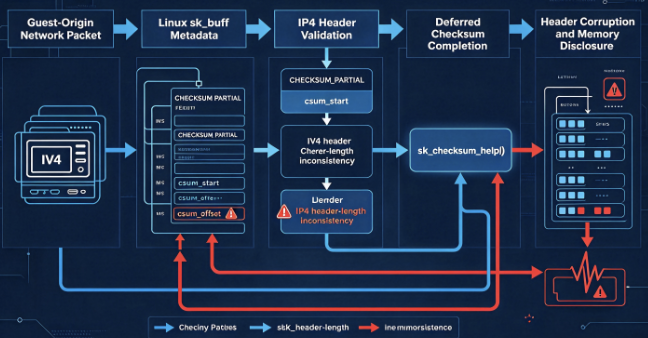
Linux uses the sk_buff structure to maintain packet data together with metadata needed for routing, filtering, fragmentation, checksum processing, and transmission. A socket buffer does not simply contain an immutable byte sequence. It also includes information describing where protocol headers begin, which operations remain unfinished, and how the packet should be processed.
Three fields are central to the vulnerability: skb->ip_summed, skb->csum_start, और skb->csum_offset.
जब skb->ip_summed is set to CHECKSUM_PARTIAL, the packet contains a checksum that must still be completed. The csum_start field identifies the beginning of the data used for checksum computation, while csum_offset determines the location of the checksum result relative to that starting point.
During ordinary TCP or UDP transmission, these values refer to the appropriate transport-layer data. The kernel or networking hardware later completes the checksum without altering unrelated header fields.
The problem emerges when untrusted checksum metadata survives into a processing stage where the packet’s representation has changed.
For example, a packet may initially contain Ethernet or other link-layer headers. As the packet moves through the networking stack, the kernel adjusts its internal representation to expose the IPv4 header. An offset that appeared acceptable relative to an earlier representation may no longer be valid relative to the actual IPv4 header.
If checksum processing trusts the stored offset without checking the current network-header boundary, the operation may write into bytes that the kernel has already interpreted as network-header information.
The vulnerable operation involves skb_checksum_help(), a legitimate Linux kernel helper used to complete software checksums. The helper itself performs a necessary networking function. The security defect arises when an affected caller allows it to operate on incompatible checksum metadata.
The resulting weakness is a validation-consistency failure: the kernel makes decisions using one representation of packet data, permits a later operation to modify that representation, and subsequently relies on the modified data without preserving the original security guarantees.
Why IPv4 header validation becomes unreliable
The IPv4 header contains an Internet Header Length field, commonly abbreviated as IHL. This four-bit field specifies the size of the IPv4 header in units of 32-bit words.
A conventional IPv4 header without options has an IHL of 5, corresponding to 20 bytes. The maximum valid IPv4 header length is 60 bytes.
In the PwnEscape research, the investigators showed that checksum processing could alter the interpretation of the IPv4 header length after earlier processing stages had already accepted the packet.
The simplified difference is:
| Packet interpretation | IHL value | IPv4 header length |
|---|---|---|
| Initially validated header | 5 | 20 bytes |
| Header after unintended modification | 15 | 60 bytes |
This discrepancy matters because Linux fragmentation routines use IPv4 header information when constructing outgoing fragments.
A packet originally validated with a 20-byte header can become dangerous if a later operation causes fragmentation code to treat it as a packet with a 60-byte header.
The kernel may then copy bytes under the assumption that they belong to the IPv4 header, even though those bytes were not part of the packet’s logically valid header data.
The researchers described a reproducible case in which this mismatch exposed 32 bytes of host memory. Those bytes became observable through the outgoing packet.
This is not equivalent to a conventional remote buffer-overflow vulnerability exposed directly to arbitrary internet traffic. The demonstrated attack depends on controlling the appropriate packet metadata and reaching a susceptible host networking path. Nevertheless, when an untrusted virtual machine can influence those conditions, the resulting failure can cross an important isolation boundary.
How a Networking Bug Becomes a Virtual Machine Escape
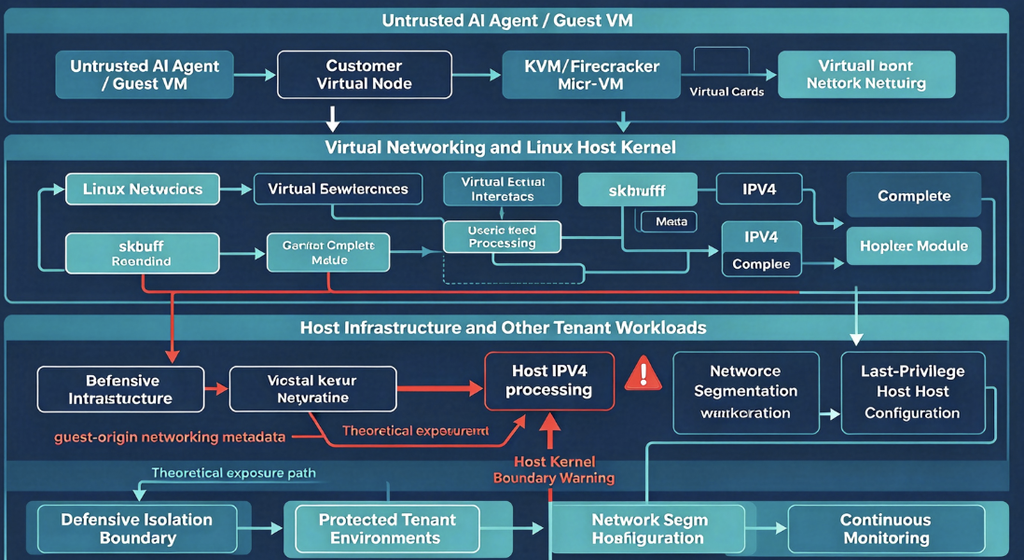
Virtual machines are commonly treated as strong execution boundaries because workloads receive separate guest kernels and virtualized hardware interfaces. A guest application should not be able to read arbitrary host memory or modify the host operating system simply by generating network traffic.
However, virtualized networking creates an unavoidable interface between guest-controlled activity and host-side software.
When an application inside a virtual machine transmits data, that traffic may pass through virtual network devices, backend interfaces, host networking functions, filtering rules, and packet-processing components before reaching its destination.
Some of those processing stages execute inside the host kernel.
PwnEscape becomes relevant when the guest-controlled input can influence host kernel checksum metadata. The host may perform deferred operations based on that metadata, even though its origin is less trusted than the host itself.
The trust boundary is crossed when metadata associated with a guest-origin packet leads the host kernel to modify its own packet memory in a way that violates previously established bounds.
A simplified conceptual sequence illustrates the failure:
Untrusted guest workloadGuest-origin traffic and checksum metadata
Host virtual networkingPacket representation and metadata processing
IPv4 parsing and validationKernel accepts a particular header layout
Deferred checksum completionInvalid metadata can modify previously validated header bytes
Later packet processingHeader inconsistency can produce memory disclosure or other corruption
This sequence explains why the issue is more significant than an ordinary malformed-packet handling defect.
The guest does not need to compromise the KVM hypervisor implementation directly. Instead, it may abuse an independent host kernel subsystem that processes data originating from the guest.
The same architectural concern is relevant to Firecracker-based microVM environments, where a small virtual-machine monitor reduces the exposed device surface but does not eliminate the need for secure host-side networking.
It would be inaccurate, however, to conclude that every Linux virtual machine automatically provides the complete PwnEscape exploitation path. Reachability depends on the networking implementation, kernel version, configuration, and relevant packet-processing behavior.
CVE-2026-99999 and the Vercel Sandbox Security Challenge
The public disclosure of PwnEscape is closely connected to Vercel’s 2026 Sandbox security challenge.
On August 18, 2026, Vercel announced a $1 million research challenge designed to test the security boundaries of its sandbox infrastructure. The program invited researchers to evaluate both network restrictions and the isolation provided by its microVM architecture.
The distinction between these security boundaries was intentional. A sandbox might prevent one workload from directly accessing another workload’s filesystem while still exposing sensitive host interfaces through networking or related infrastructure.
According to Vercel’s October 14 findings report, security researcher Paulos Yibelo discovered a Linux kernel networking vulnerability while working from an ordinary sandbox environment without special access.
The research demonstrated three classes of consequences: host-memory disclosure, host crashes, and host-level code execution.
Importantly, the evidence for these outcomes was collected in different environments.
Host-memory disclosure demonstrated in production
Vercel confirmed that the memory-disclosure technique was demonstrated against production Sandbox environments.
Under the demonstrated conditions, packets originating from a guest could cause memory belonging to the host to appear in outgoing network traffic. This was not merely a theoretical observation derived from source-code analysis.
The research provided a concrete example of confidentiality loss across the guest-host boundary.
An attacker who can repeatedly obtain host-memory data may gain information that the virtual machine is not authorized to access. The practical sensitivity of any particular disclosure depends on the contents of the affected memory and the surrounding system configuration.
Vercel separately stated that the challenge did not produce reports demonstrating unauthorized access to customer files, secrets, or application data. That statement should not be confused with a denial that host-memory disclosure occurred.
Host crashes and code execution demonstrated in controlled environments
The researchers also demonstrated that the vulnerability could be used to crash a host and achieve host-level code execution.
According to Vercel, these more destructive outcomes were reproduced on researcher-controlled KVM and Firecracker systems configured to resemble its Sandbox infrastructure.
Pwn.ai’s technical disclosure describes a progression from controlled memory disclosure to more powerful memory-manipulation capabilities, culminating in a laboratory demonstration involving host-root execution.
The researchers did not present this as evidence that they had achieved arbitrary root-level code execution inside Vercel’s production infrastructure.
This evidence boundary matters when assessing the current threat.
The research establishes that the underlying vulnerability can support a severe guest-to-host exploitation chain in appropriately configured laboratory environments. It does not establish that every Linux virtualization deployment is vulnerable to an identical chain or that production compromises have occurred.
Vercel credited coordinated disclosure work involving Linux maintainers, AWS, and other industry participants. Its report also describes additional architectural hardening designed to reduce the damage possible from future virtualization vulnerabilities.
CVE-2026-99999 Severity and Exploitability
The Linux kernel CVE team assigned CVE-2026-99999 a CVSS v3.1 score of 9.3 with the vector:
CVSS:3.1/AV:L/AC:L/PR:N/UI:N/S:C/C:H/I:H/A:H
The local attack-vector classification is especially important.
This is not evidence that an unauthenticated attacker can exploit an arbitrary Linux server simply by sending an ordinary packet from the public internet.
The demonstrated threat involves a workload that can influence relevant networking behavior from within a local execution or virtualization context.
In shared infrastructure, however, allowing untrusted users to execute code inside isolated guests may be part of the intended service model. A guest-origin attack can therefore be operationally significant even though the underlying CVSS vector is local.
Different vendors may calculate their own severity scores based on product-specific assumptions. For example, Red Hat’s security advisory lists an 8.8 CVSS v3 score, while the upstream Linux kernel announcement reports 9.3.
These scores should not be treated as conflicting descriptions of unrelated vulnerabilities. They reflect different assessments of attack preconditions and product context.
For providers running untrusted workloads alongside other tenants, the consequences of a successful guest-to-host compromise can justify urgent remediation regardless of whether the score is 8.8 or 9.3.
As of October 16, 2026, the reviewed disclosures establish responsible research demonstrations and publicly available technical analysis. They do not establish a widespread campaign of malicious exploitation in the wild. Reports of proof-of-concept activity should be distinguished from confirmed criminal exploitation.
Which Linux Kernel Versions Are Affected?
The Linux kernel CVE announcement traces the underlying issue to functionality introduced in Linux 2.6.27 and identifies corrected versions across multiple stable kernel branches.
The following table lists the first fixed versions reported by the Linux kernel CVE team on October 15, 2026.
| Linux kernel branch | First fixed version |
|---|---|
| 5.10 | 5.10.272 |
| 5.15 | 5.15.223 |
| 6.1 | 6.1.190 |
| 6.6 | 6.6.159 |
| 6.12 | 6.12.113 |
| 6.18 | 6.18.57 |
| 7.2 | 7.2.11 |
| 7.3 development | 7.3-rc7 |
These versions are taken from the official Linux kernel CVE announcement. The 7.3-rc7 entry refers to a development release candidate rather than a production stable release.
The upstream fix was accepted under commit:
6785011f8b16abf40b1e9d8b2e332232b3e68822
Administrators can inspect the accepted Linux kernel patch to understand the implementation changes.
A version below the relevant upstream fixed release should prompt investigation, but upstream version comparisons alone are insufficient to determine the status of every Linux distribution.
Enterprise distributions frequently backport security fixes without changing the kernel’s upstream version series. Conversely, a system may have a corrected kernel package installed while still running an older vulnerable kernel because it has not been restarted.
Accurate exposure assessment must therefore account for both the running kernel and the vendor’s package-specific security advisory.
Ubuntu, Red Hat, and Amazon Linux status
Distribution-specific patch availability was still developing immediately after the October 15 disclosure.
On October 16, Ubuntu’s CVE tracker listed several kernel packages as requiring evaluation. Its Ubuntu priority classification was Medium despite displaying the critical upstream CVSS score. This illustrates why an upstream severity rating and a distribution’s remediation priority should not be interpreted as interchangeable fields.
Red Hat identified multiple Red Hat Enterprise Linux kernel streams as affected in its CVE-2026-99999 advisory, including affected package streams associated with RHEL 7, 8, 9, and 10.
Amazon Linux’s advisory identified affected Amazon Linux 2 and Amazon Linux 2023 kernel packages with pending fixes at the time of review.
These are time-sensitive package states, not permanent conclusions. Organizations should consult the latest applicable vendor advisory before determining whether a particular machine requires an update.
How to Check Whether a Linux Host Is Vulnerable
Determining exposure to CVE-2026-99999 should begin with a read-only inventory of the host operating system and its running kernel.
The objective is to identify systems using affected kernel code and determine whether an authorized, untrusted workload can reach the relevant networking functionality.
Run the following commands on the Linux host, not merely inside a guest virtual machine.
# Identify the running Linux kernel
uname -r

# Identify the Linux distribution
cat /etc/os-release

# Show kernel and operating system information
uname -a
The output identifies the currently running kernel release and operating system family. This information can be compared with the applicable security advisory.
On Debian- or Ubuntu-based systems, installed kernel packages can be inspected using:
dpkg-query -W 'linux-image*'On Red Hat-derived systems, administrators can inspect kernel packages using:
rpm -qa | grep '^kernel'These commands are non-invasive. They do not trigger the vulnerability or attempt to reproduce guest-to-host memory corruption.
However, their output is only an inventory starting point.
A system reporting a kernel release from a historically affected branch is not necessarily vulnerable if a trusted distribution has backported the security fix. Likewise, an installed fixed package does not prove the system is protected until the running kernel or an independently verified live-patching mechanism contains the relevant correction.
The most reliable verification process combines the running kernel release, installed package information, vendor advisory status, and evidence that the required security update is active.
Why ordinary vulnerability scanning may miss PwnEscape
CVE-2026-99999 does not expose a conventional HTTP endpoint, application banner, or network service version that can be reliably tested through a simple remote scan.
The relevant vulnerability exists within kernel packet-processing behavior.
A conventional external vulnerability scanner may identify an outdated operating system or kernel package, but it generally cannot prove that the guest-controlled checksum path is exploitable merely by connecting to a host’s public IP address.
Network packet captures also have limitations. The vulnerable checksum metadata exists as internal Linux packet-buffer state, and not all of that state is preserved in an ordinary packet capture.
Even if a suspicious outgoing packet is observed, determining whether it resulted from this particular vulnerability requires careful correlation with the host’s networking configuration and kernel behavior.
For production environments, asset inventory and vendor patch verification are more dependable remediation controls than attempting to establish exploitability through aggressive packet manipulation.
How the Linux Kernel Patch Prevents Header Corruption
The accepted upstream fix introduces additional validation before certain IPv4 checksum-completion operations.
The central helper is named ip_check_csum_start().
Its purpose is to reject packets whose checksum starting point lies inside the currently recognized IPv4 header.
The key validation condition, from the accepted kernel patch, is:
if (unlikely(skb->csum_start <
             skb->network_header + ip_hdrlen(skb)))
    return -EINVAL;
This condition compares the checksum starting point with the end of the parsed IPv4 header.
If checksum processing would begin before that boundary, the operation is rejected rather than allowing the deferred checksum helper to proceed.
The safeguard matters because it validates the checksum metadata against the packet’s current network-header interpretation, rather than relying exclusively on assumptions established earlier in the processing path.
The accepted patch modifies six kernel source files, including include/net/ip.h, net/ipv4/ip_output.c, net/netfilter/nfnetlink_queue.c, net/netfilter/xt_CHECKSUM.c, net/bridge/netfilter/nf_conntrack_bridge.c, और net/xfrm/xfrm_output.c.
These changes cover multiple checksum-completion consumers, rather than limiting protection to one fragmentation routine.
The patch is explicitly a defense-in-depth improvement. The upstream announcement notes that more comprehensive input validation requires additional work.
That distinction matters for kernel developers and security researchers. Preventing checksum completion from overwriting the IPv4 header addresses the documented security failure, but it does not mean every possible metadata-validation inconsistency in every protocol has been eliminated.
Why administrators should not cherry-pick the patch casually
A production kernel is an integrated system containing architecture-specific changes, distribution patches, driver dependencies, and backported fixes.
Applying an individual upstream commit without accounting for the rest of the kernel may introduce compatibility problems or omit dependent corrections.
The Linux kernel CVE team explicitly recommends upgrading to the latest supported stable kernel rather than independently cherry-picking isolated changes.
For managed cloud infrastructure, organizations should follow provider-specific remediation instructions. For enterprise Linux distributions, the appropriate fix may arrive as a security update that preserves an older upstream kernel version while incorporating the corrected functionality.
How to Prioritize CVE-2026-99999 Remediation
The highest-priority environments are those where untrusted users can execute workloads that interact with host virtualization and networking components.
Multi-tenant virtualization hosts deserve particular attention because compromising a host can undermine isolation between independent workloads.
AI Agent execution platforms represent another important category. These systems intentionally run code that may be generated dynamically, supplied by users, or derived from untrusted repositories and external instructions.
Even if the AI application itself implements strong command restrictions, a vulnerability in the host kernel can threaten an independent layer of the security architecture.
The practical remediation priority should reflect the actual trust relationships in the deployment.
| पर्यावरण | Recommended priority | Reason |
|---|---|---|
| Multi-tenant KVM or Firecracker hosts running untrusted guests | Urgent | Demonstrated guest-to-host security boundary impact |
| Hosted AI coding agents and code execution sandboxes | Urgent | Untrusted code may interact with virtualized host networking |
| Shared CI/CD execution infrastructure | उच्च | Third-party builds may create untrusted execution conditions |
| Kubernetes nodes with untrusted workloads | High, depending on configuration | Shared kernel and networking exposure requires assessment |
| Dedicated Linux servers running trusted workloads | Assess promptly | Affected kernel code may exist, but the demonstrated guest-triggered path may not be reachable |
| Isolated development systems | Based on access and exposure | Risk depends on local execution privileges, network configuration, and workload trust |
These classifications are operational recommendations, not a vendor-issued applicability matrix. A platform’s actual exposure must be confirmed against its architecture and supported kernel packages.
Where immediate patching is unavailable, operators should consider reducing access to untrusted execution environments, restricting the ability to create arbitrary workloads, and separating especially sensitive hosts from lower-trust compute infrastructure.
Reducing exposure can lower the likelihood of exploitation, but it is not equivalent to applying the kernel correction.
There is currently no basis for claiming that a generic firewall rule, packet inspection signature, or single kernel configuration switch completely mitigates CVE-2026-99999 across all affected deployments.
Why PwnEscape Matters for AI Agent Sandbox Security
AI coding agents, autonomous software-development tools, and browser-based execution platforms increasingly require isolated environments for running generated code.
These environments frequently rely on containers, virtual machines, microVMs, or combinations of those technologies.
Their security depends on more than whether the AI model follows instructions correctly.
A sandbox must also ensure that untrusted execution cannot reach sensitive host resources through operating-system interfaces, device emulation, network processing, filesystem mounts, or control-plane services.
PwnEscape is particularly relevant because it shows that a virtualization escape can originate outside the most obvious virtualization components.
An organization may invest heavily in protecting its hypervisor, reducing virtual device complexity, and enforcing workload-level policies while still depending on the correctness of the host’s networking implementation.
For developers designing AI execution systems, this creates an important architectural requirement: every host subsystem receiving guest-influenced state must be treated as part of the trusted computing base.
The weakness is not necessarily that the microVM architecture is fundamentally unsound. Rather, strong isolation requires consistency across several independent enforcement layers.
Vercel’s public report reflects that approach. Beyond addressing the kernel issue, it described improvements to guest-to-host trust assumptions, policy enforcement consistency, and host-side containment.
The broader research also belongs alongside other virtualization boundary vulnerabilities. For example, Penligent’s analysis of CVE-2026-74580 Vghost examines a separate Linux vhost vulnerability associated with privilege escalation and virtual machine escape.
The vulnerabilities arise from different underlying mechanisms. PwnEscape involves checksum metadata and network-header interpretation, while Vghost concerns memory-mapping behavior in a virtualization-related subsystem.
Together, they illustrate why assessing an AI sandbox requires examining the complete guest-to-host attack surface rather than assuming virtual-machine isolation is guaranteed by a single component.
Detection, Validation, and Defensive Testing
Security teams assessing CVE-2026-99999 should distinguish vulnerability identification from exploit reproduction.
The presence of affected code can often be established using kernel version information, package advisories, and distribution security records. Demonstrating memory disclosure or host compromise, however, requires a substantially more invasive investigation.
For routine production validation, the appropriate objective is to confirm whether the host contains the security correction and whether the previously exposed trust boundary remains relevant.
Where organizations maintain authorized security testing environments, additional source-code review and controlled packet-processing tests may help validate the behavior of custom kernels or network implementations.
The accepted upstream patch provides concrete locations for defensive source review. Engineers can verify that the relevant checksum-completion paths contain the corresponding validation and that their custom modifications do not bypass the intended checks.
For hosts using heavily customized kernels, simply comparing version strings may provide insufficient assurance.
Organizations may also review security telemetry for unusual host crashes, unexpected fragmentation behavior, or evidence of packet-processing failures. Such observations can contribute to an investigation, but none is a reliable standalone indicator of PwnEscape exploitation.
Host-memory disclosure is particularly difficult to detect after the fact without purpose-built observability or captured evidence. The absence of suspicious events should not be treated as proof that a vulnerable host was never exposed.
The defensive validation process is therefore best anchored in verified code and package state, supported by configuration review and controlled regression testing.
For teams maintaining a broader Linux vulnerability program, the Linux CVE Hub provides related context on kernel attack surfaces, vulnerability classification, and safe validation workflows. PwnEscape should be evaluated within that broader host-security inventory rather than treated as an isolated application vulnerability.
Is There a Public PwnEscape Exploit?
The October 15 disclosure provides substantial technical information about the vulnerability, including its root cause, affected kernel operations, and the researcher’s progression from memory disclosure to host compromise.
However, the initial Pwn.ai publication does not provide a complete, general-purpose exploit chain that can be assumed to work across arbitrary KVM or Firecracker installations.
The researchers explicitly distinguish their reproducible memory-disclosure findings from the more complex exploit development required to achieve controlled host writes and root-level execution.
Their initial publication describes the latter work at a higher level and indicates that further technical discussion may follow.
This is a meaningful distinction for vulnerability prioritization.
The lack of a broadly available exploit does not make the issue harmless. An untrusted guest successfully disclosing host memory is already a violation of the isolation guarantees expected from a multi-tenant virtualization platform.
At the same time, organizations should avoid treating a laboratory demonstration as evidence that every vulnerable system can be compromised using an identical, readily available attack.
As of October 16, 2026, the reviewed authoritative sources do not confirm widespread malicious exploitation of CVE-2026-99999 in the wild. The vulnerability’s seriousness is grounded in demonstrated technical impact and the importance of the affected security boundary, not in an unsupported claim of an ongoing exploitation campaign.
Final Assessment
CVE-2026-99999 PwnEscape demonstrates how a seemingly narrow Linux networking defect can threaten the security assumptions underlying modern virtualized infrastructure.
The root cause is not a traditional hypervisor vulnerability. It is a failure to consistently validate checksum metadata before a deferred packet-processing operation. Under specific conditions, that failure allows already-validated IPv4 header information to be modified, creating a path to host-memory disclosure and more severe exploitation consequences.
The public research established repeatable host-memory disclosure, while separate laboratory demonstrations showed that the underlying weakness could support host crashes and guest-to-host code execution.
For cloud providers, security teams, and AI infrastructure operators, the central lesson is that virtualization security extends beyond the hypervisor. Host networking, metadata handling, and other kernel subsystems remain critical parts of the isolation boundary.
Organizations operating untrusted guest workloads should prioritize determining whether their running host kernels contain the relevant fix, follow authoritative distribution advisories, and deploy supported security updates as they become available.
PwnEscape is ultimately a reminder that secure isolation depends on preserving trust boundaries throughout the entire processing path, including the ordinary kernel operations that appear unrelated to virtualization security.Article research verified against the Linux kernel CVE announcement, upstream patch, Pwn.ai disclosure, Vercel’s official report, and distribution advisories on October 16, 2026. Publication should retain this date so readers can distinguish the original findings from later patch and exploitation updates.

 Hindi
Hindi  English
  German
  French
  Spanish
  Portuguese
  Japanese
  Korean
  Arabic
  Turkish
  Hebrew