
CVE-2024-38476 concerns a dangerous change in authority inside Apache HTTP Server: backend response information can influence the local handler used to process a request after an internal redirect. Apache’s security advisory identifies information disclosure, SSRF, and local script execution in affected deployments running 2.4.59 or earlier. Version 2.4.60 introduced the original fix; a deployment being maintained in 2026 should use its vendor’s currently supported, corrected package.
The maintenance problem extends beyond installing a binary. Apache explicitly warns that some legacy uses of AddType to select a handler must move to SetHandler after this correction. That warning connects the vulnerability mechanism to a practical regression risk: the server must continue executing intended scripts while refusing to let backend output choose an unintended execution path.
A response type and an execution handler answer different questions
A media type describes a representation. A handler tells Apache which processing implementation should produce the result. Serving a static file, executing a script, and passing a request to a proxy are different server actions. Apache’s handler documentation describes the assignment and use of those processing functions.
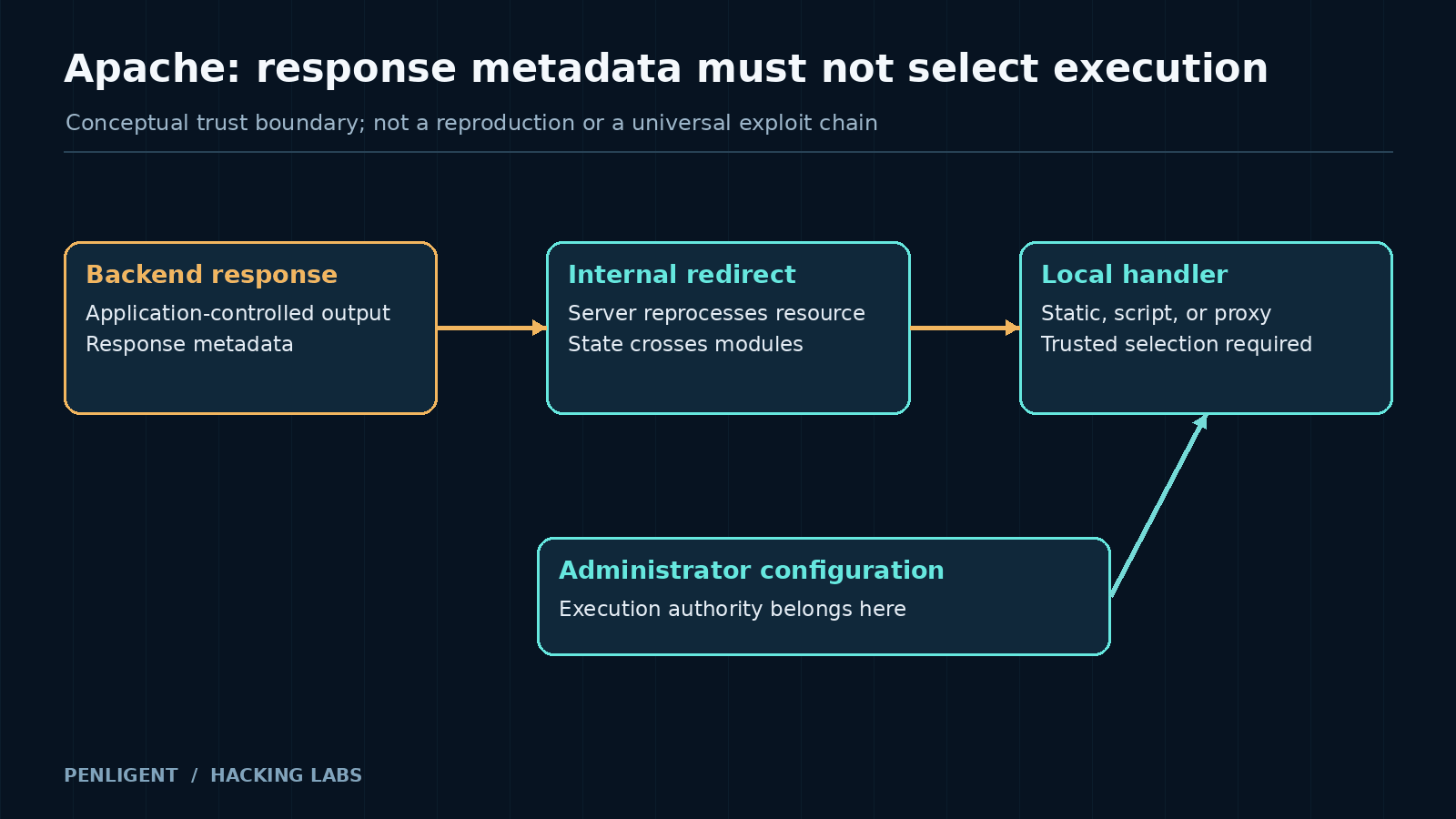
The distinction ought to be straightforward: application response metadata should not gain the authority of administrator-controlled execution configuration. In a modular server, however, information travels through shared request state and can be interpreted again by a later component. The security of the whole request depends on preserving the meaning and provenance of that information through each transition.
Orange Tsai’s original DEVCORE research explains a legacy fallback in which Apache uses content-type state when no handler has been assigned. The research connects that overloaded state to handler confusion and shows how a local redirect from a backend can carry response-derived information into another processing step. The unsafe boundary is the promotion of less-trusted response metadata into local processing authority.
An internal redirect is different from telling a browser to visit another address. The server reprocesses a resource within its own request machinery. That distinction matters because a browser-facing redirect observation cannot, by itself, establish what Apache did internally. A review must identify which component produced the response, whether Apache performed an internal transition, and how the next handler was selected.
The CGI specification’s local-redirect section illustrates the distinction precisely: a local path in the script’s Location field asks the server to reprocess the resource, while a client redirect asks the client to make another request. A conforming local-redirect response has its own restricted form. Reviewing which response form an application emits is consequently more useful than treating every Location header as equivalent.
That protocol distinction also improves a regression plan. Capture the backend response before Apache transforms it and compare it with the client-visible outcome in an isolated environment. If only the latter is retained, a normal-looking page can conceal the fact that another handler produced it. The relevant observation is the server’s processing decision, not whether the browser displayed a redirect animation or changed its address bar.
The shared state is what makes this a server architecture problem rather than just an application header problem. A value can be harmless to the module that writes it and consequential to the module that later reads it. Review the meaning of the value at both ends of the internal transition, including which component was entitled to choose the processing action.
Exposure depends on the complete request path
The presence of Apache and a vulnerable-looking version string is not a complete exploitability assessment. The disclosed behavior involves backend output and local processing. A useful inventory must therefore include the application integration, relevant redirect behavior, and available handlers, as well as the server package. A purely static deployment and a script-backed application should not receive the same architecture description merely because both report “Apache.”
Start with an owner-controlled application path and follow it through the real deployment. Does the public edge forward to Apache? Does Apache invoke a CGI-style backend or another application integration? Can application data influence response headers? Which local handlers are configured, and what resources can their operating-system identity reach? These are assessment questions, not a claim that every such component is vulnerable.
The possible outcomes also need separate reasoning. A request processed as static content can disclose something that was supposed to be executed. A proxy handler can create a network-access concern. A script handler can turn a content-processing decision into execution. Which outcome is possible depends on the handlers, reachable resources, and permissions of that installation. Do not import the most severe research demonstration into every Apache deployment.
A restrictive filesystem permission may limit one outcome without correcting handler selection. A network rule may constrain an outbound destination without preventing local disclosure. Those controls can reduce consequences, but their effect should be mapped to the stage they constrain. They should not replace the vendor correction to the server’s trust handling.
Keep this issue separate from mod_rewrite path confusion
CVE-2024-38475 and CVE-2024-38476 emerged from the same broader research, but the Apache advisory for 38475 describes a different boundary: rewrite output can map a URL to filesystem locations that were not intentionally reachable through a URL. Its configuration conditions concern substitutions and mapping. The focus of 38476 is backend output reaching local handler processing.
| Question | CVE-2024-38475 | CVE-2024-38476 |
|---|---|---|
| Boundary to examine | Rewrite output to filesystem mapping | Backend response to local handler selection |
| Configuration review | Relevant server-context rewrite substitutions | Application response paths and handler mappings |
| Useful functional retest | Expected URL mapping and resource reachability | Expected execution versus static delivery |
Penligent’s existing 38475 analysis covers the rewrite side. Keep the investigations linked without treating one CVE’s test as evidence for the other. A rewrite rule behaving correctly does not demonstrate that backend response metadata cannot influence a later handler, and a repaired handler mapping does not validate every rewrite substitution.
Review AddType as a migration concern, not a universal search-and-replace
The SetHandler reference defines explicit handler selection for matching requests and documents several configuration contexts. That is the administrator-controlled decision the security advisory points toward. But a site’s correct mapping still depends on its PHP, CGI, proxy, and virtual-host design.
Do not copy a mod_php handler example into a PHP-FPM deployment, or invent a FastCGI socket path from a tutorial. The handler name, integration module, and destination must match the installed architecture. Likewise, not every AddType directive is an execution mapping: many deliberately assign ordinary media types. A global replacement can break static content and leave the actual execution configuration unresolved.
Classify the existing directives by purpose. Keep representation metadata as representation metadata. Identify any entries relied upon to execute content and migrate those with the supported instructions for that integration. Then examine inherited directory rules, virtual-host overrides, and permitted per-directory configuration. The effective mapping can differ from the first matching line in the main configuration file.
Pay particular attention to directories accepting user uploads. Those files should not acquire script execution merely because an extension or inherited handler rule places them inside an executable namespace. This is a proposed hardening review, not an assertion that the CVE always requires an upload feature. Keep administrator-controlled execution mappings separate from user-controlled content storage.
Inspect the binary and configuration actually used by the service
Apache documents the following inspection options in the httpd command reference. Use the installed distribution’s launcher and the service’s actual configuration context. The commands shown here are documented examples; they were not executed against a live Apache deployment for this article.
httpd -v
httpd -M
httpd -S
httpd -t
These observations answer different questions. -v prints the binary’s version. -M lists loaded static and shared modules. -एस shows parsed virtual-host settings. -t checks configuration syntax. None is a demonstration that a particular backend response can or cannot reach a handler. In particular, a syntax check does not mean running workers have loaded the proposed configuration.
A distribution may supply security backports under an upstream-looking version that appears old. Match the package release and vendor advisory rather than declaring it vulnerable from the banner alone. At the other extreme, a new binary on disk can coexist with an old running process or an unmodified container. Tie the package result to the serving workload and its restart or rollout record.
For a multi-node application, preserve the instance identity with each result. One corrected origin does not establish the state of another node behind the same load balancer. An edge cache can also serve a response without exercising the origin path under review. Use an owner-approved path that makes the intended instance and backend transaction observable.
Make the regression test distinguish execution from source delivery
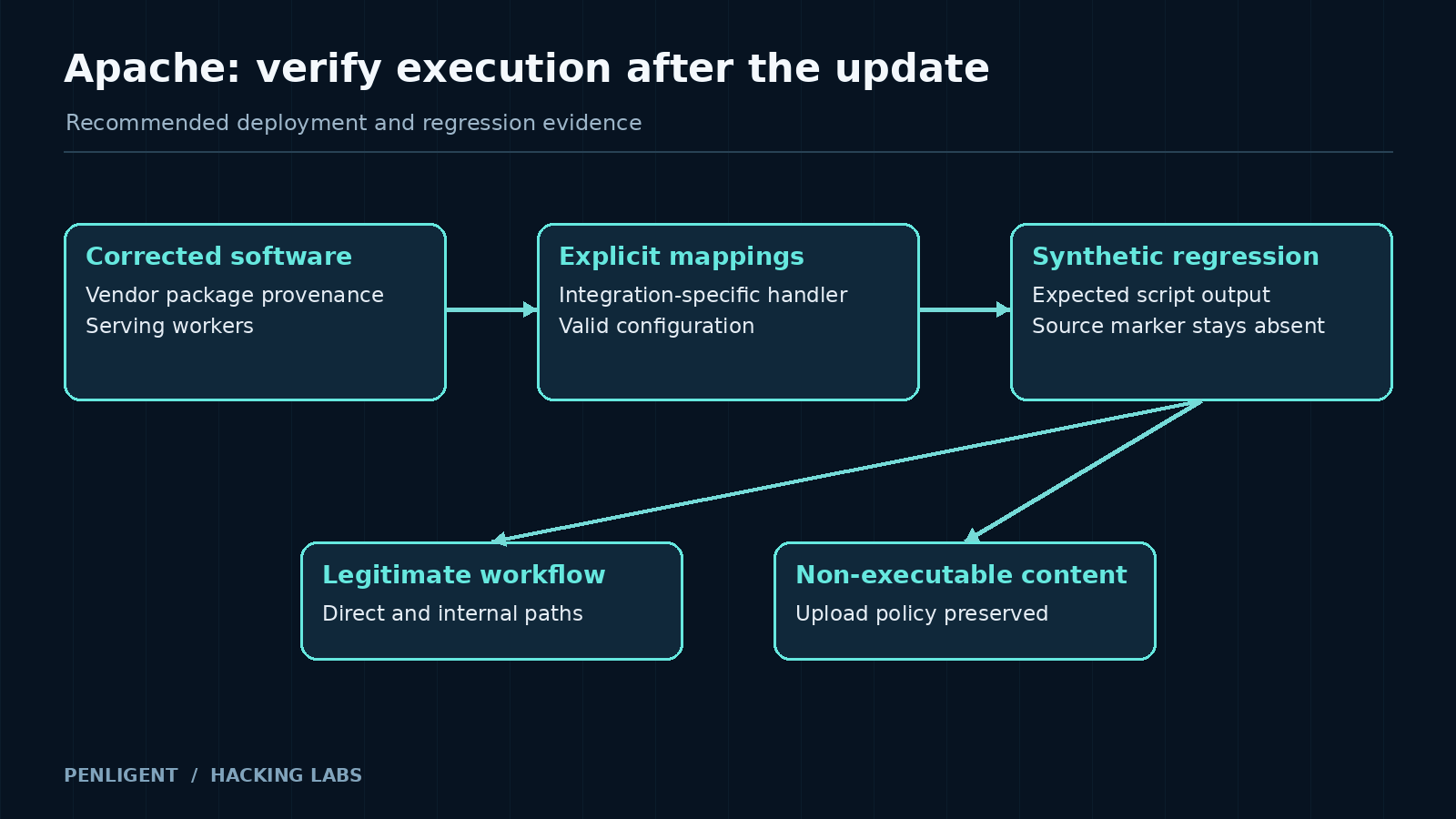
Prepare an isolated staging copy with the same handler integration and a synthetic script containing no credentials or customer data. Give that script a harmless, recognizable output and a separate marker present only in its source text. The intended request should return the output, while the source-only marker should remain absent. This is a proposed test design, not an executed reproduction.
That pairing detects a failure ordinary health checks can miss. A request can return HTTP 200 and still expose source instead of executing it. Checking only the status or page size would accept the wrong behavior. Inspect the body against the expected representation, and make sure a cache did not supply an older successful result.
Test the application’s legitimate local-redirect workflows as well as direct script requests. If the maintenance change preserves direct execution but breaks an internal transition, users may see a failure only in a specific operation. Record which backend action produced the response and which resource was ultimately served. Keep the fixtures synthetic so an unexpected static response does not become a secret disclosure during the test.
The negative controls should reflect the site’s intended policy. A synthetic file in a non-executable upload area should remain non-executable. A protected resource should remain unavailable to an unauthorized client. Those controls test the relevant configuration boundaries without supplying a weaponized header-injection or handler-selection payload.
After a supported deployment, repeat the functional cases against the serving release and confirm the rollback plan does not restore vulnerable software. If compatibility fails, repair the handler mapping or route through the vendor-supported recovery process. Reinstating legacy execution behavior simply to make a health check green can defeat the purpose of the security maintenance.
What logs can tell an investigator
Access records show the client-visible request and outcome selected by the logging configuration. They do not necessarily expose every internal handler decision or backend response header. A request returning 200 therefore needs interpretation alongside application and server evidence. Conversely, the absence of a dramatic error does not establish that content was processed by the intended handler.
For an owner-approved investigation, look for contradictions between intended and observed processing: script source delivered as content, a backend request followed by an unexpected local operation, or unexplained proxy activity. Correlate those observations with deployment changes and application behavior. Ordinary proxying and redirects can resemble parts of that activity; the mismatch with the configured processing policy is what warrants explanation.
Preserve the configuration and deployment history before changing them. The current mapping may be corrected while an earlier version exposed a different path. If a script was served as text, assess which secrets that particular file contained and who could retrieve it during the relevant interval. Do not assume every script was exposed, or that patching the server revokes a credential already disclosed.
The repair is complete when the supported server build is serving traffic and the intended processing mappings survive the update. Apache should execute scripts because trusted configuration selects the handler, not because a backend response supplied a convenient content type. Keeping those two sources of authority separate is the practical lesson of CVE-2024-38476.


 Hindi
Hindi  English
  German
  French
  Spanish
  Portuguese
  Japanese
  Korean
  Arabic
  Turkish
  Hebrew