
Cloud pentesting starts with a boundary, not a scanner. A developer running a SaaS application on AWS needs to distinguish three questions: can an outsider reach something unintended, can an application user access another user’s data, and can a cloud identity perform actions it should not? A tool that answers one question may leave the other two untouched.
For a solo developer, the most useful first assessment is one application, one named cloud account and one important customer workflow. This guide uses AWS for the command examples, compares AWS and Azure testing-policy boundaries, and explains when application testing needs a separate cloud-permissions review. The commands are read-only examples for resources you administer. We did not run a cloud penetration test or benchmark a product for this article. Provider policies and command references were reviewed on October 21, 2026.
Decide which layer you are trying to test
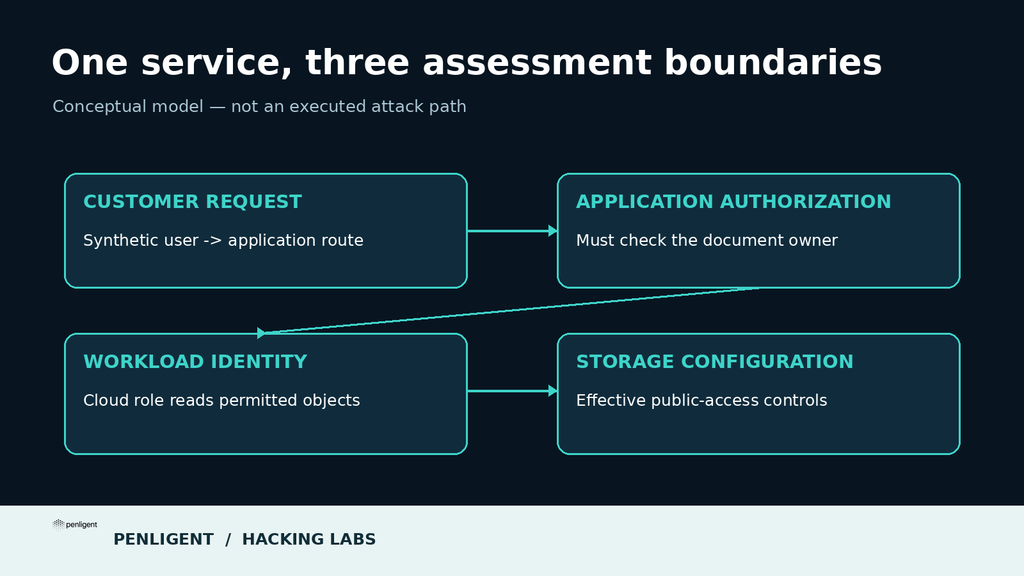
Consider a small document-sharing service. Its public API runs behind a load balancer, the application stores documents in object storage, and a runtime role lets the application retrieve files. A customer might receive another customer’s document because the application failed to check ownership. The same storage service might also have a public-access configuration problem. Those failures require different observations and different repairs.
| परत | Question to answer | Useful assessment | What does not settle it |
|---|---|---|---|
| Public application | Can an unauthenticated visitor reach sensitive functionality? | Scoped web and API testing | A clean cloud configuration dashboard |
| Authenticated application | Can one test user retrieve another user’s private document? | Two-account authorization tests | An HTTP 200 without inspecting its content |
| Cloud permissions | What can the workload identity read or change? | Identity and resource-policy review | A scan performed only from the internet |
| Deployment configuration | Is an unintended service or resource exposed? | Inventory and configuration review | The absence of a public version banner |
This separation matters when you buy a tool. A black-box application workflow should not be assumed to review your entire cloud account. A cloud posture check should not be assumed to exercise the business rules behind login. Ask the vendor to name the layer it reaches, the access it requires and the evidence it returns. “Cloud coverage” is too broad to make a purchasing decision.
Check the provider policy before choosing a test method
The AWS penetration-testing policy permits assessments without prior approval for its listed services, but it does not authorize testing AWS infrastructure itself. It also contains important exceptions: testing that includes command and control requires prior approval, and prohibited activities include request flooding, bucket takeover and subdomain takeover. A scanner’s available options are not a substitute for checking that policy.
For Azure, Microsoft’s penetration-testing guidance says preapproval is not required for testing owned Azure resources, while its Rules of Engagement remain controlling. A third party needs explicit written authorization from the resource owner. This is not blanket permission to test other tenants or another Microsoft service. Recheck the current rules when the method or target changes.
For a first assessment, make the method narrower than the maximum permitted scope. Use a staging deployment that represents the intended workflow, synthetic documents and accounts created for the test. Record the public hostname separately from the cloud resource identifiers. A hostname that resolves to a shared service does not make every neighboring address part of your assessment.
Assessment: document-sharing staging application
Owner: [resource owner and incident contact]
Allowed hostname: [owned staging hostname]
Cloud account / subscription: [explicit identifier]
Allowed identities: [two synthetic users; scoped cloud role]
Allowed operations: [named read-only routes and configuration reads]
Excluded: production customer data; other tenants; takeovers; flooding
Stop condition: unexpected real data, service degradation or scope drift
Evidence: sanitized requests, responses, identity and timestamp
Treat that template as a starting point for an agreement, not a universal authorization form. Add the exact methods, limits and provider requirements relevant to your deployment. The practical question is whether an operator can tell, before an action executes, that both the target and the action are allowed.
Establish the AWS identity before interpreting any result
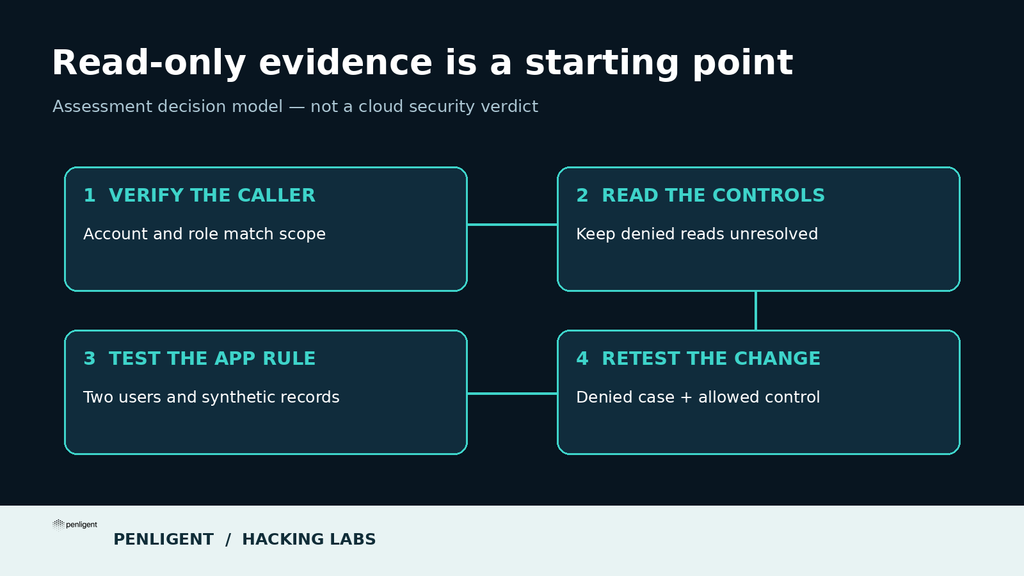
An authenticated cloud check depends on the active identity. A permission error made under the wrong profile can send an investigation in the wrong direction. The AWS CLI GetCallerIdentity reference documents a command that returns the caller’s account and ARN. Run it with the same profile used for the following configuration reads.
aws sts get-caller-identity \
  --profile YOUR_TEST_PROFILE \
  --query '{Account:Account,Arn:Arn}' \
  --output json
Compare the returned account and role with the written scope before continuing. This establishes the caller for that invocation. It does not show every permission the role has, and it does not establish the identity used by a separately running web application. Preserve the account and role in the private assessment record; redact unnecessary identifiers from any public example.
Read storage controls without confusing configuration with exploitability
For an owned S3 bucket, the bucket-level GetPublicAccessBlock command reads the bucket’s Block Public Access configuration. Replace the placeholders rather than copying an unrelated bucket name into your environment. The corresponding account-level operation is a separate command.
aws s3api get-public-access-block \
  --bucket YOUR_OWNED_BUCKET \
  --profile YOUR_TEST_PROFILE \
  --output json

aws s3control get-public-access-block \
  --account-id YOUR_ACCOUNT_ID \
  --profile YOUR_TEST_PROFILE \
  --output json
The S3 Control command reference describes the account-level read. Keep its result separate from the bucket-level result. An AccessDenied response means the request was denied under that invocation; it does not establish that the bucket is private. A missing configuration is also different from a successful response containing four enabled settings.
AWS explains in its Block Public Access documentation that controls can apply at multiple levels and the effective restrictions matter. A bucket-level setting alone is therefore an incomplete public-access verdict. Record applicable account, organization and access-point controls, then examine the relevant resource policies. Do not switch protection off to make a demonstration easier.
| Observed result | Reasonable interpretation | Next action |
|---|---|---|
| Caller identity is outside the agreed account | The check is in the wrong account context | Stop and correct the profile |
| Configuration read is denied | The current caller could not inspect that setting | Ask the owner for a scoped read or configuration evidence |
| Bucket-level protection is disabled | One layer does not supply that protection | Check effective higher-level controls and relevant policies |
| Effective public-access restrictions are present | Those restrictions constrain public access | Assess application-mediated access separately |
| Application returns another user’s private file | Potential application authorization failure | Verify ownership and reproduce with synthetic accounts |
A private bucket can still be involved in an application data leak. The application may legitimately read the object using its own identity, then return it to the wrong customer. That is why the storage check and the authenticated application test belong in the same assessment plan without being collapsed into the same finding.
Test a customer boundary using two synthetic users
Create Alice and Bob as separate users in your staging application. Give each a private synthetic document with a distinct marker. First confirm that each can read their own document. Then, using only references to the two test documents, check whether Alice can retrieve Bob’s private document. Establish any legitimate sharing rule before judging the result.
This tests the category described by OWASP’s Broken Object Level Authorization guidance: the application must enforce authorization for the object being requested. The evidence needs the acting user, object owner, expected sharing policy and returned content. A response code alone cannot establish a cross-user disclosure.
| Request in the proposed test | Required behavior | Evidence to inspect |
|---|---|---|
| Alice reads Alice’s document | Allow | Alice’s synthetic marker and expected content |
| Bob reads Bob’s document | Allow | Bob’s synthetic marker and expected content |
| Alice reads Bob’s private document | Deny access to the private content | No Bob marker or private document body |
| Anonymous visitor requests a private document | Deny private access | No private content; authentication behavior documented |
This is a proposed test plan, not a report of executed results. Implement it against your own application’s actual routes and policy. A denial might legitimately be expressed as a 403, a nonrevealing 404 or another application-specific response. The security property is that the unauthorized identity does not receive the private content. Keep redirects and login pages in the evidence so they cannot be mistaken for document responses.
After a fix, repeat both the denied case and the legitimate owner cases. Blocking every document request would hide the leak by breaking the service. A useful retest establishes that the boundary holds while the intended workflow remains available. It still does not establish that every other object type, role or sharing mode was covered.
Choose a tool around the access you can provide
| Your immediate need | Start with | Purchase question |
|---|---|---|
| Understand one cloud configuration result | Provider-native read-only controls and documentation | Do I need another product for this question? |
| Inspect and replay a known application request | An intercepting proxy or HTTP client | Can I preserve the correct session and inspect the response? |
| Explore an owned web application with AI assistance | A scoped application-testing workflow | Can it reach the authenticated feature and produce reviewable proof? |
| Assess complex cloud identity relationships | A specialist cloud security assessment | Which identities, policies and escalation paths are actually reviewed? |
| Deliver an externally required assessment | A provider accepted by the report recipient | Does the agreed scope and assessor meet that recipient’s requirements? |
Penligent’s application-testing workflow is relevant to the web and API portion of this plan: testing an owned application, investigating a candidate issue and reviewing reproduction evidence. Evaluate that workflow against the two-user task before expanding the scope. This article does not demonstrate an AWS IAM audit, a cloud privilege-escalation capability or a measured product result.
Keep the cloud role out of the application-testing job unless a defined test needs it and the tool’s credential handling has been assessed. A browser test account and a cloud administrator are different grants of authority. Giving a product broader access does not by itself establish that it will test the relevant boundary more thoroughly.
Spend on the next useful test, not a bigger finding count
For a solo developer, start with a fixed decision: can this workflow reach the feature that matters and return evidence you can explain? Record setup time, blocked prerequisites, review time and usage consumed. If the login fails, resolve that failure before purchasing more runs. A larger allowance cannot turn an unauthenticated crawl into an authenticated authorization test.
Compare the full commitment at checkout: monthly or annual billing, included usage, any separate model or infrastructure costs and the cost of retesting. Do not infer an account-wide cloud assessment from a target-based application plan. Ask what a target means, what happens when a run is blocked and whether retesting uses additional allowance. These are scope questions as much as pricing questions.
Move to a larger engagement when the first result reveals a specific need: another role, another object family, a broader deployment or a cloud permission relationship requiring specialist analysis. If a customer requires an independent assessment, agree the assessor and report requirements with that customer before buying an automated report on the strength of its format.
Keep one finding tied to one violated rule
A useful report does not say simply that cloud storage is insecure. It might say that Alice’s application session retrieved Bob’s private synthetic document, identify the request and object owner, and show the response containing Bob’s marker. The remediation then belongs to application authorization. If the observed problem is instead an excessive cloud permission, identify the cloud principal, action, resource and policy context; do not reuse the application finding’s impact statement.
Finding record
Layer: application / cloud identity / deployment configuration
Acting identity: [synthetic user or scoped role]
Resource and owner: [exact test resource]
Expected rule: [allowed and denied behavior]
Observation: [sanitized request and response or provider output]
Limitations: [unavailable settings, untested roles and assumptions]
Retest: [same denied case plus legitimate positive control]
That distinction also makes fixes cheaper to route. The application maintainer can repair ownership checks; the cloud owner can review a resource policy; the deployment owner can remove an unintended listener. When a finding needs two teams, show the relationship explicitly rather than assigning both teams a generic critical issue.
Questions before your first cloud pentest
Is a website scan a cloud pentest?
It can be one part. Testing the application from outside does not automatically inspect cloud identities, storage policies or internal deployment configuration. State the assessed layer and access level in the scope and report.
Do I need provider permission?
Check the current policy for your provider and exact method. AWS lists permitted services and exceptions; Azure points to its Rules of Engagement. Resource-owner authorization and provider-policy compliance are separate requirements.
Can I start without cloud administrator credentials?
Yes, if the initial task is a narrowly scoped application test or configuration evidence supplied by the owner. Record the resulting coverage limits. Do not request broad administrator access merely because the assessment is called cloud pentesting.
Does private storage prevent cross-user data leaks?
It does not establish application authorization. A backend with legitimate storage access can still return data to the wrong user. Test the customer-facing ownership rule separately using synthetic records.
What should the first paid evaluation accomplish?
It should answer one meaningful question with inspectable evidence under a stated identity. Choose the next purchase based on the remaining gap, whether that is application coverage, cloud-permissions expertise or an independently accepted assessment.

 Hindi
 English
 German
 French
 Spanish
 Portuguese
 Japanese
 Korean
 Arabic
 Turkish
 Hebrew