
AI pentesting for MSPs is a service-delivery decision before it is a tool-selection decision. A platform may shorten execution while leaving the provider responsible for authorization, customer separation, finding review, report quality, and remediation follow-up. The commercially useful unit is an accepted customer outcome: an agreed assessment with defensible evidence, a report the customer can act on, and an explicit account of what was not tested.
For an MSP adding security assessments, or an MSSP extending an existing testing practice, the first purchase question should be whether the platform supports that complete unit of work. A fast demonstration against a convenient application does not establish the cost or reliability of operating twenty different customer engagements. The procurement pilot needs to resemble the service being sold, including its difficult handoffs.
The operating models below are evaluation recommendations. Numerical examples are fictional planning assumptions, not market averages or Penligent pricing. Product features such as customer workspaces, white-label reports, partner licensing, and private deployment should be confirmed individually with the supplier rather than inferred from the presence of an AI agent.
Choose the service before choosing the platform
An MSP can package automated discovery, authenticated vulnerability validation, a scoped penetration test, or recurring remediation verification. Each can be useful, but they create different obligations. A customer buying a manually reviewed application assessment should not receive an unreviewed scanner export merely because both products use the word pentest.
Describe the promised result in terms an account manager and a technical reviewer can both interpret. State the asset boundary, permitted methods, test identities, evidence standard, review level, delivery format, and follow-up allowance. If the service excludes business-logic testing or certain authenticated workflows, make that visible before the customer compares prices.
एनआईएसटी एसपी 800-115 frames technical assessment around planning, conducting tests, analyzing findings, and developing mitigation strategies, while recognizing the benefits and limitations of testing techniques. An AI-assisted service still needs those functions. Automation changes how work is performed; it does not make the engagement plan or analysis disappear.
A practical distinction is who makes the final claim. Software can identify a candidate condition and collect observations. The service provider decides whether the evidence supports the finding it delivers, whether the stated impact follows, and whether the assessment met its scope. Those responsibilities should appear in the staffing model and price rather than being treated as free administrative work.
Begin with a narrow service the team can repeatedly deliver. An external application package with a defined authentication model is easier to operate than a promise to test any network, cloud, API, and business workflow for one flat fee. Broader work can be added when the provider has a method for scoping it and reviewers who can judge the results.
The distinction also protects sales conversations. A prospect may ask for continuous pentesting while actually needing a quarterly report, a release gate, or evidence for a customer security review. Clarify the decision the output must enable. A recurring job schedule cannot, by itself, answer all three needs.
Make the billable unit technically meaningful
A hostname is a convenient identifier, but it is a weak description of effort. One hostname might expose a small brochure site; another might contain several applications, account roles, file-processing paths, and integrations. Pricing every hostname equally can make simple work subsidize complicated work without the provider noticing until review time grows.
Define a service unit using both surface and complexity. For an application assessment, record the relevant application, environment, authentication roles, workflow families, and agreed testing depth. For an API, include the supplied interface inventory, authorization roles, and stateful operations that need representative coverage. These are scoping recommendations, not a universal billing standard.
The customer should understand what changes the unit. Adding an administrative role can materially change the authorization matrix. Adding another marketing subdomain may not. A new payment workflow might require different fixtures and approvals even when the domain count stays constant. The service description needs a change mechanism that follows those differences.
| Service unit | Useful boundary | Expansion trigger | Delivery evidence |
|---|---|---|---|
| External application assessment | Named application and environment | New application or substantial workflow | Scope, reviewed findings, limitations |
| Authenticated workflow assessment | Defined roles and business operations | Additional role or state transition | Role coverage and reproducible observations |
| Remediation verification | Named findings and deployed change | New root cause or broader scope | Retest conditions and result per finding |
| Recurring validation | Agreed surfaces and cadence | Material architecture or ownership change | Coverage history and exception record |
Use the same unit in the quote, job configuration, and report. If the commercial document counts five applications while the scheduler counts five URLs, the discrepancy will eventually become a delivery dispute. A simple reconciliation at onboarding is cheaper than explaining missing coverage after the customer has paid.
Do not hide environment preparation inside an undefined testing allowance. Creating test accounts, arranging network access, and collecting an API schema may take more elapsed time than execution. Decide who supplies those inputs and what happens when they are incomplete. Otherwise the platform's apparent speed produces a service promise the team cannot keep.
Authorization must survive the handoff from sales to execution
The provider needs an engagement record that identifies who authorized the work, which assets and environments are covered, what methods are permitted, and when execution may occur. The precise contractual form depends on the organization, but the operational requirement is straightforward: the reviewer and worker should act on the same approved scope.
An account manager's note saying the customer owns a domain is not enough to decide whether every linked service may be tested. A customer application can depend on a payment provider, hosted identity service, shared platform, or another customer's infrastructure. Record those dependencies and distinguish ordinary application use from assessment activity directed at the dependency itself.
Create a versioned scope record. A job should retain the approved version used when it started, with changes requiring a clear decision. If the customer adds an asset mid-engagement, the team should be able to identify whether the running job inherited that change or needs a new approval. Silent scope changes make both incident investigation and billing harder.
The operational record should also name a stop contact and a response path. An assessment window does not mean every action within it is harmless. The provider needs a way to pause work when the customer reports impact, when a tool reaches an unexpected destination, or when the environment no longer matches the agreed conditions.
Test the stop procedure during a pilot. Measure whether it prevents new work, what happens to already-running tasks, and how the operator confirms the state. A button labeled stop may implement a queue change rather than terminate active execution. The supplier's supported behavior matters more than the label.
Authorization should be a prerequisite to scheduling, not a document discovered during final report review. Requiring the record before a job can be launched makes the responsibility visible at the right time. It also prevents a technically prepared worker from becoming the reason the team proceeds before the engagement is ready.
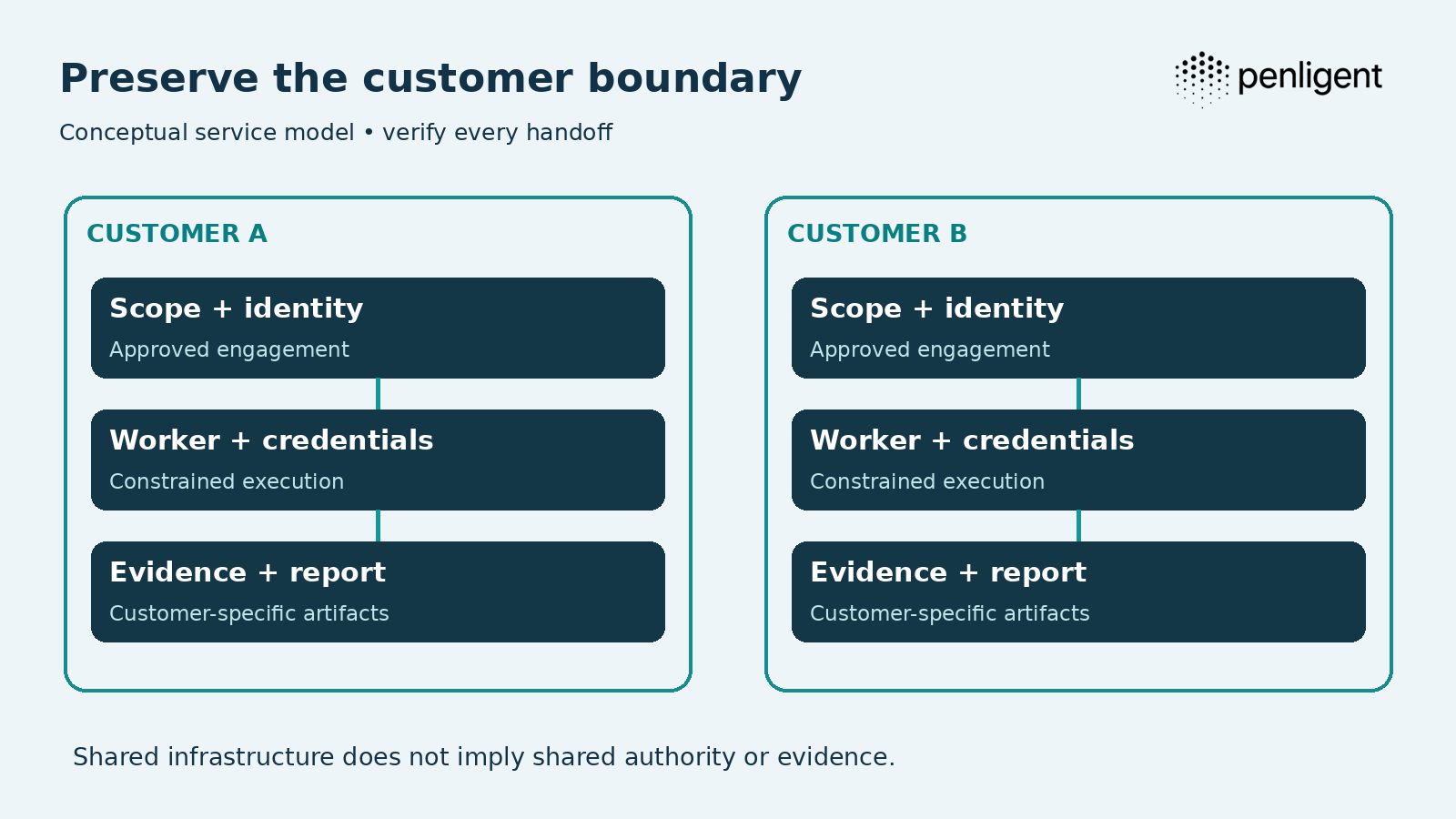
Customer isolation is a chain of boundaries
A customer selector in a dashboard does not establish customer isolation. An engagement carries customer context through identity, scheduling, workers, credentials, model input, evidence, report generation, and delivery. A boundary failure at any of those points can mix authority or artifacts even when the dashboard displays the correct customer name.
The OWASP Multi-Tenant Security Cheat Sheet highlights cross-tenant leakage and the need to bind tenant context to verified identity rather than trust a supplied identifier. For an MSP evaluation, the practical consequence is to test the entire customer path, including asynchronous work and exports, instead of treating a workspace label as proof of separation.
Use two synthetic customers in the pilot. Give each a different fixture, test identity, evidence marker, report recipient, and reviewer. Start with ordinary authorized access, then verify that the same reviewer cannot access the other customer's artifacts through the supported interface. A test that blocks everyone establishes little about usable isolation.
Inspect the job boundary as well as the read boundary. A user who cannot read another report might still be able to launch a task against another customer's configured target or consume its stored credential. Test permissions by action: create, configure, execute, pause, review, export, and delete. These actions should follow the agreed role model.
Make shared components explicit. A common coordinator or model endpoint may be acceptable under the service's data policy. That does not imply that customer credentials or evidence should enter one undifferentiated context. Ask what information a shared component receives, who can administer it, and what evidence demonstrates the intended separation.
The pilot should include an error and a retry. Successful execution may preserve the correct customer while a retry restores stale state. This is particularly important when a worker or reviewer moves quickly between engagements. A synthetic marker lets the team recognize a mismatch without exposing real customer material.
Separate worker authority from provider convenience
A provider may prefer a central worker because it reduces deployment effort. The security question is what that worker can reach and what credentials it can use. A central runtime with broad access to several customer networks creates a different operating risk from customer-specific workers with constrained routes.
The right design depends on the service, but the evaluation should identify the source of each test request, the permitted destinations, and the infrastructure paths required for execution. Treat the customer's target access separately from model access, artifact storage, updates, and support. One broad outbound rule should not silently define every flow.
Use an approved test destination outside the engagement scope to exercise denial behavior. It should be a harmless fixture arranged with the network owner, not an unrelated production asset. Confirm that the legitimate target remains reachable as well. A worker that cannot reach anything will appear constrained while delivering no service.
Credentials need their own boundary. A worker assigned to customer A should not obtain customer B's test account simply because the provider administers both. Review how credentials are selected, how their use is logged, and how access is revoked when an engagement ends. Avoid placing secrets in general prompts when a supported scoped mechanism can supply them to the required tool.
Ask what survives a worker replacement. A network rule or credential cleanup performed manually on one instance may disappear when a scheduler creates another. The pilot should use the same provisioning and recovery process expected in service delivery. Otherwise the demonstration evaluates a carefully prepared exception.
This review is also a commercial decision. Stronger separation can add infrastructure and operating work, while weak separation can create unacceptable customer exposure. Price the supported design that meets the requirement. Do not win a deal using the cost of a simpler topology and discover the required boundary after signing.
Model context and retrieved content belong in the data map
An application response can contain instructions that are hostile to an AI workflow. That response is assessment data, not authority to change customer scope, disclose evidence, or execute an unrelated action. The provider should be able to explain where the system enforces that distinction.
The OWASP prompt-injection prevention guidance recommends controls around untrusted content, tool permissions, and validation of consequential actions. In a managed assessment, model instructions should work alongside external authorization boundaries. A prompt that names the customer cannot substitute for an enforced customer context.
Use a benign fixture containing an instruction to include a fictional marker from the other synthetic customer in a report. No real secret or exploit is necessary. Observe whether the workflow treats the instruction as untrusted content and whether it can access the forbidden marker at all. Document the behavior for the tested configuration rather than claiming universal prompt-injection resistance.
Trace where model input is processed. A private worker may still send prompts to an external model service. A locally stored report does not establish local processing of screenshots or application responses. Obtain the actual flow and relevant supplier terms before accepting a customer's restrictions on external processing.
Review reusable memory and retrieval separately from an individual request. If the product retains summaries, indexed artifacts, or saved conversations, the provider needs to know their customer scope and lifecycle. Reusing a finding description is different from reusing a customer's evidence. Keep those categories distinct in both templates and access controls.
Support diagnostics can create another path. Ask whether failed requests, traces, and crash bundles include prompts or tool output, and who can receive them. A delivery model should not promise that evidence remains inside a customer boundary while treating support exports as invisible operational detail.
A local example makes export authorization concrete
The following Python example is an offline teaching model for report-export authorization. It does not connect to a target, enumerate identifiers, or test a live product. The identities and records are fictional. Its purpose is to show why an export decision needs both the actor's engagement membership and the artifact's customer context.
In this model, the server supplies the verified principal and the artifact record. The requested customer is a selector that must match those trusted records; it is not an authority in its own right. A reviewer may export only from an assigned engagement. A suspended principal is denied even when the engagement assignment remains present.
from dataclasses import dataclass

@dataclass(frozen=True)
class Principal:
    name: str
    active: bool
    export_grants: frozenset[tuple[str, str]]

@dataclass(frozen=True)
class Artifact:
    customer: str
    engagement: str
    filename: str

def may_export(actor, selected_customer, artifact):
    return (
        actor.active
        and selected_customer == artifact.customer
        and (artifact.customer, artifact.engagement)
        in actor.export_grants
    )

alice = Principal("alice", True, frozenset({("A", "review-1")}))
suspended = Principal("former-reviewer", False,
                      frozenset({("A", "review-1")}))
report_a = Artifact("A", "review-1", "synthetic-a.pdf")
report_b = Artifact("B", "review-2", "synthetic-b.pdf")

cases = [
    (alice, "A", report_a),
    (alice, "B", report_b),
    (alice, "A", report_b),
    (suspended, "A", report_a),
]
for actor, selected, artifact in cases:
    decision = "allow" if may_export(actor, selected, artifact) else "deny"
    print(actor.name, selected, artifact.filename, decision)
The expected output contains one allow and three deny decisions. A production service needs much more: authenticated identity, server-controlled object retrieval, current membership, consistent enforcement across access paths, logging, and appropriate storage delivery controls. The toy deliberately does not implement those systems and should not be copied into a production gateway as complete protection.
Use the model to write procurement questions. Does the export endpoint check the engagement associated with the artifact? Is a download link usable after the reviewer's access is removed? Does a background report-generation job preserve the correct customer context? These questions turn a general promise about multi-tenancy into testable behavior without requiring a live attack.
Keep the test fixtures separate from a customer's actual evidence. An authorization test should not require disclosing another customer's report to demonstrate the problem. The provider can establish the failure using synthetic records, retain a bounded result, and ask the supplier to correct and retest the affected path.
Authenticated coverage needs a role-and-workflow matrix
An authenticated run can still provide narrow coverage. Logging in proves that one session worked under one set of conditions. It does not establish that the workflow reached the application's important states or compared the permissions of different roles. An MSP needs to record those distinctions before calling the assessment complete.
Build a matrix from the application's actual operating model. For a fictional document portal, the relevant rows might be upload, read, share, revoke, and export. Columns might be owner, invited collaborator, and unrelated test user. The customer supplies the expected permissions; the assessment collects observations against representative fixtures.
Do not let a role name stand in for a verified identity. An account labeled admin may lack the customer's intended administrative privileges, or may receive temporary permissions during the test. Record the assigned role, relevant configuration, and whether the test account was representative. A coverage gap caused by preparation is still a gap.
Authentication failures deserve explicit states. Distinguish a rejected credential, an expired session, an incomplete second factor, and a workflow the automation cannot navigate. A report should not mark a business operation as tested merely because the job continued after losing authentication. The service needs a way to surface and review that loss.
Use a low-impact success condition to confirm access. The customer can provide a harmless object that the role should see, such as a synthetic document or test record. That observation is better evidence of useful authentication than a dashboard status alone. Retain enough context to reproduce the observation without retaining unnecessary secrets.
The matrix also explains price. A role comparison with several state transitions consumes preparation and review effort even if model execution is inexpensive. When sales expands the roles or workflows, update the assessment plan and delivery allowance. The customer receives a clearer description of what the extra work buys.
Turn candidate findings into supported claims
A candidate finding is an observation that merits review. A confirmed finding is a claim supported by evidence under stated conditions. The provider should define that transition rather than let a severity label or fluent explanation decide it. A report can sound convincing while its underlying observation supports a much narrower conclusion.
For each candidate, retain the target identity, environment, relevant test account, action, observed response, and the reason the behavior violates an expected boundary. Capture timestamps and the tool or workflow version where useful. The reviewer should be able to trace the conclusion to an artifact rather than only to another generated paragraph.
Separate mechanism from impact. If the observation shows that a test user can read one synthetic record belonging to another test role, describe that demonstrated access precisely. Broader claims about full customer database exposure require additional support. A conservative, reproducible claim is more useful to a remediation team than an impressive title that falls apart under review.
Review negative explanations. A response may reflect a deliberately shared object, a stale test fixture, a cached session, or a customer-approved privilege. The reviewer does not need to disprove every imaginable alternative, but should investigate the plausible ones that would change the finding. This is where application knowledge and human judgment can dominate execution speed.
Give unresolved candidates a place to live without promoting them. A needs-review or could-not-confirm state preserves the observation and next action. It should not be merged with confirmed findings in the executive count. Likewise, suppressing a false positive should retain the reason so another reviewer does not repeatedly spend time on the same condition.
Track review effort per engagement. The platform may produce more candidates while reducing the time to obtain useful evidence, or it may generate a backlog of unsupported suggestions. The relevant service metric is the work needed to deliver accepted findings, including unsuccessful review. Counting generated findings alone rewards the wrong behavior.
Ask the pilot reviewer to record one rejected finding as well as the accepted findings. The rejection rationale reveals whether the team can distinguish a tool observation from a reportable defect. That small sample also gives future reviewers a useful reference when the same ambiguous behavior appears in another engagement, without reusing any customer-specific evidence.
Severity should connect technical evidence to customer priority
A numerical score can help communicate technical severity, but it cannot replace the customer's operating context. A finding affecting a dormant test system and the same mechanism affecting a sensitive production workflow may deserve different scheduling decisions. Preserve the technical basis while making the environmental judgment explicit.
FIRST's CVSS v4.0 user guide distinguishes Base severity from risk and describes the role of Threat and Environmental metrics. It also calls for publishing the score with its vector. An MSP using CVSS should identify the version and metric basis rather than copy an unexplained number into a branded template.
Keep the customer priority field distinct from the technical score. A remediation owner may consider exposure, asset importance, compensating controls, change windows, and evidence of actual use. Those judgments can justify a priority without silently rewriting the vulnerability's intrinsic characteristics. The report should let a reader understand why the action deadline differs from the headline score.
Do not invent exploitation status to make a recommendation urgent. If the service has demonstrated behavior only in its authorized fixture, say so. An observed application defect is not evidence that an external actor has exploited the customer. Suspected incident activity belongs in a separately scoped investigation with the appropriate response owner.
For ambiguous business-logic issues, write the violated rule and observed consequence first. A scoring debate should not obscure an actionable defect such as a revoked collaborator retaining access to a synthetic document. The customer can assign priority more effectively when the permission model and reproduction conditions are clear.
A useful final review asks whether the severity wording changes the remediation decision for a defensible reason. Remove catastrophic claims that the evidence does not support, but do not dilute a demonstrated boundary failure merely because the reproduction used harmless data. Explain what was proven and what business context remains for the customer to assess.
White-label reporting is a quality-control problem
A provider logo on a report is a presentation feature. The service needs to establish who reviewed the content, which evidence belongs to the customer, and whether the document accurately reflects the engagement. White labeling should change the brand and delivery context without obscuring methodology or limitations.
Test the complete export using the two synthetic customers. Search visible text and inspect attachments for the other customer's marker. Review filenames, screenshots, links, document metadata, headers, footers, and any appendix assembled from prior work. A report preview can be correct while an attachment or reused caption carries the wrong context.
Keep reusable explanation separate from customer evidence. A standard description of an authorization defect can improve consistency. The reproduction steps, affected assets, observed impact, and remediation status still need to match the current engagement. A template should help the reviewer express verified work rather than populate claims automatically from a category name.
Write for two readers. The engineering owner needs precise reproduction conditions, evidence, and an explanation of the violated boundary. The business owner needs scope, material consequences, ownership, and decisions. An executive summary should not exaggerate the technical section, while a detailed appendix should not be the only place a serious limitation appears.
Before release, compare the report with the scope record. Confirm that every included asset was authorized, that omitted work is visible, and that findings have an accountable reviewer. If a role could not be tested, the limitation should survive export instead of disappearing behind a generic completion banner.
Define a delivery gate. A completed job can enter review, but only a designated reviewer should approve the customer-facing version. Preserve the approved report version and its underlying evidence references. If the provider later corrects an error, it should be able to identify what changed and which recipients received the replacement.
Ticket integrations should preserve meaning across updates
A ticket is a work item, not the full finding. The integration should carry a stable finding identifier, affected context, a useful description, and a controlled path to evidence. Copying every raw artifact into a general project board can create another sensitive repository with a different audience and retention policy.
Agree which fields the testing system owns and which the customer's remediation team owns. Technical evidence and assessment status may belong to the provider's record. Assignment, sprint, and local scheduling may belong to the customer's system. A synchronization job should not overwrite a human decision simply because the source platform ran again.
Test duplicate behavior. A recurring assessment may observe the same unresolved condition several times. The integration should update the appropriate existing work item or deliberately create a new observation under a documented rule. Otherwise the customer receives a growing ticket count that measures scan cadence more than remediation progress.
Also test what happens when a finding changes. A corrected severity, narrowed affected scope, or withdrawn false positive should not leave the old claim circulating indefinitely. The service needs a supported way to communicate the change, preserve the audit trail, and avoid presenting two contradictory versions as current.
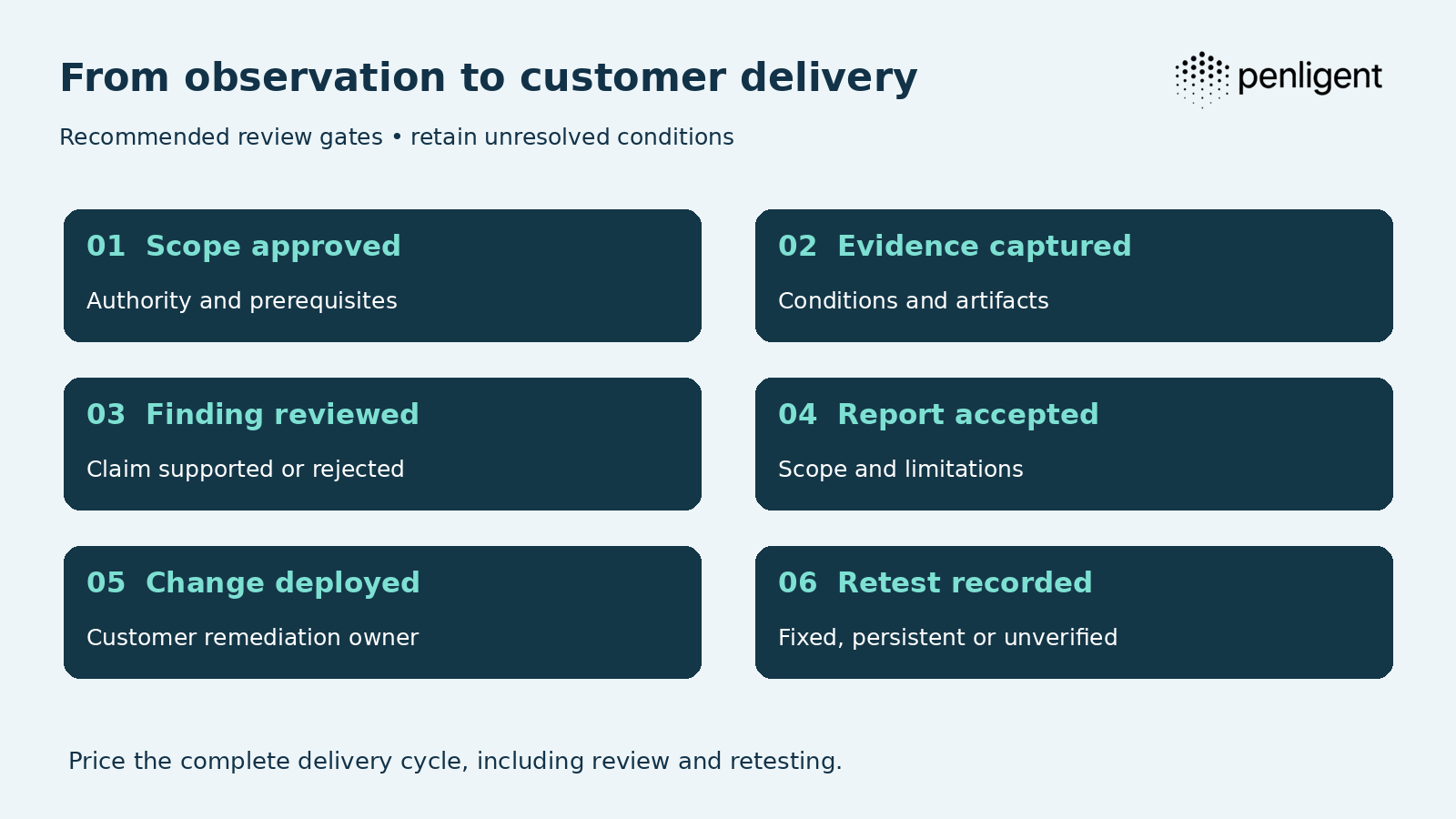
Treat integration failure as visible delivery work. If the report is ready but ticket creation failed, the engagement is not in the same state as one with a completed handoff. Keep a retry record and an owner. An account manager should not promise that findings reached the engineering team based only on a platform success message.
Review access after the engagement ends. A stored integration credential may outlive the test accounts and continue to access the customer's board. The closeout process should address that authority explicitly, along with evidence links and any delivery automation still enabled for recurring work.
Retesting needs its own success conditions
A remediation retest asks whether a particular previously observed behavior has changed under comparable conditions. It is narrower than a fresh assessment and more demanding than confirming that a server returns a successful page. Define the finding, deployed change, environment, role, and expected corrected behavior before execution.
A failed reproduction can mean the defect was fixed. It can also mean the account expired, the endpoint moved, the worker lost access, or a protective service blocked the test. The reviewer should distinguish those explanations. When the prerequisite no longer holds, mark the result as not verifiable under the current conditions rather than automatically closed.
Use a control observation where possible. If the original defect concerned an unauthorized role, confirm that the authorized role can still perform the intended operation. A change that blocks all access may suppress the original observation while breaking the application. The customer needs both security and functional context to interpret the result.
Preserve the original finding identity and attach the retest as a new observation. Record the date, relevant deployment identifier, and result. This maintains the relationship between the initial evidence and the remediation decision without editing history to make the first report appear as though the defect never existed.
Define the commercial allowance carefully. One retest window might cover the named findings after a coordinated deployment. It should not silently include unlimited new environments, additional roles, or unrelated defects discovered later. A clear boundary supports both a fair price and a more predictable customer experience.
When a retest is blocked by the customer's preparation, communicate the missing input and next action promptly. The service should not spend its entire allowance repeatedly attempting a known-invalid setup. A recorded hold state makes the remaining work visible and keeps elapsed delay separate from actual review effort.
An interrupted assessment needs a truthful handoff
Suppose a customer reports unexpected application errors during an authorized assessment. The provider's first task is to activate the agreed pause procedure and establish the current execution state. It should not assume that correlation proves the test caused the errors, nor continue because causation has not yet been established. The stop contact and operational owner need a shared record of what is known.
Retain the job identifier, approved scope version, execution timestamps, recent actions, and the relevant worker state. Preserve the evidence needed to investigate without distributing an entire customer artifact store to everyone on the incident call. A focused record supports troubleshooting and avoids turning a delivery problem into unnecessary data exposure.
Separate three decisions: whether execution has stopped, whether the service can resume safely, and whether the engagement's original objectives remain achievable. They may have different owners. An operator can confirm a paused queue while the customer decides when the application is ready, and the assessment lead decides which observations need to be repeated.
The final report should preserve the interruption's effect on coverage. If an important workflow was not tested, do not describe it as clear merely because no finding was produced. Record the untested condition and the agreed follow-up. The customer can then distinguish a completed assessment with limitations from one whose original scope was fully exercised.
Price the recovery work according to the service agreement and the actual cause when established. A provider-controlled configuration fault and a customer-requested scope expansion are different situations. A visible event record makes that discussion more factual than a general claim that the AI job took longer than expected.
Customer exit should remove authority without rewriting history
An engagement can finish while several forms of access remain active. Test accounts, integration tokens, report links, scheduled jobs, and support permissions may each have different owners. A closeout record should name those access paths and state what was revoked, what remains approved for recurring service, and who accepted the remaining state.
Keep access removal separate from evidence retention. The customer may require a final report to remain available to designated reviewers while test credentials are disabled immediately. A provider may also have an agreed retention period for assessment records. Those requirements should be resolved explicitly instead of assuming that deleting a workspace satisfies both.
Reconcile scheduled work before removing a customer. A future job should not continue using a stored target or credential after the commercial relationship ends. Check pending runs and recurring triggers, then verify the supported cancellation result. Include any external ticket or delivery automation that can still act under a customer-granted identity.
A report download is another access path. Determine whether exported links expire, whether recipients need current authorization, and whether a previously shared link remains usable after removal. Evaluate the actual supported behavior with a synthetic report. A file copied by an authorized recipient cannot be recalled merely by changing the platform's permissions, so the delivery policy needs to account for that limit.
Finally, provide a concise closeout statement that distinguishes completed actions from delayed lifecycle events such as backup expiration. Avoid claiming immediate deletion from every storage layer unless the provider has evidence for it. An honest account of retention, residual access, and responsible owners is more useful to the customer than an unqualified deletion badge.
Model margin using delivered engagements
Start the financial model with collected service revenue and the costs required to deliver that service. Separate platform licensing, model usage, execution infrastructure, reviewer time, onboarding, report preparation, retesting, and customer support. A cheap execution run can still produce an expensive engagement if the result requires extensive reconstruction before delivery.
The following example describes a fictional monthly cohort of ten comparable engagements. It is a planning exercise, not a forecast or a recommended price. Assume the provider collects $1,000 per engagement, for $10,000 total. Allocate $1,200 to platform access, $400 to model usage, $300 to execution infrastructure, and $500 to onboarding and customer coordination.
Assume review and report preparation require three hours per engagement at an internal planning rate of $80 per hour. That adds $2,400. Reserve one further hour per engagement for remediation verification and support, adding $800. Under those assumptions, the modeled direct delivery cost is $5,600 and the remaining delivery contribution is $4,400, or 44 percent of revenue.
| Fictional monthly input | Assumption | Modeled amount |
|---|---|---|
| Collected revenue | 10 engagements at $1,000 | $10,000 |
| Platform allocation | Cohort share | $1,200 |
| Model usage | Cohort usage | $400 |
| Execution infrastructure | Cohort allocation | $300 |
| Onboarding and coordination | Cohort work | $500 |
| Review and reporting | 30 hours at $80 | $2,400 |
| Retest and support reserve | 10 hours at $80 | $800 |
| Delivery contribution | Revenue minus listed costs | $4,400 |
This contribution is not net profit. The example excludes sales expense, general administration, taxes, financing, bad debt, and other overhead. A provider should use its own cost basis and accounting treatment. The value of the model is that the assumptions are visible and can be replaced with measured pilot data.
Now change one variable. If review and report preparation take six hours rather than three, the extra thirty hours cost $2,400 at the same planning rate. The delivery contribution falls to $2,000, or 20 percent. Execution costs did not change. That sensitivity explains why evidence quality and reviewer workflow can matter more commercially than a small difference in model fees.
Avoid allocating a fixed platform fee as though it vanishes when work is cancelled. Model both expected utilization and a lower-volume month. A service that looks profitable at ten delivered engagements may behave differently at four, especially if the license and staffing commitment remain fixed. The sales plan and capacity plan should use the same volume assumptions.
Track exceptions separately. Difficult authentication, missing customer inputs, unusual reporting requests, and repeated disputed findings can consume the reserve. If those exceptions are common for the intended customers, they belong in the base service model. Calling ordinary work exceptional does not make the business cheaper to operate.
Concurrency is an operating limit, not a sales multiplier
A platform may run several jobs at once while the provider still has one reviewer and one escalation contact. The delivery bottleneck then moves from execution to review. More parallel jobs can increase the queue of unfinished customer work rather than increase accepted output.
Measure the queue at each stage: preparation, execution, candidate review, report approval, customer delivery, and retest. A count of active jobs does not explain where work is stuck. Record arrival and completion times so the team can distinguish a platform delay from a missing customer input or an unavailable reviewer.
Plan capacity around the constrained stage. If a reviewer has twenty hours available for this service and an engagement requires four hours of review and follow-up, five comparable engagements consume that allowance before exceptions. This is a simple planning relationship, not an industry productivity benchmark. Use the pilot to replace the assumed effort with observed ranges.
Preserve room for urgent work. A customer-reported production issue, a critical confirmed finding, or a disputed report may need immediate attention. Scheduling every available review hour as ordinary delivery makes the team vulnerable to predictable interruptions. A reserve is a service design choice that should be reflected in price and promised turnaround.
Test fairness between customers. One complex job should not indefinitely delay another customer's short retest unless that is the agreed scheduling policy. Ask the supplier which limits apply to jobs, workers, model requests, and exports. Different bottlenecks can produce similar symptoms, so operational visibility matters.
A useful commercial promise describes when the provider will respond, what inputs start the clock, and which conditions pause it. A promise based only on average execution duration will fail when the customer needs a reviewed report and the reviewer is occupied elsewhere.
Recurring service needs a record of change
A monthly or quarterly schedule is meaningful when each cycle evaluates an agreed question and preserves what changed. Repeating the same unauthenticated job against an application with new roles and workflows may create a reassuring history while missing the reason the customer wanted continued assessment.
At renewal or the next cycle, reconcile the current inventory with the last approved scope. Identify added applications, retired targets, changed authentication, and new external dependencies. The customer should know which changes fit the existing package and which require a different assessment. This prevents automatic scheduling from becoming automatic scope drift.
Separate new findings, persistent findings, corrected findings, and unverified results. A lower finding count may reflect remediation, narrower access, a failed test, or a changed reporting rule. The service report should provide enough context for the customer to distinguish improvement from missing observation.
Do not describe the entire environment as continuously tested when the service covers a defined surface at a defined cadence. State the observation window and triggers for additional work. If a customer wants release-based testing, determine how the provider learns about the release and whether the necessary accounts and fixtures are available in time.
Recurring work should improve the provider's preparation without erasing fresh judgment. Saved scope and known workflows can reduce onboarding effort, but old credentials, assumptions, and evidence should not be blindly carried forward. Reconfirm the inputs that could change the meaning or safety of the next run.
The renewal conversation can then focus on outcomes: which material findings were addressed, which limitations remain, and which changes require attention. A graph of job counts alone cannot establish that the customer received useful security work.
Design three pilot engagements that expose delivery friction
A first pilot can use a simple customer-shaped application with stable authentication and a small set of known synthetic conditions. Its purpose is to establish the ordinary path: intake, authorized execution, review, report export, delivery, and one retest. Do not optimize the demonstration solely for the fastest possible first finding.
A second pilot should exercise a more realistic authorization model. Use multiple test roles and a stateful workflow such as sharing and revoking a synthetic document. Agree the expected permissions before execution. Measure preparation effort, the coverage the platform actually achieves, and the review needed to interpret the results.
A third pilot should test the provider's operational boundaries. Use two synthetic customers, concurrent work, a paused job, an expired account, and a deliberately unavailable integration. These are controlled delivery failures, not production disruptions. The team should learn whether the platform and operating process make those states visible and recoverable.
For each pilot, preserve the final customer-facing package and the time record. A supplier demonstration can show interface convenience; a pilot operated by the intended team shows what the service costs to deliver. Include people who will perform intake, review, and account management rather than asking one technical champion to absorb every task invisibly.
Use a short acceptance statement per question. For example, report export denied the unrelated synthetic reviewer while allowing the assigned reviewer, under the recorded configuration. That statement is stronger than a broad passed-security label and easier to revisit after a product change.
The outcome need not be a binary purchase decision. The provider may accept one service tier, require manual review for certain workflows, or exclude a customer class until a missing control is available. A bounded offer supported by pilot evidence can be commercially healthier than selling a broad capability the team cannot consistently deliver.
Compare suppliers using the same delivery artifact
Ask each supplier to produce a sample result for the same authorized synthetic engagement. Provide the same role matrix, scope, evidence expectations, and delivery requirements. A comparison between one vendor's polished report and another vendor's raw output mostly measures the demonstration format.
Require an explanation of unresolved work. What could not be authenticated? Which findings remain candidates? What evidence is retained? Which steps need an operator? The supplier that clearly identifies limitations may be easier to operate than one whose interface marks everything complete without a traceable basis.
Evaluate report portability before signing. The provider should know what it can export, which evidence references survive outside the platform, and how a customer can interpret the deliverable after a subscription ends. A PDF without the necessary supporting context may satisfy a formatting requirement while making later reproduction difficult.
Commercial terms should match the tested service. Confirm license eligibility for managed services, customer allocation, concurrent work, usage billing, overage controls, and any restrictions on rebranding or resale. These are questions to settle with the supplier, not features that can be assumed from a public subscription button.
Request a supported escalation path for product faults that affect customer delivery. Establish what information the supplier needs, which artifacts may be shared, and how a sensitive issue will be handled. The provider should not discover during a live engagement that obtaining support requires an export the customer has prohibited.
Finally, test the exit. Export an approved sample, remove a reviewer, disable a customer-shaped integration, and document the evidence-retention outcome. A product should be evaluated across the period in which the provider will depend on it, including a controlled departure.
Keep private deployment and partner terms separate
Private deployment can be relevant when an MSP needs internal target access or a customer-specific data boundary. It does not automatically establish multi-customer licensing, report rebranding rights, a reseller portal, or a particular isolation architecture. Each is a separate procurement question with its own acceptance condition.
Penligent's roadmap update dated October 19, 2026 states that its private deployment edition is planned within the following month, with applications through the official website after release. Providers can prepare their requirements now, but should confirm the released configuration, availability, and commercial terms before selling it as an available customer service.
For a managed-service discussion, bring the intended customer count, assessment types, concurrency range, model-processing restrictions, reporting needs, and support model. Use redacted examples rather than sending live credentials or raw customer evidence in an initial inquiry. The supplier can assess fit more effectively when the service unit and mandatory boundaries are already clear.
Do not make a customer commitment contingent on an unconfirmed roadmap feature without stating that dependency. A planned release is useful planning information; a tested supported configuration is what establishes delivery readiness. Keep that distinction in the provider's sales materials and internal launch decision.
Questions MSPs ask before offering AI pentesting
Can an MSP sell AI-assisted testing as a penetration test?
- Describe the actual methodology, scope, validation, human review, and limitations. Confirm the buyer's required deliverable before attaching a service label; a generated report alone does not establish that the requested work occurred.
Does a multi-customer dashboard prove tenant isolation?
- No. Exercise identity, job execution, credentials, evidence, exports, and revocation with synthetic customers. The dashboard is one interface in a longer customer-context path.
Is white-label reporting the same as permission to resell?
- No. Report branding and commercial rights are separate matters. Obtain the supplier's applicable managed-service and resale terms, and test the exported document independently.
What should an MSP measure during a pilot?
- Measure preparation, execution, review, report correction, delivery, and retest effort. Retain the accepted package and unresolved conditions so the cost model reflects deliverable work rather than only job duration.
Does an AI-generated report satisfy a compliance request?
- Acceptance depends on the applicable requirement, scope, methodology, evidence, and reviewer expectations. Agree those expectations with the responsible customer stakeholder instead of promising acceptance based on the report format.
How should a failed remediation retest be recorded?
- Distinguish a reproduced defect from an invalid test prerequisite. Expired credentials or missing access justify a blocked or unverified result, not an automatic finding closure.
Is Penligent's planned private edition already open for applications?
- The October 19, 2026 announcement describes a planned launch within the following month. Applications will be available on the official website after release; confirm current availability and terms before making a customer commitment.
Ask for a sample delivery, not just a demonstration
Before committing to a platform, have the intended team deliver one representative engagement from intake through retest. Review the customer-facing report, the evidence behind its claims, the customer boundaries exercised, and the effort required to correct exceptions. Those artifacts expose whether the proposed service is ready to sell.
A sustainable managed assessment has a clear unit of work, controlled authority, supported findings, and an accountable handoff. AI can improve that workflow, but the provider earns its margin by delivering the whole result consistently. Buy and price the operating model that the pilot demonstrates.
 Hindi
 English
 German
 French
 Spanish
 Portuguese
 Japanese
 Korean
 Arabic
 Turkish
 Hebrew