
Why this CVE matters beyond the CVSS headline
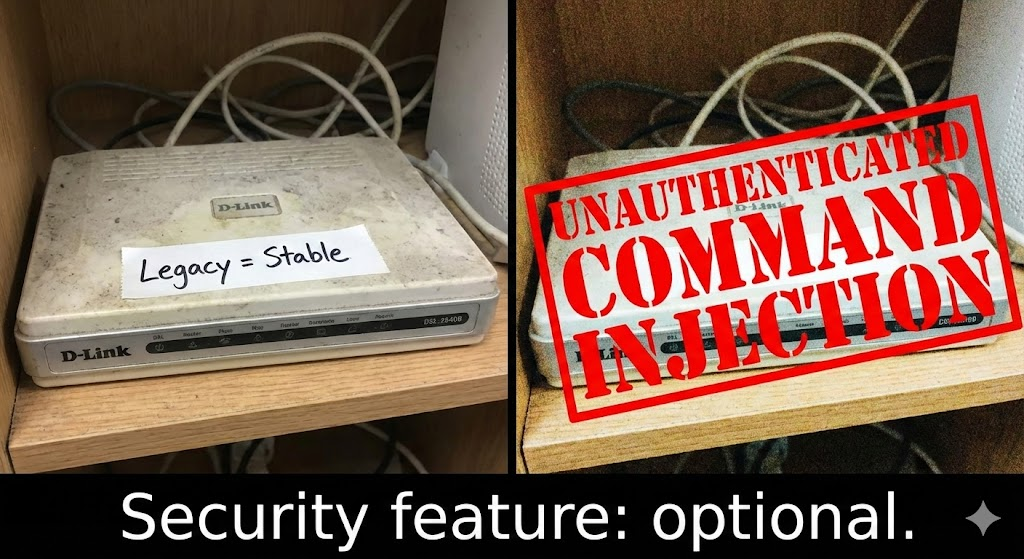
CVE-2026-0625 is an OS command injection issue (mapped to CWE-78) affecting multiple legacy D-Link DSL gateway devices. The vulnerable surface is the device’s embedded web management stack, specifically the dnscfg.cgi endpoint used for DNS configuration. Because DNS parameters are not properly sanitized, an unauthenticated attacker can inject shell metacharacters and achieve remote code execution (RCE). The CNA (VulnCheck) assigned a CVSS 9.3 (Critical) score. (एनवीडी)
But the operational impact is not just “critical RCE.” The real story is lifecycle gravity: these devices are end-of-life/end-of-support, and public guidance consistently converges on retire and replace rather than patch. In other words, defenders are forced into compensating controls—network exposure reduction, segmentation, and DNS integrity monitoring—because firmware remediation is often off the table. (supportannouncement.us.dlink.com)
What’s affected (confirmed) and what remains uncertain
Public reporting provides a concrete, confirmed set of impacted models and firmware ranges. VulnCheck and downstream coverage list the following (note the inequality ranges):
| Model | Confirmed vulnerable firmware range | Notes |
|---|---|---|
| DSL-526B | ≤ 2.01 | Legacy/EOL, unauth RCE via dnscfg.cgi (VulnCheck) |
| DSL-2640B | ≤ 1.07 | Legacy/EOL, unauth RCE via dnscfg.cgi (VulnCheck) |
| DSL-2740R | < 1.17 | Legacy/EOL, unauth RCE via dnscfg.cgi (VulnCheck) |
| DSL-2780B | ≤ 1.01.14 | Legacy/EOL, unauth RCE via dnscfg.cgi (VulnCheck) |
The important nuance: D-Link states there’s no reliable way to determine affected models by model number alone, because the vulnerable CGI library can vary across firmware builds; verification may require direct firmware inspection. (supportannouncement.us.dlink.com)
This is a classic trap in edge-device vuln management: inventory labels don’t always map cleanly to software lineage. If you operate carriers, branches, or “shadow IT” gateways, assume your exposure is broader than the neat four-row table until proven otherwise.
Exploitation context: how attackers reach dnscfg.cgi in real environments
The dominant high-CTR phrase in top-ranking headlines is essentially a composite: “actively exploited zero-day / critical RCE / end-of-life routers.” You’ll see the same hook repeated across major security outlets because it compresses three urgency signals into one line: exploitation is happening now, impact is full code execution, and patching is unlikely. (The Hacker News)
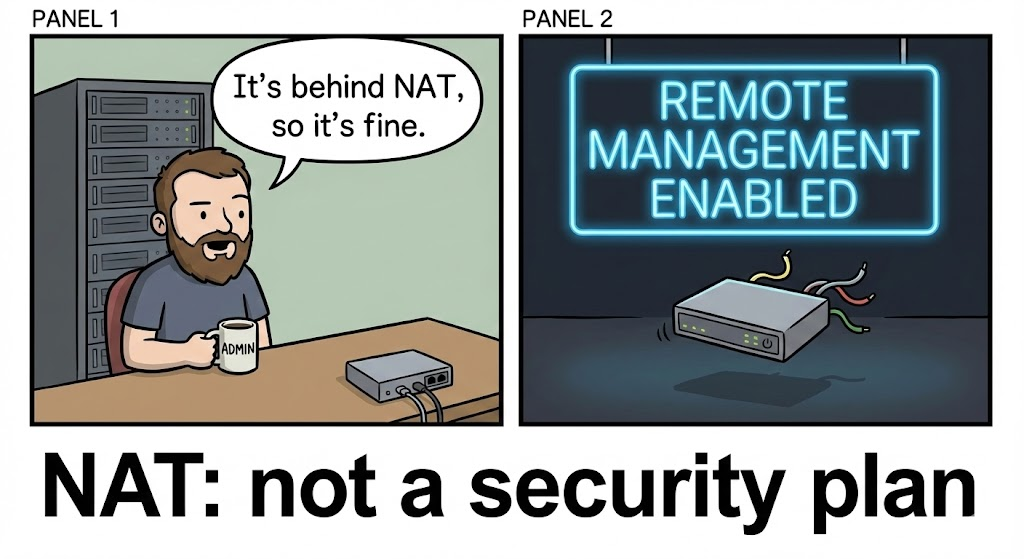
From a defender’s perspective, the practical question is not “is it exploitable?” (it is), but “is my management plane reachable?” Many consumer DSL gateways expose administrative CGI endpoints only on LAN by default. BleepingComputer notes that exploiting CVE-2026-0625 may imply either a browser-based path or a device configured for remote administration, since many setups restrict management endpoints such as dnscfg.cgi to local networks. (BleepingComputer)
That said, edge-device compromise doesn’t require WAN admin to be enabled in every scenario. Once an attacker gains a foothold inside a network (phishing, a compromised endpoint, malicious extension, or an exposed service), the router’s web UI becomes a high-leverage target. The reason is DNS control: if an attacker can change DNS resolvers at the gateway, every downstream device inherits a silent traffic-steering primitive.
D-Link’s own historical write-ups tie this class of behavior to GhostDNS/DNSChanger campaigns: password guessing against default credentials (e.g., admin/admin), scanning for exposed CGI paths like dnscfg.cgi, and then rewriting DNS values to redirect users to attacker infrastructure. (supportannouncement.us.dlink.com)
What to do today: safe verification without weaponizing the bug
Below is a defensible workflow for security teams. It focuses on exposure identification और DNS integrity checks—not exploit reproduction.
Step 1: Find your potential management plane exposure
Start with asset discovery:
- Internet-facing IPs that expose HTTP(S) on common and uncommon ports (80/443/8080/8443, etc.).
- Branch offices and “temporary” connectivity setups (the places where legacy gateways persist).
- Public DNS records that map to CPE management endpoints (occasionally mislabeled as “monitoring” or “admin”).
Step 2: Check whether dnscfg.cgi is reachable (no payloads)
This Python snippet performs a simple reachability and auth-boundary check.
import requests

def probe_dnscfg(base_url: str, timeout=6):
    url = base_url.rstrip("/") + "/dnscfg.cgi"
    try:
        r = requests.get(url, timeout=timeout, allow_redirects=False)
        return {
            "url": url,
            "status": r.status_code,
            "server": r.headers.get("Server", ""),
            "www_authenticate": r.headers.get("WWW-Authenticate", ""),
            "location": r.headers.get("Location", ""),
        }
    except requests.RequestException as e:
        return {"url": url, "error": str(e)}

targets = [
    "<http://192.168.1.1>",
    # "<https://example-gateway.company.com>",
]

for t in targets:
    print(probe_dnscfg(t))
Interpretation tips:
- 200 without auth → your management plane may be dangerously exposed.
- 401/302 to login → still high risk if credentials are weak, reused, or default.
- Errors/timeouts → can indicate filtering, non-HTTP service, or simply not present.
Step 3: Treat DNS changes as a primary compromise indicator
Because CVE-2026-0625 sits on the DNS configuration path, “did my resolvers change?” is the most practical detection question. D-Link explicitly describes DNSChanger workflows as rewriting router DNS to redirect banking and other high-value traffic. (supportannouncement.us.dlink.com)
Operationally:
- Validate router-configured DNS resolvers against your approved baseline.
- Validate DHCP-handed DNS on sampled clients (Windows
ipconfig /all, macOSscutil --dns). - Alert on sudden resolver shifts, especially to residential ranges or unusual ASNs.
Mitigation when patching isn’t an option: a prioritized playbook
Coverage and vendor messaging emphasize that the impacted models are legacy and should be replaced; SecurityWeek explicitly states that no patch will be released and advises owners to retire and replace. (SecurityWeek)
A pragmatic mitigation ladder:
1) Replace (the only clean end state).
If the device is EOL/EOS, modernization is risk reduction you can actually measure.
2) Collapse the attack surface.
Disable WAN-side admin, block inbound access to management ports at the ISP edge, and restrict admin access to a hardened management VLAN.
3) Segment blast radius.
Separate router management, user endpoints, IoT, and guest networks. Assume internal compromise happens; design so it doesn’t become DNS control of everything.
4) Credential hygiene.
Default credentials and weak passwords remain a recurring theme in GhostDNS/DNSChanger narratives. (supportannouncement.us.dlink.com)
5) DNS integrity controls.
Where possible, enforce approved resolvers and monitor for deviations. Even if a legacy gateway is compromised, your detection should trip on resolver drift.
Related CVEs: the broader pattern you should optimize for
CVE-2026-0625 fits a repeating exploitation template: edge device + web management + injection/bypass + automation-friendly scanning. That pattern is why these issues get botnet attention and why “EOL” is such a painful multiplier.
A few high-signal parallels:
- CVE-2023-1389 (TP-Link Archer AX21): NVD describes an unauthenticated command injection in the web management interface, and TP-Link acknowledges reports of the CVE being added to the Mirai botnet arsenal. (एनवीडी)
- CVE-2024-3400 (Palo Alto Networks PAN-OS GlobalProtect): PAN’s advisory frames it as a chain leading to root-level code execution for specific configurations—illustrating how “edge RCE” crosses from consumer to enterprise perimeter. (security.paloaltonetworks.com)
- CVE-2024-12987 (DrayTek Vigor): Armis describes it as a critical OS command injection in a router web management handler. (Armis)
If you’re building a vulnerability prioritization rubric, consider encoding this as a rule: management plane vulnerabilities on edge devices get elevated priority, even when the impacted products are “just a few routers,” because the control they provide (DNS, routing, NAT) amplifies downstream compromise.
Penligent Workflow: From Asset Discovery to Evidence-Chain Reporting
If your workflow includes Penligent, CVE-2026-0625 is a strong candidate for a repeatable exposure-to-evidence pipeline: discover internet-reachable admin surfaces, fingerprint and correlate edge assets, and generate an evidence-chain report showing where management planes are reachable and whether suspicious DNS configuration behavior exists. Penligent’s public positioning and documentation emphasize orchestrated testing and report output across end-to-end workflows. (पेनलिजेंट)
In practice, the value is not “one-click exploit.” It’s operational: turning the messy reality of legacy edge devices into a trackable remediation program (replace, restrict, segment), backed by artifacts your IT owners can act on.
Authoritative reference links
- NVD: https://nvd.nist.gov/vuln/detail/CVE-2026-0625 (एनवीडी)
- D-Link advisory (SAP10488): https://supportannouncement.us.dlink.com/security/publication.aspx?name=SAP10488 (supportannouncement.us.dlink.com)
- VulnCheck advisory: https://www.vulncheck.com/advisories/dlink-dsl-command-injection-via-dns-configuration-endpoint (VulnCheck)
- CWE-78: https://cwe.mitre.org/data/definitions/78.html (एनवीडी)
- BleepingComputer coverage (versions + lifecycle context): https://www.bleepingcomputer.com/news/security/new-d-link-flaw-in-legacy-dsl-routers-actively-exploited-in-attacks/ (BleepingComputer)
 Hindi
Hindi  English
  German
  French
  Spanish
  Portuguese
  Japanese
  Korean
  Arabic
  Turkish
  Hebrew