
CVE-2026-46331 is a Linux kernel local privilege escalation flaw in the traffic-control packet editor path. It is not a remote drive-by bug, and it does not mean every Linux server is instantly exposed from the internet. The risk is narrower and more operationally important: if an attacker can already run low-privileged code on a vulnerable host, the act_pedit bug can help turn that local foothold into root by corrupting page-cache-backed memory. NVD records the kernel.org CNA score as 7.8 High, while Red Hat describes the issue as an Important privilege escalation in the Linux traffic-control subsystem. (एनवीडी)
The issue is commonly discussed as “pedit COW” because it sits at the intersection of packet editing, copy-on-write logic, and page-cache corruption. The vulnerable code path lives around the Linux act_pedit action, where packet bytes may be modified according to configured edit keys. The flaw comes from ensuring writability for one estimated range, then performing later writes whose final runtime offsets can fall outside that protected range. In practical terms, part of the packet data that should have been copied before modification may remain shared or page-backed when the kernel writes through it. (एनवीडी)
That detail matters because page-cache corruption is not just “memory weirdness.” Linux uses the page cache to hold file-backed data in memory. If a kernel write corrupts a page-cache-backed fragment, the attacker may influence what another process later reads or executes from memory, even when the file on disk has not obviously changed. Public reporting and public PoC discussion describe an exploit path that poisons cached content for a setuid-root binary, but defenders should not treat this as a recipe to reproduce on production systems. The safer and more useful task is to identify whether the vulnerable kernel path is reachable, whether untrusted local code can reach the needed capabilities, and whether the host has received the vendor fix. (द हैकर न्यूज़)
| Question defenders need answered | Practical answer |
|---|---|
| What is CVE-2026-46331? | A Linux kernel local privilege escalation vulnerability in the act_pedit traffic-control action. |
| What is the bug class? | Partial copy-on-write failure leading to page-cache corruption. |
| What is the vulnerable component? | Linux traffic control, mainly net/sched/act_pedit.c and related tc_pedit logic. (एनवीडी) |
| Is it remote by itself? | No. It requires local code execution or an equivalent local foothold. |
| Why is it serious? | A low-privileged local user may be able to escalate to root on vulnerable and reachable systems. Red Hat explicitly describes local root escalation risk. (Red Hat Customer Portal) |
| What raises exposure? | Untrusted local users, shared CI runners, Kubernetes worker nodes, rootless container environments, permissive user namespaces, and hosts where act_pedit can be loaded or used. |
| What is the primary fix? | Install the vendor-fixed kernel and reboot into it. |
| What are temporary mitigations? | Block or unload act_pedit where safe, restrict unprivileged user namespaces where compatible, and isolate untrusted workloads. (Red Hat Customer Portal) |
| Why is detection hard? | Page-cache corruption may not modify the file on disk, so file hash checks and classic file-integrity monitoring can miss the key event. |
Why a traffic-control packet editor can become a root bug
Linux traffic control exists for legitimate network engineering. Administrators use tc to shape, classify, police, redirect, and sometimes modify packets. In that model, filters decide which packets match, qdiscs control scheduling, and actions perform operations on matching packets. Packet editing is one of those operations. The pedit action can change packet bytes by offset or by known protocol fields, which is useful for specialized routing, network testing, tunneling, encapsulation, and policy enforcement. (man7.org)
The security problem is not that packet editing exists. The problem is that packet editing touches packet memory in a kernel context, and packet memory is not always a simple linear buffer privately owned by one code path. Linux packets are represented by sk_buff structures, and those structures can include linear data plus fragments. Some fragments may be shared. Some may be backed by pages that also represent file data. Before a kernel path writes into packet data, it must make sure the target bytes are safe to write. If the bytes are shared or page-cache-backed, the kernel must copy or otherwise prepare the memory so the write does not corrupt data that belongs to another context.
CVE-2026-46331 is a failure in that preparation step. The vulnerable path calculated a rough writable prefix before processing the edit keys, but the final offset for a typed key could be computed later, inside the loop, using current header state. Red Hat’s bug record explains that TCP and UDP keys recompute the L4 base from the current L3 header in the key loop, and an earlier key can change a later header-relative base. That can make the final store land outside the initially ensured writable prefix. (Red Hat Bugzilla)
A simplified version of the mistake looks like this:
/*
 * Simplified shape of the bug, not kernel source and not exploit code.
 * The important part is the timing: writability is estimated before
 * final per-key offsets are known.
 */

max_hint = estimate_writable_prefix_from_rule(rule);
skb_ensure_writable(skb, max_hint);

for each key in rule.keys {
    offset = compute_runtime_offset(key, skb);

    /*
     * If offset is beyond the earlier max_hint, this write may touch
     * data that was not safely copied before modification.
     */
    write_packet_bytes(skb, offset, key.value);
}
The fixed shape moves the safety check closer to the actual write:
/*
 * Simplified fixed shape.
 * The final offset is computed first, then the exact range is made writable
 * before the packet bytes are read or written.
 */

for each key in rule.keys {
    offset = compute_runtime_offset(key, skb);
    length = key.write_length;

    if (!offset_is_valid(offset, length))
        reject_or_skip_key();

    skb_ensure_writable(skb, offset + length);
    write_packet_bytes(skb, offset, key.value);
}
The real patch is more specific than this pseudocode. NVD’s description says the fix moves skb_ensure_writable() inside the per-key loop, adds overflow checking, uses skb_cow() for negative offsets, and guards offset_valid() against INT_MIN. Those details are important because kernel bugs often survive when a patch fixes the common path but leaves arithmetic edge cases alive. (एनवीडी)
The copy-on-write failure in plain technical terms
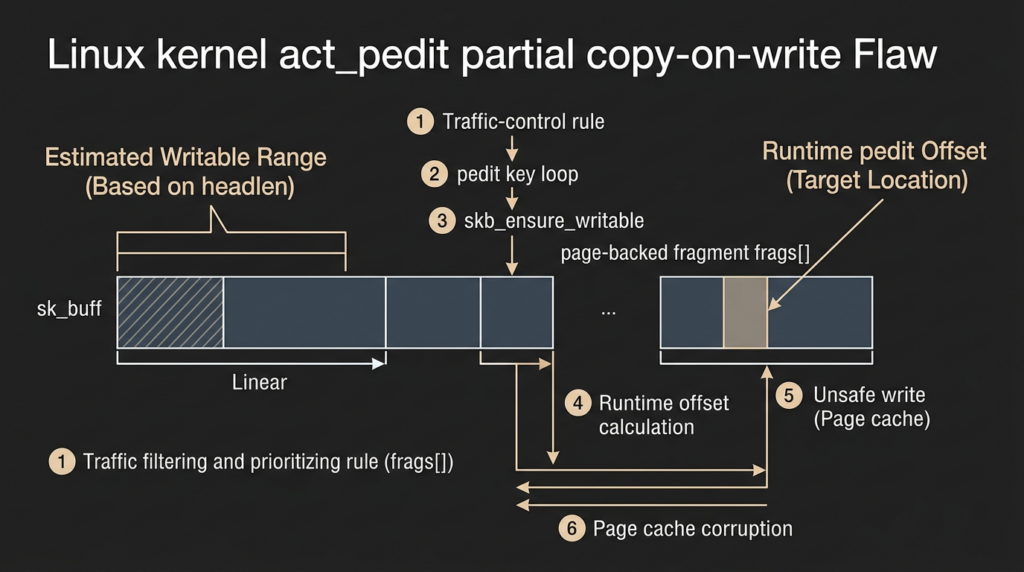
Copy-on-write is a performance technique that lets memory be shared until someone needs to modify it. Instead of copying data immediately, the system lets readers share the same backing memory and creates a private copy when a writer appears. This works only if the write path correctly identifies the bytes it is about to modify. If the write path underestimates the range, it may copy the first part and then write beyond the copied region into memory that is still shared.
That is why the phrase “partial COW” is more than a nickname. CVE-2026-46331 is dangerous because the kernel can believe it has made the packet data writable when only part of the eventual write target has been protected. The estimated range was based on a hint, while the final edit location could depend on packet header state that was resolved later. The bug is not merely “missing bounds check” in the abstract. It is a mismatch between pre-loop writability assumptions and per-key runtime offsets.
The exploitability of this class depends on several conditions. The attacker needs a way to arrange packet data and edit rules so the later write reaches the wrong kind of backing memory. The attacker also needs the privilege to configure the relevant traffic-control action. On many systems, that capability is normally administrative. The reason user namespaces matter is that a process can sometimes gain capabilities inside a new namespace even though it is not root on the host. A local unprivileged user may not have host-level CAP_NET_ADMIN, but user namespace and network namespace behavior can create a namespace-local route to traffic-control operations.
That does not make every machine exploitable. It does mean defenders should not dismiss the bug only because tc looks like an admin tool. A vulnerability reachable through namespace-local capabilities can be serious on systems that allow unprivileged namespace creation, run untrusted jobs, host developer workloads, or execute third-party code in CI.
Why page-cache corruption crosses a privilege boundary
The page cache is a performance layer, but it is also part of the operating system’s trust boundary. When a process reads a file, Linux may serve the content from cached memory instead of reading from disk. When a process executes a binary, the kernel may map file-backed pages into memory. If a vulnerability corrupts cached file-backed pages, the system can behave as if a trusted file has changed even when the on-disk file appears intact.
That is the reason defenders should take page-cache bugs seriously. File permissions may prevent an unprivileged user from modifying /bin/su or another privileged binary on disk. But if a kernel bug lets that user corrupt the cached bytes later used for execution, the permission model has been bypassed in memory. Public coverage of CVE-2026-46331 describes a working exploit strategy based on poisoning cached setuid-root program content, and the public PoC repository describes root results on selected distributions and kernels. (द हैकर न्यूज़)
This pattern is familiar. Dirty COW, tracked as CVE-2016-5195, was a Linux kernel race condition involving incorrect copy-on-write handling that allowed local users to gain privileges by writing to read-only memory mappings, and NVD notes it was exploited in the wild in 2016. (एनवीडी) Dirty Pipe, CVE-2022-0847, came from uninitialized pipe buffer flags and allowed a local user to write to page-cache-backed read-only files; CISA later added it to the Known Exploited Vulnerabilities catalog. (एनवीडी) Copy Fail, CVE-2026-31431, was another Linux local privilege escalation path involving page-cache corruption, with Microsoft describing public PoC availability and risk to cloud, Kubernetes, and CI environments. (माइक्रोसॉफ्ट)
CVE-2026-46331 belongs in that mental bucket. The triggering subsystem is different, but the defender’s question is similar: can a local attacker influence file-backed memory that should be protected by file permissions and kernel memory safety rules?
Attack path, without turning it into an exploit recipe
A safe way to reason about CVE-2026-46331 is to model the attack chain as a set of gates. Each gate reduces or increases practical risk.
| Gate | What the attacker needs | Defender question |
|---|---|---|
| Local foothold | Ability to run code as a low-privileged user, CI job, container user, plugin, agent tool, or compromised service account | Can untrusted or semi-trusted code run on this host? |
| Namespace path | Ability to obtain the needed namespace-local network administration capability | Are unprivileged user namespaces enabled? Are AppArmor namespace restrictions active? |
| Reachable component | act_pedit available, loadable, or already loaded | Is the module present? Is it loaded? Is tc pedit used in production? |
| Vulnerable kernel | Kernel build contains the vulnerable code and lacks vendor backport | What does the vendor advisory say for this exact package? |
| Useful target | Page-cache-backed content can be corrupted in a way that affects privileged execution | Are setuid binaries, shared nodes, and multi-user workloads present? |
| Persistence or command execution | Attacker obtains root shell or equivalent control | Can monitoring catch abnormal namespace, tc, module, and setuid execution behavior? |
The public exploit discussion is enough to treat this as a real local privilege escalation risk, but defenders do not need to run exploit code to start reducing risk. A production validation plan should begin with inventory, module state, namespace policy, vendor status, and safe mitigation checks. Exploit execution belongs only in an authorized, isolated lab where the host can be destroyed and rebuilt afterward.
This distinction matters for security teams. Running a public LPE PoC on production creates its own incident. Page-cache poisoning can change runtime behavior in ways that are hard to prove clean afterward. Even if a machine appears normal after a failed exploit attempt, a failed local root exploit is not a benign scanner result. Treat exploit-based validation as a destructive test unless you have strong evidence otherwise.
Vendor status is not a single global answer
Kernel CVEs are rarely uniform across distributions. Upstream Linux versions, stable branches, vendor backports, enterprise kernels, cloud kernels, hardening defaults, module policies, and namespace settings can all change the answer. CVE-2026-46331 is a good example.
Red Hat’s security bulletin describes an Important privilege escalation in act_pedit, says a local account can exploit the missing bounds check and page-cache corruption to gain root, and lists RHEL 8, RHEL 9, RHEL 10, RHEL for NVIDIA, and OpenShift-related products as affected or potentially impacted depending on the underlying kernel. Red Hat also notes that OpenShift Container Platform is assessed as lower severity because the module is not loaded by default. (Red Hat Customer Portal)
Ubuntu’s CVE page, updated on June 27, 2026, lists CVE-2026-46331 as High priority and shows several Ubuntu releases, including 26.04 LTS, 25.10, 24.04 LTS, 22.04 LTS, 20.04 LTS, and 18.04 LTS, as vulnerable for the main linux package at that time. (Ubuntu) Debian’s tracker shows a more branch-specific picture: trixie security has a fixed version, while several bullseye and bookworm entries still appear vulnerable in the tracker snapshot. (Security Tracker) AWS rates the issue Medium in its advisory, lists some Amazon Linux kernels as pending fix, and states that the Amazon Linux 2 core kernel is not affected. (Amazon Explore)
| Vendor or distribution source | Status signal from the advisory | Operational reading |
|---|---|---|
| Red Hat | Important impact, RHEL 8/9/10 affected, mitigation includes blocking act_pedit where safe. (Red Hat Customer Portal) | Treat shared RHEL hosts and OpenShift nodes as patch-priority assets, but check whether the module and kernel package are actually present. |
| Ubuntu | High priority; multiple supported releases listed as vulnerable in the CVE page snapshot. (Ubuntu) | Do not assume an Ubuntu host is safe because it is “new.” Check the exact kernel package and update status. |
| Debian | trixie security fixed in tracker snapshot, while some older branches still show vulnerable entries. (Security Tracker) | Use the Debian security tracker and installed package version, not generic kernel version comparisons. |
| Amazon Linux | AWS uses Medium severity, AL2 core kernel not affected, several other kernel packages pending fix. (Amazon Explore) | Cloud severity may differ because AWS evaluates package exposure and privilege assumptions differently. Still patch affected kernels. |
The severity differences do not necessarily mean the sources disagree about the bug. They often differ in assumptions. One vendor may assume high local privilege requirements. Another may assume unprivileged user namespaces are available. A container platform may reduce severity if the relevant module is not loaded by default. A cloud distribution may split affected and unaffected kernel packages more narrowly. For defenders, the practical rule is simple: trust your vendor’s package status for remediation, but use the highest credible exploitability model when prioritizing shared or untrusted-code systems.
How to check exposure safely
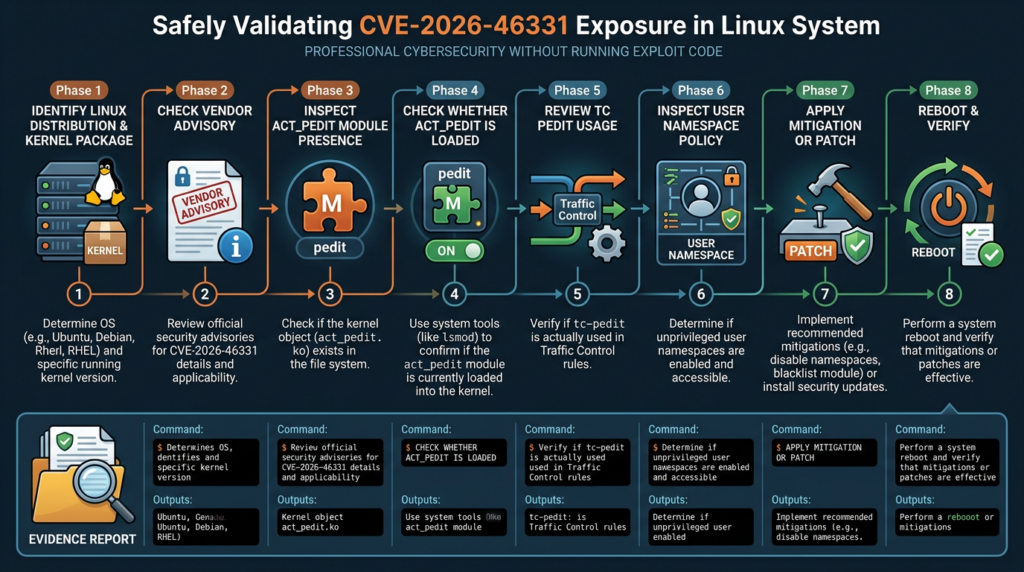
A safe exposure check should answer five questions. What kernel package is installed? Does the vendor say that package is vulnerable? Is act_pedit present or loaded? Are pedit actions in use? Can untrusted local users create the namespace conditions that make the bug reachable?
Start with basic system identity. Do not stop at uname -r; vendors backport fixes without changing upstream version numbers in obvious ways.
uname -a
cat /etc/os-release 2>/dev/null || true

# Red Hat, Fedora, CentOS Stream, AlmaLinux, Rocky
rpm -q kernel kernel-core 2>/dev/null || true

# Debian and Ubuntu
dpkg -l 'linux-image*' 2>/dev/null | awk '/^ii/ {print $2, $3}' || true
Then check whether the packet editing action is present and whether it is loaded. modinfo only tells you whether the module exists on the system. lsmod tells you whether it is currently loaded. A module that is not loaded may still be auto-loadable if a privileged or namespace-capable process triggers the right path.
if modinfo act_pedit >/dev/null 2>&1; then
  echo "act_pedit module is present"
  modinfo act_pedit | sed -n '1,20p'
else
  echo "act_pedit module not found through modinfo"
fi

if lsmod | awk '{print $1}' | grep -qx 'act_pedit'; then
  echo "act_pedit is currently loaded"
else
  echo "act_pedit is not currently loaded"
fi
अगर tc is installed, check whether pedit actions are configured. This is not a complete exploitability test. It is an operations check: if your production networking depends on pedit, blocking the module may break traffic policy.
command -v tc >/dev/null 2>&1 && {
  echo "Listing configured pedit actions, if visible"
  tc actions list action pedit 2>/dev/null || true
}
Next check namespace-related policy. Different distributions expose different sysctls. Missing keys are normal.
for key in \
  user.max_user_namespaces \
  kernel.unprivileged_userns_clone \
  kernel.apparmor_restrict_unprivileged_userns \
  kernel.apparmor_restrict_unprivileged_unconfined
do
  value="$(sysctl -n "$key" 2>/dev/null || true)"
  if [ -n "$value" ]; then
    echo "$key=$value"
  else
    echo "$key=not present"
  fi
done
Ubuntu-specific AppArmor behavior matters because public PoC discussion distinguishes between versions and policy settings. The public PoC README claims Ubuntu 24.04.4 could be reached through an AppArmor profile route under one setting combination, while Ubuntu 26.04 blocked that path by default under a stricter unconfined-userns setting. Treat that as PoC-author reporting, not a universal guarantee. The correct production answer is still to check the installed kernel package and current policy. (गिटहब)
For repeatable internal triage, use a non-exploit collection script. This script does not attempt to trigger the vulnerability. It only gathers evidence for remediation planning.
#!/usr/bin/env bash
set -euo pipefail

echo "== System =="
uname -a
cat /etc/os-release 2>/dev/null || true

echo
echo "== Kernel packages =="
if command -v rpm >/dev/null 2>&1; then
  rpm -q kernel kernel-core 2>/dev/null || true
fi

if command -v dpkg >/dev/null 2>&1; then
  dpkg -l 'linux-image*' 2>/dev/null | awk '/^ii/ {print $2, $3}' || true
fi

echo
echo "== act_pedit module =="
if modinfo act_pedit >/dev/null 2>&1; then
  echo "present=yes"
  modinfo act_pedit | sed -n '1,25p'
else
  echo "present=no_or_builtin_or_unavailable"
fi

if lsmod | awk '{print $1}' | grep -qx 'act_pedit'; then
  echo "loaded=yes"
else
  echo "loaded=no"
fi

echo
echo "== tc pedit actions =="
if command -v tc >/dev/null 2>&1; then
  tc actions list action pedit 2>/dev/null || echo "no visible pedit actions or insufficient privilege"
else
  echo "tc command not installed"
fi

echo
echo "== Namespace policy =="
for key in \
  user.max_user_namespaces \
  kernel.unprivileged_userns_clone \
  kernel.apparmor_restrict_unprivileged_userns \
  kernel.apparmor_restrict_unprivileged_unconfined
do
  if sysctl "$key" >/dev/null 2>&1; then
    sysctl "$key"
  else
    echo "$key=not present"
  fi
done

echo
echo "Next step: compare installed kernel package with the vendor advisory."
The final line is intentional. Kernel version strings are not enough. Enterprise vendors often backport security fixes into older kernel version families. A host can run a kernel that looks old by upstream numbering but contains the fix, or it can run a newer-looking package that has not yet received the distribution-specific patch.
Mitigation choices and what they can break
The clean fix is to install a vendor-fixed kernel and reboot. Kernel updates do not protect the running kernel until the host boots into the fixed image. In fleets where reboot windows are hard, that last step is often the real security gap. Patch dashboards that show “package installed” but do not verify the running kernel can give a false sense of closure.
On Red Hat-family systems, the basic remediation path is normally a kernel update followed by reboot:
sudo dnf update 'kernel*'
sudo reboot
After reboot, verify the running kernel and package state:
uname -r
rpm -q kernel kernel-core 2>/dev/null || true
On Debian and Ubuntu-family systems, update the kernel packages through the vendor channel, reboot, and verify:
sudo apt update
sudo apt full-upgrade
sudo reboot
After reboot:
uname -r
dpkg -l 'linux-image*' 2>/dev/null | awk '/^ii/ {print $2, $3}'
Where immediate patching is not possible, Red Hat recommends blocking the act_pedit module if the system does not require it, and warns that this can affect systems that rely on tc pedit. Its bulletin gives a blacklist-style mitigation and recommends checking whether the module is loaded. (Red Hat Customer Portal) A stricter local control is an install override, which prevents normal module loading through modprobe:
echo 'install act_pedit /bin/true' | sudo tee /etc/modprobe.d/disable-act_pedit.conf

# If the module is already loaded and no active pedit rules depend on it:
sudo rmmod act_pedit 2>/dev/null || echo "act_pedit could not be unloaded"
Use this only after confirming that production traffic control does not depend on pedit. Breaking packet modification on a router, gateway, lab appliance, or network test host can create an outage that looks unrelated to a security change.
Restricting unprivileged user namespaces can reduce exploitability, but it has a larger blast radius. Rootless containers, build systems, browser sandboxes, Flatpak, developer tooling, and some CI isolation models may rely on user namespaces. On some enterprise Linux systems, reducing user namespaces may look like this:
sudo sysctl -w user.max_user_namespaces=0
echo 'user.max_user_namespaces = 0' | sudo tee /etc/sysctl.d/90-disable-userns.conf
On some Debian and Ubuntu systems, the relevant knob may be:
sudo sysctl -w kernel.unprivileged_userns_clone=0
echo 'kernel.unprivileged_userns_clone = 0' | sudo tee /etc/sysctl.d/90-disable-unpriv-userns.conf
Do not apply these blindly across developer or container fleets. Test first. A mitigation that breaks the build pipeline may cause teams to roll it back under pressure, leaving the original vulnerability in place. A better pattern is to prioritize kernel updates, apply module blocking where pedit is unused, and restrict namespaces first on high-risk shared hosts that do not need rootless workloads.
| निवारण | Reduces which risk | Main trade-off | Best fit |
|---|---|---|---|
| Vendor-fixed kernel plus reboot | Removes the vulnerable kernel code path | Requires maintenance window and reboot verification | All affected systems |
Block act_pedit module | Prevents normal use or autoloading of the vulnerable action | Breaks legitimate tc pedit use | Hosts that do not use packet editing |
Unload act_pedit | Removes currently loaded module until reloaded | Unsafe if active traffic rules depend on it | Short-term containment after dependency check |
| Restrict unprivileged user namespaces | Removes a common local path to namespace capabilities | Can break rootless containers, browser sandboxes, Flatpak, and CI | Shared hosts with untrusted local users |
| Stronger workload isolation | Limits attacker movement after low-privileged code execution | Requires architecture change | CI runners, Kubernetes nodes, AI agent sandboxes |
| Drop page cache | May clear poisoned cached content temporarily | Does not fix the bug or prove host integrity | Emergency containment only |
Dropping page cache deserves special caution. If a page-cache attack is suspected, clearing cache may remove a poisoned in-memory view, but it does not answer whether the attacker already obtained root, modified the system, installed persistence, or stole secrets. It is not remediation. It is at most a containment step inside a broader incident response plan.
Detection and investigation
There may be no single reliable signature for CVE-2026-46331 exploitation. That is typical for local kernel privilege escalation bugs, and it is especially true when the meaningful corruption is in page-cache-backed memory rather than an obvious on-disk file. File-integrity monitoring can still be useful for post-root persistence, but it should not be treated as proof that page-cache corruption did not occur.
Better detection focuses on behavior around the exploit gates. Unexpected use of tc, loading of act_pedit, creation of unprivileged user namespaces, and sudden execution of setuid-root programs by unusual users are all higher-value signals. None is perfect. Network administrators may legitimately run tc. Container tools may legitimately create namespaces. Setuid binaries are normal on Linux. The detection value comes from sequence, user context, host role, and rarity.
A basic auditd setup can capture useful signals:
# Track execution of tc from common paths.
sudo auditctl -w /sbin/tc -p x -k tc_exec 2>/dev/null || true
sudo auditctl -w /usr/sbin/tc -p x -k tc_exec 2>/dev/null || true

# Track kernel module load and unload syscalls.
sudo auditctl -a always,exit -F arch=b64 -S init_module -S finit_module -S delete_module -k kernel_module_change

# Search later.
sudo ausearch -k tc_exec
sudo ausearch -k kernel_module_change
For higher signal, enrich these events with user identity, parent process, container ID, CI job ID, Kubernetes pod name, and whether the host normally uses traffic-control actions. On a Kubernetes node, an unexpected tc execution from a workload context is more suspicious than the same command run by a CNI plugin or node networking service. On a CI runner, namespace creation followed by tc execution and then a setuid program should be treated as suspicious even if each event is individually allowed.
| Signal | यह क्यों मायने रखती है | Data source | False-positive risk |
|---|---|---|---|
act_pedit module load on a host that does not use pedit | The vulnerable action may have become reachable | auditd, kernel logs, EDR, module inventory | Low to medium |
tc actions या tc filter commands from unusual users | Exploit setup may require traffic-control configuration | shell logs, auditd, process telemetry | Medium on network hosts |
Unprivileged user namespace creation before tc activity | Namespace-local capabilities may be part of the path | auditd, eBPF telemetry, container runtime logs | Medium to high |
Setuid-root binary execution after suspicious namespace and tc activity | Page-cache poisoning attacks may target privileged execution paths | process telemetry, auditd | मध्यम |
| Root shell spawned from CI, build, plugin, or agent process | Possible successful local privilege escalation | EDR, session logs, CI logs | Low if source role should never become root |
| File hash unchanged despite suspicious privileged execution | Page-cache corruption may not alter disk content | FIM plus process telemetry | High if used alone |
Incident response should assume that a suspected successful exploit means host compromise, not just kernel instability. Preserve volatile data if possible, isolate the host, collect logs, snapshot the system if the platform allows it, and rebuild from trusted images after patching. For shared CI and Kubernetes worker nodes, also rotate secrets that were accessible to jobs or pods scheduled on the host during the suspected compromise window.
Containers, Kubernetes, CI runners, and agentic workflows
CVE-2026-46331 is a local bug, but modern infrastructure creates local footholds constantly. A pull request runs code in CI. A build step executes package scripts. A container runs a third-party image. A browser opens untrusted content inside a sandbox. A security lab lets researchers run tools. An AI agent may execute shell commands, clone repositories, run tests, or inspect artifacts. Each case can turn “local only” into “reachable by an attacker who influenced code execution.”
Kubernetes does not automatically neutralize kernel local privilege escalation. Containers share the host kernel. A container escape is not required if the attacker’s path is a kernel bug reachable from a container context with the right namespace and capability conditions. The exact exploitability depends on the pod’s privileges, host settings, namespace policy, seccomp, AppArmor or SELinux, module availability, and kernel version. The safe default is to patch worker nodes and avoid co-locating untrusted workloads on nodes that lag behind kernel security updates.
CI runners deserve special attention. They commonly execute untrusted or semi-trusted code, hold credentials, and run on long-lived hosts that teams do not treat like production. A successful local privilege escalation on a runner can expose repository tokens, signing keys, cloud credentials, deployment secrets, and build artifacts. For CVE-2026-46331, shared runners and self-hosted runners should be near the top of the patch queue, especially if they allow rootless containers or user namespaces.
Security teams using agentic testing workflows should treat kernel LPE validation as a controlled evidence-collection task, not an invitation to run public exploits on production. Penligent’s CVE-2026-46331 field note makes the same practical distinction: determine whether the vulnerable kernel path is reachable, capture module and namespace evidence, and verify remediation rather than turning live hosts into exploit labs. In authorized environments, an agentic pentesting workflow can preserve the evidence defenders actually need — kernel package state, act_pedit availability, namespace policy, mitigation checks, and post-reboot verification — while keeping exploit execution confined to lab systems. (पेनलिजेंट)
The right control model is layered. Patch the kernel. Reduce namespace exposure where possible. Block act_pedit if unused. Avoid running untrusted jobs on general-purpose hosts. Use ephemeral CI runners for high-risk projects. Keep privileged containers rare and reviewed. Treat any unexpected root transition from a build, plugin, scanner, or AI tool as an incident until proven otherwise.
Related CVEs and the pattern defenders should notice
CVE-2026-46331 is easier to prioritize when placed next to earlier Linux memory and page-cache privilege escalation bugs. The point is not that all of these vulnerabilities are identical. They are not. The point is that kernel writes into shared or file-backed memory can break assumptions that defenders often rely on: file permissions, disk hashes, and “local only” severity labels.
| सीवीई | मूल समस्या | Why it is relevant | Defensive lesson |
|---|---|---|---|
| CVE-2016-5195, Dirty COW | Race condition in Linux COW handling allowed local users to write to read-only memory mappings and gain privileges. NVD notes in-the-wild exploitation in 2016. (एनवीडी) | Shows that COW bugs can become practical local root vulnerabilities. | Local kernel memory bugs can become urgent when exploit code is reliable. |
| CVE-2022-0847, Dirty Pipe | Uninitialized pipe buffer flags allowed local users to write to page-cache-backed read-only files. (एनवीडी) | Shows that page-cache-backed file content can be a privilege boundary. | File hashes may not tell the whole story during runtime corruption. |
| CVE-2026-31431, Copy Fail | लिनक्स algif_aead issue involving page-cache corruption and local privilege escalation risk; Microsoft described public PoC availability and risk to cloud, Kubernetes, and CI environments. (माइक्रोसॉफ्ट) | Shows that page-cache corruption remains a modern kernel exploitation pattern. | Patch shared compute and build infrastructure quickly even when bugs are local. |
| CVE-2026-46300 | लिनक्स sk_buff shared-frag marker loss during coalescing could let later in-place writers miss shared or page-cache-backed fragments. (एनवीडी) | Technically adjacent to packet buffer shared-fragment safety. | Packet buffer metadata invariants are security-sensitive. |
| CVE-2026-46331 | act_pedit partial COW caused by pre-loop writability assumptions and later runtime offsets. (एनवीडी) | Combines packet editing, namespace reachability, and page-cache corruption. | Validate kernel state, module reachability, namespace policy, and vendor patch status together. |
This pattern should change how teams triage local Linux kernel bugs. A local-only CVE on a single-user desktop may be a normal patch-cycle issue. The same CVE on a shared CI runner, a Kubernetes node, a university shell server, a bug bounty lab box, or a developer workstation that runs untrusted code is a higher-priority exposure. The difference is not the CVE number. The difference is attacker access to local execution.
Prioritizing remediation
The highest-priority systems are those where untrusted or semi-trusted code execution is normal. Start with shared CI runners, self-hosted GitHub Actions runners, GitLab runners, Jenkins workers, build farms, package testing infrastructure, multi-user servers, security labs, bastion-adjacent developer machines, Kubernetes worker nodes, and any host where users can run containers or create namespaces.
Second, patch developer workstations that regularly run third-party repositories, package scripts, exploit labs, browser automation, AI coding agents, or local test harnesses. These systems often hold high-value credentials but are patched less rigorously than production servers. A local privilege escalation on a developer laptop can become a source-code, cloud-token, or signing-key incident.
Third, patch single-purpose servers even if they do not run untrusted code. The risk may be lower, but kernel patch debt accumulates. If a later application compromise gives an attacker a low-privileged shell, yesterday’s local-only kernel bug becomes today’s root path.
A practical priority model looks like this:
| Priority | Host type | क्यों |
|---|---|---|
| Immediate | Shared CI runners, build farms, multi-user Linux hosts | Untrusted local execution is expected. |
| Immediate | Kubernetes worker nodes running mixed-trust workloads | Containers share the host kernel, and namespace policy varies. |
| Immediate | Security labs, pentest boxes, bug bounty infrastructure | Exploit tools and untrusted code are commonly executed. |
| उच्च | Developer workstations with secrets and third-party code | Local compromise can expose credentials and source. |
| उच्च | Internet-facing servers with any history of app-level RCE or shell upload risk | A web foothold can become root. |
| Normal but required | Single-user controlled hosts with no untrusted code | Lower immediate likelihood, but patching still removes future escalation paths. |
Avoid two common mistakes. The first is treating “local” as “low.” Local privilege escalation is often the second stage of a real intrusion. The second is treating module-not-loaded as fully safe. If a module is present and auto-loadable, and if an attacker can reach a path that loads it, the current lsmod state may not be enough. Module blocking is stronger than observation, but it must be tested against production networking requirements.
Common mistakes during CVE-2026-46331 response
The first mistake is relying only on upstream version numbers. Distribution kernels are patched through backports. A fixed enterprise kernel may not look like a fixed upstream kernel. Always use the vendor’s advisory and package status.
The second mistake is running a public PoC on production to “prove” exposure. This is especially risky for page-cache corruption bugs. If the exploit succeeds, the host is compromised. If it fails, the host may still be in an uncertain state. If it crashes, the test becomes an outage. Production validation should use non-exploit checks unless the host is disposable.
The third mistake is disabling user namespaces without understanding dependencies. Namespace restrictions can be effective, but they may break rootless containers, browser sandboxing, developer tools, and CI workloads. A rushed global change can cause operational rollback and leave the vulnerability unpatched.
The fourth mistake is assuming file-integrity monitoring will catch the attack. Page-cache corruption may affect what is read or executed from memory without changing the on-disk file. FIM is useful for many persistence techniques, but it is not a complete detection strategy for this class.
The fifth mistake is patching packages without rebooting. The vulnerable code remains active until the running kernel changes. Always verify uname -r after reboot and confirm the booted kernel corresponds to the fixed package.
अक्सर पूछे जाने वाले प्रश्न
Is CVE-2026-46331 remotely exploitable?
- No, CVE-2026-46331 is a local privilege escalation issue, not a standalone remote code execution vulnerability.
- The practical risk appears when an attacker can already run code on the host as a low-privileged user, container process, CI job, plugin, or compromised service account.
- Internet-facing systems still matter because a separate application bug can provide the local foothold needed to reach the kernel LPE path.
- Shared CI, Kubernetes, developer, and multi-user systems should be prioritized because local code execution is common in those environments.
What makes pedit COW different from an ordinary kernel bounds bug?
- The vulnerable path involves packet editing in
act_pedit, not a generic file write API. - The bug is tied to a copy-on-write range that was estimated before final per-key offsets were computed.
- A later packet edit can land outside the range that was made safely writable.
- Because the write may touch shared or page-cache-backed fragments, the impact can cross from packet corruption into page-cache corruption and local privilege escalation.
How can I check whether act_pedit is loaded?
- Run
lsmod | grep -w act_peditto see whether the module is currently loaded. - Run
modinfo act_peditto see whether the module is present on the system. - Run
tc actions list action peditto check for visible pedit action configuration, if you have sufficient privileges. - Remember that “not loaded right now” is not the same as “cannot be loaded.” Use module blocking if you need a temporary mitigation and production does not depend on pedit.
Is disabling unprivileged user namespaces a good mitigation?
- It can reduce exploitability by removing a common route to namespace-local capabilities.
- It may break rootless containers, CI isolation, browser sandboxes, Flatpak, and developer workflows.
- It should be tested before broad deployment.
- It is a mitigation, not a patch. The fixed kernel is still the correct remediation.
Why can file-integrity monitoring miss page-cache attacks?
- File-integrity monitoring usually checks files on disk.
- Page-cache corruption can affect cached in-memory file content without producing a normal disk write.
- A setuid binary or other privileged file may appear unchanged by hash while the cached bytes used at runtime have been corrupted.
- FIM remains useful for detecting post-compromise persistence, but it should be combined with process, namespace, module, and
tctelemetry.
Should I run the public PoC to verify exposure?
- Do not run public exploit code on production systems.
- For production, use safe checks: vendor package status, running kernel, module presence, module load state, pedit usage, namespace policy, and reboot verification.
- If exploit validation is required, use an authorized isolated lab with disposable hosts and no production secrets.
- Treat any successful exploit test as host compromise and rebuild the machine afterward.
Which systems should be patched first?
- Patch shared CI runners, build hosts, Kubernetes worker nodes, multi-user servers, and security lab machines first.
- Patch developer workstations quickly if they run untrusted repositories, containers, browser automation, or AI agent toolchains.
- Patch internet-facing servers with any plausible path to local shell access.
- Lower-exposure single-user hosts can follow normal emergency patch processes, but they should not be ignored.
Closing judgment
CVE-2026-46331 is not the kind of vulnerability that should be measured only by whether a port is open to the internet. Its importance comes from what happens after the first foothold. In shared Linux environments, local code execution is not rare; it is part of the operating model. CI jobs run code. Containers run code. Developers run code. Security tools run code. Agents run code. A kernel flaw that can turn that code into root deserves fast, disciplined response.
The safest remediation is straightforward: install the vendor-fixed kernel, reboot, and verify the running kernel. If patching must wait, reduce reachability by blocking act_pedit where it is unused and restricting unprivileged namespaces where the operational impact is acceptable. For detection, look for the behavior chain rather than a single file hash. For investigation, treat suspected exploitation as host compromise. The technical lesson is the same one Linux defenders learned from earlier COW and page-cache bugs: when shared memory, file-backed pages, and privileged execution meet a kernel write bug, “local only” can become a very short path to root.
 Hindi
Hindi  English
  German
  French
  Spanish
  Portuguese
  Japanese
  Korean
  Arabic
  Turkish
  Hebrew