
CVE-2026-59873 is a critical denial-of-service vulnerability in node-tar, the widely used Node.js TAR archive processing library distributed on npm as the tar package. The vulnerability affects versions 7.5.18 and earlier and is fixed in 7.5.19. It arises because vulnerable versions do not impose an effective upper bound on the relationship between compressed input and the amount of data produced during decompression.
That distinction matters.
This is not primarily a memory corruption vulnerability, remote code execution primitive, or path traversal bug. Instead, CVE-2026-59873 targets one of the most basic assumptions behind server-side archive processing: that the cost of accepting a compressed file will remain reasonably proportional to the amount of data received.
With a specially constructed highly compressible archive, that assumption can fail dramatically. A relatively small compressed payload can cause node-tar to process vastly more decompressed data, consuming CPU cycles, storage capacity, filesystem I/O, and application execution time. In environments that automatically extract attacker-controlled archives, the result can be a remotely triggered denial of service.
GitHub classifies CVE-2026-59873 as Critical with a CVSS v4 score of 9.2. Its vector reflects network accessibility, low attack complexity, no required privileges, no required user interaction, and high availability impact. GitHub lists the weakness as CWE-770: Allocation of Resources Without Limits or Throttling. (गिटहब)
The practical lesson extends beyond node-tar itself. CVE-2026-59873 demonstrates why compressed file handling should be treated as a security boundary in Node.js applications rather than as a simple serialization or storage operation.
CVE-2026-59873 at a Glance
| क्षेत्र | Detail |
|---|---|
| सीवीई | CVE-2026-59873 |
| अवयव | node-tar |
| npm package | tar |
| Vulnerability type | Decompression / parsing denial of service |
| Primary attack concept | Gzip bomb / explosive decompression |
| प्रभावित संस्करण | <= 7.5.18 |
| Fixed version | 7.5.19 |
| GitHub severity | आलोचनात्मक |
| CVSS v4 | 9.2 |
| सामूहिक रूप से | CWE-770 |
| Main impact | CPU, disk, I/O and service availability |
| Authentication required | No, when an application exposes archive processing to untrusted users |
| User interaction | None in automatically processed workflows |
| Primary remediation | Upgrade to tar 7.5.19 or newer |
GitHub’s advisory states that node-tar did not impose hard limits on total decompressed data or entry processing, allowing maliciously compressed input to exhaust server resources. The fixed release is 7.5.19. (गिटहब)
What Is node-tar?
node-tar is a TAR archive implementation for Node.js. On npm, developers typically install it under the package name:
npm install tar
Applications can then create, list, parse, update, and extract TAR archives, including compressed archives.
Typical usage looks conceptually like this:
import * as tar from 'tar'

await tar.x({
  file: 'archive.tar.gz',
  cwd: './output'
})
There is nothing inherently dangerous about this pattern when the archive is trusted.
The security boundary changes when archive.tar.gz originates from an external user, remote repository, package upload, build artifact, API request, plugin marketplace, CI/CD job, or other source that an attacker might influence.
In those environments, the application is no longer merely opening a file.
It is allowing external input to control a potentially expensive decompression and filesystem operation.
That is the attack surface behind CVE-2026-59873.
How CVE-2026-59873 Works
Compressed data can have an asymmetric relationship between input size and output size.
Imagine that an application receives a 2 MB archive.
A naive security control may reason:
The upload is only 2 MB, so processing it cannot consume very many resources.
That assumption is wrong for compression formats.
Repeated or predictable data can compress extremely efficiently. Consequently, a relatively small compressed stream may represent hundreds of megabytes or gigabytes after decompression.
Conceptually:
Attacker
   |
   | small compressed archive
   v
Node.js application
   |
   v
node-tar
   |
   | decompress
   v
Very large decompressed stream
   |
   +--> CPU consumption
   +--> filesystem writes
   +--> disk exhaustion
   +--> I/O pressure
   +--> event-loop/application degradation
   +--> service outage
The critical problem in vulnerable node-tar versions was not simply that decompression was supported.
The problem was that the parser did not maintain an effective security boundary around how much decompressed data could be produced relative to incoming compressed data.
GitHub’s advisory specifically explains that node-tar lacked a total-bytes limit, entry-count limit, and decompression-ratio guard in the affected processing path. (गिटहब)
That allows an attacker-controlled archive to turn a seemingly reasonable network request into a disproportionately expensive local operation.
Why This Is Called a Gzip Bomb
A gzip bomb, sometimes discussed more generally as a decompression bomb or compression bomb, exploits unusually high compression ratios.
The attacker creates content that compresses extremely well. The compressed representation remains small enough to upload, transfer, queue, or store without triggering ordinary file-size restrictions.
During decompression, however, the data expands dramatically.
The security problem can be represented as:
compressed bytes << decompressed bytes
or as a decompression ratio:
decompression ratio =
    decompressed bytes / compressed bytes
Consider a conceptual example.
If:
Compressed input:      5 MB
Decompressed output:   5 GB
then approximately:
5 GB / 5 MB ≈ 1000
The server is performing roughly three orders of magnitude more data processing than the upload size alone would suggest.
In real systems, the consequences extend beyond disk capacity. Decompression consumes CPU. Extracting files generates filesystem writes. Filesystem metadata operations consume additional resources. Concurrent archive-processing jobs multiply the pressure.
The result is a resource-amplification attack.
Why Upload Size Limits Are Not Enough
One of the easiest mistakes to make when defending archive-upload endpoints is to enforce only the HTTP body size.
For example:
app.use(express.raw({
  limit: '20mb'
}))
That can prevent a user from uploading a 2 GB request.
It does नहीं guarantee that a 20 MB compressed archive will produce only 20 MB of extracted data.
The real resource equation is closer to:
External cost
     ↓
compressed payload
     ↓
decompression
     ↓
expanded output
     ↓
filesystem + CPU + I/O cost
A secure system therefore needs separate controls for:
compressed input size
decompressed output size
compression ratio
number of archive entries
individual file size
total filesystem consumption
CPU usage
processing time
concurrency
CVE-2026-59873 illustrates why these controls cannot safely be collapsed into a single upload-size restriction.
Why maxReadSize Did Not Solve the Problem
node-tar already exposed an option called maxReadSize.
At first glance, its name might sound like exactly the type of control needed against decompression bombs.
It was not.
GitHub’s advisory explains that maxReadSize controls the size of individual reads rather than the cumulative amount of decompressed data processed or written. The default discussed in the advisory is 16 MB. (गिटहब)
Consider the difference.
A read-size restriction effectively says:
Read no more than X bytes at once.
A decompression limit says:
Do not process more than Y total bytes.
Those are completely different security properties.
An application could repeatedly process reasonably sized chunks:
16 MB
16 MB
16 MB
16 MB
16 MB
...
while eventually consuming gigabytes of disk space.
The individual operation remains bounded.
The cumulative operation does not.
That is precisely why resource-exhaustion defenses need global accounting.
The CVE-2026-59873 Attack Path
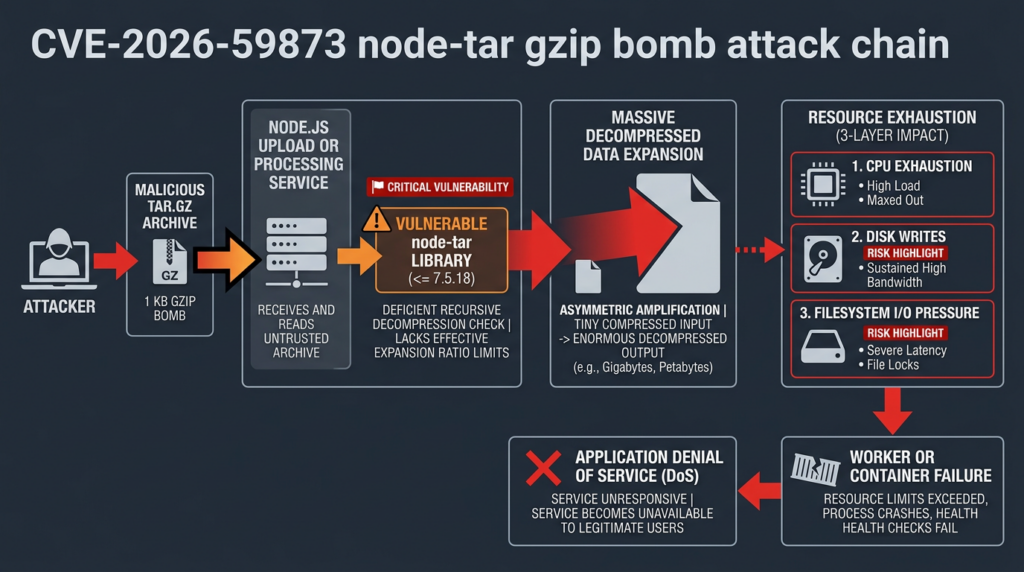
A realistic attack chain might look like this:
1. Attacker identifies archive-processing endpoint
                 |
                 v
2. Attacker submits highly compressed TAR/GZIP archive
                 |
                 v
3. Application accepts small compressed input
                 |
                 v
4. node-tar begins decompression
                 |
                 v
5. Decompressed output grows disproportionately
                 |
          +------+------+
          |             |
          v             v
      High CPU       Disk writes
          |             |
          +------+------+
                 |
                 v
6. Host resources become constrained
                 |
                 v
7. Application latency increases
                 |
                 v
8. Worker/container/process becomes unavailable
                 |
                 v
9. Neighboring workloads may also be affected
The vulnerability becomes most dangerous when archive processing is automatic.
An attacker does not necessarily need a victim to manually open a malicious archive.
If an API accepts the file and immediately extracts it, processing itself becomes the trigger.
GitHub’s CVSS assessment reflects that scenario: network attack vector, low complexity, no privileges, no user interaction, and high availability impact. (गिटहब)
Where CVE-2026-59873 Becomes Externally Exploitable
Not every application containing node-tar is automatically remotely vulnerable.
Reachability matters.
An application becomes significantly more exposed when attacker-controlled data reaches node-tar extraction or parsing APIs.
Typical high-risk architectures include:
File Upload Services
Consider:
POST /upload
        |
        v
archive.tar.gz
        |
        v
temporary storage
        |
        v
tar.extract()
If anonymous or low-privileged users can upload archives, an attacker may be able to repeatedly initiate resource-intensive extraction jobs.
Plugin and Extension Marketplaces
Applications frequently distribute extensions as TAR or TGZ packages.
A pipeline might perform:
Upload plugin
     ↓
Extract manifest
     ↓
Inspect package
     ↓
Validate plugin
     ↓
Publish
Security validation may occur only after extraction.
In such a design, malicious content can attack the infrastructure before later-stage validation runs.
CI/CD Systems
Build systems routinely download and extract:
source archives
dependencies
build caches
artifacts
release packages
SDK bundles
If a pull request, artifact repository, external contributor, or compromised dependency can influence an archive, decompression becomes part of the CI/CD attack surface.
GitHub explicitly identifies CI/CD pipelines among the types of environments affected when untrusted archives reach vulnerable node-tar versions. (गिटहब)
Package Processing Infrastructure
Registries and artifact-management systems may automatically unpack uploaded packages to inspect metadata.
This is particularly dangerous because archive processing may occur at high volume and without human interaction.
SaaS Import Functions
Features such as:
Import project
Import backup
Import theme
Import template
Restore workspace
Upload dataset
frequently accept compressed archives.
The visible product feature may have nothing to do with TAR security, yet node-tar may exist deep inside the import pipeline.
Direct Dependencies Are Only Part of the Problem
Developers should not assume they are safe simply because "tar" does not appear directly inside पैकेज.जेएसओएन.
Node.js applications often inherit packages transitively.
Start with:
npm ls tar
A vulnerable application might reveal something like:
my-app
└─┬ some-build-tool
  └── tar@7.5.18
The application never explicitly imported node-tar.
Its dependency did.
Another useful command is:
npm explain tar
This can help identify why the package exists in the dependency graph.
For lockfile-oriented checks:
grep -n '"tar"' package-lock.json
For production dependency inspection:
npm ls tar --omit=dev
The crucial question is not merely:
Do we depend on tar?
It is:
Can attacker-controlled archive data reach this dependency
inside a deployed environment?
That distinction separates dependency presence from real exploitability.
CVE Severity Versus Real-World Risk
GitHub assigns CVE-2026-59873 a CVSS v4 score of 9.2 Critical with this vector:
CVSS:4.0/AV:N/AC:L/AT:N/PR:N/UI:N/
VC:N/VI:N/VA:H/SC:N/SI:N/SA:H
GitHub records no direct confidentiality or integrity impact but high availability impact on both the vulnerable and subsequent systems. (गिटहब)
That distinction is important.
CVE-2026-59873 should not be described as remote code execution.
A successful exploit does not inherently give the attacker shell access or allow arbitrary JavaScript execution.
Instead, it attacks availability.
For many production systems, however, availability attacks are far from harmless.
A disk-exhaustion condition may affect:
application logs
database temporary files
container writable layers
system services
job queues
artifact storage
package managers
monitoring agents
other tenants
Once a filesystem reaches capacity, failures can propagate beyond the original Node.js worker.
The security consequence can therefore exceed one crashed request handler.
Why Node.js Applications Can Be Particularly Sensitive
Node.js applications are often deployed as relatively lightweight services designed to process many concurrent requests.
Archive processing introduces work that is much heavier than ordinary JSON API handling.
A service may normally execute:
request
→ database query
→ JSON response
but an extraction endpoint changes the resource profile:
request
→ compressed input
→ decompression
→ TAR parsing
→ filesystem creation
→ filesystem writes
→ metadata operations
→ cleanup
If those operations occur in the same container, worker pool, storage volume, or host used by production requests, archive processing can become a resource contention point.
The problem becomes worse under concurrency.
A single decompression task might be survivable.
Ten simultaneous malicious archives may not be.
This means defenders should think in terms of:
cost per request × attacker-controlled concurrency
rather than evaluating one archive in isolation.
How node-tar 7.5.19 Fixes CVE-2026-59873
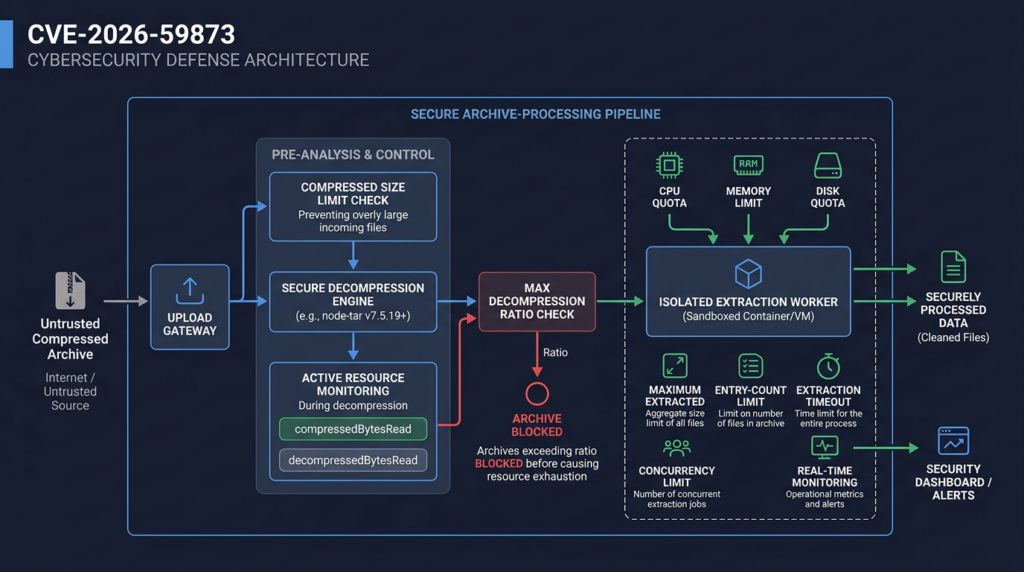
The node-tar maintainers introduced an explicit decompression-ratio defense.
The relevant patch added a new option:
maxDecompressionRatio
The project documentation added by the patch states that the default is 1000, representing the maximum ratio of decompressed bytes to compressed bytes. Setting it to Infinity disables the protection. (गिटहब)
The patch also introduced internal accounting for:
compressedBytesRead
decompressedBytesRead
Conceptually:
ratio =
  decompressedBytesRead /
  compressedBytesRead
The parser then checks:
if (ratio > maxDecompressionRatio) {
  abort()
}
The actual node-tar patch adds symbols for compressed and decompressed byte counters and invokes a decompression-ratio check for output chunks. When the configured ratio is exceeded, the parser aborts the operation. (गिटहब)
This transforms decompression from an open-ended process into a resource-accounted operation.
The Fix Covers More Than Gzip
Although CVE-2026-59873 is commonly discussed as a Gzip Bomb vulnerability, the new node-tar option is documented more broadly.
The patch describes maxDecompressionRatio as applying when reading:
gzip
brotli
zstd
compressed archives. (गिटहब)
That is an important architectural decision.
The underlying security principle is not specific to gzip.
Any compression format capable of producing dramatically more output than input can create resource-amplification risk.
The correct defense belongs at the decompression boundary itself.
Safe Version Verification
The first remediation step is straightforward.
Check the installed version:
npm ls tar
If vulnerable versions appear, update the dependency.
For a direct dependency:
npm install tar@^7.5.19
Then verify:
npm ls tar
The goal is to ensure that production dependency paths no longer resolve to:
tar <= 7.5.18
GitHub identifies 7.5.19 as the first patched version. (गिटहब)
If node-tar is transitive, remediation may instead require updating the parent dependency.
For example:
npm outdated
npm explain tar
Then upgrade the dependency introducing the vulnerable version.
Avoid blindly forcing dependency overrides without regression testing, especially in build and packaging infrastructure where archive semantics may be application-critical.
package-lock.json Matters
Updating पैकेज.जेएसओएन does not automatically prove that all deployed systems are running the fixed code.
Production deployments may depend on:
package-lock.json
npm-shrinkwrap.json
cached node_modules
container layers
CI caches
prebuilt artifacts
serverless bundles
desktop application bundles
A security review should therefore verify the effective dependency inside the deployment artifact.
For example:
node -p "require('tar/package.json').version"
This checks the package version visible from the current runtime.
Inside a container:
docker run --rm your-image \
  node -p "require('tar/package.json').version"
That is often more useful than inspecting a developer workstation.
The question is:
What version is actually executing in production?
Safe Validation Without Building a Gzip Bomb
Defenders do not need to generate multi-gigabyte malicious archives on production systems to validate remediation.
A safer approach is to verify three properties.
First, confirm dependency state:
npm ls tar
Second, confirm the runtime version:
node -p "require('tar/package.json').version"
Third, validate that decompression limits are enabled in an isolated test environment using a deliberately small, bounded test fixture.
For example:
import * as tar from 'tar'

try {
  await tar.x({
    file: './security-test-fixture.tgz',
    cwd: './sandbox',
    maxDecompressionRatio: 100
  })

  console.log('Archive accepted')
} catch (err) {
  console.error('Archive rejected:', err.message)
}
The test archive should remain intentionally small enough that an unexpected failure of the guard cannot exhaust the test host.
Do not perform uncontrolled decompression-bomb testing against shared production infrastructure.
Defense in Depth Beyond 7.5.19
Updating node-tar is the primary fix.
It should not be the only defense.
Compression bombs represent a general resource-control problem, and future bugs may occur in different decompression libraries or code paths.
A stronger design uses several independent controls.
Limit Compressed Upload Size
For example:
Maximum upload:
50 MB
This reduces network and storage abuse.
But it is only the first boundary.
Limit Decompressed Output
The application should establish a maximum acceptable expanded archive size.
उदाहरण:
compressed archive       <= 50 MB
expanded archive         <= 500 MB
The exact values depend on the application’s legitimate workloads.
Limit Compression Ratio
node-tar 7.5.19 provides this directly through maxDecompressionRatio.
The project defaults to 1000. (गिटहब)
Security-sensitive applications can evaluate whether a significantly lower application-specific threshold is appropriate.
A theme package containing a few JavaScript and image files may never legitimately require anything remotely approaching a 1000:1 ratio.
A specialized data pipeline might.
Security limits should reflect expected business data rather than simply accepting library defaults indefinitely.
Limit Entry Count
A different archive attack may contain huge numbers of tiny files.
For example:
500,000 entries
×
tiny filesystem operation
=
major metadata + I/O load
Compression ratio alone does not adequately address this pattern.
Applications should independently restrict archive entry count.
Limit Individual File Size
An archive containing one enormous file may still represent an operational risk even when the compression ratio appears acceptable.
Set a maximum logical size for an individual entry.
Limit Directory Depth
Deeply nested archives can increase path-processing and filesystem overhead.
A defensive parser should constrain path depth where appropriate.
Enforce Timeouts
Archive processing should not run indefinitely.
For asynchronous workers, define a maximum execution time and terminate jobs that exceed it.
Isolate the Extraction Environment
Untrusted archive extraction should ideally happen outside the primary web process.
A safer architecture is:
Internet
   |
   v
Upload API
   |
   v
Object storage
   |
   v
Isolated extraction worker
   |
   +--> CPU quota
   +--> memory quota
   +--> disk quota
   +--> timeout
   +--> no secrets
   +--> restricted network
   |
   v
Validated output
This dramatically reduces blast radius.
Even if archive parsing fails catastrophically, the public-facing application may remain available.
Container Limits Can Reduce Impact
Containerized workloads provide useful resource boundaries.
For example, an archive-processing worker might be given:
CPU:       limited
Memory:    limited
Ephemeral disk: limited
Duration:  limited
Concurrency: limited
This does not remove the vulnerability.
It changes the failure mode.
Without isolation:
archive bomb
→ host disk full
→ multiple services fail
With properly configured isolation:
archive bomb
→ extraction worker exceeds quota
→ worker terminates
→ job fails
→ core application survives
That is a significant security improvement.
Disk Quotas Matter as Much as Memory Limits
Developers frequently focus on memory DoS because JavaScript applications are often associated with heap exhaustion.
CVE-2026-59873 emphasizes another resource: disk.
GitHub’s advisory specifically describes disk-space and CPU exhaustion. (गिटहब)
A service may have a strict Node.js heap limit while still writing massive amounts of decompressed content to storage.
Therefore:
--max-old-space-size
is not a complete defense.
Monitor:
filesystem capacity
inode consumption
temporary directories
container writable layers
volume usage
write throughput
Archive extraction is fundamentally a filesystem security concern as well as an application security concern.
What Defenders Should Monitor
Detection opportunities exist at several layers.
Abnormal Compression Ratios
Log:
compressed_bytes
decompressed_bytes
ratio
Then flag values significantly outside normal workloads.
उदाहरण:
{
  "compressed_bytes": 2097152,
  "decompressed_bytes": 524288000,
  "ratio": 250
}
The threshold should be derived from normal application behavior.
Extraction Errors
After upgrading, monitor for errors associated with decompression limits.
A sudden increase may indicate either:
legitimate incompatible archives
or:
active probing
Both deserve investigation.
Unexpected Disk Growth
Alert on rapid growth in directories used for:
/tmp
uploads
build workspaces
package extraction
CI runners
plugin processing
Sustained CPU During Archive Processing
Correlate worker CPU usage with archive-processing requests.
A pattern such as:
small incoming request
+
long high-CPU extraction
is suspicious.
Repeated Archive Failures From One Source
Rate-limit clients producing repeated malformed or resource-intensive archives.
Detection Should Be Correlated, Not Isolated
A high CPU alert alone generates noise.
A disk-growth alert alone generates noise.
A much stronger signal is:
archive upload
        +
high decompression ratio
        +
CPU spike
        +
temporary-directory growth
        +
TAR_ABORT
        =
high-confidence archive abuse
This is where application telemetry can outperform generic infrastructure monitoring.
The application knows that an archive is being processed.
The operating system does not.
CI/CD Is a Particularly Important Exposure
CVE-2026-59873 deserves special attention in CI environments because build systems routinely process untrusted or semi-trusted content.
A pipeline may automatically handle:
pull-request artifacts
npm packages
release bundles
source archives
dependencies
cache archives
test fixtures
uploaded build outputs
A decompression bomb can therefore become a supply-chain infrastructure attack.
Consider:
External contributor
      |
      v
Pull request
      |
      v
CI job
      |
      v
Download archive
      |
      v
node-tar
      |
      v
Runner disk exhaustion
Even if the attacker cannot access production servers, destabilizing CI infrastructure can still interrupt development, releases, security testing, and incident-response workflows.
Organizations should therefore scan developer tooling and build images, not only production Node.js applications.
Serverless Does Not Automatically Solve the Problem
It might seem that serverless infrastructure makes resource-exhaustion attacks irrelevant because functions are isolated and disposable.
That is only partly true.
A decompression bomb can still consume:
execution duration
ephemeral storage
CPU allocation
function concurrency
job retries
cloud spending
queue capacity
Repeated failures may create cost amplification.
An attacker may not need to permanently crash the host if they can force the platform to repeatedly execute expensive failed jobs.
Resource-exhaustion vulnerabilities should therefore be evaluated in economic terms as well as availability terms.
Resource Amplification Is the Core Security Principle
CVE-2026-59873 can be understood as a broader class of asymmetric-cost attacks.
The attacker spends:
small bandwidth
small storage
little computation
while the defender spends:
large decompression CPU
large disk writes
large I/O volume
worker time
operational recovery effort
The attack is attractive precisely because the costs are asymmetric.
This principle appears elsewhere in security:
regex DoS
XML entity expansion
recursive parsing
hash collision attacks
algorithmic complexity attacks
archive bombs
expensive database queries
LLM token amplification
Different technologies, same basic idea:
allow attacker-controlled input to trigger disproportionately expensive computation.
Security boundaries therefore need to limit work, not merely input size.
Why Rate Limiting Alone Is Insufficient
Suppose an API permits:
10 archive uploads per minute
That sounds restrictive.
But if one archive can consume the worker’s disk or occupy significant CPU, an attacker may need only one request.
Rate limiting helps prevent repeated attacks.
It cannot guarantee that the permitted request itself is safe.
The correct structure is:
rate limiting
+
input size limit
+
decompression limit
+
entry limit
+
disk quota
+
CPU quota
+
timeout
Defense in depth matters because each control constrains a different resource.
Patch First, Then Harden
Security teams sometimes overcomplicate vulnerability response by designing compensating controls before performing the straightforward dependency update.
For CVE-2026-59873, the priority should normally be:
Identify
   ↓
Upgrade
   ↓
Verify
   ↓
Harden
   ↓
Monitor
Not:
Add WAF rule
   ↓
Add monitoring
   ↓
Add upload filter
   ↓
Keep vulnerable library
GitHub identifies 7.5.19 as the patched release, and the node-tar repository shows that release being tagged on June 27, 2026. (गिटहब)
Compensating controls are valuable, but they should complement the fixed dependency.
Recommended CVE-2026-59873 Response Checklist
| Priority | Action | उद्देश्य |
|---|---|---|
| आलोचनात्मक | Identify all tar <= 7.5.18 installations | Find vulnerable dependencies |
| आलोचनात्मक | Upgrade to 7.5.19+ | Apply upstream fix |
| आलोचनात्मक | Identify untrusted archive-processing paths | Establish real exploitability |
| उच्च | Inspect transitive dependencies | Find hidden node-tar usage |
| उच्च | Verify deployed container/runtime version | Prevent lockfile/build mismatch |
| उच्च | Restrict decompression ratio | Limit resource amplification |
| उच्च | Limit total extracted bytes | Prevent storage exhaustion |
| उच्च | Limit archive entry counts | Prevent metadata/file-count DoS |
| उच्च | Isolate extraction workers | Reduce blast radius |
| मध्यम | Add CPU/disk/time quotas | Contain failures |
| मध्यम | Monitor abnormal extraction ratios | Detect attacks |
| मध्यम | Rate-limit archive endpoints | Reduce repeated abuse |
| मध्यम | Review CI/CD extraction paths | Address development infrastructure |
CVE-2026-59873 Timeline
The node-tar GitHub security advisory lists the vulnerability as published on June 27, 2026, and GitHub’s advisory page records subsequent updates in July. The NVD record was received from GitHub on July 8, while the patched node-tar 7.5.19 release was tagged on June 27. (गिटहब)
The important operational detail is simpler than the disclosure chronology:
<= 7.5.18   vulnerable
7.5.19      patched
CVE-2026-59873 Is Not an RCE
Security teams should be precise when communicating this vulnerability.
CVE-2026-59873 does नहीं inherently provide:
remote shell
arbitrary JavaScript execution
credential theft
filesystem traversal
privilege escalation
Its documented security impact is denial of service through uncontrolled resource consumption. GitHub’s CVSS assessment assigns no direct confidentiality or integrity impact while rating availability impact high. (गिटहब)
That does not make the vulnerability unimportant.
A critical availability vulnerability can still:
crash customer-facing services
break CI/CD
fill shared storage
disable build workers
trigger cascading service failures
consume cloud resources
interrupt security operations
Correct vulnerability classification improves remediation prioritization and prevents exaggerated reporting.
Why CVE-2026-59873 Matters Beyond node-tar
The most valuable lesson from CVE-2026-59873 is not simply:
Upgrade node-tar.
It is:
Treat every decompression boundary as an attacker-controlled resource multiplier.
Modern applications process compressed content everywhere.
Dependencies arrive compressed.
Containers contain layers.
Backups are compressed.
Plugins are compressed.
Source packages are compressed.
AI datasets are compressed.
Build artifacts are compressed.
User imports are compressed.
Software architectures increasingly automate these workflows, meaning there may be no human checkpoint between receiving an archive and processing it.
That automation increases the importance of hard resource limits.
Secure Archive Processing Architecture
A hardened production architecture might look like this:
                    Internet
                       |
                       v
                Upload Gateway
                       |
          +------------+-------------+
          |                          |
     Size limit                  Rate limit
          |                          |
          +------------+-------------+
                       |
                       v
                Object Storage
                       |
                       v
                 Job Queue
                       |
                       v
             Isolated Worker
                       |
        +--------------+--------------+
        |              |              |
        v              v              v
 Compression       Size limit      Entry limit
 ratio limit
        |              |              |
        +--------------+--------------+
                       |
                       v
               Filesystem Quota
                       |
                       v
                  Timeout
                       |
                       v
              Content Validation
                       |
                       v
               Approved Output
This architecture assumes archive processing may fail or become hostile.
That is a better assumption than trusting the compressed file because its upload size appears small.
Final Assessment
CVE-2026-59873 is a critical node-tar resource-exhaustion vulnerability affecting tar versions through 7.5.18. Applications that automatically process attacker-controlled compressed TAR archives can be exposed to denial-of-service attacks in which a relatively small compressed input drives disproportionate decompression, CPU consumption, disk writes, and service disruption. GitHub assigns the vulnerability a CVSS v4 score of 9.2 and categorizes the underlying weakness as resource allocation without appropriate limits. (गिटहब)
The immediate remediation is to upgrade to node-tar 7.5.19 or later. The upstream patch introduces maxDecompressionRatio, defaults it to 1000, records compressed and decompressed byte counts, and aborts processing when the configured ratio is exceeded. The implementation covers compressed archive processing including gzip, Brotli, and Zstandard paths. (गिटहब)
But upgrading the package should be viewed as the beginning of a stronger archive-security model rather than the end.
Any service processing untrusted compressed content should independently control:
input size
expanded size
compression ratio
file size
file count
CPU
disk
execution time
concurrency
CVE-2026-59873 is ultimately a reminder that small input does not mean small computational cost. In automated Node.js systems, whenever an attacker can control what gets decompressed, resource consumption itself becomes part of the application security boundary.

 Hindi
Hindi  English
  German
  French
  Spanish
  Portuguese
  Japanese
  Korean
  Arabic
  Turkish
  Hebrew