
CVE-2026-85046 is a high-severity type confusion vulnerability in Google Chrome’s V8 JavaScript and WebAssembly engine that has already crossed the line from theoretical vulnerability to real-world threat.
Google disclosed the vulnerability on September 3, 2026, as part of a Chrome Stable Channel security update. More importantly, the company explicitly confirmed that an exploit for CVE-2026-85046 exists in the wild. The patched Chrome release is 152.0.7977.82/.83 for Windows and macOS and 152.0.7977.82 for Linux. Google identified the vulnerability as a high-severity V8 type confusion issue and credited security researcher Salvatore Gulizia, also known as Serotav, with reporting it on August 4, 2026. (क्रोम रिलीज़)
One day later, on September 4, the U.S. Cybersecurity and Infrastructure Security Agency added CVE-2026-85046 to its Known Exploited Vulnerabilities Catalog after determining that there was evidence of active exploitation. (सीआईएसए)
That combination changes the operational meaning of the vulnerability.
CVE-2026-85046 is not merely a bug that could theoretically become exploitable. Defenders now have confirmation from both the vendor and CISA that exploitation has occurred in real environments.
For enterprises, that should move the issue out of an ordinary browser patch queue and into accelerated remediation.
CVE-2026-85046 at a Glance
| क्षेत्र | विवरण |
|---|---|
| सीवीई | CVE-2026-85046 |
| उत्पाद | गूगल क्रोम |
| अवयव | V8 JavaScript/WebAssembly engine |
| संवेदनशीलता वर्ग | प्रकार भ्रम |
| सामूहिक रूप से | CWE-843 |
| गंभीरता | उच्च |
| CVSS v3.1 | 8.8 |
| Attack vector | Network |
| Attack complexity | कम |
| Privileges required | None |
| User interaction | Required |
| प्रभाव | Code execution inside Chrome sandbox |
| Affected Chrome versions | Versions before 152.0.7977.82 |
| Fixed Windows version | 152.0.7977.82/.83 or later |
| Fixed macOS version | 152.0.7977.82/.83 or later |
| Fixed Linux version | 152.0.7977.82 or later |
| Exploited in the wild | Yes |
| सीआईएसए केईवी | Yes |
| Public disclosure | September 3, 2026 |
| Reporter | Salvatore Gulizia, Serotav |
The CVE record describes the vulnerability as a type confusion condition in V8 that can allow a remote attacker to execute arbitrary code inside the sandbox using a crafted HTML page. CISA’s CVSS enrichment gives it a score of 8.8 with the vector CVSS:3.1/AV:N/AC:L/PR:N/UI:R/S:U/C:H/I:H/A:H. (ओपनसीवीई)
वाक्यांश inside the sandbox deserves special attention. It determines both what CVE-2026-85046 can do on its own and what additional vulnerabilities an attacker may need for full system compromise.
What Happened With CVE-2026-85046?
Google released Chrome Stable 152.0.7977.82/.83 for Windows and macOS and 152.0.7977.82 for Linux on September 3.
The release contained 12 security fixes, including vulnerabilities affecting V8, DevTools, Skia, WebGL, Compositing, CacheStorage, CrashReporting, Network and other Chrome components.
CVE-2026-85046 was the vulnerability for which Google specifically stated that an exploit existed in the wild. Google also said that access to bug details may remain restricted until a majority of users have updated, a standard defensive measure that slows down exploit reproduction while vulnerable systems remain widespread. (क्रोम रिलीज़)
This matters because vulnerability disclosure creates a race.
Before a patch becomes public, sophisticated attackers who already possess an exploit hold an information advantage.
Once the patch ships, other researchers and threat actors can begin binary-diffing vulnerable and fixed builds. Even when the original Chromium issue is restricted, the patch itself may eventually reveal enough information to help experienced exploit developers reconstruct the vulnerability.
For a browser zero-day already known to be exploited, the risk can therefore evolve quickly after disclosure.
Why Active Exploitation Matters More Than the 8.8 CVSS Score
A CVSS score is useful, but it should never be treated as the only prioritization signal.
CVE-2026-85046 has a CVSS v3.1 score of 8.8, formally placing it in the High rather than Critical range.
Organizations using rigid CVSS-based patching workflows could therefore make the mistake of placing a 9.8 server vulnerability ahead of CVE-2026-85046 while allowing vulnerable employee browsers to remain exposed for days or weeks.
That would ignore the strongest available threat signal: exploitation has already occurred.
Google’s confirmation of exploitation and CISA’s subsequent KEV inclusion provide much stronger evidence of immediate risk than the numerical difference between an 8.8 and a 9.x vulnerability. (सीआईएसए)
Risk should therefore be considered approximately as:
Risk =
    Exploitability
  × Exposure
  × Asset Value
  × Real-World Exploitation Evidence
CVE-2026-85046 scores badly on almost every dimension.
Browsers process hostile internet content continuously.
No prior authentication is required.
Delivery can potentially happen through attacker-controlled web content.
And exploitation is no longer hypothetical.
What Is V8?
V8 is Google’s high-performance JavaScript and WebAssembly engine.
When a user visits a modern web application, V8 is responsible for executing much of the JavaScript behind the page. That JavaScript may come from trusted websites, third-party scripts, advertisements, analytics providers, content delivery networks or attacker-controlled infrastructure.
Performance is critical.
JavaScript is dynamically typed, meaning variables can change between integers, floating-point values, strings, objects and other representations at runtime.
A naive engine could carefully re-check every assumption before every operation.
That would be safe but slow.
Modern JavaScript engines instead observe how code behaves and optimize frequently executed paths. V8 contains several execution and optimization tiers designed to transform JavaScript into increasingly optimized machine code.
The security challenge is straightforward:
optimized machine code must remain consistent with JavaScript’s dynamic semantics.
If the optimizer concludes that a value has one representation when memory actually contains another, memory safety may collapse.
That is where type confusion vulnerabilities become dangerous.
What Is Type Confusion?
Type confusion occurs when software accesses a resource using a type that does not correctly describe what is actually stored there.
CVE classifies CVE-2026-85046 under CWE-843: Access of Resource Using Incompatible Type. (ओपनसीवीई)
Consider a simplified example.
Imagine an engine believes a memory slot contains:
Integer: 42but the same bits actually represent:
Pointer: 0x000001F83A102000If the engine processes pointer bits as an integer, or integer bits as a trusted object pointer, the discrepancy can expose memory addresses or corrupt memory structures.
In managed runtimes such as JavaScript engines, these bugs are particularly powerful because attackers frequently begin with a highly constrained scripting environment and attempt to convert a logic error into increasingly powerful memory primitives.
A common conceptual progression is:
Type confusion
      ↓
Incorrect memory interpretation
      ↓
Address disclosure / memory corruption
      ↓
Arbitrary heap read/write
      ↓
Control of security-sensitive object state
      ↓
Renderer code execution
Not every type confusion vulnerability follows exactly this chain, but it illustrates why apparently small mistakes in JavaScript engine optimization can ultimately become browser RCE vulnerabilities.
Understanding V8 Elements Kinds
To understand the publicly reported technical explanation of CVE-2026-85046, it helps to understand elements kinds.
JavaScript arrays appear extremely flexible:
let values = [1, 2, 3];

values[0] = 3.14159;
values[1] = {admin: true};
From JavaScript’s perspective this is perfectly normal.
From the perspective of a high-performance runtime, however, storing every possible value using the same generic representation would sacrifice enormous performance.
V8 therefore tracks information about the kinds of elements stored inside arrays.
Conceptually, an array may contain:
Small integers
Floating-point numbers
Generic JavaScript objects
Holes
Mixed values
Different representations allow optimized code to manipulate those values more efficiently.
Two elements kinds relevant to the public CVE-2026-85046 discussion are:
PACKED_SMI_ELEMENTS
PACKED_ELEMENTS
PACKED_SMI_ELEMENTS
SMI means a small integer representation used internally by V8.
An array such as:
const numbers = [1, 2, 3, 4];may be represented using an optimized integer-oriented elements kind.
The engine can make stronger assumptions about what exists in each element slot.
PACKED_ELEMENTS
An array containing generic tagged JavaScript objects requires a broader representation.
For example:
const objects = [
    {id: 1},
    {id: 2},
    {id: 3}
];
The values stored in the backing memory may include references to heap objects.
Confusing those representations is dangerous.
An optimizer that believes object references are integers can reinterpret address-like data as numeric values.
Conversely, carefully constructed integer data could potentially be interpreted in ways that influence pointer-like state.
The Publicly Reported Root Cause of CVE-2026-85046
Google’s public advisory currently provides only the high-level classification: Type confusion in V8.
The underlying Chromium issue remains restricted, and Google explicitly notes that vulnerability details may remain inaccessible while the update is still rolling out. (Chromium Issues)
However, public security reporting quoting vulnerability researcher Salvatore Gulizia provides additional context.
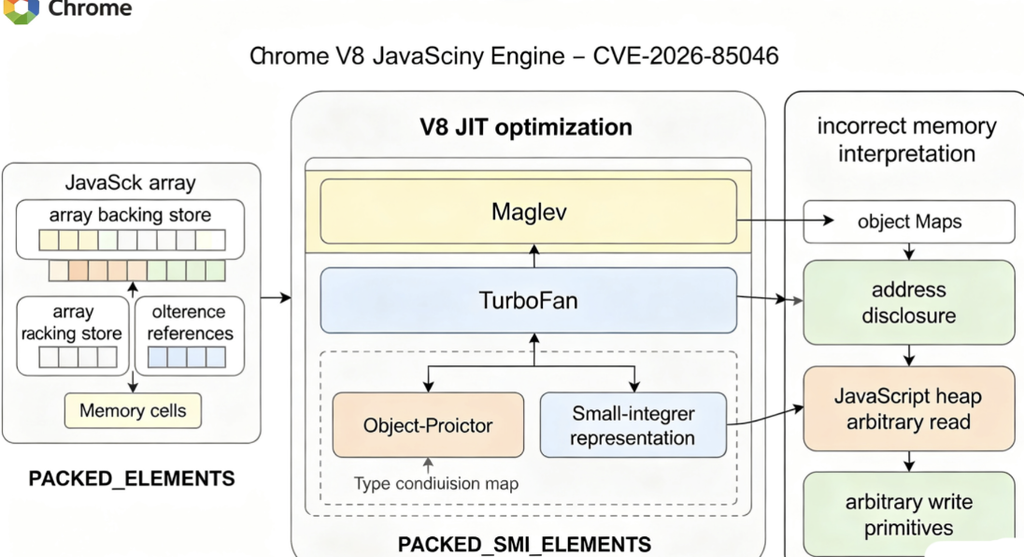
According to those reports, Gulizia described a compiler bug that could cause an array containing PACKED_ELEMENTS to receive a PACKED_SMI_ELEMENTS map, eventually allowing the type confusion to be transformed into arbitrary read/write access within the JavaScript heap. He also reportedly stated that the issue affected both Maglev and TurboFan compiler paths. (द हैकर न्यूज़)
That distinction is important for technical accuracy.
The following is publicly supported:
V8 compiler optimization
        ↓
Elements-kind/type mismatch
        ↓
PACKED_ELEMENTS data
interpreted under a
PACKED_SMI_ELEMENTS map
        ↓
Type confusion
        ↓
JavaScript heap read/write primitive
What is not yet publicly established by Google’s advisory is the complete weaponized exploit chain used by attackers in the wild.
Those two things should not be conflated.
Maps, Objects and Why the Mismatch Matters
In V8, a Map is an internal metadata structure describing important characteristics of an object.
This has nothing to do with JavaScript’s Map() collection object.
A simplified JavaScript array can be imagined like this:
JSArray
+----------------------+
| Map                   |
| Properties            |
| Elements pointer -----+-----> Backing store
| Length                |
+----------------------+
The Map tells V8 how the object should be interpreted.
If the Map says:
PACKED_SMI_ELEMENTSthe optimized engine can assume the backing store contains values compatible with that representation.
But suppose the backing store actually contains generic object references:
Backing store
+-----------------------+
| pointer -> Object A   |
| pointer -> Object B   |
| pointer -> Object C   |
+-----------------------+
while metadata incorrectly describes those slots as integer values.
The engine and the actual memory layout now disagree.
That disagreement is the heart of a type confusion bug.
From an exploit-development perspective, the attacker is interested not merely in causing a crash but in making the confusion predictable.
A reliable primitive might eventually allow operations such as:
addr_of(object)
read(address)
write(address, value)
These are conceptual primitives, not a CVE-2026-85046 exploit implementation.
Once reliable memory disclosure and modification exist, the attacker’s control over the JavaScript heap becomes substantially greater.
Why Arbitrary Read and Write Is So Powerful
Arbitrary read/write is one of the most important transitions in browser exploitation.
Before reaching that point, the attacker may only control ordinary JavaScript objects.
After reaching it, the attacker may be capable of reading or modifying memory outside normal JavaScript semantics.
A read primitive can potentially expose:
Heap addresses
Object layouts
Internal pointers
Security-sensitive metadata
That information can help attackers overcome memory-layout uncertainty.
A write primitive can potentially alter:
Object metadata
Backing-store pointers
Object lengths
Internal references
Compiler structures
The exact post-exploitation techniques depend heavily on V8’s current architecture and mitigations.
Modern V8 is significantly more hardened than older versions, and techniques that worked several years ago may no longer directly translate into contemporary Chrome exploitation.
That is why a statement such as:
“Type confusion gives arbitrary read/write, therefore arbitrary native RCE is trivial”
would be an oversimplification.
A working browser exploit has to survive current memory-safety defenses, renderer isolation, process sandboxing and additional V8 security mechanisms.
Maglev and TurboFan
Public reporting quoting Gulizia indicates that the issue was present in both Maglev और TurboFan. (सुरक्षा संबंधी मामले)
These are optimization components within V8.
At a high level, optimized JavaScript execution works somewhat like this:
JavaScript
    ↓
Parsing
    ↓
Interpreter / lower execution tier
    ↓
Runtime profiling
    ↓
Optimization assumptions
    ↓
Maglev / TurboFan optimized code
    ↓
Native machine execution
The optimizer gathers information such as:
What types usually appear here?
Does this function normally receive integers?
What array representation is being used?
Has this object's structure remained stable?
Can bounds or type checks be eliminated?
If an assumption becomes invalid, the engine may need to deoptimize and return execution to a safer representation.
Security bugs emerge when optimized code makes an assumption that is no longer valid but does not properly deoptimize or revalidate it.
A mistake that is only a semantic bug in ordinary application code can become a memory-safety vulnerability when it occurs inside a JIT compiler.
A Conceptual CVE-2026-85046 Attack Chain
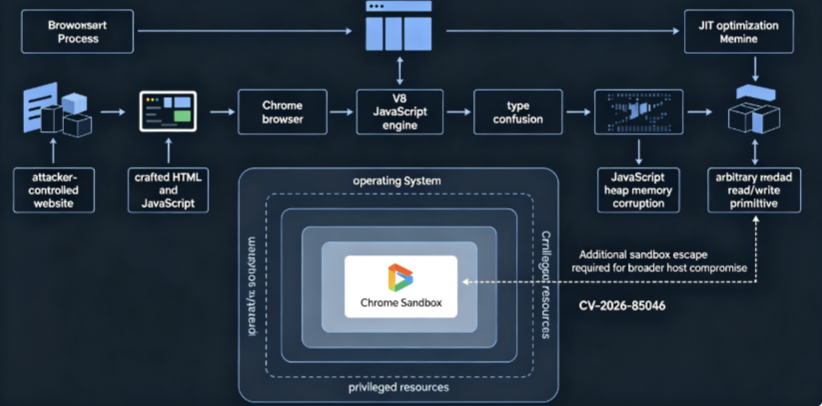
Based on the official CVE description and currently public information, a high-level attack path can be modeled as follows:
Attacker-controlled website
          ↓
Crafted HTML / JavaScript
          ↓
Chrome loads malicious content
          ↓
V8 executes attacker-controlled JavaScript
          ↓
JIT optimization reaches vulnerable condition
          ↓
Elements-kind type confusion
          ↓
Memory safety violation
          ↓
JavaScript heap arbitrary read/write
          ↓
Exploit primitives
          ↓
Code execution in Chrome renderer sandbox
The CVSS vector contains UI:R, meaning user interaction is required.
In practical terms, that does not necessarily mean a victim has to download and launch an executable.
Opening attacker-controlled web content can constitute the relevant interaction.
That makes browser vulnerabilities attractive for delivery through mechanisms such as:
Phishing links
Compromised websites
Malicious redirects
Watering-hole attacks
Third-party content compromise
Potential malvertising chains
Those are plausible delivery mechanisms rather than confirmed CVE-2026-85046 campaign details.
Google has not publicly identified the threat actors, targeted organizations, malicious domains or complete exploitation infrastructure associated with the observed exploitation.
CVE-2026-85046 Is Browser RCE, but There Is an Important Boundary
The CVE description states that CVE-2026-85046 allows arbitrary code execution:
inside the sandbox.
That phrase should not be omitted.
A simplistic vulnerability headline might describe CVE-2026-85046 as:
Visit a website → attacker owns your computerThat goes beyond currently verified information.
A more technically accurate model is:
Malicious web page
      ↓
CVE-2026-85046
      ↓
Chrome renderer compromise
      ↓
Code execution inside sandbox
Chrome deliberately isolates renderer processes to limit what compromised web content can access.
A successful V8 renderer exploit therefore does not automatically mean unrestricted kernel, filesystem or operating-system execution.
What Would an Attacker Need for Full Host Compromise?
A more complete exploitation chain may look like:
Stage 1
Browser renderer vulnerability
CVE-2026-85046
        ↓
Renderer code execution

Stage 2
Chrome sandbox escape
        ↓
Greater operating-system access

Stage 3
Optional privilege escalation
        ↓
Elevated privileges

Stage 4
Payload execution / persistence
CVE-2026-85046 provides the first major step.
Whether attackers observed in the wild chained it with another vulnerability has not been publicly disclosed by Google.
This is not unusual.
Advanced browser exploitation frequently involves vulnerability chains because modern browsers operate under multiple layers of isolation.
For defenders, however, the absence of a publicly known sandbox escape should नहीं be interpreted as a reason to delay patching.
If sophisticated attackers already possess the browser component of an exploit chain, leaving vulnerable systems available gives them exactly the foothold they need.
Which Chrome Versions Are Affected?
The CVE record identifies Chrome releases before:
152.0.7977.82प्रभावित के रूप में। (ओपनसीवीई)
Google’s desktop update shipped:
| मंच | Fixed release |
|---|---|
| विंडोज़ | 152.0.7977.82/.83 |
| मैकओएस | 152.0.7977.82/.83 |
| लिनक्स | 152.0.7977.82 |
Google initially said the release would roll out progressively over the following days and weeks. (क्रोम रिलीज़)
Organizations should therefore verify the installed browser version rather than assuming that Chrome’s automatic updater has already completed deployment.
How to Check Whether Chrome Is Patched
The easiest interactive check is:
chrome://versionor:
Chrome
→ Settings
→ About Chrome
For CVE-2026-85046, a desktop Chrome installation earlier than:
152.0.7977.82should be treated as vulnerable.
Simply telling users to “restart Chrome” is not sufficient evidence of remediation.
Security teams should verify the resulting version after relaunch.
Windows Version Verification
Administrators can inspect Chrome’s installed version with PowerShell.
For example:
$paths = @(
    "$env:ProgramFiles\Google\Chrome\Application\chrome.exe",
    "${env:ProgramFiles(x86)}\Google\Chrome\Application\chrome.exe",
    "$env:LOCALAPPDATA\Google\Chrome\Application\chrome.exe"
)

foreach ($path in $paths) {
    if (Test-Path $path) {
        $version = (Get-Item $path).VersionInfo.ProductVersion
        Write-Output "$path : $version"
    }
}
The important point is not merely detecting whether Chrome exists.
Inventory systems should normalize browser versions and identify all endpoints where:
Chrome version < 152.0.7977.82macOS Version Verification
A basic macOS check can use:
"/Applications/Google Chrome.app/Contents/MacOS/Google Chrome" --versionwhich should return output similar to:
Google Chrome 152.0.7977.83Organizations managing large macOS fleets should retrieve this through their MDM or endpoint-management platform rather than relying on manual inspection.
Linux Version Verification
Depending on the package:
google-chrome --versionor:
google-chrome-stable --versionPackage-manager inventory can also be used.
For Debian-based systems:
dpkg -l | grep google-chromeFor RPM-based systems:
rpm -qa | grep -i chromeAgain, presence is not the security question.
The security question is:
Is every running Chrome installation at or above the fixed version?
Don’t Forget Running Browser Processes
Browser patching has an operational detail that security teams sometimes overlook.
Installing a new browser binary does not necessarily mean an already-running browser process has begun executing the fixed code.
Users often maintain Chrome sessions for days.
Hundreds of tabs may remain open.
Therefore fleet validation should ideally distinguish between:
Fixed binary installedand:
Fixed browser version actively runningA forced or carefully communicated browser relaunch may be necessary in managed environments.
Are Microsoft Edge and Other Chromium Browsers Affected?
This requires careful wording.
CVE-2026-85046 exists in वी8, a component used by Chromium and Chromium-derived browsers.
That creates potential downstream relevance for browsers including:
Microsoft Edge
Brave
Opera
Vivaldi
Other Chromium-based browsers
Electron applications using vulnerable Chromium builds
But it is incorrect to automatically map Google’s Chrome version number directly onto every Chromium-derived product.
Each downstream vendor integrates Chromium releases on its own schedule and publishes its own version numbers and advisories.
Therefore administrators should:
1. Identify all Chromium-based applications.
2. Determine their embedded Chromium/V8 version.
3. Review the relevant vendor's security update.
4. Deploy a version containing the upstream fix.
The key dependency is the vulnerable Chromium/V8 code, not the Chrome branding.
Electron Deserves Special Attention
Browser vulnerabilities do not always remain confined to browsers.
Electron applications embed Chromium and V8 to provide desktop application interfaces using web technologies.
That means organizations should consider whether internally deployed or third-party Electron applications use a Chromium release containing the vulnerable V8 implementation.
The risk profile may differ from Chrome because an Electron application controls what content it loads.
An application that never renders untrusted web content has a very different exposure surface from a general-purpose browser.
But Electron applications that process:
Remote websites
Untrusted HTML
User-provided web content
External links
Remote embedded content
deserve additional scrutiny.
Is There a Public CVE-2026-85046 PoC?
As of the current public disclosure window, organizations should be highly skeptical of claims that every GitHub repository carrying the name CVE-2026-85046 represents the real browser exploit.
Google’s underlying Chromium issue remains restricted. (Chromium Issues)
Security researchers reviewing public repositories have already noted that at least some material labeled as CVE-2026-85046 does not demonstrate the actual V8 type-confusion exploit and instead performs version detection or simulation. (Exploit Intel)
This is an increasingly important security problem around high-profile CVEs.
Within hours of disclosure, repositories may appear containing:
Fake PoCs
AI-generated vulnerability scanners
Detection scripts presented as exploits
Malicious downloaders
Unrelated demo applications
README-only repositories
Repackaged malware
A repository named:
CVE-2026-85046-PoCis not evidence that the underlying V8 exploit has been reproduced.
How to Validate a Claimed CVE-2026-85046 Exploit
Researchers should ask several questions.
Does the code actually interact with V8 internals?
Does it trigger a genuine elements-kind confusion?
Does it demonstrate different behavior between vulnerable and patched V8 builds?
Does it produce a legitimate memory corruption primitive?
Does it depend on an external binary or script downloaded from an unrelated host?
Does it merely check Chrome’s version?
Does the repository author explain the relevant Maglev or TurboFan path?
Does the code correspond to the public root-cause description?
A legitimate browser-engine exploit should contain evidence relating to the vulnerable runtime behavior.
A Python script making HTTP requests to a web server is not magically a V8 browser exploit simply because its filename includes a CVE number.
Why Fake PoCs Are Dangerous
Fake exploit repositories create two different risks.
The first is operational confusion.
Security teams may execute a scanner, see:
Target vulnerableand mistakenly conclude that exploitation has been reproduced.
But browser vulnerability exposure is generally determined primarily from the vulnerable browser component and version, not by sending conventional HTTP probes to a website.
The second risk is supply-chain compromise.
Attackers know security researchers actively download new exploit code.
A fake CVE repository can therefore become an effective malware delivery mechanism aimed directly at:
Security engineers
Bug bounty hunters
Threat researchers
Incident responders
Red teams
Treat newly created exploit repositories as hostile until proven otherwise.
Detection Is Harder Than Patching
There is currently an important asymmetry around CVE-2026-85046.
Defenders know enough to patch.
They do not necessarily know enough to build a perfect exploit-specific detection rule.
Google has confirmed exploitation but has not publicly released detailed campaign IOCs such as:
Attack domains
IP addresses
Payload hashes
Exploit JavaScript
Threat-actor attribution
Specific post-exploitation artifacts
That means detection should not wait for a magical CVE-specific signature.
Organizations should combine exposure management with behavioral investigation.
Start With Vulnerability Exposure
The first defensive query is simple:
Which machines ran Chrome < 152.0.7977.82?Then ask:
For how long?Then:
Which of those machines processed untrusted web content?For an employee browser, the answer to the third question is usually:
Nearly all of them.That is why browser patch compliance is such an important security control.
EDR Hunting for Potential Browser Exploitation
Because public campaign-specific indicators are limited, EDR hunting should focus on suspicious sequences rather than an assumed exploit signature.
Useful investigation paths include:
Chrome renderer
      ↓
Unexpected process behavior
      ↓
Script interpreter
      ↓
Payload execution
      ↓
Persistence or privilege escalation
Examples of suspicious child processes might include:
powershell.exe
cmd.exe
wscript.exe
cscript.exe
mshta.exe
rundll32.exe
regsvr32.exe
bash
sh
python
curl
wget
Context matters.
Chrome can legitimately invoke external applications through registered protocols, enterprise integrations and user actions.
Therefore:
chrome.exe → powershell.exeis not automatically proof of CVE-2026-85046 exploitation.
Instead, analysts should correlate process behavior with:
Browser version
Visited URL
Browser crash telemetry
EDR memory alerts
Download events
Network connections
Credential-access activity
Privilege escalation
Persistence creation
Example Microsoft Defender Hunting Concept
A defensive hunting query might begin with suspicious descendants of Chrome:
DeviceProcessEvents
| where InitiatingProcessFileName =~ "chrome.exe"
| where FileName in~ (
    "powershell.exe",
    "cmd.exe",
    "wscript.exe",
    "cscript.exe",
    "mshta.exe",
    "rundll32.exe",
    "regsvr32.exe"
)
| project
    Timestamp,
    DeviceName,
    InitiatingProcessFileName,
    InitiatingProcessCommandLine,
    FileName,
    ProcessCommandLine
| order by Timestamp desc
This is not a CVE-2026-85046 detection signature.
It is a post-exploitation hunting lead.
That distinction should be preserved in SOC documentation.
Investigate Renderer Crashes
Memory-corruption exploits can produce browser crashes during development, failed exploitation or environmental mismatch.
A sudden renderer crash by itself is extremely weak evidence.
Chrome crashes regularly for benign reasons.
But the combination:
Vulnerable Chrome
+
Unusual web destination
+
Renderer crash
+
Suspicious subsequent endpoint activity
is much more interesting.
Security teams should therefore preserve and correlate:
Chrome crash logs
EDR process telemetry
DNS events
Web proxy history
Secure web gateway events
Email clicks
Downloaded files
Browser isolation alerts
around endpoints that remained vulnerable.
DNS and Proxy Telemetry
Browser exploitation originates from web content.
That makes historical network telemetry valuable.
For high-risk endpoints, analysts can review activity shortly before anomalous browser or endpoint events.
Questions include:
Did the browser visit a newly registered domain?

Was the domain first seen in the organization minutes earlier?

Did a phishing email contain the URL?

Was there an unusual redirect chain?

Did the page load obfuscated JavaScript from a second domain?

Did browser activity immediately precede credential theft?

Did the machine establish unusual outbound connections afterward?
None of these indicators individually proves exploitation.
Together they can provide a coherent incident timeline.
Why Static IOCs Are Not Enough
Memory-corruption browser exploits can be delivered through rapidly rotating infrastructure.
Attackers can:
Change domains
Change URLs
Encrypt payloads
Obfuscate JavaScript
Use legitimate compromised sites
Serve exploits only to selected targets
A threat actor may fingerprint visitors and send the exploit only when:
Chrome version is vulnerable
Operating system matches
IP belongs to target organization
Language matches target geography
User arrived through expected phishing path
Everyone else can receive a harmless page.
This selective delivery dramatically reduces defenders’ ability to capture the exploit.
That is one reason browser zero-days have historically been valuable for targeted intrusion operations.
CISA KEV Changes the Remediation Priority
CISA’s Known Exploited Vulnerabilities Catalog is specifically designed around vulnerabilities for which exploitation evidence exists.
CISA added CVE-2026-85046 to the catalog on September 4, 2026. (सीआईएसए)
Public KEV mirrors show a remediation due date of September 18, 2026 for affected federal systems. (CIRCL Vulnerability Lookup)
Private-sector organizations are not automatically bound by that federal deadline, but KEV membership remains an important prioritization signal.
The logic is simple:
Known exploitable
+
Known exploited
+
Broadly deployed software
=
Patch immediately
For most organizations, waiting until September 18 would make little sense if the update can be deployed safely now.
Recommended Patch Priority
An appropriate internal classification could be:
Priority: Emergency / P1

Reason:
- Actively exploited
- Browser remote attack surface
- No authentication required
- Low attack complexity
- User interaction limited to web content
- Code execution impact
The exact SLA depends on enterprise change-control policy.
For high-risk endpoints, same-day remediation is reasonable.
Examples include:
Executives
Developers
Security teams
Finance staff
Privileged administrators
Government users
Research personnel
Employees handling sensitive IP
These users are disproportionately attractive targets for sophisticated browser exploitation.
Enterprise Remediation Workflow
A practical response should look like:
1. Inventory Chrome installations.

2. Identify versions below 152.0.7977.82.

3. Push the fixed release.

4. Force or request browser relaunch.

5. Confirm the actively running version.

6. Identify endpoints that remained vulnerable.

7. Review high-risk endpoints for suspicious activity.

8. Patch Chromium-derived browsers.

9. Check applications embedding vulnerable Chromium.

10. Continue monitoring for new exploit intelligence.
The most common failure occurs between steps 3 and 5.
A deployment dashboard may show:
Package delivered successfullywhile users continue operating an old Chrome process.
Security teams should validate runtime state whenever possible.
Temporary Mitigations Are Not a Substitute for Updating
Organizations unable to deploy immediately may reduce exposure using:
Browser isolation
Secure web gateways
URL filtering
DNS filtering
Email-link protection
Application allowlisting
EDR exploit protection
Restricted browsing for privileged endpoints
These controls can reduce the likelihood or impact of exploitation.
They do not repair the V8 vulnerability.
The durable remediation is to deploy a browser containing the corrected code.
What About Disabling JavaScript?
Disabling JavaScript globally would drastically reduce the practical attack surface for many V8 exploits.
It would also break a substantial portion of the modern web.
For most enterprises, this is not a realistic organization-wide remediation strategy.
Selective JavaScript restrictions on highly sensitive systems can be useful as defense in depth, but they should not replace patch deployment.
Should Organizations Temporarily Use Another Browser?
Only if the alternative browser is confirmed not to contain the vulnerable Chromium/V8 code.
Moving users from Chrome to another Chromium-based browser without verifying that browser’s embedded Chromium version may simply preserve the vulnerability under a different application name.
A safe migration decision therefore requires component-level version awareness.
Incident Response: What If the Endpoint Was Vulnerable Before September 3?
Because exploitation existed before public disclosure, patching only addresses future exposure.
It cannot tell you whether a previously vulnerable endpoint was already targeted.
For ordinary endpoints with no suspicious telemetry, mass forensic imaging may not be proportionate.
For high-value systems, however, defenders should consider retrospective hunting.
The relevant period extends back before Google’s public September 3 disclosure because the company stated that exploitation already existed at that time.
Prioritize systems showing:
Suspicious web browsing
Unexplained Chrome crashes
EDR exploit alerts
Unexpected child processes
Credential-access activity
New persistence
Unusual network connections
Privilege escalation
during the vulnerable period.
A Practical Triage Matrix
| Condition | Recommended action |
|---|---|
| Vulnerable Chrome, no suspicious telemetry | Patch immediately and monitor |
| Vulnerable Chrome on privileged workstation | Patch and perform retrospective hunting |
| Vulnerable Chrome + suspicious browser crash | Investigate browser/network timeline |
| Vulnerable Chrome + suspicious child process | Escalate to incident response |
| Vulnerable Chrome + credential theft/persistence | Treat as probable host compromise |
| Patched Chrome with no prior exposure | Normal monitoring |
| Unknown browser version | Resolve inventory gap immediately |
This is risk-based triage rather than proof of exploitation.
Why Browser Inventory Is a Security Control
CVE-2026-85046 illustrates a broader lesson about enterprise security.
Organizations often maintain excellent visibility into:
Servers
Cloud workloads
Containers
Internet-facing APIs
while having much weaker visibility into browser versions.
But browsers are effectively internet-facing execution environments running on employee endpoints.
They ingest attacker-controlled input all day.
A browser vulnerability management program should therefore answer:
Which browsers exist?

Which version is installed?

Which version is running?

Which update channel is configured?

When was the machine last restarted?

Are updates pinned?

Are users allowed to postpone restarts indefinitely?
These are not desktop-support questions anymore.
They are attack-surface questions.
Why V8 Continues to Attract Exploit Research
V8 sits at an unusually important intersection.
It must simultaneously provide:
Dynamic language semantics
Extremely high execution performance
Garbage collection
JIT compilation
WebAssembly
Multiple object representations
Complex speculative optimizations
Strong security isolation
Compatibility with enormous amounts of web code
Each optimization potentially creates assumptions.
Each assumption creates state transitions.
And every state transition must remain correct even when attacker-controlled JavaScript deliberately pushes the runtime into unusual combinations developers rarely encounter.
An ordinary application may process relatively predictable inputs.
A browser engine processes programs deliberately constructed to break its assumptions.
That makes JavaScript engines among the most heavily adversarially tested software components deployed at global scale.
Memory Safety Bugs Are Often About Assumptions
A useful way to think about CVE-2026-85046 is not simply:
V8 confused one type with another.The deeper issue is:
Optimized code trusted metadata
that no longer accurately described
the underlying memory.
Security failures frequently emerge where two views of system state diverge.
Examples across security include:
Parser disagreement
Authentication state mismatch
Cache inconsistency
Object lifetime disagreement
Integer representation mismatch
Type metadata mismatch
Authorization state race
CVE-2026-85046 belongs to that broader family of failures.
The security boundary assumes two components agree.
An attacker creates a condition in which they do not.
Why Browser Exploit Chains Are Valuable
A remotely reachable V8 primitive is valuable because the browser already solves the attacker’s delivery problem.
Employees routinely open:
Email links
Search results
Shared documents
Customer portals
News sites
SaaS applications
Social media
Advertisements
The attack surface comes to the user.
Compare this with a vulnerability requiring an attacker to:
Discover a private server
Bypass authentication
Reach a non-default service
Know a specific configuration
Browser exploitation may require only getting a target to interact with web content.
That can make even a CVSS 8.8 browser vulnerability strategically more attractive than vulnerabilities carrying superficially higher scores.
Browser Zero-Days and Targeted Attacks
Google has not publicly disclosed who used CVE-2026-85046.
Therefore claims such as:
CVE-2026-85046 was used by country Xor:
CVE-2026-85046 targeted industry Yshould currently be treated with skepticism unless backed by new vendor or threat-intelligence evidence.
The existence of in-the-wild exploitation tells us that attackers have used the vulnerability.
It does not tell us:
Who they are
How many attacks occurred
Which countries were targeted
Which sectors were targeted
Whether attacks were espionage
Whether attacks were financially motivated
Whether ransomware was involved
Maintaining this distinction is essential in vulnerability intelligence.
CVE-2026-85046 and the Myth of “Just a Browser Bug”
Browsers hold enormous amounts of valuable contextual access.
A browser session may contain:
Enterprise SSO sessions
Cloud administration consoles
Source-code repositories
Email
CRM systems
Developer dashboards
Internal SaaS applications
Banking sessions
Authentication cookies
OAuth tokens
Modern architecture does isolate much of this information, and a renderer compromise does not automatically grant access to everything.
Nevertheless, browser exploitation sits extremely close to user identity and sensitive workflows.
Attackers do not necessarily need persistent root access for every objective.
Sometimes stealing the right authenticated session can be sufficient.
This is another reason organizations should not treat browser vulnerabilities as low-priority workstation maintenance.
CVE-2026-85046 Detection Versus Verification
Security teams sometimes ask:
How can we send a request to a machine and verify CVE-2026-85046?
That mental model fits server vulnerabilities better than browser vulnerabilities.
CVE-2026-85046 is executed in the victim’s browser when attacker-controlled content is processed.
A conventional network scanner cannot normally prove exploitability simply by sending an HTTP request to the endpoint.
The safest and most reliable exposure check is currently:
Browser version identificationrather than triggering the actual memory-corruption condition.
That gives defenders a deterministic remediation answer without executing exploit code.
Safe Validation Procedure
A defensive validation workflow can therefore be:
Asset inventory
       ↓
Find Chrome installations
       ↓
Extract exact version
       ↓
Compare against fixed threshold
       ↓
Patch vulnerable systems
       ↓
Relaunch browser
       ↓
Re-query version
       ↓
Record evidence
Example result:
Host: FINANCE-LAPTOP-017
Chrome: 151.x
Status: VULNERABLE
Action: Update required

Host: DEV-MAC-044
Chrome: 152.0.7977.83
Status: PATCHED
Action: None
This approach is more useful to enterprise defenders than running questionable public exploit repositories.
Why Reproducing the Exploit Should Be Separated From Vulnerability Management
Exploit reproduction has legitimate value for security research.
It can help:
Understand root causes
Test mitigations
Develop detections
Assess exploit reliability
Study browser security
But enterprise patch decisions do not need to wait for successful reproduction.
Google has already confirmed:
The vulnerability exists.
The affected version range is known.
A fix exists.
An exploit exists in the wild.
Waiting until an internal red team achieves code execution before approving the patch would invert the purpose of vulnerability management.
CVE-2026-85046 Frequently Asked Questions
What is CVE-2026-85046?
CVE-2026-85046 is a high-severity type confusion vulnerability in Chrome’s V8 JavaScript and WebAssembly engine. A remote attacker can use crafted web content to achieve arbitrary code execution inside the Chrome sandbox on affected versions. (सीवीई)
Is CVE-2026-85046 being exploited?
Yes.
Google explicitly confirmed on September 3, 2026 that an exploit exists in the wild. CISA added the vulnerability to its Known Exploited Vulnerabilities Catalog on September 4. (chromereleases.googleblog.com)
What is the CVSS score?
CISA’s CVSS v3.1 enrichment gives CVE-2026-85046 a score of 8.8 High, with:
CVSS:3.1/AV:N/AC:L/PR:N/UI:R/S:U/C:H/I:H/A:H(ओपनसीवीई)
Does CVE-2026-85046 require authentication?
नहीं।
The published CVSS vector indicates PR:N, meaning no existing privileges are required.
Does it require user interaction?
Yes.
The CVSS vector specifies UI:R.
The official CVE description identifies a crafted HTML page as the delivery mechanism.
Can CVE-2026-85046 completely compromise Windows or macOS?
CVE-2026-85046 is documented as enabling arbitrary code execution inside the browser sandbox.
A complete operating-system compromise would generally require additional steps, potentially including a sandbox escape and possibly privilege escalation.
Google has not publicly disclosed whether the observed attacks used such a chain.
What Chrome versions are vulnerable?
Google Chrome versions prior to:
152.0.7977.82are identified as affected. (ओपनसीवीई)
What version fixes CVE-2026-85046?
Google released:
Windows: 152.0.7977.82/.83
macOS:   152.0.7977.82/.83
Linux:   152.0.7977.82
or later. (क्रोम रिलीज़)
Who discovered CVE-2026-85046?
Google credited security researcher Salvatore Gulizia, also known as Serotav, who reported the vulnerability on August 4, 2026. Google listed a $1,000 reward alongside the issue in its release advisory. (क्रोम रिलीज़)
How does CVE-2026-85046 work?
Google publicly classifies it as a V8 type confusion vulnerability.
Public reporting quoting Gulizia describes an incorrect relationship between PACKED_ELEMENTS data and a PACKED_SMI_ELEMENTS map inside V8 compiler optimization, which can reportedly be developed into arbitrary read/write capability in the JavaScript heap. (द हैकर न्यूज़)
Is the Chromium bug public?
Full technical access is currently limited.
Google routinely restricts vulnerability details while updates are rolling out, and the Chromium issue associated with CVE-2026-85046 currently requires access rather than exposing the complete report publicly. (क्रोम रिलीज़)
Is there a trustworthy public exploit?
Researchers should be cautious.
Some repositories using the CVE number have already been characterized as detection or simulation tooling rather than proof of exploitation of the underlying V8 bug. (Exploit Intel)
A GitHub repository named after the CVE should never be assumed to be genuine solely because of its filename.
Should I update immediately?
Yes.
The combination of:
Remote attack surface
+
No privileges required
+
Browser exploitation
+
Confirmed exploitation in the wild
+
CISA KEV inclusion
makes rapid patching strongly justified.
The Most Important Defensive Lesson
CVE-2026-85046 demonstrates why vulnerability prioritization cannot be reduced to sorting a spreadsheet by CVSS score.
Imagine two vulnerabilities:
Vulnerability A
CVSS: 9.8
No evidence of exploitation
Difficult to reach in your environment

Vulnerability B
CVSS: 8.8
Installed on thousands of employee laptops
Processes hostile internet content
Confirmed exploitation in the wild
A purely numerical system prioritizes A.
A threat-informed system may correctly prioritize B.
CVE-2026-85046 is an example of the second category.
Final Assessment
CVE-2026-85046 should be treated as an urgent browser security issue.
The confirmed facts are already sufficient to justify rapid action.
Google Chrome before version 152.0.7977.82 contains a high-severity V8 type confusion vulnerability capable of enabling arbitrary code execution inside the browser sandbox through crafted web content. Google released fixed builds on September 3, 2026 and confirmed that an exploit exists in the wild. CISA added the vulnerability to its Known Exploited Vulnerabilities Catalog the following day. (chromereleases.googleblog.com)
Public technical reporting indicates that the bug involves V8 compiler logic allowing incompatible elements-kind metadata involving PACKED_ELEMENTS और PACKED_SMI_ELEMENTS, with the resulting confusion capable of producing arbitrary JavaScript heap read/write access. (द हैकर न्यूज़)
At the same time, several details remain intentionally undisclosed.
Google has not publicly documented the complete in-the-wild exploit chain, attack infrastructure, threat actor, victim profile or confirmed sandbox-escape component.
That uncertainty should not reduce patch urgency.
It should increase caution around unsupported claims.
For defenders, the correct response is straightforward:
Find vulnerable Chrome installations.
Update them.
Relaunch them.
Verify the running version.
Patch downstream Chromium products.
Review high-risk previously vulnerable endpoints.
Do not rely on unverified “PoCs.”
Continue monitoring for new exploitation intelligence.
The most authoritative starting points remain Google’s September 3 Chrome Stable Channel advisory and CISA’s Known Exploited Vulnerabilities program. Google Chrome Stable Channel Update CISA Known Exploited Vulnerabilities Catalog
For CVE-2026-85046, the crucial security signal is no longer “could this vulnerability be exploited?”
Google has already answered that question.
It has been.


 Hindi
Hindi  English
  German
  French
  Spanish
  Portuguese
  Japanese
  Korean
  Arabic
  Turkish
  Hebrew