
The Core Concept: The Semantic Gap in Link Analysis
In the context of modern threat hunting, a Bypass Link is not merely a “hidden URL.” It represents a Semantic Gap—a discrepancy between how a security scanner (the “Observer”) interprets a URI and how a victim’s browser (the “Executor”) renders it.
Attackers exploit this gap to circumvent Secure Email Gateways (SEG), Web Content Filters, and Endpoint Detection and Response (EDR) systems. The goal is to present a “benign facade” to automated analyzers while delivering a “malicious payload” to the end-user.
Advanced Evasion Methodologies
1. Living off the Land (LotL) via Open Redirects
Attackers increasingly leverage “Open Redirects” on highly trusted domains (e.g., Google, Microsoft, or AWS).
- The Technique: A link like
https://www.google.com/url?q=https://malicious.examplemay bypass reputation filters because the primary domain (google.com) is globally allowlisted. - The Bypass: The filter sees a trusted domain; the user’s browser executes the redirect to the phishing site.
2. URL Cloaking and Environment Keying
Sophisticated bypass links utilize Server-Side Cloaking. The hosting server inspects the incoming request before deciding what to serve.
- Bot/Scanner Detection: If the request originates from a known data center (AWS, Azure) or contains a “Security Scanner” User-Agent, the server returns a 200 OK with a benign “Under Construction” page.
- Targeted Delivery: If the request matches a human profile (residential IP, specific browser language, valid mouse-movement telemetry), it delivers the phishing kit.
3. Parser Differential Exploits (RFC 3986 Non-Compliance)
Different libraries (Python’s urllib, Go’s net/url, Chrome’s Blink) parse URLs differently.
- CVE-2020-0696 Example: By using specific character encodings or non-standard URI schemes, attackers can cause an email gateway to “see” one domain while the browser navigates to another.
Attack & Defense: Engineering Implementations
Example 1: Bypassing Depth-Limited Scanners
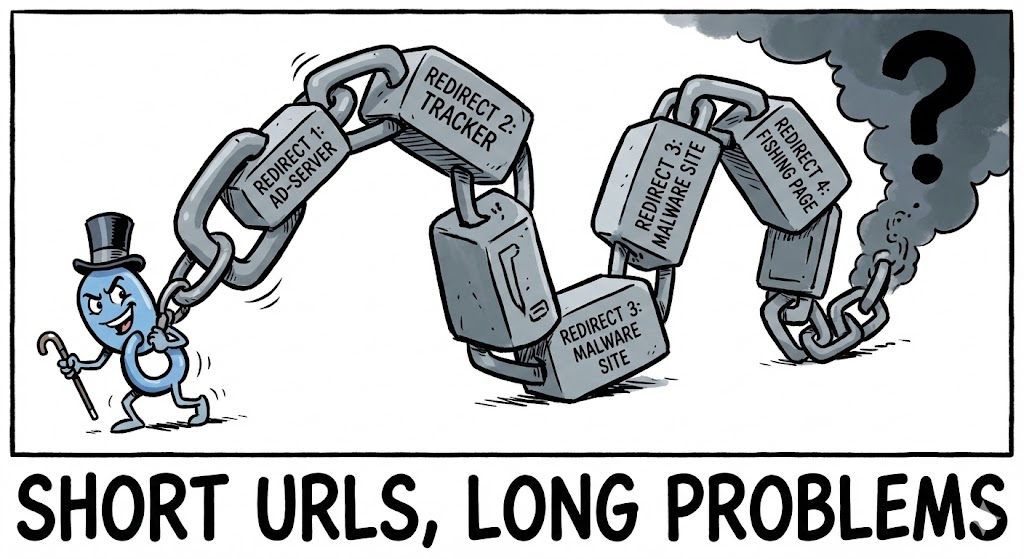
Many automated scanners only follow 2 or 3 redirects to save resources. Attackers exploit this by “Laundering” the link through multiple hops.
Attack: The Redirect Laundromat
Plaintext
Hop 1: Trusted Shortener (bit.ly) Hop 2: Compromised WordPress Site (wp-admin/redirect.php) Hop 3: Marketing Tracking Pixel (ads.example.com) Hop 4: Final Malicious Landing Page
Defense: Exhaustive Redirect Unraveling (Python)
Python
`import requests
def unravel_link(url, max_hops=10): try: # We use a custom User-Agent to mimic a real browser headers = {‘User-Agent’: ‘Mozilla/5.0 (Windows NT 10.0; Win64; x64)’} response = requests.get(url, headers=headers, allow_redirects=True, timeout=5)
    hop_count = len(response.history)
    print(f"Total Hops: {hop_count}")

    for i, hop in enumerate(response.history):
        print(f"Hop {i+1}: {hop.url} ({hop.status_code})")

    if hop_count > 5:
        return "ALERT: High-entropy redirect chain detected (Potential Laundering)"
    return response.url
except Exception as e:
    return f"Error: {e}"`
Example 2: Detecting Conditional Cloaking
Attackers serve different content to curl (scanners) vs. Chrome (users).
Defense: Differential Response Analysis
Python
`def check_for_cloaking(url): # Profile 1: Headless/Scanner r1 = requests.get(url, headers={‘User-Agent’: ‘Security-Scanner/1.0’}) # Profile 2: Realistic User r2 = requests.get(url, headers={‘User-Agent’: ‘Mozilla/5.0 Chrome/120.0.0.0’})
# Measure Semantic Difference (simple length check or hash)
diff_ratio = abs(len(r1.text) - len(r2.text)) / max(len(r1.text), len(r2.text), 1)

if diff_ratio > 0.2: # 20% difference in page content
    return "CRITICAL: Conditional logic (Cloaking) detected."
return "Stable Content"`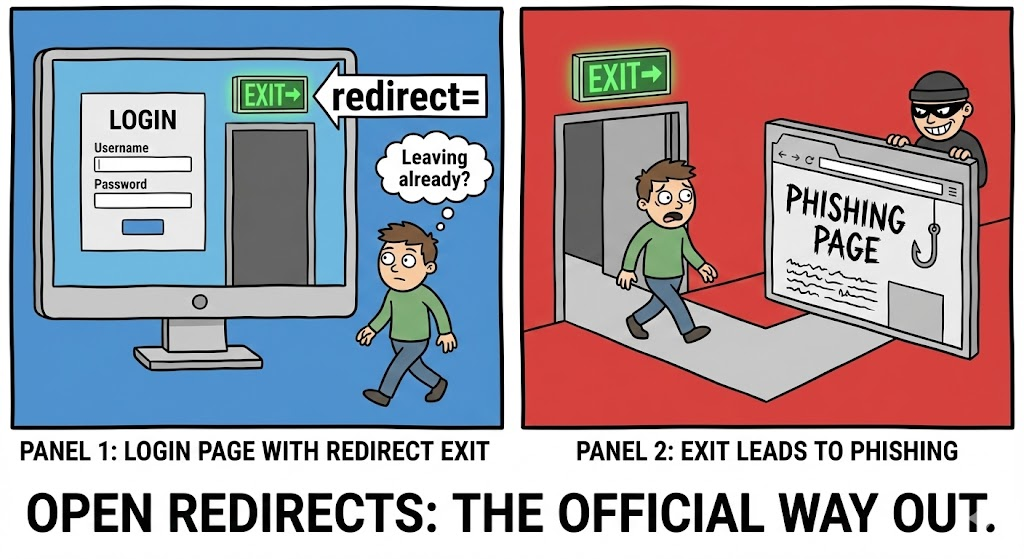
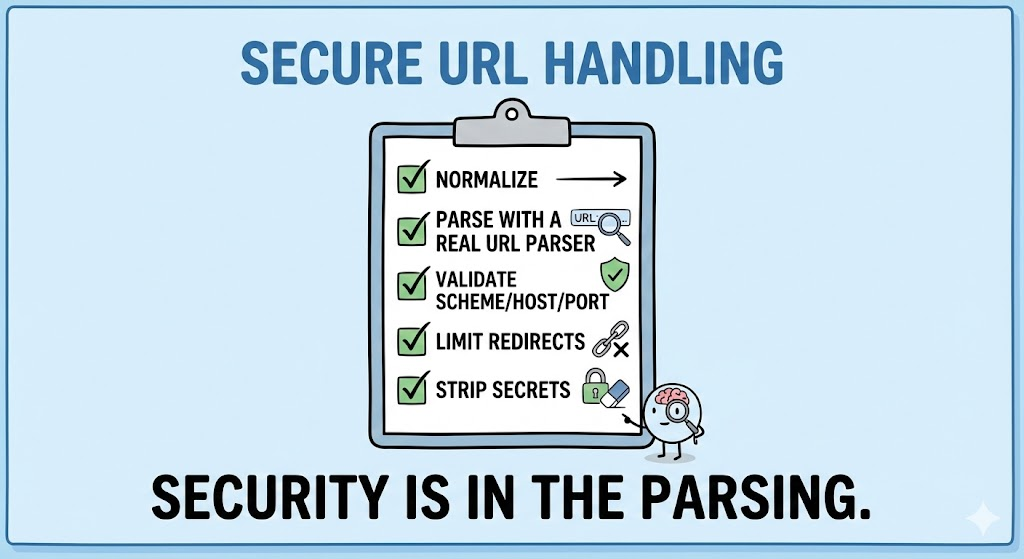
Example 3: Preventing Parser Mismatch (Canonicalization)
Attackers use %2e%2e/ (encoded dots) to confuse filters about the actual path being accessed.
Defense: Aggressive Normalization Pipeline
Python
`from urllib.parse import urlparse, unquote import os
def sanitize_and_canonicalize(url): # 1. Double Decode to catch nested encoding (%252e) decoded_url = unquote(unquote(url))
# 2. Parse and Normalize Path
parsed = urlparse(decoded_url)
# Using os.path.normpath to resolve /../ segments
clean_path = os.path.normpath(parsed.path)

return f"{parsed.scheme}://{parsed.netloc}{clean_path}"
Input: https://example.com/login/..%2F..%2Fadmin
Output: https://example.com/admin`
Strategic Defensive Posture
| Defense Layer | Mechanism | Engineering Focus |
|---|---|---|
| Ingress Filtering | JA3/TLS Fingerprinting | Identify the client library (e.g., Python requests) rather than the User-Agent. |
| Dynamic Analysis | Headless Browser Detonation | Execute links in a sandbox to observe DOM changes, not just HTTP headers. |
| Logic Layer | Zero-Trust URL Signing | For internal bypass use cases, use HMAC-signed URLs to ensure integrity. |
| User Layer | Visual Indicators | Deploy browser extensions that “unmask” shortened URLs before a user clicks. |
Conclusion: Beyond Blacklisting
The era of static URL blacklisting is over. As attackers move toward ephemeral, conditional, and multi-stage bypass links, security teams must shift toward behavioral link analysis.
By treating every URL as a “program” that requires execution in a controlled environment (sandboxing) and normalizing all inputs to close the “Semantic Gap,” organizations can dismantle the infrastructure of link-based attacks before the user even sees the “Click Here” button.
 Hindi
Hindi  English
  German
  French
  Spanish
  Portuguese
  Japanese
  Korean
  Arabic
  Turkish
  Hebrew