
Why this CVE is getting instant attention in security teams
CVE-2026-20700 has the exact characteristics that force a fast decision in real enterprises: vendor language that acknowledges possible exploitation, a core platform component with wide reach, and a public risk-tracking signal that many programs treat as escalation criteria.
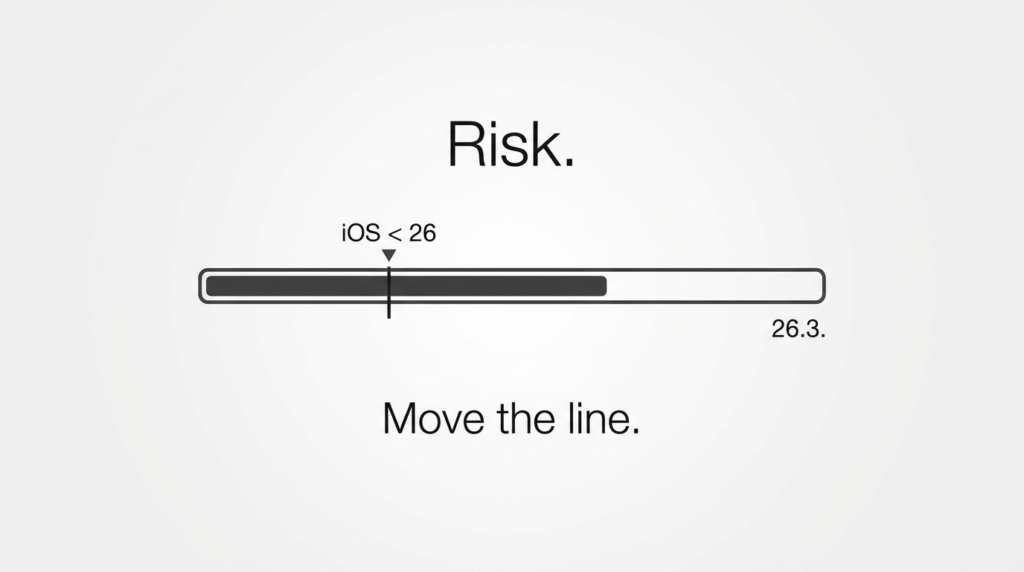
In Apple’s own security content, the company states it is aware of a report that the issue may have been exploited in an extremely sophisticated attack against specific targeted individuals on iOS versions before iOS 26. (アップル・サポート)
NVD summarizes the same exploitation language and lists the patched OS releases across Apple platforms. (NVD)
That combination is why coverage quickly converged on the same high-urgency framing: exploited, sophisticated, patch now. One of the highest-circulation writeups is from BleepingComputer, which emphasizes that Apple shipped updates to fix a zero-day vulnerability exploited in an extremely sophisticated attack targeting specific individuals. (ブリーピングコンピューター)
If you are responsible for vulnerability management, endpoint security, or incident readiness, this is not a story you read for curiosity. It is a story you read so you can answer three questions immediately:
- Are we exposed
- How fast can we patch
- How do we prove we are no longer exposed
This piece is built to help you answer those questions without speculation.
What Apple actually confirmed about CVE-2026-20700
Apple’s iOS 26.3 and iPadOS 26.3 security content describes CVE-2026-20700 as a memory corruption issue addressed with improved state management. The impact statement is clear: an attacker with memory write capability may be able to execute arbitrary code. (アップル・サポート)
Apple’s macOS Tahoe 26.3 security content repeats the same core description and impact statement under the dyld entry, and credits Google Threat Analysis Group for reporting. (アップル・サポート)
NVD consolidates the vendor narrative into a single record: the issue is fixed in iOS 26.3, iPadOS 26.3, macOS Tahoe 26.3, and watchOS, tvOS, visionOS 26.3, and Apple is aware of a report that this issue may have been exploited in an extremely sophisticated attack against specific targeted individuals on versions of iOS before iOS 26. (NVD)
Apple also explicitly notes that CVE-2025-14174 そして CVE-2025-43529 were issued in response to the same report. (アップル・サポート)
That is the factual core. Everything else you may have seen in social posts about actors, chains, delivery methods, or tooling is not in Apple’s wording and should not be treated as confirmed.
What dyld is and why defenders should care
dyld is the Dynamic Link Editor, a system component involved when apps load and connect to shared libraries and frameworks. Several high-signal articles explain dyld in precisely this practical way: it runs in the background and is essential for running apps. (テックレーダー)
From a defender viewpoint, dyld matters for two reasons.
First, components like this are part of the runtime foundation for many processes. When a vulnerability sits in a foundational component, the “blast radius” is often broader than the name of the component suggests, because it is present across devices and OS families. NVD’s fixed-version list spanning iOS, iPadOS, macOS, watchOS, tvOS, and visionOS is consistent with that broader footprint. (NVD)
Second, runtime-level issues tend to be hard to mitigate with compensating controls. For this class of vulnerability, the most reliable control is patching and verifying patch coverage, not hoping a network rule or a configuration tweak will fully reduce risk.
The high-click phrases people search for around this incident
You asked for the “highest click-through” wording. There is no public CTR dataset for this specific CVE across all search engines, so I will not pretend we have one. What we can do accurately is identify the phrasing that dominates the top-ranked coverage and is repeatedly echoed in headlines, which strongly correlates with what users end up searching.
Across major coverage and vendor wording, the recurring phrases are:
- “Apple fixes zero-day” (ブリーピングコンピューター)
- “exploited in extremely sophisticated attacks” (ブリーピングコンピューター)
- “targeting specific individuals” (アップル・サポート)
- “dyld Dynamic Link Editor” (テックレーダー)
- “iOS before iOS 26” (アップル・サポート)
- “KEV Known Exploited Vulnerabilities Catalog” (CISA)
These are the phrases that reliably match how defenders communicate urgency to each other. If your SEO goal is to capture real operational intent, these are the terms that align with how engineers search when they are under time pressure.
Affected platforms and fixed versions
This is where you should be extremely literal and only use what Apple and NVD confirm.
NVD states the issue is fixed in:
- iOS 26.3 and iPadOS 26.3
- macOS Tahoe 26.3
- watchOS 26.3
- tvOS 26.3
- visionOS 26.3 (NVD)
Apple’s security content pages for iOS 26.3 and macOS Tahoe 26.3 match this, and include the exploitation-language statement that drives urgency. (アップル・サポート)
Defender-ready table
| 項目 | What to record in your program | Source of truth |
|---|---|---|
| CVE | CVE-2026-20700 | NVD record (NVD) |
| コンポーネント | dyld Dynamic Link Editor | Apple security content and coverage (アップル・サポート) |
| Issue class | Memory corruption addressed with improved state management | Apple security content (アップル・サポート) |
| Exploitation statement | May have been exploited in extremely sophisticated attack against specific targeted individuals on iOS before iOS 26 | Apple security content and NVD (アップル・サポート) |
| 修正版 | iOS 26.3, iPadOS 26.3, macOS Tahoe 26.3, watchOS 26.3, tvOS 26.3, visionOS 26.3 | NVD (NVD) |
If you need a one-line policy statement for leadership, keep it boring and verifiable: “Upgrade all Apple endpoints to the vendor fixed versions listed in NVD and Apple security content.”
KEV changes the conversation even if you are not a federal agency
CISA’s Known Exploited Vulnerabilities Catalog is not just another list. Many organizations treat KEV as a governance hook that allows them to bypass usual patch windows for exploited vulnerabilities.
CISA’s KEV catalog includes CVE-2026-20700 and lists a due date for remediation. (CISA)
NVD also flags its KEV inclusion, which is useful when teams automate intake through NVD feeds rather than manually reading CISA pages. (NVD)
If you run a vulnerability management program with SLAs, KEV is the kind of signal that supports an “expedite path” without arguing about CVSS in meetings.
Risk triage that works in real enterprises
A practical triage model for exploited zero-days looks like this:
Priority tier one patch immediately
- Devices used by executives, high-risk staff, and anyone likely to be targeted
- Devices outside strong management control or with spotty compliance reporting
- Devices that regularly handle sensitive communication or access to privileged systems
Apple’s wording explicitly frames targeted individuals. You do not have to know who they are in the public report to adopt targeted-individual thinking in your own org. (アップル・サポート)
Priority tier two patch fast with controlled rollout
- Broad fleet where MDM policies and staged rollouts can reduce operational risk
- Devices where you can verify version compliance reliably
The point is not just patch speed. The point is patch speed plus proof.
How to inventory and prove exposure is closed
You asked for “How to prove you’re not exposed.” That is mostly an asset-management problem, not a reverse-engineering problem.
Step one establish a compliance threshold
Your compliance threshold is the minimum fixed version per platform:
- iOS and iPadOS minimum 26.3
- macOS minimum Tahoe 26.3
- watchOS, tvOS, visionOS minimum 26.3 (NVD)
Step two collect version data at scale
For macOS, you can collect version output locally and ship it to your inventory pipeline.
#!/usr/bin/env bash
set -euo pipefail

HOSTNAME="$(scutil --get ComputerName 2>/dev/null || hostname)"
SERIAL="$(system_profiler SPHardwareDataType | awk -F': ' '/Serial Number/{print $2; exit}')"
VERSION="$(/usr/bin/sw_vers -productVersion)"
BUILD="$(/usr/bin/sw_vers -buildVersion)"

echo "hostname=$HOSTNAME serial=$SERIAL macos_version=$VERSION build=$BUILD"
This does not “detect exploitation.” It answers the question that matters first: are you running a fixed version.
For iOS and iPadOS fleets, your MDM should report OS versions. The specific UI varies by platform, so the portable pattern is:
- Build a smart group query for devices below 26.3
- Force update policies for those devices
- Track exceptions and remediation
Step three turn compliance into a report leadership understands
The simplest proof pack has three numbers:
- Total managed Apple devices
- Devices at or above fixed versions
- Devices below fixed versions plus reasons
Add a short exceptions table.
| Exception reason | 例 | アクション |
|---|---|---|
| Offline devices | Traveling, powered off, not checking in | Escalate to owner, schedule update window |
| Unmanaged devices | BYOD without enrollment | Require enrollment or restrict access |
| Update failures | Storage, battery, policy conflicts | IT remediation workflow |
Verification beyond version numbers
Version compliance is necessary but not always sufficient for audit and incident readiness. You also want to confirm the patch is actually deployed and devices rebooted where required.
For macOS, confirm update history and last boot time.
# macOS last boot time
sysctl -n kern.boottime

# macOS software update history summary
softwareupdate --history | head -n 50
Again, do not claim this proves absence of compromise. It proves patch deployment and reduces exposure.
A safe way to automate KEV intake without relying on a single webpage
If you automate patch prioritization, do not scrape HTML. Use a structured feed.
CISA publishes a GitHub repository that mirrors KEV data for automation. (NVD)
Here is a minimal Python example that pulls the KEV JSON and filters for CVE-2026-20700. It is defensive automation, not exploit content.
import json
import urllib.request

KEV_JSON = "<https://raw.githubusercontent.com/cisagov/kev-data/main/known_exploited_vulnerabilities.json>"

with urllib.request.urlopen(KEV_JSON, timeout=20) as r:
    data = json.loads(r.read().decode("utf-8"))

hits = [x for x in data.get("vulnerabilities", []) if x.get("cveID") == "CVE-2026-20700"]
print(json.dumps(hits[0] if hits else {"found": False}, indent=2))
Use this to drive your internal SLA clock and tracking ticket creation.
How to talk about this incident without overclaiming
This is important for credibility, especially if you publish for a technical audience.
What you can say with high confidence:
- Apple states it may have been exploited in an extremely sophisticated attack against specific targeted individuals on iOS before iOS 26. (アップル・サポート)
- The issue is a memory corruption in dyld addressed with improved state management. (アップル・サポート)
- NVD lists fixed versions across iOS, iPadOS, macOS Tahoe, watchOS, tvOS, visionOS in 26.3 releases. (NVD)
- CISA KEV includes the CVE with a remediation due date. (CISA)
What you should avoid saying unless you have additional verified sources:
- Exact exploitation chain
- Delivery vector
- Attribution claims beyond what reputable reporting states
Some reporting speculates state-sponsored involvement by interpreting the reporting group and wording. That can be a reasonable inference, but treat it as inference, not a vendor-confirmed fact. (テックレーダー)
Related CVEs Apple mentions and why defenders should still track them
Apple’s security content states that CVE-2025-14174 and CVE-2025-43529 were also issued in response to the same report. (アップル・サポート)
For defenders, the practical takeaway is not to guess the chain, but to ensure your patch program does not fix only the headline CVE while leaving adjacent referenced issues unresolved in your environment. If your fleet spans OS versions and device types, you should review how those CVEs map to your device inventory and confirm they are addressed by your applied updates.
If you already run a mature patch and compliance pipeline, CVE-2026-20700 is “just another exploited zero-day” operationally. But many teams struggle with the same two pain points every time:
- They can patch, but they cannot prove coverage fast
- They can prove coverage, but they cannot turn proof into a clean narrative for stakeholders
That is a workflow gap where Penligent can help as a practical layer on top of your existing tools:
- Convert vendor and NVD statements into a structured remediation checklist and compliance threshold
- Turn asset inventory outputs into an evidence-first report that answers, in one page, what is fixed and what is still exposed
- Keep an exception backlog that does not disappear after the initial urgency fades
This is not about claiming Penligent “detects” a dyld exploit. It is about closing the loop between public vulnerability intelligence, operational patching, and proof.
What a strong internal advisory looks like
If you need a template for an internal bulletin, keep it short, factual, and action-driven.
- Summary: exploited zero-day in dyld fixed in Apple 26.3 releases
- Scope: Apple devices below fixed versions
- Action: patch to minimum versions
- Deadline: align with KEV due date
- Proof: version compliance report and exceptions list
This is the content that gets forwarded, approved, and executed.
Links
https://support.apple.com/en-us/126346 https://support.apple.com/en-us/126348 https://nvd.nist.gov/vuln/detail/CVE-2026-20700 https://www.cve.org/CVERecord?id=CVE-2026-20700 https://www.cisa.gov/known-exploited-vulnerabilities-catalog https://github.com/cisagov/kev-data https://www.bleepingcomputer.com/news/security/apple-fixes-zero-day-flaw-used-in-extremely-sophisticated-attacks/ https://www.techradar.com/pro/security/apple-fixes-dangerous-zero-day-flaw-affecting-macos-ios-and-more-update-now-to-avoid-extremely-sophisticated-attack https://www.sans.org/newsletters/newsbites/xxviii-11/ https://www.penligent.ai/hackinglabs/cve-2026-20700-poc-the-dyld-zero-day-that-turns-memory-write-into-code-execution-across-apples-stack/ https://www.penligent.ai/hackinglabs/windows-notepad-cve-when-markdown-turns-text-into-an-execution-boundary/ https://www.penligent.ai/


 Japanese
  English
  German
  French
  Spanish
  Portuguese
  Korean
  Hindi
Hindi  Arabic
  Turkish
  Hebrew