
What CVE-2025-66034 actually is
CVE-2025-66034 affects fontTools, the widely used Python library for working with TrueType, OpenType, and related font formats. The vulnerable path is the fontTools.varLib command-line flow and any code path that directly invokes fontTools.varLib.main(). According to the NVD record and GitHub’s security advisory, versions from 4.33.0 up to but not including 4.60.2 are affected, and the issue is fixed in 4.60.2. (NVD)
That headline matters because fontTools is not a niche package. PyPI Stats shows more than 174 million downloads in the last 30 days, which means the package sits in far more environments than the average security team may realize: local build boxes, CI pipelines, design automation, font production workflows, package builders, Linux distributions, and developer tools that transform design assets into deliverables. A vulnerability in that layer does not need mass-market visibility to become operationally important. (pypistats.org)
The official description is unusually direct. When a malicious .designspace file is processed by the affected varLib path, an attacker can trigger an arbitrary file write that can in turn lead to リモートコード実行 in the right deployment conditions. GitHub’s advisory ties the issue to two ingredients working together: unsanitized filename handling そして content injection. That combination is what turns what might otherwise be a constrained local parsing issue into a broader execution problem. (ギットハブ)
Why this bug is more interesting than it first looks
At first glance, a vulnerability in a font-building tool can sound niche. Many engineers hear “font tooling” and assume a desktop-only workflow, a narrow creative pipeline, or an edge case that matters only to type foundries. That is the wrong mental model in 2026. fontTools is a general-purpose Python package, and .designspace files are part of real automated workflows that can be triggered by CI jobs, pull-request validation, design asset ingestion, packaging steps, and downstream system builders. The official documentation also makes clear that .designspace is an input format for constructing variable fonts, not a toy file type that exists only in one GUI editor. (fonttools.readthedocs.io)
That operational context is the real story. A file-processing vulnerability becomes far more serious when the affected file type is one your organization treats as “safe enough to automate.” In practice, teams often allow design assets, font sources, or generated artifacts to move through pipelines with less scrutiny than code or container images. CVE-2025-66034 lands precisely in that blind spot: it exploits trust in a format that developers and build systems may process automatically. GitHub’s advisory explicitly says the attacker can control the target file location, extension, and contents, enabling arbitrary writes, denial of service through corruption, and possible remote execution when the written files end up in executable or web-accessible locations. (ギットハブ)
In other words, the problem is not “fonts are dangerous.” The problem is that many teams have pipelines that process untrusted structured files and then write outputs into places that matter. Whenever a parser or build tool uses attacker-controlled path components to decide where output lands, the distance between “imported document” and “changed runtime state” gets shorter than most teams expect. CVE-2025-66034 is one of those vulnerabilities that forces a reevaluation of what counts as a trusted build input. (ギットハブ)
The core technical issue, stripped of noise
The essential bug is easy to describe. In the vulnerable code path, vf.filename could be used directly when constructing the output path. GitHub’s advisory summarizes the dangerous flow as: an unsanitized filename is read, joined with the output directory, and then saved. That means path traversal sequences inside the filename can influence where the resulting file is written. (ギットハブ)
The patch is equally clear. The upstream commit changes the behavior so the code uses os.path.basename(vf.filename) instead of trusting the whole supplied path. The release notes for 4.61.0 describe the fix in plain language: only use the basename of vf.filename to prevent path traversal attacks in the fonttools varLib command-line script or code that invokes fonttools.varLib.main(). The backported 4.60.2 release exists specifically so downstream projects still on Python 3.9 can take the same security fix without the unrelated runtime support change introduced in 4.61.0. (ギットハブ)
That fix tells you everything you need to know about the vulnerability class. This was not a subtle memory corruption issue. It was a trust-boundary bug. The tool took attacker-influenced path data and treated it like a safe local filename. Once that happens in an automated build chain, the system is no longer just “parsing” a file. It is letting the file help choose where outputs land on disk. (ギットハブ)
The GitHub advisory goes one step further and explains why file write alone is not the end of the story. It notes that attackers can pair path traversal with content injection, including injecting code such as PHP into written output files, and that when those files are placed in web-accessible locations and executed, the result can be リモートコード実行 without needing elevated privileges. That is the part many summaries miss. The exploitability is environment-sensitive, but the path from arbitrary write to real execution is not hypothetical. It is explicitly part of the published advisory model. (ギットハブ)

Why the CVSS scores disagree so sharply
One of the most important facts about CVE-2025-66034 is that public sources do ない agree on severity. GitHub, acting as CNA, assigns a CVSS 3.1 score of 6.3 Medium with the vector AV:L/AC:H/PR:N/UI:R/S:C/C:N/I:H/A:L. NVD later enriches the record with a much more aggressive 9.8 Critical vector, AV:N/AC:L/PR:N/UI:N/S:U/C:H/I:H/A:H. Those numbers are not close, and that gap is not a clerical detail. It reflects two very different assumptions about how the bug is reached and what environments turn it into a remotely meaningful compromise. (NVD)
If you read only the 9.8 number, you might conclude this is an internet-exposed remote service flaw in the usual sense. If you read only the 6.3 number, you might dismiss it as a mildly annoying local-tool issue. Both readings can be wrong in practice. The GitHub score captures the idea that exploitation starts from processing a malicious file and depends on how the tool is used. The NVD score reflects a broader interpretation that the impact chain can cross into remotely exploitable conditions when automated systems ingest attacker-controlled inputs and place the outputs in sensitive locations. The gap is a reminder that environmental reality matters more than a single number. (NVD)
Ubuntu’s public security page aligns more closely with the lower-severity view and lists the issue as Medium 6.3, while still repeating the core description that arbitrary file write may lead to RCE when a malicious .designspace file is processed. That combination is useful because it shows a mature vendor stance: the vulnerable behavior is real, but impact is deployment-dependent. Teams should copy that reasoning model. Severity is not a property of the CVE alone. It is a property of the CVE in your workflow. (Ubuntu)
A better way to think about severity here
For practical defense, the cleanest way to assess CVE-2025-66034 is to classify your use of fontTools into one of four buckets.
| Deployment pattern | Realistic risk level | なぜ |
|---|---|---|
| Local developer box, manual font work, trusted files only | より低い | File processing exists, but there is no untrusted ingestion path and no valuable output target |
| CI job processing artifacts from pull requests or external uploads | Moderate to high | Untrusted files can reach automation; path traversal can affect the build worker or artifacts |
| Build system that writes outputs into shared storage, package staging, or deployable assets | 高い | Arbitrary write can corrupt outputs, configs, or files later consumed by other systems |
| Pipeline whose outputs land in web-accessible or executable paths | 非常に高い | GitHub’s published impact model explicitly allows a path from arbitrary write plus injected content to RCE |
The table above is a synthesis of the upstream advisory, NVD enrichment, and vendor remediation notes. The exact bucket for your environment depends on where .designspace files come from, whether processing is automated, and whether output paths intersect with executable, deployable, or publicly reachable locations. (ギットハブ)
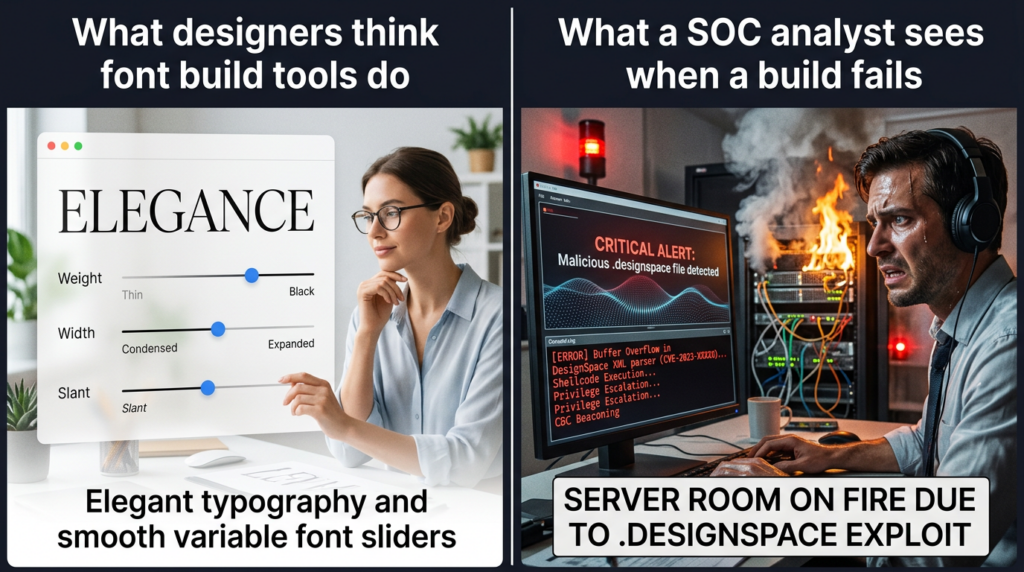
How the exploit chain works in the real world
A useful article about this CVE should avoid fake drama and also avoid hand-waving. The exploit chain is not “open a font, get owned.” It is more specific than that.
First, the attacker needs a route to get a malicious .designspace ファイル processed by the vulnerable varLib path. That route might be a pull request, a downloaded design asset, a synced package source, a customer-uploaded file that enters an automated pipeline, or a repository that a build worker treats as trustworthy enough to compile. GitHub’s advisory and the fontTools docs together make clear that .designspace is a real working format in variable-font production, not a placeholder artifact. (ギットハブ)
Second, the malicious input supplies a filename value that includes path components or traversal sequences. In the vulnerable logic, that value can influence where output files are written. The upstream commit shows exactly what had to change to block the issue: dropping everything except the basename. That is a strong indicator that the dangerous condition was not theoretical or abstract; it was simple enough to fix with direct filename normalization. (ギットハブ)
Third, the attacker benefits from the fact that the advisory is not just about path traversal. It also describes XML-based content injection 経由 labelname elements. That means the attacker can influence not only where a file lands, but what gets written into it. If the chosen target location is a script directory, a configuration path, or a web-served directory interpreted by the runtime, the arbitrary file write becomes far more than corruption. It becomes a bridge into actual code execution or application compromise. (ギットハブ)
Fourth, privilege escalation and broader system impact depend on the surrounding environment. GitHub’s advisory explicitly mentions that once RCE is obtained, attackers may escalate further and compromise system files such as /etc/passwd. That does not mean every vulnerable system instantly yields full host takeover. It means the vulnerability can become a serious foothold if the processing environment is overprivileged, badly segmented, or allowed to write where it should not. (ギットハブ)
This is why the most dangerous deployments are not individual designers opening files on a locked-down workstation. The most dangerous deployments are automated builders そして shared services that process design inputs at scale, run with write permissions they do not need, and place outputs into locations that matter to production. That is the pattern security engineers should hunt for. (ギットハブ)
The patch story, and why 4.60.2 matters more than many people realize
Upstream effectively shipped the security change in 4.61.0, and the release notes state the fix in one line: use only basename(vf.filename) で varLib.main() to prevent path traversal attacks. But a lot of environments were still tied to Python 3.9, so the project also issued 4.60.2 as a backport release to make the CVE fix available without forcing downstreams into a Python support transition. That backport decision matters because it lowers the excuse threshold for not patching. There is a clean security target version for organizations that could not jump to 4.61.0 immediately. (ギットハブ)
That split also explains why package inventory alone can mislead you. If your environment says “we are not on the newest major-minor release, but we are on 4.60.2,” you are still on a patched line. If you are on 4.60.1 or earlier within the affected window, you are not. Security teams should make sure their version-matching logic understands that nuance rather than blindly flagging “not latest” as “vulnerable” or assuming “same minor line” means safe. (ギットハブ)
The release notes also reveal something else worth noticing: the project did not frame the change as a speculative hardening tweak. It called out the security reason explicitly. That is usually a sign that maintainers regard the exploit mechanics as credible and reproducible enough to justify a clean, minimal, security-focused patch. (ギットハブ)
Linux distribution status shows this is not just a PyPI problem
When a vulnerability remains confined to a single upstream package page, many teams ignore it. CVE-2025-66034 is already beyond that stage. Ubuntu tracks it publicly, states that the issue is fixed, and lists package-level remediation information for supported releases. Ubuntu’s CVE page notes that 24.04 LTS, 25.04そして 25.10 received fixes, while some older supported releases are listed as not affected because they do not ship the vulnerable package state. The corresponding Ubuntu security notice also pairs CVE-2025-66034 with the older fontTools XXE issue, CVE-2023-45139. (Ubuntu)
Debian’s security tracker also carries the CVE, and Fedora update tracking shows the fix flowing through fonttools 4.61.0-1.fc42. Amazon Linux has a dedicated CVE entry as well, and Red Hat publicly describes the issue as crafted .designspace input leading to arbitrary file writes and XML-based content injection during variable-font generation. This matters because it means the issue is surfacing in standard OS package ecosystems, not only in direct pip install deployments. (Debian Security Tracker)
That creates two separate patching problems. The first is obvious: Python environments managed directly with ピップ need dependency upgrades. The second is less obvious: base images, Linux workstations, CI runners, and builder AMIs may inherit vulnerable fontTools packages from distro repositories or from previously baked layers. Teams that check only application lockfiles will miss part of the exposure. (Ubuntu)

Where this vulnerability actually shows up in engineering environments
The most likely affected environments are not the ones people first imagine. The common failure modes cluster around automation.
One cluster is design or asset build pipelines. Teams ingest design repositories, generate static or variable fonts, package them, and publish them as artifacts. Those pipelines often assume design assets are friendly because they come from internal contributors or trusted partners. The vulnerability breaks that assumption whenever external or semi-trusted input can reach the build step. (fonttools.readthedocs.io)
A second cluster is CI and code review automation. A monorepo may contain design sources or generated font assets, and a build workflow may compile or validate them automatically on pull requests. If the runner has write access to shared workspace paths, caches, or deployable output directories, arbitrary write becomes more than a local nuisance. It becomes a build integrity issue. (ギットハブ)
A third cluster is multi-stage packaging or site generation. Some systems transform design assets into files later served by web infrastructure, bundled into installable packages, or copied into runtime images. GitHub’s advisory is explicit that remote code execution can follow when attacker-controlled output lands in an executable or web-interpreted location. That is why this CVE deserves attention even from teams who do not think of themselves as “font users.” They may be fontTools users indirectly through a build system. (ギットハブ)
A fourth cluster is enterprise software with transitive dependency exposure. IBM security bulletins reference CVE-2025-66034 in watsonx-related runtimes and speech services, which shows the package can surface inside larger commercial stacks. That is not proof that every transitive use is exploitable in the same way, but it is evidence that the dependency exists in production software beyond the obvious design-tool world. (IBM)
A concise technical model for defenders
A simple defender model for CVE-2025-66034 looks like this:
- Input boundary — Can an attacker influence a
.designspacefile that your system processes. - Execution boundary — Does the vulnerable
varLibpath orfontTools.varLib.main()get invoked automatically. - Write boundary — Can that process write into shared, deployable, or executable paths.
- Privilege boundary — Does the worker run with broader permissions than the task actually requires.
- Follow-on boundary — Are written outputs later served, executed, imported, or trusted by another system.
If you answer yes to the first three and weakly yes to the last two, the CVE is not a theory exercise. It is a real engineering risk. That logic is directly supported by the advisory’s description of arbitrary write, content injection, and the possibility of RCE in environments that execute or expose the written files. (ギットハブ)
Safe code and command examples for finding exposure
The most useful code in an article like this is detection and validation code, not offensive proof-of-concept. Start by locating the package version across Python environments and container layers:
python - <<'PY'
import sys
try:
    import fontTools
    print("fontTools version:", getattr(fontTools, "__version__", "unknown"))
except Exception as e:
    print("fontTools import failed:", e)
    sys.exit(1)
PY

pip show fonttools 2>/dev/null || true
pip freeze | grep -i '^fonttools=='
The official fixed target for the vulnerable PyPI package line is 4.60.2 or later, with 4.61.0 also carrying the fix. Use that as your minimum acceptable version unless you are relying on a distro-packaged backport and have validated the vendor’s fixed package build. (ギットハブ)
Next, search your codebase for direct use of the vulnerable execution path:
grep -R "fontTools\\.varLib\\.main" -n .
grep -R "fonttools varLib" -n .
grep -R "\\.designspace" -n .
That search matters because the advisory does not limit risk to the CLI. It explicitly includes any code that invokes fontTools.varLib.main(). If your internal tooling wraps the function directly, you have to treat that wrapper as part of the exposure surface. (NVD)
For CI, add a guard that fails the pipeline on vulnerable versions:
from packaging.version import Version
import sys

try:
    import fontTools
except Exception as e:
    print(f"Unable to import fontTools: {e}")
    sys.exit(2)

version = Version(getattr(fontTools, "__version__", "0"))
if version < Version("4.60.2"):
    print(f"Blocked: vulnerable fontTools version detected: {version}")
    sys.exit(1)

print(f"OK: fontTools version {version} is at or above 4.60.2")
This example intentionally checks the upstream fixed version boundary. In environments that rely on vendor backports under different package versioning, use your distro’s security advisory state rather than upstream PyPI semantics alone. Ubuntu, Debian, Fedora, and Amazon Linux all publish public status data for this CVE. (Ubuntu)
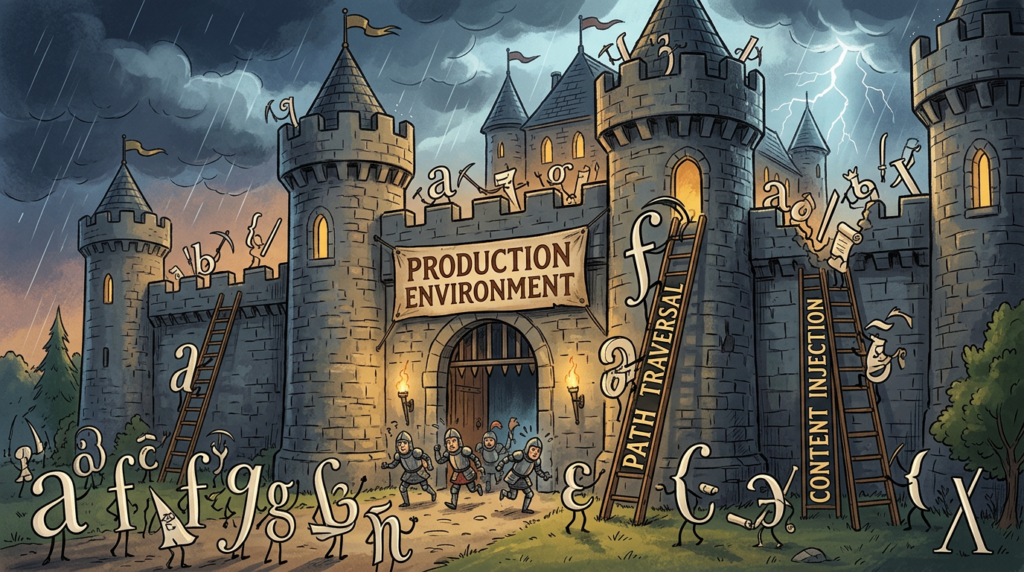
What engineering teams should change right now
The first move is obvious but still worth stating clearly: upgrade. If you install from PyPI, move to 4.60.2 or later. If you consume distro packages, verify the vendor-fixed package version for your release rather than assuming your last general update covered it. The upstream and vendor remediation records are already public and unambiguous on that point. (ギットハブ)
The second move is less obvious and often more important: stop treating design assets as harmless build inputs. A .designspace file is structured input capable of driving filesystem effects in a vulnerable build path. Put it under the same trust model you apply to code-generated artifacts, templates, and package manifests. That means PR review, repository trust boundaries, staging areas, and isolated build workers instead of broad write permissions on shared hosts. The upstream patch itself makes the trust-boundary failure obvious: it had to strip path semantics out of input-supplied filenames for security reasons. (ギットハブ)
The third move is to isolate the output directory. Even after patching, build systems should not write directly into a web root, package publish directory, or executable runtime path. Write into a scratch directory, validate outputs, and promote only vetted artifacts. The GitHub advisory’s RCE model depends heavily on written content landing somewhere the next stage will interpret. Breaking that chain sharply reduces impact. (ギットハブ)
The fourth move is 最低特権. If a builder only needs to write into its own temp directory, it should not have permission to overwrite shared configs, dependency caches, service-owned directories, or deployment content. GitHub’s advisory mentions compromise of system files after foothold; that escalation path gets much harder when the initial processing worker is tightly sandboxed. (ギットハブ)
The fifth move is inventory transitive use. fontTools appears in broad software ecosystems, and vendor bulletins show it turning up inside larger products and service runtimes. SCA, SBOM review, container scanning, and OS package inventory should all be in play here. This is not a CVE you should hunt only in application requirements.txt. (IBM)
Why CVE-2023-45139 belongs in the same conversation
CVE-2025-66034 is not the first security problem in fontTools that comes from parsing complex external data. The earlier CVE-2023-45139 affected the subsetting module and involved XML External Entity injection, allowing arbitrary entity resolution when a crafted OT-SVG font was parsed. The published impact included arbitrary file inclusion from the filesystem and outbound web requests from the host. It was fixed in 4.43.0. (NVD)
The connection between the two CVEs matters. They are different bugs, but they belong to the same engineering lesson: file-processing pipelines are execution surfaces. In 2023, the problem was XXE during font parsing. In 2025, the problem is path traversal and content injection during variable-font generation. In both cases, the issue is not that typography tooling is unusually cursed. The issue is that structured asset formats often cross trust boundaries while teams still think of them as “content,” not code-adjacent inputs. (NVD)
Ubuntu’s own advisory groups CVE-2025-66034 and CVE-2023-45139 together in its fontTools notice. That is a useful hint for defenders: when you see repeated parser-boundary and asset-ingestion issues in the same ecosystem, your remediation should not stop at patching. You should update the operating model for how those inputs are handled. (Ubuntu)
The most common mistakes I expect teams to make
The first mistake is assuming a vulnerable package on a developer laptop is the whole story. In reality, the highest-value exposure is often in automated builders, package generation systems, and repository-driven pipelines, where untrusted inputs meet privileged filesystem access. The public advisory material supports this because the dangerous behavior is about where files are written and what later interprets them, not merely whether a single user manually opens a file. (ギットハブ)
The second mistake is treating CVSS as a verdict instead of a clue. Here, the public record itself disagrees, with a medium CNA score and a critical NVD enrichment score. The right response is not to pick whichever number justifies your prior assumption. The right response is to examine your own ingestion, automation, and output paths. (NVD)
The third mistake is patching upstream PyPI dependencies while ignoring OS packages, base images, and commercial products that embed the same library. The distro trackers and IBM bulletins show that fontTools lives in more places than a quick Python package grep will reveal. (Ubuntu)
The fourth mistake is believing that once the filename sanitization fix is in place, the system is broadly “safe.” The specific CVE is addressed by patching, yes. But the larger class of risk remains: if your build system processes untrusted assets with broad permissions and writes directly into important paths, another parser or build-chain flaw can recreate the same kind of incident under a different CVE number. (ギットハブ)
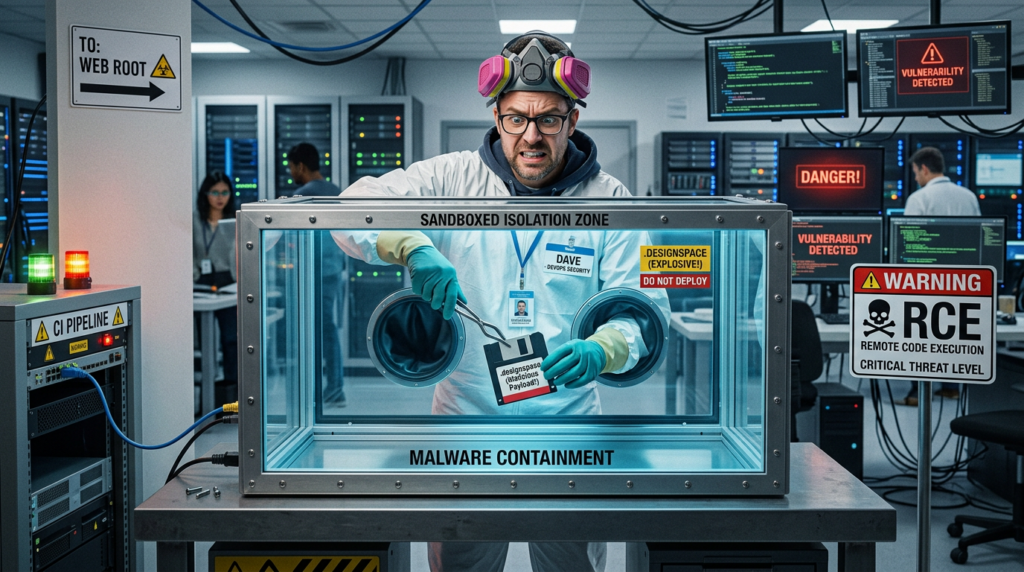
A practical validation checklist
Use this checklist when assessing whether CVE-2025-66034 is materially relevant in your environment.
| Question | なぜそれが重要なのか |
|---|---|
Do you process .designspace files anywhere in CI, automation, or packaging | This is the primary input type referenced by the advisory |
Do any tools call fonttools varLib または fontTools.varLib.main() | The vulnerability scope explicitly includes both |
Is fontTools present in both PyPI environments and OS packages | Exposure may exist in multiple inventory layers |
| Can untrusted contributors, synced repos, or external uploads influence those inputs | This determines reachability |
| Does the processing worker write into shared, deployable, or executable directories | This determines whether arbitrary write becomes meaningful compromise |
| Are outputs promoted directly into production or web-accessible locations | This is where the advisory’s RCE scenario becomes realistic |
| Do you have vendor-fixed package versions, not just “latest-ish” versions | Backports and distro versions complicate naive checks |
This checklist is derived from the upstream advisory scope, the release notes, the patch diff, and public distro remediation records. It is meant to help teams separate theoretical dependency presence from operationally dangerous deployment patterns. (ギットハブ)
For a security team, the interesting question is not merely “Is fontTools older than 4.60.2.” SCA can answer that. The harder question is whether your real workflow turns a vulnerable dependency into a credible execution path. That means validating who can supply the input, which service processes it, what permissions that service holds, what it can overwrite, and what downstream stage will trust the written result. That kind of question is operational, not just inventory-driven. Penligent’s recent technical material has been pushing in that direction more broadly: shifting from static finding lists toward evidence-driven validation of whether a risky path actually survives contact with the real environment. (寡黙)
That framing is especially useful for CVEs like this one because the severity is heavily environment-dependent. A dependency dashboard can tell you that fontTools is present. It cannot, by itself, prove whether your builder can be steered from untrusted asset ingestion into meaningful filesystem impact. In environments that rely on automated offensive validation, the value is in testing the path, not only classifying the package. That is the category where a platform like Penligent makes sense: not as a substitute for patching, but as a way to verify whether patching and workflow hardening actually closed the path you care about. (寡黙)
Final assessment
CVE-2025-66034 is one of those vulnerabilities that looks smaller than it is if you read it too quickly. The upstream bug is straightforward: vulnerable fontTools varLib logic trusted attacker-influenced filename data, enabling arbitrary file write, and the published advisory explains how content injection can turn the bug into RCE under the wrong output conditions. The fixed versions are clear. The patch is simple. The distro status is public. The package is widely deployed. None of that is ambiguous. (ギットハブ)
What is ambiguous is the environment, and that is exactly why good teams should care. If you never process untrusted .designspace files, never automate varLib, and never let build outputs land in meaningful locations, your exposure may be limited. But if you have modern design or asset automation, CI that compiles external inputs, or pipelines that turn semi-trusted structured files into production-adjacent artifacts, this CVE is a clean reminder that content-processing tools belong inside your threat model. (ギットハブ)
The engineering takeaway is simple. Patch fontTools. Audit for varLib use. Lock down build permissions. Separate scratch output from production paths. Inventory both PyPI and distro sources. And stop assuming that “design files” live outside the security boundary. CVE-2025-66034 is not really a story about fonts. It is a story about how modern automation turns structured files into control surfaces. (ギットハブ)
さらに読む
- NVD record for CVE-2025-66034 — authoritative vulnerability summary and scoring history. (NVD)
- GitHub Advisory GHSA-768j-98cg-p3fv — upstream security explanation, affected versions, and exploit conditions. (ギットハブ)
- Upstream patch commit — shows the exact
basenamefix invarLib. (ギットハブ) - fontTools releases 4.61.0 and 4.60.2 — explains the initial fix and the security backport. (ギットハブ)
- Ubuntu CVE page and USN-7917-1 — practical distro remediation status. (Ubuntu)
- Debian security tracker entry — additional distro package tracking. (Debian Security Tracker)
- CVE-2023-45139 on NVD and GitHub Advisory — related fontTools trust-boundary history. (NVD)
- Penligent, Pentest AI Tools in 2026 — What Actually Works, What Breaks — relevant for continuous validation framing. (寡黙)
- Penligent, 2026年AI侵入テスト究極ガイド:エージェントによるレッド・ティームの時代 — useful adjacent reading on evidence-driven offensive validation. (寡黙)
- Penligent blog hub — for related English technical content. (寡黙)


 Japanese
  English
  German
  French
  Spanish
  Portuguese
  Korean
  Hindi
Hindi  Arabic
  Turkish
  Hebrew