
CVE-2026-34908 is not just another critical CVE in a network appliance. It is an access-control failure in Ubiquiti UniFi OS, a management plane that can sit close to gateways, switching, Wi-Fi, cameras, door access, remote administration, identity flows, and multi-site operations. NVD describes CVE-2026-34908 as an Improper Access Control vulnerability in UniFi OS devices that a malicious actor with network access could exploit to make unauthorized system changes. The CNA score shown by NVD is CVSS v3.1 10.0 Critical with the vector AV:N/AC:L/PR:N/UI:N/S:C/C:H/I:H/A:H, while NVD’s own assessment was still not provided at the time of the record view.(nvd.nist.gov)
That distinction matters. The most useful question is not “is the score high?” The answer is already yes. The useful question is whether a vulnerable UniFi OS deployment is reachable from any network segment an attacker could touch, whether it has been updated to the relevant fixed branch, and whether the environment shows evidence that the bug chain was already used before the patch was applied.
CISA added CVE-2026-34908 to the Known Exploited Vulnerabilities catalog, with a June 23, 2026 addition date and a June 26, 2026 federal due date shown in the NVD record. The same NVD change history shows CISA’s SSVC assessment moving to active exploitation, automatable exploitation, and total technical impact.(nvd.nist.gov) SecurityWeek and BleepingComputer both reported that CISA’s KEV update covered the three UniFi OS flaws CVE-2026-34908, CVE-2026-34909, and CVE-2026-34910, and that federal agencies were told to patch within a short BOD 26-04 window.(セキュリティ・ウィーク)
The short version for defenders is simple: patch first, validate safely, then investigate for signs of compromise. The longer version is more interesting because CVE-2026-34908 is best understood as one part of a chain. Bishop Fox analyzed Ubiquiti’s patch, confirmed the root cause across multiple layers, validated an unauthenticated chain on UniFi OS Server 5.0.6, and confirmed the fix on a patched 5.0.8 target. Their analysis places CVE-2026-34908 and CVE-2026-34909 in the authentication gateway bypass portion of the chain, with CVE-2026-34910 as the command-injection sink reached after the bypass.(Bishop Fox)
CVE-2026-34908 at a glance
| フィールド | Current public information |
|---|---|
| CVE | CVE-2026-34908 |
| Vendor | Ubiquiti |
| Product family | UniFi OS devices and UniFi OS Server |
| 弱さ | Improper Access Control |
| CWE | CWE-284 in the NVD record |
| Public impact summary | A malicious actor with network access could make unauthorized system changes |
| CNA severity | CVSS v3.1 10.0 Critical |
| NVD enrichment status | NVD assessment not yet provided in the viewed record |
| Exploitation status | Added to CISA KEV, with CISA SSVC showing active exploitation |
| Closely related CVEs | CVE-2026-34909 and CVE-2026-34910 |
| Primary remediation theme | Update to the fixed UniFi OS branch, then investigate whether exposure already became compromise |
The CVE record is intentionally terse. That is normal for many CVE entries, but it can mislead teams that rely only on database text. “Improper Access Control” tells you the category. It does not tell you how the boundary failed, which component made the wrong decision, why the bug became chainable, or which operational artifacts should be reviewed after patching. MITRE’s CWE entry for CWE-284 itself warns that the category is extremely high-level and often misused or over-applied in low-information reports.(cwe.mitre.org)
In this case, the useful technical detail comes from the interaction between Ubiquiti’s advisory, NVD, CISA KEV, and Bishop Fox’s patch analysis. The public picture is now clear enough for defenders to act without guessing: CVE-2026-34908 belongs to a control-plane authentication boundary problem, and the safest operational treatment is to handle it together with CVE-2026-34909 and CVE-2026-34910.
Why UniFi OS changes the risk model
A vulnerability in a management plane is different from a vulnerability in a normal web application. UniFi OS is not just a place where users click buttons. It is the system that coordinates device management, configuration, remote access, and site-level operations.
Ubiquiti’s own product material describes UniFi Cloud Gateways as gateway firewalls that run the UniFi application suite for networking, Wi-Fi, camera security, door access, business VoIP, and more.(ui.com) Ubiquiti’s self-hosting documentation describes UniFi OS Server as the new standard for self-hosting UniFi, replacing the legacy UniFi Network Server, and notes that it delivers a management experience aligned with UniFi-native deployments and Site Manager centralized multi-site control.(help.ui.com)
That means the blast radius is not limited to one application account. Depending on deployment, a UniFi OS compromise can affect device configuration, network segmentation, administrator accounts, remote access paths, tokens, secrets, and operational visibility. The real asset is not a box. The real asset is the authority the box has over the environment.
This is why the phrase “network access required” should not calm anyone down. Many real intrusions start with access to a VPN, a contractor workstation, an exposed management interface, a misconfigured reverse proxy, a compromised jump host, a flat internal network, or an MSP tool. A bug that requires network reachability can still be urgent when the reachable service controls the network.
The three-CVE chain around CVE-2026-34908
CVE-2026-34908 should be tracked on its own, but it should not be handled alone. The public research points to a chain where three weaknesses work together.
| CVE | Public weakness | Chain role | Defender interpretation |
|---|---|---|---|
| CVE-2026-34908 | Improper Access Control | Part of the authentication gateway bypass | The system may allow an unauthenticated request to cross a boundary it should not cross |
| CVE-2026-34909 | Path Traversal | Part of the path normalization and routing mismatch | Encoded traversal and path normalization behavior help the request resolve somewhere different from what the auth gate intended |
| CVE-2026-34910 | Improper Input Validation leading to command injection | Impact stage after the bypass | A reachable backend route can pass untrusted input into a command execution path |
| CVE-2026-33000 | Authenticated command-injection variant | Related sink under a privileged-access condition | Shows that the dangerous command path also exists in a privileged context |
Bishop Fox’s analysis says the chain has three parts: getting past the authentication gateway, reaching the command-injection sink, and escalating from the service account to root. They state that they validated the full unauthenticated chain against UniFi OS Server 5.0.6 and confirmed the fix on 5.0.8.(Bishop Fox)
That does not mean every sentence about CVE-2026-34908 should call it “RCE.” Precision matters. CVE-2026-34908 is the access-control piece. CVE-2026-34910 is the command-injection piece. The practical risk becomes remote code execution when the relevant pieces are reachable and chained.
SecurityWeek’s summary matches that chain model: CVE-2026-34908 is described as the improper access-control issue, CVE-2026-34909 as a path traversal issue, and CVE-2026-34910 as the improper input validation issue that enables command injection. The same report notes that Bishop Fox’s patch analysis connects CVE-2026-34908 and CVE-2026-34909 to an Nginx authentication gateway bypass rooted in crafted request processing.(セキュリティ・ウィーク)
The raw URI and normalized URI problem
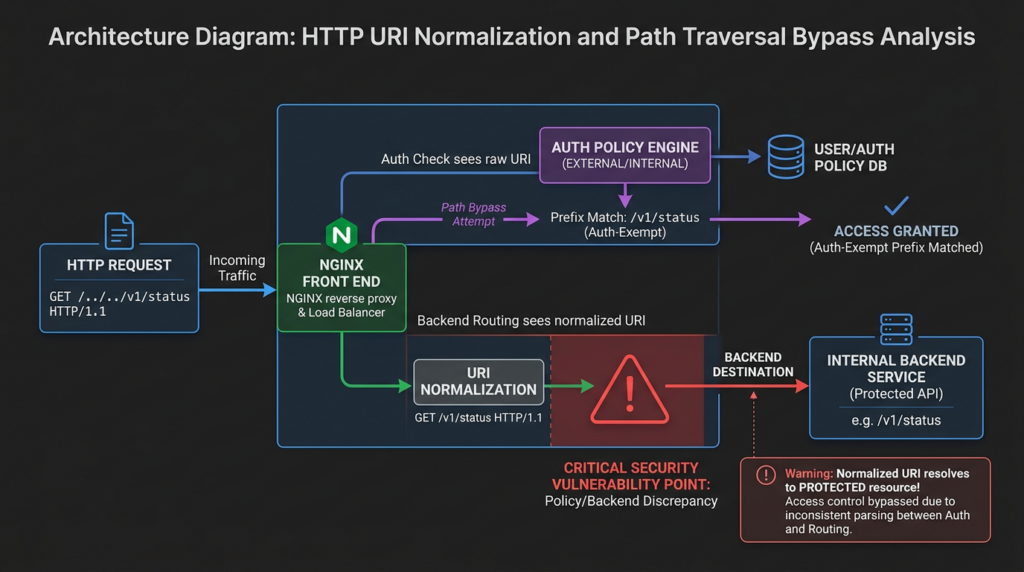
The most important engineering lesson in this bug is that access control fails when different layers disagree about what a request means.
In Bishop Fox’s write-up, Nginx fronts services and enforces authentication with an auth_request subrequest to a Node service. The authentication handler decides whether a request is public or must be authenticated. The bypass arises when one layer evaluates a raw URI with an auth-exempt prefix, while routing later uses a normalized URI that decodes and collapses path segments. Bishop Fox describes a request shape where the raw form begins with an exempt path, but the normalized form resolves to an internal route that should require authentication.(ギットハブ)
This is not an exotic class of weakness. It is a classic boundary-consistency problem. Access control is only as strong as the most permissive parser in the chain. If the reverse proxy, authentication middleware, router, application framework, and backend service each parse paths differently, the system may not be enforcing one policy. It may be enforcing several inconsistent policies.
OWASP’s path traversal material lists encoded traversal variations such as %2e%2e%2f, %2e%2e/そして ..%2f, all representing attempts to express parent-directory traversal through encoded or partially encoded paths.(owasp.org) MITRE’s CWE-22 entry describes how attackers use special elements such as .. and path separators to escape intended directory restrictions.(cwe.mitre.org) In the UniFi OS chain, the key point is not just file reading. The important point is path interpretation drift across gateway and backend logic.
A simplified model looks like this:
Client request
    |
    v
Nginx front end
    |
    |-- auth subrequest checks one representation of the URI
    |
    v
routing logic normalizes or decodes the URI
    |
    v
backend receives a different effective path
    |
    v
protected handler is reached without the intended authentication boundary
A secure design needs the opposite behavior:
Client request
    |
    v
canonicalize once, reject ambiguous forms early
    |
    v
apply authentication and routing to the same canonical representation
    |
    v
enforce backend authorization again before sensitive action
Bishop Fox says Ubiquiti’s patched configuration adds an Nginx raw-versus-normalized URI comparison and rejects divergence with HTTP 400. They describe the patch as removing the gateway bypass by making the gate and router agree on what the request is.(Bishop Fox)
That is the right lesson for developers beyond this CVE. Normalization is not a cosmetic step. It is part of the security boundary.
Why the command-injection stage raises the stakes
CVE-2026-34910 is the reason the access-control bypass becomes operationally explosive. Bishop Fox found that a backend package-update route accepted a caller-supplied package name and passed it into a command-building path. Their analysis describes a command string built with a package name interpolated into a local command and then executed through a shell wrapper in the vulnerable version.(Bishop Fox)
This matters because command injection is not simply “the attacker can run a command.” On a control plane, command execution can become credential theft, network pivoting, configuration tampering, persistent access, and physical-security impact if cameras or door access are managed by the same ecosystem.
MITRE’s CWE-20 definition covers products that receive input but do not validate or incorrectly validate that the input has the properties required for safe and correct processing.(cwe.mitre.org) That description is generic, but the UniFi OS case shows the concrete risk: a parameter that should be a package name must be constrained as a package name, not treated as a free-form string that can reach a shell.
Bishop Fox’s patch analysis says the backend fix added a package-name allowlist and rewrote execution to use an argument-array helper without a shell, removing the sh -c wrapper so shell metacharacters are no longer interpreted.(Bishop Fox) That is the difference between “string that becomes code” and “data passed as data.”
What root on UniFi OS can mean
The highest-risk part of this issue is not the initial HTTP request. It is the control-plane authority behind it.
Bishop Fox describes a UniFi OS Server as a management plane for an organization’s network, and, where those devices are deployed, for physical-access doors, surveillance cameras, and related identities. Their analysis says root access on the appliance can expose session-token signing keys, TLS private keys, cloud-access tokens, local PostgreSQL user data, credential-server holdings such as RADIUS secrets, Wi-Fi credentials, VPN and WireGuard configurations, NFC card data, and facial-recognition templates for UniFi Access.(Bishop Fox)
That list should change how defenders respond. If a device was merely vulnerable and no exploitation evidence exists, patching and validation may be enough. If exploitation is confirmed or strongly suspected, rotating one password is not enough. A root-level attacker may have read secrets that enable access beyond the appliance. They may have created accounts, changed SSH state, modified remote access settings, extracted cloud tokens, or planted persistence.
Bishop Fox explicitly recommends rebuilding rather than “rotate-and-hope” for confirmed compromise, because a forged token could have enabled SSH and set a root password that outlives key rotation, and root could have planted other persistence.(Bishop Fox)
Affected versions and fixed branches
Ubiquiti’s Security Advisory Bulletin 064 is the vendor anchor for this issue. Search-visible advisory summaries and independent write-ups point to UniFi OS Server 5.0.8 or later as the fixed line for UniFi OS Server, with different fixed versions across hardware families. Bishop Fox summarizes the fixed targets as UniFi OS Server 5.0.8 or later, most Cloud Gateways, Dream Machines, NVRs, and similar appliances moving to 5.1.12 or later, the UNAS line to 5.1.10 or later, Dream Machine Beast to 5.1.11 or later, and UniFi Express to 4.0.14 or later.(Bishop Fox) A separate public advisory summary from MCNC gives the same practical remediation pattern: update UNAS to 5.1.10 or later, UniFi OS Server to 5.0.8 or later, many gateway and NVR lines to 5.1.12 or later, and UDM-Beast to 5.1.11 or later.(mcnc.org)
| Product line | Publicly stated fixed target |
|---|---|
| UniFi OS Server | 5.0.8 or later |
| UCG, UDM, UDW, UDR, Express 7, UNVR, ENVR, UCK, EFG and similar lines | 5.1.12 or later, depending on model |
| UNAS line | 5.1.10 or later |
| UDM-Beast | 5.1.11 or later |
| UniFi Express | 4.0.14 or later |
Treat this table as a triage aid, not a substitute for the local Update Manager or the latest Ubiquiti advisory. UniFi product naming is easy to blur during an incident. A Cloud Gateway, a UniFi OS Server install, a CloudKey, a Dream Machine, an NVR, and a UNAS device can all show up in the same environment, and not every device line follows the same fixed branch.
The operational rule is better than memorizing version numbers: identify every UniFi OS control-plane instance, map it to its product line, confirm the current version locally, update to the relevant fixed or newer branch, then retest.
Why “internal only” is not a safe reason to delay
Many organizations under-prioritize CVEs that require network access because they interpret “not internet-facing” as “low urgency.” That is a bad model for management-plane bugs.
A UniFi OS interface might be reachable from:
| Reachability path | なぜそれが重要なのか |
|---|---|
| Public internet | Direct unauthenticated probing and exploitation become possible |
| VPN address space | Compromised VPN users, stolen credentials, and weak MFA can expose the service |
| Management VLAN | A single compromised admin workstation may reach it |
| MSP or contractor network | Third-party access can become a path into the control plane |
| Reverse proxy | Header, path, and normalization behavior can complicate exposure analysis |
| Site-to-site networks | A compromise in one site may reach management services in another |
| Cloud or remote management path | Tokens and remote access workflows become part of the risk surface |
A management interface does not need to be on Shodan to be reachable by an attacker. The correct question is whether it is reachable from any place where an attacker could plausibly land.
Safe validation workflow
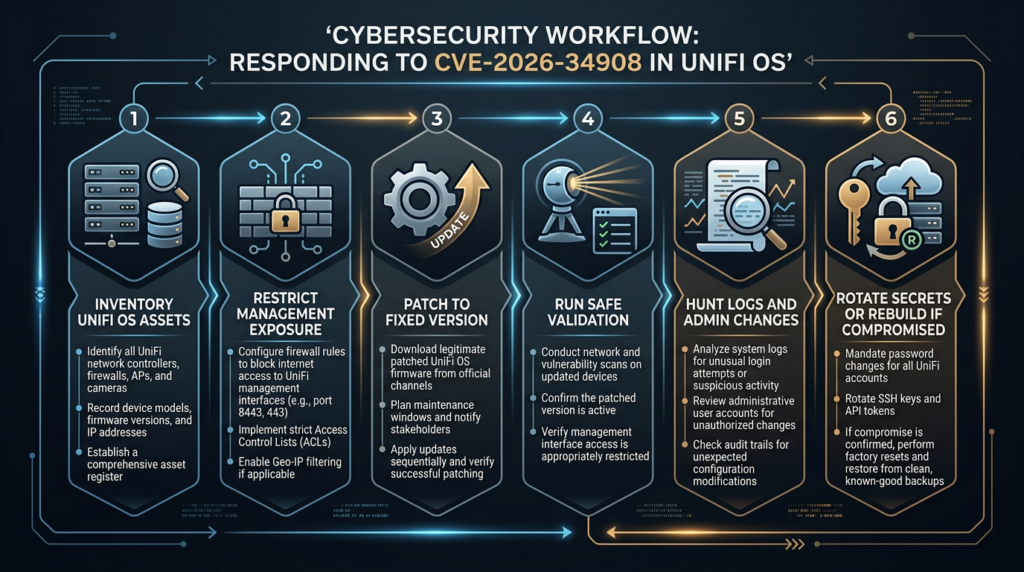
Validation should answer four questions without causing damage:
- Is this actually a UniFi OS target?
- Is the vulnerable behavior reachable?
- Is the system patched or merely hidden behind a filter?
- Is there evidence that the vulnerability was already used?
Bishop Fox released a safe detector for UniFi OS Server that they describe as using only ゲット requests, executing no commands, changing no target state, and requiring a baseline request to be rejected with 401 before declaring a target vulnerable. The detector reports VULNERABLE, PATCHED, UNAFFECTED, INCONCLUSIVEあるいは エラー, and its README explains the false-positive guard and the meaning of each verdict.(ギットハブ)
A responsible workflow can look like this:
# 1. Prepare an authorized list of known UniFi OS management targets.
# Do not scan networks outside your written scope.
cat authorized-unifi-targets.txt
# 2. Survey common management ports inside the authorized scope.
nmap -Pn -p 443,8443,11443 --open -oA unifi-management-survey -iL authorized-unifi-targets.txt
# 3. Run a non-destructive detector where policy allows it.
# The Bishop Fox detector is documented as using GET requests and executing no commands.
python3 cve_2026_34908_check.py -f authorized-unifi-targets.txt --json > unifi-cve-2026-34908-results.json
# 4. Extract only results that need action.
jq -r '.[] | select(.verdict=="VULNERABLE" or .verdict=="INCONCLUSIVE" or .verdict=="ERROR") |
       [.target, .verdict, (.error // .bypass.detail // "review manually")] | @tsv' \
       unifi-cve-2026-34908-results.json
Do not turn validation into exploitation. A time-delay command injection test may be useful in a research lab, but it is not appropriate as a default production check. For most defenders, version confirmation, safe detector output, logs, and post-patch retest are enough.
How to interpret detector outcomes
| Verdict | 意味 | What to do next |
|---|---|---|
| VULNERABLE | The auth bypass reached the vulnerable handler unauthenticated | Patch immediately, restrict reachability, preserve logs, investigate for compromise |
| PATCHED | The patched behavior rejected the normalized-path divergence | Still review exposure window and logs if the host was reachable before patching |
| UNAFFECTED | The root page did not show UniFi OS fingerprint | Confirm the target list was accurate; beware reverse proxies that strip fingerprints |
| INCONCLUSIVE | UniFi OS was confirmed, but the probe could not classify it | Confirm version locally and inspect proxy or filtering behavior |
| エラー | Connection, timeout, or TLS failure | Re-run from the right network path and validate inventory |
The most dangerous mistake is treating INCONCLUSIVE as safe. Bishop Fox’s README explicitly notes that INCONCLUSIVE is not a guarantee of safety; it can mean the host is confirmed as UniFi OS but could not be classified from network behavior alone.(ギットハブ)
Log detection and hunting
Bishop Fox identifies a recognizable bypass shape: request URIs containing the /api/auth/validate-sso/ exemption prefix together with encoded path traversal sequences such as ..%2f, ..%2e, %2e%2e, and similar. They state that legitimate validate-sso requests should not carry encoded traversal, so this pattern is suspicious regardless of response code. They also recommend watching the package-update route for parameters carrying shell metacharacters and watching the host for unexpected child processes and anomalous sudo dpkg, chmodあるいは systemctl calls under the relevant service account.(Bishop Fox)
A simple log-hunting script can help teams triage reverse proxy or web access logs:
#!/usr/bin/env python3
import re
import sys
from pathlib import Path

SUSPICIOUS_PATH = re.compile(
    r"/api/auth/validate-sso/.*("
    r"\.\.%2f|%2e%2e%2f|%2e%2e/|"
    r"\.\.%5c|%2e%2e%5c|%252e%252e%255c|"
    r"\.\.%2e|%2e%2e"
    r")",
    re.IGNORECASE,
)

def scan_file(path: Path) -> None:
    with path.open("r", errors="replace") as f:
        for line_no, line in enumerate(f, 1):
            if SUSPICIOUS_PATH.search(line):
                print(f"{path}:{line_no}: {line.rstrip()}")

def main() -> int:
    if len(sys.argv) < 2:
        print("Usage: hunt_unifi_cve_2026_34908.py <logfile> [<logfile> ...]", file=sys.stderr)
        return 2

    for name in sys.argv[1:]:
        p = Path(name)
        if not p.exists():
            print(f"missing: {p}", file=sys.stderr)
            continue
        scan_file(p)

    return 0

if __name__ == "__main__":
    raise SystemExit(main())
Run it only on logs you are authorized to review:
python3 hunt_unifi_cve_2026_34908.py /var/log/nginx/access.log /var/log/nginx/access.log.1
A Splunk-style query can express the same idea:
index=proxy OR index=nginx
uri_path="/api/auth/validate-sso/*"
(
  uri="*..%2f*" OR uri="*%2e%2e%2f*" OR uri="*%2e%2e/*" OR
  uri="*..%5c*" OR uri="*%2e%2e%5c*" OR uri="*%252e%252e%255c*"
)
| table _time src_ip host method uri status user_agent
An Elastic-style query can be written as:
url.path : "/api/auth/validate-sso/*" and
url.original : (*..%2f* or *%2e%2e%2f* or *%2e%2e/* or *..%5c* or *%2e%2e%5c*)
These are detection starting points, not final incident conclusions. A single suspicious request may be a failed scan. Multiple requests from distributed sources, successful responses, backend handler errors, new admin accounts, SSH state changes, or suspicious host processes are stronger signals.
Host and application indicators to review
| 信号 | なぜそれが重要なのか | False positive risk | 推奨される措置 |
|---|---|---|---|
Encoded traversal in /api/auth/validate-sso/ リクエスト | Matches the public bypass shape | Low for normal SSO traffic | Preserve logs, identify source, correlate response and timing |
| Protected backend response without expected authentication | Suggests the boundary may have been crossed | Medium if proxy behavior is unusual | Validate directly and patch |
| Unexpected administrator account | Could indicate unauthorized system modification | ミディアム | Audit creation time, source IP, session, and admin actions |
| SSH enabled unexpectedly | Can indicate persistence or post-exploitation setup | ミディアム | Review change history and disable if not required |
| New root password or local account change | Could survive token rotation | Low to medium | Treat as possible compromise |
sudo, dpkg, chmod, systemctl from update-related service context | Aligns with post-exploitation behavior described by researchers | Low to medium | Escalate to incident response |
| TLS private key access or replacement | Could enable impersonation or interception | 低い | Rotate certificates and inspect system integrity |
| Cloud-access token exposure | Enables multi-site or remote-management impact | 低い | Revoke and reissue tokens, audit remote sessions |
If you find evidence of successful exploitation, avoid the common trap of applying only a version update and closing the ticket. Patching removes the known vulnerability. It does not remove accounts, tokens, keys, configuration changes, or persistence created before the patch.
Remediation order for defenders
The order matters because exposed management planes can be targeted quickly after public disclosure and KEV listing.
| 優先順位 | アクション | なぜそれが重要なのか |
|---|---|---|
| 1 | Restrict management interface reachability | Reduces immediate exposure before and during patching |
| 2 | Patch to the correct fixed branch | Closes the known vulnerability path |
| 3 | Verify the version locally | Avoids false confidence from stale inventory or partial rollout |
| 4 | Run a safe validation check | Confirms the vulnerable behavior is no longer reachable |
| 5 | Review logs from before patching | Determines whether this was exposure only or compromise |
| 6 | Audit admin accounts and SSH state | Finds unauthorized changes |
| 7 | Rotate secrets where exposure is plausible | Reduces follow-on access from stolen tokens and keys |
| 8 | Rebuild confirmed compromised systems | Removes persistence that rotation may not touch |
| 9 | Retest after remediation | Produces evidence that the fix worked |
| 10 | Record artifacts in a report | Helps operations, audit, insurance, and leadership decisions |
A minimal remediation ticket should capture:
{
  "asset": "unifi-os-server-01",
  "product_line": "UniFi OS Server",
  "previous_version": "5.0.6",
  "fixed_version": "5.0.8",
  "network_reachability": ["management_vlan", "vpn"],
  "validation_method": "non-destructive detector plus local version check",
  "pre_patch_verdict": "VULNERABLE",
  "post_patch_verdict": "PATCHED",
  "log_review_window_utc": {
    "start": "2026-05-21T00:00:00Z",
    "end": "2026-06-27T00:00:00Z"
  },
  "suspicious_requests_found": true,
  "admin_account_audit": "no unauthorized admins found",
  "ssh_state_review": "unchanged",
  "secrets_rotated": ["remote_access_tokens", "local_admin_passwords"],
  "rebuild_required": false,
  "owner": "network-security",
  "evidence_location": "case-2026-34908/unifi-os-server-01/"
}
This kind of evidence is more useful than a screenshot of a green scanner result. It tells the next person what was tested, what changed, what was observed, and what remains uncertain.
Network hardening after the patch
Patching closes the disclosed vulnerability. It does not fix the architectural habit that made the interface reachable.
Use CVE-2026-34908 as a reason to re-check management-plane exposure:
| コントロール | Practical implementation |
|---|---|
| Management segmentation | Place UniFi OS interfaces in a dedicated management VLAN or restricted admin network |
| Explicit access paths | Require VPN, bastion, or privileged access workstation routes rather than broad LAN reachability |
| MFA for administrators | Reduce risk from stolen credentials after patching |
| Account minimization | Remove stale local admins and third-party accounts |
| Remote access review | Audit Site Manager and cloud-access tokens |
| Logging | Send reverse proxy, application, auth, and host logs to central storage |
| Egress monitoring | Watch for unexpected outbound connections from the control plane |
| Backup integrity | Keep offline or immutable backups of control-plane configuration |
| Change monitoring | Alert on SSH enablement, admin creation, token changes, and firmware downgrade attempts |
| Retest cadence | Revalidate after patching, topology changes, remote-access changes, or new UniFi advisories |
The goal is not to make administration painful. The goal is to ensure that management authority is not reachable from every host that happens to be on the network.
Developer lessons from CVE-2026-34908
The bug chain contains lessons for anyone building gateways, admin panels, API proxies, service meshes, or agent orchestration layers.
First, canonicalization must happen before security decisions. If one layer checks an unnormalized string and another layer routes a normalized string, access-control decisions become fragile.
Second, public-path exemptions should be as narrow as possible. Any unauthenticated path must be treated as hostile input, especially if it shares routing machinery with protected internal services.
Third, backend services must enforce authorization again. A reverse proxy auth gate is useful, but sensitive backend handlers should not assume the proxy always got it right.
Fourth, command execution must avoid shell interpolation. Allowlisted arguments passed as arrays are safer than command strings. Input that is supposed to be a package name should be validated as a package name.
Fifth, patches should be observable. Bishop Fox was able to reason about the fix because the patched behavior rejects raw-versus-normalized divergence and removes the shell interpretation path. Good fixes create clear, testable security behavior.
How CVE-2026-34908 compares with related UniFi issues
Ubiquiti’s recent advisory history reinforces the same operational lesson: UniFi management software should be treated as a high-value control plane.
Penligent previously covered CVE-2026-22557, a UniFi Network Application path traversal issue disclosed in March 2026, and framed it as a management-plane path-boundary problem rather than a generic file-path bug. That comparison is useful because both cases show how path handling and control-plane authority can turn a familiar weakness class into an emergency patching event.(寡黙)
| CVE | Product area | 弱さ | Relevance to CVE-2026-34908 |
|---|---|---|---|
| CVE-2026-34908 | UniFi OS | Improper access control | Authentication boundary failure in the control plane |
| CVE-2026-34909 | UniFi OS | Path traversal | Path normalization and traversal behavior contribute to the bypass model |
| CVE-2026-34910 | UniFi OS | Improper input validation and command injection | Impact stage reachable after bypass |
| CVE-2026-33000 | UniFi OS | Command injection variant requiring privileges | Related sink under authenticated conditions |
| CVE-2026-22557 | UniFi Network Application | Path traversal | Earlier UniFi management-plane path-boundary issue |
The point is not that every UniFi CVE is the same. They are not. The point is that management-plane vulnerabilities deserve a different remediation muscle memory than ordinary application bugs.
Safe use of AI-assisted validation
For teams running large environments, the hardest part is often not knowing that a CVE exists. It is turning the advisory into a controlled workflow: inventory, exposure mapping, version confirmation, safe validation, evidence capture, remediation, and retesting.
In an authorized security workflow, AI-assisted tooling can help structure those repetitive steps without replacing human judgment. A platform such as Penligent is relevant in this narrow operational sense: its site describes agentic workflows for finding vulnerabilities, verifying findings, executing controlled tests, and preserving evidence-first results for authorized security testing.(寡黙) For a vulnerability like CVE-2026-34908, the useful role is not “let an agent exploit production.” The useful role is bounded orchestration: keep scope explicit, run safe checks, capture artifacts, summarize evidence, and make retesting repeatable.
The guardrails matter more than the model. A good validation workflow should know the target list, the allowed checks, the forbidden payloads, the evidence format, the approval points, and the escalation criteria. CVE-2026-34908 is exactly the kind of issue where disciplined automation helps, because the same question must be answered across many sites and devices: is the management plane still exposed to the known vulnerable behavior, and can we prove the fix worked?
Common mistakes to avoid
The first mistake is treating CVE-2026-34908 as a normal web-app issue. It is not. The affected software can control network infrastructure and adjacent systems.
The second mistake is saying “it requires network access” as if that removes urgency. Network access is not rare during intrusions. VPNs, jump hosts, contractors, flat internal networks, exposed admin paths, and compromised workstations all matter.
The third mistake is patching only the most visible UniFi device. Environments may contain UniFi OS Server, Cloud Gateways, Dream Machines, NVRs, CloudKeys, UNAS systems, or other related devices. The full inventory matters.
The fourth mistake is stopping after a patched version appears. If the device was reachable before patching, review logs and admin state.
The fifth mistake is confusing INCONCLUSIVE with safe. A filtered or proxied host can be difficult to classify remotely. Confirm the version locally.
The sixth mistake is rotating one password after suspected root compromise. Root access can expose keys, tokens, account databases, and persistence paths. Rebuild may be the only defensible path for confirmed compromise.
Practical incident-response checklist
Use this checklist after identifying any UniFi OS system that was vulnerable or exposed during the relevant window.
| ステップ | Question | Evidence to collect |
|---|---|---|
| Asset ownership | Who owns this UniFi OS device or server? | Asset record, hostname, IP, site, owner |
| Version | What version was running before and after remediation? | Update Manager screenshot, CLI output, change ticket |
| Exposure | Which networks could reach the management interface? | Firewall rules, VPN routes, proxy logs |
| 検出 | Were suspicious validate-sso traversal requests observed? | Access logs, SIEM query output |
| Account audit | Were new admins created or modified? | Admin user export, audit trail |
| SSH state | Was SSH enabled, changed, or used unexpectedly? | Configuration history, auth logs |
| Token review | Could cloud-access or remote-management tokens have been exposed? | Token inventory, revocation evidence |
| Secret rotation | Which secrets were rotated? | Credential rotation ticket |
| 誠実さ | Was the system rebuilt or only patched? | Rebuild notes, backup source, firmware image |
| Retest | Did post-fix validation show patched behavior? | Detector output, local version confirmation |
よくあるご質問
What is CVE-2026-34908?
- CVE-2026-34908 is an Improper Access Control vulnerability in Ubiquiti UniFi OS.
- NVD describes it as a flaw that a malicious actor with network access could exploit to make unauthorized system changes.
- The CNA score shown in NVD is CVSS v3.1 10.0 Critical.
- It should be handled together with CVE-2026-34909 and CVE-2026-34910 because public research shows they can form a broader auth-bypass and command-injection chain.(nvd.nist.gov)
Is CVE-2026-34908 being exploited in the wild?
- Yes, CISA added CVE-2026-34908 to the Known Exploited Vulnerabilities catalog.
- NVD’s change history shows CISA’s SSVC state for the CVE as active exploitation, automatable, and total technical impact.
- CISA did not publish detailed exploitation telemetry in the sources reviewed here, so defenders should avoid overclaiming specific attacker identity unless they have their own evidence.(nvd.nist.gov)
Does CVE-2026-34908 require authentication?
- The CVSS vector shown by NVD for the CNA score includes
PR:N, meaning no privileges required. - It also includes
UI:N, meaning no user interaction required. - The public exploit-chain analysis treats CVE-2026-34908 and CVE-2026-34909 as part of an authentication gateway bypass.
- Network reachability is still required, so exposure mapping is critical.(nvd.nist.gov)
Is CVE-2026-34908 itself remote code execution?
- Not precisely.
- CVE-2026-34908 is the improper access-control component.
- CVE-2026-34910 is the improper input validation and command-injection component.
- Public research shows the flaws can be chained so an unauthenticated attacker can reach a command-injection path on vulnerable UniFi OS Server versions.(Bishop Fox)
Which versions should be patched?
- UniFi OS Server should be updated to 5.0.8 or later.
- Public summaries identify different fixed branches for different hardware lines, including 5.1.12 or later for many Cloud Gateway, Dream Machine, NVR, UCK, and related lines.
- UNAS devices and UDM-Beast have different fixed targets in public summaries.
- Administrators should confirm the exact fixed version in the latest Ubiquiti advisory or local Update Manager for their specific device model.(Bishop Fox)
How can defenders safely check exposure?
- Build an authorized list of UniFi OS management targets.
- Confirm product and version locally where possible.
- Use non-destructive validation only.
- Bishop Fox’s detector is documented as executing no commands, changing no target state, and using baseline behavior to reduce false positives.
- トリート
INCONCLUSIVEas “manual verification required,” not as “safe.”(ギットハブ)
What logs should teams review after patching?
- Reverse proxy and web access logs for
/api/auth/validate-sso/combined with encoded traversal sequences. - Backend logs for unexpected access to package-update routes.
- Host logs for suspicious child processes under update-related service contexts.
- Admin audit logs for newly created users, changed roles, SSH enablement, remote access changes, and token activity.
- Network logs for unexpected outbound connections from the UniFi OS host.
Should a compromised UniFi OS device be rebuilt?
- If exploitation is confirmed, rebuilding is safer than only rotating credentials.
- Root-level compromise can expose secrets and allow persistence that survives simple password changes.
- Rebuild from a known-good image, restore only trusted configuration, rotate relevant secrets, and retest.
- If there is exposure but no evidence of compromise, patching, validation, log review, and targeted rotation may be sufficient depending on the environment’s risk tolerance.
Closing judgment
CVE-2026-34908 deserves emergency treatment because of three facts that reinforce each other: it affects a management plane, it is part of a publicly analyzed auth-bypass chain, and CISA has placed it in KEV with active exploitation reflected in the public record. The right response is not panic and not passive patch tracking. It is a controlled sequence: identify every UniFi OS control-plane asset, update to the relevant fixed branch, validate safely, hunt for evidence from the exposure window, rotate or rebuild where compromise is plausible, and keep management interfaces off broad networks going forward.
 Japanese
  English
  German
  French
  Spanish
  Portuguese
  Korean
  Hindi
Hindi  Arabic
  Turkish
  Hebrew