
Januscape is not a Proxmox login bug, a Proxmox API flaw, or a weakness in the Proxmox web interface. CVE-2026-53359 is a Linux KVM x86 vulnerability in the shadow MMU, and it matters to Proxmox because Proxmox VE uses Linux KVM to run virtual machines. The practical question for a Proxmox administrator is not “Is the Proxmox dashboard exposed?” It is “Can an untrusted or compromised virtual machine reach a vulnerable KVM code path on the host, especially through nested virtualization?” The NVD description identifies the vulnerable area as KVM’s x86 shadow paging logic and describes a use-after-free condition caused by reusing a shadow page when its role does not match the translation KVM is trying to build. (NVD)
The public disclosure from Hyunwoo Kim describes Januscape as a guest-to-host escape class vulnerability affecting KVM on x86 Intel and AMD systems. The public material says the issue can be triggered from the guest side when the right virtualization conditions exist, and that the public proof of concept can crash the host kernel rather than provide a full public escape exploit. The disclosure also states that the vulnerability was used in Google kvmCTF and later reported to the Linux kernel security team. (Openwall)
For Proxmox environments, the highest-priority exposure pattern is an x86 Proxmox VE node running vulnerable kernel packages where nested virtualization is made available to a VM that should not be trusted as part of the host’s security boundary. Proxmox staff acknowledged the issue in the Proxmox forum, said fixed kernel packages were being prepared, and identified disabling nested KVM as the known mitigation before patched kernels were available. Later in the same thread, Proxmox staff said fixed 6.8 and 7.0 kernel packages were available in testing and then on the pve-no-subscription repository. (Proxmox Support Forum)
That framing matters because a careless response can create as much operational risk as the vulnerability itself. Running a public kernel-crash PoC on a production Proxmox node is not a validation plan. Treating every Proxmox VM as automatically exploitable is also wrong. A useful response starts with scope: x86 KVM, host kernel version, nested virtualization exposure, guest trust level, and patch status.
The short version for Proxmox operators
CVE-2026-53359 should be treated as a serious virtualization isolation issue, but not as a remotely reachable network bug in Proxmox VE. The affected component is the Linux kernel’s KVM x86 shadow MMU. A malicious or compromised guest can matter when nested virtualization is exposed. The public Januscape repository describes a public PoC that triggers a host kernel panic and says a full escape exploit exists in a controlled environment but is not publicly released. (ギットハブ)
| Question | Practical answer |
|---|---|
| Is this a Proxmox Web UI vulnerability? | No. The vulnerable area is Linux KVM x86 shadow paging, not the Proxmox web interface. |
| Why does Proxmox appear in searches for CVE-2026-53359? | Proxmox VE uses KVM for virtual machines, so Proxmox hosts inherit exposure from vulnerable host kernels and VM configuration. |
| Does every Proxmox VM become a host escape risk? | No. The most relevant risk is x86 KVM with nested virtualization exposed to an untrusted or compromised guest. |
| Is the public PoC safe to run on production? | No. The public material describes a host panic PoC, and Proxmox forum users explicitly warned against production testing. (Proxmox Support Forum) |
| What should be done first? | Check host kernel packages, identify VMs with nested virtualization exposure, disable unnecessary nested KVM, and install patched Proxmox kernel packages through the appropriate repository. |
| Is a reboot required after patching? | Yes. A kernel package update does not protect a running node until the host boots into the patched kernel. |
| Is there an NVD CVSS score? | NVD had not yet provided CVSS metrics on the record captured here, so the absence of a score should not be treated as evidence of low risk. (NVD) |
NVD lists CVE-2026-53359 as published on July 4, 2026 and modified on July 6, 2026. Its record describes the bug as a Linux kernel KVM x86 shadow paging issue and lists several upstream fixed kernel lines as unaffected, including 6.1.177, 6.6.144, 6.12.95, 6.18.38, 7.1.3, and 7.2-rc1. (NVD)
The immediate operational advice is simple: do not run Januscape proof-of-concept code on production Proxmox nodes; do not leave nested virtualization enabled for guests that do not need it; and do not assume a package update has taken effect until the node has booted into the fixed kernel.
Why a KVM bug becomes a Proxmox risk
Proxmox VE is a virtualization management platform. It gives administrators cluster management, storage integration, networking, VM lifecycle operations, backups, and a usable web interface. The VM isolation layer underneath those workflows is still provided by the host operating system and KVM. When a KVM vulnerability affects the host kernel, Proxmox does not need to have a bug in its own application code for Proxmox hosts to be operationally affected.
That distinction is often lost in emergency vulnerability handling. A web application vulnerability usually has an external service, an HTTP request path, a vulnerable endpoint, and often a remote scanning pattern. CVE-2026-53359 does not fit that model. It is a hypervisor isolation problem. The attacker’s meaningful position is inside a guest VM, not outside the Proxmox web interface. The dangerous boundary is guest-to-host, not internet-to-dashboard.
Nested virtualization is the key configuration detail for most Proxmox readers. Nested virtualization allows a VM to run its own virtual machines or hypervisor-like workloads. In Proxmox, that may be used for labs, training ranges, CI environments, nested Proxmox testing, Android emulator workloads, malware analysis sandboxes, or customer-provided VM images. It is useful, but it weakens the assumption that the first-level guest is only a normal workload. It lets that guest exercise more of the host KVM virtualization machinery.
Proxmox staff clarified in the forum that nested virtualization may be enabled at the kernel module level by default, but it is not necessarily available to every VM by default. The VM must be configured in a way that exposes the relevant virtualization capability, such as by using a CPU model or flags that present virtualization features to the guest. Proxmox staff also clarified that container nesting flags are not the same as this VM KVM exposure. (Proxmox Support Forum)
That means a Proxmox exposure assessment should not stop at “Is nested enabled in the kernel module?” It should continue to “Which VMs can actually see vmx or svm inside the guest?” and “Who controls those VMs?”

How KVM shadow MMU works, enough to understand Januscape
A normal process on a normal Linux system uses virtual memory. The CPU translates virtual addresses to physical memory through page tables. Virtual machines add another layer. A guest operating system believes it owns physical memory, but those “physical” addresses are guest physical addresses. The host ultimately maps them to host physical memory.
With hardware-assisted virtualization, modern x86 systems often use Intel EPT or AMD NPT to handle parts of this translation efficiently. KVM also has a shadow MMU implementation that creates host-side page table structures representing guest translations. The Linux kernel documentation describes KVM’s MMU as supporting both first-generation shadow paging and two-dimensional paging such as EPT and NPT, and explains that nested guest translations can involve chains such as nested guest virtual address to nested guest physical address to guest physical address to host physical address. (Kernel Documentation)
The shadow MMU keeps shadow pages. A shadow page contains shadow page table entries, or SPTEs. A non-leaf SPTE points to another shadow page. A leaf SPTE maps to the actual guest memory that KVM is making accessible under a particular translation. The kernel documentation also explains that KVM tracks metadata such as guest frame number, shadow page role, and whether the page is direct. (Kernel Documentation)
Three terms are important for CVE-2026-53359.
The first is GFN, or guest frame number. A GFN identifies a guest physical frame. It is a central key in KVM’s view of guest memory.
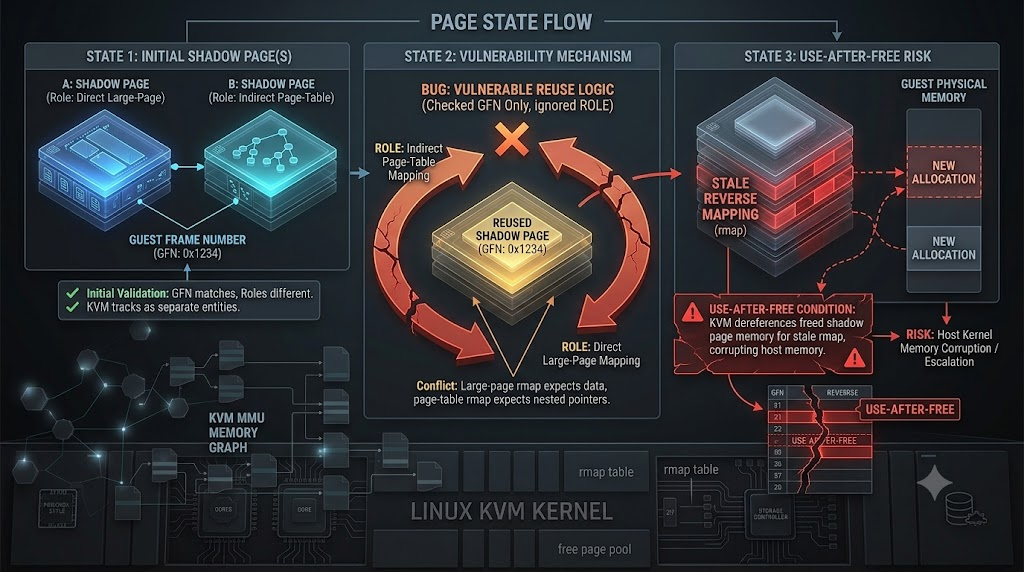
The second is role. A shadow page role describes what kind of shadow page it is. The role includes level, directness, access-related information, and translation context. Two shadow pages can refer to the same GFN but still have different roles. That distinction is central to Januscape.
The third is reverse mapping, often shortened to rmap. Reverse mappings help KVM find all shadow PTEs that map a given guest frame. The Linux KVM MMU documentation describes reverse mapping as a way to locate PTEs reachable by a GFN when the host needs to update, drop, or invalidate translations. (Kernel Documentation)
A use-after-free in this machinery is not like a simple application pointer bug. It is a corruption of the hypervisor’s memory-management model. If KVM keeps metadata pointing to a shadow page after the page has been freed, later host-side memory-management work can walk stale structures. The result may be a crash, memory corruption, or, in a sufficiently controlled exploit, a path toward guest-to-host compromise.
The bug in plain terms, same GFN, wrong role
The NVD description for CVE-2026-53359 says that an earlier KVM fix addressed one case by validating a GFN mismatch, but a similar hole remained when a modified guest page table entry pointed to a non-leaf page table. In the Januscape case, the GFN can match even though the role does not. The NVD description gives the example of a 2MB mapping with direct=1 being replaced by a 4KB page-table mapping that should use direct=0. KVM’s child shadow page lookup did not compare the full role and could reuse an incompatible shadow page. (NVD)
That is the core idea: matching the guest frame number is not enough. If the role is different, the object is not interchangeable.
The earlier related issue, CVE-2026-46113, was also a KVM x86 shadow paging use-after-free. Its NVD record describes a stale reverse mapping problem caused by an unexpected GFN that later became dangerous when dirty logging or MMU notifier invalidation walked freed memory. (NVD) A kernel patch discussion for that earlier flaw explains that KVM had assumed direct shadow page GFNs could be computed in a simple way, but guest page table changes between VM entries could break that assumption. The fix for that earlier flaw checked target GFN mismatch and zapped the existing SPTE. (patchew.org)
CVE-2026-53359 is important because it shows that the GFN check did not fully close the class of error. A shadow page must be compatible in both identity and role. If KVM reuses a shadow page with the same GFN but a different role, it can preserve a stale rmap connection after the page is freed. Later, when the host performs memory-management operations, the stale rmap can cause KVM to walk freed memory.
This is why Januscape is not accurately described as “just another crash.” The public PoC may be a host panic, but the underlying class is a hypervisor memory corruption issue at the guest-host boundary. The public Januscape repository says the full escape exploit exists in a controlled environment but is not publicly released. (ギットハブ)
Why nested virtualization changes the risk
Nested virtualization gives a guest access to virtualization features that are normally reserved for the host. On Intel, that usually means VMX. On AMD, that usually means SVM. When those features are exposed to a VM, that VM can run a nested hypervisor or nested guests. From the host’s perspective, KVM now needs to emulate or manage more complex guest translation behavior.
The Januscape repository states that the issue affects KVM/x86 on both Intel and AMD and that root privileges inside the guest are required for the demonstrated attack path. It also notes that root inside a cloud VM is a common assumption for customers who control their own guest operating systems. (ギットハブ)
For a Proxmox operator, that means the risk depends heavily on trust. A single-user homelab where the administrator controls every VM image is not the same as a hosting platform where customers upload VM images, a security lab where participants get root in their own guest VMs, or a CI platform where untrusted jobs can run virtualization-aware workloads.
Nested virtualization is common in exactly the environments where trust boundaries are messy. Security training labs allow students to run exploitation environments. Bug bounty researchers may run nested labs. Cloud-like platforms may let customers install arbitrary kernels. Internal engineering teams may run test clusters inside VMs. If those guests are untrusted or can be compromised, nested virtualization turns a guest configuration choice into a hypervisor attack-surface decision.
The Proxmox forum guidance is consistent with that framing: disable nested KVM as the mitigation while waiting for fixed kernel packages, and verify VM-level exposure rather than assuming all workloads are equal. (Proxmox Support Forum)
Exposure matrix for Proxmox environments
The following matrix helps separate realistic exposure from noise. It is not a substitute for reading your installed package changelog, but it gives a useful triage model.
| Proxmox environment | Nested virtualization exposed to VM | Guest trust level | Practical risk from CVE-2026-53359 | First action |
|---|---|---|---|---|
| Single-admin homelab with personal VMs only | いいえ | Trusted | Lower, assuming no untrusted VM images and no nested KVM exposure | Patch during normal maintenance and keep nested off unless needed |
| Single-admin homelab running downloaded lab images | Maybe | Partially trusted | Medium if lab images can run as root and see VMX or SVM | Check VM CPU flags, disable nested, patch host |
| Security training platform on Proxmox | Often yes | Untrusted or semi-trusted | High, because students or participants may control guests | Disable nested for untrusted VMs, patch immediately, isolate nodes |
| Hosting provider or private cloud with customer VMs | Sometimes yes | Untrusted | High if customer VMs receive nested virtualization | Treat as hypervisor boundary issue, live migrate or drain, patch and reboot |
| Enterprise Proxmox cluster with internal app VMs | 通常は | Trusted but compromise possible | Medium, depending on threat model and guest hardening | Inventory nested exposure and patch in maintenance window |
| Proxmox node running containers only | Not directly relevant | Depends | This KVM VM path is not the same as container nesting | Do not confuse LXC nesting with KVM nested virtualization |
| Proxmox node with VM CPU model set to host for performance | Possibly | Depends | Requires inspection, because host CPU model may expose virtualization capabilities | Check guest-visible flags and VM configuration |
A common mistake is to treat “nested enabled in the host kernel module” and “nested exposed to this VM” as identical. Proxmox staff pointed out that nested may be on in module settings but not available to a VM unless the VM configuration exposes the feature. (Proxmox Support Forum)
Another common mistake is to assume that VM networking controls solve the problem. Network isolation is useful, but Januscape is not a remote network protocol flaw. If the attacker already controls a guest VM with the needed capabilities, the meaningful boundary is the hypervisor boundary.
Version and patch status, what to trust
For upstream Linux, NVD’s record says the affected product is the Linux kernel and lists fixed lines including 6.1.177, 6.6.144, 6.12.95, 6.18.38, 7.1.3, and 7.2-rc1 as unaffected. The record also lists the relevant upstream commit references and notes that CVSS metrics were not yet provided in the captured NVD entry. (NVD)
For Proxmox, do not map upstream Linux version numbers mechanically to your host and assume safety. Proxmox ships its own kernel packages. In the Proxmox forum thread, staff said fixed proxmox-kernel-6.8.12-33-pve そして proxmox-kernel-7.0.14-4-pve packages were available on the test repository, and later said fixed kernels were on pve-no-subscription. (Proxmox Support Forum)
For Debian-based systems, Debian’s DSA-6381-1 advisory includes CVE-2026-53359 among Linux kernel issues fixed for Debian stable in version 6.12.95-1 and recommends upgrading the Linux packages. (Debian Mailing Lists) Ubuntu’s CVE tracker describes the issue as a guest-to-host escape in KVM and marked a range of Ubuntu releases as vulnerable in the status captured from the tracker. (Ubuntu)
The operational lesson is that your source of truth should be the vendor package stream for the host you actually run. A Proxmox node is not fixed because an upstream commit exists. It is fixed when the relevant Proxmox kernel package is installed, the node is rebooted into that kernel, and your configuration no longer exposes unnecessary nested virtualization to untrusted guests.
| レイヤー | What to check | なぜそれが重要なのか |
|---|---|---|
| Upstream Linux | CVE record, stable kernel fixes, commit references | Confirms the root vulnerable component and fixed kernel lines |
| Proxmox kernel package | Installed proxmox-kernel-* package and repository updates | Proxmox hosts depend on Proxmox-packaged kernels, not generic assumptions |
| Running kernel | uname -r after reboot | The fixed package does not protect the host until the node boots into it |
| VM configuration | CPU model and guest-visible VMX or SVM flags | Nested KVM exposure is the most relevant VM-level risk factor |
| Workload trust | Who controls the guest OS and kernel | Guest root matters more when the guest is untrusted |
| Operational channel | Enterprise, no-subscription, or test repository | Repository choice affects availability and maintenance policy |
Some Proxmox forum users reported operational boot issues with certain fixed kernels in specific legacy BIOS and GRUB environments. That should not be generalized into “the patch is broken,” but it is a reminder to test kernel updates on representative hardware and maintain a rollback plan before cluster-wide deployment. (Proxmox Support Forum)
Local exposure checks for a Proxmox node
The following commands are intended for administrators on their own Proxmox hosts. They do not scan third-party systems, do not run exploit code, and do not attempt to trigger the vulnerability. They help answer three questions: what kernel is running, what Proxmox kernel packages are installed, and which VMs may expose nested virtualization.
Check the running kernel and Proxmox package state:
pveversion -v
uname -r
dpkg -l | grep -E 'proxmox-kernel|pve-kernel|pve-qemu-kvm'
Check whether the KVM module reports nested virtualization support at the host level:
for f in /sys/module/kvm_intel/parameters/nested /sys/module/kvm_amd/parameters/nested; do
  if [ -r "$f" ]; then
    echo "$f=$(cat "$f")"
  fi
done
Inventory VM CPU configuration:
grep -R "^cpu:" /etc/pve/qemu-server/*.conf 2>/dev/null
grep -R "nested-virt\|vmx\|svm\|host" /etc/pve/qemu-server/*.conf 2>/dev/null
If you can safely inspect from inside a guest you control, check whether the guest sees virtualization flags:
egrep -o 'vmx|svm' /proc/cpuinfo | sort -u
The last command must be run only inside a VM you own or administer. Seeing vmx または svm inside a guest means the guest can see hardware virtualization capability. That does not automatically prove exploitability, but it is a strong signal that nested virtualization exposure should be reviewed.
| チェック | Safer command | Risk signal | Common false assumption |
|---|---|---|---|
| Running host kernel | uname -r | Host still booted into an older kernel | Assuming package installation equals active protection |
| Installed Proxmox kernels | `dpkg -l | grep proxmox-kernel` | Fixed package absent or not installed |
| Host nested module state | 読む /sys/module/kvm_* parameter | Nested available at module level | Assuming module setting proves every VM is exposed |
| VM CPU config | Grep /etc/pve/qemu-server/*.conf | host, VMX, SVM, or nested-related flags | Assuming default VM config always hides nested |
| Guest-visible flags | `egrep ‘vmx | svm’ /proc/cpuinfo` inside owned VM | Guest can see virtualization features |
| Workload owner | Review tenant or lab ownership | Untrusted user has guest root | Treating all internal VMs as equally trusted |
Do not use these checks as an excuse to delay patching. They help prioritize and reduce exposure while the kernel rollout is planned. The vulnerability is in the host kernel, so the durable fix is a patched kernel running on the host.
Temporary mitigation, disable nested KVM where it is not required
The most useful temporary mitigation is to prevent untrusted guests from exercising nested KVM paths. Proxmox staff explicitly identified disabling nested KVM as the known mitigation while fixed kernels were being prepared. (Proxmox Support Forum)
A host-level module configuration can be used to disable nested KVM. On many Linux systems, modprobe normalizes hyphens and underscores in module names, but using the underscore form keeps the configuration aligned with the module names visible under /sys/module.
cat >/etc/modprobe.d/disable-nested-kvm.conf <<'EOF'
options kvm_intel nested=0
options kvm_amd nested=0
EOF

update-initramfs -u -k all
reboot
After the reboot, verify the state:
for f in /sys/module/kvm_intel/parameters/nested /sys/module/kvm_amd/parameters/nested; do
  if [ -r "$f" ]; then
    echo "$f=$(cat "$f")"
  fi
done
This is a blunt host-level mitigation. It may break legitimate nested virtualization workloads. That is the point: if a VM does not need to run another hypervisor, it should not receive nested virtualization capability during an active hypervisor vulnerability response.
For production clusters, do not reload KVM modules on a busy node unless you understand the impact on running VMs. Plan a maintenance window, migrate VMs away where possible, and reboot cleanly after configuration changes. In clustered Proxmox environments, treat this like any other host kernel risk: drain, patch, reboot, verify, return to service.
Disabling nested virtualization should not become a substitute for patching. It reduces the most relevant known exposure path, but the vulnerable host kernel should still be replaced with a fixed kernel. A layered response is better than a single control.
Patch workflow for Proxmox clusters
A good patch workflow for CVE-2026-53359 should avoid both extremes: panic rebooting every node without testing, and waiting for a perfect risk score while untrusted nested guests continue running.
Start with inventory. List all nodes, running kernels, installed Proxmox kernel packages, and VM CPU configurations. Identify VMs that expose nested virtualization or use host CPU passthrough-style configuration. Then classify the workload owner. A VM controlled by the same trusted infrastructure team is different from a VM controlled by a customer, student, contractor, external researcher, or CI job.
Next, reduce exposure. Disable nested virtualization for guests that do not need it. If a guest does need it, ask whether it needs to run on a vulnerable host before the patch is complete. For high-risk untrusted workloads, migration to isolated patched capacity or temporary suspension may be more appropriate than relying on detection.
Then patch one representative node. Use the repository appropriate to your support model and maintenance policy. Install the fixed Proxmox kernel package, reboot, and confirm the running kernel. If the host uses legacy BIOS, GRUB, unusual storage boot layouts, out-of-tree modules, or vendor-specific hardware, validate boot reliability before broad rollout. Proxmox forum reports of boot issues in specific environments are not universal, but they are enough to justify careful staging. (Proxmox Support Forum)
After the test node is stable, roll the update through the cluster. In Proxmox, the safer pattern is usually to migrate or shut down VMs, patch and reboot one node at a time, verify, then proceed. Do not leave a node in a state where a fixed package is installed but the old vulnerable kernel is still running.
A simple evidence checklist helps prevent confusion later:
date -u
hostname -f
pveversion -v
uname -r
dpkg -l | grep -E 'proxmox-kernel|pve-kernel'
for f in /sys/module/kvm_intel/parameters/nested /sys/module/kvm_amd/parameters/nested; do
  if [ -r "$f" ]; then
    echo "$f=$(cat "$f")"
  fi
done
grep -R "^cpu:" /etc/pve/qemu-server/*.conf 2>/dev/null
Save the output in your change record. It gives security, infrastructure, and compliance teams a shared view of what changed: package state, active kernel, nested setting, and VM CPU exposure.
What not to do with public PoC material
The Januscape public repository describes a public PoC that can trigger a host kernel panic. It also states that a full escape exploit exists in a controlled environment but is not released. (ギットハブ) That distinction is important for defenders.
A public crash PoC is not a harmless test. On a Proxmox host, a kernel panic is a host outage. That can interrupt every VM on the node, corrupt in-flight workloads, cause storage recovery events, and make incident analysis harder. It also does not prove that the host is safe if it fails to crash. Race conditions and environment-sensitive kernel bugs can fail to reproduce while the underlying version remains vulnerable.
Do not run public Januscape PoC code on production Proxmox hosts. Do not run it on customer nodes. Do not run it on a cluster node simply because it is “only a crash.” If your organization needs exploit-level validation, use an isolated lab host, non-production hardware, no shared storage risk, no customer workloads, and a written authorization scope. Even then, the safer default is to validate through version, configuration, and patch evidence rather than triggering the bug.
A useful validation result for most organizations looks like this:
| Unsafe validation | Safer substitute |
|---|---|
| Run public host-panic PoC on production | Confirm vulnerable kernel package and nested exposure, then patch and reboot |
| Test against a customer Proxmox node | Reproduce only in an isolated owned lab if exploit-level testing is approved |
| Treat “PoC did not crash” as safe | Treat patch state and configuration as the source of truth |
| Share exploit output broadly | Share minimal evidence: versions, config, patch status, reboot confirmation |
| Keep nested virtualization enabled during testing | Disable nested for untrusted guests before validation begins |
The goal is to reduce risk, not prove that the host can be crashed.
Safe PoC model, why role checking matters
The following demonstration is not Januscape exploit code. It does not use KVM. It does not open /dev/kvm. It does not require Proxmox. It does not trigger a kernel bug. It is a toy model that shows the logic error defenders need to understand: reusing an object because the GFN matches is unsafe if the role is different.
Run it locally with Python. It models a shadow page cache that has a vulnerable lookup and a patched lookup.
#!/usr/bin/env python3

from dataclasses import dataclass


@dataclass(frozen=True)
class Role:
    level: int
    direct: bool
    kind: str


@dataclass
class ShadowPage:
    gfn: int
    role: Role
    alive: bool = True


class ToyShadowMMU:
    def __init__(self):
        self.cache_by_gfn = {}

    def allocate(self, gfn: int, role: Role) -> ShadowPage:
        page = ShadowPage(gfn=gfn, role=role)
        self.cache_by_gfn[gfn] = page
        return page

    def vulnerable_get_child_sp(self, gfn: int, wanted_role: Role) -> ShadowPage:
        """
        Toy vulnerable behavior:
        reuses a cached page when only the GFN matches.
        It ignores the requested role.
        """
        cached = self.cache_by_gfn.get(gfn)
        if cached is not None:
            return cached
        return self.allocate(gfn, wanted_role)

    def patched_get_child_sp(self, gfn: int, wanted_role: Role) -> ShadowPage:
        """
        Toy patched behavior:
        reuses a cached page only when both GFN and role match.
        """
        cached = self.cache_by_gfn.get(gfn)
        if cached is not None and cached.role == wanted_role:
            return cached
        return self.allocate(gfn, wanted_role)


def main():
    mmu = ToyShadowMMU()

    large_direct_page = Role(level=2, direct=True, kind="large-page-mapping")
    small_indirect_table = Role(level=1, direct=False, kind="page-table-mapping")

    original = mmu.allocate(gfn=0x1234, role=large_direct_page)

    wrong = mmu.vulnerable_get_child_sp(
        gfn=0x1234,
        wanted_role=small_indirect_table,
    )

    print("Vulnerable lookup reused object:", wrong is original)
    print("Returned role:", wrong.role)
    print("Wanted role:  ", small_indirect_table)

    fixed = mmu.patched_get_child_sp(
        gfn=0x1234,
        wanted_role=small_indirect_table,
    )

    print("Patched lookup reused incompatible object:", fixed is original)
    print("Returned role after patched lookup:", fixed.role)


if __name__ == "__main__":
    main()
Expected output:
Vulnerable lookup reused object: True
Returned role: Role(level=2, direct=True, kind='large-page-mapping')
Wanted role:   Role(level=1, direct=False, kind='page-table-mapping')
Patched lookup reused incompatible object: False
Returned role after patched lookup: Role(level=1, direct=False, kind='page-table-mapping')
This toy model maps to the defensive lesson behind CVE-2026-53359. The vulnerable lookup is wrong because it treats gfn=0x1234 as sufficient identity. The patched lookup treats GFN and role as part of the object identity. In real KVM, the role is more complex than this toy 役割 class, and the consequences are more serious because stale shadow MMU metadata can survive into later reverse-map operations. But the principle is the same: a page with the same GFN but a different role is not the same page.
This is the right kind of PoC for a production-facing security article because it teaches the failure mode without giving readers a host-crashing kernel trigger. It helps defenders understand why a version check and role-aware patch matter, while keeping the demonstration harmless.
Detection, what you can and cannot see
CVE-2026-53359 is not a vulnerability that a perimeter scanner can reliably detect from the network. A Proxmox host can have no internet-exposed management service and still be at risk if an untrusted VM can exercise nested KVM paths on a vulnerable kernel. Conversely, a public Proxmox login page does not prove CVE-2026-53359 exposure.
Detection should focus on three areas: configuration exposure, patch state, and host instability signals.
Configuration exposure means identifying VMs that can use nested virtualization. Patch state means confirming the installed and running kernel. Host instability means reviewing kernel logs, crash records, and VM disruption around suspicious guest activity. A successful or attempted trigger may look like a host panic, KVM warning, qemu-kvm disruption, or sudden node reboot rather than a clean security alert.
Useful local log checks include:
journalctl -k --since "2026-07-01" | grep -Ei 'kvm|mmu|shadow|BUG|panic|oops|pte|rmap'
journalctl --since "2026-07-01" | grep -Ei 'qemu|kvm|panic|reboot|watchdog'
last -x | head -50
If your hosts forward logs to a SIEM, query for host kernel panic events, KVM MMU warnings, unexpected reboots, and qemu-kvm crashes around the same time. Avoid writing detection rules that assume a specific public PoC string. Kernel bugs often leave noisy and environment-specific traces.
| 信号 | What it may indicate | 制限事項 |
|---|---|---|
| Host kernel panic on Proxmox node | Possible crash trigger, hardware issue, unrelated kernel bug, or unstable module | Not specific to Januscape |
| KVM MMU warning or BUG line | Potential hypervisor memory-management issue | Requires kernel log retention |
| qemu-kvm process disruption | VM impact from host-side issue or unrelated VM failure | Not enough to prove CVE-2026-53359 |
| Unexpected node reboot | Host crash, power issue, watchdog reset, admin action | Needs correlation with logs |
Guest visible vmx または svm | Nested virtualization exposed | Not proof of exploit, but a risk input |
| Old running kernel after update | Patch not active | Very common operational error |
| Untrusted VM with host CPU model | Possible exposure of virtualization features | Must inspect actual flags |
For incident response, preserve logs before rebooting repeatedly. If the node crashed, collect kernel logs, Proxmox task history, VM ownership details, VM configuration, and the running kernel version after recovery. If untrusted guests had nested virtualization exposed, consider those hosts higher priority for forensic review.
Why the public crash PoC and the private escape claim should both matter
Security teams sometimes underreact when a public PoC “only crashes” and overreact when they hear “escape” without public exploit code. CVE-2026-53359 sits between those reactions.
The public Januscape repository says the available PoC triggers a host kernel panic, while the complete escape exploit is not released. (ギットハブ) That means most defenders should not expect commodity copy-paste host escape exploitation in the public material at the time of writing. It also means they should not dismiss the issue as a denial-of-service-only bug. The underlying memory corruption sits at the KVM guest-host boundary, and the disclosure states that Januscape was used in kvmCTF.
Google’s kvmCTF program is explicitly focused on KVM vulnerabilities reachable from a guest VM and rewards guest-to-host attacks in a controlled lab environment. Google describes the goal as a guest-to-host attack against a bare-metal lab host running a single guest, with reward categories including full VM escape and other host-impacting primitives. (blog.google)
That context changes the severity discussion. A bug found and demonstrated in a KVM escape-focused program deserves serious attention even if the public artifact is a crash PoC. The right response is still boring and disciplined: patch, disable unnecessary nested virtualization, verify running kernels, and avoid production exploit testing.
Related CVE, CVE-2026-46113
CVE-2026-46113 is the most directly relevant companion issue because it affected the same broad subsystem: KVM x86 shadow paging. NVD describes it as a use-after-free caused by an unexpected GFN in KVM’s x86 shadow paging path, where stale reverse mappings could later be dereferenced during dirty logging or MMU notifier invalidation. (NVD)
The relationship is not that CVE-2026-53359 is simply the same bug with a new number. The useful lesson is that memory-management invariants in the shadow MMU are subtle. CVE-2026-46113 focused on an unexpected GFN mismatch. CVE-2026-53359 shows that a GFN match can still be unsafe if the shadow page role differs. The earlier patch discussion explains why direct shadow page GFN assumptions could break when guest page tables changed between VM entries, and why the fix zapped an existing SPTE when the target GFN did not match. (patchew.org)
For defenders, that means two things. First, patch level matters more than one-off mitigations because these bugs live in deep kernel translation logic. Second, related CVEs should be used to understand the class of failure, not to build a false sense of safety from partial fixes.
| CVE | Relevant component | Relationship to Januscape | Defensive lesson |
|---|---|---|---|
| CVE-2026-46113 | Linux KVM x86 shadow paging | Earlier stale rmap use-after-free involving unexpected GFN | GFN identity assumptions can become unsafe when guest mappings change |
| CVE-2026-53359 | Linux KVM x86 shadow paging | Role mismatch remains dangerous even when GFN matches | Shadow page role must be part of compatibility checks |
| Januscape public PoC | KVM/x86 host crash path | Demonstrates host impact without releasing full escape exploit | Do not run crash PoCs on production; validate through patch and config evidence |
This is also why security teams should watch kernel vendor advisories after the first emergency patch. Hypervisor memory-management fixes can be refined across stable branches, distro kernels, and platform-specific packages.
Proxmox-specific hardening beyond the emergency patch
Patching CVE-2026-53359 is the urgent task. Hardening is the longer-term control that makes the next KVM issue less disruptive.
Start by treating nested virtualization as an exception, not a default entitlement. Maintain an allowlist of VMs that require nested virtualization. Record the business reason, owner, expected lifetime, and risk acceptance. If a VM no longer needs nested KVM, remove it.
Separate trust zones at the node level where practical. Do not mix untrusted nested-virtualization workloads with high-value production workloads on the same host. In a small cluster, that may be difficult, but even a basic separation between lab nodes and production nodes reduces blast radius.
Avoid giving customer-controlled or student-controlled VMs the host CPU model unless the use case requires it. Host CPU passthrough can improve performance and expose useful features, but it also increases the need to understand exactly what the guest can see. Use explicit CPU models and flags where possible, and document exceptions.
Restrict host shell access. The Januscape guest-to-host path is the main concern here, but some disclosures also discuss local /dev/kvm access patterns on certain distributions. On Proxmox hosts, ordinary users should not have casual shell access. Treat the host as privileged infrastructure.
Retain kernel logs. A host crash without logs is an operational mystery. Forward kernel logs to a remote system where feasible, because a host panic can destroy local context. Keep enough retention to correlate crashes with VM creation, VM migration, CPU configuration changes, and customer activity.
Build a reboot discipline. Hypervisor patching fails when teams install packages and postpone reboots indefinitely. For KVM vulnerabilities, the running kernel is the security boundary. Every kernel emergency plan should include a way to drain, reboot, verify, and return nodes to service.
A practical Proxmox response plan
The following plan is designed for administrators who need a concrete path without running exploit code.
| ステップ | アクション | Evidence to keep | Failure mode to avoid |
|---|---|---|---|
| 1 | Inventory all Proxmox nodes and running kernels | pveversion -v, uname -r, package list | Assuming all nodes match because the cluster UI looks healthy |
| 2 | Identify nested virtualization exposure | VM CPU config, guest-visible VMX or SVM where safe | Confusing LXC nesting with KVM nested virtualization |
| 3 | Classify guest trust | Owner, tenant, lab user, CI job, customer role | Treating all VMs as trusted infrastructure |
| 4 | Disable unnecessary nested KVM | Module config and VM config change records | Leaving risky flags enabled for convenience |
| 5 | Patch a representative node | Package version and repository used | Updating package without rebooting |
| 6 | Reboot and verify active kernel | uname -r after reboot | Assuming the bootloader selected the newest kernel |
| 7 | Roll through the cluster | Per-node maintenance record | Rebooting too many nodes at once |
| 8 | Review logs for suspicious crashes | Kernel and Proxmox task logs | Treating prior crashes as unrelated without checking |
| 9 | Restore only required nested access | Approved VM allowlist | Re-enabling nested globally after the emergency |
| 10 | Produce a short technical report | Scope, exposure, patch state, exceptions | Writing a vague “patched” note without evidence |
In organizations using authorized security automation, this is the kind of vulnerability where automation should be constrained to inventory, configuration analysis, non-destructive validation, evidence capture, and report generation. Penligent’s public site frames its platform around authorized testing, and that distinction is important for kernel virtualization flaws because running a public host-panic PoC is not a responsible default validation method. (寡黙) Its AI pentesting page also describes audit-ready reporting with verified findings, reproduction steps, evidence, and remediation guidance, which maps better to a Proxmox response workflow than indiscriminate exploit execution. (寡黙)
The automation boundary should be explicit: collect proof of exposure, not proof of crash. A good report says which nodes were vulnerable, which VMs had nested virtualization exposure, which packages were installed, which kernels are now running, which exceptions remain, and who approved them.
Handling untrusted guests during remediation
If untrusted guests had nested virtualization access on vulnerable Proxmox nodes, patching the host is necessary but not the only question. You also need to decide whether there was suspicious activity before the patch.
Start with the highest-risk guests. These include VMs controlled by external users, VMs used for security research, VMs running unknown kernels, VMs that recently loaded KVM modules inside the guest, and VMs involved in unexplained host crashes. Review host logs around those workloads. If the node experienced a kernel panic, preserve crash evidence and correlate it with VM activity.
Inside guests you own, look for nested virtualization usage. On Linux guests, loaded kvm_intel, kvm_amdあるいは kvm modules may indicate nested virtualization use. That does not prove malicious behavior, because legitimate nested workloads use those modules too. But it helps scope which guests exercised the relevant path.
For customer or student VMs, do not enter guest systems without authorization. Use host-side metadata, VM configuration, and platform logs. If terms of service or program rules allow deeper inspection, follow your organization’s legal and privacy process.
If a full guest-to-host compromise is suspected, treat the Proxmox host as potentially compromised. Kernel-level host compromise changes the trust model. Rotate secrets accessible from the host, inspect cluster credentials, review storage access, and consider rebuilding the node from known-good media. The public material does not release a full exploit, but incident response should be based on observed host behavior and exposure, not only public exploit availability.
Why “no CVSS yet” is not a risk decision
NVD had not provided CVSS metrics in the record captured for CVE-2026-53359. (NVD) That can create a process problem in organizations that trigger emergency patching only from CVSS thresholds.
For hypervisor bugs, especially guest-to-host boundary issues, the absence of a score should not delay triage. The facts that matter are already concrete: vulnerable component, guest-side trigger conditions, x86 KVM, nested virtualization relevance, public crash PoC, private escape claim, upstream fixes, and Proxmox kernel package work. That is enough to justify a high-priority operational response for exposed environments.
A better internal severity model for CVE-2026-53359 uses environment-specific factors:
| ファクター | Raises priority when | Lowers priority when |
|---|---|---|
| Guest trust | Customers, students, contractors, CI users, or researchers control guests | Only trusted administrators control all VMs |
| Nested virtualization | VMX or SVM is exposed to untrusted guests | Nested KVM is disabled and verified |
| Workload density | Many critical VMs share a node | Isolated lab node with no production workloads |
| Patch availability | Fixed kernel package is available | No package yet, but nested can be disabled as a temporary control |
| Host crash history | Unexplained kernel panics or qemu-kvm disruptions exist | No instability, though absence of crashes does not prove safety |
| Compliance impact | Tenant isolation or customer data boundary depends on KVM | Non-sensitive internal lab only |
This model gives infrastructure teams a way to act before a standardized score arrives.
Communication for leadership and customers
A good explanation to leadership should avoid both panic and minimization.
Do not say, “Proxmox has a remote code execution vulnerability.” That is inaccurate and will send people looking in the wrong place.
Do not say, “It is only a crash PoC.” That understates the guest-to-host memory corruption class and the kvmCTF context.
A precise summary would be:
“CVE-2026-53359, also called Januscape, is a Linux KVM x86 shadow MMU vulnerability relevant to Proxmox hosts because Proxmox uses KVM for virtual machines. The highest-risk scenario is a vulnerable host exposing nested virtualization to an untrusted or compromised VM. Public material includes a host-panic PoC, while a full escape exploit is not publicly released. We are disabling unnecessary nested virtualization, installing fixed Proxmox kernel packages, rebooting nodes into patched kernels, and preserving evidence of exposure and remediation.”
For customer-facing environments, include whether customer-controlled VMs had nested virtualization enabled. If they did not, say that clearly. If they did, explain the remediation timeline and whether any suspicious host instability was observed. Avoid claiming “no exploitation possible” unless you can support that with configuration evidence, logs, and patch state.
Common mistakes that lead to bad decisions
The first mistake is treating CVE-2026-53359 as a Proxmox web vulnerability. That leads to irrelevant mitigations such as changing dashboard exposure while leaving nested KVM available to untrusted guests on a vulnerable host.
The second mistake is confusing container nesting with KVM nested virtualization. Proxmox staff explicitly clarified that the issue is about virtual machines and the kernel KVM hypervisor, and that container nested flags are not the relevant control. (Proxmox Support Forum)
The third mistake is assuming a guest must be network-exposed to matter. A guest-to-host attack begins from inside the VM. If the attacker controls the guest, external network exposure may be irrelevant.
The fourth mistake is trusting an installed package without checking the running kernel. Kernel fixes require a reboot. A node can have the fixed package installed and still be running the vulnerable kernel.
The fifth mistake is running a public PoC on production to “confirm” exposure. A host crash confirms poor change control as much as vulnerability exposure.
The sixth mistake is leaving nested virtualization enabled after the emergency because “the patch is installed.” Patches are necessary, but nested virtualization is still a powerful capability that should be exposed only where needed.
The seventh mistake is writing a vague remediation ticket. “Patched Proxmox” is not enough. The record should include package versions, active kernel, nested virtualization status, VM exceptions, and reboot confirmation.
よくあるご質問
Is CVE-2026-53359 a Proxmox vulnerability?
- Not in the sense of a Proxmox web interface, API, or authentication flaw.
- The vulnerable component is Linux KVM x86 shadow paging in the host kernel.
- Proxmox is relevant because Proxmox VE uses KVM to run VMs.
- The real exposure question is whether a vulnerable Proxmox host exposes nested virtualization to an untrusted or compromised guest.
Do I need to shut down every Proxmox VM immediately?
- Not automatically.
- Prioritize VMs that are untrusted, customer-controlled, lab-controlled, CI-controlled, or configured with nested virtualization.
- Disable nested virtualization where it is not required.
- Patch and reboot Proxmox nodes into fixed kernels through a controlled maintenance plan.
- If a host has unexplained kernel panics and untrusted nested guests, treat it as higher priority.
How do I know if a VM has nested virtualization exposed?
- Review the VM CPU configuration under
/etc/pve/qemu-server/*.conf. - Look for CPU models or flags that may expose
vmxまたはsvm. - On a guest you own, check
/proc/cpuinfoにとってvmxまたはsvm. - Remember that host-level nested module settings and VM-level exposure are related but not identical.
- Do not confuse Proxmox container nesting with KVM nested virtualization for VMs.
Is it safe to run the public Januscape PoC?
- Do not run it on production Proxmox nodes.
- The public repository describes a host kernel panic PoC, which can crash the node.
- A failed crash does not prove the host is safe.
- Safer validation uses package version, running kernel, nested exposure, and configuration evidence.
- Exploit-level testing belongs only in an isolated, authorized lab.
Does patching remove the need to disable nested virtualization?
- Patching is the durable fix for the known vulnerability.
- Disabling unnecessary nested virtualization is still good hardening.
- Only re-enable nested virtualization for VMs with a documented need and trusted ownership.
- For untrusted guests, nested virtualization should be treated as a privileged capability, not a default feature.
Are Proxmox containers affected by CVE-2026-53359?
- The relevant issue is in KVM virtualization for VMs, not ordinary LXC container nesting.
- Proxmox staff specifically clarified that container nested flags are not the relevant control for this KVM hypervisor issue.
- Containers still have their own security model and risks, but they are not the Januscape KVM nested virtualization path.
- If the same host also runs VMs, assess the VM side separately.
Why does guest root matter if the host is the real target?
- The disclosed Januscape attack path requires control inside the guest, and the public repository states guest root is required.
- In many cloud, lab, and hosting environments, the guest owner naturally has root inside their own VM.
- Guest root should not imply host trust.
- Hypervisor isolation exists precisely because guest administrators are not supposed to become host administrators.
How should I explain the risk to management?
- Say it is a Linux KVM x86 hypervisor isolation vulnerability relevant to Proxmox VM hosts.
- Emphasize the highest-risk condition: vulnerable host plus nested virtualization exposed to untrusted guests.
- State whether public material is crash-only and whether a full public escape exploit is available.
- Focus on actions: disable unnecessary nested virtualization, patch host kernels, reboot into fixed kernels, verify evidence, and review suspicious host crashes.
- Avoid calling it a Proxmox dashboard bug or a generic network RCE.
Closing judgment
CVE-2026-53359 is a serious KVM isolation issue, not a reason to spread panic about every Proxmox installation. The difference is configuration and trust. A Proxmox node running trusted VMs without nested virtualization exposure is not in the same risk category as a multi-tenant lab or hosting platform where users control guest kernels and can access VMX or SVM inside their VMs.
The right response is direct: identify vulnerable kernels, find nested virtualization exposure, disable what is unnecessary, install fixed Proxmox kernel packages, reboot into the patched kernel, and keep evidence. Do not validate production hosts by crashing them. Do not treat the lack of an NVD score as a reason to wait. And do not let nested virtualization remain an undocumented convenience feature after the emergency has passed.

 Japanese
  English
  German
  French
  Spanish
  Portuguese
  Korean
  Hindi
Hindi  Arabic
  Turkish
  Hebrew