
CVE-2016-2183 is what happens when an encryption algorithm can resist straightforward key recovery yet still becomes unsafe under realistic protocol usage. The issue, commonly called Sweet32, targets the 64-bit block size used by DES and Triple DES. After enough data is encrypted under the same key, ciphertext block collisions become probable. Under specific conditions, those collisions can reveal relationships between plaintext blocks and allow an attacker to recover repeatedly transmitted secrets such as authentication cookies.
That does not make Sweet32 a one-packet exploit. An attacker normally needs to observe a large volume of encrypted traffic, keep the victim communicating under the same encryption key, influence or predict substantial portions of the plaintext, and repeatedly position a target secret inside the encrypted stream. The original research demonstrated those conditions against HTTPS using 3DES-CBC and against HTTP traffic carried through OpenVPN using Blowfish-CBC. It did not show that every server accepting a 3DES cipher suite can be immediately decrypted.
The remediation is still straightforward: stop negotiating 3DES and other 64-bit block ciphers. OpenSSL advised server operators to disable Triple DES when Sweet32 was disclosed, modern browsers subsequently removed or disabled 3DES support, current TLS guidance favors AEAD suites, and NIST has withdrawn TDEA as an approved block cipher for applying new cryptographic protection. (openssl-library.org)
What CVE-2016-2183 Actually Describes
The CVE record describes a birthday-bound weakness in DES and Triple DES when those ciphers are used by TLS, SSH, IPsec, and other protocols. NVD explains that the approximately four-billion-block birthday boundary makes it easier for a remote attacker to obtain cleartext from a long-duration encrypted session. The demonstrated case was an HTTPS session using Triple DES in CBC mode. NVD currently assigns a CVSS 3.1 base score of 7.5 with confidentiality as the primary impact. (NVD)
That description needs operational context.
CVE-2016-2183 is not a memory corruption bug in OpenSSL. It is not a certificate-validation bypass. It is not an authentication bypass in a web server. It does not mean that the 3DES key can be recovered by sending a few crafted packets. The underlying problem is a property of short-block ciphers used for too much data under one key.
The distinction matters because vulnerability management teams often treat every CVE as a package-version problem. Sweet32 is more accurately treated as a cryptographic configuration and protocol-exposure problem. Updating a library may change defaults, remove weak algorithms, or raise the security level, but a patched application can remain exposed if it explicitly enables 3DES. Conversely, an older library may not present an exploitable TLS surface when the application has already disabled all affected suites.
OpenSSL called Sweet32 primarily a configuration issue. In its disclosure response, the project moved Triple DES from the HIGH cipher group to MEDIUM for OpenSSL 1.0.1 and 1.0.2. In OpenSSL 1.1.0, weak SSL ciphers were not compiled by default, Triple DES was removed from the default cipher group, and enabling it required an explicit weak-cipher build option. OpenSSL also advised server operators to disable Triple DES and upgrade systems that could offer nothing stronger than DES or RC4. (openssl-library.org)
A defensible finding should therefore answer three separate questions:
| Question | What it proves | What it does not prove |
|---|---|---|
| Is 3DES implemented by the library? | The software may be capable of using it | That any running service enables it |
| Does a service accept a 3DES handshake? | A remotely reachable weak cipher is enabled | That normal clients actually select it |
| Is 3DES used for long, high-volume sessions with repeatable secrets? | The practical Sweet32 attack conditions may exist | That plaintext recovery has already succeeded |
The first two questions are usually enough to justify remediation. The third determines how urgently the finding should be treated in its specific business context.
Why 3DES Can Be Weak Without Its Key Being Brute-Forced
Triple DES is often described using a nominal key length of 168 bits because it applies DES three times with three 56-bit key components. That number can create false confidence.
Three different measurements are relevant:
- Nominal key material — how many key bits appear in the construction.
- Effective resistance to key search — reduced by meet-in-the-middle techniques.
- Block size — the number of plaintext bits processed as one block.
Sweet32 is driven by the third measurement.
RFC 9325 notes that 168-bit 3DES has an effective key length of about 112 bits because of meet-in-the-middle attacks. Even that effective key length is not the direct cause of Sweet32. The more important limit for this attack is that DES and 3DES process data in blocks of only 64 bits. (RFCエディター)
A 64-bit block can take one of (2^{64}) possible values. It might appear that a system should be safe until nearly all those possibilities have been used. The birthday paradox shows otherwise. When values are sampled from a finite space, the chance that any two values collide becomes meaningful after roughly the square root of the space has been sampled.
For a 64-bit block cipher:
[
\sqrt{2^{64}} = 2^{32}
]
That is the origin of the Sweet32 name and the commonly cited four-billion-block boundary.
Each 3DES block contains eight bytes, so (2^{32}) blocks correspond to:
[
2^{32} \times 8 = 2^{35} \text{ bytes}
]
That is 32 GiB of block data.
The 32 GiB figure is a birthday-bound scale, not a guaranteed cookie-recovery threshold. It means collisions become plausible around that order of magnitude. Turning a collision into useful plaintext requires more structure:
- A target secret must be transmitted repeatedly.
- The attacker needs predictable or chosen plaintext near that secret.
- The target bytes need useful block alignment.
- A large amount of data must remain under the same traffic key.
- The attacker must collect and process the ciphertext.
- The protocol must not rekey or terminate the connection too early.
- The collision must involve the right kinds of blocks, not merely any two arbitrary blocks.
Those additional requirements explain why the practical experiments consumed hundreds of gigabytes rather than exactly 32 GiB.
The original Sweet32 researchers reported a full recovery of a 16-byte authentication token from an OpenVPN trace after 18.6 hours and 705 GB of traffic. In the HTTPS experiment, they recovered a two-block cookie from 610 GB captured over 30.5 hours. Their analysis estimated that full recovery in the tested configurations generally required around 785 GB, although random collision timing produced variation between experiments. (sweet32.info)
The correct interpretation is therefore not “3DES breaks after precisely 32 GiB.” It is:
A 64-bit block cipher enters a collision regime at data volumes that modern high-throughput, long-lived connections can realistically reach, and carefully structured traffic can turn some of those collisions into plaintext disclosure.
How CBC Collisions Reveal Information
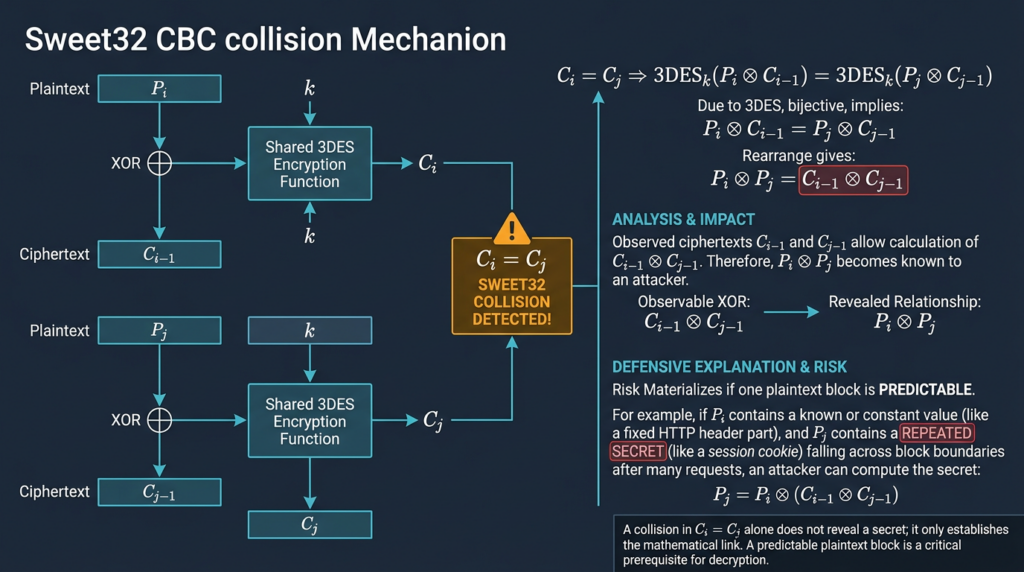
Sweet32 relies on the behavior of block ciphers in cipher block chaining mode.
In CBC encryption, a plaintext block (P_i) is XORed with the preceding ciphertext block (C_{i-1}) before being encrypted:
[
C_i = E_K(P_i \oplus C_{i-1})
]
Here:
- (P_i) is the current plaintext block.
- (C_{i-1}) is the previous ciphertext block.
- (E_K) is block encryption under key (K).
- (C_i) is the resulting ciphertext block.
Suppose two ciphertext blocks collide:
[
C_i = C_j
]
Because block encryption under a fixed key is a permutation, equal ciphertext outputs imply equal inputs:
[
P_i \oplus C_{i-1} = P_j \oplus C_{j-1}
]
Rearranging gives:
[
P_i \oplus P_j = C_{i-1} \oplus C_{j-1}
]
The attacker can observe (C_{i-1}) and (C_{j-1}), so the right side is known. A collision therefore reveals the XOR relationship between the two plaintext blocks.
That alone does not reveal either plaintext block. If one plaintext block is known, predictable, or chosen by the attacker, however, the other can be calculated:
[
P_i = P_j \oplus C_{i-1} \oplus C_{j-1}
]
The original research used predictable HTTP traffic to create exactly that situation. Most of an HTTP request can be known or controlled: the method, path, query string, header names, and many header values. A cookie or Basic Authentication value may be the only unknown portion, and the browser may send it repeatedly on every request.
The attacker’s task is to generate enough requests that a ciphertext block containing the secret eventually collides with a ciphertext block whose corresponding plaintext is known. The attacker then uses the CBC relationship to recover the secret block.
Several protocol details complicate that clean equation:
- TLS records contain MAC or authentication data in older cipher constructions.
- CBC padding changes record length.
- Sequence numbers affect authenticated content.
- Browsers distribute requests across multiple connections.
- Secrets do not always begin at a block boundary.
- HTTP headers can vary.
- TLS libraries may fragment records differently.
- Session resumption and reconnection can change keys.
- Application-layer rate limits may prevent sustained traffic generation.
The Sweet32 work was important because it showed that those complications could be managed in real protocol implementations. It was not merely a theoretical observation that 64-bit ciphers have short blocks. The researchers produced practical plaintext recovery against mainstream network protocols under carefully constructed conditions. (sweet32.info)
The Practical Sweet32 Attack Chain
A realistic Sweet32 attack is a sequence of capabilities, not a single payload.
A 64-bit block cipher must be negotiated
For HTTPS, the demonstrated condition was Triple DES in CBC mode. A well-known TLS suite is:
TLS_RSA_WITH_3DES_EDE_CBC_SHA
Its historical OpenSSL name is:
DES-CBC3-SHA
Other 3DES suites use different authentication or key-exchange methods, but the relevant data cipher still has a 64-bit block size. OpenSSL’s historical cipher documentation maps TLS_RSA_WITH_3DES_EDE_CBC_SHA への DES-CBC3-SHA. (OpenSSL Documentation)
Merely enabling TLS 1.2 does not guarantee that 3DES is absent. TLS 1.2 can negotiate both modern AEAD suites and older CBC suites, depending on client and server configuration. TLS 1.3 is different: it removed the legacy cipher-suite model and does not include 3DES.
The attacker must observe encrypted traffic
The original scenario assumes an attacker who can see traffic between the victim and the protected service. Possible positions include:
- A malicious or compromised network gateway.
- An untrusted wireless network.
- A compromised router.
- A network provider or internal segment with traffic visibility.
- A host-level capture point.
- A malicious VPN operator or compromised VPN path.
Sweet32 is not normally an off-path attack. A random internet host that cannot see the victim’s encrypted connection does not gain the required ciphertext simply because the destination server supports 3DES.
The attacker needs substantial traffic under one key
The collision probability depends on how many blocks are encrypted under the same key. If connections are short, keys rotate frequently, or clients reconnect before substantial traffic accumulates, the attack becomes harder.
The original HTTPS demonstration intentionally concentrated requests into a long-lived connection. Modern browsers ordinarily open several parallel connections, which divides traffic across different sessions and keys. The researchers manipulated connection behavior so that most requests traveled through a single TLS connection. (sweet32.info)
The attacker benefits from a browser or application traffic generator
In the published browser scenario, attacker-controlled JavaScript repeatedly sent requests to the target service. The victim did not need to enter the secret repeatedly; the browser automatically attached the authentication cookie.
The research assumed that the attacker could run JavaScript in a page loaded by the victim. That might happen because the victim visits an attacker-controlled site or because an attacker modifies an unencrypted HTTP response. The attacker also needs the browser to send authenticated cross-origin requests or otherwise generate traffic containing the target secret. (sweet32.info)
Modern browser security controls, cookie attributes, fetch behavior, connection management, and the widespread removal of 3DES make direct reproduction against current browsers much less straightforward than it was in 2016. The attack model remains useful for understanding why repeatedly encrypted bearer secrets and high-volume sessions are dangerous.
The secret must be repeated and usefully positioned
Sweet32 is most meaningful when the same sensitive value appears many times:
- Session cookies.
- Basic Authentication headers.
- Long-lived bearer tokens.
- Stable application identifiers with security value.
- Repeated protocol credentials.
A secret transmitted once in an unpredictable message is a much less convenient target. A secret automatically included in millions of requests is more attractive.
The attacker must process collisions
The original researchers captured encrypted packets and extracted ciphertext blocks. Because the datasets were hundreds of gigabytes, they used external sorting to locate collisions efficiently. Finding a random duplicate block is not enough; the collision must be connected to blocks with the required plaintext structure and alignment. (sweet32.info)
Recovered data must still be useful
A recovered cookie may expire before the attack completes. The application may bind sessions to devices, TLS channels, IP addresses, or additional context. The service may rotate tokens. Multi-factor authentication does not necessarily prevent session-token theft, but downstream controls can limit what the recovered token can accomplish.
For that reason, Sweet32 severity in a specific environment depends on both cryptography and application behavior.
What the Original Research Proved
The Sweet32 research provided two major demonstrations.
The first used HTTP traffic inside an OpenVPN tunnel configured with Blowfish-CBC. The researchers generated repeated Basic Authentication traffic and recovered a 16-byte authentication token after processing hundreds of gigabytes of ciphertext. The associated OpenVPN weakness is tracked separately as CVE-2016-6329. (sweet32.info)
The second used HTTPS with 3DES-CBC. The test environment included Firefox Developer Edition and IIS 6.0 on Windows Server 2003 R2. The researchers forced large numbers of requests through a long-lived TLS connection and recovered a two-block cookie from a 610 GB trace collected over 30.5 hours. (sweet32.info)
Those experiments demonstrated that:
- Birthday collisions in 64-bit block ciphers were practical at network scale.
- Repeated HTTP secrets could be recovered without brute-forcing the encryption key.
- Browser-generated traffic could supply the required volume.
- CBC structure could convert selected collisions into useful plaintext relationships.
- Legacy protocol compatibility created real confidentiality risk.
They did not demonstrate that:
- Every 3DES-enabled endpoint can be exploited in under two days.
- A single passive packet capture always contains enough information.
- Any collision reveals arbitrary plaintext.
- The server’s private key or 3DES session key can be recovered.
- TLS 1.3 is affected.
- Every SSH or IPsec deployment has the same traffic structure and practical exploitability.
- A vulnerability scanner can confirm successful plaintext recovery merely by negotiating a 3DES suite.
The Sweet32 site explicitly stated that the researchers expected some SSH and IPsec connections to be affected but did not have concrete measurements for those protocols. That limitation is important. The broad cipher weakness applies wherever excessive data is encrypted with a 64-bit block cipher, but protocol-specific exploitability depends on record formats, rekey behavior, traffic volume, and predictable plaintext. (sweet32.info)
How Relevant Is Sweet32 Today
Modern public web browsing is much less exposed than it was at disclosure.
Chrome removed support for TLS_RSA_WITH_3DES_EDE_CBC_SHA in Chrome 93. Microsoft documents that the temporary Edge policy for enabling 3DES was removed after 3DES itself was removed from the browser. Firefox 93 disabled TLS suites using 3DES by default, allowing them only when deprecated TLS versions were deliberately re-enabled. (Chrome for Developers)
Current IETF TLS recommendations prioritize TLS 1.3 and modern TLS 1.2 AEAD suites. RFC 9325 recommends AES-GCM suites for TLS 1.2, requires implementations to reject cipher suites offering less than 112 bits of security, and discusses key-usage limits as a general cryptographic requirement. (RFCエディター)
NIST’s position has moved even further. NIST withdrew SP 800-67 Revision 2 on January 1, 2024. Its announcement states that TDEA was deprecated for applying cryptographic protection through 2023 and disallowed after December 31, 2023. TDEA remains relevant only for limited legacy operations such as decrypting or verifying data that was already protected. (NISTコンピュータセキュリティリソースセンター)
Sweet32 nevertheless continues to appear in enterprise assessments because browsers are only one category of TLS client. Residual exposure often exists in:
- Embedded devices.
- Building-management systems.
- Industrial controllers.
- Old Java applications.
- Proprietary desktop software.
- Legacy API clients.
- Payment or financial middleware.
- Network appliances.
- VPN concentrators.
- Storage management interfaces.
- Printer and scanner administration panels.
- Old load balancers.
- Internal SMTP, IMAP, LDAP, database, and messaging services.
- Vendor products that ship their own TLS stack.
- Systems restored from old images or disaster-recovery backups.
A service may also support 3DES even if no current client uses it. That lowers immediate exploitation likelihood, but it still represents unnecessary cryptographic attack surface. A future configuration change, fallback path, emergency legacy client, or protocol downgrade may cause the weak suite to be selected.
The practical risk can be organized as follows:
| Condition | Effect on real-world risk |
|---|---|
| 3DES is not remotely negotiable | Sweet32 exposure is not present on that tested endpoint |
| 3DES is enabled but no active client offers it | Immediate likelihood is lower, but weak compatibility remains |
| A legacy client regularly negotiates 3DES | The exposure is active rather than theoretical |
| Sessions are short and low-volume | Collision collection is more difficult |
| Sessions are long and exceed tens or hundreds of gigabytes | Birthday-bound risk becomes more relevant |
| Traffic keys rotate frequently | Data per key is reduced |
| The same cookie or credential appears repeatedly | Plaintext recovery becomes more plausible |
| An attacker can observe and influence traffic | Core attack prerequisites are satisfied |
| Modern AEAD suites are the only accepted suites | Sweet32 is mitigated |
| The endpoint is an internal management plane | Internet likelihood may be lower, but credential impact can be high |
The absence of known widespread exploitation should not be treated as evidence that 3DES is acceptable. The better question is whether any business requirement still justifies preserving an obsolete cipher that modern clients, standards, and cryptographic guidance have already abandoned.
In most environments, the answer is no.
TLS 1.2 Does Not Automatically Fix Sweet32
One of the most common remediation mistakes is enabling TLS 1.2 while leaving the cipher list unchanged.
TLS versions and cipher suites are related but distinct settings.
TLS 1.2 supports modern options such as:
TLS_ECDHE_RSA_WITH_AES_128_GCM_SHA256
TLS_ECDHE_RSA_WITH_AES_256_GCM_SHA384
TLS_ECDHE_ECDSA_WITH_AES_128_GCM_SHA256
TLS_ECDHE_ECDSA_WITH_AES_256_GCM_SHA384
It can also support older CBC suites when the implementation enables them. In historical implementations, 3DES suites could still be negotiated under TLS 1.2.
Therefore:
TLS 1.2 enabled
does not necessarily imply:
3DES disabled
A secure TLS 1.2 configuration needs an explicit modern cipher policy or a platform default known to exclude weak suites. RFC 9325 recommends four AES-GCM suites for TLS 1.2 and prefers forward-secret ECDHE key exchange. (RFCエディター)
TLS 1.3 removes this ambiguity for Sweet32. Its cipher suites use modern AEAD algorithms such as AES-GCM and ChaCha20-Poly1305. There is no TLS 1.3 3DES suite. A service that permits only TLS 1.3 is not exposed to CVE-2016-2183 through its TLS data cipher.
Many environments still need TLS 1.2 for compatibility. That is reasonable when TLS 1.2 is configured with modern AEAD suites. The goal is not to disable TLS 1.2 merely because Sweet32 exists. The goal is to ensure TLS 1.2 cannot select 3DES, DES, Blowfish, RC4, export ciphers, null encryption, or other obsolete options.
Exposure Beyond HTTPS
OpenVPN
The related OpenVPN issue is CVE-2016-6329. NVD describes it as cleartext recovery from a long-duration OpenVPN session using a 64-bit block cipher, demonstrated with HTTP over Blowfish-CBC. (NVD)
OpenVPN 2.4 and older historically defaulted the --cipher option to BF-CBC for compatibility. OpenVPN 2.5 changed negotiation behavior so BF-CBC was no longer implicitly accepted, and OpenVPN 2.6 defaults its negotiated data cipher list to AES-256-GCM, AES-128-GCM, and, when available, ChaCha20-Poly1305. The OpenVPN 2.6 manual strongly recommends moving away from BF-CBC. (OpenVPN)
Modern OpenVPN configurations should resemble:
data-ciphers AES-256-GCM:AES-128-GCM:CHACHA20-POLY1305
The exact list depends on client support and the underlying crypto library.
Administrators should examine:
cipherdata-ciphersdata-ciphers-fallbackcompat-mode- Client profiles
- Server-pushed options
- Old clients without cipher negotiation
- Static-key deployments
- Logs showing the negotiated data cipher
OpenVPN can impose a default 64 MB renegotiation threshold when a cipher with a block size below 128 bits is used. That reduces data encrypted under one key and was designed as partial protection against Sweet32. It should be treated as an emergency compatibility safeguard, not a reason to continue using BF-CBC or 3DES. (OpenVPN)
SSH
NVD’s CVE description includes SSH because SSH implementations may support DES or 3DES and can carry long-lived encrypted sessions. (NVD)
However, SSH differs from HTTPS in important ways:
- SSH has its own packet framing.
- Implementations commonly enforce rekey limits.
- Browser-based cross-origin request generation does not directly apply.
- Authentication secrets are not necessarily repeated in the same pattern as HTTP cookies.
- Modern OpenSSH configurations usually prefer AES-GCM, ChaCha20-Poly1305, or AES-CTR.
A scanner reporting 3des-cbc support on SSH has identified an obsolete algorithm that should be removed. It has not necessarily demonstrated the exact HTTPS cookie-recovery attack from the Sweet32 paper.
Authorized validation should focus on the server’s effective SSH cipher list and an actual handshake attempt. On OpenSSH servers, check the resolved configuration rather than relying only on the file contents:
sshd -T | grep -i '^ciphers'
A modern explicit policy might include:
Ciphers chacha20-poly1305@openssh.com,aes256-gcm@openssh.com,aes128-gcm@openssh.com,aes256-ctr,aes128-ctr
Before changing SSH ciphers remotely, keep an existing administrative session open and verify that the management client supports the replacement list. An incorrect SSH configuration can lock administrators out.
IPsec
IPsec and IKE products may retain 3DES for old peers, hardware accelerators, or compatibility profiles. The Sweet32 principle applies when large quantities of data are encrypted under a 64-bit block cipher without sufficiently frequent rekeying.
Operational assessment should examine:
- IKE proposal sets.
- ESP transform sets.
- Phase-one and phase-two lifetimes.
- Volume-based rekey thresholds.
- Peer capabilities.
- Actual negotiated transforms.
- Whether 3DES appears only in an unused compatibility proposal or in active security associations.
The preferred remediation is to remove 3DES proposals and move to AES-GCM or an appropriately configured AES-based alternative. Rekeying limits reduce exposure but do not make obsolete algorithms desirable.
How to Validate CVE-2016-2183 Safely
The safest validation question is not “Can I recover a live user’s cookie?” It is:
Can the authorized endpoint negotiate a cipher based on DES, 3DES, Blowfish, or another 64-bit block cipher?
That question can be answered without generating hundreds of gigabytes of traffic or handling real credentials.
Step 1 — Identify every TLS termination point
A hostname may terminate TLS at several layers:
Client
  ↓
CDN
  ↓
Cloud load balancer
  ↓
WAF or reverse proxy
  ↓
Ingress controller
  ↓
Application server
  ↓
Internal API or database
Testing only the public hostname may prove the CDN is secure while leaving an origin, administrative interface, health endpoint, or internal service exposed.
Record:
- Hostname.
- IP address.
- Port.
- SNI value.
- Environment.
- TLS terminator owner.
- Software or managed service.
- Internet or internal exposure.
- Backend encryption path.
- Expected minimum TLS version.
- Expected cipher policy.
Do not assume port 443 is the only TLS service. Common alternatives include 8443, 9443, 10443, 636, 993, 995, 465, 587 with STARTTLS, database ports, management ports, and vendor-specific interfaces.
Step 2 — Inspect local OpenSSL cipher capability
On a system using OpenSSL, list available cipher suites:
openssl ciphers -v -stdname 'ALL' | grep -Ei '3DES|DES-CBC3'
OpenSSL 3 builds may omit legacy algorithms or reject them at the active security level. No output therefore means the local OpenSSL client cannot offer the cipher under its current provider and security configuration. It does not, by itself, prove that a remote server cannot support it.
について openssl ciphers command supports -s to show suites that are consistent with the active protocol and security-level constraints. (OpenSSL Documentation)
Step 3 — Attempt a controlled 3DES handshake
Use only an endpoint you own or are explicitly authorized to test.
A historical OpenSSL syntax is:
openssl s_client \
  -connect 127.0.0.1:443 \
  -servername lab.example.test \
  -tls1_2 \
  -cipher 'DES-CBC3-SHA'
On modern OpenSSL versions, the local client may refuse the suite because 3DES is unavailable or blocked by the security level. A lab-only diagnostic may require a lower security level or legacy provider:
openssl s_client \
  -connect 127.0.0.1:443 \
  -servername lab.example.test \
  -tls1_2 \
  -cipher 'DES-CBC3-SHA:@SECLEVEL=0' \
  -provider default \
  -provider legacy
Do not lower the system-wide security policy merely to run this test. Use an isolated test container or temporary diagnostic environment. The purpose is to determine whether the server accepts 3DES, not to make legacy cryptography part of normal operations.
A successful result will identify the negotiated protocol and cipher. A failed result needs interpretation:
no cipher matchmay mean the local client lacks 3DES.no shared ciphermay mean the server rejected it.- A protocol-version alert may mean TLS 1.2 is unavailable.
- A certificate error does not necessarily mean cipher negotiation failed.
- A proxy or CDN may be answering instead of the expected origin.
Step 4 — Enumerate suites with Nmap
Nmap’s ssl-enum-ciphers script repeatedly initiates TLS connections while offering different cipher suites, then reports the suites accepted by the server. (エヌマップ)
例
nmap -sV \
  --script ssl-enum-ciphers \
  -p 443 \
  127.0.0.1
For a nonstandard authorized port:
nmap -sV \
  --script +ssl-enum-ciphers \
  -p 8443 \
  127.0.0.1
The script is more active than a single handshake because it creates many connections. Use appropriate rate limits and avoid fragile production systems without approval.
Look for names containing:
3DES
DES-CBC3
TLS_RSA_WITH_3DES_EDE_CBC_SHA
TLS_ECDHE_RSA_WITH_3DES_EDE_CBC_SHA
TLS_DHE_RSA_WITH_3DES_EDE_CBC_SHA
Do not search only for the exact RSA suite. Different key-exchange and authentication combinations may still use the same 3DES data cipher.
Step 5 — Inspect Windows Schannel
On supported Windows systems:
Get-TlsCipherSuite |
    Where-Object {
        $_.Name -match '3DES|DES'
    } |
    Select-Object Name, Cipher, CipherLength
Microsoft documents Get-TlsCipherSuite as the supported cmdlet for obtaining the ordered cipher-suite collection available to the computer. (マイクロソフト学習)
To disable the common 3DES TLS suite:
Disable-TlsCipherSuite `
    -Name 'TLS_RSA_WITH_3DES_EDE_CBC_SHA'
Microsoft’s official cmdlet documentation uses that exact command as its primary example. (マイクロソフト学習)
Then verify:
Get-TlsCipherSuite -Name '3DES'
Local enumeration is not enough. Schannel settings can be overridden by Group Policy, MDM, registry policy, or application-level SSPI behavior, and some Windows applications ship a separate TLS library rather than using Schannel. Microsoft recommends managing cipher suites through Group Policy, MDM, or PowerShell rather than relying on undocumented registry manipulation. (マイクロソフト学習)
Step 6 — Search application configuration
Examples for Linux and Unix-like systems:
grep -RniE \
  '3DES|DES-CBC3|DES-EDE3|TLS_RSA_WITH_3DES|BF-CBC|Blowfish' \
  /etc/nginx \
  /etc/httpd \
  /etc/apache2 \
  /etc/haproxy \
  /etc/openvpn \
  /etc/ssl 2>/dev/null
For containerized workloads:
docker exec <container-name> \
  sh -c "grep -RniE '3DES|DES-CBC3|BF-CBC' /etc 2>/dev/null"
For Kubernetes:
kubectl get configmap,secret,ingress \
  --all-namespaces \
  -o yaml |
  grep -inE '3DES|DES-CBC3|BF-CBC'
Searching secrets may expose sensitive material in the terminal or shell history. Run that command only where policy permits and redirect results to an appropriately protected evidence location.
Step 7 — Inspect actual negotiation telemetry
Support and usage are different.
Useful evidence includes:
- Load-balancer TLS logs.
- Reverse-proxy variables containing protocol and cipher.
- VPN connection logs.
- Java SSL debugging in a controlled environment.
- Packet captures containing ClientHello and ServerHello messages.
- Endpoint telemetry showing obsolete client versions.
- Application metrics grouped by TLS version and negotiated suite.
For NGINX, a temporary log format can include:
log_format tls_audit '$remote_addr '
                     '$host '
                     '$ssl_protocol '
                     '$ssl_cipher '
                     '$request';

access_log /var/log/nginx/tls_audit.log tls_audit;
Do not leave high-volume diagnostic logging enabled indefinitely without considering privacy, storage, and log-retention requirements.
The telemetry answers whether 3DES is merely offered or actively selected. If no 3DES negotiations are observed over a representative business cycle, removal is less likely to cause disruption. Absence in a short observation window is not proof that no quarterly, disaster-recovery, or rarely used integration depends on it.
Safe PoC — Demonstrating the Birthday Boundary Without Attacking TLS
The following toy program demonstrates collision probability in a deliberately tiny 16-bit block space. It does not implement 3DES, generate network traffic, recover cookies, inspect real ciphertext, or interact with any external system.
Its purpose is limited to one concept: collisions appear after roughly the square root of the output space has been sampled.
#!/usr/bin/env python3
"""
Safe birthday-collision demonstration.

This program:
- Uses random 16-bit integers as toy "ciphertext blocks"
- Runs entirely in local memory
- Does not implement encryption
- Does not connect to a network
- Does not recover plaintext or credentials

It demonstrates why an n-bit block space reaches the
birthday-collision region after roughly 2 ** (n / 2) samples.
"""

from __future__ import annotations

import math
import secrets
import statistics


def samples_until_collision(block_bits: int) -> int:
    """Return how many random blocks were sampled before a duplicate appeared."""
    if block_bits < 2 or block_bits > 24:
        raise ValueError("Use a toy block size between 2 and 24 bits.")

    seen: set[int] = set()
    count = 0

    while True:
        value = secrets.randbits(block_bits)
        count += 1

        if value in seen:
            return count

        seen.add(value)


def run_experiment(block_bits: int = 16, trials: int = 50) -> None:
    results = [
        samples_until_collision(block_bits)
        for _ in range(trials)
    ]

    birthday_scale = 2 ** (block_bits / 2)
    approximate_mean = math.sqrt(math.pi / 2) * birthday_scale

    print(f"Toy block size: {block_bits} bits")
    print(f"Possible block values: {2 ** block_bits:,}")
    print(f"Birthday scale: {birthday_scale:,.1f} samples")
    print(f"Approximate expected first collision: {approximate_mean:,.1f}")
    print(f"Observed minimum: {min(results):,}")
    print(f"Observed median: {statistics.median(results):,.1f}")
    print(f"Observed mean: {statistics.mean(results):,.1f}")
    print(f"Observed maximum: {max(results):,}")


if __name__ == "__main__":
    run_experiment()
A representative run may show the first duplicate after a few hundred samples, even though a 16-bit space contains 65,536 possible values. The program does not need to generate all 65,536 values because it is looking for any pair that matches.
The same scaling principle applies to a 64-bit block cipher:
Toy 16-bit block:
2^16 possible blocks
Birthday scale near 2^8 samples

Real 64-bit block:
2^64 possible blocks
Birthday scale near 2^32 samples
This PoC intentionally stops before the dangerous parts of a real Sweet32 workflow. A practical plaintext-recovery experiment would require protocol-specific ciphertext collection, traffic generation, block alignment, collision classification, and known-plaintext analysis. Performing those steps against real users or production sessions could expose credentials and create substantial load.
The defensive lesson is already visible from the toy model: doubling key length does not enlarge the cipher’s block space. Triple application of DES does not change the DES block size. A 64-bit block remains a 64-bit block.
Remediation Priorities
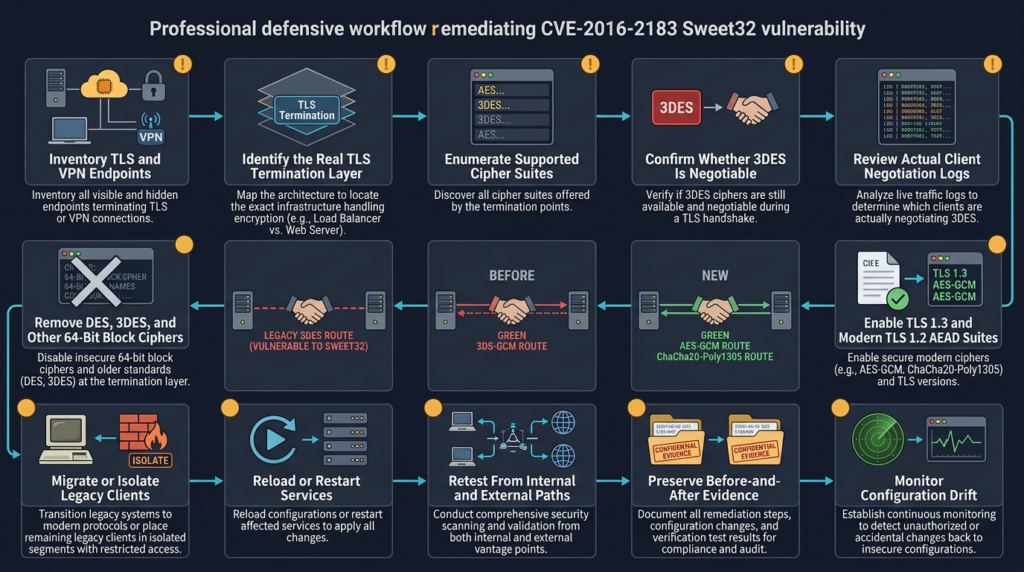
A reliable remediation program should follow this order:
- Remove 3DES and all other 64-bit block ciphers from active protocol policies.
- Prefer TLS 1.3 where clients support it.
- For TLS 1.2, allow only modern AEAD suites with forward-secret key exchange.
- Inventory and migrate clients that fail after the change.
- Check every TLS termination point and nonstandard port.
- Retest from independent network locations.
- Preserve before-and-after evidence.
- Monitor configuration drift.
Simply putting AES above 3DES in the preference order is not sufficient. A client that offers only 3DES may still negotiate it.
Simply disabling TLS 1.0 and TLS 1.1 may not be sufficient. Some stacks can negotiate a 3DES suite under TLS 1.2.
Simply installing a new certificate is not sufficient. The server certificate and the symmetric data cipher are different parts of the handshake.
Simply upgrading OpenSSL may not be sufficient. An application can override library defaults or use another TLS implementation.
Simply setting short HTTP keep-alive timeouts is not a complete fix. It may reduce traffic per connection, but session resumption, VPN data channels, protocol behavior, and implementation-specific key reuse complicate the result.
Simply accepting the risk because exploitation requires high traffic is difficult to justify in a modern environment. AES-GCM and ChaCha20-Poly1305 are widely available, faster on many platforms, and not affected by Sweet32’s 64-bit block limitation.
NGINX Remediation
Current NGINX documentation states that the default protocol setting is TLS 1.2 and TLS 1.3. NGINX uses the ssl_protocols そして ssl_ciphers directives to restrict protocol versions and suites. (Nginx)
A conservative TLS 1.2 and TLS 1.3 configuration is:
server {
    listen 443 ssl;
    server_name app.example.test;

    ssl_certificate     /etc/nginx/tls/fullchain.pem;
    ssl_certificate_key /etc/nginx/tls/private-key.pem;

    ssl_protocols TLSv1.2 TLSv1.3;

    # Applies to TLS 1.2 and earlier.
    ssl_ciphers
        ECDHE-ECDSA-AES128-GCM-SHA256:
        ECDHE-RSA-AES128-GCM-SHA256:
        ECDHE-ECDSA-AES256-GCM-SHA384:
        ECDHE-RSA-AES256-GCM-SHA384;

    # Modern clients make their own preference decisions effectively.
    ssl_prefer_server_ciphers off;
}
Before reloading:
nginx -t
Then:
nginx -s reload
Or, under systemd:
systemctl reload nginx
Retest all relevant names and addresses:
nmap -sV --script ssl-enum-ciphers -p 443 app.example.test
Potential NGINX failure modes include:
- A different
serverblock handles the tested SNI. - A global
ssl_ciphersdirective is overridden. - The public endpoint terminates at a CDN rather than NGINX.
- A stream or mail module has separate TLS directives.
- The reload failed and the old worker processes remain.
- Multiple ingress controllers use different ConfigMaps.
- A legacy backend TLS connection still accepts 3DES.
- An IPv6 address routes to an old node.
- Port 8443 uses a separate configuration.
Do not assume an externally secure CDN configuration proves that an origin address is equally hardened.
Apache HTTP Server Remediation
アパッチ mod_ssl relies on the underlying OpenSSL library for its cryptographic engine and uses SSLProtocol そして SSLCipherSuite for protocol and cipher policy. (Apache HTTP Server)
例
<VirtualHost *:443>
    ServerName app.example.test

    SSLEngine on
    SSLCertificateFile /etc/httpd/tls/fullchain.pem
    SSLCertificateKeyFile /etc/httpd/tls/private-key.pem

    SSLProtocol -all +TLSv1.2 +TLSv1.3

    SSLCipherSuite ECDHE+AESGCM:!aNULL:!eNULL:!MD5:!DSS:!DES:!3DES:!RC4
</VirtualHost>
Validate configuration:
apachectl configtest
Reload on a Red Hat-style system:
systemctl reload httpd
Reload on a Debian-style system:
systemctl reload apache2
Inspect the effective virtual-host mapping:
apachectl -S
That step is important because the expected host may be handled by a different virtual host than the one edited.
Apache installations can inherit cipher settings from:
- Distribution-wide SSL configuration.
- Included virtual-host files.
- Control panels.
- Reverse-proxy modules.
- Application-server connectors.
- Container entrypoint templates.
- Configuration-management systems.
- Vendor packages that overwrite local changes.
After remediation, test both the main host and every alias. An SNI mismatch can cause the default virtual host to present a different cipher policy.
HAProxy Remediation
HAProxy distinguishes TLS 1.2-and-earlier cipher strings from TLS 1.3 cipher-suite strings. Its documentation provides ssl-default-bind-ciphers for TLS up to 1.2 and ssl-default-bind-ciphersuites for TLS 1.3. (HAProxy Documentation)
例
global
    ssl-default-bind-options ssl-min-ver TLSv1.2

    ssl-default-bind-ciphers \
ECDHE-ECDSA-AES128-GCM-SHA256:\
ECDHE-RSA-AES128-GCM-SHA256:\
ECDHE-ECDSA-AES256-GCM-SHA384:\
ECDHE-RSA-AES256-GCM-SHA384

    ssl-default-bind-ciphersuites \
TLS_AES_128_GCM_SHA256:\
TLS_AES_256_GCM_SHA384:\
TLS_CHACHA20_POLY1305_SHA256

defaults
    mode http
    timeout connect 5s
    timeout client 30s
    timeout server 30s

frontend https_frontend
    bind :443 ssl crt /etc/haproxy/certs/app.pem
    default_backend app_backend

backend app_backend
    server app1 10.0.10.21:8443 ssl verify required ca-file /etc/haproxy/ca.pem
Validate before reload:
haproxy -c -f /etc/haproxy/haproxy.cfg
Then reload through the service manager.
HAProxy requires two separate reviews:
- Frontend policy — what external clients negotiate with HAProxy.
- Backend policy — what HAProxy negotiates with application servers.
A hardened frontend can hide a weak backend connection. That backend may not be attacker-accessible from the internet, but internal compromise, traffic capture, or network-segmentation failures can make it relevant.
用途 ssl-default-server-ciphers and related server-side directives when backend TLS also needs an explicit policy.
Windows Schannel Remediation
Microsoft recommends controlling cipher suites through Group Policy, MDM, or the TLS PowerShell module. (マイクロソフト学習)
Inventory:
Get-TlsCipherSuite |
    Select-Object Name, Cipher, CipherLength |
    Format-Table -AutoSize
Filter for DES-related suites:
Get-TlsCipherSuite |
    Where-Object {
        $_.Name -match '3DES|DES'
    } |
    Format-Table Name, Cipher, CipherLength -AutoSize
Disable the standard 3DES RSA suite:
Disable-TlsCipherSuite `
    -Name 'TLS_RSA_WITH_3DES_EDE_CBC_SHA'
検証する:
Get-TlsCipherSuite -Name '3DES'
In an enterprise environment, first determine whether cipher policy is controlled by:
- Local PowerShell configuration.
- Local Group Policy.
- Domain Group Policy.
- MDM.
- A security baseline.
- Exchange or AD FS guidance.
- Application-specific Schannel flags.
- A third-party TLS library.
Microsoft notes that GPO and registry policy can override manual Enable-TlsCipherSuite または Disable-TlsCipherSuite changes. Applications may also limit algorithms through SSPI, while applications that bundle OpenSSL, Java, NSS, or another library may ignore Schannel entirely. (マイクロソフト学習)
After changing Windows TLS policy:
- Confirm the effective policy after Group Policy refresh.
- Restart services that cache TLS configuration.
- Reboot if required by the affected product or deployment procedure.
- Test the actual listening service remotely.
- Test clustered nodes independently.
- Confirm that Windows Update, monitoring agents, proxies, and line-of-business clients still function.
- Record any compatibility failures and their owners.
Avoid deleting arbitrary cipher-list registry entries without a rollback plan. A malformed system-wide cipher list can break unrelated services.
Java Remediation
Java TLS behavior is influenced by:
- JDK version.
java.security.jdk.tls.disabledAlgorithms.- Application-server configuration.
- JVM system properties.
- Custom
SSLContextcode. - Container base image.
- Vendor-specific security files.
A hardened jdk.tls.disabledAlgorithms policy commonly includes entries such as:
jdk.tls.disabledAlgorithms=SSLv3, TLSv1, TLSv1.1, \
    RC4, DES, 3DES_EDE_CBC, MD5withRSA, \
    DH keySize < 2048, EC keySize < 224, \
    anon, NULL
Exact syntax and supported tokens depend on the JDK release. Oracle documentation shows 3DES_EDE_CBC in disabled-algorithm examples for Java TLS policy. (Oracle Docs)
Before changing a shared Java runtime:
java -version
Find the active security file:
find "${JAVA_HOME:-/usr/lib/jvm}" \
  -path '*/conf/security/java.security' \
  -o -path '*/lib/security/java.security' 2>/dev/null
Inspect the current rule:
grep -n '^jdk.tls.disabledAlgorithms' \
  "$JAVA_HOME/conf/security/java.security"
Older JDK layouts may use:
grep -n '^jdk.tls.disabledAlgorithms' \
  "$JAVA_HOME/jre/lib/security/java.security"
The change normally requires restarting the JVM. For an application server, verify whether the product supplies its own security file or startup property such as:
-Djava.security.properties=/path/to/custom.security
Test both directions:
- Java acting as a TLS server.
- Java acting as a TLS client.
A server-side fix can break an outbound integration that only supports 3DES, while an outbound-only Java service may not expose an inbound Sweet32 surface at all. Both are cryptographic debt, but the operational impact differs.
OpenVPN Remediation
For OpenVPN 2.6, a modern server and client policy can use:
data-ciphers AES-256-GCM:AES-128-GCM:CHACHA20-POLY1305
When ChaCha20-Poly1305 is not available in the linked crypto library:
data-ciphers AES-256-GCM:AES-128-GCM
Remove entries such as:
cipher BF-CBC
cipher DES-EDE3-CBC
data-ciphers-fallback BF-CBC
Do not add BF-CBC back merely to silence a client error. The OpenVPN 2.6 manual states that BF-CBC was the historical default in OpenVPN 2.4 and older, that it is weak because of its 64-bit block size, and that modern versions default to AEAD ciphers. (OpenVPN)
A staged migration can use the following process:
- Inventory client versions and platforms.
- Enable modern
data-ciphersをサーバー上に置く。 - Confirm which clients negotiate AES-GCM or ChaCha20-Poly1305.
- Upgrade clients that require a legacy fallback.
- Remove
data-ciphers-fallback. - Remove old
cipherdirectives. - Reconnect every client type.
- Review server logs for negotiated ciphers.
- Rotate long-lived credentials if the legacy tunnel carried sensitive reusable secrets.
- Document the date when legacy cipher support was eliminated.
If an obsolete client cannot be upgraded immediately, isolate it behind a dedicated compatibility gateway with strict network restrictions and a removal deadline. Do not weaken the primary VPN profile for every user.
Migrating Legacy Clients Without Creating a Permanent Exception
Legacy compatibility is the main reason 3DES survives.
A safe migration begins with evidence rather than speculation. Collect a representative sample of actual TLS handshakes and group clients by:
- Application.
- Owner.
- Operating system.
- TLS library.
- Protocol version.
- Negotiated cipher.
- Business criticality.
- Upgrade path.
- Last observed use.
- Source network.
- Authentication method.
Then separate clients into four categories.
Modern clients
These already negotiate TLS 1.2 AEAD or TLS 1.3. They should continue working after 3DES removal.
Upgradeable legacy clients
These fail because of an old runtime, browser, library, or device firmware that can be updated. Assign an owner and deadline.
Replaceable legacy clients
These cannot be upgraded but can be replaced by a supported product or integration.
Temporarily unavoidable clients
These require a short-lived exception because replacement depends on a vendor, contract, hardware project, or regulated change window.
An exception should include:
- Named business owner.
- Named security owner.
- Exact source addresses.
- Exact destination and port.
- Required cipher.
- Data classification.
- Compensating controls.
- Monitoring requirements.
- Expiration date.
- Replacement plan.
- Approval record.
Place the exception on a dedicated listener or gateway rather than the main service. Restrict access by network policy, device identity, mutual TLS, or another control appropriate to the environment. Avoid exposing the compatibility endpoint to the public internet.
A temporary exception without an expiration date is not temporary. It is a new permanent dependency.
Common Remediation Mistakes
Editing the wrong TLS layer
A team changes NGINX while the public connection terminates at a cloud load balancer. The scan remains unchanged because NGINX never participated in the external handshake.
Map the connection path first.
Removing one suite name only
TLS_RSA_WITH_3DES_EDE_CBC_SHA is common, but other 3DES suites may exist. Search by the encryption algorithm, not only one complete suite name.
Confusing cipher order with cipher removal
Moving 3DES to the bottom still allows clients with no stronger overlap to select it.
Use a deny rule or an explicit allowlist.
Assuming the browser test is sufficient
Modern Chrome and Edge do not offer 3DES, so an ordinary browser connection cannot prove whether the server would accept it from a legacy client.
Use a controlled diagnostic client capable of offering the exact suite.
Trusting a single scanner location
CDNs, split DNS, IPv6, region-specific load balancers, and internal routes can produce different results.
Test each distinct path.
Forgetting STARTTLS services
SMTP, IMAP, POP3, LDAP, XMPP, and database protocols may upgrade plaintext connections to TLS. A web-only scanner may miss them.
Modifying a node but not the cluster
One unpatched or misconfigured load-balancer node can make findings intermittent. Scan repeatedly and identify backend affinity where possible.
Treating a failed OpenSSL test as proof
The local OpenSSL build may be unable to offer 3DES. Confirm local capability before concluding the server rejected it.
Lowering the global security level
使用 @SECLEVEL=0 in a temporary lab command can help diagnose a legacy suite. Applying it globally can re-enable several classes of obsolete cryptography.
Keep diagnostic exceptions isolated.
Using session limits as the final fix
Shorter sessions and more frequent rekeying reduce the amount of data under one key, but they do not modernize the cipher. NIST’s historical reduction to (2^{20}) TDEA blocks was a transitional restriction, not an endorsement of continued TLS usage. NIST has since disallowed TDEA for applying new cryptographic protection. (NISTコンピュータセキュリティリソースセンター)
Related Vulnerabilities That Explain the Legacy TLS Problem
Sweet32 is part of a larger pattern: old protocol compatibility repeatedly turns known cryptographic weaknesses into operational exposure.
| Issue | Core weakness | Typical prerequisite | Main remediation |
|---|---|---|---|
| CVE-2016-2183 Sweet32 | Birthday collisions in 64-bit block ciphers such as 3DES | Large data volume under one key, traffic observation, predictable or repeated plaintext | Remove 3DES and other 64-bit block ciphers |
| CVE-2016-6329 | Sweet32 against OpenVPN with ciphers such as BF-CBC | Long-lived VPN session and substantial encrypted traffic | Use AES-GCM or ChaCha20-Poly1305 |
| CVE-2014-3566 POODLE | SSL 3.0 CBC padding behavior creates a padding oracle | MITM position and SSL 3.0 negotiation or downgrade | Disable SSL 3.0 |
| CVE-2016-0800 DROWN | SSLv2 RSA oracle can be abused to decrypt TLS traffic | SSLv2 service sharing relevant RSA key material | Disable SSLv2 everywhere and update affected software |
| RC4 prohibition | Statistical biases in the RC4 keystream | Large numbers of related encryptions or sessions | Never negotiate RC4 |
CVE-2014-3566 POODLE
POODLE targets SSL 3.0’s CBC padding behavior. NVD describes it as a man-in-the-middle plaintext-recovery attack caused by nondeterministic CBC padding. The appropriate fix is to disable SSL 3.0 rather than attempting to make its CBC mode safe. (NVD)
POODLE and Sweet32 both involve CBC-era cryptography, but they are not the same attack. POODLE uses a padding oracle. Sweet32 uses block collisions caused by a short block size.
CVE-2016-0800 DROWN
DROWN uses SSLv2 behavior as a Bleichenbacher-style RSA oracle to decrypt TLS ciphertext. A server can be exposed when the same RSA key is used on another service that accepts SSLv2. NVD identifies affected historical OpenSSL versions and the cross-protocol decryption condition. (NVD)
The operational lesson is that a secure-looking TLS endpoint can still inherit risk from another protocol endpoint sharing keys or infrastructure.
RC4
RC4 was once retained as a way to avoid CBC attacks. That trade became indefensible as practical attacks against RC4 biases improved. RFC 7465 requires TLS clients and servers never to negotiate RC4 suites, regardless of TLS version. (RFCエディター)
Replacing one obsolete cipher with another is not modernization.
CVE-2016-6329
CVE-2016-6329 is the closest companion to CVE-2016-2183 because it applies the same birthday-collision principle to OpenVPN sessions using 64-bit block ciphers such as Blowfish-CBC. (NVD)
The shared lesson is that block size and key-usage volume matter across protocols. A cipher cannot be evaluated solely by reading the number in its key-length label.
Verification After Remediation
A change is not complete until the original condition is retested.
Use a before-and-after evidence set.
Before remediation
Record:
Asset: app.example.test
IP: 192.0.2.10
Port: 443
SNI: app.example.test
Observed protocol: TLS 1.2
Observed weak suite: TLS_RSA_WITH_3DES_EDE_CBC_SHA
Tool: Nmap ssl-enum-ciphers
Timestamp: 2026-07-14T18:00:00Z
Attach:
- Scanner output.
- Successful forced handshake.
- Relevant server configuration.
- Change owner.
- Asset owner.
- Exposure path.
After remediation
Record:
Expected result:
- TLS 1.2 and TLS 1.3 remain available
- 3DES handshake fails
- Modern AEAD handshake succeeds
- Application health checks pass
- Representative clients remain functional
Test rejection:
openssl s_client \
  -connect app.example.test:443 \
  -servername app.example.test \
  -tls1_2 \
  -cipher 'DES-CBC3-SHA:@SECLEVEL=0'
Test a modern TLS 1.2 suite:
openssl s_client \
  -connect app.example.test:443 \
  -servername app.example.test \
  -tls1_2 \
  -cipher 'ECDHE-RSA-AES128-GCM-SHA256'
Test TLS 1.3:
openssl s_client \
  -connect app.example.test:443 \
  -servername app.example.test \
  -tls1_3
Enumerate again:
nmap -sV \
  --script ssl-enum-ciphers \
  -p 443 \
  app.example.test
A strong closure statement is:
The endpoint previously accepted TLS_RSA_WITH_3DES_EDE_CBC_SHA.
After the configuration change, a forced 3DES handshake is rejected,
TLS 1.2 AES-GCM succeeds, TLS 1.3 succeeds, and full cipher enumeration
shows no DES or 3DES suites.
A weak closure statement is:
The package was updated.
Package state is useful evidence, but Sweet32 is ultimately about the effective negotiated cipher.
For organizations managing many endpoints, authorized automation can connect asset inventory, cipher enumeration, configuration evidence, remediation tickets, and post-change retesting. An evidence-driven platform such as 寡黙 can support that kind of scoped validation workflow, while Penligent’s existing TLS encryption vulnerability overview provides additional context on protocol versions, cipher configuration, certificate problems, and TLS testing. The important control is that automated output remains tied to explicit authorization, raw tool evidence, and a reproducible retest rather than treating a version string or model-generated claim as proof. (寡黙)
Operational Monitoring After the Fix
Cryptographic settings drift.
Drift can occur when:
- A load balancer is replaced.
- A disaster-recovery site is activated.
- A vendor appliance is upgraded.
- A container rolls back to an old image.
- A certificate-renewal automation replaces the TLS listener.
- A new virtual host inherits a default cipher policy.
- A Group Policy changes.
- A cloud service introduces a compatibility profile.
- An engineer copies an old configuration.
- A newly acquired business unit connects a legacy client.
- A test environment is promoted to production.
Add TLS policy to continuous controls:
- External cipher enumeration on a defined schedule.
- Internal scanning of management and service ports.
- Configuration-as-code rules rejecting
3DES,DES-CBC3,BF-CBC, and obsolete protocol versions. - CI checks for ingress and proxy configuration.
- Runtime metrics for negotiated protocol and cipher.
- Alerts when deprecated suites appear.
- Expiration tracking for compatibility exceptions.
- Retesting after infrastructure changes.
A simple CI check can reject known weak tokens:
#!/usr/bin/env bash
set -euo pipefail

TARGET_DIR="${1:-.}"

if grep -RniE \
  '3DES|DES-CBC3|DES-EDE3|TLS_RSA_WITH_3DES|BF-CBC' \
  "$TARGET_DIR"; then
    echo "Legacy 64-bit block cipher reference detected."
    exit 1
fi

echo "No explicit 3DES or BF-CBC references detected."
This control is intentionally simple. It may flag documentation, migration notes, or deny rules such as !3DES, and it cannot detect dynamically generated policies. Use it as a review trigger, not a complete cryptographic analyzer.
よくあるご質問
Is CVE-2016-2183 still relevant?
- Yes, when a reachable service can still negotiate 3DES, DES, or another affected 64-bit block cipher.
- Modern browsers have largely removed 3DES, so ordinary public web traffic is less exposed than it was in 2016. (Chrome for Developers)
- Legacy APIs, VPNs, appliances, Java applications, management interfaces, and embedded clients may still use affected ciphers.
- NIST no longer approves TDEA for applying new cryptographic protection, making continued support difficult to justify even where practical exploitation is unlikely. (NISTコンピュータセキュリティリソースセンター)
- The correct response is to verify effective cipher negotiation and remove the weak suite, not dismiss the finding because the CVE is old.
Is a server vulnerable merely because it supports 3DES?
- The server exposes the cryptographic condition associated with CVE-2016-2183 if a client can negotiate 3DES.
- Support alone does not prove that the complete plaintext-recovery attack is practical in that environment.
- Practical exploitation also depends on traffic volume, key lifetime, attacker visibility, repeated secrets, predictable plaintext, connection behavior, and token validity.
- A scanner finding should therefore be described as confirmed weak-cipher exposure, not automatically as confirmed cookie theft.
- Remediation should still remove 3DES because modern alternatives are widely available.
Does TLS 1.2 prevent Sweet32?
- No. TLS 1.2 can support 3DES when the implementation and cipher policy allow it.
- TLS version and cipher-suite policy must be checked separately.
- A secure TLS 1.2 configuration should use modern AEAD suites such as AES-GCM with ECDHE.
- TLS 1.3 does not include 3DES and is not affected by Sweet32 through its record-protection ciphers.
- Test the actual negotiated suite instead of assuming the protocol version determines everything.
Can updating OpenSSL alone fix CVE-2016-2183?
- Not reliably.
- Newer OpenSSL versions changed defaults and availability, which can remove 3DES from many applications. (openssl-library.org)
- Applications can override library defaults or compile legacy support explicitly.
- A reverse proxy, load balancer, Java runtime, Windows Schannel service, or vendor TLS stack may not use the OpenSSL package you updated.
- The final proof is a failed 3DES handshake and clean remote cipher enumeration on every relevant endpoint.
- Package inventory should be supporting evidence, not the only closure evidence.
How can I verify that 3DES is disabled?
- Attempt an authorized forced handshake using a client capable of offering
DES-CBC3-SHA. - Run Nmap’s
ssl-enum-ciphersscript against every relevant port and SNI name. (エヌマップ) - Check the effective local policy with tools such as
Get-TlsCipherSuite,nginx -T,apachectl -S,haproxy -c, or application-specific configuration commands. - Confirm modern TLS 1.2 AEAD and TLS 1.3 handshakes still succeed.
- Repeat the test through public, internal, IPv4, IPv6, and load-balanced paths where applicable.
- Preserve both the pre-remediation successful 3DES result and post-remediation rejection.
Is limiting session duration an acceptable Sweet32 mitigation?
- It is a risk-reduction measure, not the preferred final remediation.
- Rekeying and connection limits reduce the amount of data encrypted under one key.
- The correct threshold is protocol- and implementation-dependent.
- A timeout may not control all forms of key reuse, session resumption, VPN data-channel behavior, or parallel connections.
- NIST historically imposed strict TDEA block limits but has since disallowed TDEA for applying new protection. (NISTコンピュータセキュリティリソースセンター)
- Use short sessions only as a temporary compatibility control while migrating to AES-GCM or ChaCha20-Poly1305.
Why does my scanner still report Sweet32 after I disabled 3DES?
- You may have modified the application while TLS terminates at a CDN, proxy, load balancer, or operating-system layer.
- Another virtual host, SNI route, port, IPv6 address, or cluster node may still use the old policy.
- Group Policy or configuration management may have restored the suite.
- The service may require a restart or reload.
- Your OpenSSL test client may be reaching a different endpoint than the scanner.
- The scanner may be reporting another 64-bit cipher or a different 3DES suite.
- Re-enumerate the full suite list and map each result to the exact IP, port, SNI, protocol, and TLS terminator.
What should replace 3DES?
- Prefer TLS 1.3 where possible.
- For TLS 1.2, use ECDHE with AES-128-GCM or AES-256-GCM.
- ChaCha20-Poly1305 is useful where supported, especially on systems without efficient AES acceleration.
- For OpenVPN, use the modern
data-ciphersdefaults based on AES-GCM and optionally ChaCha20-Poly1305. (OpenVPN) - Do not replace 3DES with RC4, single DES, Blowfish-CBC, export ciphers, or static RSA suites.
- Validate client compatibility before deployment, but treat legacy support as a migration project with an end date.
Closing Judgment
Sweet32 is neither an instant decryption button nor an obsolete academic curiosity. It demonstrated that the 64-bit block size of 3DES and Blowfish could become a practical confidentiality failure when modern applications pushed enough structured traffic through long-lived encrypted sessions.
The attack’s prerequisites should shape severity, but they should not be used to defend continued 3DES support. Current browsers have moved away from it, modern TLS guidance recommends AEAD suites, and NIST no longer approves TDEA for new cryptographic protection.
The correct response to CVE-2016-2183 is to identify every effective TLS or VPN termination point, confirm whether a 64-bit block cipher can actually be negotiated, remove it from the accepted policy, migrate dependent clients, and prove the change through an independent handshake and full cipher enumeration.
A system that still needs 3DES does not have a Sweet32 exception. It has an unfinished cryptographic migration.

 Japanese
  English
  German
  French
  Spanish
  Portuguese
  Korean
  Hindi
Hindi  Arabic
  Turkish
  Hebrew