
CVE-2026-20272 is a critical Cisco IOS XE security-hardening identifier covering multiple internally discovered weaknesses related to the improper neutralization of special elements. Cisco maps the identifier to CWE-74, a high-level injection category that includes command injection, operating system command injection, and argument injection.
Cisco published the advisory on August 5, 2026, assigned the vulnerability group a maximum CVSS 3.1 score of 9.8, confirmed that no workaround addresses the underlying issues, and released fixed IOS XE versions for the evaluated software trains. Cisco recommends upgrading affected systems to the appropriate fixed release. (Cisco)
However, CVE-2026-20272 should not be described as one conventional command injection vulnerability with a known endpoint, parameter, payload, and exploitation sequence. It is an umbrella CVE representing multiple internally discovered bugs grouped under the same CWE category.
That distinction matters. Security teams should treat CVE-2026-20272 as a critical software-upgrade priority, but they should not claim that every affected device exposes the same unauthenticated command-execution path or attempt to construct speculative proof-of-concept payloads from information Cisco has not published.
CVE-2026-20272 at a Glance
| フィールド | Confirmed information |
|---|---|
| CVE ID | CVE-2026-20272 |
| Vendor | Cisco |
| 製品 | Cisco IOS XE Software |
| Disclosure date | August 5, 2026 |
| Advisory type | IOS XE Software Security Hardening Release |
| Weakness category | CWE-74 |
| Covered vulnerability classes | Command injection, OS command injection, argument injection |
| Highest published CVSS score | 9.8 |
| Published CVSS vector | CVSS:3.1/AV:N/AC:L/PR:N/UI:N/S:U/C:H/I:H/A:H |
| Affected operating modes | Autonomous mode and controller mode |
| Configuration dependency | Cisco states affected status applies regardless of device configuration |
| Workaround | なし |
| Primary remediation | Upgrade to a fixed IOS XE release |
| Public exploitation at disclosure | Cisco reported no known public announcement or malicious use |
| Discovery source | Cisco internal testing using existing processes and frontier AI models |
Cisco explains that the CVSS score attached to each umbrella CVE represents the maximum potential severity of the single most impactful underlying bug within that CWE category. Therefore, the 9.8 rating for CVE-2026-20272 does not necessarily describe every individual bug included in the group. (Cisco)
What Is CVE-2026-20272?
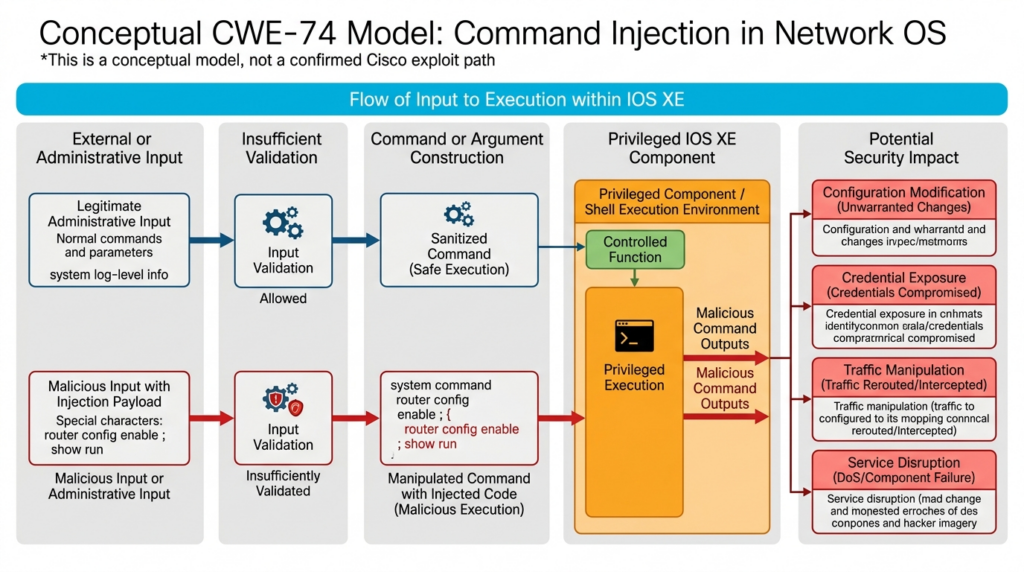
CVE-2026-20272 tracks a group of Cisco IOS XE weaknesses categorized under CWE-74, “Improper Neutralization of Special Elements in Output Used by a Downstream Component.”
MITRE defines CWE-74 as a class-level weakness in which software constructs a command, data structure, or record using externally influenced input but fails to neutralize special elements that can change how a downstream component parses or interprets that content. CWE-74 is intentionally broad and can encompass several more specific injection weaknesses. (CWE)
Cisco’s advisory narrows the relevant scope by stating that CVE-2026-20272 covers command injection, operating system command injection, and argument injection issues. (Cisco)
A simplified unsafe design could look conceptually like this:
command = "diagnostic_tool --target " + externally_controlled_value
execute_through_shell(command)
もし externally_controlled_value is inserted into a shell-interpreted string without strict validation and separation, special characters may alter the command structure rather than remaining ordinary data.
A safer software design generally separates the executable from its arguments:
execute_program(
    program="diagnostic_tool",
    arguments=["--target", validated_target]
)
That pattern reduces shell interpretation risk, but it does not automatically eliminate argument injection. An attacker-controlled value could still be interpreted as an unintended option, switch, file path, or secondary instruction by the invoked program.
MITRE distinguishes OS command injection from argument injection for this reason. OS command injection can allow input to alter operating-system directives, while argument injection may allow an attacker to add or modify command-line switches even when the attacker cannot directly introduce a separate shell command. (CWE)
These examples explain the general vulnerability class. They are not a reconstruction of Cisco IOS XE source code, and Cisco has not disclosed which internal components contain the grouped weaknesses.
Why CVE-2026-20272 Is an Umbrella CVE
Cisco introduced an evolved risk-based vulnerability disclosure model in July 2026. Under this model, internally discovered vulnerabilities that share the same high-level CWE may be consolidated into one umbrella CVE. The associated CVSS score represents the worst-case severity among the individual bugs grouped beneath that identifier. (Cisco)
Cisco says the new process is intended to accommodate the increased speed and volume of vulnerability discovery associated with AI-assisted analysis. It also introduces scheduled hardening releases for major network operating systems, including IOS XE, IOS XR, NX-OS, Secure Firewall, and ASA. (Cisco)
This means CVE-2026-20272 is fundamentally different from a typical advisory that describes one vulnerable API or function.
There may be multiple underlying bugs with different:
- Affected components
- Input channels
- Authentication requirements
- Network reachability
- Execution contexts
- Privilege levels
- Device dependencies
- Operational impacts
- Exploitation prerequisites
Cisco has not published those individual details.
The umbrella model therefore shifts the defender’s primary question from:
Can we reproduce one exact CVE payload?
に:
Is the device running an IOS XE release that predates Cisco’s security-hardened version?
For CVE-2026-20272, version-based remediation is the most authoritative public validation method because Cisco has published the affected release families and first fixed releases but has not published a supported behavioral test.
Confirmed Affected Scope
Cisco states that the vulnerabilities covered by the August 2026 IOS XE hardening advisory affect Cisco IOS XE Software running in either autonomous mode or controller mode, regardless of device configuration. (Cisco)
The internal evaluation focused on the following release trains:
| Evaluated IOS XE train |
|---|
| 17.9 |
| 17.12 |
| 17.15 |
| 17.18 |
| 26.1 |
The phrase regardless of device configuration is important. It means administrators should not assume that disabling one suspected interface, restricting one protocol, or deploying the device in a particular management mode removes the need to upgrade.
Cisco has not said that every feature in every configuration is independently exploitable. Rather, it has stated that device configuration does not exclude an IOS XE system in the evaluated release scope from the hardening advisory.
This also means that configuration-based scanners must be careful. A scanner should not mark a device as unaffected simply because the web interface, RESTCONF, NETCONF, SNMP, or another management service is disabled. Cisco has not identified which component or components contain each underlying CWE-74 bug.
Fixed Cisco IOS XE Releases
Cisco lists the following first fixed releases for the August 2026 IOS XE security-hardening advisory:
| IOS XE release train | First fixed release |
|---|---|
| 17.9 | 17.9.10 |
| 17.12 | 17.12.8 |
| 17.15 | 17.15.6 |
| 17.18 | 17.18.4 or 17.18.4a |
| 26.1 | 26.1.2 |
Cisco strongly recommends upgrading to the appropriate fixed software and states that there are no workarounds that address the vulnerabilities. Cisco PSIRT also emphasizes that it validates only the affected and fixed release information documented in the advisory. (Cisco)
A system running IOS XE 17.12.7, for example, should not be considered remediated merely because management access is restricted to an internal network. The first fixed release in that train is 17.12.8.
Similarly, a device running 17.9.9 remains below the first fixed 17.9 release, which is 17.9.10.
Administrators must compare the complete version rather than using naive string comparison. A lexical comparison may incorrectly decide that 17.9.9 is newer than 17.9.10 because it compares characters instead of numeric version components.
# Incorrect approach for software version comparison
"17.9.9" > "17.9.10"
Inventory and vulnerability-management systems should normalize IOS XE release strings into numeric components or rely on Cisco-supported product and software assessment tools.
Is CVE-2026-20272 an Unauthenticated Remote Command Injection?
The published CVSS vector is:
CVSS:3.1/AV:N/AC:L/PR:N/UI:N/S:U/C:H/I:H/A:H
NVD records this vector for CVE-2026-20272. It represents network reachability, low attack complexity, no required privileges, no user interaction, unchanged scope, and high potential impact to confidentiality, integrity, and availability. (NVD)
However, Cisco explicitly states that the score represents the maximum severity of the most impactful underlying bug in the CWE-74 category. (Cisco)
The accurate interpretation is therefore:
At least one underlying bug grouped under CVE-2026-20272 was assessed using a critical 9.8 vector representing an unauthenticated, network-reachable, low-complexity path with high confidentiality, integrity, and availability impact.
The inaccurate interpretation would be:
Every bug grouped under CVE-2026-20272 is the same unauthenticated remote root command injection vulnerability.
Cisco has not published enough detail to support the second statement.
This distinction should be preserved in vulnerability reports, customer communications, threat-intelligence summaries, and SEO content. Overstating the technical details may generate attention, but it also creates incorrect remediation assumptions and reduces trust when researchers cannot reproduce the claimed path.
Why CVE-2026-20272 Still Deserves Urgent Priority
The absence of a public endpoint or proof of concept does not reduce CVE-2026-20272 to a routine maintenance issue.
The strongest reasons for prioritization are already present:
- The affected product is an enterprise network operating system.
- The vulnerability group includes command, OS command, and argument injection.
- The highest underlying severity is CVSS 9.8.
- The highest-scored vector represents unauthenticated network access.
- Cisco says affected status applies in autonomous and controller modes.
- Cisco states that device configuration does not remove affected status.
- There is no workaround.
- Fixed releases are available.
- Cisco advises customers to upgrade immediately under its risk-based disclosure model. (Cisco)
Network infrastructure also occupies a privileged position within enterprise environments. IOS XE devices may enforce routing, segmentation, wireless access, branch connectivity, software-defined networking, authentication integration, telemetry, and administrative access.
A vulnerability that crosses from an externally influenced input into a privileged command-processing path can therefore create consequences beyond the compromise of one isolated application.
Depending on the actual underlying bug, possible command-injection-class consequences could include configuration modification, credential exposure, unauthorized account creation, traffic manipulation, monitoring disruption, persistence, service interruption, or use of the network device as a pivot point.
These are threat-model outcomes derived from the CWE category and the role of network infrastructure. They are not confirmed capabilities of a published CVE-2026-20272 exploit.
What Cisco Has Not Disclosed
As of August 6, 2026, Cisco has not publicly disclosed the exact technical details of the individual bugs grouped under CVE-2026-20272.
The advisory does not identify:
- The exact vulnerable IOS XE components
- The vulnerable functions
- The affected commands
- The user-controlled input fields
- The involved management protocols
- The command interpreter or downstream processor
- The process privileges
- The precise affected hardware models
- A reproduction request
- A malicious payload
- A proof-of-concept exploit
- Exploitation-specific indicators of compromise
- The number of bugs grouped under the CVE
- Whether every evaluated train contains the same underlying bugs
The advisory also does not establish that the weakness is located specifically in the IOS XE web interface.
It could theoretically involve web management, a controller interface, an administrative service, a diagnostic function, a parser, a configuration path, an automation interface, or another subsystem. Without supporting evidence, choosing one of these possibilities and presenting it as fact would be speculation.
Known Exploitation Status
Cisco PSIRT stated that it was not aware of public announcements or malicious use involving the vulnerabilities described in the advisory at the time of publication. Cisco also said the issues were discovered through internal security testing using existing processes and frontier AI models. (Cisco)
This means there was no vendor-confirmed evidence of active exploitation when Cisco released the advisory on August 5, 2026.
It does not mean exploitation is impossible.
Publication changes the environment. Researchers and attackers can begin analyzing fixed and vulnerable software images, comparing changed binaries, examining removed code paths, monitoring new process behavior, and narrowing the location of security-relevant patches.
Because Cisco has bundled multiple bugs into a hardened release, reverse engineering may be more difficult than comparing a single isolated patch. However, the 9.8 rating and the command-injection classification are likely to attract sustained research attention.
Organizations should therefore avoid using “no known exploitation” as a reason to postpone the upgrade.
CVE-2026-20272 Patch Priority Model
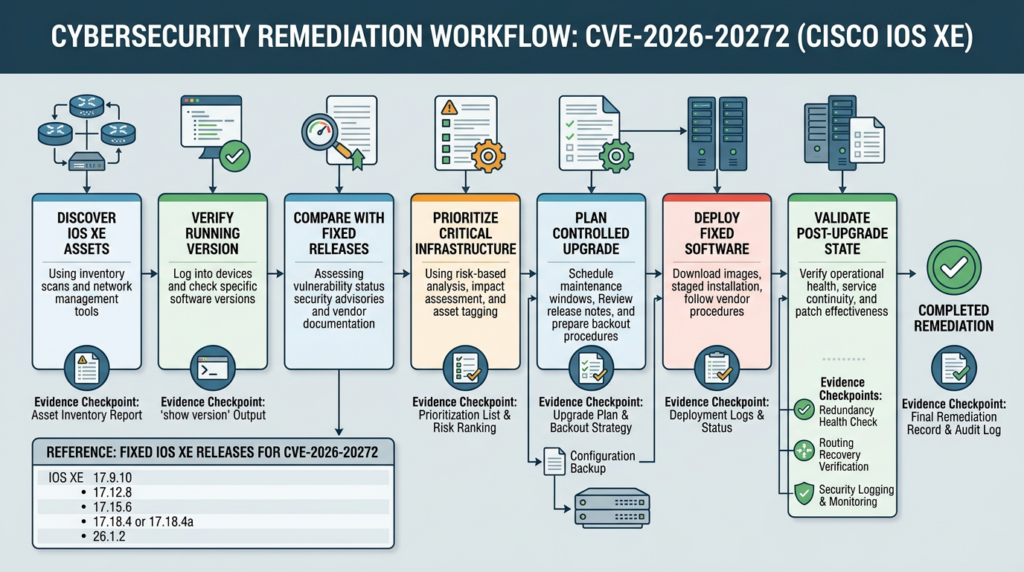
Not every IOS XE device presents the same operational exposure, but every affected release requires a remediation decision.
| 優先順位 | Typical conditions | Recommended response |
|---|---|---|
| Emergency | Management services exposed to the internet, partner networks, untrusted administrative segments, or compromised-access pathways | Begin expedited upgrade procedures immediately |
| クリティカル | Core routing, WAN, wireless, campus, data-center, branch, or segmentation infrastructure running an affected release | Patch in the earliest approved emergency window |
| 高い | Management access is restricted but the device remains reachable from internal administrative or orchestration systems | Schedule rapid upgrade and maintain enhanced monitoring |
| Controlled | Lab, staging, or isolated systems with verified access restrictions | Upgrade before production use or reconnection |
| Investigation required | IOS XE version, hardware model, active image, or ownership cannot be confirmed | Resolve inventory gaps immediately |
External exposure is not the only factor.
An internal network device may be reachable from:
- Administrator workstations
- Jump servers
- Network management platforms
- Wireless controllers
- Automation servers
- Configuration-management tools
- Monitoring systems
- VPN-connected endpoints
- Compromised privileged accounts
- Third-party support networks
If one of these trusted systems is compromised, an attacker may gain access to management paths that are not publicly exposed.
Safe Exposure Assessment
The safest validation objective is to determine whether the device runs an affected IOS XE release, not to guess the undisclosed command-injection input.
Step 1: Build an Authoritative Inventory
For every IOS XE asset, record:
| Inventory field | なぜそれが重要なのか |
|---|---|
| Hostname | Identifies the managed system |
| Management address | Links evidence to the correct asset |
| Hardware model | Determines release and upgrade compatibility |
| Serial number | Supports Cisco entitlement and TAC cases |
| Active IOS XE version | Determines advisory exposure |
| Installed image | Confirms which software is present |
| Boot configuration | Confirms which image will run after reload |
| Autonomous or controller mode | Records the operational context |
| Network role | Supports risk prioritization |
| Site or business owner | Enables change coordination |
| Redundancy relationship | Prevents simultaneous failure |
| External and internal exposure | Helps prioritize deployment |
| Support status | Determines available upgrade assistance |
| Last configuration backup | Supports rollback |
| Planned maintenance window | Establishes remediation timing |
Inventory should be corroborated through more than one source where possible. Useful sources may include direct device output, network-management systems, controller inventories, configuration repositories, asset databases, and Cisco support portals.
Step 2: Confirm the Running Version
On an authorized IOS XE device, administrators commonly begin with:
show version
Depending on the platform, additional commands may include:
show inventory
show platform
show boot
show redundancy
The exact command syntax and output differ across routers, switches, wireless controllers, virtual platforms, stacks, and chassis systems.
The evidence should identify the running image. Merely copying a fixed image onto device storage does not remediate the vulnerability if the device continues to boot or run the older version.
Step 3: Compare the Version with Cisco’s Fixed Releases
The exposure logic is straightforward at the train level:
17.9.x  → first fixed release: 17.9.10
17.12.x → first fixed release: 17.12.8
17.15.x → first fixed release: 17.15.6
17.18.x → first fixed release: 17.18.4 or 17.18.4a
26.1.x  → first fixed release: 26.1.2
These values come directly from Cisco’s August 2026 advisory. (Cisco)
A vulnerability-management platform should classify results carefully:
| 結果 | 意味 |
|---|---|
| Confirmed affected release | Authoritative evidence shows the running version predates the fixed release |
| Fixed by version | Authoritative evidence shows the device is running a Cisco-listed fixed release |
| Possibly affected | Product family is known, but exact version evidence is incomplete |
| Unknown | Product or release cannot be established reliably |
| Behaviorally verified | Not generally supportable without a vendor-published validation method |
A scanner should not label an affected version as “command execution confirmed.” Version evidence confirms exposure to the Cisco hardening advisory, not successful exploitation of an individual underlying bug.
Why Speculative Exploit Testing Is Unsafe
A conventional vulnerability scanner often relies on a known request-response pattern. It may send a harmless probe to a documented endpoint and look for a deterministic result.
CVE-2026-20272 does not currently provide that type of public validation path.
Without knowing the vulnerable component, speculative testing can create several problems.
First, it may generate false negatives. A tester may probe the web interface even though the relevant bug is located in another subsystem.
Second, it may create false positives. Unexpected command output or error behavior may be unrelated to CVE-2026-20272.
Third, network infrastructure is operationally sensitive. Aggressive malformed input, command separators, recursive arguments, long strings, or unexpected control characters may crash a process, modify configuration, trigger failover, or interrupt connectivity.
Fourth, an improvised test may cross authorization boundaries. Permission to scan a device does not always include permission to attempt command execution on production infrastructure.
Fifth, a speculative payload may accidentally persist. If an undisclosed path writes to configuration, the test may produce a lasting change rather than a temporary response.
For this advisory, safe validation means proving the software state and the remediation state.
Pre-Upgrade Validation
Before changing the device, preserve enough evidence to support rollback and post-upgrade comparison.
Common pre-upgrade evidence may include:
show version
show inventory
show running-config
show startup-config
show boot
show redundancy
show platform
show logging
The exact set should be adapted to the platform and organizational change procedure.
Teams should also record:
- Interface state
- Routing neighbors
- Tunnel state
- Wireless access-point registration
- Controller health
- High-availability state
- CPU and memory utilization
- Available storage
- Licensing status
- Current boot variables
- Recent reloads
- Recent crashes
- Logging destinations
- AAA connectivity
- Telemetry state
- Configuration checksum or baseline
Running configurations may contain passwords, encrypted secrets, SNMP credentials, community strings, authentication server details, VPN material, certificate data, and internal addressing. Backups and evidence packages must be encrypted and restricted.
Selecting the Correct Fixed Release
The first fixed release is the minimum Cisco-documented remediation point in a train, but release selection should not be reduced to choosing the smallest acceptable version number.
The target release must also support:
- The hardware model
- Installed memory
- Available flash storage
- Required features
- Wireless access points
- Stack members
- Chassis supervisors
- Controller relationships
- SD-WAN dependencies
- High-availability design
- Existing licenses
- Bootloader or ROMMON requirements
- Required intermediate upgrade paths
Cisco specifically advises customers to verify memory capacity and confirm that existing hardware and software configurations remain supported after the upgrade. Cisco recommends contacting TAC or the relevant maintenance provider when the upgrade path is unclear. (Cisco)
For Catalyst 9800 wireless deployments, Cisco’s current release guidance recommends 17.12.8 for deployments that must remain on the 17.12 train, 17.15.6 for deployments not actively using Wi-Fi 7 features, and consideration of 17.18.4a for relevant Wi-Fi 7 environments. Cisco also says customers running 17.9 should move to 17.9.10 as soon as possible while considering migration to a newer supported train. (Cisco)
That platform-specific guidance should be considered alongside the security advisory rather than applying one release choice to every IOS XE device.
Controlled Upgrade Workflow
A staged rollout reduces operational risk while preserving security urgency.
A typical sequence is:
Representative lab device
        ↓
Noncritical production device
        ↓
Limited deployment group
        ↓
Redundant infrastructure pair
        ↓
Core and business-critical systems
Before the deployment starts, the change plan should define:
- Target release
- Image checksum
- Storage requirements
- Upgrade method
- Expected reboot duration
- Failover behavior
- Validation commands
- Business-service tests
- Rollback release
- Rollback triggers
- Responsible engineers
- Escalation contacts
- Evidence requirements
For redundant systems, teams should avoid assuming that redundancy alone guarantees a safe upgrade. Version mismatches, state synchronization failures, configuration migration issues, incompatible supervisor behavior, and incomplete member upgrades can create outages.
Security teams should also verify that every stack member, chassis component, controller node, or standby system reaches the intended fixed version.
Post-Upgrade Validation
After the device returns to service, confirm the running software rather than relying only on the change record.
Start by checking:
show version
show boot
show redundancy
show platform
show logging
Then verify the operational functions relevant to the device:
| Area | Example validation |
|---|---|
| Interfaces | Required links are up and stable |
| Routing | Expected neighbors and routes are present |
| Tunnels | VPN, SD-WAN, or overlay tunnels have recovered |
| Wireless | Access points and clients can reconnect |
| 認証 | TACACS+, RADIUS, or local fallback works as designed |
| High availability | Active and standby states are healthy |
| Logging | Events reach remote logging systems |
| Telemetry | Monitoring data is being exported |
| Management | Approved administrative access works |
| Configuration | No unexpected changes appeared during migration |
| Licensing | Required entitlements remain active |
| Application traffic | Critical services can traverse the device |
The final evidence package should contain the exact running version and the validation results.
A remediation record could look like this:
asset:
  hostname: branch-edge-01
  role: branch-router
  model: example-model
  serial_number: redacted

advisory:
  cve: CVE-2026-20272
  publication_date: 2026-08-05

pre_upgrade:
  ios_xe_version: 17.12.7
  status: affected_release
  configuration_backup: completed
  health_check: passed

change:
  target_version: 17.12.8
  rollback_plan: documented
  change_owner: network-operations

post_upgrade:
  ios_xe_version: 17.12.8
  running_image_verified: true
  routing_verified: true
  interfaces_verified: true
  logging_verified: true
  redundancy_verified: true

result:
  remediation_status: complete
This record does not prove which individual CWE-74 bug existed on the device. It proves that the system moved from an affected release to a vendor-designated fixed release.
Detection and Threat Hunting
Cisco has not published exploit-specific indicators for CVE-2026-20272. Detection should therefore focus on suspicious management-plane and configuration activity rather than a CVE-specific signature.
Relevant areas for review include:
- Unexpected configuration changes
- New local users
- Changed privilege levels
- Modified AAA settings
- New SSH keys
- Unexpected certificate changes
- Management ACL modifications
- Unplanned HTTP or HTTPS service changes
- RESTCONF or NETCONF configuration changes
- SNMP community or user changes
- New EEM applets
- Unexpected scripts
- Guest Shell changes
- Application-hosting changes
- Unexpected files
- Changed boot variables
- Unknown software images
- Unexplained device reloads
- Logging interruptions
- Telemetry destination changes
- Unexpected outbound connections
- Routing changes
- NAT changes
- Tunnel modifications
- Access-control changes
- Configuration archive deletion
These indicators are not unique to CVE-2026-20272. They may also result from legitimate administration, credential theft, another vulnerability, insider activity, automation errors, or failed upgrades.
The absence of these signals does not prove that an affected device has not been compromised. Network-device logging may be incomplete, attacker commands may resemble legitimate administration, and some underlying bugs may not produce obvious persistent changes.
Management-Plane Hardening
Cisco states that no workaround addresses the vulnerabilities, so management-plane hardening must not be presented as a substitute for upgrading. (Cisco)
However, defense-in-depth controls can reduce the number of systems and identities capable of reaching sensitive administrative interfaces while the upgrade is being deployed.
Organizations should consider restricting device administration to dedicated management networks and hardened jump hosts. Management access should not be available directly from ordinary employee, guest, server, development, or wireless-client networks.
Unused services should be disabled where operationally possible. This may include HTTP, HTTPS, RESTCONF, NETCONF, SNMP, SSH, telemetry collectors, or other management features that the organization does not use.
Administrative access should use centralized authentication, named accounts, least privilege, strong credential policies, and session logging. Dormant local accounts should be removed, and emergency credentials should be tightly controlled.
Automation credentials deserve particular attention. Configuration-management and orchestration systems often hold privileged access to many network devices. Compromise of one automation platform can create a direct path to an otherwise isolated IOS XE management plane.
These measures reduce exposure, but they do not change Cisco’s version-based remediation requirement.
Common Assessment Mistakes
Mistake 1: Calling It a Single Web UI Vulnerability
Cisco has not identified the web interface as the affected component. The vulnerability group may include one or more web-accessible bugs, but that has not been confirmed publicly.
Mistake 2: Treating CVSS 9.8 as the Score of Every Underlying Bug
The 9.8 score represents the highest-severity individual bug within the CWE-74 group. Other grouped bugs may have different conditions and impacts. (Cisco)
Mistake 3: Marking a Device Safe Because Management Access Is Internal
Cisco says affected status applies regardless of device configuration. Internal exposure can also be reached through compromised administrator systems, automation platforms, or trusted network segments. (Cisco)
Mistake 4: Reporting Command Execution from Version Evidence Alone
An affected version proves that the device falls within Cisco’s advisory scope. It does not prove that a specific command was executed successfully.
A better finding title is:
Cisco IOS XE Release Affected by CVE-2026-20272 Security Hardening Advisory
Mistake 5: Treating Image Installation as Remediation
A fixed image stored on flash does not provide protection unless the device is actually running the fixed version.
Mistake 6: Ignoring Standby or Stack Members
An active node may run the fixed version while a standby node or stack member remains vulnerable.
Mistake 7: Using String-Based Version Comparison
Software versions must be parsed numerically and evaluated within the correct release train.
Mistake 8: Waiting for a Public PoC
A public proof of concept would increase immediate exploitation concern, but the lack of one does not negate the critical severity, available fix, and absence of a workaround.
Catalyst 3650 and 3850 Scope
Cisco notes that Catalyst 3650 and Catalyst 3850 Series Switches do not run the IOS XE releases evaluated in the August 2026 review and were therefore not evaluated as part of this hardening exercise. Cisco says vulnerabilities later confirmed to affect those products will be addressed according to its security vulnerability policy. (Cisco)
This does not support the statement that Catalyst 3650 and 3850 switches are immune to every command-injection-class weakness.
The accurate interpretation is that the reviewed release scope—17.9, 17.12, 17.15, 17.18, and 26.1—does not apply to those platforms, so they were outside the evaluated set.
Organizations should continue following platform-specific advisories, software lifecycle guidance, and Cisco support recommendations for those devices.
CVE-2026-20272 and Cisco’s Wider August 2026 Hardening Release
CVE-2026-20272 is one part of a broader IOS XE hardening release.
Cisco grouped the addressed weaknesses into seven umbrella CVEs:
| CVE | CWE category | Maximum CVSS |
|---|---|---|
| CVE-2026-20267 | CWE-284: Improper access control | 9.0 |
| CVE-2026-20268 | CWE-119: Memory-buffer bounds errors | 8.6 |
| CVE-2026-20269 | CWE-664: Resource-lifetime control | 8.6 |
| CVE-2026-20270 | CWE-682: Incorrect calculation | 8.6 |
| CVE-2026-20271 | CWE-691: Insufficient control-flow management | 8.6 |
| CVE-2026-20272 | CWE-74: Improper neutralization of special elements | 9.8 |
| CVE-2026-20273 | CWE-20: Improper input validation | 8.6 |
The fixed software releases address the broader hardening package rather than one isolated CVE. (Cisco)
This matters for vulnerability management. An organization should not create seven disconnected change requests if the same IOS XE upgrade remediates the entire advisory.
A better approach is to create one upgrade program with each applicable umbrella CVE mapped to the affected assets, business owners, evidence records, and completion status.
AI-Assisted Vulnerability Discovery Changes the Disclosure Model
Cisco states that the August 2026 IOS XE vulnerabilities were found through internal testing that combined existing security processes with frontier AI models. (Cisco)
Cisco has not disclosed which models discovered CVE-2026-20272, how many findings originated from AI analysis, how many required manual discovery, or how the models contributed to each individual bug.
The broader Cisco disclosure describes an agentic security-testing framework involving specialized agents for static analysis, live-system testing, configuration review, and exploit simulation, with security engineers remaining involved in validation, prioritization, and verification. (シスコブログ)
The operational implication is important. AI-assisted testing may find related defects across a large codebase faster than traditional advisory and patch workflows can process them individually.
Cisco’s umbrella-CVE approach prioritizes release-level hardening. Instead of asking customers to evaluate and mitigate every internal bug independently, Cisco groups related findings and provides a hardened software boundary.
This approach offers more predictable remediation but less detail about each constituent bug. Defenders must therefore avoid treating the absence of per-bug exploit information as evidence of low risk.
Using Penligent for Evidence-Driven CVE Validation
CVE-2026-20272 illustrates why CVE validation should separate exposure evidence from exploitability evidence.
Penligent’s public AI pentesting workflow emphasizes verified findings, evidence preservation, independent validation, and human control. Its guidance for AI-assisted CVE testing also warns that a version string alone is not proof of exploitability because banners may be hidden, stale, proxied, backported, or irrelevant. (寡黙)
For CVE-2026-20272, an evidence-driven workflow should focus on:
- Identifying authorized IOS XE assets.
- Collecting authoritative running-version evidence.
- Normalizing the release strings.
- Comparing them with Cisco’s fixed-version table.
- Prioritizing exposed and business-critical infrastructure.
- Recording management-plane observations.
- Supporting controlled upgrade planning.
- Retesting the running version after deployment.
- Preserving a complete before-and-after evidence chain.
The workflow should not generate a speculative command-injection payload simply because the advisory maps to CWE-74.
When the vendor has not disclosed a behavioral test, the technically honest result is a version-backed exposure assessment rather than an invented exploit claim.
Frequently Asked Questions
Is CVE-2026-20272 a command injection vulnerability?
Cisco classifies CVE-2026-20272 under CWE-74 and says the group covers command injection, OS command injection, and argument injection. It is most accurate to describe it as a command-injection-class umbrella CVE rather than one fully disclosed command injection flaw. (Cisco)
What is the severity of CVE-2026-20272?
The highest published CVSS 3.1 score is 9.8. Cisco says this score represents the maximum severity of the most impactful underlying bug grouped under the CWE-74 category. (NVD)
Does CVE-2026-20272 allow unauthenticated remote code execution?
The highest-scored underlying bug has a vector representing network access, low complexity, no required privileges, and no user interaction. However, Cisco has not published the individual bug details or established that every grouped weakness provides the same unauthenticated command-execution path.
Which IOS XE versions fix CVE-2026-20272?
Cisco lists 17.9.10, 17.12.8, 17.15.6, 17.18.4 or 17.18.4a, and 26.1.2 as the first fixed releases for the evaluated trains. (Cisco)
Is there a workaround?
No. Cisco states that there are no workarounds that address the vulnerabilities. (Cisco)
Does disabling the IOS XE web interface remove the risk?
Cisco has not said that CVE-2026-20272 is limited to the web interface. Disabling an unused management service may reduce exposure, but it is not a vendor-recognized remediation.
Are controller-mode systems affected?
Yes. Cisco says the vulnerabilities affect IOS XE systems running in autonomous or controller mode, regardless of device configuration. (Cisco)
Is CVE-2026-20272 actively exploited?
Cisco PSIRT reported no known public announcements or malicious use at the time of the August 5, 2026 publication. (Cisco)
Is there a public proof of concept?
Cisco’s initial advisory does not provide a proof-of-concept exploit, affected endpoint, input parameter, or payload.
Can a vulnerability scanner detect CVE-2026-20272?
A scanner can identify affected IOS XE releases when it has reliable product and version evidence. Without a vendor-supported behavioral test, it generally cannot safely confirm the individual command-injection behavior.
Should organizations wait for active exploitation?
No. The critical maximum severity, network-infrastructure role, available fixed software, absence of a workaround, and configuration-independent advisory scope already support rapid remediation.
Are Catalyst 3650 and 3850 switches vulnerable?
Cisco says those products do not run the evaluated IOS XE releases and were not assessed as part of this review. That is different from confirming that they are unaffected by every similar weakness. (Cisco)
Final Assessment
CVE-2026-20272 should be treated as a critical Cisco IOS XE software-hardening priority.
The vulnerability identifier covers multiple internally discovered weaknesses grouped under CWE-74, including command injection, OS command injection, and argument injection classes. The maximum CVSS score is 9.8, representing the most severe underlying bug rather than every bug in the group.
Cisco has not published the vulnerable components, endpoints, parameters, command contexts, or proof-of-concept payloads. Security teams should not fill those gaps with speculation.
What Cisco has confirmed is sufficient to drive action:
- IOS XE 17.9, 17.12, 17.15, 17.18, and 26.1 were included in the evaluation.
- Autonomous and controller modes are affected.
- Device configuration does not remove systems from the advisory scope.
- No workaround addresses the vulnerabilities.
- Fixed software releases are available.
- Cisco recommends upgrading to the hardened releases. (Cisco)
The correct response is to identify every relevant IOS XE asset, verify its authoritative running version, compare it with Cisco’s fixed-release table, prioritize high-value infrastructure, deploy the appropriate upgrade through a controlled change process, and preserve post-upgrade evidence.
For CVE-2026-20272, patch-state validation is more reliable than exploit speculation. Until Cisco or another authoritative source publishes further technical evidence, defenders should focus on the remediation boundary the vendor has actually validated.


 Japanese
  English
  German
  French
  Spanish
  Portuguese
  Korean
  Hindi
Hindi  Arabic
  Turkish
  Hebrew