
CVE-2026-20268 is a high-severity Cisco IOS XE security issue that deserves attention not because a public remote-code-execution exploit has been demonstrated, but because of the security boundary it affects: memory handling inside software that operates some of the most consequential devices in enterprise networks.
Cisco disclosed CVE-2026-20268 on August 5, 2026, as part of its Cisco IOS XE Software Security Hardening Release: August 2026. The company classifies the vulnerability under CWE-119, Improper Restriction of Operations within the Bounds of a Memory Buffer, a broad category covering memory-safety failures such as buffer overflows and out-of-bounds writes. Cisco assigned CVE-2026-20268 a maximum CVSS v3.1 score of 8.6 High. (sec.cloudapps.cisco.com)
The vulnerability is particularly interesting because Cisco’s disclosure model differs from the conventional “one identifiable bug, one CVE” pattern. The August hardening review discovered multiple vulnerabilities internally and grouped them according to their highest-level Common Weakness Enumeration category. CVE-2026-20268 therefore represents the memory-buffer-boundary class uncovered during that review rather than a publicly documented single function containing one specific overflow. (sec.cloudapps.cisco.com)
That distinction matters.
There is currently no responsible basis for claiming that CVE-2026-20268 provides arbitrary code execution, privilege escalation, credential theft, or configuration modification. Cisco’s published CVSS vector instead describes a remotely reachable, unauthenticated, low-complexity vulnerability whose demonstrated security consequence is high availability impact.
For network defenders, that is already serious enough.
CVE-2026-20268 at a Glance
| 属性 | CVE-2026-20268 |
|---|---|
| Vendor | Cisco |
| 製品 | Cisco IOS XE Software |
| CVE | CVE-2026-20268 |
| 脆弱性クラス | Memory-buffer boundary violation |
| CWE | CWE-119 |
| Examples covered by Cisco | Buffer overflows, out-of-bounds writes |
| CVSS v3.1 | 8.6 High |
| 攻撃ベクトル | ネットワーク |
| Attack complexity | 低い |
| Privileges required | なし |
| User interaction | なし |
| スコープ | Changed |
| Confidentiality impact | なし |
| Integrity impact | なし |
| Availability impact | 高い |
| Public disclosure | August 5, 2026 |
| Workaround | なし |
| Vendor fix | Available |
| Known malicious exploitation | Cisco reports none |
| Discovery | Cisco internal security testing |
Cisco’s CVSS vector is:
CVSS:3.1/AV:N/AC:L/PR:N/UI:N/S:C/C:N/I:N/A:H
NVD reproduces the Cisco CNA score of 8.6 and confirms CWE-119 as the assigned weakness category. (NVD)
One particularly important SEO and operational clarification is that CVE-2026-20268 is not a CVSS 9.8 vulnerability.
Cisco’s overall August IOS XE hardening advisory is displayed as Critical with a maximum score of 9.8 because the advisory contains several CVEs. CVE-2026-20272, an injection-class vulnerability grouping, reaches 9.8. CVE-2026-20268 itself has a highest score of 8.6. (sec.cloudapps.cisco.com)
Conflating those two numbers exaggerates what is currently known about CVE-2026-20268.
What CVE-2026-20268 Actually Represents
The best way to understand CVE-2026-20268 is to begin with Cisco’s unusual disclosure structure.
Cisco states that its IOS XE engineering team conducted a comprehensive internal security review and discovered multiple vulnerabilities. Rather than necessarily assigning an individual CVE to every underlying defect, Cisco grouped issues according to their highest-level CWE and assigned a CVE to each grouping. (sec.cloudapps.cisco.com)
The resulting categories included:
| CVE | CWE | Vulnerability category | Maximum CVSS |
|---|---|---|---|
| CVE-2026-20267 | CWE-284 | Improper access control | 9.0 |
| CVE-2026-20268 | CWE-119 | Memory-buffer boundary errors | 8.6 |
| CVE-2026-20269 | CWE-664 | Resource lifetime errors | 8.6 |
| CVE-2026-20270 | CWE-682 | Incorrect calculations | 8.6 |
| CVE-2026-20271 | CWE-691 | Control-flow management errors | 8.6 |
| CVE-2026-20272 | CWE-74 | Improper neutralization / injection | 9.8 |
| CVE-2026-20273 | CWE-20 | Improper input validation | 8.6 |
Cisco explicitly describes the CVE-2026-20268 category as covering buffer overflows and out-of-bounds writes. (sec.cloudapps.cisco.com)
That means analysts should resist trying to reverse-engineer a precise vulnerability description from the CVE identifier alone.
There may be more than one affected code path.
There may be different trigger conditions among the underlying defects.
There may be separate services or subsystems involved.
And the highest CVSS score represents the most impactful bug inside this CWE grouping, not necessarily every underlying memory-safety issue grouped under CVE-2026-20268. Cisco explicitly says that each grouped CVE’s score represents the maximum potential severity of the single most impactful underlying bug within that category. (sec.cloudapps.cisco.com)
This is crucial when building scanners, vulnerability-management rules, exploitability assessments, or threat-intelligence reports.
Understanding CWE-119
MITRE defines CWE-119 as a condition where software performs operations on a memory buffer but reads from or writes to memory outside the intended boundary of that buffer. The unintended location may overlap with variables, program data, metadata, or other structures. (CWE)
Conceptually:
Expected memory layout

+--------------------------+
| Valid Buffer             |
|                          |
| 0 1 2 3 4 5 ... N       |
+--------------------------+
                  ^
                  |
              valid limit


Unsafe operation

+--------------------------+-----------------------+
| Valid Buffer             | Unrelated Memory      |
|                          |                       |
+--------------------------+-----------------------+
                           ^
                           |
                  write continues here
If software incorrectly calculates a length, trusts an attacker-controlled field, fails to validate an index, or copies more bytes than the destination can hold, the resulting operation may escape the intended buffer.
CWE-119 is deliberately broad. MITRE’s hierarchy includes more specific weaknesses associated with memory-boundary errors, including classic buffer overflows, stack-based and heap-based overflows, out-of-bounds reads, out-of-bounds writes, invalid indices, incorrect buffer-size calculations, and other memory-access conditions. (CWE)
Cisco has not publicly mapped CVE-2026-20268 to one specific low-level CWE such as CWE-121 for stack buffer overflow or CWE-787 for out-of-bounds write. Cisco uses the higher-level CWE-119 category and states that the grouping includes buffer overflows and out-of-bounds writes. (sec.cloudapps.cisco.com)
Therefore, statements such as:
“CVE-2026-20268 is a stack overflow in protocol X”
or:
“The vulnerability overwrites the return address of function Y”
would currently go beyond the vendor’s published evidence.
Why a Memory Corruption Vulnerability Does Not Automatically Mean RCE
The phrase “buffer overflow” often causes vulnerability reports to jump immediately to remote code execution.
That is not a safe conclusion here.
Memory corruption is a mechanism. The actual security consequence depends on where corruption occurs, what memory is controllable, what mitigations exist, whether the attacker can repeatedly influence memory layout, and whether the corrupted object affects executable control flow or merely crashes a process.
A simplified progression might look like this:
Attacker-controlled network input
            |
            v
Affected IOS XE processing path
            |
            v
Incorrect memory-boundary operation
            |
            v
Memory corruption
       /          \
      /            \
     v              v
Process failure   Exploitable state
     |              |
     v              v
Availability     Potential additional
impact           security consequences
The first branch is consistent with Cisco’s published scoring.
The second branch is not currently demonstrated for CVE-2026-20268.
Cisco’s own CVSS vector tells us something important:
C:N / I:N / A:H
In other words, the vendor currently scores the vulnerability with:
- no confidentiality impact;
- no integrity impact;
- high availability impact.
NVD lists the same Cisco vector. (NVD)
If Cisco were currently asserting that the highest-impact underlying bug enabled straightforward arbitrary code execution under attacker control, a vector containing no confidentiality or integrity impact would require substantial explanation.
Instead, the disclosed impact profile strongly supports treating CVE-2026-20268 primarily as a remotely triggerable availability risk unless further technical information changes that assessment.
The Attack Vector Is Still Aggressive
Avoiding an unsupported RCE claim does not mean CVE-2026-20268 should be considered minor.
Quite the opposite.
Its vector begins:
AV:N/AC:L/PR:N/UI:N
This indicates:
Network attack vector. Exploitation can occur over a network rather than requiring local access.
Low attack complexity. Cisco’s assessment does not require unusual circumstances or particularly difficult environmental preparation.
No privileges required. Authentication is not required according to the assigned vector.
No user interaction. An administrator or other user does not need to click, open, approve, or execute something for the vulnerable path to be reached.
NVD records exactly these characteristics for CVE-2026-20268. (NVD)
From an infrastructure-risk perspective, this combination matters.
The conceptual threat path is:
Remote attacker
      |
      | crafted network interaction
      v
IOS XE reachable processing surface
      |
      v
Memory-buffer boundary violation
      |
      v
Affected process/component disruption
      |
      v
High availability impact
The phrase crafted network interaction in this model is intentionally generic. Cisco has not publicly disclosed the protocol, packet format, exposed service, function name, or precise trigger corresponding to the highest-severity underlying bug.
Any article pretending otherwise would be filling disclosure gaps with speculation.
Why Availability Matters More on Network Infrastructure
A high availability impact on an ordinary application server can be disruptive.
A high availability impact on network infrastructure can propagate.
IOS XE is not simply another end-user application. It operates across Cisco networking platforms, meaning disruption can occur at a layer on which other applications and users depend.
Depending on the affected device’s role and the surrounding network design, an availability failure can potentially interfere with connectivity to business services, authentication systems, cloud workloads, branch networks, wireless users, or other dependent infrastructure.
This does not mean CVE-2026-20268 necessarily takes down an entire enterprise network. Cisco has not published such a claim.
It means vulnerability prioritization needs to consider where an affected IOS XE device sits in the topology, not just the numerical CVSS score.
An affected lab switch and an affected device sitting on an important production traffic path do not create the same operational exposure.
What Does Scope Changed Mean?
Another unusual part of the CVSS vector is:
S:C
または Scope: Changed.
Under CVSS v3.1, changed scope indicates that exploitation of a vulnerability in one security authority can affect resources governed by another security authority. NVD describes changed scope as a situation where a vulnerable component can affect resources beyond its own security scope. (NVD)
However, Cisco’s public CVE-2026-20268 documentation does not explain which IOS XE architectural boundary causes the scope change.
It would therefore be inappropriate to claim, without evidence, that the transition corresponds specifically to a particular IOSd process, Linux host component, forwarding-plane process, container, subsystem, or other architectural element.
The score tells defenders that Cisco considers a security-scope transition relevant.
It does not tell us precisely where that transition occurs.
Which Cisco IOS XE Systems Are Affected?
Cisco states that the vulnerabilities addressed by the August 2026 hardening advisory affect IOS XE Software when running in either:
autonomous modeあるいは
controller mode,
and that exposure applies regardless of device configuration. (sec.cloudapps.cisco.com)
The “regardless of device configuration” statement is particularly important.
Many Cisco vulnerabilities depend on whether a specific feature is enabled. Administrators can sometimes eliminate exposure by disabling a service, removing management-plane reachability, or changing a configuration.
Cisco does not provide such an escape condition for this hardening release.
Its advisory instead says there are no workarounds and recommends upgrading to fixed software. (Cisco)
Cisco says its review focused on the following IOS XE release families:
- 17.9
- 17.12
- 17.15
- 17.18
- 26.1
The vendor also specifically notes that Catalyst 3650 and Catalyst 3850 switches do not run any of those evaluated releases and therefore were not evaluated as part of this review. If vulnerabilities from the review are subsequently confirmed to affect those products, Cisco says fixes will be handled according to its security vulnerability policy. (sec.cloudapps.cisco.com)
This distinction is important: “not evaluated” must not be rewritten as “confirmed safe.”
CVE-2026-20268 Fixed Versions
Cisco provides the following first fixed releases for the August IOS XE hardening vulnerabilities:
| IOS XE Release Train | First Fixed Release |
|---|---|
| 17.9 | 17.9.10 |
| 17.12 | 17.12.8 |
| 17.15 | 17.15.6 |
| 17.18 | 17.18.4 / 17.18.4a |
| 26.1 | 26.1.2 |
These versions come directly from Cisco’s August 2026 advisory. (Cisco)
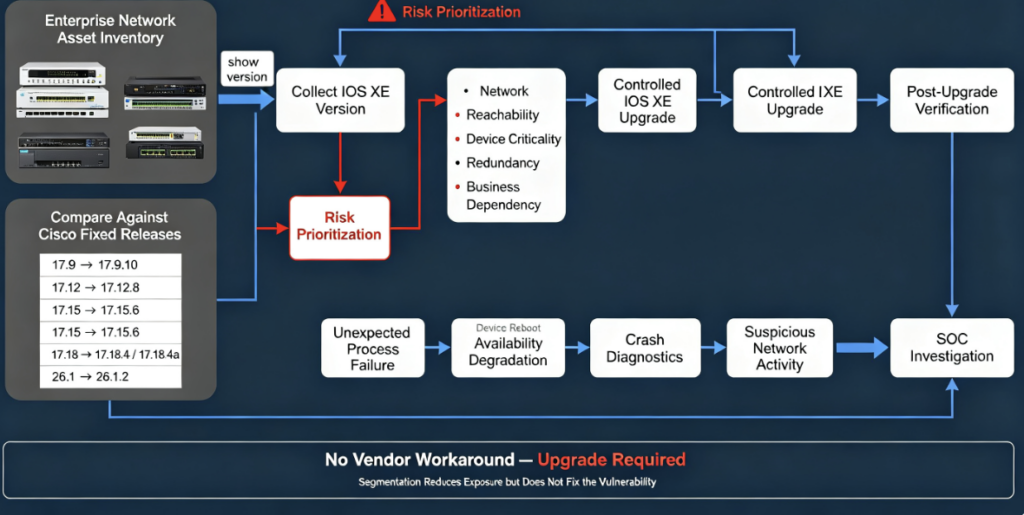
Cisco explicitly recommends upgrading to an appropriate fixed release and states that there are no workarounds that fully address the vulnerabilities. (sec.cloudapps.cisco.com)
For defenders, that makes the remediation decision relatively straightforward:
Inventory
   |
   v
Identify IOS XE release train
   |
   v
Compare against Cisco fixed release
   |
   +---- vulnerable/older ---> schedule upgrade
   |
   +---- fixed/newer --------> verify advisory applicability
Do not treat this table as a universal statement that every numerically higher IOS XE version is automatically appropriate for every hardware platform. Cisco recommends checking hardware, memory, configuration, software compatibility, and applicable advisories when planning upgrades. (sec.cloudapps.cisco.com)
How to Check an IOS XE Version Safely
There is little justification for attempting destructive vulnerability reproduction on production routers or switches when the vendor already provides a version-based remediation path.
Start with inventory.
On Cisco devices, the standard command:
show version
displays system and software-version information. Cisco documents show version as an EXEC command for obtaining information including the software version and boot image. (Cisco)
A simplified assessment workflow is:
Device# show version
Extract the IOS XE release and compare it against the appropriate Cisco fixed-release branch.
例えば、こうだ:
17.9.x  -> target at least 17.9.10
17.12.x -> target at least 17.12.8
17.15.x -> target at least 17.15.6
17.18.x -> target 17.18.4 / 17.18.4a or appropriate later fixed release
26.1.x  -> target at least 26.1.2
Cisco also provides its IOS Software Checker for assessing whether particular IOS and IOS XE releases are affected by published Cisco security advisories and identifying first-fixed releases. (Cisco)
For larger environments, this process should be automated against asset inventory rather than performed device by device.
A Safe Exposure-Validation Model
Because Cisco has not published the low-level trigger for CVE-2026-20268, vulnerability validation should distinguish between exposure validation そして exploit validation.
Exposure validation asks:
Does this asset run IOS XE?
        |
        v
Which release?
        |
        v
Does Cisco identify that branch
as requiring the August fix?
        |
        v
Has the fixed release been installed?
Exploit validation asks something much more invasive:
Can attacker-controlled network input
trigger the memory corruption condition?
At present, defenders generally do not need the second question answered before patching.
The vendor has already established the vulnerability class, remote attack characteristics, affected software scope, and fixed releases. (sec.cloudapps.cisco.com)
Attempting to construct malformed packets based only on a CWE classification risks testing the wrong subsystem while creating unnecessary instability.
What Security Scanners Should and Should Not Claim
CVE-2026-20268 creates an interesting problem for scanner vendors.
A scanner can reliably report something like:
Cisco IOS XE detected
Version: 17.12.x
Vendor first fixed version: 17.12.8
Observed version predates fixed release
Potential exposure: CVE-2026-20268 / August 2026 hardening advisory
That is evidence-based.
A scanner should be much more cautious about claiming:
CVE-2026-20268 successfully exploited
unless it has an actual protocol-specific test validated against Cisco’s underlying vulnerable behavior.
Likewise, merely sending a malformed packet and observing a timeout is not sufficient proof.
A timeout could represent:
- packet filtering;
- rate limiting;
- service behavior;
- transient packet loss;
- an unrelated process failure;
- control-plane protection;
- or actual vulnerability triggering.
High-quality validation needs causality, not correlation.
Detection Is More Difficult Than Version Assessment
Traditional vulnerabilities often provide a convenient detection signature:
specific service
+
specific request
+
specific parameter
+
known malformed payload
CVE-2026-20268 currently does not offer that level of public detail.
Cisco’s bundled advisory links Snort rules 66897–66898 and 66891–66896, but the public advisory does not provide a one-to-one mapping establishing that a particular rule corresponds specifically to CVE-2026-20268 rather than another issue within the overall hardening release. (sec.cloudapps.cisco.com)
Defenders should therefore avoid describing those rule numbers as dedicated CVE-2026-20268 signatures unless Cisco provides more specific mapping.
A practical detection strategy should instead combine:
Asset vulnerability state
          +
Device/process instability
          +
Unexpected network activity
          +
Infrastructure telemetry
          |
          v
Contextual investigation
Version state remains the strongest initial exposure signal.
What SOC Teams Should Monitor
The published CVSS impact is availability rather than confidentiality or integrity. Therefore, monitoring should emphasize operational anomalies around vulnerable network infrastructure.
Security teams can prioritize investigation of:
Unexpected IOS XE process failures. Repeated or unexplained service instability on an affected software release deserves investigation.
Unexpected device reboots or availability interruptions. These are not automatically evidence of CVE-2026-20268, but they become more interesting when they coincide with abnormal inbound network activity.
Crash artifacts and diagnostic output. Where available, device-generated diagnostics can help distinguish software defects from connectivity failures.
Repeated malformed or unusual traffic preceding instability. Correlation between an external source and recurring process failures is substantially stronger evidence than either event independently.
Clusters of similar failures across devices. Identical events across multiple IOS XE devices may indicate deliberate probing rather than isolated hardware or operational faults.
None of those signals uniquely identifies CVE-2026-20268.
They are investigation pivots appropriate to a remotely reachable vulnerability whose known impact is availability.
Internet Exposure Should Influence Priority, but Not Define Vulnerability
It is tempting to search only for internet-facing IOS XE devices.
That would be incomplete.
The CVSS attack vector is network based, but “network” does not necessarily mean “public Internet.” (NVD)
An attacker who compromises:
- a branch workstation,
- a VPN account,
- a Wi-Fi client,
- an internal server,
- a vendor connection,
- or another foothold
may obtain network paths unavailable from the public Internet.
Therefore, a sensible prioritization model looks more like:
Patch priority
=
vendor severity
× reachability
× device criticality
× redundancy
× attacker proximity
× business dependency
A core infrastructure device with no direct Internet exposure may still deserve faster remediation than an isolated internet-facing lab device.
Why Network Segmentation Is Still Useful
Cisco says there is no workaround for the underlying vulnerabilities. (sec.cloudapps.cisco.com)
That means segmentation should not be described as a fix.
However, reducing unnecessary network reachability remains useful as a compensating control.
If a management or infrastructure service does not need to accept traffic from arbitrary user networks, guest networks, partner networks, or the public Internet, security architecture should not expose it unnecessarily.
The difference is important:
アップグレードだ: remediation.
Reachability reduction: risk reduction.
Monitoring: detection.
These controls complement each other but are not interchangeable.
Is CVE-2026-20268 Being Exploited in the Wild?
Cisco states that the vulnerabilities from the August 2026 hardening advisory were discovered during internal testing and were not known to be actively exploited when the advisory was published. Cisco PSIRT further states that it was not aware of public announcements or malicious use of the vulnerabilities described in the advisory. (sec.cloudapps.cisco.com)
NVD’s August 2026 record also contains a CISA SSVC entry marking exploitation as "なし" at the time of that assessment. (NVD)
This should be interpreted precisely.
It means:
There is currently no vendor-confirmed evidence of malicious exploitation reported in the cited sources.
It does ない mean:
Exploitation is impossible.
Nor does it mean defenders should wait for exploitation before patching.
A vulnerability characterized as network reachable, low complexity, unauthenticated, and requiring no user interaction already provides enough reason to prioritize remediation on strategically important devices. (NVD)
There Is No Publicly Documented Exploit Chain
As of the current disclosure, Cisco has not published enough technical detail to construct a responsible packet-level exploit chain for CVE-2026-20268.
The following details are not established by Cisco’s advisory:
Exact affected protocol:       undisclosed
Exact message type:            undisclosed
Exact parser/function:         undisclosed
Exact malformed field:         undisclosed
Required packet sequence:      undisclosed
Memory region corrupted:       undisclosed
Stack vs heap:                 undisclosed
Control-flow hijack:           not established
Arbitrary code execution:      not established
This absence is itself valuable information.
Good vulnerability research distinguishes unknown from false.
例えば、こうだ:
“RCE is impossible” would exceed the evidence.
But:
“RCE has not been established by the currently available vendor disclosure” accurately reflects the evidence.
The second formulation is preferable.
A Conceptual Attack Path Without Inventing Details
Based strictly on the public CVSS characteristics and vulnerability class, the maximum responsible conceptual model is:
┌───────────────────────┐
│ Unauthenticated       │
│ Network Attacker      │
└──────────┬────────────┘
           │
           │ Network-reachable input
           │ AV:N / PR:N / UI:N
           v
┌───────────────────────┐
│ IOS XE Processing     │
│ Path                  │
│ Exact path undisclosed│
└──────────┬────────────┘
           │
           │ Improper buffer-boundary
           │ operation
           v
┌───────────────────────┐
│ CWE-119 Memory        │
│ Corruption Condition  │
└──────────┬────────────┘
           │
           │ Published impact
           v
┌───────────────────────┐
│ High Availability     │
│ Impact                │
└───────────────────────┘
Everything beyond that boundary requires additional evidence.
This is also a useful rule for AI-assisted vulnerability research. Large language models are very good at filling missing causal steps with plausible-looking protocol names, parser functions, packet structures, and exploit mechanics. In CVE research, plausibility is not evidence.
Why Cisco’s Disclosure Method Matters
CVE-2026-20268 is also notable from a vulnerability-management perspective.
Cisco says these vulnerabilities were found using existing internal security testing processes as well as frontier AI models. (sec.cloudapps.cisco.com)
The result is a disclosure structure that reflects the possibility of discovering many related security weaknesses during large-scale product review.
That creates an operational challenge.
Traditional vulnerability databases work well when a record maps neatly onto:
one bug
→ one affected feature
→ one exploit condition
→ one patch
CVE-2026-20268 instead resembles:
Internal review
      |
      v
Multiple memory-safety findings
      |
      v
Common CWE-119 category
      |
      v
One grouped CVE
      |
      v
One highest severity score
Security teams therefore need to read the vendor advisory rather than treating the CVE number as a complete vulnerability specification.
Why the NVD Version List Needs Careful Interpretation
NVD contains CPE-related information for IOS XE versions, but Cisco places an important qualification on its own advisory: PSIRT validates the affected and fixed release information documented in Cisco’s advisory. (sec.cloudapps.cisco.com)
For remediation decisions, Cisco’s fixed-release table should therefore be treated as the authoritative operational reference rather than attempting to infer support or vulnerability state solely from an automatically generated CPE range.
This is especially important for long-lived network products where release trains, maintenance releases, platform support, and end-of-life status can be complicated.
Patch Prioritization
Organizations with large Cisco estates should not necessarily patch every device simultaneously.
A risk-based rollout can prioritize devices that combine multiple factors:
| ファクター | Higher Priority Condition |
|---|---|
| Software | Release below Cisco’s fixed version |
| Reachability | Broad network reachability |
| Authentication boundary | Reachable before authentication |
| Device role | Core/aggregation/critical infrastructure |
| Redundancy | Single point of failure |
| User exposure | Reachable from less-trusted segments |
| Operational impact | Outage would affect many systems |
| Existing telemetry | Unexplained instability observed |
Because Cisco states that configuration does not remove exposure for the reviewed IOS XE modes, an organization’s first question should generally be when can this device be safely upgraded?, rather than which feature can we disable? (sec.cloudapps.cisco.com)
Example Enterprise Response Workflow
A mature response could proceed as follows:
1. Asset discovery
        |
        v
2. Collect IOS XE versions
        |
        v
3. Map devices to release train
        |
        v
4. Compare against Cisco fixed releases
        |
        v
5. Add topology and criticality context
        |
        v
6. Prioritize reachable/high-impact devices
        |
        v
7. Test upgrade on representative hardware
        |
        v
8. Deploy fixed IOS XE releases
        |
        v
9. Verify post-upgrade version
        |
        v
10. Review historical instability and telemetry
Cisco itself recommends ensuring that devices have sufficient memory and that existing hardware and software configurations remain supported before an upgrade. (sec.cloudapps.cisco.com)
That matters particularly for networking infrastructure, where emergency patching without platform validation can itself create availability problems.
Do Not Confuse CVE-2026-20268 With the Other August IOS XE CVEs
The bundled disclosure creates another potential source of misinformation.
CVE-2026-20268 should not be conflated with:
CVE-2026-20267, the improper-access-control grouping;
CVE-2026-20269, the resource-lifetime grouping;
CVE-2026-20270, the incorrect-calculation grouping;
CVE-2026-20271, the control-flow-management grouping;
CVE-2026-20272, the injection grouping with the bundle’s highest score of 9.8;
または CVE-2026-20273, the input-validation grouping.
Cisco treats them as separate vulnerability classes even though they were published in the same hardening advisory. (sec.cloudapps.cisco.com)
For vulnerability databases and remediation dashboards, preserving that distinction prevents misleading severity and exploitability statements.
Common Misconceptions About CVE-2026-20268
“CVE-2026-20268 is a critical 9.8 RCE”
Incorrect based on currently published evidence.
CVE-2026-20268 is scored 8.6 High. The entire Cisco advisory reaches 9.8 because another CVE category in the bundle has a 9.8 maximum score. (sec.cloudapps.cisco.com)
No RCE impact has been established for CVE-2026-20268.
“It is definitely a stack-based buffer overflow”
Not established.
Cisco maps the vulnerabilities to CWE-119 and says the grouping covers buffer overflows and out-of-bounds writes. It does not publicly specify stack versus heap for the relevant underlying bugs. (Cisco)
“Only devices with a specific optional feature enabled are vulnerable”
Cisco says the reviewed IOS XE vulnerabilities affect autonomous or controller mode regardless of device configuration. (sec.cloudapps.cisco.com)
“A firewall rule completely fixes it”
No.
Reducing attack surface may be valuable, but Cisco states that no workaround addresses these vulnerabilities. The vendor’s remediation is upgrading to fixed software. (Cisco)
“There is already confirmed active exploitation”
Cisco says it is not aware of malicious use or public announcements concerning the vulnerabilities described in the advisory. (sec.cloudapps.cisco.com)
“No active exploitation means patching can wait”
That is a risky interpretation.
The vulnerability carries network reachability, low complexity, no privilege requirement, no user interaction, and high availability impact according to Cisco’s CVSS assessment. (NVD)
What Defenders Should Do Now
The most defensible response to CVE-2026-20268 is relatively simple.
First, identify devices running Cisco IOS XE.
Second, collect the exact IOS XE software release rather than relying only on hardware model information.
Third, map each device against Cisco’s current advisory.
Fourth, prioritize critical and broadly reachable infrastructure.
Fifth, upgrade affected systems to Cisco’s applicable fixed release.
Sixth, retain monitoring around abnormal crashes and network-triggered instability even after patching so that historical activity can be investigated if additional technical details become public.
Cisco’s published first-fixed versions remain:
17.9  -> 17.9.10
17.12 -> 17.12.8
17.15 -> 17.15.6
17.18 -> 17.18.4 / 17.18.4a
26.1  -> 26.1.2
There is no vendor-supported workaround that replaces the software update. (Cisco)
CVE-2026-20268 and the Broader Memory-Safety Problem
CVE-2026-20268 illustrates why memory corruption remains consequential even when a public exploit is unavailable.
Network operating systems continuously process structured and semi-structured inputs originating outside individual code components. Length fields, protocol messages, control packets, management requests, serialized objects, and other input eventually interact with parsers and memory-management logic.
A single unsafe assumption can produce a chain such as:
Untrusted length or index
        ↓
Incorrect bounds decision
        ↓
Out-of-range memory operation
        ↓
Memory corruption
        ↓
Process instability
        ↓
Infrastructure availability impact
CWE-119 exists specifically to represent software that accesses memory outside an intended buffer boundary. (CWE)
What CVE-2026-20268 does ない tell us is which concrete instance of that general pattern exists in each underlying IOS XE bug.
That information gap should influence testing methodology.
Why Evidence-Based Validation Matters
CVE reporting increasingly competes for attention. A headline containing “Cisco,” “memory corruption,” and “unauthenticated remote attacker” naturally creates pressure to describe an impressive exploitation chain.
Security engineering requires the opposite instinct.
Start from verified facts:
Verified:
Cisco IOS XE
CWE-119
buffer overflow / OOB-write class
network reachable
low complexity
no privileges
no user interaction
availability high
CVSS 8.6
no workaround
fixed releases available
no known malicious use reported by Cisco
Then separate unknowns:
Unknown:
exact protocol
exact endpoint
exact packet
exact memory layout
exact underlying functions
exact crash behavior
reliable exploit primitive
arbitrary code execution
This discipline matters for both human researchers and AI security agents.
An AI system that converts every unknown field into the statistically most plausible answer may generate a convincing vulnerability report while actually reducing factual accuracy.
The correct security workflow is:
Evidence
   ↓
Hypothesis
   ↓
Controlled validation
   ↓
Reproducible evidence
   ↓
Conclusion
not:
Incomplete advisory
   ↓
Plausible story
   ↓
Confident conclusion
Final Assessment
CVE-2026-20268 is a significant Cisco IOS XE memory-safety issue, but its significance should be described precisely.
Cisco associates the CVE with multiple internally discovered vulnerabilities falling under CWE-119, covering memory-buffer boundary failures such as buffer overflows and out-of-bounds writes. The highest underlying severity is CVSS 8.6 High, with a network attack vector, low complexity, no privileges required, no user interaction, changed scope, and high availability impact. (sec.cloudapps.cisco.com)
The evidence does ない currently establish arbitrary code execution.
Cisco has not publicly disclosed the precise vulnerable service, protocol, parser, packet format, function, or corruption primitive. The company also reports no known malicious exploitation or public announcements involving the disclosed vulnerabilities at the time covered by its advisory. (sec.cloudapps.cisco.com)
That uncertainty should not delay remediation.
Cisco says the vulnerabilities affect the evaluated IOS XE software in autonomous or controller mode regardless of configuration, provides no workaround, and recommends upgrading to fixed software. The first fixed releases are IOS XE 17.9.10, 17.12.8, 17.15.6, 17.18.4/17.18.4a, and 26.1.2. (Cisco)
For most organizations, the correct response is therefore not speculative exploit development. It is accurate asset discovery, version-based exposure validation, topology-aware prioritization, controlled upgrading, and monitoring for unexplained infrastructure instability.
CVE-2026-20268 is a useful reminder that memory corruption risk does not need to become confirmed RCE before it matters. On software responsible for enterprise network availability, a remotely reachable memory-safety failure with no authentication requirement is already a vulnerability worth fixing quickly. (NVD)


 Japanese
  English
  German
  French
  Spanish
  Portuguese
  Korean
  Hindi
Hindi  Arabic
  Turkish
  Hebrew