
CVE-2026-71290 is an improper TLS hostname verification vulnerability affecting the asynchronous transport of Apache HttpComponents Client. The flaw can allow a network-positioned attacker to impersonate an HTTPS server even when the certificate presented by the attacker belongs to a completely different domain.
The vulnerability affects the Maven package org.apache.httpcomponents.client5:httpclient5 from 5.4-alpha through 5.6.3. Apache recommends upgrading to 5.6.4 or later. The classic, blocking HttpClient implementation is explicitly not affected. Apache publicly categorized the vulnerability as Important, while CISA’s ADP enrichment assigned it a CVSS 3.1 score of 9.1 Critical, using the vector CVSS:3.1/AV:N/AC:L/PR:N/UI:N/S:U/C:H/I:H/A:N. As of the latest NVD record, NIST had not yet published its own independent CVSS assessment. (NVD)
What makes CVE-2026-71290 particularly interesting is that TLS itself does not necessarily fail. The certificate can still be cryptographically valid. The certificate chain can still terminate at a trusted certificate authority. The TLS connection can still be encrypted.
What fails is one of the most important identity checks in HTTPS:
Does this certificate actually belong to the hostname the client intended to contact?
That distinction turns a seemingly small implementation-order bug into a potentially serious man-in-the-middle vulnerability.
CVE-2026-71290 at a Glance
| フィールド | 詳細 |
|---|---|
| CVE | CVE-2026-71290 |
| 製品 | Apache HttpComponents Client |
| パッケージ | org.apache.httpcomponents.client5:httpclient5 |
| 脆弱性 | TLS hostname verification bypass |
| CWE | CWE-295 Improper Certificate Validation |
| Affected transport | Async HttpClient |
| Classic HttpClient | Not affected |
| 影響を受けるバージョン | 5.4-alpha through 5.6.3 |
| Fixed version | 5.6.4 |
| Attack requirement | Ability to intercept or modify client-server traffic |
| Potential impact | Server impersonation, confidentiality and integrity compromise |
| CISA ADP CVSS 3.1 | 9.1 Critical |
| Apache severity | Important |
Apache HttpComponents Client 5.6.4 was released on August 10, 2026, with Apache’s release announcement specifically noting that the maintenance release fixed SSL parameter application in the async TLS upgrade strategy. CVE-2026-71290 was published shortly afterward, on August 11. (Apache HttpComponents)
That short release note turns out to describe the technical heart of the vulnerability almost exactly.
Why TLS Hostname Verification Matters
To understand CVE-2026-71290, it is necessary to separate two checks that developers often mentally group together as “certificate validation.”
Imagine an application is connecting to:
https://api.example-bank.com
During the TLS handshake, the server presents an X.509 certificate.
The client typically needs to answer at least two different questions.
The first question is whether the certificate is cryptographically trustworthy.
Is it signed by a certificate authority trusted by the JVM? Is the signature valid? Is the certificate still within its validity period? Can a valid chain be constructed to an accepted root certificate?
The second question is whether that trusted certificate actually represents:
api.example-bank.com
That is hostname verification.
A certificate might be completely valid from the perspective of the PKI while belonging to:
attacker-example.com
If the client validates only the certificate chain but fails to compare the requested hostname with the certificate’s Subject Alternative Names or other applicable identity information, HTTPS authentication has effectively been broken.
Encryption alone is not enough.
You can have an encrypted TLS connection directly to the attacker.
A Simple Example of the Security Failure
Suppose a backend service intends to call:
https://payments.example.com
Under correct behavior, the server certificate might contain:
Subject Alternative Name:
DNS:payments.example.com
Now imagine an attacker controls:
evil-example.net
and owns a perfectly valid publicly trusted TLS certificate containing:
Subject Alternative Name:
DNS:evil-example.net
The certificate itself is valid.
The CA signature is valid.
The certificate has not expired.
The attacker possesses the associated private key.
But it is obviously not a certificate for payments.example.com.
A correctly implemented HTTPS client must reject it.
CVE-2026-71290 creates circumstances in which Apache HttpComponents Client’s asynchronous TLS implementation could fail to perform that hostname comparison when relying on its built-in JSSE verification policy.
Apache’s advisory describes precisely this scenario: an attacker able to intercept and modify traffic can impersonate the intended server by presenting a valid certificate for another domain. (SecLists)
HostnameVerificationPolicy Explained
Apache HttpClient exposes HostnameVerificationPolicy, which defines where hostname verification occurs.
Apache’s own API documentation describes three modes. BUILTIN delegates hostname verification to the Java Secure Socket Extension, generally during the TLS handshake. CLIENT lets HttpClient perform hostname verification after the handshake. BOTH uses the JSSE verification mechanism and HttpClient’s own post-handshake verification. (Apache HttpComponents)
Conceptually, the three modes work like this:
| 方針 | Verification mechanism |
|---|---|
BUILTIN | JSSE endpoint identification |
CLIENT | HttpClient HostnameVerifier |
BOTH | JSSE verification plus HttpClient verification |
The important one for CVE-2026-71290 is:
HostnameVerificationPolicy.BUILTIN
For built-in HTTPS endpoint identification to happen, the appropriate configuration must reach the SSLEngine before the TLS handshake.
Internally, this involves an SSLParameters configuration containing an HTTPS endpoint-identification algorithm.
Conceptually:
sslParameters.setEndpointIdentificationAlgorithm("HTTPS");
sslEngine.setSSLParameters(sslParameters);
Once that configuration is attached to the engine, JSSE knows that the peer certificate must be verified against the intended HTTPS hostname.
The vulnerability came down to those operations occurring in the wrong order.
The Actual Root Cause of CVE-2026-71290
This is where CVE-2026-71290 becomes much more interesting than the relatively short advisory suggests.
The Apache source code allows us to see what changed between HttpComponents Client 5.6.3 and 5.6.4.
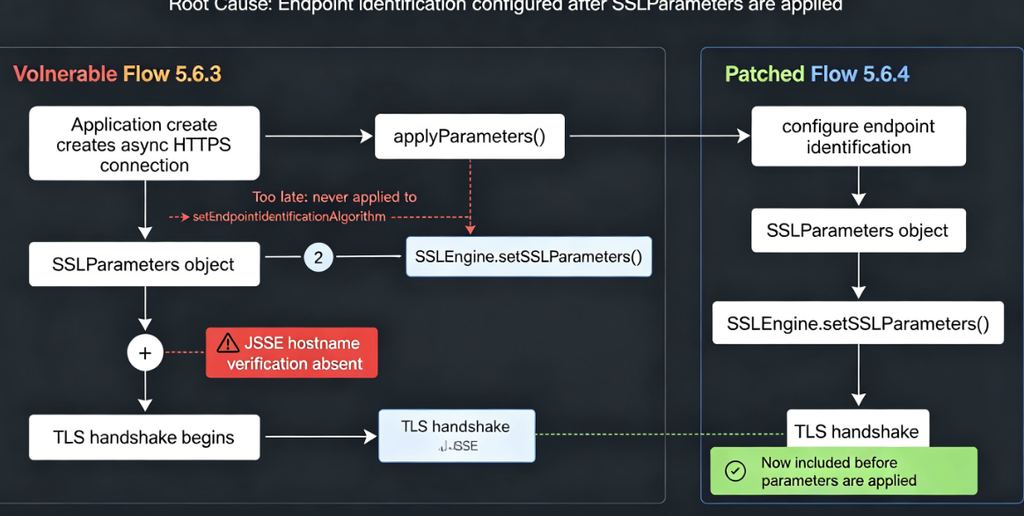
In the vulnerable 5.6.3 async TLS path, the logic effectively operated in this order:
applyParameters(
    sslEngine,
    sslParameters,
    H2TlsSupport.selectApplicationProtocols(versionPolicy)
);

if (hostnameVerificationPolicy == HostnameVerificationPolicy.BUILTIN
        || hostnameVerificationPolicy == HostnameVerificationPolicy.BOTH) {
    sslParameters.setEndpointIdentificationAlgorithm(
        URIScheme.HTTPS.id
    );
}
The problem is subtle.
applyParameters() is not merely modifying the local SSLParameters オブジェクトがある。
内部 DefaultClientTlsStrategy, it eventually does this:
void applyParameters(
        final SSLEngine sslEngine,
        final SSLParameters sslParameters,
        final String[] appProtocols) {

    sslParameters.setApplicationProtocols(appProtocols);
    sslEngine.setSSLParameters(sslParameters);
}
In other words, HttpClient 5.6.3 first applied the current parameters to the SSLEngine.
Only afterward did it configure:
setEndpointIdentificationAlgorithm("https")
on the local SSLParameters インスタンスだ。
But those modified parameters were not subsequently applied to the engine.
The code therefore looked like it enabled built-in hostname verification, while the actual SSLEngine used for the handshake had already been configured without it. The 5.6.3 source shows applyParameters() occurring before setEndpointIdentificationAlgorithm(), while the TLS strategy’s implementation shows that applyParameters() is the point where sslEngine.setSSLParameters() occurs. (ギットハブ)
This explains Apache’s description that:
HostnameVerificationPolicy#BUILTIN
had “no effect” with the asynchronous version of HttpClient.
The security control was present in the source code.
It was simply activated too late.
How Apache Fixed the Bug in HttpClient 5.6.4
HttpClient 5.6.4 makes a tiny but security-critical change to the ordering.
The patched path effectively becomes:
if (hostnameVerificationPolicy == HostnameVerificationPolicy.BUILTIN
        || hostnameVerificationPolicy == HostnameVerificationPolicy.BOTH) {

    sslParameters.setEndpointIdentificationAlgorithm(
        URIScheme.HTTPS.id
    );
}

applyParameters(
    sslEngine,
    sslParameters,
    H2TlsSupport.selectApplicationProtocols(versionPolicy)
);
Now endpoint identification is enabled first.
Only then are the completed SSLParameters applied to the SSLEngine.
Apache’s 5.6.4 source clearly shows the endpoint-identification configuration at lines 1169-1173 followed by applyParameters() at line 1174. In 5.6.3, applyParameters() appeared first and endpoint identification was configured afterward. (ギットハブ)
The patch is therefore conceptually tiny:
- apply SSLParameters to SSLEngine
- enable HTTPS endpoint identification

+ enable HTTPS endpoint identification
+ apply SSLParameters to SSLEngine
Yet the security consequence is enormous.
It is a classic example of why TLS security bugs often occur not because cryptography has been broken, but because state has been configured at the wrong stage of the protocol lifecycle.
Why This Bug Can Be Difficult to Notice
CVE-2026-71290 does not necessarily cause TLS errors.
That is exactly the problem.
Most obvious TLS configuration defects fail loudly. The application receives an SSLHandshakeException, users complain that the API is unreachable, developers inspect certificates, and the configuration gets fixed.
CVE-2026-71290 can fail silently in the opposite direction.
A valid certificate chain continues to succeed.
HTTPS requests continue to work.
The application still sees an encrypted connection.
Monitoring still sees TCP port 443.
The developer may have explicitly selected BUILTIN hostname verification and reasonably assume the JVM is checking the hostname.
Nothing in the ordinary successful request flow necessarily indicates that endpoint identification has been skipped.
This kind of failure is significantly more dangerous than a straightforward TLS outage because the system appears healthy while one of its authentication properties is missing.
Why the Async Client Is Affected but the Classic Client Is Not
Apache explicitly states that the classic version of HttpClient is not affected. (SecLists)
This distinction matters because Apache HttpComponents supports multiple transport architectures.
The async implementation works around non-blocking TLS abstractions including SSLEngine and asynchronous connection management. The classic path uses a different socket-oriented TLS flow.
The source shows that the classic socket handshake applies the endpoint-identification setting before calling:
upgradedSocket.setSSLParameters(sslParameters);
and before:
upgradedSocket.startHandshake();
The affected async path, by contrast, previously transferred the parameters into the SSLEngine too early. (ギットハブ)
That explains why treating “HttpClient 5.x” as a single implementation can lead to incorrect vulnerability assessments.
Two applications can depend on exactly the same Maven package and version while having materially different exposure depending on whether they construct a classic or asynchronous HTTP client.
Identifying Async HttpClient Usage
A dependency scanner telling you that httpclient5:5.6.3 exists is only the first step.
Developers should determine whether their application actually uses the asynchronous transport.
Common code paths may reference classes such as:
CloseableHttpAsyncClient
or builders such as:
HttpAsyncClients
Applications may also construct asynchronous connection managers using APIs such as:
PoolingAsyncClientConnectionManagerBuilder
Apache documents that the async connection manager builder accepts a TlsStrategy, while ClientTlsStrategyBuilder can create separate async and classic TLS strategies through buildAsync() そして buildClassic(). (Apache HttpComponents)
Frameworks can complicate this assessment because HttpClient may be buried several dependency layers below the application.
A developer may never instantiate CloseableHttpAsyncClient directly.
An SDK, API client, service framework, observability component, cloud integration or internal networking abstraction may do it instead.
That is why both dependency analysis and runtime path analysis matter.
Why HttpClient 5.6 Deserves Particular Attention
The vulnerability technically affects versions beginning with 5.4-alpha, according to Apache’s CVE record.
But the 5.6 release line deserves special attention because Apache changed its hostname-verification behavior.
Apache’s 5.6 release notes state that HttpClient switched to BUILTIN hostname verification by default, delegating host verification to the JSSE security manager. (ギットハブ)
That means an application might not have explicitly written:
.setHostVerificationPolicy(
    HostnameVerificationPolicy.BUILTIN
)
and could still encounter the affected behavior depending on the construction path used.
The current Apache source also shows default async TLS strategies being created with:
HostnameVerificationPolicy.BUILTIN
which underlines why this implementation detail is security relevant. (ギットハブ)
The safest response is therefore not to assume that custom TLS code is required for exposure.
If an application runs an affected HttpClient version and uses the asynchronous transport, the dependency deserves immediate investigation.
What an Attacker Needs to Exploit CVE-2026-71290
CVE-2026-71290 should not be interpreted as an ordinary remote server vulnerability where anyone on the Internet can send a malicious HTTP request and compromise an application.
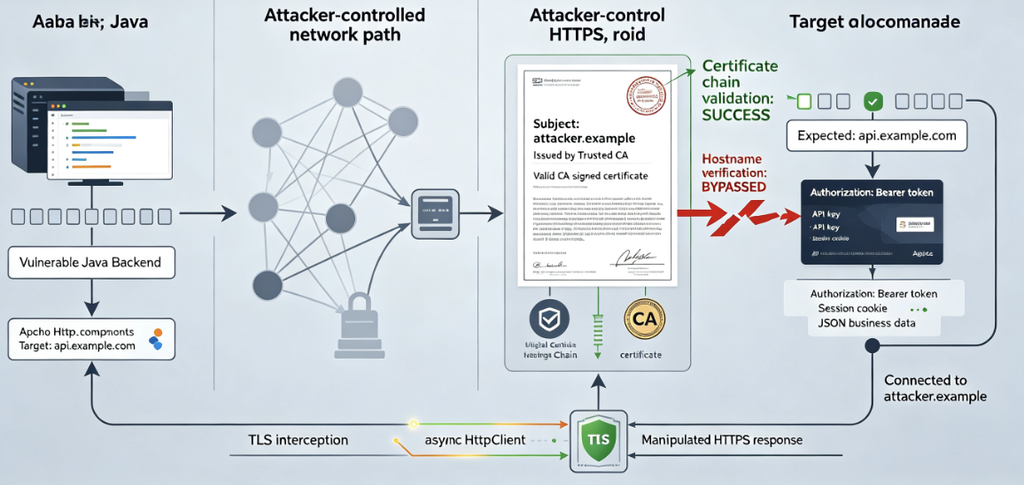
The attacker needs influence over the connection between the vulnerable HttpClient and the legitimate HTTPS server.
Conceptually:
Application
     |
     | HTTPS request intended for api.example.com
     |
     v
Attacker-controlled network position
     |
     | presents trusted certificate for attacker.example
     |
     v
Vulnerable async HttpClient
The attacker could potentially gain that position through a compromised or malicious network device, hostile proxy infrastructure, certain routing attacks, a compromised gateway, DNS manipulation combined with traffic redirection, or another mechanism that causes traffic intended for the legitimate service to reach an attacker-controlled TLS endpoint.
The attacker’s certificate does not need to be valid for the victim hostname under the vulnerable condition.
That is the entire point of the bypass.
It still generally needs to be accepted by the client’s certificate trust mechanism.
For an Internet-facing Java application using the normal public CA trust store, an attacker who controls their own domain can normally obtain a perfectly legitimate certificate for that domain.
Without hostname verification, that certificate can become useful for impersonating an unrelated target once network interception has been achieved.
A Realistic API Attack Scenario
Consider a payment service communicating with:
https://api.payment-provider.example
The application sends:
POST /v1/payment HTTP/1.1
Host: api.payment-provider.example
Authorization: Bearer eyJ...
Content-Type: application/json

{
  "account": "customer-18493",
  "amount": 5000
}
Under normal TLS validation, an attacker presenting a certificate for:
proxy-attacker.example
would fail hostname verification.
With an affected async HttpClient relying on the broken built-in verification path, the trusted but mismatched certificate may be accepted.
The attacker now terminates TLS.
The application believes it is communicating securely with the payment provider.
From the application’s perspective, the connection is encrypted and the certificate is trusted.
From the attacker’s perspective, however, the authorization token and request contents are visible.
The attacker may also return a fabricated response such as:
{
  "status": "approved",
  "transaction_id": "fake-92831"
}
The vulnerability therefore threatens both confidentiality and integrity, matching the high confidentiality and integrity impact assigned in CISA’s CVSS enrichment. (NVD)
Why API Tokens Make This Especially Dangerous
Modern service architectures frequently use HTTPS as the security boundary around highly privileged machine credentials.
A server-to-server request might contain:
Authorization: Bearer ...
AWS-style authorization headers, OAuth access tokens, API keys, session cookies, signed business payloads, database credentials transported through management APIs, webhook secrets, or internal identity tokens.
Developers sometimes assume these credentials are safe because they are “only transmitted through HTTPS.”
That assumption depends on HTTPS authenticating the remote endpoint correctly.
A hostname verification bypass undermines exactly that guarantee.
The attacker does not necessarily need to compromise the application first.
The application may voluntarily send its secret to the attacker because it believes the attacker’s TLS endpoint represents the intended hostname.
Response Manipulation Can Be as Serious as Credential Theft
Credential theft is the most obvious impact, but server impersonation also gives attackers control over responses.
That can be critical when an application downloads configuration or executable content.
Consider clients that retrieve:
software update metadata
plugin manifests
configuration files
feature flags
model configuration
certificate bundles
deployment artifacts
remote policy documents
service discovery information
A manipulated HTTPS response could influence subsequent application behavior.
Whether that leads to code execution depends entirely on how the consuming application processes the response. CVE-2026-71290 itself should therefore ない automatically be described as a remote code execution vulnerability.
The direct vulnerability is server impersonation caused by failed hostname verification.
RCE may become a downstream consequence only in a specific application whose trusted remote server supplies executable or otherwise security-sensitive data.
That distinction is important when evaluating real-world risk.
CVSS 9.1 Versus Apache Important Severity
Security teams may encounter two different severity labels for CVE-2026-71290.
Apache’s disclosure labels the vulnerability:
Severity: important
CISA ADP, however, supplied the following CVSS 3.1 vector:
CVSS:3.1/AV:N/AC:L/PR:N/UI:N/S:U/C:H/I:H/A:N
which produces a score of:
9.1 Critical
(NVD)
These classifications are not necessarily contradictory.
CVSS attempts to capture technical impact under its metric model.
Operational exploitability depends heavily on whether an attacker can actually position themselves between the vulnerable client and the server.
For a backend system communicating entirely through carefully controlled private networking, the practical probability may differ substantially from that of a desktop application connecting through arbitrary networks.
Likewise, an internal service whose outbound requests contain production API keys may carry far greater business impact than a public-data crawler.
Organizations should therefore combine the CVSS score with architecture-specific analysis rather than treating the number as a complete risk assessment.
How to Check Whether Your Application Is Vulnerable
The first check is the dependency version.
For Maven projects:
mvn dependency:tree \
  -Dincludes=org.apache.httpcomponents.client5:httpclient5
A vulnerable result might look like:
org.apache.httpcomponents.client5:httpclient5:jar:5.6.3
For Gradle, inspect the runtime dependency graph:
./gradlew dependencies --configuration runtimeClasspath
and search for:
org.apache.httpcomponents.client5:httpclient5
Any version from:
5.4-alpha
through:
5.6.3
should be treated as potentially affected until the application’s transport path is understood. Apache’s CNA record identifies precisely that package and version range. (NVD)
Next, inspect whether the application uses the async implementation rather than only the classic client.
Finally, investigate the TLS strategy and hostname verification policy.
If the affected async code path uses BUILTIN, exposure is directly relevant.
Configurations involving BOTH also deserve review because the built-in side of that verification policy participates in the affected code path, although a correctly configured independent HttpClient hostname verifier may provide an additional check.
Upgrading remains preferable to trying to reason about every possible configuration combination.
Safe Validation in a Controlled Test Environment
Security teams can verify the expected behavior without attacking a production system.
Create an isolated HTTPS test service whose certificate chain is trusted by the test JVM but whose certificate hostname deliberately does not match the hostname used in the HTTP request.
For example, the client might request:
https://service.test.internal
while the test certificate contains only:
DNS:other-service.test.internal
The expected secure behavior is failure.
A patched client should reject the handshake or connection because the certificate identity does not match the requested endpoint.
A successful request under circumstances where the only relevant certificate identity belongs to another hostname is a strong sign that hostname verification is not being performed correctly.
The important part of this validation is that certificate trust and hostname identity are deliberately separated. Using an untrusted self-signed certificate alone would test CA trust, not necessarily the hostname-verification behavior involved in CVE-2026-71290.
Fixing CVE-2026-71290
The primary remediation is straightforward:
Upgrade Apache HttpComponents Client to 5.6.4 or later.
For Maven:
<dependency>
    <groupId>org.apache.httpcomponents.client5</groupId>
    <artifactId>httpclient5</artifactId>
    <version>5.6.4</version>
</dependency>
For Gradle:
implementation(
    "org.apache.httpcomponents.client5:httpclient5:5.6.4"
)
Apache’s advisory explicitly recommends version 5.6.4 or newer, and Apache’s project news confirms that 5.6.4 fixes SSL parameter application in the asynchronous TLS upgrade strategy. (SecLists)
Teams should remember that explicitly changing the version in the application may not be enough when dependency-management frameworks override it.
Spring-based stacks, SDK BOMs, corporate dependency platforms and framework-specific version catalogs can pin transitive dependencies.
After upgrading, verify the resolved artifact rather than merely inspecting the version written in pom.xml.
Temporary Mitigation When Immediate Upgrade Is Impossible
Upgrading is much safer than configuration-based workarounds.
However, the architecture of the vulnerability explains why an explicitly configured HttpClient-side hostname verifier can provide an alternative verification path.
Apache documents HostnameVerificationPolicy.CLIENT as performing hostname verification in HttpClient after the TLS handshake rather than delegating it exclusively to JSSE. (Apache HttpComponents)
A carefully controlled configuration could therefore use a real hostname verifier through the client verification path rather than relying on the affected built-in async behavior.
Conceptually:
final TlsStrategy tlsStrategy =
    ClientTlsStrategyBuilder.create()
        .setHostVerificationPolicy(
            HostnameVerificationPolicy.CLIENT
        )
        .setHostnameVerifier(
            new DefaultHostnameVerifier()
        )
        .buildAsync();
The resulting async TLS strategy can be supplied to an async connection manager using the documented setTlsStrategy() API. (Apache HttpComponents)
This should be viewed as a temporary defensive option, not a substitute for patching.
TLS configuration is notoriously easy to weaken accidentally, and application frameworks may introduce additional TLS strategy layers that are not obvious from a single code fragment.
Do Not Replace the Bug With NoopHostnameVerifier
One particularly dangerous response would be to “fix” compatibility problems by disabling hostname verification.
Apache exposes NoopHostnameVerifier for configurations where hostname verification is intentionally suppressed.
That is almost never appropriate for production Internet traffic.
Developers sometimes reach for no-op verification when dealing with private PKI, staging systems, self-signed development certificates or internal hostnames.
But certificate trust problems and hostname identity problems should be solved independently.
If a private service uses an internal CA, install the correct CA trust.
If the certificate lacks the correct Subject Alternative Name, issue a correct certificate.
Turning hostname verification off converts a certificate configuration problem into a security vulnerability.
CVE-2026-71290 demonstrates exactly why hostname identity cannot be treated as an optional cosmetic property of TLS.
Dependency Scanning Alone Is Not Enough
Software composition analysis will be valuable for locating affected versions, but CVE-2026-71290 illustrates a broader limitation of version-based vulnerability management.
Imagine two services:
Service A
httpclient5 5.6.3
Classic HttpClient only
and:
Service B
httpclient5 5.6.3
Async HttpClient
BUILTIN hostname verification
Both produce the same SCA finding.
Their exposure is not the same.
Apache explicitly says the classic client is unaffected.
A mature response therefore combines dependency inventory with execution-path analysis.
This is particularly important in large Java environments where HttpClient may be wrapped by frameworks several layers away from business code.
Transitive Dependencies Are a Major Concern
Many applications do not declare Apache HttpComponents Client directly.
A software development kit may depend on it.
That SDK may be imported by a framework.
The framework may be imported by the application.
The final runtime can therefore contain a vulnerable httpclient5 even though developers never typed “Apache HttpClient” anywhere in their source.
SBOM and dependency graph tooling should identify the actual resolved version.
If the vulnerable package is transitive, teams can typically override the dependency to a patched release, assuming compatibility has been validated.
The official affected package identifier is useful here:
org.apache.httpcomponents.client5:httpclient5
Using that exact coordinate prevents confusion with older Apache HttpClient 4.x packages or unrelated HTTP libraries. (NVD)
Why CWE-295 Fits the Vulnerability
Apache maps CVE-2026-71290 to:
CWE-295: Improper Certificate Validation
(NVD)
The classification is appropriate even though the certificate’s cryptographic validity is not necessarily the problem.
Certificate validation in an HTTPS context is about more than verifying a CA signature.
A certificate authenticates an identity.
If an implementation accepts a trusted certificate for attacker.example while it is trying to authenticate api.example.com, certificate authentication has failed.
This is why security documentation often distinguishes between “trust validation” and “endpoint identification,” while vulnerability databases may classify both under broader certificate-validation weaknesses.
CVE-2026-71290 Is Not a Broken-CA Vulnerability
The vulnerability does not require the attacker to compromise a certificate authority.
It does not require forging an X.509 signature.
It does not break RSA, ECDSA, TLS 1.2 or TLS 1.3.
It does not allow an attacker to magically obtain a certificate for the victim’s domain.
The attacker can use a certificate that legitimately belongs to another domain because the affected client may fail to enforce the domain-binding property.
That makes the attack model much more realistic than one requiring CA compromise.
Getting a valid certificate for a domain you control is routine.
Getting control over the victim’s network path is the harder requirement.
Once those two conditions coincide, missing hostname verification can turn an otherwise useless mismatched certificate into an impersonation credential.
Why This Matters in Cloud and Microservice Environments
The traditional mental model for TLS interception focuses heavily on users connecting to websites over hostile Wi-Fi.
CVE-2026-71290 is just as relevant to machine-to-machine traffic.
Modern Java applications make enormous numbers of HTTPS requests to SaaS APIs, cloud control planes, identity services, payment processors, AI model endpoints, object storage platforms and internal microservices.
These calls often happen automatically and continuously.
There is no human browser UI.
There is no red certificate warning.
There is no user who can notice that the page “looks strange.”
The HTTP library itself is the security boundary.
When hostname verification silently disappears, the application may continue exchanging machine credentials and sensitive payloads indefinitely.
Service Meshes and Proxies Do Not Automatically Eliminate the Risk
Some organizations may assume that a service mesh, outbound proxy or TLS inspection appliance eliminates concerns around CVE-2026-71290.
The reality depends on architecture.
If the application terminates TLS directly against an upstream endpoint, vulnerable hostname verification remains relevant.
If a corporate proxy terminates TLS and generates certificates dynamically, then the security boundary changes: the application may trust an internal CA and authenticate certificates generated by that proxy.
A compromised or malicious component possessing credentials under that trusted CA could become particularly powerful if hostname identity checks are also missing.
The key question remains unchanged:
What entity does the application trust to authenticate the remote hostname, and is that authentication actually enforced?
Architecture diagrams are often more useful than vulnerability scores when answering this question.
Testing Should Include Negative TLS Cases
TLS tests often verify only that valid connections succeed.
For security-sensitive HTTP clients, that is insufficient.
A good TLS regression suite should also verify that invalid identities fail.
That includes at least certificate hostname mismatches, untrusted certificate chains, expired certificates and certificates issued for unrelated identities.
CVE-2026-71290 is an excellent example of why negative tests matter.
Normal integration tests against correctly configured servers would almost certainly pass in both vulnerable and patched versions.
The security defect becomes visible only when the server presents a certificate that should be rejected.
Security properties must therefore be tested by intentionally violating their assumptions.
The Bigger Engineering Lesson From CVE-2026-71290
The most instructive aspect of this vulnerability may be how small the actual code defect was.
There was no complicated memory corruption.
No exotic parser confusion.
No race to overwrite a security flag.
No cryptographic weakness.
The difference between vulnerable and fixed behavior was essentially:
configure security property after applying parameters
versus:
configure security property before applying parameters
That ordering controlled whether hostname verification existed at all.
Security-critical state machines are full of these boundaries.
TLS configuration must happen before the handshake.
Authentication metadata must be attached before authorization decisions.
Signature validation must happen before trusted parsing.
Redirect security policies must be applied before credentials are forwarded.
A control that exists in source code but runs after the security decision is often equivalent to a control that does not exist.
What Security Teams Should Prioritize
Organizations running Java workloads should prioritize applications containing org.apache.httpcomponents.client5:httpclient5 versions between 5.4-alpha and 5.6.3 and determine whether those applications use the asynchronous client.
Priority should increase where those clients communicate across untrusted or semi-trusted networks, rely on proxies or complex routing infrastructure, transmit reusable authorization credentials, call financially or operationally sensitive APIs, retrieve security-sensitive configuration, or communicate with external SaaS services.
Apache HttpComponents Client 5.6.4 removes the underlying defect, so patching should generally be faster and more reliable than attempting to prove that every runtime path is unreachable.
Final Assessment
CVE-2026-71290 is a strong example of how HTTPS can remain encrypted while still being insecure.
The vulnerable Apache HttpComponents Client async transport could accept a trusted certificate without correctly binding that certificate to the hostname the application intended to contact.
The flaw affected httpclient5 versions 5.4-alpha through 5.6.3, while the classic HttpClient remained unaffected. Apache fixed the issue in 5.6.4. (NVD)
Source-code comparison makes the root cause unusually clear. In 5.6.3, the async TLS code applied SSLParameters to the SSLEngine before enabling HTTPS endpoint identification. Because the modified parameters were not subsequently reapplied, HostnameVerificationPolicy.BUILTIN could silently fail to perform its intended hostname check. HttpClient 5.6.4 reverses that sequence: endpoint identification is configured first, and the completed parameters are then applied to the TLS engine. (ギットハブ)
For defenders, the remediation is simple: upgrade to Apache HttpComponents Client 5.6.4 or later, verify the resolved runtime dependency, and pay particular attention to asynchronous HttpClient usage.
The broader lesson is equally important. A valid certificate is not enough. A trusted certificate is not enough. An encrypted TLS session is not enough.
HTTPS is secure only when the client also verifies that the certificate belongs to the server it actually intended to reach.

 Japanese
  English
  German
  French
  Spanish
  Portuguese
  Korean
  Hindi
Hindi  Arabic
  Turkish
  Hebrew