
CVE-2026-18963 is a critical vulnerability in Keycloak’s password recovery workflow that can allow a remote unauthenticated attacker to take control of another user’s account without possessing the victim’s password and, critically, without completing the email verification step that is supposed to authorize a password reset.
The vulnerability affects the reset-credentials authentication flow implemented by the keycloak-services component. Red Hat assigned the issue a CVSS v3.1 score of 9.1 Critical, with the vector:
CVSS:3.1/AV:N/AC:L/PR:N/UI:N/S:U/C:H/I:H/A:NThis vector captures why CVE-2026-18963 deserves immediate attention: the attack is remotely reachable, requires low complexity, requires no privileges, and requires no user interaction. Successful exploitation can provide high confidentiality and integrity impact because the attacker can replace the victim’s credentials and subsequently authenticate as that user. (Red Hat Customer Portal)
Red Hat classifies the vulnerability as CWE-640: Weak Password Recovery Mechanism for Forgotten Password. That classification is accurate at the outcome level, but the underlying engineering failure is more interesting than a conventional weak reset-token vulnerability.
The password-reset token itself does not simply have low entropy.
Instead, Keycloak’s authentication state machine can be manipulated in a way that causes the reset process to advance as though the email verification requirement had already been satisfied.
That distinction matters.
CVE-2026-18963 is fundamentally an authentication-flow state validation vulnerability.
Red Hat CVE-2026-18963 advisory
CVE-2026-18963 at a Glance
| Property | 詳細 |
|---|---|
| CVE | CVE-2026-18963 |
| 製品 | Keycloak / Red Hat build of Keycloak |
| コンポーネント | keycloak-services |
| 脆弱性 | Reset-credentials authentication-flow bypass |
| 主な影響 | Unauthenticated account takeover |
| CVSS v3.1 | 9.1 Critical |
| CWE | CWE-640 |
| Authentication required | いいえ |
| User interaction required | いいえ |
| Network reachable | はい |
| Main security control bypassed | Email verification/action token |
| Upstream patched release | Keycloak 26.7.2 |
| Patched maintenance branches | 26.4.15, 26.6.6 |
| Temporary mitigation | Disable Forgot Password |
| Public technical PoCs | Yes, now publicly available |
Keycloak itself lists CVE-2026-18963 among the security fixes delivered in Keycloak 26.7.2, released on August 19, 2026. (Keycloak)
Why a Keycloak Account Takeover Is Especially Dangerous
Keycloak is rarely just another web application.
Organizations commonly place it at the center of an identity architecture involving multiple applications, APIs, administrative interfaces, internal systems and sometimes cloud services.
Conceptually, the architecture may look like this:
                    ┌───────────────────┐
                    │     Keycloak      │
                    │ Identity Provider │
                    └─────────┬─────────┘
                              │
             ┌────────────────┼────────────────┐
             │                │                │
             ▼                ▼                ▼
      Customer Portal     Admin Console    Internal Apps
             │                │                │
             ▼                ▼                ▼
           APIs          Infrastructure      Services
An account takeover vulnerability against an ordinary SaaS application compromises one application account.
An account takeover vulnerability against an identity provider can potentially compromise an identity shared across an entire application ecosystem.
The actual blast radius depends on the target user’s privileges, client configurations, realm structure, session policies and applications federated to Keycloak. It should therefore not be assumed that exploiting CVE-2026-18963 automatically grants organization-wide access.
But the architectural position of Keycloak makes that escalation path realistic.
An attacker who resets the credentials of an administrator, privileged employee or service-linked identity could potentially gain access far beyond the Keycloak login page itself.
How Keycloak Password Reset Normally Works
To understand CVE-2026-18963, it helps to understand the security property that the password-reset workflow is intended to enforce.
A simplified reset process looks like this:
User requests password reset
          │
          ▼
User identifies account
          │
          ▼
Keycloak generates email action token
          │
          ▼
Reset email sent to registered mailbox
          │
          ▼
User clicks authenticated reset link
          │
          ▼
Keycloak verifies action token
          │
          ▼
User receives permission to set new password
The security boundary is obvious:
Knowing an account’s username or email address must not be equivalent to controlling that account.
Possession of the registered email account provides the second piece of evidence.
The reset link therefore acts as a capability. Whoever possesses the valid action token is temporarily authorized to move the reset state machine into the credential-update stage.
In abstract terms:
IDENTIFY_ACCOUNT
       │
       ▼
SEND_RESET_EMAIL
       │
       ▼
VERIFY_ACTION_TOKEN
       │
       ▼
UPDATE_PASSWORD
The vulnerable implementation allowed the system to reach the final state without reliably proving that the VERIFY_ACTION_TOKEN state had actually succeeded.
That is the heart of CVE-2026-18963.
The Root Cause of CVE-2026-18963
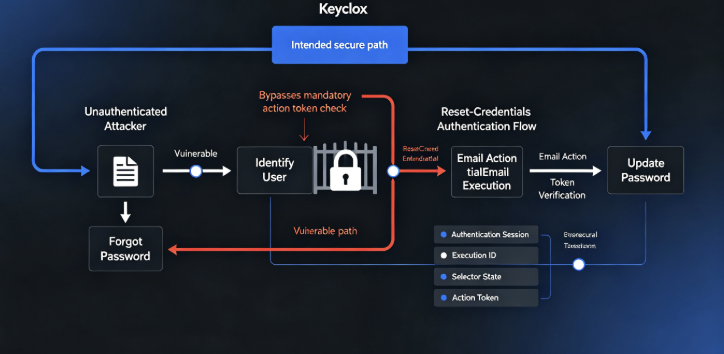
Red Hat describes the root cause as improper state validation within the reset-credentials authentication flow. (Red Hat Customer Portal)
The upstream Keycloak patch makes the problem more concrete.
The fix modifies several important areas, particularly:
DefaultAuthenticationFlow.java
ResetCredentialEmail.java
ResetPasswordTest.java
According to the upstream patch review, the remediation does three important things:
- It binds authenticator-selector state to the specific authentication execution.
- It rejects reset-email actions that do not have the appropriate matching action token.
- It adds regression testing covering stale reset-flow navigation. (ギットハブ)
This combination is important because the vulnerability was not merely the result of one badly written もし statement.
Two pieces of state management interacted in an unsafe way.
Authentication Selector State Was Too Weakly Bound
Keycloak authentication flows can contain multiple executions.
An authentication session may therefore track concepts such as:
CURRENT_AUTHENTICATION_EXECUTION
AUTHENTICATION_SELECTOR_SCREEN_DISPLAYED
In vulnerable versions, the state recording whether an authentication-method selector had been displayed could behave too much like a general boolean condition rather than a state tied tightly enough to the specific execution for which that selector was rendered.
Conceptually, the vulnerable assumption looked roughly like this:
selectorDisplayed = trueThe safer model is closer to:
selectorDisplayedFor = execution_12345Why does that difference matter?
Because authentication flows are state machines.
A state marker saying:
"the selector has been displayed"is substantially weaker than:
"the selector has been displayed for this exact authentication execution"If the first form survives while the flow moves to another execution, stale state can affect an execution for which it was never intended.
The official fix consequently binds selector state to the appropriate execution ID and validates that relationship before trusting it. (ギットハブ)
The Reset Email Execution Also Needed Stronger Validation
The second part of the problem involved ResetCredentialEmail.
A password recovery flow must never equate:
reaching the reset-email authenticatorwith:
proving possession of the emailed reset tokenThose two statements are fundamentally different.
The patch specifically strengthens this boundary by requiring the reset-email action to have the expected action-token user identity before treating the execution as valid.
The upstream PR summarizes the security change as:
“Rejects reset-email actions lacking a matching action token.”
(ギットハブ)
That is the most important technical sentence in the patch.
The action token is the evidence that connects the browser executing the reset flow to the user who received the reset email.
Without validating that evidence, reaching the action handler can incorrectly become equivalent to authorization.
The Vulnerable State Machine
A useful way to understand CVE-2026-18963 is not as an endpoint vulnerability but as an invalid state transition.
A safe password-reset state machine should enforce:
                 VALID TOKEN
RESET EMAIL ─────────────────────► UPDATE PASSWORD
Anything else should fail:
                 NO TOKEN
RESET EMAIL ─────────X───────────► UPDATE PASSWORD
With CVE-2026-18963, manipulated authentication-flow state could effectively cause the second transition to become reachable.
The security invariant:
UPDATE_PASSWORD requires proof of mailbox ownershipwas therefore violated.
That produces the account takeover.
Simplified CVE-2026-18963 Attack Path
At a conceptual level, exploitation can be represented as:
Unauthenticated attacker
        │
        ▼
Starts password recovery flow
        │
        ▼
Manipulates authentication flow state
        │
        ▼
Victim account enters reset workflow
        │
        ▼
Reset email stage becomes current execution
        │
        ▼
Email-token possession check is bypassed
        │
        ▼
Flow reaches password update
        │
        ▼
Attacker chooses new credentials
        │
        ▼
Victim account compromised
Importantly, Red Hat explicitly states that the attacker does ない need the user to interact with the reset email. Successful exploitation can allow the attacker to set new credentials directly. (Red Hat Customer Portal)
That is why the issue is an unauthenticated account takeover rather than simply a password-reset workflow anomaly.
Why CVE-2026-18963 Is Not Just Another Password Reset Bug
Many password-reset vulnerabilities fall into familiar categories:
| 脆弱性タイプ | Typical failure |
|---|---|
| Predictable token | Attacker guesses reset token |
| Token leakage | Reset token appears in logs or URLs |
| Host-header poisoning | Reset URL points to attacker infrastructure |
| Token reuse | Used token remains valid |
| ユーザー列挙 | Reset flow reveals whether users exist |
| Weak recovery questions | Recovery evidence is guessable |
| CVE-2026-18963 | Required verification state can be bypassed |
CVE-2026-18963 belongs to a more subtle category.
The reset token itself can be cryptographically sound.
The problem is that the surrounding state machine does not always require the token before allowing the privileged transition.
This illustrates an important security engineering principle:
A strong credential is useless if the application logic contains a route around the point where the credential is checked.
Why MFA May Not Save a Vulnerable Deployment
A common reaction to account takeover vulnerabilities is:
“Our users have MFA, so a password reset alone should not be enough.”
That assumption needs careful examination.
Authentication MFA and account recovery are often separate security workflows.
Imagine the normal login flow:
Password
   +
OTP / WebAuthn
   =
Authentication
But the reset flow may instead be:
Email ownership
      │
      ▼
Reset password
If recovery logic eventually creates an authentication state or resets credentials without enforcing an additional authenticator, login MFA may not provide the protection administrators expect.
Whether MFA prevents complete takeover therefore depends on the exact reset-credentials flow configuration.
Some customized reset flows may require additional authentication steps, which can reduce exploitation impact.
But administrators should not assume that ordinary MFA configuration automatically neutralizes CVE-2026-18963.
The vulnerable password recovery path itself must be patched.
Which Keycloak Versions Are Affected?
Public advisory data identifies the following vulnerable release ranges:
| Release branch | 脆弱 | Fixed |
|---|---|---|
| Keycloak 26.0.x–26.4.x | Before 26.4.15 | 26.4.15 |
| Keycloak 26.5.x–26.6.x | Before 26.6.6 | 26.6.6 |
| Keycloak 26.7.x | 26.7.0–26.7.1 | 26.7.2 |
| Current upstream | Older vulnerable builds | Upgrade to a fixed/current release |
GitLab’s advisory database describes the affected Maven ranges as starting at 26.0.0 and ending before the respective patched maintenance releases. (advisories.gitlab.io)
The Keycloak project’s CVE issue also carries release labels for 26.4.15, 26.6.6, 26.7.2 and 26.8.0, confirming the branches receiving the correction. (ギットハブ)
For upstream deployments following the current Keycloak line, 26.7.2 is the important minimum patched release from the August security update.
Administrators should nevertheless move to the latest supported Keycloak release appropriate for their environment rather than treating 26.7.2 as a permanent target.
How to Check Your Installed Keycloak Version
On a conventional Keycloak deployment, check the running version rather than relying only on documentation or deployment manifests.
例えば、こうだ:
bin/kc.sh --versionContainerized environments should also inspect the image actually running:
kubectl get pods -n keycloakThen inspect the container image:
kubectl get pod <keycloak-pod> -n keycloak \
  -o jsonpath='{.spec.containers[*].image}'
For Docker:
docker ps --format '{{.Image}} {{.Names}}'Do not assume that updating a Helm values file means the cluster has successfully rolled over to the patched image.
Verify the deployed workload.
This matters particularly in environments where:
Desired image: 26.7.2
Running image: 26.7.1
can persist because of failed rollouts, image caching, pinned digests or operator configuration.
Red Hat Build of Keycloak
Organizations using Red Hat Build of Keycloak should use the Red Hat errata associated with the CVE instead of blindly applying community-version assumptions.
Red Hat’s security data identifies multiple advisories for CVE-2026-18963, including:
RHSA-2026:56519
RHSA-2026:56520
RHSA-2026:56523
RHSA-2026:56524
and identifies corrected RHBK builds associated with the affected supported branches. (Red Hat Customer Portal)
This distinction matters because enterprise distributions frequently backport security fixes rather than simply mirroring upstream release numbers.
The Official Keycloak Patch
The upstream repair was merged through Keycloak pull request #51844.
Keycloak CVE-2026-18963 fix PR #51844
The PR explicitly states that it closes CVE-2026-18963 and hardens the reset-credentials flow. It was merged into the Keycloak main branch on August 20, 2026. (ギットハブ)
The patch changes the security model in two complementary ways.
Before
Authentication flow state could be trusted too broadly:
selector state exists
        │
        ▼
assume relevant execution can use it
The reset-email stage could also be reached without sufficiently proving the action-token relationship.
After
Keycloak requires stronger relationships:
selector execution ID
        │
        ├── must match ──► current execution ID
        │
        ▼
continue
and:
action token identity
        │
        ├── must match ──► reset user identity
        │
        ▼
allow reset flow
This is classic defense in depth.
The first correction prevents stale authentication-selector state from being reused incorrectly.
The second prevents the sensitive email-reset authenticator from succeeding merely because execution control reaches it.
Why the Patch Is Better Than Simply Blocking One Attack Sequence
An inferior patch might attempt to recognize the specific known request sequence and block it.
例えば、こうだ:
if request looks like published exploit:
    deny
That would be fragile.
The actual Keycloak fix strengthens the security invariants of the authentication state machine.
The system now asks:
Does this selector state belong to this execution?and:
Does the reset action possess the identity evidence expected from the action token?That approach protects against broader classes of state confusion rather than one literal proof-of-concept request sequence.
Can CVE-2026-18963 Be Exploited Remotely?
Yes.
The CVSS vector contains:
AV:Nmeaning Network Attack Vector.
It also contains:
PR:Nmeaning no privileges are required, and:
UI:Nmeaning the victim does not need to interact with the attack.
Combined with:
AC:Lfor low attack complexity, these characteristics explain the 9.1 rating. (Red Hat Customer Portal)
From a defender’s prioritization perspective, this means CVE-2026-18963 should rank considerably higher than vulnerabilities requiring:
local access
+
existing credentials
+
victim interaction
+
complex race conditions
The attacker-facing prerequisites are unusually favorable.
Public Exploit Availability Changes the Risk Calculation
At the time of some early reporting on August 24, 2026, researchers noted that they had not yet found a verified public exploit. (ハッカーニュース)
That statement is no longer useful as a current operational assumption.
Public GitHub repositories now contain CVE-2026-18963 proof-of-concept implementations and vulnerable test labs. (ギットハブ)
This changes the patching equation.
Once technical exploitation details become publicly reproducible, the defender’s window between disclosure and commodity exploitation can shrink dramatically.
Organizations should therefore not delay remediation simply because they have not observed an incident.
Is CVE-2026-18963 Being Exploited in the Wild?
As of August 31, 2026, the sources reviewed for this article do not provide reliable evidence of widespread confirmed exploitation in the wild, and a search of CISA’s published KEV material did not surface CVE-2026-18963.
That should not be interpreted as evidence that exploitation has not occurred.
There are several reasons.
First, public PoCs now exist.
Second, password-reset exploitation can resemble legitimate account recovery activity.
Third, Keycloak event logging may be disabled or retained only for a limited period.
Fourth, an attacker who successfully changes a user’s credentials may subsequently interact with downstream applications through apparently valid authenticated sessions.
Detection therefore requires more than searching for a single obvious exploit signature.
Detecting Possible CVE-2026-18963 Exploitation
Defenders should think about detection in three layers:
Layer 1: HTTP / reverse proxy activity
Layer 2: Keycloak authentication events
Layer 3: Credential and account state changes
No single layer is guaranteed to be complete.
Layer 1: Reverse Proxy and Ingress Logs
Inspect requests associated with Keycloak reset-credentials and login-action workflows.
The objective is not simply to detect someone using “Forgot Password.” That is expected behavior.
Instead, investigators should correlate unusually compressed sequences of:
reset workflow requests
        │
        ▼
credential update
where there is no corresponding request representing the legitimate action-token navigation expected after the victim clicks the reset email.
A legitimate recovery should usually contain evidence corresponding to:
reset request
    ↓
email delivery
    ↓
action-token navigation
    ↓
password update
A suspicious pattern is:
reset request
    ↓
password update

without expected token-consumption activity
Public incident-response research around the vulnerability specifically recommends looking for the absence of the expected /login-actions/action-token navigation between reset initiation and credential update. (ギットハブ)
That is useful as a heuristic, not as absolute proof.
Keycloak Event Analysis
A community-developed defensive hunt for CVE-2026-18963 recommends correlating password-reset and credential-update events with earlier reset-email events. (ギットハブ)
Useful event categories may include activity resembling:
SEND_RESET_PASSWORD
RESET_PASSWORD
UPDATE_PASSWORD
UPDATE_CREDENTIAL
Investigators should ask:
Was a password changed?
        │
        ▼
Was there a legitimate recovery request?
        │
        ▼
Was the action-token stage observed?
        │
        ▼
Do source IPs and timestamps make sense?
One particularly useful hunting strategy is identifying password changes that cannot be reconciled with:
- legitimate user recovery;
- administrator-driven credential resets;
- enrollment flows;
- approved helpdesk actions.
A credential change by itself does not prove compromise.
Context matters.
Database-Level Hunting
Where incident response requires historical investigation, the Keycloak database can provide evidence even if application event retention is incomplete.
A public defensive project designed specifically around CVE-2026-18963 notes that credential.created_date can help identify credentials created during the exposure window, even where event logging was disabled. (ギットハブ)
That is valuable because event histories may expire.
A high-level investigative query should identify:
user
credential type
credential creation/change time
realm
for the period between:
date vulnerable version introduced
          ↓
date patched version deployed
Each result should then be correlated against known business activity.
Do not automatically classify every credential update as compromise.
Build an Exposure Window
This vulnerability is particularly well suited to timeline-based incident response.
For each Keycloak environment, determine:
T0 = first deployment of an affected release
T1 = CVE disclosure / increased public awareness
T2 = public exploitation details available
T3 = patched release deployed
The investigation window should usually begin at T0, not merely the disclosure date.
A vulnerability can be exploited before public disclosure.
Public disclosure only changes attacker awareness; it does not create the vulnerable code.
Indicators That Deserve Investigation
Potential warning signs include:
| 信号 | なぜそれが重要なのか |
|---|---|
| Unexpected password changes | Direct result of the attack |
| Admin password reset with no ticket | High-impact identity compromise |
| Password reset followed by unfamiliar IP login | Possible takeover |
| Reset flow immediately followed by credential update | Abnormally compressed workflow |
| Missing action-token navigation | Consistent with bypassed email verification |
| New downstream sessions after password reset | Possible post-compromise activity |
| Offline token activity | Persistence may survive password remediation |
| Privileged actions shortly after reset | Possible attacker objective |
None of these indicators individually proves CVE-2026-18963 exploitation.
Their value comes from correlation.
What to Do If You Suspect Account Takeover
Patching the server stops new exploitation of the vulnerable path.
It does ない undo an account compromise that already occurred.
If suspicious credential changes are discovered, responders should treat the event as an identity compromise.
The response process should include:
Disable or contain affected identity
        │
        ▼
Reset credentials through trusted channel
        │
        ▼
Revoke active sessions
        │
        ▼
Invalidate offline sessions/tokens
        │
        ▼
Review connected applications
        │
        ▼
Rotate accessible secrets if necessary
        │
        ▼
Investigate post-reset activity
The public Keycloak incident-hunting project similarly recommends revoking sessions and offline tokens and then investigating downstream actions performed by the affected account. (ギットハブ)
This is especially important for administrator identities.
An attacker may use the compromised Keycloak identity simply as the initial access mechanism.
The actual objective may be elsewhere.
Temporary Mitigation: Disable Forgot Password
Red Hat provides a clear temporary mitigation:
Disable the Forgot Password functionality across all realms.
This prevents access to the vulnerable recovery path.
For organizations unable to upgrade immediately, this is materially better than leaving the vulnerable reset flow exposed.
However, it should be treated as an emergency control rather than a replacement for patching.
Reasons include:
- Users lose self-service password recovery.
- Every relevant realm must actually be covered.
- Configuration could later be re-enabled.
- The vulnerable code remains present.
- Operational procedures may unintentionally restore exposure.
The permanent solution is to run a patched version.
Recommended Remediation Priority
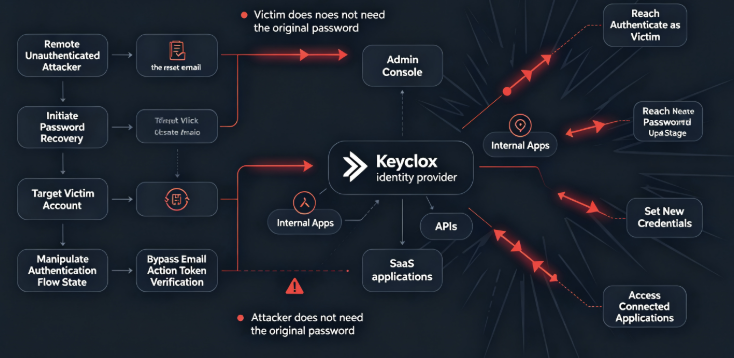
For Internet-exposed Keycloak systems with password recovery enabled, CVE-2026-18963 should generally be treated as an emergency identity-security patch.
A practical priority model is:
| Environment | 優先順位 |
|---|---|
| Internet-facing Keycloak + Forgot Password enabled | Emergency |
| Admin accounts reachable through vulnerable realm | Emergency |
| Keycloak federating many production apps | Emergency |
| Internal-only Keycloak with broad employee access | 非常に高い |
| Forgot Password disabled | High — mitigation exists, still patch |
| Patched version already verified | Monitor and investigate exposure window |
The distinction between mitigated そして patched is important.
A mitigated server can become vulnerable again if configuration changes.
A patched server has the underlying security defect corrected.
Verification After Patching
Do not stop at:
deployment pipeline succeededVerify the security outcome.
A robust validation process includes:
1. Verify running Keycloak version
2. Verify every replica/pod
3. Check old instances are terminated
4. Confirm rollback images are patched
5. Confirm Forgot Password configuration
6. Validate legitimate reset still works
7. Confirm invalid reset state cannot reach password update
8. Review logs from the historical exposure window
Testing should occur against systems you own or are explicitly authorized to assess.
For production systems, prefer non-destructive validation that confirms the vulnerable state transition is unavailable without actually changing another user’s credentials.
Why Version-Only Vulnerability Scanning Is Not Enough
Some vulnerability scanners detect CVE-2026-18963 primarily through Keycloak version information.
For example, Tenable describes its check as relying on the application’s reported version rather than exploiting the issue. (Tenable®)
That approach is safe and useful for inventory.
But version scanning answers:
Is this build expected to contain the vulnerability?It does not necessarily answer:
Is this specific reset flow exploitable?or:
Was it exploited last week?Security teams should separate these questions.
Exposure detection
Asset inventory
+
version detection
+
realm configuration
Vulnerability validation
Authentication-flow behavior
+
safe security testing
Incident investigation
Keycloak events
+
database history
+
reverse-proxy logs
+
downstream application activity
These are three different tasks.
Security Testing Lessons From CVE-2026-18963
CVE-2026-18963 also demonstrates why identity systems require business-logic testing rather than only conventional endpoint scanning.
A traditional scanner may ask:
Does this parameter contain SQL injection?
Does this page contain XSS?
Is this package vulnerable?
Those questions remain important.
But this vulnerability requires another class of reasoning:
Can authentication state from execution A
incorrectly authorize execution B?
That is a state-machine question.
The interesting test cases include:
resume flow
restart flow
switch authentication method
revisit old execution
reuse authentication session
submit stale forms
move backward in flow
move forward without expected proof
For identity infrastructure, those transitions are often where high-impact vulnerabilities hide.
Authentication Flows Should Be Tested as Graphs
Instead of viewing authentication as a list of pages:
Page 1
Page 2
Page 3
security engineers should model it as a graph:
                 ┌──► OTP ──────┐
                 │               │
IDENTIFY ─► AUTH ┼──► WebAuthn ─┼──► SUCCESS
                 │               │
                 └──► Password ──┘
Password recovery creates another graph:
                EMAIL TOKEN
                    │
IDENTIFY ─► EMAIL ──┼──► UPDATE PASSWORD
                    │
                    X
              no proof allowed
Then test not only the legitimate edges, but unintended ones.
例えば、こうだ:
Can EMAIL be reached twice?

Can stale browser state select another execution?

Can the user return to an earlier step?

Can an execution be invoked directly?

Does every sensitive authenticator independently validate its proof?

Can state from one branch affect another branch?
CVE-2026-18963 is a textbook example of why this methodology works.
The Deeper Engineering Lesson
Authentication systems frequently accumulate state in multiple places:
cookies
HTTP parameters
authentication sessions
server-side notes
action tokens
execution IDs
browser tabs
required actions
realm configuration
Security problems emerge when two components have different assumptions about which piece of state is authoritative.
Component A may believe:
current execution proves where the user came fromwhile component B assumes:
if this action method is running,
the token must already have been checked
Neither assumption is safe unless the relationship is explicitly validated.
Security-sensitive transitions should therefore follow a principle similar to:
Never infer proof from control flow
when the proof itself can be verified.
If a token proves mailbox possession, verify the token.
If an execution ID proves flow ownership, verify the execution ID.
Do not infer either property merely because the request reached the right handler.
Why Identity Vulnerabilities Can Have Disproportionate Blast Radius
Consider a company using Keycloak for:
Git platform
CI/CD platform
internal dashboard
customer console
cloud administration
VPN portal
monitoring
developer tools
A single identity might authenticate to several of those systems.
The vulnerability itself remains an account takeover.
But downstream impact becomes:
Keycloak account takeover
        │
        ├──► application access
        ├──► API access
        ├──► administrative privileges
        ├──► sensitive data
        └──► lateral movement
This is why identity-provider vulnerabilities should often receive remediation priority above an equivalent CVSS vulnerability in an isolated application.
The identity system is part of the organization’s security control plane.
Defender Checklist for CVE-2026-18963
| アクション | ゴール |
|---|---|
| Inventory all Keycloak environments | Establish exposure |
| Determine running versions | Identify vulnerable deployments |
| Identify all realms | Avoid missing secondary realms |
| Determine whether Forgot Password is enabled | Confirm attack surface |
| Upgrade to patched releases | Remove root cause |
| Temporarily disable Forgot Password if necessary | Emergency mitigation |
| Review historical password changes | Hunt for takeover |
| Correlate reset and action-token events | Identify bypass patterns |
| Review reverse-proxy logs | Reconstruct HTTP activity |
| Investigate privileged accounts first | Reduce blast radius |
| Revoke suspicious sessions | Remove attacker persistence |
| Review downstream applications | Find post-compromise activity |
| Improve event retention | Support future incident response |
Frequently Asked Questions
What is CVE-2026-18963?
CVE-2026-18963 is a critical vulnerability in Keycloak’s reset-credentials flow that can allow an unauthenticated remote attacker to bypass the email-verification step of password recovery and potentially set new credentials for another account. Red Hat rates it Critical with CVSS 9.1. (Red Hat Customer Portal)
What is the main impact?
The primary impact is unauthenticated account takeover.
An attacker does not need the victim’s existing password and does not need the victim to click the password-reset email.
Does the attacker need access to the victim’s email?
No.
Bypassing the requirement to prove access to the reset email is precisely what makes the vulnerability dangerous.
Does CVE-2026-18963 require authentication?
No.
The CVSS vector specifies PR:N.
Does the victim need to click anything?
No.
The vulnerability has UI:N.
Is CVE-2026-18963 Critical?
Yes.
Red Hat assigned CVSS v3.1 9.1 Critical. (Red Hat Customer Portal)
What CWE is CVE-2026-18963?
CWE-640, Weak Password Recovery Mechanism for Forgotten Password.
What Keycloak version fixes CVE-2026-18963?
For the current upstream line, Keycloak 26.7.2 contains the security fix. Patched maintenance releases also include 26.4.15 そして 26.6.6 for the corresponding branches. (Keycloak)
Can I mitigate the vulnerability without immediately upgrading?
Yes.
Red Hat recommends disabling Forgot Password across all realms if immediate upgrading is impossible. (Red Hat Customer Portal)
That should be considered temporary mitigation rather than a permanent solution.
Does MFA completely stop CVE-2026-18963?
Not necessarily.
MFA protection depends on the structure of the reset-credentials flow. Normal login MFA does not automatically guarantee that password recovery requires the same authenticators.
Patch the vulnerable Keycloak version regardless.
Are public exploits available?
Yes.
Public technical implementations and test environments for CVE-2026-18963 are now available, increasing the urgency of remediation. (ギットハブ)
Is CVE-2026-18963 actively exploited?
As of August 31, 2026, reliable public confirmation of widespread active exploitation was not identified in the sources reviewed for this article.
However, public proof-of-concept material exists, so absence of confirmed exploitation should not be used to justify delaying remediation.
結論
CVE-2026-18963 is dangerous not because Keycloak generated a weak reset token, but because the authentication state machine could be manipulated into bypassing the security boundary that the token was supposed to enforce.
That distinction makes the vulnerability an important case study in modern identity security.
The vulnerable logic effectively allowed this invariant:
Password reset requires verified mailbox ownershipto become:
Password reset may succeed
because authentication-flow state says
the process has advanced far enough
The Keycloak patch fixes that trust problem by binding selector state to the correct authentication execution and requiring the reset-email action to possess matching action-token identity evidence. (ギットハブ)
For defenders, the response is straightforward: identify every Keycloak deployment, verify the running version rather than the intended version, upgrade vulnerable instances, temporarily disable Forgot Password where patching cannot happen immediately, and investigate historical credential changes across the exposure window.
For security engineers, CVE-2026-18963 offers a broader lesson.
Authentication flows should not only be tested for whether the correct path works.
They should be tested for whether an attacker can reach a privileged state through an incorrect path.
In identity infrastructure, that difference can be the difference between a harmless workflow bug and a complete account takeover.


 Japanese
  English
  German
  French
  Spanish
  Portuguese
  Korean
  Hindi
Hindi  Arabic
  Turkish
  Hebrew