
CVE-2026-110879 makes an earlier Jackson remediation incomplete: an application can approve an outer polymorphic type while failing to apply the intended security decision to types named inside it. The relevant question is therefore broader than whether a dependency was updated after the previous advisory. A defensible response needs evidence about the Jackson build actually loaded, the mapper handling the data, and the behavior of that mapper when nested types are rejected.
について Jackson maintainer advisory identifies generic type arguments and array element types as the affected paths and describes the issue as an incomplete fix for CVE-2026-54512. Class-name polymorphism and a reachable source of attacker-controlled serialized data matter. A service that merely uses Jackson to bind ordinary JSON to concrete application records should not be described as remotely exploitable on that fact alone.
For engineers who already closed the older finding, the useful next step is to reopen the evidence behind that closure. Check the new fixed releases, identify every relevant deserialization boundary, and add rejection tests that observe object construction as well as the final exception. This article separates the published patch facts from a recommended deployment and verification procedure; it does not claim that the procedure has been run against your application.
Which Jackson versions need attention
The upstream advisory gives the following affected ranges and fixed releases. These are Maven artifact coordinates, not a claim about every operating-system package carrying a similar version string. The table follows the maintainer’s affected-package matrix.
| Maven artifact | Affected range | Fixed release listed for that line |
|---|---|---|
com.fasterxml.jackson.core:jackson-databind | 2.10.0 through 2.18.11 | 2.18.12 |
com.fasterxml.jackson.core:jackson-databind | 2.19.0 through 2.21.7 | 2.21.8 |
com.fasterxml.jackson.core:jackson-databind | 2.22.0 through 2.22.3 | 2.22.4 |
tools.jackson.core:jackson-databind | 3.0.0 through 3.1.7 | 3.1.8 |
tools.jackson.core:jackson-databind | 3.2.0 through 3.2.3 | 3.2.4 |
Treat these as minimum fixes for this CVE within the listed lines, not a permanent recommendation to pin those versions. Select a currently supported release compatible with the application and review newer advisories before deployment. If a framework manages Jackson, prefer a supported framework update that includes the correction; an isolated override needs compatibility testing and a clear owner.
A distribution build may contain a backport without matching an upstream fixed version number. Conversely, upgrading an operating-system package does not establish that a self-contained Java application stopped loading an embedded JAR. Keep those two inventories separate. The Amazon Linux CVE record, checked for this article, lists its own package status and assigns an 8.1 score with high attack complexity. The maintainer advisory assigns 9.8 with low attack complexity. Record the scoring authority rather than mixing the number from one assessment with the vector from another.
That difference should not become an argument about which number an application team must use. Use the upstream range to find candidate dependencies, then assess the application’s actual data path. A public deserialization boundary with class-name typing and untrusted bytes deserves a different response from an isolated batch worker reading a controlled, immutable fixture. Both may require a library update; the evidence determines containment and rollout order.
について 2.18 release notes list 2.18.12 on October 17, 2026 and document stricter treatment of nested type parameters and array elements. Preserve a link to the relevant release record in the remediation ticket. A statement such as “Jackson patched” ages poorly because it loses the branch, coordinate, release, and deployment context needed by the next engineer.
The authorization boundary is inside the object graph
A useful conceptual model has three actors: the application declares an expected data shape, the serialized input supplies type information, and a validator decides which concrete classes may participate. Trouble starts when approval of the first class silently answers a different question about a class embedded deeper in the type description.
For example, imagine an application-owned Envelope carrying a message. The application may intentionally accept that envelope while allowing only a narrow family of message implementations. Approving the envelope does not express approval of every possible class that can appear in its contents. This example describes the trust boundary; it is not a complete Jackson payload or a claim that every generic envelope is vulnerable.
について main patch discussion in pull request 6287 explains two important failure paths: nested parameters could be checked in the wrong base-type context, and approval of an outer base could replace the configured validator with a permissive one. The correction preserves the configured policy for nested decisions. That is the central security property: a wrapper must not expand the authority of a type that would otherwise be rejected.
A reviewer should therefore ask where a policy decision is made, what subject it applies to, and whether that decision gets reused for a different subject. This is more precise than searching for a dangerous class name. A deny entry for a particular class cannot establish that every nested class was evaluated. Likewise, a successful test for a direct type ID says little about a path that introduces the same class through a container.
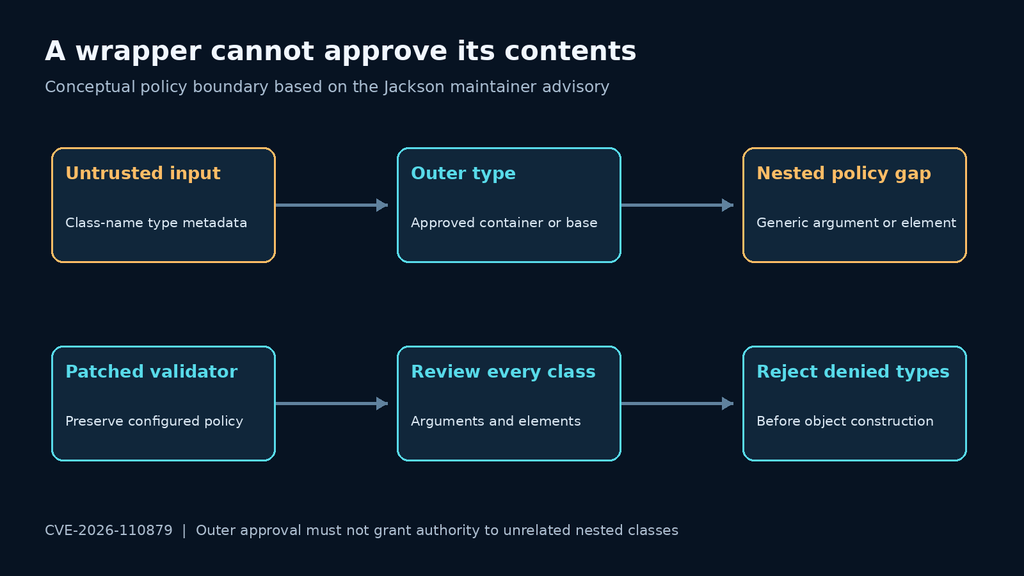
Arrays make this reasoning less intuitive because an accepted array class and an accepted element class are different propositions. Java’s type system can make broad array supertypes convenient in ordinary code. A security policy still needs to decide what may be instantiated at the element boundary. A rule intended to cover a collection shape can become far broader if the implementation treats it as permission for all contents.
The final behavior must be read with the follow-up in pull request 6289. That change replaces an inference about whether an array rule is specific with an explicit validator contract. It also covers cases involving array depth. An explanation based only on the first patch’s probe of a one-dimensional array would teach an intermediate implementation rather than the completed correction.
There is another boundary worth preserving: validating the classes named by input is not identical to proving every generic binding matches the application’s declared generic signature. The patch discussion distinguishes those questions. For an application review, keep security rejection and ordinary type correctness as separate acceptance criteria. A later cast failure is a compatibility problem; it should not be presented as proof that no unexpected object was constructed earlier.
This distinction changes how a test should observe failure. If an inert forbidden class is instantiated and the request later fails, the rejection came too late for the property being tested. Observe the earliest meaningful effect within the test process, such as a harmless constructor counter, rather than relying only on HTTP status. Do not introduce network callbacks, command execution, file writes, or live gadget classes simply to make the result look more dramatic.
Start exposure analysis at the data boundary
One review trap is treating default mapper construction as proof that class selection is absent. The maintainer advisory also documents annotation-driven class-name polymorphism with a default Jackson 3.x mapper. Review the model annotations as well as the mapper builder. An application can inherit type-selection behavior from an interface or property even when the surrounding service never calls a default-typing configuration method. For an exposure assessment, capture the declared target model and its annotations beside the effective mapper configuration. Checking only the mapper factory leaves part of the input contract unexamined.
Jackson’s polymorphic deserialization documentation distinguishes class-name type information from indirect names and explains both annotation-driven and default typing. Use that distinction when reviewing an application. Search results for ObjectMapper alone are a starting inventory, not an exposure finding.
The recommended review is to take one data boundary at a time and follow it until deserialization finishes. Write down who can supply bytes, who can alter them later, the selected serializer, the mapper instance, the declared target type, and the effective type policy. If any link is unknown, keep that uncertainty visible. Do not convert missing evidence into a negative finding.
Start with external request bodies, imported documents, message consumers, session restoration, and cached object reads. These are review categories, not a claim that this CVE affects every member of them. A request might use concrete DTOs, while a cache serializer elsewhere enables polymorphic handling. A queue might be writable by several services with different trust levels. The important boundary is control of serialized data, not whether the storage system is inside a private network.
Trace authorship and modification separately. A value can begin as trusted application output and later become writable through a different service, administrative feature, migration job, or restore process. Ask whether the consumer verifies the same trust assumptions after that change. For each writer, identify the identity and the permitted data shape. “Only internal services write here” is too broad when those services serve tenants with different privileges.
Framework-owned mappers deserve explicit entries. Do not assume a configuration applied to an injected application mapper also changes a serializer created by a convenience factory. Capture how that serializer is constructed and how its mapper is obtained. If the configuration is implicit, use a small integration test or supported diagnostic hook to establish the behavior instead of inferring it from a nearby bean declaration.
について Spring Data Redis serializer documentation describes multiple serializers and notes that serialization can apply to keys, values, and hashes. That is a reason to inventory the actual configured serializer at each location. It is not evidence that Redis itself, every Spring cache, or every JSON serializer is affected by this Jackson issue.
A practical review sheet can stay compact:
| Boundary | Evidence to collect | Decision it supports |
|---|---|---|
| HTTP or import input | DTO, annotations, mapper construction, caller permissions | Whether submitted data reaches class-name typing |
| Queue consumer | Producer identities, serializer configuration, message schema | Whether another writer can influence deserialized types |
| Cache or session read | Namespace writers, value serializer, mapper, retention | Whether stored bytes cross a trust boundary |
| Background restore | Artifact provenance, transformation steps, consumer build | Whether delayed data still meets original assumptions |
For each row, choose a named service owner rather than an organizational group. The owner should be able to point to the configuration and reproduce the relevant test. If a shared platform supplies the mapper, the platform team can own the common correction while application teams own their data paths and compatibility checks.
An authentication requirement does not erase the issue. It changes who can reach the path and how quickly access can be restricted. A low-privilege tenant, a compromised producer, and an administrator are different threat models. Record the least privilege needed to control the relevant bytes, then use that evidence to prioritize. Do not label an internal endpoint unauthenticated simply because a generic CVSS vector has no privileges required.
Finally, distinguish absence of class-name typing from absence of a known exploit. The former can be concrete configuration evidence. The latter is an observation with limited scope. If your review establishes only that a published demonstration does not work in one environment, keep the result narrow: the tested path did not reproduce the observed behavior under those conditions. It is not a universal safety statement about the dependency.
Prove the dependency at three different layers
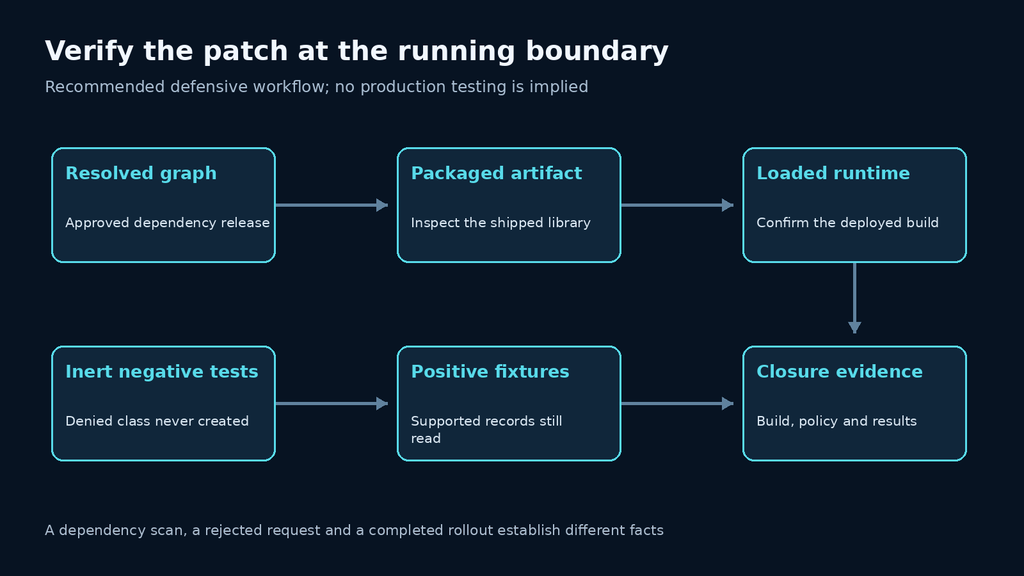
A dependency declaration, a packaged dependency, and a loaded class are three different pieces of evidence. The recommended verification sequence checks all three because each answers a distinct question. Source review tells you what the project intends to use. Artifact inspection tells you what was shipped. Runtime evidence tells you what the process actually chose.
For Maven projects, inspect the resolved graph instead of searching only the nearest pom.xml.その Maven dependency mechanism guide documents transitive dependencies, mediation, and dependency management. A framework BOM or parent can determine the selected version even when an application module has no visible Jackson version declaration. Capture the effective outcome for the deployable module and relevant profile.
The following commands inspect the current owned project. They are inventory commands, not vulnerability tests. Run them in the module and build context used to produce the service:
mvn dependency:tree -Dincludes=com.fasterxml.jackson.core:jackson-databind
mvn dependency:tree -Dincludes=tools.jackson.core:jackson-databind
について Maven Dependency Plugin usage documentation describes the tree goal and output options. Save the relevant output with the commit and build identifier. If the graph excludes an unexpected version, retain the reason as well as the selected version; it helps explain why a later dependency change might reintroduce the old artifact.
For Gradle projects, inspect the runtime configuration that belongs to the service. The Gradle dependency-report documentation describes dependency reports and dependencyInsight, including selection reasons. A suitable starting point for a conventional Java module is:
./gradlew dependencyInsight --dependency jackson-databind --configuration runtimeClasspathAdjust the configuration to the actual project rather than treating that example as universal. A custom plugin, application packaging task, or multi-project build can introduce a different runtime path. Keep the command and output together so another engineer can tell which configuration was examined.
Next, inspect the deployable artifact through the organization’s normal build tooling. Look for embedded libraries, shaded copies, application-server libraries, plugin directories, and sidecar tools that perform their own deserialization. The objective is an inventory of loadable implementations, not a filename search with a green result. A renamed or relocated class may require evidence from the packaging process or software bill of materials rather than a recognizable JAR name.
Do not assume that rebuilding the top-level application also rebuilt every helper image or worker. Enumerate the release units that consume the shared code. A web process, a queue worker, and a scheduled importer may have separate images even when they originate from one repository. Tie the selected artifact digest to each unit. Otherwise a ticket can look complete while an older worker continues to process the same untrusted data.
Finally, collect runtime provenance through an approved diagnostic mechanism in staging or production. Useful evidence includes the code source for a representative Jackson class, the loaded implementation version when available, and the running image or artifact digest. Some packaging modes obscure version metadata, so do not rely on a single manifest string. Pair runtime observations with the artifact inventory and build record.
Keep this diagnostic narrow. It should not dump the complete environment, credentials, classloader internals, or user payloads. An authenticated operational endpoint that exposes arbitrary system properties would create a separate problem. Prefer existing observability or a temporary startup log containing only the approved dependency fields, then remove temporary instrumentation after evidence collection.
A conflicting result is a finding to investigate rather than an inconvenience to hide. If the dependency tree shows a fixed release but runtime points to an older library, inspect the launch classpath and deployment packaging. If the artifact contains both versions, establish which path owns each and whether both execute. If a scanner reports a vulnerable version that the vendor backported, request the vendor advisory and package release evidence instead of dismissing the scanner with a comment.
The acceptance criterion should name the runtime unit. For example: “The session worker running image digest X loads the approved Jackson artifact from location Y, and the attached integration tests run against the same packaged build.” That connects the dependency change to the executable under review. It also makes rollback review possible because the dependency evidence remains attached to a particular release.
Design a regression matrix around policy decisions
A good regression suite has both rejection cases and legitimate data. Rejection cases establish a security boundary. Legitimate fixtures establish that the proposed correction preserves the application’s protocol. Testing only one side invites either a security regression or an avoidable production outage.
Start by naming the intended policy in application language. For example: a notification envelope may carry a small set of application-owned message records, and historical string and numeric fields remain readable. This statement should be specific enough that an application owner can review it without knowing Jackson internals. Then map it to the mapper and serializer configurations that implement it.
Use inert classes written for the test. A forbidden marker can expose a constructor counter inside the test process and have no other behavior. It should not open sockets, spawn threads, create files, load XML, invoke processes, or depend on a real exploitation gadget. The result you need is whether an unapproved type crosses the instantiation boundary, not whether a demonstration can produce a dramatic side effect.
The recommended matrix below is a test design, not a list of reproduced results. Populate its expected behavior from your application’s policy and the final patched implementation. Some applications intentionally allow a class that another application forbids; a shared test name cannot replace that policy decision.
| Test family | 目的 | Observe |
|---|---|---|
| Approved ordinary record | Establish a working baseline | Expected value and type |
| Rejected direct type | Confirm the policy denies the inert marker | Rejection and zero constructions |
| Same rejected marker nested in a container | Check that wrapping grants no extra permission | Rejection and zero constructions |
| Nested container within another container | Exercise recursive policy application | Rejection at the relevant boundary |
| Rejected marker as an array element | Separate array shape from element permission | Rejection and zero constructions |
| More than one array dimension | Cover depth-sensitive policy assumptions | Consistent policy at each depth |
| Application-approved nested type | Preserve required legitimate polymorphism | Correct round trip |
| Historical persisted fixture | Protect real stored-data compatibility | Expected migration or readable value |
Do not assemble a universal payload catalog from that matrix. Choose cases that correspond to your mapper’s actual inclusion mode and data model. An annotation-driven model and a serializer using default typing may need different fixtures. The input must reach the same read operation that production uses; invoking an unrelated mapper in a unit test can produce a reassuring result without exercising the affected boundary.
Assert more than an exception class. Record whether the expected validator path ran, whether the marker was constructed, and whether deserialization returned an unexpected object. Reset counters between cases and keep test state isolated. If tests run concurrently, use an observation mechanism that cannot be confused by another case. A false positive caused by shared state wastes time and can lead engineers to disable a useful test.
Also test the post-deserialization consumer. A successfully parsed envelope that later fails a cast is a distinct problem from a validator rejecting an unapproved type before construction. Keep those assertions separate so a future refactor cannot turn a late application failure into a passing security test. Describe the exact property in the test name and failure message.
Preserve at least one fixture produced by the application before the upgrade. Generate it from a controlled test object, remove sensitive fields, and document its producer build. This fixture tests the actual stored format rather than a hand-written approximation. For cache or session systems, include a realistic sample of each supported schema version and serializer configuration.
When an upgrade rejects a legitimate nested type, examine why that type needs approval. Prefer a narrow rule for the intended application class or bounded hierarchy. Avoid restoring compatibility by approving a broad package, every array, or a very general base type without reviewing the resulting authority. The goal is to express the application protocol precisely, not to make every old byte sequence parse again.
A harmless local model of the failure property
The following pseudocode is an educational control model. It does not call Jackson, does not reproduce CVE-2026-110879, and does not establish that any release is vulnerable or fixed. It demonstrates why a regression should count forbidden construction before relying on the final outcome. Run a real Jackson regression only in an isolated owned test environment with the application’s actual configuration.
allowed = {"Envelope", "AllowedMessage"}
constructed = []

function instantiate(typeName):
    constructed.append(typeName)   # in-memory observation only
    return inertObject(typeName)

function unsafeRead(node):
    require node.outerType in allowed
    return instantiate(node.innerType)

function checkedRead(node):
    require node.outerType in allowed
    require node.innerType in allowed
    return instantiate(node.innerType)

case = {outerType: "Envelope", innerType: "ForbiddenMarker"}

constructed.clear()
unsafeRead(case)
assert constructed == ["ForbiddenMarker"]

constructed.clear()
expect PolicyRejection from checkedRead(case)
assert constructed == []
The useful observation is the second assertion. The model verifies a property before construction, whereas a check placed after instantiate would reject too late. Nothing in the pseudocode represents a real Jackson type-ID string, a production endpoint, or a loadable gadget. Keep those boundaries when adapting it into an application test.
Extend the model conceptually to a tree: the envelope has children, some children contain other nodes, and an array introduces an element node. Define the intended policy for each node before writing the traversal. Then ask whether the implementation evaluates every relevant node under the correct context. This exercise helps reviewers spot assumptions about container approval without needing to execute untrusted code.
A real regression should additionally prove that the intended code path was reached. Include a positive control using an approved inert message and confirm that the serializer reads it successfully. If both approved and forbidden inputs fail because the fixture is malformed, the test has not measured the security policy. Repair the fixture format first, then compare behavior across the candidate builds.
Use a bounded local process with no production credentials and no network requirement. Store fixtures in the test repository with a short explanation of the property each protects. There is no reason to add a callback server, an external hostname, or shell execution to verify nested type rejection. Such additions would change the risk of the test without making its conclusion more precise.
The strongest result is a small reproducible test that fails on the known affected application build, passes on the corrected application build, and retains a successful legitimate baseline. If you cannot obtain that comparison, report the limitation. A test that passes only after patching is useful evidence of current behavior, but it does not by itself establish that your particular deployment was previously exploitable.
Turn patching into a controlled deployment
The recommended rollout starts with a release candidate that has already passed both dependency verification and the application-specific regression matrix. Keep the candidate build immutable throughout testing. If a dependency override changes after the tests, rebuild and rerun the affected checks; the previous result belongs to the previous artifact.
Separate containment from permanent remediation. Containment reduces access to a risky data path while a corrected build is prepared. Permanent remediation establishes that the approved build is running and the intended policy holds. Track them as separate tasks so a temporary restriction does not accidentally become the only closure evidence.
For a reachable class-name deserialization path, reasonable temporary options include disabling the feature, restricting who can write the consumed data, or pausing the affected consumer. Select the control that actually cuts the identified path. A restriction on public HTTP requests will not protect a worker that reads independently writable cache values. A network control on Redis will not validate objects already stored there.
Any change to serialization behavior needs a data-lifecycle plan. Decide whether existing values remain readable, require migration, or can be safely expired. Make that decision per namespace or data class. A cache containing derived search results may tolerate invalidation; a session store or queued business operation may not. Do not apply a global flush as a substitute for understanding retention and recovery requirements.
For persisted values, use a staging corpus produced by the real application. Sample across schema versions and producer releases, redact sensitive data, and record the sampling method. A corpus consisting only of newly serialized values can miss failures affecting older records. If the application has several writers, include a fixture from each supported writer configuration.
A useful canary has a named owner, a defined observation window, and an explicit rollback condition. Measure normal deserialization error categories, consumer progress, session continuity, and business-level completion. Select thresholds from the service’s baseline rather than inventing a universal percentage. A sudden rejection spike can mean the patch is blocking unexpected input, but it can also expose an undocumented legitimate format.
Investigate the rejected type category before broadening the policy. Capture only sanitized metadata needed to identify the mismatch, then reproduce it with an inert fixture in staging. If the type is legitimate, add the narrowest reviewed permission and a positive test. If the data is malformed or untrusted, repair the producer or reject the record through the application’s normal error handling.
Rollback needs a security boundary of its own. Before deployment, ask whether the proposed rollback artifact reintroduces the affected library or restores broad class-name acceptance. If it does, the rollback plan should also preserve containment: pause the consumer, limit writers, or disable the vulnerable feature while restoring service. A rollback that quietly removes the only effective control is not an acceptable default.
When a queue consumer must stop on an unreadable value, decide how it handles that value before starting the canary. Repeatedly retrying a permanently rejected record can block useful work. Automatically discarding it may lose business data. A reviewed quarantine path should preserve the record’s identifier and provenance, restrict access to its bytes, and provide a deliberate replay process after analysis.
Avoid having the production consumer deserialize quarantined bytes simply to display an administrative preview. That would create a second read boundary with potentially different controls. An operational viewer can show sanitized metadata and a safe textual representation without reconstructing arbitrary application objects. Include that viewer in the inventory if it already performs object deserialization.
For multiple services sharing a cache or queue, document the compatibility interval. An old producer may write data read by a new consumer, or a new producer may write data an old consumer cannot read. Test the combinations you will actually run during deployment. Versioned namespaces or explicit schema identifiers can make a transition easier to reason about, but their introduction also needs application-specific design and testing.
The deployment is complete only after the last relevant runtime unit has moved to the approved artifact. Review stale workers, scheduled jobs, disaster-recovery images, and rollback references. A corrected primary deployment with an old standby image leaves a future reintroduction path. Attach the inventory change to the release record so the next emergency restore starts from a reviewed build.
A final release check should cover the caller-visible outcome when deserialization is rejected. Define whether the operation returns a bounded client error, moves a message into a reviewed failure path, or leaves the previous session state unchanged. These are application contract decisions. Verify that the failure does not partially commit a business operation or trigger an automatic retry with a more permissive serializer. Include the transaction boundary in the test when a read is part of a larger update. A policy rejection that silently falls back to another object reader defeats the intended control, while a rejection that leaves an operation half-complete creates a separate reliability problem. Test both the security decision and the application’s recovery behavior before declaring the rollout ready.
Detect suspicious behavior without treating every exception as an exploit
Detection should answer two questions: is untrusted input trying to cross a type boundary, and is there evidence that an unexpected type reached execution? Those questions require different signals. A rejected type ID can be useful telemetry, but rejection alone does not establish successful exploitation.
Build structured events around the deserialization boundary. Recommended fields include service and build identifiers, serializer configuration identifier, input channel, sanitized failure category, correlation identifier, and the decision taken by the application. Include a tenant or producer identity only when it is permitted and necessary for investigation. Avoid copying full session values, message bodies, authorization headers, or serialized secrets into logs.
Type names themselves can reveal internal application structure or contain attacker-controlled material. Normalize and truncate them before logging, and apply the same handling to error messages. A log pipeline must not turn a rejected input into uncontrolled storage growth or a new injection surface. Preserve the original bytes only in an approved evidence system when an investigation requires them.
Baseline the boundary before interpreting an alert. A legacy migration might routinely produce parse errors, while a normally quiet session reader might have none. Group related events by producer, endpoint, serializer, and release rather than reporting an undifferentiated exception count. During the canary, compare the same traffic classes on old and new deployments where that comparison is safe and authorized.
A sharp increase immediately after rollout deserves a compatibility investigation first, followed by a security assessment of the actual data. Do not assume that every newly rejected record is malicious. Equally, do not silence the category because most records turn out to be benign. Keep a path for distinguishing expected migrations, client mistakes, and unexplained type-selection attempts.
Successful exploitation would need more than a parser error to establish. Depending on the application’s behavior, relevant supporting evidence could include unexpected object construction observed by approved instrumentation, correlated process activity, unusual outbound connections, or changes to files the service can access. These are investigation categories, not indicators asserted for this CVE or proof that any of them occurred.
An absence of such signals is also limited. A service may not collect the relevant telemetry, a type may have a subtle side effect, or logs may have expired. State what was examined and over which time window. “No evidence found in retained application and process logs” is defensible when accurate; “no exploitation occurred” generally requires more evidence than a routine log search can provide.
If suspicious input was stored before the patch, deploying a fixed consumer may change when the issue becomes visible. The new build can reject a value at the next read even though the write happened earlier. Correlate write time, read time, producer identity, and deployment time where available. Otherwise the team may attribute old data to a new attack or overlook the writer that originally supplied it.
Preserve evidence before destructive cleanup. If the team decides to invalidate a cache namespace, record the affected scope and retain approved samples or metadata needed for the investigation. Coordinate with privacy and incident-response owners through established procedures. The point is to retain enough information to explain the event without turning routine patching into unnecessary collection of user data.
Two hypothetical services show why priority differs
Consider a fictional notification worker that receives messages from a shared queue. Its HTTP API uses concrete request records, but the queue serializer accepts class-name metadata. Several application services can publish messages. A dependency inventory finds an affected Jackson build inside the worker image, and the mapper policy for the queue is undocumented.
The first useful action is to identify the writers and the worker’s actual serializer, not to test the HTTP API with random type strings. The team can temporarily restrict queue publishing to the required producers while preparing a corrected worker. It can then build inert fixtures around the queue reader and verify the new image. If a lower-trust producer can supply the relevant bytes, that evidence raises the priority of the worker even though the vulnerable path has no public endpoint.
Suppose the same organization has a second fictional service that reads a signed, versioned configuration artifact through a concrete DTO model and has no class-name polymorphism on that boundary. The dependency scanner still identifies an affected Jackson coordinate. The team should update the dependency, but its exposure statement can explain the reviewed data path and configuration rather than claiming an established remote class-instantiation path.
These examples are deliberately different in two dimensions: the deserializer’s authority and the writer’s trust level. Neither a private network nor a vulnerable dependency alone answers both questions. Reviewers should be able to see which condition is confirmed, which is absent, and which remains unknown. That is how an inventory result becomes an actionable application finding.
Now add a historical session store to the first example. A new consumer rejects a small group of older values after the patch. The correct response is to inspect those fixtures and the policy they require, then decide whether to migrate or expire them. Broadening the validator to restore every historical value would bypass the analysis just completed. The availability issue is real, but it needs a bounded compatibility solution.
Finally, imagine the second service has a forgotten administrative import tool using a separate mapper. That discovery changes the exposure assessment. The previous conclusion applied to the reviewed configuration boundary, not every executable in the repository. A precise record can be extended with the new tool; an unqualified “not exploitable” label would have to be untangled before the team could even explain what changed.
Close the finding with evidence another engineer can use
A remediation record should let a reviewer reconstruct the conclusion without repeating the entire investigation. The recommended record has a short exposure statement, a precise artifact reference, the tests that establish the intended behavior, and the rollout evidence. Keep raw output available, but lead with what that output proves.
Write the exposure statement as a bounded claim. Name the boundary reviewed, the source of serialized bytes, and whether class-name polymorphism is enabled there. Include the mapper or serializer construction path. If a convenience serializer creates its own mapper, record that separately. If a path was not reviewed, list it as remaining work rather than allowing it to disappear behind a service-wide status.
For the dependency correction, record the artifact coordinate, approved release or vendor backport, resolved graph, packaged build digest, and runtime observation. A reviewer should be able to connect the original affected unit to the corrected unit. If the service was decommissioned instead of patched, retain evidence that the consumer stopped and the data path is no longer reachable.
For behavior, attach test identifiers and results with enough context to tell which build and configuration ran. Include both the inert rejection cases and legitimate fixtures. State whether a before-and-after comparison was performed. If a test could not reach a particular framework serializer, keep that gap visible and assign it to the owner rather than substituting an unrelated mapper test.
For deployment, identify the canary and final rollout, the runtime units covered, the monitoring window, and the rollback state. Record any data migration, session expiry, or queue quarantine decision. The objective is traceability: a future incident responder should know what changed and which historical bytes may still exist.
A compact closure table helps distinguish evidence from interpretation:
| Closure item | Example of useful evidence | What it does not establish alone |
|---|---|---|
| Dependency correction | Approved artifact in the running release | Whether untrusted input can reach polymorphism |
| Boundary review | Data flow and effective serializer configuration | Whether every other service uses the same configuration |
| Rejection regression | Forbidden inert type never constructed | Absence of every unrelated deserialization flaw |
| Compatibility regression | Supported fixtures remain readable | Safety of arbitrary historical or attacker-written bytes |
| Deployment completion | All listed runtime units use approved digests | Safety of an unreviewed future rollback |
| Incident review | Named telemetry and retention window examined | Certainty that no unobserved activity occurred |
Use explicit status language. “Patched and verified on the listed boundaries” communicates a completed action with defined scope. “Mitigated pending deployment” communicates a temporary control and outstanding work. “Dependency present, exposure review incomplete” communicates a real inventory result without inventing application exploitability. These categories make escalation easier because uncertainty has a place to live.
The record should also say who may reopen the finding and under what trigger. A new serializer, a new queue writer, a framework upgrade, a change to type annotations, or a restored old image can invalidate part of the evidence. Those triggers are more useful than a vague reminder to review security periodically. Attach the regression suite to the build so routine changes exercise the boundary automatically.
Keep responsibility split according to control. A platform team may own the managed dependency release; an application team may own allowed types and historical data; operations may own image rollout and observability. One person should coordinate closure, but each evidence item should have an owner able to verify it. Otherwise a shared-library change can stall while everyone assumes someone else checked the consumer.
Make the next serialization change easier to review
After the urgent update, reduce the amount of implicit authority in the data model. Prefer a protocol where application code determines the permitted record family and the input supplies values within that family. Where polymorphism is necessary, document why it is necessary and how allowed implementations are registered. This is a design recommendation, not a requirement to rewrite every application during an incident.
について OWASP deserialization guidance distinguishes ordinary JSON binding from configurations that reconstruct polymorphic objects. Use that distinction to review where the application truly needs type selection. A narrowly typed public request model often has different requirements from a heterogeneous internal persistence format. One convenient mapper configuration should not silently become the policy for both.
A useful design exercise is to remove concrete Java class names from a sample protocol and ask what information the receiver actually needs. Often it needs an application-level message kind, a schema version, and validated fields. If the receiver can map those values through a closed application registry, reviewers gain a smaller set of decisions to inspect. This approach still requires correct mapping and validation; an indirect name is not safe merely because it is shorter than a class name.
Keep serializer construction centralized enough to audit, while preserving deliberate differences between trust boundaries. A single global mapper can make configuration easier to find but can also spread a permissive policy into unrelated consumers. A set of named serializer profiles can be clearer if each profile has an owner, a documented input contract, and tests. Choose the arrangement that makes authority visible in your codebase.
Review custom validators as security code. Their contract should specify what base approval means, what happens for nested types, and how arrays are handled. Require tests for both allowed and denied examples. Avoid clever rules whose safety depends on an assumption that another layer will reject the same class later. The application should be able to explain why a type is permitted at the point where that decision is made.
Treat persisted object formats as versioned interfaces. Record which producer versions may write each format and which consumer versions can read it. When changing a rule, include a migration or retention decision in the design review. That small discipline reduces the pressure to broaden a validator during an outage because historical data suddenly becomes unreadable.
Finally, retain the smallest useful regression fixtures. A focused inert example explaining a past failure is easier to maintain than a large opaque serialized blob copied from an exploit repository. Pair each fixture with the policy statement it protects. When a future maintainer removes or updates the fixture, that statement makes the consequence reviewable.
Questions engineers are asking about CVE-2026-110879
Does every application using Jackson need an emergency shutdown?
- No application-specific conclusion follows from a dependency name alone. Establish the affected build, reachable data source, and effective typing configuration. Update affected dependencies, and prioritize containment according to the reviewed path.
- A shutdown or paused consumer is an operational choice when a risky boundary cannot otherwise be contained. It should have a service owner and a recovery plan, rather than being inferred from a generic severity score.
Why does an earlier CVE-2026-54512 remediation need another review?
- The new issue has its own fix matrix. Match the running build against that matrix and verify nested-type behavior instead of reusing the old ticket’s conclusion.
- Preserve the older remediation as historical evidence. Add the new correction and tests with their own build references so reviewers can distinguish the two events.
Is a rejected request enough to prove the patch worked?
- A rejection is useful only when the input reached the intended read path and failed for the intended policy reason. Include an approved baseline and check that the forbidden inert class was never constructed.
- A malformed fixture, a route that bypasses the serializer, or a late application exception can all produce a failed request without proving the boundary you intended to test.
Can a strict application allowlist replace the library update?
- A narrow policy is valuable, but this issue concerns enforcement of type validation. Do not close the dependency finding solely because a policy exists in source code; verify the corrected implementation and the policy together.
- Temporary restrictions should name the path they cut and remain tracked until the approved build is deployed. Removing a known gadget or blocking one observed input is not evidence that every nested type is evaluated correctly.
Are Redis caches automatically vulnerable?
- No. Inspect the serializer, mapper, data shape, and writers for the specific namespace. The use of Redis or JSON alone does not establish the relevant Jackson configuration.
- Include stored values and their lifecycle in the rollout plan. A new consumer may need to read values written by older application builds, and compatibility testing should cover that interval.
Should teams test with a real remote-code-execution gadget?
- An inert constructor marker is sufficient to test whether an unapproved type crosses the instantiation boundary. A real gadget adds risk and unrelated dependencies to a regression that should be small and deterministic.
- This article provides a control model rather than a working exploit. Real application tests must use the application’s serializer in an isolated owned environment and document what was actually observed.
What should a security review or audit retain?
- Retain the exposure statement, approved dependency evidence, build and runtime identifiers, regression results, and rollout record. Distinguish patched, temporarily mitigated, and still unreviewed paths.
- Record evidence limits and the triggers that require reassessment. A future serializer change or old image restoration should lead back to concrete tests and ownership rather than an ambiguous closed ticket.
Before closing a record, date every external advisory check and retain the assessment authority. A later vendor update can change the recommended release or clarify a package’s status. Make that follow-up a normal dependency-management task rather than treating today’s article as a permanent compatibility guarantee. If a team discovers a disagreement between upstream and distributor records, retain both links and ask the responsible supplier to resolve the package-specific question. Do not silently substitute one version scheme for the other in the inventory.
The useful finish line is a verified boundary
CVE-2026-110879 should leave the application with a more precise statement than “Jackson updated.” The reviewed runtime must load the approved build, the relevant serializer must enforce the intended policy before constructing an unapproved type, and supported application data must still behave as expected. Each of those claims needs its own evidence.
Make the update, test the boundary with inert fixtures, and carry that evidence through the deployed artifact. If a result remains uncertain, narrow the conclusion and keep the missing check assigned. That gives the next release a stable starting point and keeps an older remediation from being mistaken for proof about a newer failure path.

 Japanese
 English
 German
 French
 Spanish
 Portuguese
 Korean
 Hindi
 Arabic
 Turkish
 Hebrew