
CVE-2026-48710 is a Host header validation vulnerability in the Python Starlette ASGI framework that can cause security middleware and application routing logic to interpret the same HTTP request differently.
That description may sound like a relatively narrow framework bug.
It is not.
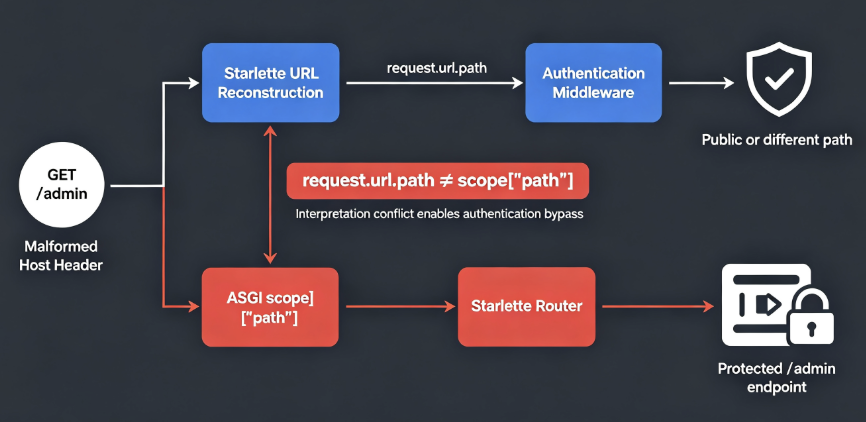
In vulnerable Starlette versions, an attacker-controlled ホスト header can change the URL reconstructed as request.url. Starlette’s router, however, continues routing the request according to the actual ASGI request path. If authentication, authorization, tenant isolation, rate limiting, or another security control makes its decision using request.url.path, the security layer can effectively authorize one path while Starlette executes another.
The vulnerability is commonly known as BadHost.
GitHub’s reviewed security advisory assigns CVE-2026-48710 a CVSS v3.1 score of 6.5 Medium, with network exploitation possible without privileges or user interaction. The affected package range is Starlette versions through 1.0.0, and the issue is fixed in Starlette 1.0.1. (ギットハブ)
GitHub Security Advisory GHSA-86qp-5c8j-p5mr
But looking only at the 6.5 base score now substantially understates the operational importance of the vulnerability.
オン September 2, 2026, CISA added CVE-2026-48710 to its Known Exploited Vulnerabilities Catalog, marking exploitation as active. The KEV record sets a remediation due date of September 16, 2026 for affected U.S. federal systems and explicitly warns that CVE-2026-48710 can be chained with CVE-2026-42271. (オープンCVE)
That changes the way defenders should think about CVE-2026-48710.
This is no longer simply a theoretical Starlette parsing edge case. It is a framework-level authentication primitive relevant to exposed AI gateways, FastAPI applications, MCP infrastructure, LLM services, and other Python systems built on top of Starlette.
CVE-2026-48710 at a Glance
| 属性 | CVE-2026-48710 |
|---|---|
| CVE ID | CVE-2026-48710 |
| Common name | BadHost |
| コンポーネント | Starlette |
| Ecosystem | Python / ASGI |
| 脆弱性タイプ | Host Header Validation Bypass |
| Security consequence | Authentication and authorization bypass |
| CWE | CWE-444, CWE-1289 |
| GitHub CVSS | 6.5 Medium |
| 攻撃ベクトル | ネットワーク |
| Attack complexity | 低い |
| Privileges required | なし |
| User interaction | なし |
| 影響を受けるバージョン | Starlette < 1.0.1 |
| パッチ版 | Starlette 1.0.1 |
| GitHub advisory | GHSA-86qp-5c8j-p5mr |
| CISA KEV | はい |
| KEV date added | September 2, 2026 |
| CISA remediation date | September 16, 2026 |
| Important downstream chain | CVE-2026-48710 + CVE-2026-42271 |
| Potential chained impact | Unauthenticated remote code execution in vulnerable LiteLLM deployments |
The vulnerability was originally disclosed in May 2026. OSTIF published expanded details on May 26 after concerns about slow patch adoption and the discovery of vulnerable downstream services. OSTIF stated that the issue was discovered by X41 D-Sec during a security audit of vLLM managed by OSTIF and sponsored by the Alpha-Omega Project. (OSTIF)
What Is Starlette?
Starlette is a lightweight ASGI framework and toolkit used across the Python web ecosystem.
Its importance goes far beyond applications that explicitly advertise themselves as “Starlette applications.”
FastAPI is built on top of Starlette. Numerous Python API gateways, AI inference servers, MCP implementations, administration interfaces, model services, agent infrastructure components, and internal control-plane applications consequently inherit Starlette as a direct or transitive dependency.
This creates an important dependency-security problem.
An engineering team may never have written:
starlettein its application architecture diagram, yet the production service can still contain a vulnerable Starlette release somewhere underneath FastAPI or another framework.
OSTIF specifically highlighted the relevance of BadHost to FastAPI, LiteLLM, vLLM, OpenAI-compatible proxy infrastructure, MCP servers, agent harnesses, evaluation dashboards, and model-management interfaces. (OSTIF)
That ecosystem reach is one reason CVE-2026-48710 deserves significantly more attention than an ordinary medium-severity dependency finding.
The Root Cause of CVE-2026-48710
The heart of CVE-2026-48710 is surprisingly simple:
Starlette’s URL reconstruction and Starlette’s routing engine could disagree about the path of the same request.
Consider a normal HTTP request:
GET /admin HTTP/1.1
Host: example.com
The application receives an ASGI scope containing information roughly equivalent to:
scope["path"] == "/admin"Starlette can also construct a higher-level URL representation accessible through:
request.urland:
request.url.pathFor an ordinary request, both representations agree:
scope["path"]       -> /admin
request.url.path    -> /admin
Developers therefore naturally assume the two values represent the same resource.
Before Starlette 1.0.1, that assumption was not guaranteed.
GitHub’s advisory explains that Starlette used the client-controlled HTTP ホスト request header while reconstructing request.url, but failed to sufficiently validate the Host before doing so. The router, meanwhile, continued operating on the actual HTTP path. (ギットハブ)
The result was an interpretation conflict.

Why a Malformed Host Header Changes URL Parsing
A Host header is supposed to contain host information, optionally including a port.
Conceptually:
example.comor:
example.com:8000The vulnerable implementation effectively combined the scheme, Host and request path into a URL representation.
例えば、こうだ:
scheme = http
host   = example.com
path   = /admin
becomes:
http://example.com/adminEverything works as expected.
But URI characters such as:
/
?
#
have structural meaning when a URL parser encounters them.
If an attacker can place such characters where the application expects only a hostname, concatenating that value with another URL component can change the boundaries between the host, path, query and fragment.
GitHub describes exactly this issue: malformed Host data can make the reconstructed request.url.path different from the path actually requested by the client. (ギットハブ)
OSTIF gives the same explanation more directly: Starlette reconstructed the URL using the Host and request path, and characters including /, ?そして # could shift URL boundaries when the resulting value was parsed again. (OSTIF)
The security model therefore becomes:
                     HTTP Request
                          |
              +-----------+-----------+
              |                       |
              v                       v
        Raw ASGI Path          Host Header
              |                       |
              |                       v
              |               URL Reconstruction
              |                       |
              |                       v
              |               request.url.path
              |                       |
              |                       v
              |              Authentication Logic
              |
              v
        Starlette Router
              |
              v
        Actual Endpoint
Normally both branches identify the same resource.
CVE-2026-48710 allows them to diverge.
The Security Boundary That Actually Breaks
Imagine an application that exempts /public from authentication:
async def auth_middleware(request, call_next):
    if request.url.path.startswith("/public"):
        return await call_next(request)

    if not is_authenticated(request):
        return Response("Unauthorized", status_code=401)

    return await call_next(request)
The code appears reasonable because developers assume:
request.url.pathrepresents the endpoint that will execute.
But suppose the router is ultimately making its routing decision using:
request.scope["path"]If malformed Host input causes:
request.url.pathto represent one location while:
scope["path"]still represents the protected location, the application has created a classic time-of-interpretation security gap.
The authentication layer answers:
"Is Path A allowed?"while the router later answers:
"Execute Path B."The attack does not defeat authentication cryptography.
It defeats the application’s understanding of what resource authentication is protecting.
That difference is essential for understanding CVE-2026-48710.
CVE-2026-48710 Is an Interpretation Conflict
CVE-2026-48710 is associated with CWE-444: Inconsistent Interpretation of HTTP Requests そして CWE-1289: Improper Validation of Unsafe Equivalence in Input in the GitHub advisory. (ギットハブ)
CISA’s KEV entry calls it a Kludex Starlette HTTP Request/Response Smuggling Vulnerability. (オープンCVE)
That terminology requires some nuance.
When security engineers hear “HTTP request smuggling,” they often immediately think of classic front-end/back-end disagreement involving:
Content-Lengthversus:
Transfer-Encodingor HTTP/1.1 message-boundary desynchronization.
BadHost is not primarily that classic CL.TE/TE.CL desynchronization pattern.
The critical problem here is an interpretation difference inside the request-processing stack, where two components derive different path identities from related representations of the request.
From a defensive perspective, the broader principle behind CWE-444 still applies perfectly:
Two security-relevant components must not interpret attacker-controlled HTTP input differently.
That principle extends far beyond Starlette.
A Safe Local Demonstration
Security teams can understand the failure without attacking an external application.
Consider a deliberately vulnerable local middleware:
from starlette.applications import Starlette
from starlette.requests import Request
from starlette.responses import JSONResponse
from starlette.routing import Route

async def admin(request: Request):
    return JSONResponse({
        "message": "protected admin endpoint",
        "scope_path": request.scope["path"],
        "url_path": request.url.path,
    })

app = Starlette(routes=[
    Route("/admin", admin)
])
Now imagine security middleware that trusts:
request.url.pathto decide whether authentication is necessary.
A local regression test can compare:
request.scope["path"]against:
request.url.pathwhen malformed Host values are supplied.
The important test assertion is not “did the exploit work?”
It is:
assert request.scope["path"] == request.url.pathfor all inputs that the application’s trusted edge permits.
If these two identifiers can differ across a security boundary, the application architecture deserves review even after the specific CVE is patched.
Why Path-Based Authentication Is Particularly Dangerous
Path-based security rules appear everywhere.
例を挙げよう:
/admin/*/internal/*/api/private/*/metrics/debug/*/v1/keys/*/mcp/*/tools/*An application may intentionally allow several routes before authentication:
PUBLIC_PATHS = {
    "/health",
    "/login",
    "/docs",
}
and protect everything else.
Alternatively, middleware might implement:
if request.url.path.startswith("/internal"):
    require_admin()
or:
if request.url.path.startswith("/v1"):
    verify_api_key()
CVE-2026-48710 attacks the assumption underlying all these patterns.
The question is not whether path-based authentication is inherently wrong.
The question is whether the path being authenticated is guaranteed to be the same path ultimately dispatched by the router.
FastAPI and CVE-2026-48710
CVE-2026-48710 is especially relevant to FastAPI users because FastAPI relies on Starlette.
That does ない mean every FastAPI application is automatically exploitable.
This distinction is important.
A vulnerable Starlette version provides the vulnerable behavior, but meaningful security impact generally requires another condition: application or middleware logic must make a security-relevant decision using the poisoned URL representation.
A simplified risk model is:
Vulnerable Starlette
        +
Attacker-controlled malformed Host reaches application
        +
Security decision depends on request.url / request.url.path
        =
Potential authentication bypass
A reverse proxy may reduce exposure if it strictly rejects malformed Host values before Starlette receives them.
However, GitHub specifically warns that a proxy or load balancer is only an effective mitigation if malformed Host headers are actually rejected or normalized before forwarding and if the application does not later trust attacker-controlled forwarded host information. (ギットハブ)
Simply saying:
“We use nginx.”
is therefore not a vulnerability assessment.
The relevant question is:
“Does our exact production request path guarantee that malformed Host information cannot reach vulnerable URL reconstruction?”
Why AI Infrastructure Is a Particularly Important Downstream Target
BadHost was discovered in a context closely related to AI infrastructure.
OSTIF says the vulnerability was identified by X41 D-Sec during a vLLM security audit. It subsequently warned about downstream exposure across FastAPI, LiteLLM, vLLM, MCP servers and other Python LLM infrastructure. (OSTIF)
That ecosystem is unusually sensitive because an AI gateway frequently has much more authority than a normal web API.
An LLM gateway may have access to:
OpenAI API keys
Anthropic API keys
Azure credentials
Gemini credentials
database connection strings
proxy master keys
virtual API keys
tenant configuration
model routing policies
MCP tools
internal services
container execution environments
Microsoft Security Research made precisely this broader observation in its August 26 investigation: AI gateways, RAG systems and workflow platforms increasingly function as high-value control points because they concentrate credentials, data connectivity and execution privileges. (マイクロソフト)
Microsoft Security Research: When AI infrastructure becomes the target
This means a seemingly modest authentication primitive can have disproportionately large consequences when it sits in front of privileged AI infrastructure.
CVE-2026-48710 and LiteLLM
The LiteLLM case is where CVE-2026-48710 becomes particularly significant.
Microsoft investigated a real LiteLLM gateway compromise and reported attacker activity including credential harvesting, PostgreSQL collection, miner deployment and persistence.
Microsoft assessed with high confidence that initial access likely occurred through exploitation of the exposed LiteLLM gateway surface. It specifically identified the public vulnerability chain involving CVE-2026-42271 and CVE-2026-48710 as consistent with the observed initial-access path. (マイクロソフト)
Microsoft’s description is careful and should be preserved accurately.
It does not claim forensic proof that one specific HTTP request definitively exploited both CVEs.
Instead, it states that the observed initial access was consistent with the publicly documented vulnerability chain.
That is nevertheless extremely important evidence.
CVE-2026-48710 + CVE-2026-42271
The two vulnerabilities complement each other.
Conceptually:
CVE-2026-48710
Authentication boundary bypass
          |
          v
Previously protected LiteLLM functionality becomes reachable
          |
          v
CVE-2026-42271
Command-execution capability
          |
          v
Remote code execution
Microsoft describes CVE-2026-42271 as an authenticated command-execution issue involving LiteLLM MCP stdio test functionality.
Normally, authentication limits who can reach that dangerous functionality.
CVE-2026-48710 can weaken that boundary in affected configurations.
Microsoft summarizes the relationship clearly: CVE-2026-42271 provides command execution, while CVE-2026-48710 can make the affected functionality reachable without valid credentials in vulnerable deployments. (マイクロソフト)
This is an important example of why vulnerability severity cannot always be understood from individual CVSS values.
The attacker does not necessarily care whether one vulnerability scores 6.5.
The attacker cares whether:
Bug A + Bug B = unauthenticated code executionFrom Authentication Bypass to Full Gateway Compromise
Microsoft’s LiteLLM investigation shows what happens after the initial web vulnerability is no longer the main story.
The attackers performed credential harvesting from the LiteLLM runtime environment.
According to Microsoft’s investigation, targeted material included provider API keys, LiteLLM master keys, database connection information, credentials, tokens and other secrets. (マイクロソフト)
The compromise then progressed into broader host-level activity.
Microsoft observed persistence mechanisms, including modification of SSH authorized keys, hidden execution paths and other measures designed to maintain continued access.
Cryptocurrency mining was also observed.
This illustrates a critical AI security principle:
An AI gateway compromise is rarely limited to the gateway API itself.
Because the gateway is positioned between applications and model providers, it can become a bridge into secrets, databases, model infrastructure and downstream cloud resources.
Wiz’s AI Infrastructure Honeypot Research
Microsoft’s observations fit into a wider attack trend.
Wiz Threat Research published results from a 90-day honeypot program on August 27, 2026, examining attacks against AI and ML infrastructure including LiteLLM, Flowise, LangChain, Langflow, ChromaDB and Ollama.
Wiz reported sustained malicious activity specifically adapted to the internal behaviors of these systems, including remote-code-execution attempts against exposed MCP infrastructure, blind prompt injection and AI-specific post-exploitation activity. (ウィズ・アイオ)
Wiz: Inside 90 days of attacks on AI infrastructure
The significance for CVE-2026-48710 is strategic.
Internet-facing AI infrastructure is no longer obscure enough to depend on security through obscurity.
Attackers are actively identifying and weaponizing AI gateways, orchestration systems and agent infrastructure.
A framework-level authentication bypass underneath those systems therefore deserves rapid remediation.
Why CISA Added CVE-2026-48710 to KEV
CISA’s Known Exploited Vulnerabilities Catalog is fundamentally different from a vulnerability database that simply lists every assigned CVE.
KEV inclusion means CISA has sufficient evidence that a vulnerability has been exploited in real-world conditions.
For CVE-2026-48710, the CISA ADP record marks exploitation as:
アクティブand records:
dateAdded: 2026-09-02with the KEV remediation deadline:
2026-09-16(オープンCVE)
That dramatically increases patch priority.
An organization using pure CVSS-based prioritization might see:
6.5 Mediumand place CVE-2026-48710 below numerous 8.x or 9.x vulnerabilities.
A threat-informed prioritization model sees something different:
Internet reachable
+
No privileges required
+
Authentication bypass
+
AI infrastructure exposure
+
Public understanding of the technique
+
Known exploitation
+
Useful vulnerability chains
That is a much stronger remediation signal.
CVSS 6.5 Does Not Mean Low Priority
GitHub’s CVSS vector is:
CVSS:3.1/AV:N/AC:L/PR:N/UI:N/S:U/C:L/I:L/A:N(ギットハブ)
The vector tells us several useful things.
The attack is network-accessible:
AV:NAttack complexity is low:
AC:LNo privileges are required:
PR:NNo victim interaction is required:
UI:NThe base impact assessment assumes limited confidentiality and integrity impact and no direct availability impact.
That is a reasonable assessment of CVE-2026-48710 in isolation.
But downstream systems determine what authentication protects.
Suppose the bypass exposes a read-only metadata endpoint.
Impact may indeed remain modest.
Suppose instead it exposes:
/admin/executeor an AI gateway endpoint capable of launching a process.
The effective impact changes dramatically.
CVSS is not wrong.
The environment changes the consequence.
Checking Whether You Run a Vulnerable Starlette Version
Python teams should check both direct and transitive dependencies.
A simple first step is:
python -m pip show starletteLook for:
Version: 1.0.1or a later patched release.
You can also inspect the complete dependency environment:
python -m pip freeze | grep -i starletteFor projects using pipdeptree:
pipdeptree | grep -i -B 3 -A 3 starletteThe goal is not merely to identify whether your application’s requirements file mentions Starlette.
You need to determine which version actually ships in production.
Containers Make Dependency Verification More Difficult
Containerized applications deserve additional attention.
Checking Starlette on a developer laptop does not prove the production container contains the same version.
例えば、こうだ:
docker run --rm your-image \
  python -c "import starlette; print(starlette.__version__)"
The same concept applies to Kubernetes workloads.
Inspect the deployed image rather than relying only on source manifests.
OSTIF specifically recommended rebuilding and redeploying containers, virtual environments and bundled artifacts containing vulnerable Starlette installations, noting that checking the host Python environment alone may miss dependencies packaged inside AI infrastructure. (OSTIF)
Dependency Constraints Can Keep Applications Vulnerable
CVE-2026-48710 also exposes an important software supply-chain issue.
Even when Starlette itself provides a patch, downstream package constraints can prevent users from receiving it.
For example, an issue filed against Google’s ADK Python project documented dependency constraints allowing vulnerable Starlette versions and noted that another framework dependency could potentially constrain the upgrade path. (ギットハブ)
Another publicly reported case involved serena-agent, which pinned:
starlette==1.0.0even though 1.0.0 was affected and 1.0.1 contained the fix. (ギットハブ)
This is why remediation should verify the resolved runtime dependency rather than merely changing one line in a manifest.
How to Audit Application Code
Dependency scanning tells you whether the vulnerable primitive exists.
Code review tells you whether the primitive crosses a security boundary.
Search for security logic involving:
request.urlor:
request.url.pathParticularly sensitive areas include:
authentication middleware
authorization middleware
tenant selection
admin-route restrictions
IP or network access controls
internal API restrictions
rate limiting
API key verification
MCP tool authorization
debug functionality
metrics endpoints
model-management APIs
gateway management interfaces
A useful repository search is:
rg "request\.url(\.path)?" .or:
grep -R "request.url" .Each result should be classified according to whether it affects a security decision.
Reading the URL for logging is different from deciding whether authentication is required.
Prefer the Authoritative Request Path for Security Decisions
Where application architecture requires direct path comparisons in middleware, use an authoritative representation tied to routing behavior.
例えば、こうだ:
path = request.scope["path"]rather than rebuilding authorization identity from attacker-influenced URL components.
A simplified security check might therefore become:
async def auth_middleware(request, call_next):
    path = request.scope["path"]

    if path in PUBLIC_PATHS:
        return await call_next(request)

    if not is_authenticated(request):
        return Response("Unauthorized", status_code=401)

    return await call_next(request)
This does not mean request.url.path should never be used.
It means security-critical logic should avoid relying on a representation that can diverge from the identifier the router ultimately executes.
OSTIF explicitly recommends using request.scope["path"] の代わりに request.url.path for affected security decisions when immediate dependency remediation is not possible. (OSTIF)
How Starlette 1.0.1 Fixes CVE-2026-48710
The primary remediation is straightforward:
Upgrade Starlette to 1.0.1 or later.
GitHub’s advisory states that patched Starlette validates the Host header according to the appropriate RFC grammar when constructing request.url.
When the supplied Host is malformed, Starlette falls back to server information from:
scope["server"]instead of trusting the malformed value during URL reconstruction. (ギットハブ)
The patch therefore addresses the vulnerability at the correct layer.
Instead of expecting every downstream FastAPI application, AI service and middleware implementation to defensively rediscover the same input-validation problem, Starlette prevents malformed Host input from poisoning the higher-level URL representation.
The associated upstream patch is commit:
764dab0dcfb9033d75442d7a359645c9f94648c6referenced directly by the GitHub advisory. (ギットハブ)
Reverse Proxies Are Defense in Depth, Not a Patch Strategy
A properly configured reverse proxy can provide another layer of protection.
Malformed Host headers should generally be rejected before reaching the application.
OSTIF notes that common frontends such as nginx, Apache HTTP Server and Cloudflare reject the demonstrated malformed Host behavior under typical configurations, while also recommending verification of the exact environment. (OSTIF)
That last phrase matters:
verify the exact environment.
Infrastructure can differ because of:
custom nginx configuration
HTTP/2 translation
HTTP/3 termination
service meshes
API gateways
CDNs
load balancers
forwarded headers
X-Forwarded-Host handling
Kubernetes ingress configuration
direct Uvicorn exposure
Do not use reverse-proxy assumptions as a substitute for upgrading Starlette.
Patch the dependency.
Then keep Host validation at the edge as defense in depth.
Detecting Attempts to Exploit CVE-2026-48710
The most direct threat-hunting opportunity is abnormal Host input.
Legitimate Host headers generally look like:
api.example.comor:
api.example.com:443Security teams should investigate Host values containing unexpected URL delimiters or malformed host syntax.
Characters of particular interest include:
/
?
#
because they are central to the URL reconstruction confusion described in the advisory. (ギットハブ)
A detection pipeline might normalize fields such as:
timestamp
source_ip
method
request_path
host_header
response_status
authenticated_user
route_name
upstream
user_agent
and flag malformed Host values reaching a Starlette application.
Reverse Proxy Detection Example
A SIEM hunting concept might look for:
Host contains "?"
OR
Host contains "#"
OR
Host contains unexpected "/"
The exact query syntax depends on the logging platform.
For example, pseudo-SQL:
SELECT
    timestamp,
    src_ip,
    method,
    request_uri,
    host,
    status
FROM http_logs
WHERE
       host LIKE '%?%'
    OR host LIKE '%#%'
    OR host LIKE '%/%';
This should not immediately be interpreted as confirmed exploitation.
Potential benign noise, broken clients, scanners and edge normalization behavior must be considered.
But on an internet-facing FastAPI, LiteLLM or Starlette service, malformed Host activity deserves investigation.
Look for Authentication and Routing Disagreement
Even stronger detection comes from correlating authentication decisions with final application routes.
Suppose logs show:
auth_middleware_path = /but:
matched_route = /adminThat is an extremely useful security signal.
Where practical, structured security telemetry can record both:
request.url.pathand:
request.scope["path"]during a controlled investigation.
Any disagreement should be treated as suspicious in a vulnerable environment.
Watch for Protected Routes Returning Unexpected 2xx Responses
Another hunting approach looks for anomalies around sensitive endpoints.
Consider:
/admin
/internal
/metrics
/mcp
/tools
/key-management
/debug
If those endpoints normally return:
401or:
403to unauthenticated users, investigate sudden:
200responses correlated with unusual Host values.
For AI gateways, defenders should also look for unexpected access followed by:
shell creation
Python child processes
credential access
database queries
container enumeration
new SSH keys
cron modification
cryptocurrency mining
unexpected outbound connections
Microsoft observed several of these behaviors after the LiteLLM compromise it investigated. (マイクロソフト)
Host Validation Must Include Forwarded Headers
One subtle problem is that the original Host header may not be the only attacker-controlled hostname representation.
Modern deployment stacks frequently contain:
Host
X-Forwarded-Host
Forwarded
:authority
Depending on proxy behavior and ASGI configuration, one layer may transform another.
GitHub specifically cautions that a reverse proxy is only protective if malformed Host information is rejected or normalized and attacker-controlled forwarded host information is not trusted elsewhere. (ギットハブ)
Defenders should therefore document:
Internet
   |
   v
CDN
   |
   v
Load Balancer
   |
   v
Ingress
   |
   v
Reverse Proxy
   |
   v
ASGI Server
   |
   v
Starlette / FastAPI
and determine which component establishes the authoritative host identity.
Patch Checklist for CVE-2026-48710
The minimum remediation is:
Starlette >= 1.0.1But a mature response should include more than a package upgrade.
First, identify all environments using vulnerable Starlette versions.
That includes:
developer environments
production containers
Kubernetes images
serverless packages
CI/CD artifacts
AI gateways
MCP servers
internal APIs
FastAPI applications
model-serving infrastructure
Second, identify code making security decisions from:
request.url.pathThird, validate reverse-proxy Host handling.
Fourth, deploy the patched Starlette release.
Fifth, rebuild rather than merely restarting existing immutable images.
Sixth, rerun authentication regression tests.
Finally, inspect logs for evidence that malformed Host requests occurred before patching.
Because CVE-2026-48710 is now in KEV, remediation should include the possibility of prior exploitation rather than assuming that installing the patch completely resolves the incident risk.
Patching Is Not the Same as Incident Response
This distinction is particularly important for internet-facing AI infrastructure.
Suppose a vulnerable LiteLLM gateway was exposed publicly for several weeks before Starlette was updated.
Upgrading Starlette solves the vulnerability.
It does not answer whether an attacker already used it.
For potentially exposed systems, defenders should consider reviewing:
reverse proxy logs
application request logs
authentication logs
process execution
container runtime events
database activity
API provider usage
SSH authorized_keys
cron configuration
systemd services
outbound network traffic
cryptocurrency mining indicators
If compromise is suspected, rotate secrets accessible from the affected runtime.
For AI gateways that can include:
model-provider API keys
LiteLLM master keys
database credentials
cloud credentials
service tokens
MCP credentials
internal API keys
Microsoft’s LiteLLM investigation demonstrates why this matters: the observed attacker specifically harvested credentials from the gateway environment after gaining execution. (マイクロソフト)
Why AI Gateways Need a Different Security Model
Traditional API gateways are already security-critical.
AI gateways add several new capabilities:
model access
tool invocation
agent execution
credential brokerage
MCP connectivity
vector database access
code execution
workflow orchestration
external retrieval
This means authentication bypass can reach functionality with far more power than conventional CRUD APIs.
An endpoint that looks like:
/testor:
/toolsmay ultimately trigger:
subprocess execution
network access
file access
database queries
LLM credentials
cloud APIs
For this reason, AI infrastructure should be modeled as a privileged control plane rather than simply another web application.
Microsoft reaches a similar conclusion from its investigations, describing AI workloads as high-value control points that concentrate data access, credentials, model connectivity and execution privileges. (マイクロソフト)
CVE-2026-48710 Shows Why Middleware Security Can Fail
Middleware feels like a natural place for authentication.
It is centralized.
It executes early.
It can protect many endpoints with one implementation.
But middleware exists above lower-level HTTP parsing and routing abstractions.
That creates a dangerous question:
Is the security middleware authorizing the exact same request representation that downstream routing will execute?
CVE-2026-48710 demonstrates what happens when the answer is no.
The broader secure-design rule is:
Parse once.
Normalize once.
Authorize the canonical representation.
Route the canonical representation.
Avoid architectures that look like:
parse
-> reconstruct
-> parse again
-> authorize representation A
-> route representation B
Each interpretation boundary creates an opportunity for ambiguity.
This Pattern Exists Beyond Host Headers
BadHost belongs to a much broader family of security failures.
Related interpretation inconsistencies appear in:
HTTP request smuggling
path normalization bypass
URL parser confusion
double URL encoding
Unicode normalization
proxy/backend discrepancies
cache poisoning
host routing confusion
filesystem traversal
API gateway bypass
例えば、こうだ:
/api/adminand:
/api/%61dminmay become dangerous if the proxy and backend normalize them differently.
Similarly:
/path/../adminmay cross a security boundary if authorization and routing normalize traversal sequences at different times.
CVE-2026-48710 applies the same principle to Host-driven URL reconstruction.
The reusable lesson is simple:
Never assume two independently parsed representations of attacker-controlled input are equivalent.
Testing CVE-2026-48710 Safely
Organizations should test only systems they own or are explicitly authorized to assess.
The safest workflow begins with dependency inspection rather than network exploitation.
Determine:
Is Starlette present?Then:
What version is actually deployed?Then:
Does security middleware depend on request.url.path?Then:
Can malformed Host information reach the ASGI application?A controlled staging environment can then compare normal and malformed Host handling without touching third-party infrastructure.
OSTIF also points to tooling from the BadHost research effort, including static-analysis approaches such as Semgrep and CodeQL patterns for identifying downstream security-sensitive use of Starlette URL values. (OSTIF)
This layered method produces better evidence than simply firing a public PoC at production.
Verification After Patching
After upgrading Starlette, retest the same edge cases.
The expected behavior is that malformed Host input no longer poisons the URL path used by the application.
You should also verify:
normal requests still route correctly
authentication remains enforced
reverse proxies reject malformed Host headers
forwarded headers cannot reintroduce ambiguity
containers actually contain the patched package
all production replicas were replaced
A good regression test should become permanent.
For example, security tests can assert that protected routes remain protected across malformed Host variations.
That prevents a future framework change or proxy configuration update from silently recreating the same architectural weakness.
Where Automated Pentesting Helps
CVE-2026-48710 is a useful example of why dependency scanning and exploit validation solve different problems.
A dependency scanner can tell you:
starlette==1.0.0and correctly flag CVE-2026-48710.
But that alone does not answer:
Can malformed Host reach the application?Does the application use request.url.path for authorization?Does the reverse proxy normalize the request?Can the bypass reach a sensitive endpoint?Does exploitation create meaningful business impact?An authorized penetration-testing workflow can validate the complete security boundary rather than stopping at package presence.
For organizations using agentic security workflows, Penligent can be used to combine asset discovery, request-level testing, evidence collection and vulnerability verification within an authorized target scope. The goal in a case such as CVE-2026-48710 is not simply to identify a version string, but to determine whether the vulnerable parsing behavior actually crosses an authentication boundary in the deployed environment.
Penligent AI Penetration Testing Platform
That distinction becomes even more important when assessing chained vulnerabilities such as CVE-2026-48710 and CVE-2026-42271, because meaningful risk depends on the exact deployment topology and what functionality becomes reachable after the first control fails.
Common Questions About CVE-2026-48710
Is CVE-2026-48710 remotely exploitable?
Yes. GitHub’s CVSS vector classifies the attack vector as network-accessible, with low complexity, no privileges required and no user interaction. (ギットハブ)
Actual impact still depends on whether malformed Host data reaches the affected Starlette application and whether security logic depends on vulnerable URL reconstruction.
Which Starlette versions are affected?
The GitHub advisory lists:
Affected: <= 1.0.0
Patched: 1.0.1
The broader CVE record describes affected versions as:
< 1.0.1(ギットハブ)
Upgrade to Starlette 1.0.1 or a later compatible patched version.
Does CVE-2026-48710 affect FastAPI?
Potentially.
FastAPI relies on Starlette, so a FastAPI environment may contain an affected Starlette version.
However, vulnerable dependency presence does not automatically mean every FastAPI endpoint can have authentication bypassed.
Exploitability depends on the application’s security logic and deployment architecture.
Does nginx automatically fix CVE-2026-48710?
No.
A correctly configured proxy that rejects malformed Host headers can reduce exposure, and OSTIF reports that several common frontends reject the demonstrated behavior under typical configurations. (OSTIF)
But the correct primary remediation remains upgrading Starlette.
Your exact proxy configuration must also be tested.
Is CVE-2026-48710 being exploited in the wild?
Yes.
CISA added the vulnerability to its Known Exploited Vulnerabilities Catalog on September 2, 2026 and marks exploitation as active. (オープンCVE)
Microsoft has additionally investigated an actual LiteLLM compromise whose initial-access path was assessed as consistent with the public chain involving CVE-2026-48710 and CVE-2026-42271. (マイクロソフト)
Can CVE-2026-48710 lead to RCE?
CVE-2026-48710 itself is fundamentally an authentication or security-control bypass primitive.
It does not universally mean:
Host header -> shellHowever, if the bypass exposes an endpoint containing a separate code-execution vulnerability, the resulting chain can produce unauthenticated RCE.
The LiteLLM chain involving CVE-2026-42271 is the clearest real-world example. (マイクロソフト)
Why is the CVSS only 6.5 if the vulnerability is serious?
Because CVSS measures the vulnerability according to a standardized base model.
It cannot fully model every downstream endpoint protected by path-based authorization.
An authentication bypass protecting low-value information has one consequence.
An authentication bypass protecting an MCP command-execution endpoint has another.
CISA KEV inclusion and real-world chaining evidence should therefore influence remediation priority alongside CVSS.
Final Assessment
CVE-2026-48710 is a strong example of a vulnerability whose importance becomes clearer only when the full request-processing architecture is examined.
At the framework level, the bug is straightforward:
malformed Host
        ->
incorrect request.url reconstruction
        ->
request.url.path differs from actual request path
At the application level:
security middleware checks poisoned path
        ->
authentication decision becomes incorrect
At the routing level:
Starlette routes the real path
        ->
protected endpoint executes
And in a vulnerable downstream product:
authentication bypass
        +
command-execution endpoint
        ->
unauthenticated RCE
That progression explains why CVE-2026-48710 moved from an apparently moderate framework issue in May 2026 to a CISA Known Exploited Vulnerability by September.
The technical lesson is equally important.
Security controls cannot merely inspect something that looks like the request target. Authentication, authorization, proxy filtering and routing must operate on a canonical representation of the same request.
Whenever two components can answer the question:
“What resource is this request targeting?”
with different answers, the boundary between them deserves security scrutiny.
For Starlette users, the immediate action is clear: upgrade to Starlette 1.0.1 or later, inspect security-sensitive uses of request.url.path, verify Host validation at every proxy layer, and investigate previously exposed systems for signs of exploitation.
For AI infrastructure operators, CVE-2026-48710 carries an additional warning. Model gateways, MCP servers and agent runtimes increasingly combine credentials, privileged APIs and execution capabilities behind a single HTTP boundary. A small inconsistency in how that boundary interprets a request can therefore become the first step toward full infrastructure compromise.

 Japanese
  English
  German
  French
  Spanish
  Portuguese
  Korean
  Hindi
Hindi  Arabic
  Turkish
  Hebrew