
CVE-2026-8452 has rapidly changed from what initially looked like another high-severity NetScaler memory-safety issue into an emergency patching priority for organizations operating internet-facing NetScaler ADC and NetScaler Gateway appliances.
NetScaler disclosed the vulnerability on June 30, 2026 as a memory overflow affecting NetScaler ADC and NetScaler Gateway. According to the vendor, exploitation can result in unpredictable or erroneous appliance behavior and denial of service when a vulnerable system is configured as a Gateway—including SSL VPN, ICA Proxy, CVPN, or RDP Proxy—or as an AAA virtual server. The vendor assigned the vulnerability a CVSS 4.0 score of 8.8 High. (Citrix Support)
That description no longer captures the full operational risk defenders should associate with CVE-2026-8452.
On August 14, 2026, watchTowr Labs published detailed research into a NetScaler pre-authentication heap overflow that the researchers believe corresponds to CVE-2026-8452. Their analysis showed that the apparent memory-corruption condition could be developed far beyond denial of service, ultimately achieving unauthenticated remote code execution against a vulnerable NetScaler appliance in their test environment. (watchTowr Labs)
Soon afterward, exploitation attempts began appearing against security sensors and honeypots. NHS England warned that exploitation attempts had been observed following publication of the proof of concept, while Canada’s Cyber Centre updated its advisory on August 17 to state that open-source reporting indicated exploitation of CVE-2026-8452 in the wild. (NHS Digital)
The escalation became official on August 26, 2026, when the U.S. Cybersecurity and Infrastructure Security Agency added CVE-2026-8452 to its Known Exploited Vulnerabilities Catalog based on evidence of active exploitation. (CISA)
For security teams, that changes the vulnerability-management decision completely.
CVE-2026-8452 should no longer be prioritized solely because of its CVSS score. It should be treated as an actively exploited vulnerability affecting precisely the type of appliance attackers repeatedly target for initial access: an internet-facing remote-access gateway positioned between untrusted networks and enterprise authentication infrastructure.
CVE-2026-8452 at a Glance
| 項目 | 詳細 |
|---|---|
| CVE | CVE-2026-8452 |
| 製品 | NetScaler ADC and NetScaler Gateway |
| 脆弱性クラス | Memory overflow / memory corruption |
| CWE | CWE-119 |
| Vendor CVSS | CVSS 4.0 8.8 High |
| NVD CVSS 3.1 | 9.8 Critical |
| 攻撃ベクトル | ネットワーク |
| Authentication required | いいえ |
| User interaction | いいえ |
| Vendor-described impact | Unpredictable behavior and denial of service |
| Research-demonstrated impact | Pre-authentication RCE in the analyzed vulnerable configuration |
| Active exploitation | はい |
| CISA KEV | Added August 26, 2026 |
| Primary exposure condition | Gateway or AAA virtual server |
| Fixed 14.1 build | 14.1-72.61 or later |
| Fixed 13.1 build | 13.1-63.18 or later |
| Fixed 14.1 FIPS build | 14.1-72.61 FIPS or later |
| Fixed 13.1 FIPS / NDcPP build | 13.1-37.272 or later |
Citrix’s official bulletin identifies NetScaler ADC and Gateway 14.1 before 14.1-72.61 and 13.1 before 13.1-63.18 as vulnerable, alongside the relevant FIPS and NDcPP builds. Citrix strongly recommends upgrading affected customer-managed appliances. (Citrix Support)
Why CVE-2026-8452 Matters More Than Its Original Description Suggests
Memory-safety vulnerabilities are notoriously difficult to evaluate based only on an early vendor impact description.
A buffer overflow that initially appears useful only for crashing a service may, under the right memory layout and exploitation conditions, allow an attacker to influence adjacent objects, corrupt function pointers, obtain controlled memory writes, or eventually redirect program execution.
CVE-2026-8452 illustrates that difference unusually clearly.
The original CVE description states that a memory overflow can cause unpredictable or erroneous behavior and denial of service. The vendor CVSS vector, however, is already notable:
CVSS:4.0/AV:N/AC:L/AT:N/PR:N/UI:N/VC:H/VI:L/VA:H/SC:L/SI:L/SA:L
That translates into a vulnerability reachable across the network, requiring low attack complexity, no privileges, no user interaction, and producing potentially high confidentiality and availability impact on the vulnerable system. (NVD)
NVD separately scores the vulnerability 9.8 Critical under CVSS 3.1, using the vector:
CVSS:3.1/AV:N/AC:L/PR:N/UI:N/S:U/C:H/I:H/A:H
The difference between the two scoring systems is less important operationally than the underlying characteristics: an attacker can potentially reach the vulnerable functionality remotely without first authenticating. (NVD)
For an internet-facing VPN or application-delivery gateway, that combination deserves immediate attention even before considering the subsequent RCE research.
From Memory Overflow to Pre-Authentication RCE
The most significant technical development came from watchTowr Labs.
Researchers analyzed a patched and unpatched NetScaler environment and identified a heap-overflow condition associated with SAML processing. Their testing focused on appliances configured to use SAML as either a Service Provider or Identity Provider. (watchTowr Labs)
There is an important attribution caveat here.
Citrix’s June security bulletin included several vulnerabilities and did not publicly map each credited researcher to an individual CVE. watchTowr therefore states that it believes the vulnerability it analyzed is CVE-2026-8452 based on the memory-overflow description, but the article deliberately labels the CVE with a question mark. That distinction should be preserved in technically accurate reporting. (watchTowr Labs)
Bishop Fox subsequently analyzed the patched behavior from a defensive perspective and likewise describes the condition as CVE-2026-8452, while crediting the original discovery to Michael Tucker of JPMorgan Chase’s XOR team and watchTowr for the root-cause and exploitation research. (Bishop Fox)
The likely attack chain is particularly important because it occurs in authentication infrastructure.
SAML Signature Processing Becomes the Attack Surface
Security Assertion Markup Language, or SAML, is widely used to exchange authentication assertions between identity providers and service providers.
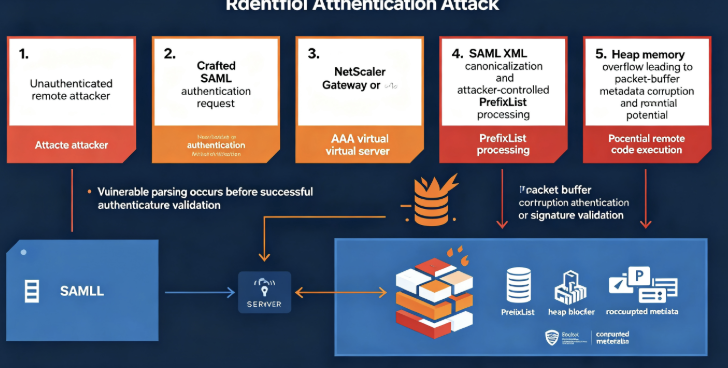
A typical enterprise may place NetScaler in front of applications and use SAML to integrate remote access with its identity infrastructure. This makes the NetScaler appliance responsible for parsing attacker-controlled XML before the authentication transaction has been completely validated.
According to the public technical research, the vulnerable path appears during SAML XML signature canonicalization.
Canonicalization is necessary because XML signatures must operate on a normalized representation of XML data. Different but semantically equivalent XML encodings need to produce the same canonical byte sequence before signature verification can work reliably.
That means the implementation has to parse portions of attacker-controlled XML before it knows whether the signature itself should ultimately be trusted.
This ordering is what makes the vulnerability especially dangerous.
The PrefixList Field
The public research identifies an attacker-controlled PrefixList associated with XML Exclusive Canonicalization as the key field involved in triggering the overflow.
Conceptually, a SAML signature may contain a structure resembling:
<ds:SignedInfo>
    ...
    <ec:InclusiveNamespaces PrefixList="..."/>
    ...
</ds:SignedInfo>
The value is legitimate XML metadata.
The problem is not the existence of PrefixList itself. The problem described by researchers is how NetScaler handles an abnormally large value.
According to Bishop Fox’s independent defensive analysis, the vulnerable implementation copied attacker-controlled PrefixList data into a fixed-size buffer without properly rejecting oversized values before the copy. (Bishop Fox)
That creates the heap overflow.
Why Authentication Does Not Protect the Device
One might assume that attacking SAML requires first possessing valid SAML credentials.
That assumption does not hold here.
The vulnerable canonicalization step occurs before NetScaler can finish validating the SAML signature. As a result, the appliance may process the malformed structure before establishing whether the request represents an authenticated user at all. (Bishop Fox)
This is why the vulnerability is characterized as pre-authentication.
The attack surface therefore sits on the public-facing authentication layer itself.
For defenders, this distinction is crucial.
Strong passwords do not stop it.
Multi-factor authentication does not stop it.
Account lockout does not stop it.
A stolen SAML assertion is not required simply to reach the vulnerable parser.
The attack targets the code responsible for deciding whether authentication should succeed in the first place.
How the Heap Overflow Can Become Code Execution
A heap overflow becomes truly dangerous when corrupted memory influences security-sensitive structures.
The NetScaler packet-processing architecture gives this bug particularly interesting exploitation properties.
watchTowr’s research describes corruption involving internal network-buffer structures handled by the NetScaler packet-processing engine. By carefully shaping heap state and overflowing into adjacent metadata, the researchers were able to progress from uncontrolled corruption toward a controlled memory-write primitive. (watchTowr Labs)
That distinction matters.
A random heap overflow commonly produces only a crash.
A partially controlled heap overflow may alter application state.
A reliable primitive that allows attacker-selected data to be written to attacker-influenced memory locations creates the building block needed for significantly more powerful exploitation.
watchTowr ultimately demonstrated control of program execution on its tested NetScaler 13.1 appliance and published a public detection/exploitation artifact for the researched condition. The repository demonstrates successful command execution with elevated effective privileges in the researchers’ environment. (ギットハブ)
The exact exploitation mechanics are build-dependent. Public research tooling contains hard-coded offsets for a specific NetScaler build, meaning defenders should not assume that one published PoC automatically compromises every affected NetScaler release without modification. (ギットハブ)
That limitation, however, should not provide comfort.
Once a vulnerability reaches public proof-of-concept maturity and attackers understand the underlying corruption primitive, adapting an exploit for additional builds becomes an engineering problem rather than a vulnerability-discovery problem.
The subsequent evidence of active exploitation demonstrates why that distinction matters.
Active Exploitation of CVE-2026-8452
The timeline following publication of the RCE research was short.
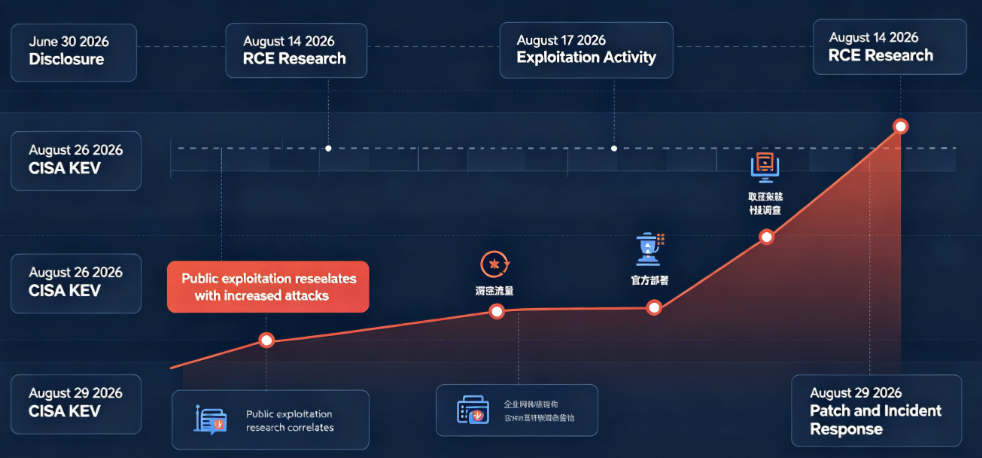
On August 14, 2026, watchTowr publicly released its technical analysis and artifact. (watchTowr Labs)
By August 17, threat-intelligence sensors reported exploitation attempts. Previdian recorded active exploitation beginning August 17 and later documented attacks from multiple source addresses targeting its sensor infrastructure. (Previdian)
Canada’s Cyber Centre updated its Citrix advisory on August 17 to state that open-source reporting indicated CVE-2026-8452 was being exploited in the wild. (Canadian Centre for Cyber Security)
NHS England subsequently published an alert stating that security researchers had observed exploitation attempts against honeypots following the release of the public proof of concept and assessed further exploitation as almost certain. (NHS Digital)
Finally, CISA added CVE-2026-8452 to the Known Exploited Vulnerabilities Catalog on August 26, alongside five other vulnerabilities, explicitly stating that the additions were based on evidence of active exploitation. (CISA)
At that point, the vulnerability moved from “public exploit available” to a much stronger risk category: confirmed known exploitation.
CISA’s KEV listing is particularly significant because inclusion requires more than theoretical exploitability. It represents evidence that adversaries are actually exploiting the vulnerability.
For vulnerability-management teams, this should override normal CVSS-based patch queues.
Affected NetScaler Versions
Citrix lists the following supported releases as affected by the group of vulnerabilities covered by bulletin CTX696604, including CVE-2026-8452. (Citrix Support)
| 製品 | 脆弱 | Fixed |
|---|---|---|
| NetScaler ADC / Gateway 14.1 | Earlier than 14.1-72.61 | 14.1-72.61 or later |
| NetScaler ADC / Gateway 13.1 | Earlier than 13.1-63.18 | 13.1-63.18 or later |
| NetScaler ADC 14.1 FIPS | Earlier than 14.1-72.61 FIPS | 14.1-72.61 FIPS or later |
| NetScaler ADC 13.1 FIPS / NDcPP | Earlier than 13.1-37.272 | 13.1-37.272 or later |
NetScaler also warns that Secure Private Access Hybrid deployments using NetScaler instances are affected and that the underlying NetScaler instances must be upgraded. (Citrix Support)
Organizations running older unsupported NetScaler branches should not interpret their absence from the current supported-version table as evidence of safety. NetScaler’s own documentation notes that its security-advisory functionality does not support builds that have reached end of life and recommends moving to supported releases. (Netscaler Docs)
Which Configurations Are Actually Exposed?
CVE-2026-8452 does not necessarily expose every NetScaler installation in exactly the same way.
Citrix states that the vulnerability applies when the appliance is configured as either a Gateway or an AAA virtual server.
The official bulletin specifically tells administrators to inspect their configuration for the presence of:
add authentication vserver ...
for an AAA virtual server, or:
add vpn vserver ...
for a Gateway virtual server. (Citrix Support)
The Gateway category includes common enterprise remote-access configurations such as SSL VPN, ICA Proxy, CVPN and RDP Proxy.
That is significant because this is not an obscure administrative feature.
Gateway functionality is often the reason the NetScaler exists in the first place.
The public RCE research adds another layer to the exposure question: watchTowr reports successfully reaching the researched vulnerability when NetScaler was configured to use SAML as either an SP or IdP. (watchTowr Labs)
Security teams should therefore pay particular attention to NetScaler Gateway or AAA virtual servers involved in SAML authentication.
But this should be used to prioritize investigation, not to delay the vendor-recommended update.
Citrix’s authoritative remediation remains upgrading affected appliances to fixed builds.
Why Internet-Facing NetScaler Appliances Are High-Value Targets
The location of a vulnerability in the network often matters as much as the vulnerability itself.
A NetScaler Gateway commonly acts as an external authentication and application-access boundary.
It may terminate TLS.
It may process VPN sessions.
It may mediate Citrix application access.
It may integrate with Active Directory, LDAP, RADIUS or SAML identity systems.
It may possess private TLS keys, API credentials, authentication configuration and session-related data.
And, most importantly, it is intentionally reachable from outside the trusted enterprise network.
An attacker who compromises a workstation has gained a workstation.
An attacker who compromises the authentication gateway through which remote users enter an enterprise may gain a strategic position directly at the edge of the environment.
This explains why vulnerabilities in VPN concentrators, application-delivery controllers, security appliances and identity gateways repeatedly attract rapid exploitation.
They provide attackers with something ordinary application vulnerabilities often do not: direct access to infrastructure designed to bridge the internet and internal enterprise resources.
CVE-2026-8452 combines that valuable position with pre-authentication reachability and public exploit research.
CVE-2026-8452 vs CVE-2026-8451
CVE-2026-8452 should also not be confused with CVE-2026-8451.
Both vulnerabilities were disclosed in the same NetScaler security bulletin and share the same patched version families, but they represent different memory-safety problems. (Citrix Support)
CVE-2026-8451 is an insufficient-input-validation vulnerability that can cause a memory overread when NetScaler is configured as a SAML Identity Provider. That class of issue can expose sensitive memory contents rather than overwriting adjacent memory. (NVD)
CVE-2026-8452 is described by the vendor as a memory overflow affecting Gateway or AAA virtual-server configurations.
In simplified form:
| 脆弱性 | Primary memory issue | Main vendor-described consequence |
|---|---|---|
| CVE-2026-8451 | Memory overread | Sensitive memory disclosure |
| CVE-2026-8452 | Memory overflow | Erroneous behavior / DoS, with RCE demonstrated by researchers |
The difference between reading beyond the intended boundary and writing beyond it is fundamental.
An overread may expose data residing nearby in memory.
An overflow can corrupt what resides nearby in memory.
That corruption capability is one of the reasons CVE-2026-8452 can potentially support more complicated exploitation.
Why the CVSS 8.8 Rating Should Not Delay Patching
Organizations sometimes prioritize vulnerabilities by filtering for CVSS scores of 9.0 or greater.
CVE-2026-8452 demonstrates the weakness in that approach.
The vendor CVSS 4.0 score is 8.8.
Yet the vulnerability is remotely reachable.
It requires no authentication.
It requires no user interaction.
Public research demonstrates a path to code execution.
Exploit tooling exists.
And CISA now recognizes exploitation in the wild.
The practical risk is therefore much higher than the phrase “High-severity denial-of-service vulnerability” might suggest to someone scanning a vulnerability dashboard.
Risk prioritization should incorporate exploitation maturity and asset context.
An 8.8 vulnerability known to be exploited against internet-facing authentication gateways usually deserves faster remediation than a hypothetical 9.8 vulnerability confined to a non-routable lab server.
CISA’s KEV program exists partly to address exactly this problem.
How to Detect Vulnerable NetScaler Appliances
The safest first step is inventory.
Administrators should identify every customer-managed NetScaler ADC and Gateway appliance, including HA nodes, disaster-recovery systems, test environments that remain externally reachable, forgotten appliances associated with migrations, and systems operated through third-party hosting providers.
The NetScaler Console security advisory dashboard has native support for identifying CVE-2026-8452-affected instances. Administrators can navigate to CVE Detection, locate CVE-2026-8452 and view impacted instances. NetScaler documents remediation through its upgrade workflow and notes that an on-demand scan can be used when administrators do not want to wait for the normal advisory scan cycle. (Netscaler Docs)
Administrators should independently confirm the actual running build as well.
Configuration should then be reviewed for the Gateway and AAA virtual-server preconditions described in CTX696604.
Citrix provides the relevant configuration patterns directly:
add authentication vserver
そして
add vpn vserver
These indicate the types of configured services associated with CVE-2026-8452 exposure. (Citrix Support)
For environments using SAML, additional attention should be placed on SAML-backed authentication paths because that is where the public RCE research identified the vulnerable processing path.
Behavioral Patch Verification
An interesting defensive development came from Bishop Fox after the public technical disclosure.
Rather than attempting to exploit the vulnerability or crash an appliance, Bishop Fox studied the behavioral difference between patched and unpatched NetScaler releases.
Their research found that fixed builds impose a limit on the relevant PrefixList processing behavior. They created a production-oriented checker designed to distinguish patched from unpatched behavior without crossing into the lengths associated with memory corruption. (Bishop Fox)
This is useful for organizations that cannot rely solely on version inventories.
Asset databases may be stale.
Appliances may have been upgraded but never restarted into the expected image.
An HA pair may contain inconsistent builds.
A change ticket may say “completed” while one internet-facing appliance remains vulnerable.
Behavioral verification provides another source of evidence.
It should still supplement rather than replace vendor-supported version verification and proper configuration management.
Detecting Possible Exploitation
Determining whether an appliance is vulnerable and determining whether it has already been compromised are different questions.
A successful upgrade answers the first question.
It does not automatically answer the second.
If CVE-2026-8452 was exploited before the system was updated, an attacker may already have executed commands or created persistence.
This matters especially now that CVE-2026-8452 has entered CISA KEV.
Security teams responsible for previously exposed, vulnerable NetScaler appliances should therefore treat patching and compromise assessment as parallel activities rather than sequential substitutes.
Useful investigation sources include NetScaler system logs, authentication logs, shell history where available, filesystem changes, unexpected files in web-accessible locations, unusual process activity, unexpected configuration modifications, outbound connections from the appliance, crashes of the packet-processing engine, unexplained reboots and anomalies around the period in which the appliance remained vulnerable.
A crash alone is not proof of exploitation.
Memory corruption can crash a vulnerable appliance without producing code execution, while legitimate operational conditions may also produce crashes.
Conversely, the absence of a visible crash is not proof that exploitation did not occur.
The public exploitation research specifically demonstrates why a capable attacker may attempt to maintain control without leaving an obvious appliance reboot as the primary artifact.
This is one reason edge-appliance incident response is difficult: organizations frequently have less EDR telemetry on VPN and networking appliances than on ordinary Windows or Linux endpoints.
Patching Is the Primary Remediation
NetScaler’s recommendation is straightforward: affected customers should install the fixed builds as soon as possible. (Citrix Support)
For CVE-2026-8452, organizations should move to at least:
NetScaler ADC / Gateway 14.1
→ 14.1-72.61 or later

NetScaler ADC / Gateway 13.1
→ 13.1-63.18 or later

NetScaler ADC 14.1 FIPS
→ 14.1-72.61 FIPS or later

NetScaler ADC 13.1 FIPS / NDcPP
→ 13.1-37.272 or later
Those values should be treated as minimum fixed builds from the June bulletin, not necessarily as the newest available NetScaler software.
If a newer supported maintenance build exists for the organization’s deployment, administrators should evaluate the latest vendor guidance rather than deliberately stopping at the oldest build containing the CVE-2026-8452 fix.
Do Not Forget HA Pairs
NetScaler is frequently deployed in high-availability configurations.
That creates an easy operational failure mode.
An organization upgrades the active appliance, verifies that applications remain available and closes the vulnerability ticket.
The secondary appliance remains vulnerable.
During a failover, the vulnerable node becomes externally reachable again.
Alternatively, attack traffic may reach more than one component depending on network architecture.
The correct remediation scope is therefore the NetScaler deployment, not merely the device that happened to be active when the vulnerability scanner ran.
Both nodes should be upgraded and independently verified.
The same principle applies to disaster-recovery environments.
A standby gateway that is normally unused but can be made publicly reachable during an emergency still belongs in the vulnerability inventory.
What to Do If You Cannot Patch Immediately
Because this vulnerability affects remote-access functionality, patching may require a carefully managed maintenance event.
But “cannot patch today” should not translate into “do nothing until the maintenance window.”
Organizations that temporarily cannot update should reduce reachability to the affected services wherever business requirements permit, restrict access from unnecessary networks, ensure management interfaces are isolated from the internet, review Gateway and AAA configurations, and increase monitoring around the exposed appliance.
These actions reduce risk but should not be described as equivalent to the vendor fix.
Citrix’s official remediation is upgrading to a fixed version. (Citrix Support)
Once active exploitation has been confirmed, temporary compensating controls should be treated as time-buying measures, not long-term remediation.
Why WAF Rules Are Not a Complete Solution
Some organizations may attempt to protect NetScaler using upstream filtering.
That can be useful as a temporary layer, especially if highly specific malicious request patterns become available.
But relying exclusively on WAF detection for a memory-corruption vulnerability in an authentication gateway is risky.
Attackers can modify XML formatting.
SAML structures may vary legitimately.
Encoding and canonicalization behaviors are complex.
Researchers can discover alternate trigger representations.
And an upstream device may terminate, normalize or transform traffic differently from the vulnerable target.
A WAF signature therefore has to solve an inherently difficult problem: distinguish every malicious representation that reaches vulnerable parser behavior from every legitimate request.
The patched NetScaler code solves the problem at the vulnerable processing point itself.
That is fundamentally more reliable.
CVE-2026-8452 and the Broader Edge-Device Problem
CVE-2026-8452 fits a broader security pattern.
Enterprise edge appliances are increasingly among the most valuable systems attackers can compromise.
They are exposed to the internet by design.
They often cannot run conventional endpoint security agents.
They possess privileged network positioning.
They interact with identity systems.
They frequently contain reusable secrets.
And defenders may patch them more slowly because maintenance can interrupt remote access for thousands of users.
From an attacker perspective, that combination is highly attractive.
This is why vulnerability-management processes designed around monthly workstation patching are poorly suited for internet-facing VPN gateways and application-delivery infrastructure.
An exploitable NetScaler vulnerability may need to be handled more like an emergency perimeter incident than a routine software-update ticket.
CVE-2026-8452 is now a strong example of that principle.
The Disclosure Timeline
The chronology shows how quickly vulnerability risk can change.
| Date | Event |
|---|---|
| June 30, 2026 | Citrix publishes CTX696604 and CVE-2026-8452 |
| June 30, 2026 | Fixed NetScaler builds become available |
| August 14, 2026 | watchTowr publishes technical research and public artifact for the likely CVE-2026-8452 pre-auth RCE |
| August 17, 2026 | Exploitation activity begins appearing in public threat-intelligence reporting |
| August 17, 2026 | Canadian Cyber Centre updates its advisory citing in-the-wild exploitation |
| August 21, 2026 | Bishop Fox publishes non-destructive patch-verification research |
| August 26, 2026 | CISA adds CVE-2026-8452 to the KEV Catalog |
| August 29, 2026 | CISA remediation deadline associated with the KEV entry for covered federal systems |
The disclosure-to-PoC gap was roughly six weeks.
The PoC-to-observed-exploitation gap was measured in days.
That compression is increasingly common once exploit research becomes public.
Why Public Exploit Research Changes the Attacker Economics
Before detailed vulnerability research exists, an attacker interested in CVE-2026-8452 would need to reverse engineer NetScaler binaries, locate the vulnerable path, understand the allocator and surrounding heap structures, identify useful corruption targets and develop a sufficiently stable execution primitive.
That is expensive work.
Once high-quality research explains the architecture and demonstrates feasibility, much of that cost disappears.
Attackers no longer begin from zero.
They begin from a known vulnerable field.
They know which component processes it.
They know that pre-authentication reachability is possible.
They know memory corruption can be progressed toward code execution.
They can inspect publicly available research artifacts.
The remaining challenge is often adapting the exploit to additional firmware versions or operational environments.
This is exactly why the period immediately after exploit publication is dangerous.
The number of actors capable of exploiting a vulnerability can increase dramatically even though nothing about the vulnerable software itself has changed.
Security Response Priorities
For an organization operating NetScaler today, the practical response can be reduced to one emergency workflow:
- Inventory every NetScaler ADC and Gateway instance, including HA nodes, DR systems and third-party-hosted appliances.
- Identify vulnerable builds, especially 14.1 releases below 14.1-72.61 and 13.1 releases below 13.1-63.18.
- Identify Gateway and AAA virtual servers, with particular attention to internet-facing SAML authentication deployments.
- Preserve relevant forensic evidence before destructive remediation when a vulnerable appliance has been publicly exposed.
- Upgrade every affected appliance to a fixed supported build or later.
- Verify the upgrade independently, rather than relying solely on a completed maintenance ticket.
- Hunt for evidence of pre-patch compromise, including unexpected files, configuration changes, process anomalies, crashes, unusual outbound connections and authentication anomalies.
- Assume credentials or secrets accessible from a confirmed compromised edge appliance may require rotation, based on the results of the incident investigation.
- Review downstream systems reachable from the NetScaler if compromise is discovered.
- Keep the appliance in heightened monitoring after remediation, because patch installation removes the vulnerability but does not automatically remove attacker persistence established beforehand.
CVE-2026-8452 Detection vs Exploitation Testing
Security teams should distinguish vulnerability verification from exploitation.
A safe verification method answers:
Is this appliance running vulnerable behavior?
An exploit answers:
Can I corrupt the process sufficiently to achieve attacker-controlled execution?
Those are very different operational activities.
For production NetScaler systems, defenders generally do not need to intentionally trigger heap corruption merely to prove exposure.
The vendor’s version information, configuration checks, NetScaler Console CVE detection and non-destructive behavioral checks provide safer approaches.
Actual exploit reproduction belongs in an isolated laboratory environment or explicitly authorized penetration-testing engagement where crashes and appliance instability are acceptable.
That distinction matters because the original vendor impact explicitly includes denial of service.
A careless “vulnerability scanner” that actually reproduces the overflow could itself create the outage the security team is attempting to prevent.
Does CVE-2026-8452 Require SAML?
There are two slightly different answers depending on the source.
Citrix’s official CVE precondition says the vulnerable appliance must be configured as a Gateway or AAA virtual server. (Citrix Support)
The public RCE research performed by watchTowr states that the vulnerability it analyzed was reachable when NetScaler was configured to use SAML as either a Service Provider or Identity Provider. (watchTowr Labs)
Those statements are not necessarily contradictory.
AAA virtual servers and NetScaler Gateways frequently participate in SAML authentication flows.
But because Citrix has not publicly confirmed every reverse-engineered implementation detail associated with the researcher’s CVE mapping, security teams should use the vendor’s broader precondition for vulnerability inventory and the SAML condition to prioritize exposure to the publicly demonstrated RCE path.
Do not use the absence of one researcher-tested configuration as justification for ignoring an officially affected build.
Is CVE-2026-8452 an RCE or a DoS Vulnerability?
Officially, Citrix describes CVE-2026-8452 as a memory overflow that can cause unpredictable or erroneous behavior and denial of service. (Citrix Support)
Public security research demonstrates that the likely underlying memory corruption can be progressed into unauthenticated remote code execution on the tested NetScaler build. (watchTowr Labs)
NHS England now explicitly warns that successful exploitation could result in DoS or RCE. (NHS Digital)
Therefore, describing CVE-2026-8452 today as merely a “NetScaler DoS vulnerability” understates its practical security significance.
The most technically precise phrasing is:
CVE-2026-8452 is a NetScaler memory-overflow vulnerability officially described as causing erroneous behavior and denial of service, while public research into the vulnerability believed to correspond to CVE-2026-8452 has demonstrated pre-authentication remote code execution.
That wording preserves both the vendor record and the research evidence.
Is CVE-2026-8452 Being Exploited in the Wild?
Yes.
This is no longer merely an inference based on proof-of-concept availability.
Canada’s Cyber Centre reported open-source evidence of in-the-wild exploitation. NHS England reported exploitation attempts against honeypots. Threat-intelligence sensors recorded activity beginning August 17. Most importantly, on August 26, 2026, CISA added CVE-2026-8452 to the Known Exploited Vulnerabilities Catalog based on evidence of active exploitation. (Canadian Centre for Cyber Security)
Organizations should therefore treat CVE-2026-8452 as an active threat, not merely a future possibility.
Is CVE-2026-8452 in CISA KEV?
Yes.
CISA added CVE-2026-8452 to the Known Exploited Vulnerabilities Catalog on August 26, 2026. (CISA)
This is an important update because some vulnerability articles published between August 14 and August 25 still state that CVE-2026-8452 was not present in KEV.
Those articles may have been correct when written, but that information is now outdated.
As of August 27, 2026, CVE-2026-8452 is a KEV vulnerability.
What Is the Fix for CVE-2026-8452?
There is no reason to wait for additional exploit intelligence before fixing the issue.
The vendor has already shipped corrected firmware.
Affected organizations should upgrade NetScaler ADC and NetScaler Gateway to 14.1-72.61 or laterあるいは 13.1-63.18 or later, depending on the supported release branch. Relevant FIPS and NDcPP deployments should use the fixed versions specified in CTX696604. (Citrix Support)
NetScaler Console can also identify instances affected by CVE-2026-8452 and feed them directly into its upgrade workflow. (Netscaler Docs)
Final Assessment
CVE-2026-8452 is a good example of why defenders should avoid treating CVE descriptions as static labels.
On June 30, it could reasonably have been summarized as a high-severity NetScaler memory overflow capable of producing denial of service.
By August 14, security researchers had demonstrated that the likely underlying corruption could be developed into unauthenticated remote code execution.
Within days, exploitation attempts were being reported.
On August 26, CISA formally placed the vulnerability in its Known Exploited Vulnerabilities Catalog.
The software did not suddenly become more vulnerable during those eight weeks.
Our understanding of what attackers could do with it changed.
That distinction is fundamental to modern vulnerability management.
CVE-2026-8452 affects an internet-facing security boundary, requires no authenticated account to reach the vulnerable path, has public exploit research, has demonstrated RCE potential and is now associated with active exploitation.
For organizations operating vulnerable NetScaler ADC or NetScaler Gateway appliances, this should not remain in a normal monthly remediation queue.
Upgrade affected systems immediately, verify every HA member and externally reachable instance, and investigate previously exposed appliances for signs of compromise.
The authoritative remediation source remains NetScaler’s CTX696604 security bulletin, which lists the affected configurations and fixed builds. (Citrix Support) The NVD entry provides the CVE record and scoring details, while CISA’s August 26 KEV update confirms that CVE-2026-8452 has crossed the threshold from public vulnerability to known exploited vulnerability. (NVD)

 Japanese
  English
  German
  French
  Spanish
  Portuguese
  Korean
  Hindi
Hindi  Arabic
  Turkish
  Hebrew