
The First Major Office Zero-Day of 2026 is Here
The uneasy silence of early 2026 has officially broken. Microsoft has released an emergency out-of-band security update to address CVE-2026-21509, a security feature bypass vulnerability in Microsoft Office. Unlike routine “Patch Tuesday” updates, this vulnerability is confirmed to be under active exploitation by sophisticated threat actors targeting enterprise environments.
For the hardcore AI security engineer and red teamer, this is the briefing you need: technical, actionable, and verified.
Technical Deep Dive: Inside CVE-2026-21509
The Vulnerability: Trusting the Untrusted
CVE-2026-21509 maps to CWE-807: Reliance on Untrusted Inputs in a Security Decision. It represents a logic failure in how Microsoft Office parses Compound File Binary formats, rather than a traditional buffer overflow or use-after-free error.
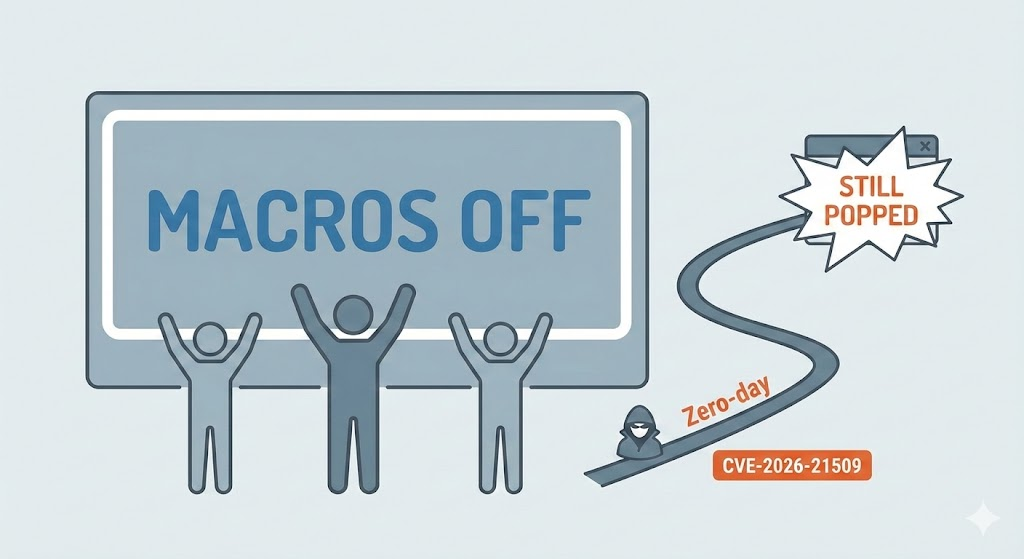
Modern Office security relies on “Mark of the Web” (MotW) and Protected View to sandbox potentially malicious content. However, CVE-2026-21509 exploits a gap in the validation logic of OLE (Object Linking and Embedding) objects.
When Office opens a document, it parses the file header to determine if embedded objects should be initialized. Attackers utilizing this zero-day craft documents with manipulated metadata that tricks the Office application (winword.exe または excel.exe) into treating a malicious OLE object as a trusted, internal system component. This effectively bypasses OLE mitigations, allowing the object to instantiate without the restrictions of Protected View.
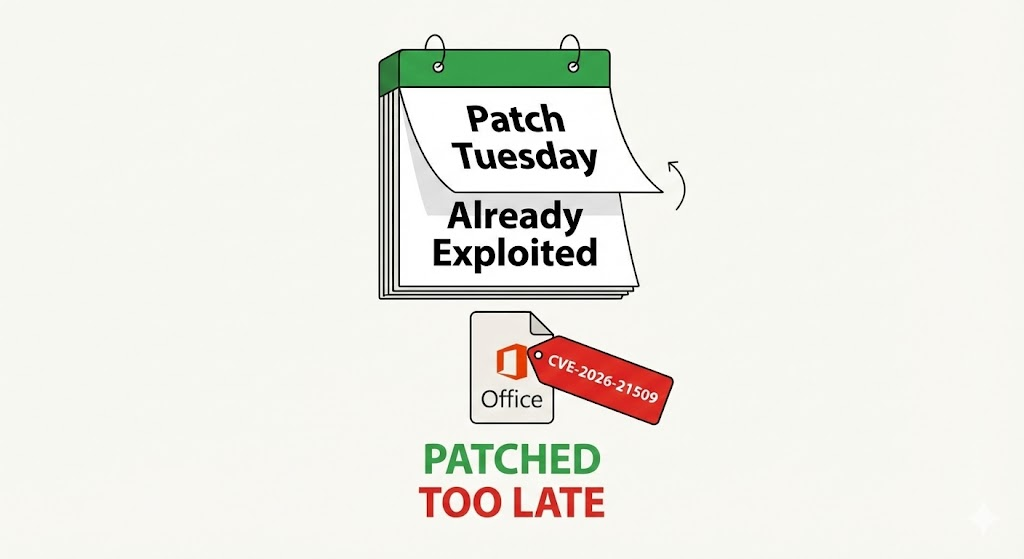
攻撃の連鎖
Contrary to the “Preview Pane” vectors that dominated 2025 (such as CVE-2025-30386), Microsoft has explicitly stated that CVE-2026-21509 is not triggerable via the Preview Pane. The attack relies on user interaction:
- Delivery: The victim receives a spear-phishing email containing a weaponized Office file (
.docx,.rtf). - 実行する: The user double-clicks to open the file.
- バイパス: The application parses the forged security headers, bypasses the “Unsafe Object” warning, and loads the malicious COM control.
- 妥協だ: Arbitrary code execution is achieved in the context of the current user, often leading to the deployment of C2 beacons or data exfiltration tools.
Threat Intelligence: The Target Profile
Early telemetry from CISA and Microsoft indicates that exploitation is currently limited to targeted attacks. This aligns with the 2024-2025 trend where zero-days are initially deployed precisely against high-value targets (government, defense, industrial base) before trickling down to cybercrime syndicates.
However, the “Low” attack complexity rating suggests that weaponization will scale rapidly. We expect ransomware operators to incorporate this exploit into their initial access broker (IAB) toolkits within days.
Mitigation & Detection: The Engineering Response
Immediate patching is the only robust fix. However, for large-scale environments where “patch now” is operationally complex, the following mitigations are critical.
1. Registry Kill Bit Implementation
For Office 2016 and 2019, a registry-based workaround is required to block the vulnerable COM activation path. Office 2021+ receives a service-side mitigation but requires a full application restart.
Detection Logic (KQL for Sentinel/Defender):
// Detect suspicious Office child processes spawned after opening documents from internet DeviceProcessEvents | where InitiatingProcessFileName in~ ("winword.exe", "excel.exe", "powerpnt.exe") | where ActionType == "ProcessCreated" | where FileName in~ ("cmd.exe", "powershell.exe", "wscript.exe") // Refine by looking for lack of MOTW/SmartScreen events preceding execution | project TimeGenerated, DeviceName, InitiatingProcessFileName, FileName, ProcessCommandLine
2. Comparison: 2025 vs. 2026 Office Exploits
| 特徴 | CVE-2025-30386 (Preview Pane) | CVE-2026-21509 (Current Zero-Day) |
|---|---|---|
| トリガー | Zero-click (Preview) | One-click (Open) |
| メカニズム | Use-After-Free (Memory) | Logic Bypass (CWE-807) |
| Bypass | Protected View (Partial) | OLE Mitigations (Complete) |
| 重大性 | クリティカル | High (but actively exploited) |
The Role of AI in Rapid Validation
In the era of “Encryptionless Extortion” and rapid exploit weaponization, static analysis is no longer sufficient. Security teams need to know if their specific security stack (EDR + WAF + Gateway) can stop this specific attack vector.
そこで ペンリジェント 試合を変える。
寡黙 operates as an AI-driven automated penetration testing platform. Unlike rigid scanners that only check for missing KB (Knowledge Base) numbers, Penligent’s AI agents can verify the エクスプロイト性 of CVE-2026-21509 in your environment safely.
- Safe Exploitation Mode: Penligent agents can simulate the exact OLE bypass technique used in CVE-2026-21509 without executing a malicious payload. It proves the vulnerability exists by echoing a harmless signal rather than dropping a shell.
- Defense Validation: By launching the attack simulation from an external IP, Penligent validates whether your email security gateway strips the malicious OLE object or if your endpoint EDR blocks the post-exploitation behavior.
For the modern security engineer, integrating Penligent allows for continuous, “always-on” red teaming. Instead of waiting for the next penetration test schedule, you get immediate validation the moment a new CVE drops.
結論
Under Attack: Microsoft Patches Office Zero-Day (CVE-2026-21509) Exploited in the Wild is not just a headline; it’s a call to action. The vulnerability highlights the persistent fragility of complex legacy formats like OLE.
Patch your systems immediately. Audit your registry configurations. And utilize advanced verification tools like Penligent to ensure your defenses are not just theoretical, but proven.
参考文献
- Microsoft Security Response Center (MSRC) – CVE-2026-21509 Security Guidance – https://msrc.microsoft.com/update-guide/vulnerability/CVE-2026-21509
- CISA既知の悪用される脆弱性カタログ – https://www.cisa.gov/known-exploited-vulnerabilities-catalog
- ペンリジェント ブログ – The 2026 Ultimate Guide to AI Penetration Testing – https://penligent.ai/resources/blog
- CrowdStrike Blog – December 2025 Patch Tuesday Analysis – https://www.crowdstrike.com/blog/


 Japanese
  English
  German
  French
  Spanish
  Portuguese
  Korean
  Hindi
Hindi  Arabic
  Turkish
  Hebrew