
Changing a Railway variable is not the same as revoking the credential it contains. Railway’s October 21, 2026 disclosure says an unauthorized third party may have accessed encrypted environment variables and obtained decrypted contents for some of them. Its precautionary recommendation covers all users: rotate stored variables and private-registry credentials, then review the associated services for unusual activity. The company has not established in that notice that every account was affected.
The recovery problem spans several systems: the service issuing a key, Railway storing a replacement, containers consuming it, and other clients holding copies. A deployment can be healthy while an old key remains usable elsewhere. This guide separates those outcomes and links to the provider’s incident-specific procedures; it does not claim access to an affected workspace or independently reproduce the intrusion.
Start with authority, not a list of variable names
Inventory credentials by what they authorize. A database connection string can grant data access; a registry token can expose private images; a cloud key can reach resources outside Railway. Non-secret settings, such as a region name, need a different decision from a signing key. Keep a restricted inventory containing identifiers and owners, never the secret values themselves. Include production, staging, preview environments, scheduled jobs and external consumers.
Railway’s disclosure describes an investigation in progress. It does not establish a public exploit endpoint, a customer count or a CVE. Treat a new claim about the initial access method as unconfirmed until a primary update supports it. Deployment availability is also changing: the live incident status supersedes the initial global pause. A queued replacement is not a completed rollout.
| Credential class | Where the old authority must end | What proves the replacement is in use |
|---|---|---|
| Third-party API key | The API provider’s key-management system | A controlled request attributed to the replacement key |
| Database password | The actual database account and relevant sessions | New connections from every intended consumer |
| Private-registry token | The registry or token issuer | A successful authorized pull with the replacement |
| Bucket key | The bucket credential issuer | A permitted object operation after consumer redeploy |
| Railway API token | Railway’s token service | The intended integration authenticates with its replacement |
Separate the platform reset from the work you still own
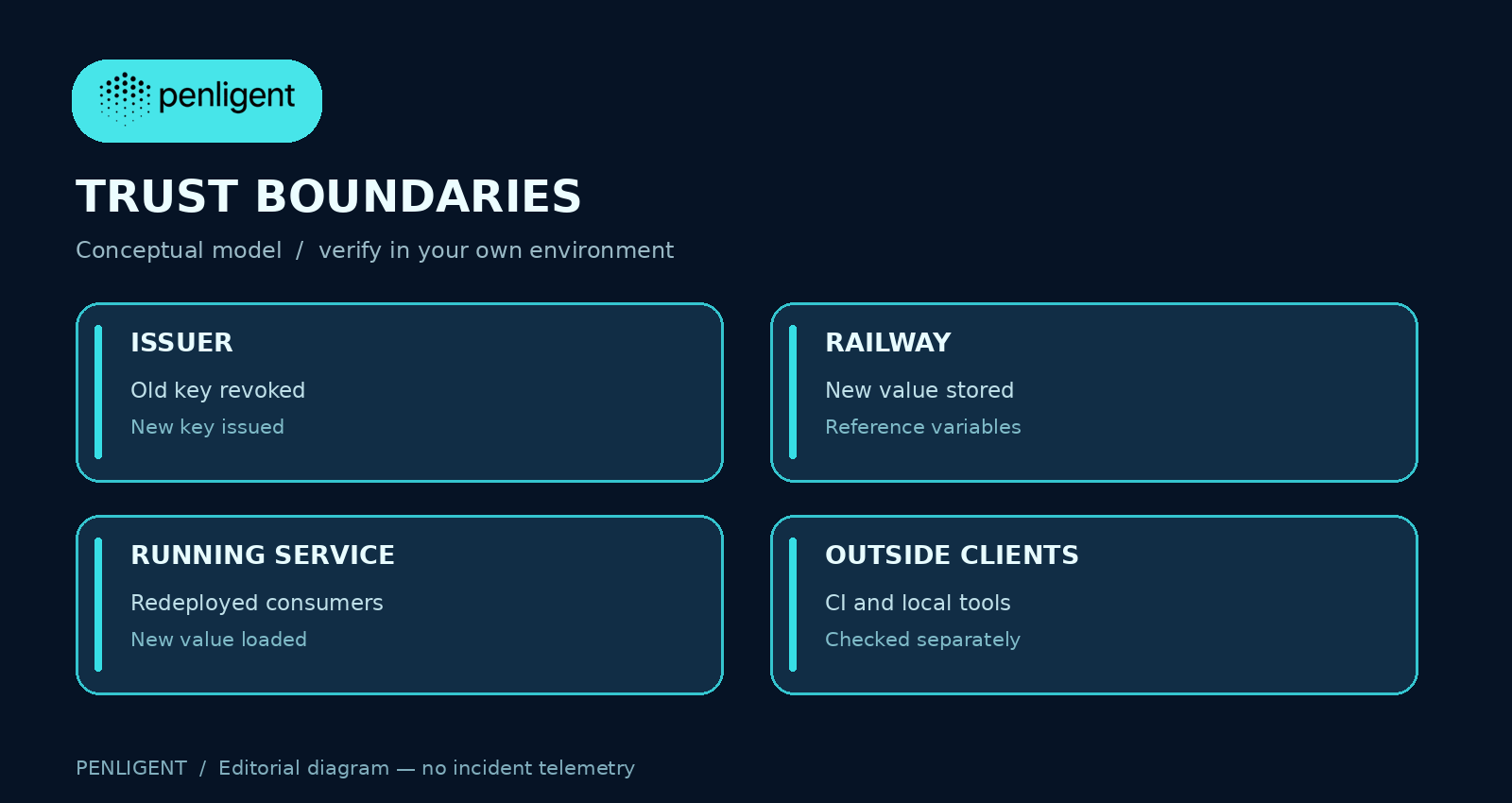
について bucket and GitHub recovery notice explains that Railway regenerated bucket credentials and invalidated the GitHub connection tokens it held. It also removed GitHub registry tokens from Railway, but those registry tokens may remain valid on GitHub until their owner revokes them. Removing a stored copy is not the same as disabling the original token. Check each affected service and each environment rather than treating one successful reconnect as workspace-wide closure.
For your recovery record, use two columns: provider-performed actions and owner-performed actions. Verify provider reset events against the official notice and workspace audit trail before treating them as suspicious administration. Conversely, do not dismiss an unfamiliar deployment simply because legitimate staff resets also occurred that day. Actor, action, resource and time need to agree.
Database variables must agree with the database
For the Railway PostgreSQL template, follow the incident-specific PostgreSQL rotation procedure. Its Regenerate operation synchronizes the database password and service variables and restarts the database. Editing only a password variable, or changing only the database account, can leave those two sides inconsistent. The procedure then requires redeploying dependent services; database regeneration alone does not refresh their running processes.
Before taking that action on your own project, identify the database template and every consumer. A copied connection string in a worker is a separate dependency from a reference variable in the API service. List local developer tools and CI jobs too. If a client cannot receive a new value during the incident window, explicitly decide whether it should remain disconnected. Do not silently keep the exposed password valid to make an incomplete migration look successful.
The acceptance test should exercise the function the application needs, using a dedicated test account and non-sensitive data. A service that only serves a static health page may pass while its database client cannot connect. Record the service deployment identity and the result of a bounded database operation. Do not put connection strings or query output containing customer data into a public ticket.
A replacement key in the dashboard is not running configuration
Reference variables reduce manual copying, but the process must still consume the changed value. Track the source credential, each dependent deployment and any external client separately. If builds are unavailable or a deploy is queued, keep that consumer pending. A screenshot of the Variables tab proves what the control plane stores; it cannot prove what a process started earlier still holds.
Reconnections also differ. Restoring GitHub source access does not establish that a private-registry credential was replaced. A successful pull does not establish that the application’s API key was revoked. Use one small verification case for each boundary. This makes partial recovery visible without requiring a destructive end-to-end test.
Credential record example — no secret values
ID: api-key-production-01
Issuer revocation: verified / pending
Replacement stored: verified / pending
Consumers: web, worker, scheduled-job, external-CI
Deployment identity: record per consumer
Authorized acceptance check: expected operation + timestamp
Historical misuse review: evidence and unresolved gaps
Check misuse where the credential could actually be used
について GitHub access review guide separates account security logs, organization audit evidence and repository-level persistence such as keys, apps and webhooks. A key replacement does not remove a previously added integration. Preserve relevant evidence within its retention window and investigate changes your team cannot explain. Avoid treating an account-password change as a substitute for reviewing independent tokens and repository permissions.
For other providers, correlate credential identity with request volume, spend, destinations and administrative changes. Compare activity with deployments and known jobs before attributing it to an attacker. An unexpected charge is a lead; normal total spend is not a complete audit. A credential may authorize actions that incur little cost or leave evidence in a different log.
Preserve the narrow records needed to explain the decision: source, time range, actor identity, resource and outcome. If logs begin after the exposure period, say so. “No unexplained activity in retained logs” is defensible; “nothing happened” usually exceeds the evidence. Do not paste raw tokens into a support form to ask whether they were leaked.
Verify application behavior after restoring access
Once the credential response is stable, check the application’s own authorization boundary separately. Use two dedicated accounts to confirm that one cannot retrieve another’s private records or trigger privileged operations. This is a different question from whether the platform secret was rotated. It deserves explicit scope and reviewable observations, especially when an application exposes several routes to the same data.
Penligent can be evaluated for an authorized application-testing workflow after recovery. Ask for reproducible evidence tied to the accounts and endpoints in scope. This article does not establish a Railway-specific incident detector, access to platform audit logs or a guarantee that a workspace was never compromised.
Questions about the Railway environment variable leak
Does the disclosure say every Railway account was breached
- No. The initial notice describes uncertain scope and recommends precautionary action for all users. Keep that recommendation separate from a confirmed account-specific finding.
Can I just replace the value in Variables
- Revoke or rotate it at the issuer as well, then update every consumer. A variable edit alone can leave the old credential usable.
Why does my service fail after a platform reset
- It may still use an old value or require a new registry or GitHub connection. Follow the relevant provider guide and verify the actual deployment rather than repeatedly restarting blindly.
What if deployment is still queued
- Check the current status. Complete safe revocation and evidence work where possible, and keep deployment-dependent verification marked pending.
Does a clean deployment settle historical misuse
- No. Rotation, rollout and investigation have different acceptance conditions. Review provider logs and account changes over the relevant exposure window.
The video below introduces authorized application testing. It is not a reconstruction of the Railway incident.
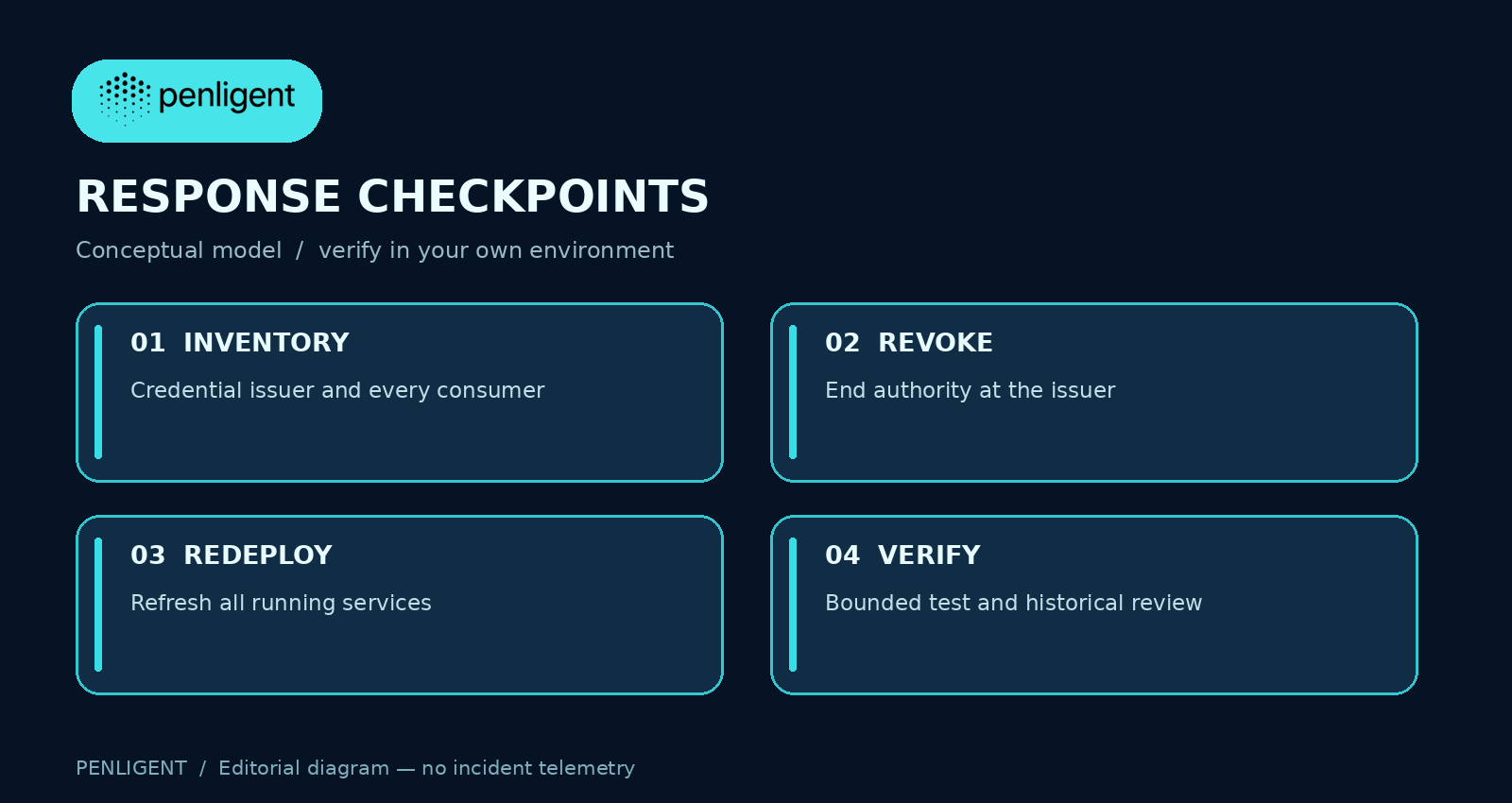
Close the incident credential by credential: old authority ended, replacement consumed, required behavior verified and earlier use reviewed. Any missing consumer or unavailable evidence should stay visible with an owner. A green application page is useful, but it cannot answer all four questions.

 Japanese
 English
 German
 French
 Spanish
 Portuguese
 Korean
 Hindi
 Arabic
 Turkish
 Hebrew