
A company buying a pen testing service is not buying a scanner. It is buying an authorized attempt to break a defined system, evidence showing what worked, expert judgment about the consequences, and a path to remediation.
An AI red team changes the economics of that process. Instead of paying for every testing window as a separate consulting project, a security team can run parts of the workflow repeatedly: map exposed assets, inspect application behavior, test common attack hypotheses, preserve evidence, and verify fixes after deployment.
That does not make human pentesters obsolete. It changes where their time is most valuable.
Human specialists remain stronger when the assessment depends on business context, unusual trust relationships, social engineering, stealth, physical access, ambiguous authorization boundaries, or a long attack chain across people, process, and technology. AI-assisted testing is strongest when the work is repeatable, tool-intensive, evidence-driven, and constrained by clear rules.
The practical choice is therefore not simply “human or AI.” It is deciding which security questions require an independent expert and which can become an internal, repeatable testing capability.
What a Pen Testing Service Actually Means
NIST defines penetration testing as testing that verifies the extent to which a system, device, or process resists active attempts to compromise its security. NIST SP 800-115 places that activity inside a broader process of planning, conducting tests, analyzing findings, and developing mitigation strategies. Penetration testing is therefore more than running a vulnerability scanner and exporting the results. (NIST 컴퓨터 보안 리소스 센터)
A professional penetration testing service normally includes several distinct activities:
- Establishing written authorization and rules of engagement
- Confirming which hosts, applications, APIs, identities, and environments are in scope
- Understanding technical and business constraints
- Discovering reachable assets and attack surfaces
- Testing security controls
- Attempting controlled exploitation
- Recording reproducible evidence
- Evaluating realistic impact
- Producing technical and executive reporting
- Supporting remediation and retesting
The phrase “pen testing service” is often used loosely. It may describe a five-day web application assessment, an API review, an internal network test, a cloud configuration assessment, a mobile application engagement, or a broader adversarial simulation.
Those projects are not interchangeable.
A test of one unauthenticated marketing site is materially different from an assessment of a multi-tenant financial platform with administrator, customer, support, reseller, and service-account roles. An external network assessment is different from an assumed-breach exercise in which testers begin with internal access. A red-team exercise is different again.
NIST describes a red team as an authorized group organized to emulate a potential adversary’s attack or exploitation capabilities against an enterprise. NIST SP 800-53 explains that red-team exercises extend penetration-testing objectives by examining the organization’s broader security posture and defensive capability. Such exercises may include technology attacks, social engineering, and attempts against mission or business functions. (NIST 컴퓨터 보안 리소스 센터)
That distinction matters when comparing prices. A $479 annual software subscription, a five-day web application test, and a multi-week red-team operation do not purchase the same outcome.
Vulnerability scanning, penetration testing, AI pentesting, and red teaming
| Activity | Primary question | Typical execution | Evidence expected | Main limitation |
|---|---|---|---|---|
| Vulnerability scanning | Does the target appear to match known weaknesses or insecure configurations? | Mostly automated signatures, probes, and version checks | Scanner observations and suspected findings | Often cannot prove exploitability or business impact |
| Penetration testing service | Can an authorized tester exploit weaknesses within a defined scope? | Human-led testing supported by tools and automation | Reproduction steps, requests, responses, screenshots, logs, and impact analysis | Point-in-time scope and limited tester time |
| AI pentesting | Can an agent coordinate tools and validate security hypotheses repeatedly? | Agent planning, tool execution, browser or API interaction, and automated evidence capture | Tool output and replayable evidence, ideally reviewed by a human | Reliability varies by task, environment, and agent design |
| Red-team exercise | Can a realistic adversary achieve an operational objective, and will defenders detect and respond? | Multi-stage activity across identities, endpoints, networks, people, and processes | Attack narrative, achieved objectives, detection gaps, and response analysis | Expensive, disruptive if poorly controlled, and difficult to run continuously |
OWASP’s Web Security Testing Guide treats application testing as a structured set of activities rather than a single scan. Its coverage includes information gathering, configuration, identity, authentication, authorization, session management, input validation, business logic, client-side behavior, APIs, and reporting. That breadth is one reason an experienced human assessment cannot be reduced to “the scanner found fewer or more vulnerabilities.” (OWASP 재단)
What You Buy From a Human Pen Testing Service
The visible deliverable from a human pentest is usually a report. The real product is expert attention applied under controlled conditions.
A good tester does not merely ask whether an endpoint accepts an unexpected value. The tester asks why the endpoint exists, which trust boundary it crosses, what the application believes about the caller, how the behavior changes between roles, and whether several individually minor weaknesses can be chained into a material compromise.
That judgment starts before testing.
Scoping and rules of engagement
The rules of engagement define what the testers may do, when they may do it, where traffic will originate, which actions require additional approval, and how the organization will respond if testing affects production.
NIST describes rules of engagement as detailed constraints established before a security test that authorize defined activities without requiring new permission for every step. This is both a safety control and a legal boundary. (NIST 컴퓨터 보안 리소스 센터)
A proper scope may specify:
- Exact domains, IP ranges, applications, APIs, and cloud accounts
- Included and excluded subsidiaries
- Production, staging, and development environments
- Permitted testing hours
- Source IP addresses
- Maximum request rates
- Test accounts and roles
- Whether password attacks are allowed
- Whether data may be created, modified, or downloaded
- Whether denial-of-service techniques are prohibited
- Emergency contacts and stop procedures
- Evidence retention and deletion requirements
- Third-party systems that must not be touched
The time spent defining these boundaries is part of the human service cost. It prevents a technically successful test from becoming an operational or legal failure.
Manual hypothesis development
A scanner usually begins with a known test. A human can begin with a contradiction.
Suppose an application states that reseller administrators can manage only customers assigned to their organization. A tester may inspect object identifiers, background API requests, export functions, notification endpoints, bulk actions, and administrative workflow transitions to determine whether the policy is enforced consistently.
The vulnerability might not be a recognizable signature. It may require combining several facts:
- An export job accepts a customer identifier.
- The user interface hides customers from other resellers.
- The API validates that the caller is a reseller but does not validate reseller ownership.
- The export is generated asynchronously.
- The download endpoint checks only whether the caller created the job.
An experienced tester can reason about the entire workflow. A generic scanner may test each endpoint separately and miss the cross-step authorization failure.
High-risk judgment
Human judgment becomes especially important when validation could alter production data, affect availability, expose personal information, or cross into another tenant.
A tester may have enough evidence to conclude that a destructive path is feasible without executing the final action. That decision requires understanding the business context and the organization’s tolerance for proof.
The result may be documented as:
- A verified control failure
- A demonstrated precondition
- A safely truncated exploit path
- A potential impact that was not fully exercised
- A residual uncertainty requiring follow-up
A mature report separates what was observed from what was inferred.
Independent assurance
External testers can provide organizational independence that an internal engineering team cannot provide by testing its own work. That distinction matters for regulated environments, board reporting, customer due diligence, and contractual assurance.
NIST SP 800-53 specifically describes independent penetration testing agents or teams as parties free from perceived or actual conflicts of interest concerning the development, operation, or management of the target system. (NIST 컴퓨터 보안 리소스 센터)
An AI platform operated by the application team can improve security dramatically, but the platform does not become an independent third party merely because its underlying model or software was created by another vendor.
What an AI Red Team Actually Does
An AI red team is useful only when it can move beyond text generation.
A language model that suggests commands is an assistant. An agentic testing system adds an execution loop:
- Observe the target and current evidence.
- Form a bounded security hypothesis.
- Select an approved tool or action.
- Execute within the authorized scope.
- Interpret the result.
- Revise or discard the hypothesis.
- Capture evidence.
- Request human approval when risk or ambiguity exceeds policy.
- Produce a finding only when the evidence meets the reporting threshold.
This loop can reduce the human effort required to coordinate reconnaissance, request replay, browser interaction, output interpretation, and retesting.
It can also fail in ways that conventional scanners do not.
An agent may misread a response, lose authentication state, choose an inappropriate tool, repeat an unproductive action, infer impact that was never demonstrated, or continue testing after the evidence is already sufficient. The control system around the model is therefore as important as the model itself.
The scope and policy layer
An AI pentesting system should not decide its own authority. Scope must be enforced outside the model through deterministic controls.
At minimum, the execution environment should restrict:
- Reachable hosts and networks
- Permitted protocols
- Request rate
- Tool availability
- Credential access
- File-system access
- Network egress
- Maximum runtime
- Maximum tool calls
- Destructive actions
- Data retention
- Human-approval thresholds
The model can propose an action. A policy layer should decide whether that action is permitted.
Tool orchestration
Many security tasks require different tools for different questions. Asset discovery, HTTP inspection, browser automation, DNS analysis, certificate inspection, dependency analysis, API testing, and network validation are distinct operations.
An AI agent can be valuable when it chooses and sequences those tools based on evidence rather than running every tool indiscriminately.
예를 들어
- DNS and certificate data may reveal an undocumented API host.
- HTTP responses may identify an authentication gateway.
- JavaScript may expose route names but not prove that they are accessible.
- A browser session may establish the required state.
- Request replay may compare behavior between two roles.
- A separate verifier may reproduce the result.
- The report generator may preserve the exact request, response, role, and expected policy.
The value is not that an LLM knows a clever payload. The value is that the system maintains state across a controlled workflow.
증거 캡처
AI reasoning is not evidence.
A finding needs artifacts that another person can inspect and reproduce. Depending on the vulnerability, those artifacts may include:
- The exact affected asset and route
- Test identity and role
- 전제 조건
- Sanitized request and response
- Relevant headers
- Browser screenshots
- Server-side log entries
- Timing data
- Before-and-after state
- Tool version
- Timestamp
- Expected behavior
- Observed behavior
- Retest result
Penligent’s public AI pentesting material describes black-box testing, browser-assisted verification, independent sub-agent validation, human-in-the-loop control, and reports containing impact, reproduction steps, evidence, and remediation guidance. Those are appropriate capabilities to evaluate in an AI red-team workflow, but teams should still validate the output against their own scope and evidence standards. (펜리전트)
Human Pen Testing Service vs AI Red Team
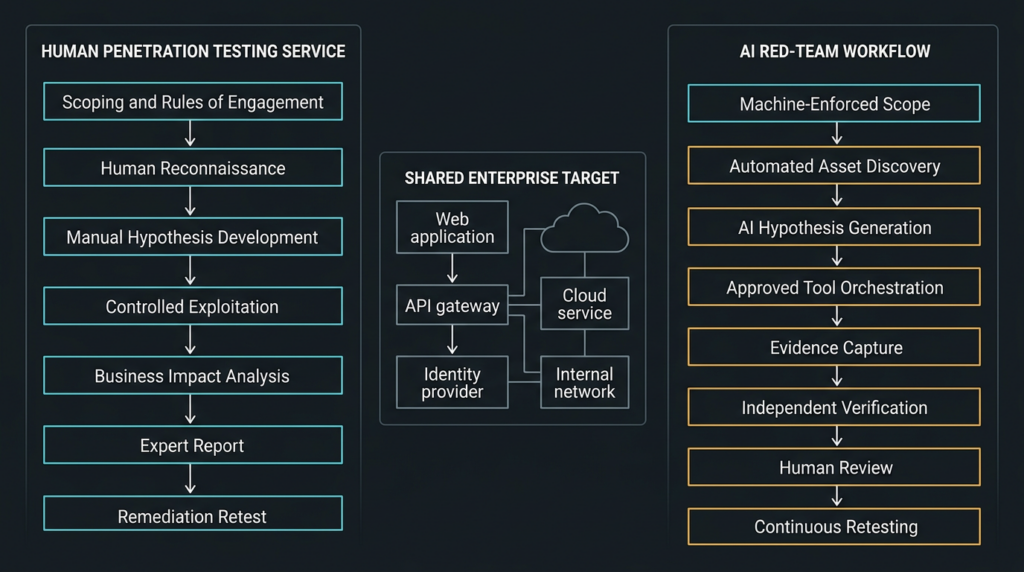
The most honest comparison separates capability from procurement model.
| 차원 | Human pen testing service | AI red team or agentic pentesting |
|---|---|---|
| Commercial model | Usually priced by engagement, scope, days, assets, or annual service capacity | Usually subscription, credits, infrastructure usage, or consumption |
| Startup process | Scoping, contracting, scheduling, access preparation, and kickoff | Can start quickly after installation, policy setup, and target authorization |
| Test frequency | Commonly periodic because each engagement consumes specialist time | Can be repeated after releases, fixes, and configuration changes |
| Marginal retest cost | May require included retest hours or a new service request | Usually lower once the workflow and evidence baseline exist |
| 정찰 | Strong when a tester has time and context | Strong for repeatable asset mapping and tool-driven enumeration |
| Known vulnerability checks | Effective but may not be economical to repeat constantly | Well suited to frequent, bounded validation |
| Complex business logic | Strong when the tester understands the product and user incentives | Variable; often limited by missing context and long multi-role state |
| Social engineering | Available in appropriate red-team engagements | Not equivalent to a human social-engineering operation |
| Physical security | Can be included in specialized engagements | Generally outside normal AI pentesting scope |
| Stealth and detection testing | Human operators can deliberately vary tradecraft and adapt to defenders | Possible only when designed into a controlled adversary-emulation platform |
| Evidence consistency | Depends on methodology and tester discipline | Can be highly structured if raw artifacts are captured automatically |
| Risk judgment | Strong when performed by experienced practitioners | Requires human review for ambiguous or high-impact conclusions |
| Independence | External providers can satisfy independence requirements | Internally operated tooling is generally not an independent assessment |
| Scalability | Constrained by skilled labor and engagement capacity | Constrained by tool reliability, model cost, infrastructure, scope, and review capacity |
| Best use | Formal assurance, complex logic, high-risk systems, adversary simulation | Continuous validation, pre-testing, regression testing, evidence collection, and fix verification |
This table does not imply that every human service is deep or that every AI system is scalable. Quality varies substantially in both categories.
A rushed human engagement can become a checklist. A poorly controlled AI system can become an expensive scanner with fluent prose. The buyer has to evaluate the actual methodology, evidence, and operational controls.
The Real Cost of a Human Pen Testing Service
Many major penetration-testing providers do not publish a universal fixed price because the scope determines the work. Bugcrowd’s pricing page, for example, requests environment details before providing a custom estimate. Cobalt uses a credit-based model intended to let customers allocate testing capacity across engagements, while HackerOne positions its product as expert-driven Pentest as a Service. (Bugcrowd)
A quote may change based on:
- Number of applications
- Number of APIs and endpoints
- Application size and architectural complexity
- Authenticated and unauthenticated coverage
- Number of user roles
- Mobile, desktop, cloud, network, or embedded components
- Source-code access
- Internal network access
- Testing window
- Production restrictions
- Required tester certifications
- Regulatory requirements
- Social-engineering scope
- Report format
- Remediation support
- Number of included retests
- Travel or onsite work
- Urgency
- Required professional liability coverage
This makes broad price claims difficult to compare.
A five-day web application assessment and a twenty-day red-team exercise may both appear under “penetration testing” in a procurement system. One is designed to identify vulnerabilities in a defined application. The other may attempt to obtain an initial foothold, escalate privileges, move laterally, access a protected objective, and evaluate the defenders’ ability to detect and contain the operation.
The price difference represents different labor, risk, and objectives.
What a human quote usually contains
A useful way to examine a quote is to divide it into four layers.
Testing labor includes the hours spent planning, discovering, validating, documenting, and retesting.
Quality assurance includes peer review, technical editing, severity calibration, and report approval.
Engagement operations include scoping, scheduling, secure communication, credential handling, project management, emergency coordination, and client meetings.
Commercial assurance includes contracts, insurance, data-handling controls, tester vetting, certifications, and vendor accountability.
AI can reduce some testing and documentation labor. It does not automatically eliminate the other three layers.
Penligent’s Price Advantage
Penligent’s current public pricing page lists a free plan and a Pro plan at $39.92 per month billed annually. The nominal annual Pro subscription is therefore $479.04. The page states that Pro includes 6,000 monthly credits and shows an estimate of approximately five targets for that credit level. It also states that usage is credit-based rather than governed by a fixed target limit. Team and Enterprise pricing is custom. (penligent.ai)
The phrase “approximately five targets” should be treated as an estimate, not a universal unit of work. A small unauthenticated application and a complex authenticated platform do not consume the same testing effort. Tool calls, browser interactions, validation depth, application behavior, and failed investigative paths can all affect consumption.
The price advantage is nevertheless substantial at the procurement level.
A Pro subscription costs less than one hour of some senior consulting engagements. That comparison is commercially striking, but it remains incomplete. The subscription does not include a dedicated external consultant spending a defined number of days on the target, accepting professional responsibility for the methodology, conducting stakeholder interviews, or providing organizational independence.
The defensible claim is narrower:
Penligent can convert repeatable portions of a pen testing service from project-based labor into an internal, reusable AI pentesting workflow with a public software price of $479.04 per year for the Pro tier.
That is a meaningful economic change without claiming that the subscription reproduces every outcome of a human engagement.
A transparent annual cost model
Consider a hypothetical company that receives a quote of $15,000 for one external application assessment. The number is illustrative; it is not presented as a universal market rate.
If the company buys two such assessments during the year, the direct external cost is:
2 × $15,000 = $30,000
If the company instead buys a Penligent Pro subscription, the public software price is:
12 × $39.92 = $479.04
The apparent difference is:
$30,000 - $479.04 = $29,520.96
It would be misleading to call the entire difference “savings” because the two purchases are not equivalent.
A more complete model is:
Annual testing cost =
    external engagement fees
  + AI platform fees
  + model or infrastructure costs
  + internal operator labor
  + human review
  + remediation engineering
  + compliance or independent-assurance costs
The company may still need an external assessment. It may also need internal engineers to operate the AI system, configure scope, review findings, and investigate ambiguous results.
The better comparison is therefore between operating models.
Model one — External testing only
The company purchases one or two formal engagements. It receives strong human judgment and an independent report, but changes between testing windows may not be covered.
Model two — AI testing only
The company runs frequent technical checks internally. It gains speed and repeatability, but may lack independent assurance and may miss contextual attack paths that require senior human analysis.
Model three — Hybrid testing
The company uses AI for:
- Pre-engagement reconnaissance
- Routine Web and API validation
- Release-triggered regression testing
- Known-vulnerability checks
- Evidence preparation
- Fix verification
It uses external experts for:
- Complex business logic
- High-impact production systems
- Threat-led adversary simulation
- Detection and response exercises
- Social engineering
- Independent reports
- Final review of critical findings
The third model is usually where the economic case is strongest. The company is not trying to replace a $15,000 engagement with a $479 product. It is trying to reduce the amount of expensive human time spent on repeatable work and increase testing frequency between formal engagements.
Price per Test Is the Wrong Metric
The most important price advantage of AI red teaming is not the cost of generating one report. It is the ability to test again.
A traditional assessment is a point-in-time statement. It tells the organization what skilled testers observed within the authorized scope, environment, accounts, and time window.
It does not prove that the system will remain secure after:
- A new API is deployed
- A feature flag is changed
- An administrator permission is expanded
- A reverse proxy is reconfigured
- A cloud security group is modified
- A dependency is upgraded
- A legacy service is restored
- A new subdomain is created
- A third-party integration is enabled
- A vulnerability is fixed incorrectly
PTaaS providers make the same general observation. Synack promotes continuous testing because vulnerabilities can emerge as the attack surface changes, while HackerOne describes PTaaS as a mechanism for more frequent testing than conventional contract-based projects. (Synack)
AI pentesting makes the economic unit smaller.
Instead of asking, “Can we afford another full engagement?” a team can ask, “Can we rerun the affected authorization checks after tonight’s release?”
That shift matters because remediation changes software.
A developer may fix the vulnerable endpoint but leave a bulk endpoint exposed. An authorization middleware may be added to one route and omitted from another. A reverse proxy rule may protect the user interface while the underlying API remains accessible. A patch may stop one payload but not address the root cause.
Retesting is not administrative closure. It is another security test.
Better economic metrics
The following metrics are more useful than raw subscription price:
| Metric | What it reveals |
|---|---|
| Cost per validated finding | Whether spending produces confirmed security knowledge rather than scanner noise |
| Cost per remediated finding | Whether testing leads to risk reduction |
| Mean time to retest | How quickly the team can confirm that a fix works |
| Percentage of releases tested | Whether testing keeps pace with engineering |
| Percentage of findings with replayable evidence | Whether developers can reproduce and resolve issues |
| Human review time per finding | Whether automation reduces or creates analyst workload |
| Critical asset coverage | Whether testing reaches the systems that matter |
| Escaped vulnerability rate | Whether important weaknesses still appear after internal validation |
An inexpensive platform that produces unverified findings may cost more in analyst time than a more disciplined system. A costly human engagement that identifies one critical business-logic flaw may produce more value than thousands of automated checks.
Price has to be connected to evidence and remediation.
Where AI Red Teams Have a Clear Advantage
AI agents are well suited to tasks that combine repeatability, structured evidence, and bounded tool use.
Repeated attack-surface mapping
Applications change continuously. Hosts appear, certificates are renewed, JavaScript bundles change, APIs move, and authentication gateways are reconfigured.
An agent can repeat the same approved discovery process, compare results with the previous run, and flag meaningful changes. The difference from a basic scanner is that the agent can correlate observations:
- A new hostname shares a certificate with an existing environment.
- The host returns an API schema.
- The schema exposes an administrative route.
- The route redirects to a known identity provider.
- The route is not present in the previous asset baseline.
A human still decides whether the route belongs in scope and whether testing it is appropriate. Automation reduces the effort required to reach that decision.
Common Web and API vulnerability validation
Many vulnerability classes have structured verification logic:
- Missing authorization checks
- Insecure direct object references
- Reflected or stored input handling
- Security-header inconsistencies
- Exposed administrative interfaces
- Misconfigured cross-origin policies
- Unintended debug endpoints
- Sensitive information in responses
- Weak session invalidation
- Unrestricted file access
- Unsafe redirect behavior
- Default credentials in an isolated lab
- Known vulnerable software versions
The agent can generate hypotheses, execute approved requests, compare responses, and preserve evidence.
This does not mean every apparent difference is a vulnerability. A 200 response may contain an error object. A 403 response may be produced by a WAF rather than the application. Different content lengths may reflect personalization. A version string may come from a proxy instead of the affected component.
Verification logic must test the security claim, not just the response code.
Multi-role regression testing
Authorization regression is one of the strongest use cases for AI-assisted testing.
Suppose an application has five roles:
- Customer
- Customer administrator
- Support agent
- Reseller administrator
- Platform administrator
Each role may interact with hundreds of objects and operations. A security team can define expected policies and repeatedly test whether those policies hold.
예를 들어
policy:
  resource: invoice
  actions:
    customer:
      own_invoice: read
      other_customer_invoice: deny
    support_agent:
      assigned_customer_invoice: read
      unassigned_customer_invoice: deny
    reseller_admin:
      reseller_customer_invoice: read
      other_reseller_invoice: deny
The agent can generate a matrix of requests, preserve identity context, and identify deviations. A human defines the policy and evaluates exceptions. The agent performs the repetitive comparisons.
Known-vulnerability triage
When a new CVE is disclosed, security teams need to answer several questions:
- Do we run the affected product?
- Is the affected component reachable?
- Is the vulnerable feature enabled?
- Is the installed version affected?
- Is a vendor mitigation already present?
- Can we obtain safe evidence without harming the system?
- Has the issue been patched?
- Does the patch actually remove the exposed behavior?
AI can assist with evidence collection and orchestration. It cannot safely infer that a system is vulnerable merely because a banner resembles an affected version.
Evidence normalization
Security evidence is often scattered across terminal output, proxy history, screenshots, browser state, notes, and tickets.
An agent can organize those artifacts into a consistent structure:
{
  "finding_id": "AUTHZ-014",
  "asset": "lab-api.local",
  "route": "GET /invoices/INV-2002",
  "test_identity": "alice",
  "expected_policy": "Alice may read only Alice-owned invoices",
  "observed_result": "Alice received Bob-owned invoice data",
  "status": "reproduced",
  "evidence": [
    "request-alice-to-bob.txt",
    "response-bob-invoice.json",
    "retest-fixed-response.txt"
  ],
  "review_status": "human-confirmed"
}
That structure makes findings easier to review, remediate, and retest.
Where Human Pentesters Still Win
The hardest vulnerabilities are frequently hard because the expected behavior is not written down.
Business-logic abuse
A financial application may correctly enforce every endpoint permission but still allow a user to combine legitimate operations in an abusive sequence.
예를 들면 다음과 같습니다:
- Applying the same promotional value through two different workflows
- Reserving inventory without completing payment
- Creating a negative balance through refund timing
- Avoiding a transaction limit by splitting activity across related accounts
- Reusing an approval token in a different business context
- Exploiting a support workflow to change account ownership
- Causing two systems to disagree about whether an order is final
The requests may all be syntactically valid. The vulnerability exists in the business meaning of the sequence.
A human tester can interview product owners, read help documentation, compare user incentives, and ask what an attacker would gain. An agent can assist, but it may not possess the unstated economic and contractual context required to distinguish a feature from an exploit.
Cross-system attack chains
A serious compromise may require chaining weaknesses across several systems:
- A public application leaks an internal identifier.
- The identifier reveals a naming convention.
- A support portal trusts an identity claim from another service.
- A cloud function exposes metadata to that support role.
- A token can access a storage bucket.
- The bucket contains deployment information.
- The information enables access to a protected environment.
Each individual step may appear low severity. The chain is critical.
Humans remain better at deciding which weak signals are worth pursuing, especially when the chain crosses organizational ownership and technical boundaries.
Social engineering and physical controls
A conventional AI pentesting platform is not equivalent to a social-engineering team.
A red-team exercise may test:
- Help-desk identity verification
- Employee phishing resilience
- Visitor procedures
- Badge controls
- Tailgating defenses
- Document handling
- Executive impersonation
- Security-operations escalation
- Incident-response coordination
NCSC guidance describes red-team exercises as authorized simulations that can reveal whether a security operations center detects adversarial activity. Purple-team exercises then bring attackers and defenders together to improve those controls. (National Cyber Security Centre)
Those objectives extend well beyond application scanning and automated exploit validation.
Stealth and defender adaptation
A human red team can alter behavior based on what defenders appear to know.
Operators can reduce noise, change infrastructure, pause activity, switch techniques, exploit trust relationships, and decide whether achieving the objective is more important than demonstrating another technical weakness.
An AI agent can be programmed to optimize for stealth, but that introduces significant operational risk. It also changes the assurance requirement. An organization should not allow an autonomous system to improvise evasion techniques in production without strict control, monitoring, and human authorization.
Ambiguous evidence
Some findings cannot be classified correctly from technical output alone.
A response may expose an internal identifier that appears sensitive. The identifier may be public by design.
An endpoint may allow users to enumerate organization names. That behavior may be a privacy issue in one product and an intentional directory feature in another.
A temporary administrator role may look overprivileged but exist to meet a documented support obligation.
Human reviewers reconcile technical behavior with product policy and business consequences.
AI Pentesting Benchmarks Support a Cautious View
Academic research shows meaningful progress in autonomous penetration testing, but it also shows why broad replacement claims are premature.
PentestEval evaluates language models across decomposed stages such as information collection, weakness gathering, attack decisions, exploit generation, and revision. Its authors report that end-to-end pipelines reached a 31 percent success rate in their scenarios and that existing autonomous agents performed poorly on the most complex end-to-end tasks. (arXiv)
Pentest-R1 reports a 24.2 percent success rate on AutoPenBench and a 15 percent success rate on unguided CyBench tasks for its reinforcement-learning approach. Those results represent progress within specific benchmark definitions, not a universal measure of production pentesting accuracy. (arXiv)
Another 2025 AutoPentest study compared an autonomous GPT-4o-based implementation with direct ChatGPT use on three Hack The Box machines. Both completed only a minority of the evaluated subtasks, and the autonomous system slightly outperformed the chat baseline. The experiment illustrates both the potential and the continuing difficulty of long, interactive attack paths. (arXiv)
Benchmark results vary because the systems vary.
Performance depends on:
- The model
- Tool interfaces
- Agent memory
- Task decomposition
- Error recovery
- Prompt design
- Environment stability
- Credential state
- Benchmark difficulty
- Whether hints are provided
- What counts as success
- Time and token budgets
A benchmark also cannot reproduce every production constraint. Real applications contain rate limits, anti-automation controls, unstable sessions, legal boundaries, sensitive data, third-party dependencies, and business logic that is not represented in a capture-the-flag environment.
The responsible conclusion is not that AI pentesting fails. It is that AI performs best when the task is bounded, the tools are reliable, the evidence standard is explicit, and humans remain available for judgment and escalation.
Proof Matters More Than Finding Count
A useful pen testing service does not win by producing the longest vulnerability table. It wins by delivering evidence the organization can act on.
A finding should move through an evidence ladder.
Observed
The tester notices behavior consistent with a possible weakness.
예시:
An authenticated customer can request an invoice identifier belonging to another customer.
At this stage, the behavior may still be an error, a test-data artifact, or an intended sharing feature.
Reproduced
The behavior occurs again under controlled conditions.
The tester records the identity, object, request, response, and expected policy.
Independently verified
A second tester or separate validation process reproduces the result without relying on the first tester’s assumptions.
This is especially useful for AI-generated hypotheses because it reduces the risk that one agent’s interpretation becomes its own proof.
Impact confirmed
The team determines what the behavior actually enables.
Reading another customer’s billing address has a different impact from reading an empty placeholder object. Access to one deliberately shared document differs from systematic cross-tenant access.
Remediation retested
The same evidence path is repeated after the fix.
The retest verifies both the original route and relevant variants so that the team does not mistake a narrow payload block for a root-cause correction.
OWASP’s reporting guidance emphasizes that reports should serve both technical and management audiences. NIST similarly frames reporting and mitigation as part of the testing process rather than an unrelated writing task. (OWASP 재단)
Common AI reporting failures
AI-generated reports often fail when the prose outruns the evidence.
Typical problems include:
Version equals vulnerability
The agent sees a version associated with a CVE and labels the system exploitable. The deployment may contain a backported patch, disabled feature, vendor mitigation, reverse-proxy protection, or inaccurate banner.
Error equals execution
The application returns a server error after an unusual input. The report claims code execution, injection, or parser compromise without observing any security impact.
Different response equals authorization bypass
Two responses differ in length, but the protected data was not exposed.
Potential impact becomes demonstrated impact
The agent explains the worst theoretical consequence without separating it from what the test actually proved.
Missing identity context
The report does not state which role was used, whether the account had prior access, or whether the object was intentionally shared.
No raw artifacts
The report contains polished steps but omits the request, response, timestamp, or state change needed for reproduction.
Severity without environment
A generic CVSS score is treated as the final priority without considering data sensitivity, asset exposure, compensating controls, or exploit prerequisites.
A trustworthy AI workflow should make unsupported conclusions harder to produce than cautious ones.
Safe Local PoC — Automating Authorization Retesting
The following demonstration runs only on 127.0.0.1. It illustrates a broken object-level authorization condition in a toy invoice API and shows how an automated verifier can preserve evidence before and after a fix.
It does not scan networks, target third-party systems, bypass real authentication, escalate privileges, or provide persistence. Its purpose is to show the difference between detecting an interesting response and proving a specific authorization failure.
Prerequisites
Use a local Python environment:
mkdir local-authz-lab
cd local-authz-lab

python3 -m venv .venv
source .venv/bin/activate

python -m pip install flask requests
On Windows PowerShell:
python -m venv .venv
.\.venv\Scripts\Activate.ps1

python -m pip install flask requests
Vulnerable local application
Create app.py:
from __future__ import annotations

from flask import Flask, jsonify, request

app = Flask(__name__)

TOKENS = {
    "token-alice": "alice",
    "token-bob": "bob",
}

INVOICES = {
    "INV-1001": {
        "owner": "alice",
        "amount": 125.00,
        "description": "Alice test invoice",
    },
    "INV-2002": {
        "owner": "bob",
        "amount": 275.00,
        "description": "Bob test invoice",
    },
}


def current_user() -> str | None:
    auth_header = request.headers.get("Authorization", "")
    if not auth_header.startswith("Bearer "):
        return None

    token = auth_header.removeprefix("Bearer ").strip()
    return TOKENS.get(token)


@app.get("/invoices/<invoice_id>")
def get_invoice(invoice_id: str):
    user = current_user()
    if user is None:
        return jsonify({"error": "unauthorized"}), 401

    invoice = INVOICES.get(invoice_id)
    if invoice is None:
        return jsonify({"error": "not found"}), 404

    # Deliberately vulnerable:
    # The application validates that the caller is authenticated,
    # but does not verify that the invoice belongs to the caller.
    return jsonify(
        {
            "invoice_id": invoice_id,
            "requested_by": user,
            "owner": invoice["owner"],
            "amount": invoice["amount"],
            "description": invoice["description"],
        }
    )


if __name__ == "__main__":
    # Localhost only. Do not expose this intentionally vulnerable lab.
    app.run(host="127.0.0.1", port=5000, debug=False)
Start the lab:
python app.py
Evidence-driven verifier
Create verify_authz.py:
from __future__ import annotations

import json
import sys
from datetime import datetime, timezone
from pathlib import Path
from urllib.parse import urlparse

import requests

BASE_URL = "http://127.0.0.1:5000"
EVIDENCE_DIR = Path("evidence")


def ensure_local_target(url: str) -> None:
    parsed = urlparse(url)
    if parsed.hostname not in {"127.0.0.1", "localhost"}:
        raise ValueError(
            "Safety check failed: this demonstration supports localhost only."
        )


def save_evidence(name: str, payload: dict) -> None:
    EVIDENCE_DIR.mkdir(exist_ok=True)
    path = EVIDENCE_DIR / name
    path.write_text(json.dumps(payload, indent=2), encoding="utf-8")


def main() -> int:
    ensure_local_target(BASE_URL)

    target_url = f"{BASE_URL}/invoices/INV-2002"
    headers = {"Authorization": "Bearer token-alice"}

    response = requests.get(
        target_url,
        headers=headers,
        timeout=5,
    )

    try:
        body = response.json()
    except ValueError:
        body = {"raw_body": response.text}

    evidence = {
        "timestamp": datetime.now(timezone.utc).isoformat(),
        "target": target_url,
        "test_identity": "alice",
        "requested_object": "INV-2002",
        "expected_owner": "bob",
        "expected_policy": "Alice must not read Bob-owned invoices",
        "status_code": response.status_code,
        "response_body": body,
    }

    save_evidence("alice-requests-bob-invoice.json", evidence)

    vulnerable = (
        response.status_code == 200
        and body.get("owner") == "bob"
        and body.get("requested_by") == "alice"
    )

    if vulnerable:
        print(
            "[CONFIRMED] Alice received a Bob-owned invoice. "
            "Evidence was written to the evidence directory."
        )
        return 1

    print(
        "[NOT CONFIRMED] The expected cross-owner access was not observed. "
        f"Status: {response.status_code}"
    )
    return 0


if __name__ == "__main__":
    sys.exit(main())
Run it:
python verify_authz.py
The verifier does not declare a vulnerability merely because the server returns 200. It checks three facts:
- The test identity was Alice.
- The requested object belonged to Bob.
- The response exposed Bob’s object to Alice.
That is a security claim supported by evidence.
Corrected authorization check
Replace the vulnerable route logic with:
@app.get("/invoices/<invoice_id>")
def get_invoice(invoice_id: str):
    user = current_user()
    if user is None:
        return jsonify({"error": "unauthorized"}), 401

    invoice = INVOICES.get(invoice_id)
    if invoice is None:
        return jsonify({"error": "not found"}), 404

    if invoice["owner"] != user:
        return jsonify({"error": "forbidden"}), 403

    return jsonify(
        {
            "invoice_id": invoice_id,
            "requested_by": user,
            "owner": invoice["owner"],
            "amount": invoice["amount"],
            "description": invoice["description"],
        }
    )
Restart the application and rerun the verifier.
The expected result is now:
[NOT CONFIRMED] The expected cross-owner access was not observed. Status: 403
A production-quality regression suite would also test:
- Alice reading Alice’s invoice
- Bob reading Bob’s invoice
- Alice reading Bob’s invoice
- Bob reading Alice’s invoice
- Missing token
- Invalid token
- Unknown invoice
- Administrative roles
- Intentionally shared invoices
- Bulk export endpoints
- Download URLs generated by background jobs
This is where AI-assisted testing becomes economically useful. Once the organization defines the expected policy, an agent can repeat the matrix after every meaningful release.
The human contribution remains essential. A person decides what ownership means, whether support agents have exceptions, whether invoices may be shared, which response is appropriate, and what business impact cross-account access would create.
A machine-enforced rules-of-engagement example
The model should not be trusted to remember testing boundaries. Store them in deterministic policy:
engagement:
  name: local-authorization-lab
  authorization_reference: LAB-ONLY

scope:
  allowed_hosts:
    - 127.0.0.1
    - localhost
  allowed_ports:
    - 5000
  allowed_protocols:
    - http

limits:
  maximum_requests_per_second: 2
  maximum_runtime_minutes: 10
  maximum_concurrent_actions: 1

allowed_actions:
  - send_http_request
  - compare_responses
  - save_sanitized_evidence
  - run_defined_regression_checks

prohibited_actions:
  - scan_external_networks
  - denial_of_service
  - credential_stuffing
  - destructive_data_changes
  - persistence
  - security_control_evasion
  - access_to_non_lab_credentials

evidence:
  directory: ./evidence
  include_timestamps: true
  redact_authorization_headers: true
  retention_days: 7

human_approval_required:
  - any_new_host
  - any_new_tool
  - any_state_changing_request
  - any_action_outside_defined_test_cases
The important design principle is that the agent proposes actions inside a boundary it cannot silently expand.
Three CVEs That Explain Why Testing Frequency Matters
Historical vulnerabilities show why neither an annual human test nor an autonomous platform can provide permanent assurance.
CVE-2021-44228 and the limits of point-in-time testing
CVE-2021-44228, commonly called Log4Shell, affected Apache Log4j log4j-core versions across multiple release branches. Apache describes the issue as unsafe JNDI lookup behavior that could allow arbitrary code loaded from an LDAP server to execute in affected conditions. CISA characterized it as a critical remote-code-execution vulnerability and issued extensive mitigation guidance after active exploitation. (CISA)
A penetration test completed in November 2021 could not reasonably certify that an application would remain safe after Log4Shell was publicly disclosed in December.
That does not mean the earlier test was poor. The relevant risk had changed.
The incident highlights several different security tasks:
- Inventorying applications and embedded dependencies
- Determining whether
log4j-coreis present - Identifying affected versions
- Understanding application configuration
- Determining whether attacker-controlled data reaches a vulnerable logging path
- Applying vendor-supported fixes
- Retesting relevant exposure
- Looking for evidence of prior exploitation
AI-assisted workflows can help correlate inventories, inspect artifacts, generate safe validation plans, and document remediation. They should not use a live exploit payload against production merely to prove a version is affected.
The primary remediation is to follow current Apache guidance and move to an appropriate fixed release for the supported Java branch. Organizations also need to account for the related Log4j issues disclosed during the response, rather than assuming that the earliest mitigation ended the problem. (Apache Logging Services)
CVE-2023-34362 and exposed edge systems
Progress disclosed CVE-2023-34362 in MOVEit Transfer on May 31, 2023. The vendor described a vulnerability that could lead to escalated privileges and unauthorized access to the environment. The disclosure became a major incident because exploitation affected internet-facing managed file-transfer systems and created urgent investigation and patching requirements. (Progress Community)
The operational lesson is not that every pentest should attempt a MOVEit exploit.
The lesson is that security teams need a fast answer to:
- Where are our MOVEit assets?
- Which versions are deployed?
- Are they internet-accessible?
- Were vendor mitigations applied?
- Were patches installed?
- Are there signs requiring incident response?
- Did emergency changes introduce new exposure?
A point-in-time application test may not include the managed file-transfer appliance. An automated attack-surface baseline can help identify the asset, but asset identification alone does not determine compromise.
The human response team still needs to interpret logs, coordinate containment, preserve evidence, evaluate data exposure, and follow vendor and incident-response guidance.
CVE-2024-3400 and configuration-specific exposure
Palo Alto Networks describes CVE-2024-3400 as a command-injection vulnerability resulting from arbitrary file creation in the GlobalProtect feature of specific PAN-OS versions and configurations. The vendor assigned a critical severity and stated that an unauthenticated attacker could execute code with root privileges on affected firewalls. Cloud NGFW, Panorama appliances, and Prisma Access were listed as not affected in the advisory. (Palo Alto Networks Security)
This is a useful example because product presence alone was not enough.
Validation required checking:
- Product family
- PAN-OS version
- GlobalProtect feature configuration
- Vendor hotfix level
- Exposure
- Mitigations
- Indicators and investigation guidance
An automated system can collect much of this evidence. It can compare versions, check whether a feature appears reachable, and flag assets that require urgent attention.
A production firewall is not an appropriate target for uncontrolled autonomous exploitation. The potential impact is too high, and a failed test could affect a critical security boundary. Safe validation should prioritize vendor guidance, configuration evidence, patch state, logs, and tightly controlled procedures.
What these CVEs teach
| CVE | Main lesson for testing programs | Good automation use | Human responsibility | Primary defensive action |
|---|---|---|---|---|
| CVE-2021-44228 | A new dependency vulnerability can invalidate earlier assumptions | Inventory correlation, version triage, safe exposure checks, retest documentation | Determine reachability, review architecture, assess compromise evidence | Follow Apache-supported upgrade guidance and investigate exposure |
| CVE-2023-34362 | Internet-facing edge systems require current inventory and rapid response | Find assets, correlate versions, track emergency remediation | Incident response, data-impact analysis, containment, legal coordination | Apply Progress guidance, patch, investigate, and monitor |
| CVE-2024-3400 | Version and feature configuration jointly determine exposure | Collect versions, feature state, reachability, and hotfix evidence | Decide safe validation depth and protect critical firewall operations | Apply Palo Alto Networks fixes and investigation guidance |
No AI red team can guarantee protection against an unknown future vulnerability. Its advantage is shortening the path from disclosure to evidence.
Compliance Does Not Reduce to a PDF
A polished report is not automatically a compliant penetration test.
Compliance requirements may specify:
- 범위
- Testing methodology
- Frequency
- Tester qualifications
- Organizational independence
- Internal and external perspectives
- Application and network layers
- Segmentation validation
- 해결 방법
- Retesting
- Evidence retention
PCI DSS provides a concrete example.
Requirement 11.4 calls for regular internal and external penetration testing and correction of exploitable vulnerabilities and security weaknesses. The methodology must cover the cardholder data environment perimeter and critical systems, testing from inside and outside the network, application and network layers, relevant recent threats, risk treatment, and evidence retention.
The cited PCI DSS material also requires internal and external testing at least once every 12 months and after significant infrastructure or application changes. It requires qualified resources, organizational independence, remediation of identified exploitable weaknesses, and repeated testing to verify corrections. (PCI Security Standards Council)
An internal AI workflow can support those activities by:
- Maintaining scope evidence
- Running repeatable checks
- Preserving artifacts
- Tracking remediation
- Accelerating retests
- Producing structured technical records
It does not automatically establish that the tester was qualified, independent, or authorized to make the organization’s compliance determination.
The same caution applies to SOC 2 and ISO 27001. Organizations may use penetration-test evidence as part of broader control assurance, but the exact requirement depends on the organization’s system description, risk assessment, controls, contracts, auditor expectations, and certification scope.
A vendor should not claim that its software alone “makes a company SOC 2 compliant” or “provides ISO 27001 certification.” Software can support controls and evidence. Certification and attestation involve a larger governance and assurance process.
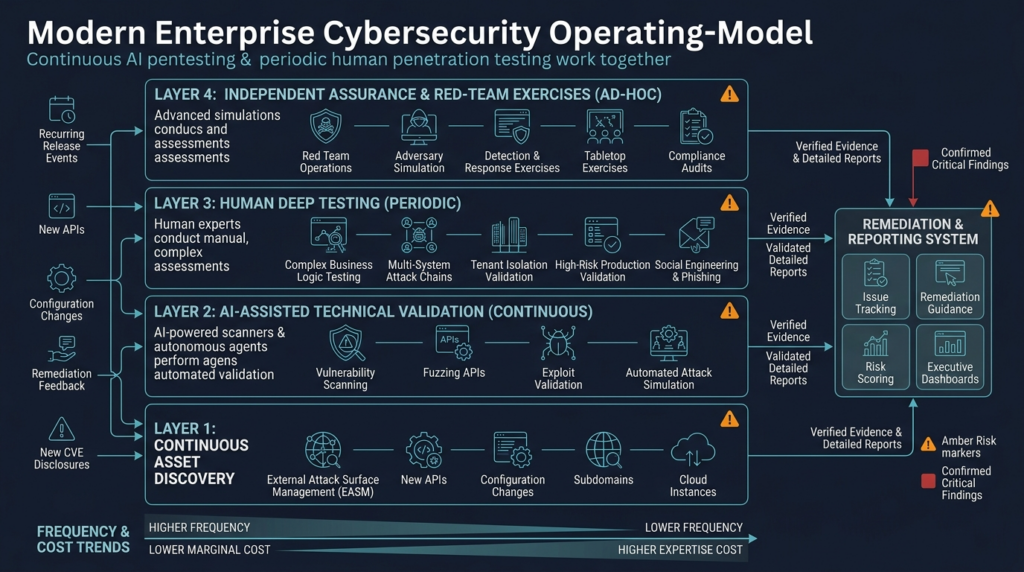
The Strongest Operating Model Is Hybrid
Human and AI testing are complementary when responsibilities are explicit.
Layer one — Continuous discovery
Maintain an updated view of:
- Public domains and subdomains
- APIs
- Certificates
- Internet-facing services
- Authentication surfaces
- Technology changes
- Critical internal assets
- New cloud endpoints
- Third-party entry points
This layer answers what exists and what changed.
Layer two — AI-assisted validation
Run bounded tests for:
- Common Web and API vulnerabilities
- Authorization regressions
- Known-vulnerability prerequisites
- Security-header and configuration changes
- Exposed sensitive interfaces
- Authentication-state differences
- Previously fixed findings
- Evidence collection
This layer answers whether repeatable technical controls still behave as expected.
Layer three — Human deep testing
Assign experts to:
- Business logic
- Tenant isolation
- Financial abuse
- Complex identity paths
- Multi-system attack chains
- High-risk production validation
- Source-assisted review
- Cloud trust relationships
- Mobile and desktop clients
- Unusual protocols
- Findings that remain ambiguous after automation
This layer answers the questions that require context and creativity.
Layer four — Independent assurance and red teaming
Use an independent service when the objective includes:
- Formal third-party assurance
- Threat-led adversary simulation
- Detection and response
- Social engineering
- Physical controls
- Executive or board assurance
- Regulatory independence
- Customer contractual requirements
This layer evaluates the organization, not just the application.
The economic logic is straightforward. Let machines repeat what can be made deterministic. Use experienced people where the answer depends on judgment.
How to Buy a Human Pen Testing Service
A low quote is not necessarily inexpensive. It may exclude the work the organization actually needs.
Define the security question first
Do not begin with “We need a pentest.”
Begin with a testable objective:
- Can one customer access another customer’s data?
- Can an external attacker reach administrative functionality?
- Can an assumed-breach operator move from a workstation to a protected environment?
- Can a compromised reseller account affect another reseller?
- Can the SOC detect a realistic identity attack?
- Are segmentation controls effective?
- Does the new payment architecture meet the organization’s defined PCI scope?
- Did remediation close the previously reported attack path?
The answer determines the engagement type.
Ask who performs the work
A provider’s brand does not reveal which tester will be assigned.
Ask:
- How are testers selected?
- What experience do they have with the technology?
- Is senior review included?
- Can the team test the required language, cloud, mobile, or identity stack?
- Will subcontractors be used?
- Where are testers located?
- What background checks or clearances apply?
- Who owns the final risk decision?
Certifications can be useful signals, but they do not replace relevant experience.
Examine the methodology
A methodology should describe more than a list of tool names.
It should explain:
- 정찰
- Authentication and authorization testing
- Session testing
- Input handling
- Business-logic analysis
- API coverage
- Client-side testing
- Configuration review
- Known-vulnerability analysis
- Controlled exploitation
- Evidence standards
- Severity assignment
- Quality assurance
- Retesting
OWASP WSTG and NIST SP 800-115 are useful reference points, but a provider should adapt them to the actual environment. (NIST 컴퓨터 보안 리소스 센터)
Confirm retesting
A report without a practical retest process can leave the organization uncertain about closure.
Ask:
- Is one retest included?
- Is the retest limited to the original payload?
- Are related endpoints tested?
- How long is the retest window?
- What evidence will be updated?
- Will partially remediated findings remain open?
- How are accepted risks recorded?
Review a sanitized report
A sample report reveals the provider’s evidence standard.
Look for:
- Clear scope
- 제한 사항
- Test dates
- 방법론
- Identity and role context
- Reproducible requests
- Screenshots where useful
- Technical root cause
- Demonstrated versus potential impact
- Actionable remediation
- Severity rationale
- Retest status
A report full of generic descriptions and copied remediation text is a warning sign.
Understand data handling
Pentest results are highly sensitive. They may contain credentials, tokens, personal information, internal hostnames, exploit evidence, and details of unpatched weaknesses.
Ask:
- Where is evidence stored?
- Who can access it?
- Is data encrypted?
- What is the retention period?
- Can the customer request deletion?
- Are third-party AI models used?
- What data is sent to those models?
- Are prompts or outputs retained?
- Can testing run in a private environment?
- Are logs available for audit?
- What happens after contract termination?
How to Evaluate an AI Red-Team Platform
The evaluation should focus on control and proof, not demonstrations of fluent reasoning.
Does it execute real tools?
A system that only recommends commands may improve analyst productivity, but it is not an autonomous testing platform.
Verify which actions it can actually perform:
- Network requests
- Browser interaction
- Proxy replay
- API authentication
- File inspection
- Tool execution
- 증거 캡처
- Retesting
Ask to see raw artifacts, not only the generated report.
Is scope enforced outside the model?
The platform should prevent an agent from reaching unapproved targets even if the model generates an incorrect command.
Useful controls include:
- Host allowlists
- IP and domain constraints
- Port restrictions
- Network namespaces
- Egress controls
- Tool-level permissions
- Time limits
- Request-rate limits
- Credential scoping
- Approval gates
- Emergency termination
A natural-language instruction such as “Only test example.com” is not sufficient enforcement.
How are findings verified?
Ask whether the platform:
- Separates hypotheses from findings
- Requires successful reproduction
- Uses independent verification
- Captures raw requests and responses
- Preserves identity context
- Records failed attempts
- Supports human approval
- Drops unsupported findings
- Marks residual uncertainty
- Supports remediation retesting
The vendor should be able to explain what prevents hallucinated vulnerability claims from entering a final report.
Can humans intervene?
Human-in-the-loop should mean more than a pause button.
Operators should be able to:
- Change direction
- Add business context
- Reject a hypothesis
- Limit a tool
- Approve a state-changing action
- Correct a role assumption
- Stop the task
- Review evidence before reporting
- Require a separate verifier
Does it preserve a durable audit trail?
The platform should record:
- Who initiated the task
- Authorized scope
- Which model and configuration were used
- Which tools ran
- Commands or requests
- Timestamps
- Target
- Credential role
- Output
- Human approvals
- Report revisions
- Retest results
Without that trail, it is difficult to determine whether a finding is reliable or whether the agent stayed inside its authority.
What are the real costs?
The public license price is only one component.
Ask about:
- Credits
- Credit consumption
- Model API usage
- Included models
- Third-party inference charges
- Local model infrastructure
- 스토리지
- Concurrency
- Private deployment
- Support
- Team seats
- CI integration
- Retention
- Professional services
- Overage
- Credit expiration or rollover
A low subscription can still produce a high total cost if every result requires extensive manual cleanup. Conversely, a higher-consumption workflow may be economical when it produces validated evidence and dramatically reduces retest time.
A Procurement Scorecard
| Evaluation area | Questions to ask | Strong evidence |
|---|---|---|
| Scope control | Can the system technically prevent out-of-scope actions? | Demonstrated allowlists, network controls, and approval gates |
| 인증 | What turns a hypothesis into a finding? | Reproduction rules, raw artifacts, and independent validation |
| Human control | Can operators correct, pause, or reject agent decisions? | Granular intervention and review workflow |
| 인증 | Can it preserve multiple roles and session states? | Role-aware browser and API testing |
| Reporting | Can another engineer replay the finding? | Requests, responses, screenshots, timestamps, and prerequisites |
| Retesting | Can the exact path run after remediation? | Versioned tests and before-and-after evidence |
| Data handling | Where do sensitive artifacts and prompts go? | Clear architecture, retention, encryption, and deployment choices |
| 비용 | What is included beyond the license? | Transparent credits, model costs, infrastructure, and support |
| 규정 준수 | Does it support the required evidence and independence? | Explicit mapping without claiming automatic certification |
| Safety | What prevents destructive or unauthorized actions? | Deterministic policy enforcement and emergency stop controls |
A Practical 90-Day Adoption Plan
Buying an AI pentesting platform and immediately pointing it at critical production systems is not a mature rollout.
Days 1 through 30 — Establish boundaries
Select a non-production application with known behavior.
Define:
- Asset scope
- Test identities
- Allowed tools
- Request limits
- Prohibited actions
- Human-approval thresholds
- Evidence format
- Severity rules
- Retention
- Stop procedure
Seed the environment with several known conditions:
- One obvious configuration issue
- One authorization defect
- One false lead
- One previously fixed finding
- One business rule that looks suspicious but is intentional
This lets the team evaluate whether the system distinguishes evidence from appearance.
Measure:
- Findings generated
- Findings confirmed
- False positives
- Missed known issues
- Human review time
- Tool failures
- Credit or model consumption
- 증거의 완전성
Days 31 through 60 — Add authenticated workflows
Introduce one Web application and one API with several roles.
Build a small regression matrix around:
- Object ownership
- Role boundaries
- Session termination
- Password reset
- Administrative operations
- File access
- Export functions
- API error handling
Have a human tester run a focused review of the same area. Compare the conclusions, not merely the number of findings.
Classify differences:
- AI found and human confirmed
- Human found and AI missed
- AI reported but human rejected
- Both observed but rated differently
- Neither found until business context was added
This comparison reveals where automation is ready and where human testing remains necessary.
Days 61 through 90 — Connect testing to remediation
Trigger selected checks after meaningful releases.
Do not begin with unrestricted continuous exploitation. Start with high-confidence regression tests.
For every finding, require:
- An owner
- 증거
- 근본 원인
- Remediation plan
- Retest procedure
- Closure status
Use the agent to rerun the exact validation after the fix.
At the end of 90 days, decide:
- Which checks can run automatically
- Which need human approval
- Which findings always require expert review
- Which applications are unsuitable for automated active testing
- How often an external pen testing service is still required
- Whether the testing program reduces remediation time
Common Buying Mistakes
Comparing only the report price
A cheap report can be expensive if it creates weeks of triage. A more expensive engagement can be economical if it finds a critical logic flaw and provides evidence that engineering can immediately use.
Treating every automated finding as a vulnerability
A finding should represent a proven failure of a security property. It should not be a tool observation rewritten in authoritative language.
Assuming AI eliminates internal labor
AI changes the work. It does not eliminate scope design, environment preparation, credentials, evidence review, remediation, and risk ownership.
Using AI as the sole independent assessor
Internal AI testing can strengthen readiness. It does not automatically satisfy requirements for independent testing.
Automating unsafe actions first
Begin with observation, comparison, and low-risk validation. Add state-changing actions only when the safety boundary and approval process are proven.
Measuring vulnerability volume
More findings can mean better coverage, excessive noise, or a lower evidence threshold. Measure verified and remediated risk.
Ignoring application owners
Security teams may misunderstand intended behavior. Application owners may underestimate abuse. High-quality triage requires both perspectives.
Replacing all human testing at once
The strongest early value usually comes from pre-testing and retesting, not from immediately delegating every complex attack decision to an autonomous agent.
Frequently Asked Questions
Is an AI red team the same as a human red team?
- No. A human red team normally emulates an adversary across a wider operational environment, potentially including endpoints, identity, networks, cloud systems, social engineering, physical controls, and defender response.
- AI pentesting is usually narrower. It is strongest in structured technical workflows such as discovery, Web and API testing, known-vulnerability validation, evidence collection, and remediation retesting.
- The terms may overlap in marketing. Buyers should evaluate the actual scope, tools, safety controls, and objectives rather than relying on the label.
- A hybrid model is usually more defensible. AI can expand routine coverage while humans handle complex reasoning, stealth, business logic, and independent assurance.
How much does a pen testing service cost?
- There is no universal price. Most providers scope the work before issuing a quote.
- Cost depends on complexity. Applications, APIs, user roles, cloud accounts, internal access, mobile clients, social engineering, testing days, and retests all affect effort.
- Red-team exercises usually cost more than a narrow application test because they pursue multi-stage objectives and may evaluate detection and response.
- Request an itemized scope. Confirm tester days, report review, meetings, retests, data handling, and any excluded activities.
- Do not compare quotes until the outcomes are equivalent. A five-day Web test and a multi-week adversary simulation are different services.
Can AI pentesting replace an annual penetration test?
- Not automatically. Internal AI testing may not satisfy requirements for qualified, organizationally independent testing.
- It can improve readiness. AI can find routine issues before the formal engagement and provide cleaner assets, accounts, and evidence to external testers.
- It can close the gap between annual tests. Release-triggered checks and remediation retests provide more current assurance.
- Compliance must be evaluated separately. The organization should confirm scope, methodology, independence, and evidence requirements with the relevant assessor or authority.
- Use AI as an additional control unless the applicable requirement clearly permits the proposed testing model.
What vulnerabilities are best suited to AI-assisted validation?
- Repeatable Web and API issues: authorization differences, exposed routes, unsafe input handling, session behavior, and common configuration errors.
- Known-vulnerability prerequisites: product version, feature state, reachability, patch status, and vendor mitigation evidence.
- Regression checks: previously fixed vulnerabilities and defined security policies.
- Evidence-heavy workflows: request replay, response comparison, screenshot capture, and report normalization.
- Less suitable areas: unusual business logic, social engineering, physical access, stealth operations, and high-risk destructive proof.
How should a company compare Penligent with a consulting engagement?
- Compare operating models, not only prices. Penligent is a reusable AI pentesting platform, while a consulting engagement provides assigned human expertise and external accountability.
- Include total cost. Account for software, credits, model or infrastructure usage, internal operator time, human review, and external assurance.
- Compare frequency. Determine how many releases, fixes, assets, and emergency CVE checks can be tested during the year.
- Compare evidence. Review whether each finding contains reproducible proof and supports retesting.
- Preserve human services for the right work. Complex logic, critical systems, adversary simulation, and independent reports remain strong consulting use cases.
Can an AI-generated pentest report be used for compliance?
- It may provide useful evidence, but the PDF itself does not create compliance.
- The testing process matters. Scope, methodology, tester qualification, independence, remediation, and retesting may all be evaluated.
- Keep raw artifacts. Requests, responses, screenshots, identities, timestamps, approvals, and retest results are more defensible than generated prose alone.
- Confirm acceptance in advance. Auditors, customers, payment brands, regulators, and contractual counterparties may apply different requirements.
- Avoid automatic-certification claims. A tool can support a control program without independently certifying the organization.
What is the safest way to introduce AI pentesting?
- Start in a local lab or non-production environment.
- Enforce scope technically. Use host allowlists, network restrictions, request limits, and tool permissions.
- Prohibit destructive actions by default.
- Require human approval for new hosts, tools, credentials, and state-changing requests.
- Seed known test cases. Measure false positives, misses, evidence quality, and review time.
- Begin with regression testing. Previously verified findings provide a clear ground truth.
- Expand only after the team can audit and stop every action.
The Better Economic Decision
A human pen testing service and an AI red team solve different parts of the security problem.
The human service provides scarce expertise, independence, contextual reasoning, and accountability. It is the stronger choice for complex business logic, critical production systems, threat-led exercises, social engineering, detection testing, and formal assurance.
AI pentesting provides repetition. It can reduce the cost and delay associated with attack-surface mapping, common technical validation, evidence collection, and remediation retesting.
Penligent’s public Pro price of $479.04 per year makes that repetition economically accessible compared with repeatedly purchasing separate consulting windows. The advantage is real, but it should be described accurately: the software turns parts of penetration testing into an internal capability; it does not turn every organization into an independent expert red team.
The most mature strategy is not to eliminate human pentesters. It is to stop spending their limited time on every task that a controlled, evidence-driven system can safely repeat.
 Korean
  English
  German
  French
  Spanish
  Portuguese
  Japanese
  Hindi
Hindi  Arabic
  Turkish
  Hebrew